




What Are the Best Blinds for Bay Windows?

Authored By Michael Turner -30 Years Home Improvement Expertise | Updated 2026 | BlindShades.pro
Updated on June 3, 2026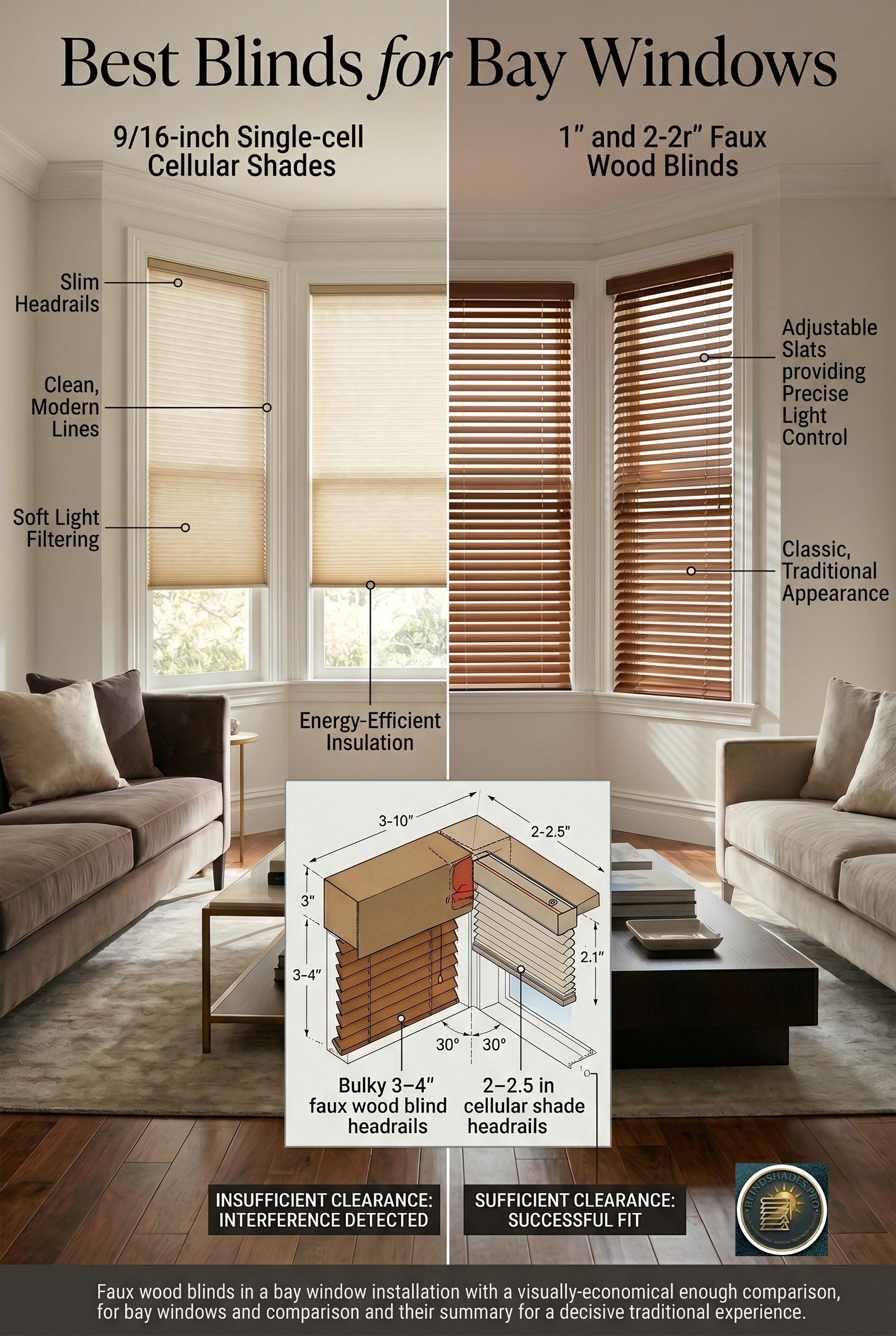
Key Takeaways:
- Before ordering any blind for a bay window, run the headrail depth interference test: cut cardboard pieces to the headrail depth of the intended product and test-fit them in the bay window corners where adjacent panels meet; faux wood and wood blinds with 3 to 4 inch headrails frequently collide at the corners of 30-degree bays; cellular shades with 2 to 2.5 inch headrails typically clear the corners without interference
- The correct treatment for a bay window depends on the bay angle: a 30-degree bay (the shallowest) can only accommodate slim-profile treatments like single-cell cellular shades or 1-inch mini blinds; a 45-degree bay (the most common) accommodates cellular shades, faux wood blinds, and shutters; a 90-degree box bay has no angle constraint and can accommodate any treatment including Roman shades and wider plantation shutters
- Roller shades create a combined corner light gap of approximately 1.5 to 2.5 inches at each bay window corner because the roller mechanism requires 1/2 to 3/4 inch clearance on each side beyond the fabric edge, adding to the natural frame gap at the angled corner; Blinds.com specifically recommends Roman shades over roller shades for bay windows for this reason
- Running a single continuous valance or three-sided cornice box across the full top of all three bay window panels creates visual unity that makes three separate blinds look like a single cohesive treatment; without this unifying element, three individually operating blinds in a bay often look disjointed and unintentional
- A typical three-panel residential bay window covers approximately 24 square feet of glass; uncovered single-pane glass at a solar heat gain coefficient of approximately 0.86 creates 8,000 to 10,000 BTU per hour of summer heat gain; cellular shades reduce this by 60 to 75 percent, saving approximately $100 to $250 per cooling season
⭐ Quick Answer — What Are the Best Blinds for Bay Windows?
- Run the Cardboard Headrail Test Before Ordering Any Blind: The first step for any bay window blind project is confirming the intended product’s headrail will fit at the bay corners without colliding with the adjacent panel’s headrail. Cut cardboard pieces to the headrail depth of the intended product and test-fit them at the angled corners. Faux wood and wood blinds (3 to 4 inch headrails) frequently collide at 30-degree bays. Cellular shades (2 to 2.5 inch headrails) typically clear the corners without interference. The best blinds for bay windows by headrail depth: 1-inch mini blind (1.5 inches — most bay-friendly); 9/16-inch cellular shade (2 to 2.5 inches); Roman shade or roller shade (2 inches); faux wood blind (2.5 to 3 inches); plantation shutter (3.5 to 4.5 inches — most bay windows cannot accommodate inside mount for shutters)
- The 30/45/90-Degree Bay Angle Determines Which Treatments Fit: The correct bay window blind depends on the bay’s angle configuration. 30-degree bay (shallowest; most fitting-constrained): slim-profile cellular shades or 1-inch mini blinds only — any treatment with a headrail over approximately 2.5 inches will collide at the corners. 45-degree bay (most common): cellular shades, faux wood blinds, Roman shades, and wood blinds all viable; plantation shutters marginal (confirm depth before ordering). 90-degree box bay (right-angle corners; no angle constraint): any treatment works including plantation shutters, wide Roman shades, and heavyweight drapes. Graber confirms: “each window treatment can potentially interfere with neighboring window treatments if you don’t properly account for those angles and the dimensions”
- Roller Shades Are the Wrong Choice — The 1.5 to 2.5 Inch Corner Gap Problem: Roller shades are frequently included in best blinds for bay windows lists; they should not be. Blinds.com confirms roller shades have “the largest light gaps of any window treatment because the fabric will always need to be more narrow than the roller and end mechanisms (1/2 to 3/4 inch each side).” At a bay window corner where two roller shades meet, this mechanism gap combines with the natural frame gap at the angled corner: roller mechanism gap (1/2 to 3/4 inch) + frame gap (1/2 to 1 inch) + second roller mechanism gap (1/2 to 3/4 inch) = combined corner light gap approximately 1.5 to 2.5 inches at every bay corner. Roman shades have only approximately 1/4 inch per side — a combined corner gap of approximately 0.75 to 1.5 inches. Blinds.com specifically recommends Roman shades over roller shades for bay windows for this reason
- The Cornice Box Trick — Making Three Separate Blinds Look Unified: Without a unifying element, three separately installed bay window blinds look exactly like that — three separate window treatments. A continuous valance or three-sided cornice box spanning the full interior width of the bay alcove creates visual unity that makes the three individual treatments read as a single cohesive bay window treatment. The cornice box (top panel + two sides, upholstered or painted) hides the individual headrails entirely from outside the room while each blind continues to operate independently behind it. This is the highest-impact visual upgrade available to an already-installed bay window blind set — and it costs far less than replacing the blinds. Recommended for any bay window with three individually operating horizontal blinds or cellular shades
- The Energy Calculation and Window Seat Consideration: A typical 3-panel residential bay window covers approximately 24 square feet of glass (center panel 3 ft × 4 ft = 12 sq ft; two side panels 1.5 ft × 4 ft each = 6 sq ft each). Uncovered single-pane glass at SHGC approximately 0.86 creates approximately 9,300 BTU per hour of summer solar heat gain — equivalent to a portable air conditioner running continuously. Cellular shades reduce this by 60 to 75 percent, saving approximately $100 to $250 per cooling season. Window seat note: built-in window seats place occupants 18 to 24 inches from the wall, putting blind cords behind the seat and out of reach. Specify cordless or motorized operation for any bay window with a window seat — standard pull cords hanging behind the seat are inaccessible without leaning or standing on the cushions
- Best Sources: Bay window treatment guide including roller shade light gap warning and shutter depth constraint → Blinds.com bay window guide · Bay window measurement protocol with headrail interference guidance → SelectBlinds bay window measurement · Treatment style and design comparison for bay windows → Graber bay window guide
⚠️ The Minimum Inside Mount Depth Chart and the Wide Sill Constraint: Before ordering any bay window blind for inside mount, confirm the available frame depth against this chart: 1-inch aluminum mini blind = 1.5 inch minimum depth. 9/16-inch single cell cellular shade = 2 inches. Roman shade = 2 inches. Roller shade = 2 inches (plus the 1/2 to 3/4 inch side gap problem). 3/4-inch double cell cellular shade = 2.5 inches. 2-inch faux wood blind = 2.5 to 3 inches. 2-inch wood blind = 2.5 to 3 inches. Plantation shutter = 3.5 to 4.5 inches (most bay window frames are too shallow for inside-mount shutters; 90-degree box bays are the exception). For frames under 2 inches: outside mount is required. SelectBlinds cautions: outside mount on bay windows may cover decorative trim and increases the risk of adjacent blinds colliding when raised and lowered. Wide sill and plant shelf constraint: bay windows with decorative sills or plant shelves 10 to 18 inches deep reduce the effective mounting height for inside mount treatments; the bottom rail when raised must clear the sill surface. For bay windows with wide sills, outside mount above the window frame is the standard installation; the sill remains visible and usable below the blind’s operating range. For the full individual panel measurement protocol including how to account for mullions and the quarter-inch tolerance rule, see How Do You Measure a Bay Window for Blinds. See the full treatment compatibility table below.
💡 The Bay Window Market Context and the Unified Treatment Specification: Bay windows grace approximately 15 to 20 percent of high-end homes built in North America since the 1990s (Drapery Company). The global blinds and shades market has reached USD 14.82 billion and is projected to climb to USD 24.63 billion by 2030, driven in part by bay window energy efficiency demand. The right bay window blinds can reduce cooling costs by up to 30 percent in sunny climates. The complete specification checklist for any bay window blind project: (1) Confirm bay angle (30/45/90 degrees). (2) Run cardboard headrail test at corners. (3) Confirm inside mount depth vs frame depth. (4) Reject roller shades; specify Roman or cellular instead. (5) Account for window seat — specify cordless or motorized if seat is present. (6) Check for wide sill — specify outside mount above frame if sill is 10 or more inches deep. (7) Plan a continuous valance or cornice box to unify three separate shades visually. (8) Specify each panel as a separate order — do not assume center and side panels are the same dimensions. The cornice box full specification: three-sided box spanning the full interior bay alcove width; upholstered in coordinating fabric or painted to match the wall or trim; depth of approximately 4 to 5 inches; mounted at the ceiling or at the top of the window frame; hides all individual headrails while allowing independent operation of each blind behind it. For the plantations shutter worth-it assessment including the depth constraint, louver tilt clearance in bay alcoves, and per-year cost comparison against cellular shades, see Can You Put Plantation Shutters in a Bay Window. See the full headrail interference test below.
📖 Read the complete guide below for: the treatment types ranked by bay window compatibility (9/16-inch cellular shade and 1-inch mini blind best; roller shades worst), the cardboard headrail depth interference test, the three bay configurations (30/45/90-degree) with treatment compatibility per angle, the roller shade combined corner gap calculation (1.5 to 2.5 inches vs Roman shade 0.75 to 1.5 inches), the continuous valance and cornice box visual unification technique, the minimum inside mount depth chart by treatment type (1.5-inch mini blind to 3.5-4.5-inch plantation shutter), the total bay glass area energy calculation (24 sq ft; 9,300 BTU/hr uncovered; cellular saves $100-$250 per cooling season), the window seat operational access problem and its four solutions (motorized / cordless / TDBU / wand vertical), and the wide sill outside mount requirement.
Best Blinds for Bay Windows – The Treatment Types Ranked
Definition: A bay window is a set of three or more windows that project outward from the main wall of a building, creating a bay inside the room. The most common residential configuration is a large central panel flanked by two angled side panels meeting the wall at 30, 45, or 90 degrees. Bay windows grace approximately 15 to 20 percent of high-end homes built in North America since the 1990s.
The bay window treatment challenge: Each panel in a bay window set requires a separate blind or shade sized to that panel’s individual dimensions. The angled corners where adjacent panels meet create fitting, clearance, and light gap challenges that do not exist with flat windows.
Treatment types ranked for bay window compatibility:
| Treatment | Bay Compatibility | Headrail Depth | Best Bay Angle |
|---|---|---|---|
| 9/16-inch single cell cellular shade | Excellent | 2 to 2.5 inches | All angles |
| 1-inch aluminum / mini blind | Excellent | 1.5 inches | All angles |
| 2-inch faux wood blind | Good | 2.5 to 3 inches | 45-degree and 90-degree |
| Roman shade | Good | 2 inches | 45-degree and 90-degree |
| 2-inch wood blind | Good | 2.5 to 3 inches | 45-degree and 90-degree |
| Roller shade | Poor | 2 inches + 1/2″–3/4″ side gap | Not recommended for any bay |
| Plantation shutter | Poor (depth constraint) | 3.5 to 4.5 inches | 90-degree box bay only |
The Three Bay Window Configurations and Their Treatment Implications
The single most important gap in all competitor bay window guides — the treatment must match the bay angle.
Configuration 1 — 30-Degree Bay (Shallowest; Most Fitting-Constrained)
A 30-degree bay has side panels angled at only 30 degrees from the wall — the shallowest common bay configuration. The side panels barely project from the wall, and the angle between adjacent treatments is very tight.
Treatment depth constraint: At a 30-degree corner, the space between adjacent headrails is extremely limited. Any treatment with a headrail deeper than approximately 2.5 inches will physically collide with the adjacent panel’s headrail or end bracket at the corner.
Compatible treatments:
- 9/16-inch single-cell cellular shade (headrail 2 to 2.5 inches): the primary correct specification
- 1-inch aluminum mini blind (headrail 1.5 inches): acceptable for budget applications
- Window film or frosted film: no headrail; no constraint
Not compatible:
- 2-inch faux wood blinds (headrail 2.5 to 3 inches): collision risk at 30-degree corners
- Roman shades: possible but tight; verify headrail depth before ordering
- Plantation shutters: not compatible; frame depth requirement too deep
Configuration 2 — 45-Degree Bay (Most Common; Best Treatment Compatibility)
A 45-degree bay — the most common residential bay window configuration — provides moderate angle clearance at the corners. The majority of standard window treatment headrails fit without collision.
Compatible treatments (all the following work):
- Cellular shades (all pleat sizes)
- 1-inch and 2-inch faux wood blinds
- Roman shades
- 2-inch wood blinds
- Cellular shades with TDBU for rooms with window seats
Marginal (verify headrail depth):
- Plantation shutters: technically viable but require inside mount depth of 3.5 to 4.5 inches; many 45-degree bays have shallow frames
Not recommended:
- Roller shades: combined corner light gap (see below)
- Plantation shutters without depth confirmation
Configuration 3 — 90-Degree Box Bay (Right Angle; Least Fitting-Constrained)
A box bay has side panels perpendicular to the center — 90 degrees. The right-angle corners create no angle-related fitting constraint. Any treatment width fits without corner collision risk.
Compatible: All treatment types including plantation shutters, wide Roman shades, heavy drapes, and wide wood blinds.
The box bay treatment advantage: The 90-degree corner means the side panels can be treated as if they were independent windows — no angle-related measurement adjustment is needed. This is the only bay configuration where plantation shutters are typically viable inside mount.
The Headrail Depth Interference Test
The pre-order test absent from all competitor guides — prevents the most common bay window blind installation failure.
Graber confirms: “the different angles pose a challenge because the window treatments installed on each of the separate windows can potentially interfere with neighboring window treatments if you don’t properly account for those angles.”
The specific problem: when two adjacent treatments are installed in a bay window, their headrails meet at the angled corner. If the combined headrail depth of the two treatments exceeds the available corner clearance, the headrails physically collide — preventing one or both treatments from opening and closing smoothly.
The cardboard spacer test:
- Obtain the headrail dimensions of the intended product from the supplier (width × depth of the headrail unit)
- Cut two pieces of cardboard to those headrail dimensions
- Hold one piece in each adjacent panel at the corner, positioned as they would be installed
- If the two cardboard pieces can sit in their positions without overlapping or touching: the products will fit
- If the cardboard pieces touch or overlap: the headrail depth is too thick for that corner angle
Treatment headrail depth guide:
- 1-inch aluminum mini blind: approximately 1.5 inches depth
- 9/16-inch single cell cellular shade: approximately 2 to 2.5 inches depth
- Roman shade: approximately 2 inches depth
- Roller shade: approximately 2 inches depth + 1/2″ to 3/4″ side gap
- 2-inch faux wood blind: approximately 2.5 to 3 inches depth
- 2-inch wood blind: approximately 2.5 to 3 inches depth
- Plantation shutter: approximately 3.5 to 4.5 inches depth
Why Roller Shades Are the Wrong Choice for Bay Windows
The combined corner light gap problem — the specific mechanism absent from all guides.
Blinds.com states: “roller shades have the largest light gaps of any window treatment because the fabric will always need to be more narrow than the roller and end mechanisms (1/2″ to 3/4″ each side). The angles on bay windows are already prone to light gaps.”
The combined corner light gap calculation:
At a bay window corner where two roller shades meet:
- Natural frame gap at the angled corner: approximately 0.5 to 1 inch (from the angle of the panels meeting)
- Roller mechanism gap on the inside edge of Shade 1: 1/2 to 3/4 inch
- Roller mechanism gap on the inside edge of Shade 2: 1/2 to 3/4 inch
- Combined corner light gap: approximately 1.5 to 2.5 inches at each corner
The Roman shade comparison: A Roman shade uses a cord mechanism with a much narrower side profile — approximately 1/4 inch per side. The combined corner gap at a Roman shade installation is approximately 0.75 to 1.5 inches — significantly less than roller shades.
The recommendation: Blinds.com directly: “we recommend Roman shades” over roller shades for bay windows specifically because of this combined corner light gap problem.
For blackout requirements: cellular shades or Roman shades with blackout lining are the correct specifications; not roller shades.
The Continuous Valance Trick — Making Three Shades Look Like One
The visual unification technique absent from all buying guides — the difference between a “bay window treatment” and “three windows with separate blinds.”
When three separate blinds or shades are installed in a bay window without a unifying element, the visual result is three distinct individual window treatments that happen to be next to each other. Each has its own headrail, its own bottom rail profile, and its own operating position — the bay window reads as three windows, not as a single architectural bay.
The solution: a continuous valance or cornice box.
A continuous valance runs horizontally across the top of all three bay window panels as a single piece — one header element that visually connects all three treatments beneath it. Behind the valance, each blind or shade operates independently.
The cornice box option: A three-sided cornice box (top + two sides) built to span the full interior width of the bay window alcove creates the most complete unification:
- From outside the room: the bay appears to have a single coordinated treatment — the cornical front hides the individual headrails
- From inside: each blind operates independently; raising the center shade does not affect the side shades
- The cornice box is typically upholstered in a coordinating fabric or painted to match the wall
The visual rule: Any bay window with three individually operating blinds benefits from a continuous valance or cornice box. This is the single largest visual upgrade available to a completed bay window blind installation — and it costs far less than replacing the blinds themselves.
The Minimum Inside Mount Depth Chart
The treatment-specific depth guide absent from all competitor guides.
Blinds To Go confirms: “if your window frames are shallow you will be forced to ‘outside mount’ your window treatments and that coupled with how close the individual windows are to each other may limit your options.”
| Treatment | Minimum Inside Mount Depth | Notes |
|---|---|---|
| 1-inch aluminum mini blind | 1.5 inches | Most bay-window-friendly; fits nearly all frames |
| 9/16-inch single cell cellular shade | 2 inches | Recommended for all bay angles |
| Roman shade | 2 inches | Good for 45-degree and 90-degree bays |
| Roller shade | 2 inches | Not recommended for bay windows (light gap problem) |
| 3/4-inch double cell cellular shade | 2.5 inches | Confirm at 30-degree bays before ordering |
| 2-inch faux wood blind | 2.5 to 3 inches | 45-degree and 90-degree bays only |
| 2-inch wood blind | 2.5 to 3 inches | 45-degree and 90-degree bays only |
| Plantation shutter | 3.5 to 4.5 inches | 90-degree box bay only; most bay frames too shallow |
For frames under 2 inches depth: Outside mount is required. SelectBlinds confirms: “outside mounts are possible but keep in mind that your blinds may stick out quite far from the wall and may also cover up any nice, decorative trim around the windows.”
The Bay Window Energy Cost Calculation
The specific calculation absent from all buying guides.
Typical residential 3-panel bay window dimensions:
- Center panel: approximately 3 feet wide × 4 feet tall = 12 sq ft
- Two side panels: approximately 1.5 feet wide × 4 feet tall each = 6 sq ft each
- Total glass area: approximately 24 sq ft
The uncovered heat gain: Single-pane glass SHGC of approximately 0.86. At peak summer solar radiation of 400 to 500 BTU per hour per square foot:
- Solar heat gain: 24 sq ft × 450 BTU/hr/sq ft × 0.86 = approximately 9,300 BTU per hour
- This is equivalent to running a medium portable air conditioner continuously during peak sun hours
With cellular shades (SHGC reduced to 0.20–0.35):
- Solar heat gain reduced to approximately 2,000 to 4,000 BTU per hour
- Reduction of approximately 60 to 75 percent
- Estimated annual cooling cost savings: $100 to $250 per cooling season (at $0.12/kWh utility rate)
The right treatment can indeed “slash cooling costs by up to 30% in sunny climates” as the Drapery Company confirms — and a bay window with its large combined glass area is one of the highest-impact windows to treat in any home.
The Window Seat Operational Access Issue
The constraint no buying guide addresses — built-in window seats limit blind cord reach.
Many residential bay windows have built-in window seats that project from the floor up to the window sill level (typically 18 to 24 inches from the floor). A window seat places the occupant 18 to 24 inches forward of the wall where the window treatment cords typically hang.
The problem: Standard pull cords on cellular shades and blinds hang at the front face of the headrail — which is now positioned behind the window seat. Reaching past the seat to pull blind cords requires leaning over the seat or standing on it.
The solutions in order of practicality:
- Motorized blinds (most practical): no cord to reach; the blind operates via remote, app, or voice command; the window seat is irrelevant to operation
- Cordless lift: push the bottom rail up to operate rather than pulling a hanging cord; accessible from the front of the seat
- TDBU (Top-Down Bottom-Up): the top rail operates from the headrail position (behind the seat) but the bottom rail can be reached more easily from the seat edge
- Wand-operated vertical blinds: the wand can extend forward past the window seat for operation
For any bay window with a window seat: specify cordless or motorized operation before ordering. Post-installation operation difficulties are the leading cause of bay window blind buyer regret.
The Wide Sill Constraint
The plant shelf and deep sill problem that forces outside mount.
Some bay windows have wide decorative sills or plant shelves (10 to 18 inches deep) running across all three panels. This creates two constraints:
- The bottom rail of an inside-mount blind, when fully raised, must not contact the wide sill surface — which reduces the maximum raised stack height available
- The sill may be too high for an inside-mount blind to fit between the sill and the top of the window frame at the minimum required measurement
For bay windows with wide plant shelves: outside mount above the window frame is the correct specification. The blind mounts above the frame opening, and the wide sill is visible below the blind’s operating range. This is the standard installation for bay windows with deep window ledges used for plants or decorative objects.
Where to Order
For bay window blinds guidance and custom fitting: Blinds.com bay window guide at blinds.com/windows/bay-window-coverings — the most detailed online guide including specific product recommendations by bay window challenge type; treatment-specific caveats including the roller shade light gap warning and the shutter depth constraint.
For bay window measurement protocol: SelectBlinds bay window measurement guide at selectblinds.com/tech-tips/how-to-measure-bay-windows.html — step-by-step measurement protocol for each bay panel individually; headrail interference guidance; inside vs outside mount guidance for shallow frames.
For treatment style and design guidance: Graber bay window guide at graberblinds.com/inspiration/window-treatments-101/treatments-for-bay-windows — cellular shades, Roman shades, wood blinds, and shutter style comparisons for bay windows; energy efficiency and TDBU options.
Frequently Asked Questions
What are the best blinds for bay windows? The best blinds for bay windows are 9/16-inch single-cell cellular shades for energy efficiency and bay-compatible slim headrails, and 1-inch or 2-inch faux wood blinds for precise light control in rooms requiring a traditional aesthetic. Before selecting any treatment, run the headrail depth interference test by holding cardboard cutouts at the headrail dimensions in the bay corners to confirm they clear without collision. The correct treatment also depends on the bay angle: 30-degree bays require slim-profile cellular or mini blinds; 45-degree bays accommodate most treatments; 90-degree box bays have no angle constraint.
Why are roller shades not recommended for bay windows? Roller shades are not recommended for bay windows because they create combined corner light gaps of approximately 1.5 to 2.5 inches at each angled corner. A roller shade requires 1/2 to 3/4 inch of clearance on each side beyond the fabric edge for its roller mechanism. At a bay window corner where two roller shades meet, this mechanism gap combines with the natural frame gap at the angled corner to create a significant visible light and privacy gap. Roman shades are recommended instead because their cord mechanism produces only approximately 1/4 inch per side, resulting in a significantly smaller combined corner gap.
How do you make bay window blinds look unified? To make three separate bay window blinds look unified, install a continuous valance or cornice box spanning the full interior width of the bay alcove. A continuous valance runs as a single horizontal element across the top of all three panels, visually connecting the individual treatments beneath it. A three-sided cornice box upholstered in a coordinating fabric or painted to match the wall provides the most complete unification, hiding individual headrails entirely while allowing each blind to operate independently behind it.
What is the minimum depth required for bay window blinds? The minimum inside mount depth for bay window blinds varies by treatment type. Aluminum mini blinds require approximately 1.5 inches. Cellular shades require approximately 2 inches. Faux wood and wood blinds require approximately 2.5 to 3 inches. Plantation shutters require 3.5 to 4.5 inches, which most bay window frames cannot accommodate for inside mount. For frames under 2 inches, outside mount is required, though SelectBlinds cautions that outside mount may cover decorative trim and increases the risk of collision when adjacent blinds are raised and lowered.
How much energy can bay window blinds save? Bay window blinds on a typical 3-panel residential bay window covering approximately 24 square feet of glass can reduce summer solar heat gain by 60 to 75 percent with cellular shades. Uncovered single-pane bay window glass with a solar heat gain coefficient of approximately 0.86 creates approximately 9,300 BTU per hour of heat gain at peak summer sun. Cellular shades reduce this to approximately 2,000 to 4,000 BTU per hour, saving approximately 100 to 250 dollars per cooling season depending on climate and utility rates.
Related Guides on BlindShades.pro
- The Best Bay Window Blinds & Shades Buying Guide
- How Do You Measure a Bay Window for Blinds
- Can You Put One Blind Across a Bay Window
- Can You Put Plantation Shutters in a Bay Window
- Are Cellular Shades Good for Bay Windows
By Michael Turner | 30 Years Home Improvement Expertise | Updated 2026 | BlindShades.pro
