Roller Blinds vs Roller Shades: What’s the Difference?

Authored By Michael Turner -30 Years Home Improvement Expertise | Updated 2026 | BlindShades.pro
Updated on June 17, 2026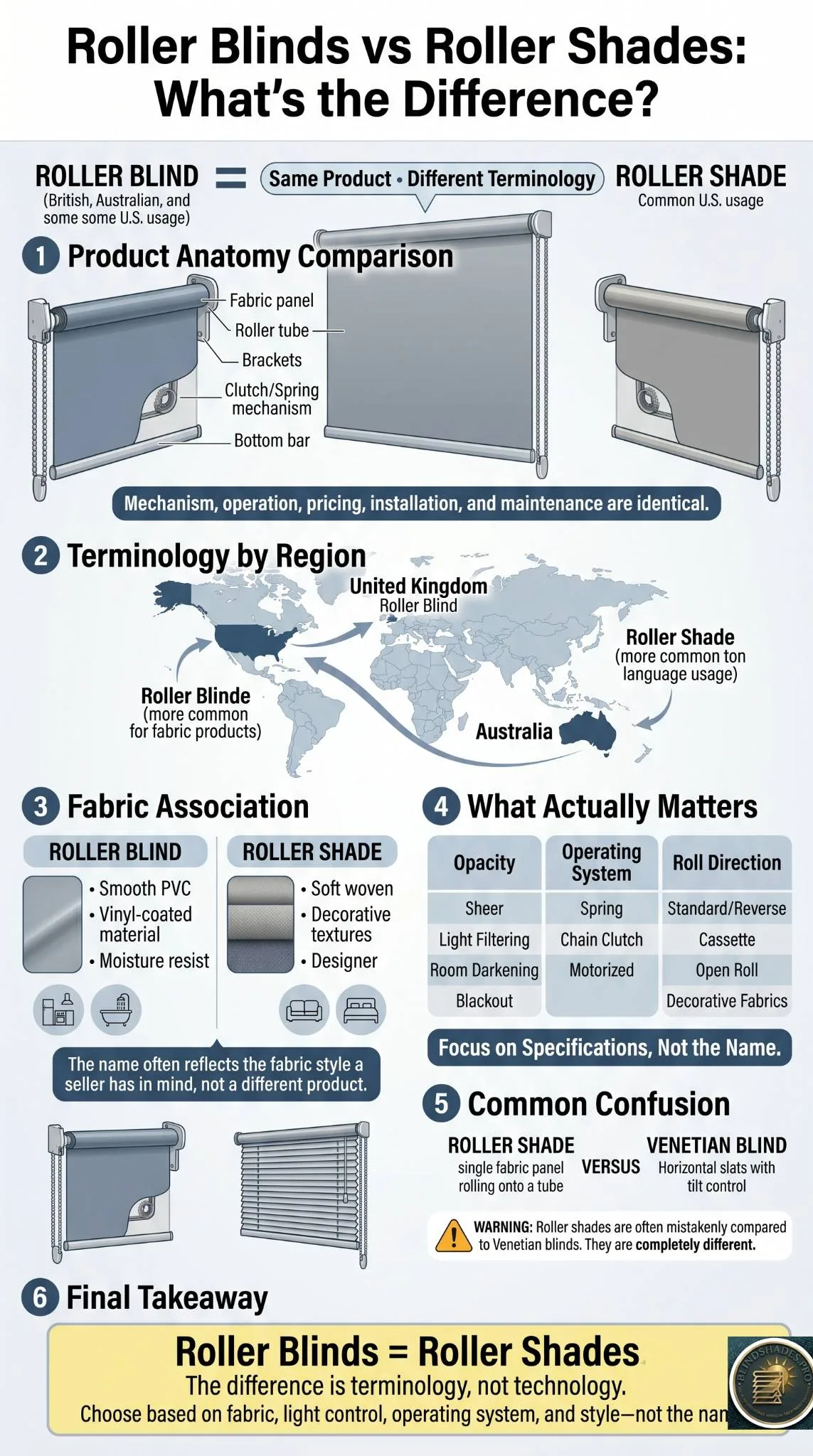
Authored by Michael Turner — 30 Years of Home Improvement Expertise | Updated 2026 | BlindShades.pro
Roller blinds and roller shades are the same product — one fabric panel on a tube. The difference is the word, not the window covering. Here is the honest resolution, why the confusion exists, and the one case where the term actually matters.
Key Takeaways
- Roller blinds and roller shades are the same window covering: a single panel of fabric or vinyl that winds onto a tube and retracts out of sight when raised. The difference is purely linguistic, not mechanical. There is no separate “roller blind mechanism” and “roller shade mechanism” — they are one product described by two words, which is why most retailers, including the same store, use the terms interchangeably across their catalog.
- The confusion exists for two reasons, and one of them sends searchers to the wrong answer. First, the words are regional: “roller blind” is the default term in British and Australian English, while “roller shade” is the U.S. marketing-preferred phrase. Second, many “roller blinds vs roller shades” articles actually answer a different question — roller shades versus slatted Venetian blinds — because they treat “blinds” as horizontal slats. If you want that comparison, it is a genuinely different product and a separate decision.
- There is one practical distinction worth knowing: the word hints at the fabric the seller has in mind. “Roller blind” often leans toward stiffened, vinyl, or PVC-coated panels — the wipe-clean, moisture-tolerant kind used in kitchens and bathrooms. “Roller shade” leans toward soft, decorative fabric. So if you specifically want a wipe-clean PVC panel, asking for a “blind” points the seller in the right direction; if you want soft fabric, ask for a “shade.”
- Because they are the same product, the word you choose is not the real decision. The choices that actually determine performance are identical for both: the fabric opacity class (sheer, light-filtering, room-darkening, blackout, or solar), the operating system (spring, chain clutch, cordless, or motorized), the roll direction, and the headrail finish. Spend your decision-making there, not on the terminology.
- Both share the same price range and the same fixes. A fabric roller, called a blind or a shade, runs roughly $60 to $260 installed manually and $350 to $1,000 motorized, and both telescope, leak light at the sides, and lose spring tension in exactly the same way. Any guide that quotes different prices or performance for “blinds” versus “shades” is describing two different products under the wrong labels.
⭐ Quick Answer
Roller blinds vs roller shades is a question about words, not products: they are the same window covering — one fabric or vinyl panel that winds onto a tube. The mechanism, price, and performance are identical.
- Same product, different word: there is no separate roller blind and roller shade mechanism. Budget Blinds confirms the terms are used interchangeably and the distinction is regional, not mechanical.
- It’s regional language: “roller shade” is the U.S. term (used by brands like Hunter Douglas), while “roller blind” is the British and Australian term (used by retailers like Hillarys). The same fabric on the same tube is sold under both names.
- The one real distinction: the word hints at the fabric. “Roller blind” leans toward stiffened, wipe-clean vinyl or PVC (kitchens and bathrooms); “roller shade” leans toward soft decorative fabric. Use the word that points the seller to the fabric you want — see best roller blinds for a bathroom for the PVC option.
- Decide the product, not the name: because it is one product, the real choices are opacity, operating system, roll direction, and finish. The full spec is in the Roller Blinds Buying Guide and the Roller Shades Buying Guide.
- Did you mean slatted blinds? Many “roller blinds vs roller shades” articles actually compare a roller to a Venetian (slatted) blind, which is a different product. For that, see roller blinds vs Venetian blinds.
Are Roller Blinds and Roller Shades the Same Thing?
Yes. A roller blind and a roller shade are the same window covering: a single sheet of material wound onto a horizontal tube that rolls up and out of sight when raised. There is no mechanical difference, no separate hardware, and no performance gap between the two — they are one product described by two words. Budget Blinds states it plainly: the terms are often used interchangeably, and the distinction comes down to regional terminology and individual preference rather than any real difference in the product.
This matters because a lot of buying advice implies the two are meaningfully different window coverings you must choose between. They are not. The same fabric, on the same tube, with the same spring or clutch, can be sold as a “roller blind” by one retailer and a “roller shade” by another. U.S. brands like Hunter Douglas market “roller shades”; British and Australian retailers such as Hillarys sell the identical product as “roller blinds.” When you understand that, the question changes from “which one is better” to “what fabric and operation do I actually need” — which is the right question.
Why Do People Think They’re Different?
The confusion comes from two sources, and recognizing them tells you whether you even have a real decision to make.
Regional and marketing language. “Roller blind” is the standard term in British and Australian English and covers everything from soft cottons to stiff PVC. “Roller shade” became the preferred U.S. marketing phrase, especially for soft fabric panels. Neither is wrong, which is exactly why catalogs use them interchangeably and shoppers end up confused.
The slatted-blinds mixup. This is the bigger trap. Many articles titled “roller blinds vs roller shades” actually compare a roller shade to a slatted Venetian or horizontal blind — the kind with tilting slats. You can see it in their content: they talk about tilting slats, adjusting the angle, and dusting individual vanes, none of which apply to a roller. That is a genuinely different product and a genuinely different decision, but it is not “roller blind vs roller shade.” If what you actually want to know is whether to choose a rolling fabric panel or a slatted blind, that is covered separately in roller blinds vs Venetian blinds.
Is There Any Real Difference Between a Roller Blind and a Roller Shade?
There is one practical distinction worth knowing, and it is about fabric, not mechanism. In common usage, the word a seller uses hints at the kind of fabric they have in mind:
- “Roller blind” often leans toward stiffened, vinyl, or PVC-coated panels — the smooth, wipe-clean, moisture-tolerant kind you would put in a kitchen, bathroom, or utility room. This usage is especially common in British and Australian catalogs and in the budget/utility segment.
- “Roller shade” leans toward soft, decorative fabric — woven textures, light-filtering weaves, and designer patterns, common in U.S. living-room and bedroom contexts.
This is a tendency, not a rule, so always confirm the actual fabric and opacity rating before ordering. But it is useful: if you specifically want a wipe-clean PVC panel for a wet room, asking for a “roller blind” nudges the seller toward the right fabric, and our best roller blinds for a bathroom guide covers exactly that specification. If you want soft fabric, “roller shade” points them the other way.
Roller Blind vs Roller Shade — Terminology Map
| “Roller blind” | “Roller shade” | |
|---|---|---|
| Common region | UK, Australia | United States |
| Fabric it implies | Soft to stiffened, incl. vinyl/PVC | Soft, decorative fabric |
| Typical context | Kitchen, bathroom, utility, budget | Living room, bedroom, designer |
| Mechanism | Identical (fabric on a tube) | Identical (fabric on a tube) |
| Price range | Same ($60-$260 manual) | Same ($60-$260 manual) |
Did You Mean Roller Blinds vs Venetian (Slatted) Blinds?
If you came here trying to decide between a rolling fabric panel and a slatted blind that tilts, that is a real and useful comparison — just not the “roller blind vs roller shade” one. Slatted blinds (Venetian, aluminum, faux wood) use horizontal slats you can tilt to angle the light without raising the blind, which a roller cannot do; rollers, in exchange, give a cleaner look, easier cleaning, and better solar-fabric glare control. The full head-to-head, including light control, cleaning, cost, and a room-by-room verdict, is in roller blinds vs Venetian blinds. Mention it here only so you know which question you are actually asking.
If They’re the Same, What Should You Actually Decide?
Since “blind” versus “shade” is just a word, the decisions that determine whether you are happy with the product are the ones that apply to both equally. In order:
- Opacity class — sheer, light-filtering, room-darkening, blackout, or solar/screen. This is the single most important choice and it is matched to the room, not the name.
- Operating system — spring, continuous chain clutch, cordless spring-assist, or motorized. Cordless is required for stock products under the ANSI/WCMA A100.1-2018 child-safety standard.
- Roll direction — standard or reverse roll, which affects how close the fabric sits to the glass and the side light gap.
- Headrail finish — open roll, cassette, or valance, which affects the look and how well the top seals light.
Make those four calls and the right product follows, whether the label on the box says “blind” or “shade.” The full decision sequence is laid out in the Roller Blinds Buying Guide.
Which Word Should You Use When Ordering?
Practically, use the word that points the seller toward the fabric you want. Ask for a “roller blind” when you want a stiffened, vinyl, or PVC-coated, wipe-clean panel — kitchens, bathrooms, garages, and rentals. Ask for a “roller shade” when you want soft, decorative fabric for a living room or bedroom. In either case, confirm the three things that actually matter regardless of the word: the opacity rating (so it does the light job you need), the operating system (cordless or motorized for safety), and the dimensions and mount (so it fits and minimizes the side gap). If a retailer’s site only uses one term, do not assume they lack the other — they almost certainly sell the same range under whichever name they have chosen.
Frequently Asked Questions
Is there a difference between roller blinds and roller shades?
Not as products. They are the same window covering — one fabric or vinyl panel on a tube. The difference is the word: “roller blind” is the British and Australian term and the U.S. term for stiffer PVC versions, while “roller shade” is the U.S. term for soft fabric. The mechanism, price, and performance are identical.
Why do some stores call them blinds and others call them shades?
It is regional and marketing language. British and Australian retailers default to “roller blind”; U.S. brands like Hunter Douglas market “roller shades.” The same fabric on the same tube is sold under both names, so the word tells you more about the retailer than about the product.
Which is better, a roller blind or a roller shade?
Neither, because they are the same product. The better question is which fabric opacity and operating system you need. Match the opacity to the room and choose a cordless or motorized lift for safety; the name on the label does not affect performance.
When does the difference between a blind and a shade actually matter?
Mainly as a fabric hint. “Roller blind” often implies a stiffened, wipe-clean vinyl or PVC panel suited to kitchens and bathrooms, while “roller shade” implies soft decorative fabric. Use the word that steers the seller toward the fabric you want, then confirm the actual opacity rating.
Are roller blinds the same as Venetian blinds?
No. Roller blinds and roller shades are rolling fabric panels; Venetian blinds have tilting horizontal slats. People sometimes confuse “roller blinds vs roller shades” with “roller vs slatted blinds.” For that comparison, see our dedicated roller blinds vs Venetian blinds guide.
This article is part of the Roller Blinds Buying Guide cluster on BlindShades.pro. Related: Roller Shades Buying Guide · Roller blinds vs Venetian blinds · Best roller blinds for a bathroom
