Roller Blinds vs Venetian Blinds: Which Is Better?

Authored By Michael Turner -30 Years Home Improvement Expertise | Updated 2026 | BlindShades.pro
Updated on June 17, 2026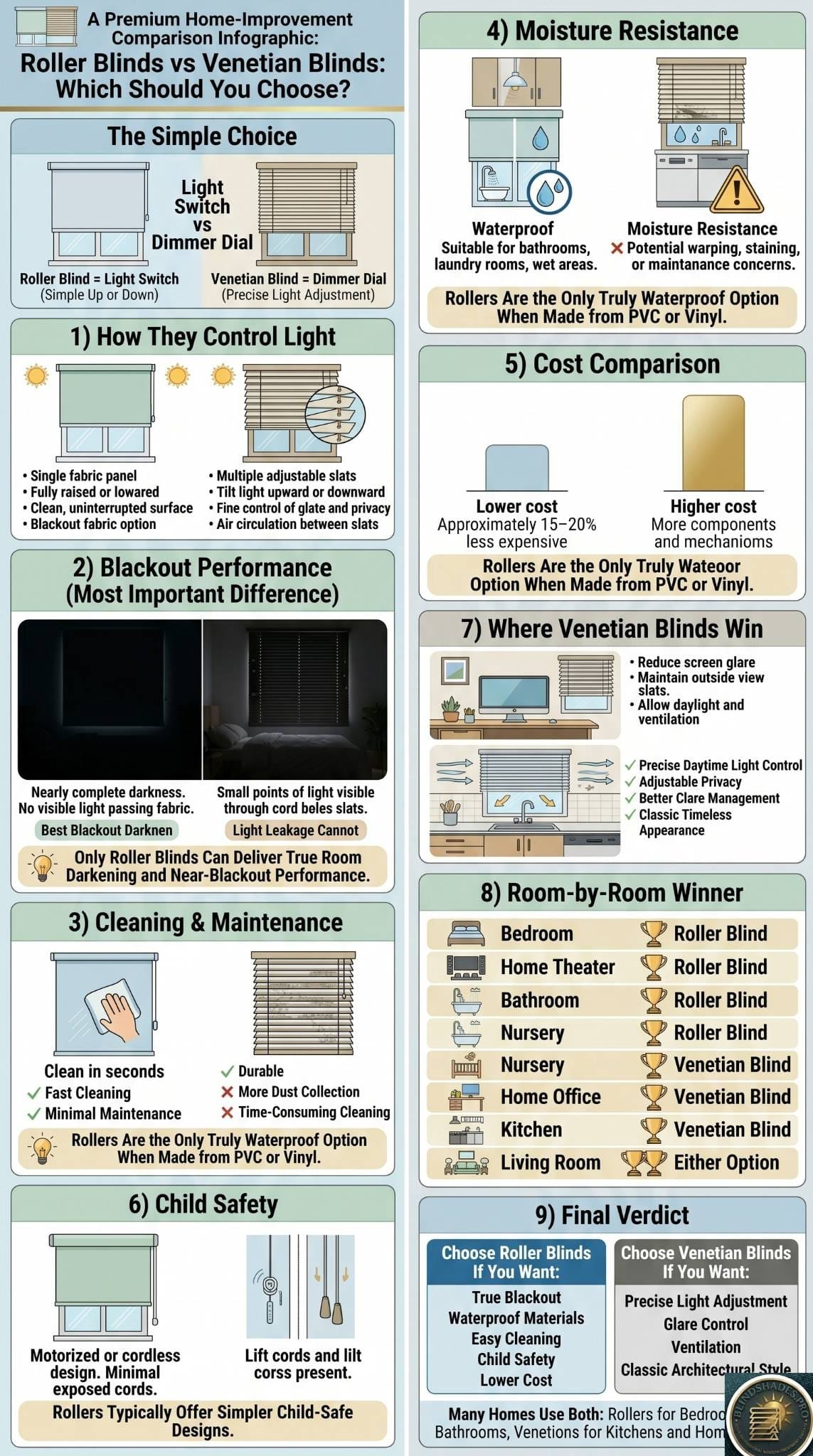
Authored by Michael Turner — 30 Years of Home Improvement Expertise | Updated 2026 | BlindShades.pro
Roller blinds win on blackout, cleaning, waterproofing, and price; Venetian blinds win on adjustable light control and a classic look. The deciding detail no one mentions: Venetian slats have lift-cord holes that leak light, so only a roller can truly black out a room.
Key Takeaways
- The core difference is mechanism: a roller blind is one fabric panel that goes up or down, while a Venetian blind is a stack of horizontal slats you can tilt to any angle. VelaBlinds frames it well — a roller is a light switch (on or off), a Venetian is a dimmer dial with angle control. That single distinction drives almost every other trade-off: Venetians win on fine-tuned daytime light and glare control, rollers win on simplicity, cleaning, full blackout, and price.
- Only a roller blind can truly black out a room, and the reason is structural. Venetian slats have small holes punched through them for the lift cords to pass through, so even when the slats are closed, pinpricks of light leak through every cord hole. English Blinds confirms Venetians darken a room acutely but cannot achieve full blackout for this reason, while a roller can be made as a genuine blackout blind. For a bedroom or nursery, this is usually the deciding factor.
- Rollers are cheaper to buy and install, but motorizing flips it. Venetian blinds typically cost about 15 to 20 percent more than standard roller blinds, and Venetian installation runs roughly $40 to $55 per unit versus $25 to $35 for a roller, according to VelaBlinds, because slatted blinds need more calibration. The exception: a high-end motorized roller can cost more than a basic aluminum Venetian, so the winner on price depends on the spec.
- For wet rooms, rollers win on a technicality that matters: only PVC or vinyl rollers are genuinely waterproof. English Blinds notes that Venetian lift cords are not fully waterproof, so for a bathroom or kitchen that gets splashed or very humid, a PVC or vinyl roller is the correct choice. A regular polyester roller is not waterproof either, so the fabric still has to be specified correctly.
- Cleaning and child safety both favor rollers. A roller wipes clean in seconds with a damp cloth; a Venetian needs every individual slat dusted, which is the most common Venetian complaint. On safety, a cordless or motorized roller meets the ANSI/WCMA A100.1-2018 child-safety standard, while corded Venetian blinds carry a strangulation risk — a real consideration for kids’ rooms.
⭐ Quick Answer
Roller blinds vs Venetian blinds comes down to one trade-off: a roller is a single fabric panel that goes up or down (a light switch), while a Venetian is a stack of tilting slats (a dimmer dial), an analogy from VelaBlinds.
- The deciding fact most guides miss: only a roller can fully black out a room. Venetian slats have lift-cord holes that leak pinpricks of light even when closed, so they darken acutely but never fully — confirmed by English Blinds. See are blackout roller blinds worth it.
- Roller blinds win on: full blackout, easy cleaning (wipe vs dusting every slat), waterproofing (PVC/vinyl only), child safety (cordless options), and price — roughly 15 to 20% cheaper, with install around $25-35 vs $40-55 per unit for Venetians (VelaBlinds).
- Venetian blinds win on: precise daytime light and glare control (tilt the slats to angle the sun or bounce it off the ceiling), ventilation while closed, and a classic, timeless look. Dollar Curtains notes Venetians suit rooms where you want light and visibility, like a kitchen.
- For wet rooms: only a PVC or vinyl roller is genuinely waterproof; Venetian lift cords are not. For a bathroom, specify a PVC/vinyl roller — see best roller blinds for a bathroom.
- Choose by room, or use both: rollers for bedrooms, bathrooms and kids’ rooms (blackout, waterproof, safe); Venetians for living rooms and offices (adjustable light). Full spec in the Roller Blinds Buying Guide.
What’s the Core Difference Between Roller and Venetian Blinds?
The difference is the mechanism, and everything else follows from it. A roller blind is a single sheet of fabric or vinyl wound onto a tube; you raise it to let light in and lower it to block light, with little in between. A Venetian blind is a stack of horizontal slats — aluminum, wood, faux wood, or PVC — connected by cords or tapes; you can raise and lower the whole stack, but you can also tilt the slats to any angle from open to closed without moving them.
VelaBlinds captures the practical effect with an analogy worth remembering: a roller shade is like a light switch, on or off, while a Venetian blind is like a dimmer dial with angle control, offering many settings in between. That is the heart of the comparison. If you want the simplest possible operation and the cleanest look, the roller’s on-or-off behavior is a feature. If you want to fine-tune how much light and glare enters through the day while keeping some view, the Venetian’s tilt is the advantage. The rest of this guide quantifies where each one wins.
Roller Blinds vs Venetian Blinds: The Quantified Comparison
Here is the side-by-side that the prose pros-and-cons lists never assemble in one place:
| Factor | Roller Blinds | Venetian Blinds |
|---|---|---|
| Mechanism | Single fabric panel (up/down) | Tilting horizontal slats |
| Light control | Binary (open or closed) | Adjustable tilt (0-90 degrees) |
| Full blackout | Yes (blackout fabric) | No (lift-cord holes leak light) |
| Cleaning | Wipe down in seconds | Dust each slat individually |
| Waterproof option | Yes (PVC/vinyl only) | No (lift cords not waterproof) |
| Typical price | Lowest-cost blind | ~15-20% higher |
| Install cost (per unit) | ~$25-35 | ~$40-55 |
| Pattern/design choice | Wide (fabrics, prints) | Limited (solid colors only) |
| Ventilation while closed | No | Yes (tilt slats) |
| Lifespan | Fabric resists fading | Aluminum 10+ years; one broken slat = replace set |
| Child safety | Cordless/motorized available | Usually corded (hazard) |
| User satisfaction | 65% rate 8/10+ | 78% rate 8/10+ |
Cost figures and satisfaction data are from VelaBlinds; the blackout and waterproofing limitations are confirmed by English Blinds. The pattern that emerges: rollers win on blackout, cleaning, waterproofing, safety, and price; Venetians win on adjustable light control, ventilation, classic looks, and measured satisfaction.
Which Gives Better Light Control?
Venetian blinds give better daytime light control; roller blinds give better total light control. They are good at different things.
With a Venetian blind, you can tilt the slats to let in a sliver of light, bounce sunlight up onto the ceiling for soft ambient light, or angle it to kill screen glare while keeping the room bright. VelaBlinds points out that in a west-facing office you can tilt the slats to block direct afternoon sun and eliminate monitor glare while still allowing ambient light in — something a single-panel shade cannot do by tilting. This is the Venetian’s signature advantage.
A roller blind, by contrast, is binary: up for light, down for dark. But it counters in two ways. First, a roller in a solar/screen fabric controls glare and UV while preserving the view without any tilting — the engineered open weave does the job a Venetian does by angling slats. Second, a roller is the only one that goes to true darkness. So the honest answer is: for nuanced daytime adjustment, Venetian; for glare control with a view, a solar roller does it differently but just as well; for total darkness, roller.
Can Venetian Blinds Fully Black Out a Room?
No — and this is the single most important fact in the comparison, because almost no guide mentions it. Venetian blind slats have small holes punched through them for the lift cords to pass through. Even with the slats tilted fully closed, light leaks through every one of those cord holes as a row of pinpricks, plus through the gaps between slats. English Blinds states it directly: Venetian blinds will darken a room very acutely, but they cannot achieve a full blackout because of the lift-cord holes in the slats.
A roller blind has no such limitation. With a blackout fabric, it blocks light through the entire panel, and with side channels and a cassette it reaches near-total darkness. (The roller’s own weakness — the side light gap — is fixable with channels, as covered in why light comes through the sides of a roller blind.) For a bedroom, nursery, shift-worker’s room, or home theater, this makes the roller the correct choice, and it is why we recommend roller blackout systems for sleep spaces. Whether the blackout upgrade is worth it is covered in are blackout roller blinds worth it.
Which Is Easier to Clean?
Roller blinds, by a wide margin. A roller is a single smooth panel that you wipe down with a damp cloth in seconds while it hangs in place. A Venetian blind has dozens of individual slats, each with a top and bottom surface, and dust settles on every one. Time Curtain and most other retailers name slat-by-slat dusting as the Venetian’s biggest day-to-day downside; it is time-consuming and, in a busy household, often simply does not get done, so the blind looks dusty.
This is why rollers dominate in low-maintenance contexts — rentals, commercial spaces, and busy family homes. If you love the Venetian look but dread the cleaning, that trade-off is worth being honest with yourself about before you buy.
Which Is Better for Bathrooms and Kitchens?
For genuinely wet or humid rooms, roller blinds win — but only the right fabric. English Blinds makes the key distinction: only PVC or vinyl roller blinds are truly waterproof, while Venetian lift cords are not fully waterproof and so are not ideal where the blind gets splashed or the room gets very humid. Note the catch on the roller side too: a standard polyester roller is not waterproof either, so for a bathroom you must specify a PVC or vinyl fabric.
For a kitchen or bathroom that stays relatively dry, both can work, and aluminum or PVC Venetians are moisture-resistant. But for a shower-adjacent window or a steamy bathroom, a PVC or vinyl roller is the correct specification. The full wet-room breakdown is in best roller blinds for a bathroom.
Which Costs More, Roller or Venetian Blinds?
Roller blinds are usually the cheaper option. English Blinds notes rollers tend to be the lowest-cost blind type overall, and VelaBlinds quantifies the gap: Venetian blinds typically cost about 15 to 20 percent more than standard rollers, with installation around $40 to $55 per unit versus $25 to $35 for a roller, because slatted blinds require more calibration to hang correctly.
There is one reversal worth knowing. A high-end motorized roller shade can cost more than a basic aluminum Venetian, and premium fabrics or blackout-plus-side-channel systems push roller prices up. So “roller is cheaper” holds for like-for-like standard products, but the winner on any specific quote depends on the fabric, the operating system, and the finish you choose. Use the Roller Blind Sizing & Split Calculator to estimate a roller’s cost for your window before comparing.
Which Is Safer for Children?
Roller blinds, when specified cordless or motorized. Corded Venetian blinds use a cord to raise and tilt the slats, and accessible pull cords are a documented strangulation hazard for young children. Roller blinds are widely available as cordless spring-assist or motorized lifts that meet the ANSI/WCMA A100.1-2018 child-safety standard, removing the hazard entirely. English Blinds notes a further point in the roller’s favor for kids’ rooms: a roller is simply made, with far less to get damaged, and can be specified in wipe-clean waterproof fabric for messy children. For a nursery or child’s bedroom, a cordless blackout roller is usually the better and safer choice.
Room-by-Room: Which Should You Choose Where?
The honest answer to “which is better” is “it depends on the room.” Here is the verdict by space:
- Bedroom / nursery: Roller, in blackout fabric with side channels — only a roller fully blacks out, and cordless is child-safe.
- Living room: Either. Roller for a sleek, modern, low-maintenance look with bold fabric; Venetian for a classic, structured look with adjustable daytime light.
- Home office: Venetian for tilt-based glare control on screens, or a solar-fabric roller for glare control with a kept view — both solve the problem differently.
- Kitchen: Roller in PVC/vinyl for wipe-clean, splash-tolerant practicality; aluminum Venetian if you want adjustable light and the room stays dry.
- Bathroom: Roller in PVC or vinyl — the only genuinely waterproof option.
- Kids’ room: Cordless blackout roller — safe, dark, and wipe-clean.
Can You Use Both Roller and Venetian Blinds?
Yes, and it is often the smartest choice. Because each wins in different rooms, many homes and commercial projects mix them: Venetian blinds in living and working spaces where adjustable daytime light matters, and roller blinds in bedrooms, bathrooms, kitchens, and utility areas where blackout, waterproofing, or low maintenance matter more. Dollar Curtains suggests exactly this — a set of Venetians for the kitchen and rollers for the living room or bedroom — and VelaBlinds notes that many successful projects combine both, using Venetians for primary spaces and rollers for utility and secondary spaces. You are not locked into one for the whole house; match the blind to the room’s job.
For the related question of roller blinds versus the term roller shades (which are the same product), see roller blinds vs roller shades.
Frequently Asked Questions
Are roller blinds or Venetian blinds better?
Neither is universally better. Roller blinds win on full blackout, easy cleaning, waterproofing, child safety, and price; Venetian blinds win on adjustable daytime light control, ventilation, and a classic look. Choose by room: rollers for bedrooms, bathrooms, and kids’ rooms; Venetians for living rooms and offices where you want to angle the light.
Can Venetian blinds black out a room like roller blinds?
No. Venetian slats have lift-cord holes that leak pinpricks of light even when fully closed, so they darken a room but cannot fully black it out. Only a roller blind with blackout fabric, ideally with side channels, achieves true blackout, which is why rollers are the better choice for bedrooms.
Are roller blinds cheaper than Venetian blinds?
Usually yes. Roller blinds tend to be the lowest-cost blind type, typically about 15 to 20 percent less than Venetian blinds, with lower installation cost too. The exception is a high-end motorized roller, which can cost more than a basic aluminum Venetian.
Which is easier to clean, roller or Venetian blinds?
Roller blinds are far easier — a single panel wiped with a damp cloth in seconds. Venetian blinds require dusting every individual slat, which is the most common Venetian complaint and the main reason rollers are preferred in busy or low-maintenance homes.
Are roller or Venetian blinds better for a bathroom?
Roller blinds in PVC or vinyl, because they are the only genuinely waterproof option; Venetian lift cords are not fully waterproof. A standard polyester roller is not waterproof either, so specify a PVC or vinyl fabric for a bathroom that gets splashed or steamy.
This article is part of the Roller Blinds Buying Guide cluster on BlindShades.pro. Related: Roller blinds vs roller shades · Are blackout roller blinds worth it? · Best roller blinds for a bathroom
