Best Made to Measure Blinds (2026) – Stop Buying Blinds That Don’t Fit

Authored By Michael Turner -30 Years Home Improvement Expertise | Updated 2026 | BlindShades.pro
Updated on July 17, 2026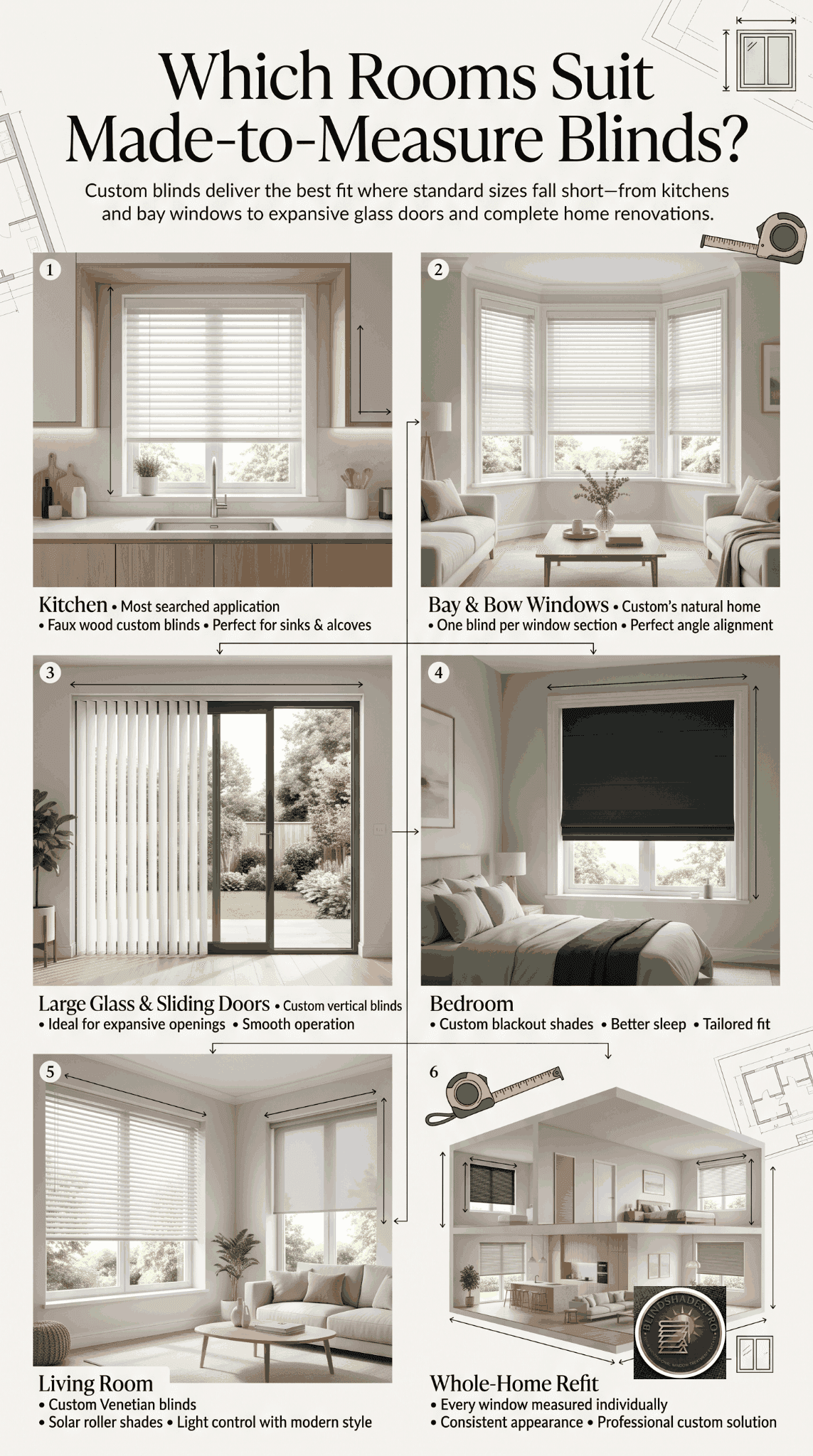
By Michael Turner, 30 years in the window treatment industry
The best made to measure blinds are custom-manufactured to your exact window dimensions, eliminating light gaps and providing a perfect fit. That has been this guide’s opening truth since it first ranked — and the rewrite beneath it adds what nobody else on this results page teaches: the measuring protocol that makes custom ordering safe (the single skill this product lives or dies on), the guarantee fine print decoded, the four maker tiers priced honestly, and the sale-cycle economics an eighty-comment community thread already voted on. One number resets the whole conversation before we start: a custom-size cordless faux wood blind now carries four point six across twenty-one thousand reviews at around forty-eight dollars — custom stopped meaning expensive years ago, and this page proves it lane by lane.
Key Takeaways
- Measure like the factory, not like a shopper. Steel tape, three widths and three drops per opening, smallest width governs inside mounts — the Measure-Once System below is a checklist you perform at the window.
- The deduction question causes most remakes. Factories either take your opening size and subtract clearance, or expect the exact blind size — confusing the two is the number-one custom-order error, and one line on the order form settles it.
- Custom no longer means expensive. Twenty-five-dollar custom faux wood with thirty-six hundred reviews, forty-eight-dollar customs with twenty-one thousand — the tier table prices all four maker lanes honestly.
- Never buy custom at list price. Half-off anchoring means the sale price is the real price, and the sales cycle runs every few months — the community’s own words, operationalized below.
- Made-to-measure wins hardest at scale. Odd sizes, big glass, and any home ordering three-plus windows — that’s where the twelve-blinds-in-one-sale math beats ready-made decisively.
⭐ Quick Answer — The Best Made to Measure Blinds
The best made to measure blinds are custom-manufactured to your exact window dimensions, eliminating light gaps and providing a perfect fit — chosen at three gates: Tape (three widths, three drops, and the deduction question answered), Tier (budget customs from around twenty-five dollars through dealer), and Timing (the sale price is the real price):
- The community’s verdict: the 78-vote top answer is the custom faux wood line (four point six across thirty-six hundred reviews, from around twenty-five dollars) at Blinds.com, with the Free Fit Guarantee lane at SelectBlinds.
- The myth-killer: a custom-size cordless faux wood carrying four point six across twenty-one thousand reviews at around forty-eight dollars — custom stopped meaning expensive; the authority roundup of online sellers is at The Spruce.
- Measure like the factory: steel tape, smallest width governs inside mounts, and answer the deduction question — opening size (they deduct) versus exact blind size — before ordering; the room the live searches name is covered in the kitchen blinds guide.
- The custom core material: composite PVC slats — the twenty-five-dollar class — argued in the faux wood blinds guide.
- Custom’s widest wins: big glass and sliders, where ready-made tops out — the case in the sliding glass door blinds guide.
Quick Specification Reference
| Specification | The Short Answer |
|---|---|
| Best overall custom value | Blinds.com Custom Faux Wood — around twenty-five dollars at thirty-four percent off, four point six across thirty-six hundred |
| Best volume verdict | Zeno Custom Size Cordless Faux Wood via Home Depot — around forty-eight, four point six across twenty-one thousand |
| Best fast build | JustBlinds — made in seven business days, four point eight across five hundred seventeen |
| Best guarantee | SelectBlinds — the Free Fit Guarantee, decoded in the picks |
| The measuring rule | Three widths, three drops per opening; smallest width governs inside mounts; steel tape only |
| The order-form rule | Answer the deduction question: opening size (they deduct) vs exact blind size (you deduct) |
| The price truth | Custom starts around twenty-five dollars; list prices are anchors — buy on the cycle |
| Lead time | Seven business days at the fast end; one to three weeks typical |
Read the complete guide below for: six Diamond picks across the maker tiers, the Tape-Tier-Timing Test, the Measure-Once System with the inside-versus-outside decision tree, the guarantee decoder, the four-tier price map, the custom-versus-ready-made decision table, room verdicts led by the kitchen question people actually search, and the sale-cycle economics — plus every retail question (Home Depot, Walmart, near-me) answered by name.
What Are the Best Made to Measure Blinds? Our Picks
Six picks across the maker tiers — anchored to the biggest review bases in this operation’s history.
The best made to measure blinds for most homes come from the online custom tier — and its review bases now dwarf everything else in window treatments:
Best Overall Custom Value — Blinds.com Custom Faux Wood. Around twenty-five dollars at thirty-four percent off, four point six across thirty-six hundred reviews — and the community’s top answer by name: an eighty-comment DIY thread’s most-voted reply (seventy-eight votes) is simply “Blinds.com!” The cordless lift variants run around twenty-six to fifty-seven, and the service reputation extends to their measure-and-upload workflow. The material itself — composite PVC slats — is argued in full in the faux wood guide.
Best Volume Verdict — Zeno Custom Size Cordless Faux Wood via Home Depot. Around forty-eight dollars, four point six across twenty-one thousand reviews — the largest review base this operation has encountered on any product, on a custom-size blind at big-box pricing. If one number kills the custom-costs-more myth, it is this one.
Best Fast — JustBlinds. Made in seven business days — their banner claim — behind a four point eight store rating across five hundred seventeen, thirty-one-to-three-sixty-six range, with the custom faux wood line around thirty-one at twenty percent off (four point five across seven hundred eighty-one). The speed lane for deadline moves.
Best Guarantee — SelectBlinds. The Free Fit Guarantee the market consensus itself names — decoded honestly in the guarantee table below, because “we’ll remake it” always has terms — plus custom no-drill lines that pair made-to-measure sizing with screwless mounting (the no-drill guide covers those mounts).
Best Brand Custom — Levolor Custom 2-Inch Real Wood. Around one ninety-four at twenty percent off, four point three across fifteen hundred — the national-brand custom lane, with Bali’s custom cordless wood (around one ninety-eight at twenty-five percent off) alongside; stained-wood territory itself lives in the real wood guide. Home Depot’s whole custom program behind both carries four point four across nine hundred ninety-eight.
Best Specialty — Blindsgalore Envision Solar Roller. Around ninety-four at half off with four point nine across sixty-two — proof the custom lane extends past slats into engineered fabrics — beside design-your-own programs around sixty-seven and, at the designer door, the linen-and-cotton custom lane The Spruce’s roundup credits to Pottery Barn. Blindsgalore’s overall custom range runs twenty-six to one eighty-five (four point seven across forty-six hundred), and American Blinds adds free design consults at four point eight across six hundred eighty.
| Pick | Product | Approx. Price (as listed) | Rating / Reviews | Wins the tier for |
|---|---|---|---|---|
| Best Custom Value | Blinds.com custom faux wood | Around twenty-five (34% off) | 4.6 / 3,600 | The community’s 78-vote answer |
| Best Volume Verdict | Zeno custom cordless faux (Home Depot) | Around forty-eight | 4.6 / 21,000 | The myth-killing base |
| Best Fast | JustBlinds custom lines | Thirty-one to three-sixty-six | 4.8 store / 517 | Seven business days |
| Best Guarantee | SelectBlinds custom range | Varies by line | The Free Fit name | Remake protection, decoded |
| Best Brand Custom | Levolor · Bali custom wood | One-ninety-four · one-ninety-eight | 4.3 / 1,500 | The national-brand lane |
| Best Specialty | Blindsgalore Envision solar · design-your-own | Ninety-four · sixty-seven | 4.9 / 62 | Custom beyond slats |
How Do You Choose? The Tape-Tier-Timing Test
Three gates: measure like the factory, pick the maker tier, and buy on the cycle.
Gate 1 — Tape. Every made-to-measure order is only as good as its numbers. The full protocol is the next section; the gate’s rule is simpler: if you haven’t measured each opening three times with a steel tape, you aren’t ready to order — and if you can’t say whether the maker deducts clearance or expects exact blind size, stop and find out.
Gate 2 — Tier. Four maker lanes, priced honestly in the tier table: budget custom (the twenty-five-to-fifty class where the review volume lives), mid custom (the service-and-selection lane), brand custom (Levolor, Bali, the Home Depot program), and dealer/designer (the measured-and-installed tier a two-year Houzz thread keeps debating against the rest — Hunter Douglas versus Budget Blinds versus Home Depot versus local shade shops). Most homes are best served one tier lower than they first shop.
Gate 3 — Timing. The economics section below operationalizes what the community already knows: list prices are anchors, sales recur every few months, and multi-window orders are where custom’s math turns decisive.
| Gate | The question | Pass looks like | Fail routes to |
|---|---|---|---|
| Tape | Three measurements, deduction question answered? | Millimeter-honest numbers, mount decided | Remakes and light gaps |
| Tier | Which maker lane fits the stakes? | Budget/mid custom for most homes | Dealer pricing for standard windows |
| Timing | Buying on the cycle, at scale? | Sale-price multi-window orders | List-price single-window impulse buys |
The Measure-Once System: How to Measure for Blinds Like the Factory Does
The protocol this entire results page skips — how to measure blinds properly, performed at the window, in order.
A naming note first: made to measure blinds, blinds made to measure, blinds to measure, made to measure window blinds, made-to-order blinds, custom blinds, custom-size blinds, cut-to-size blinds, design-your-own blinds, and made to measure pull blinds (the cord-and-chain operated class) all describe the same promise — a blind manufactured to your numbers. Which makes your numbers the product. Here is how to get them right, once:
Step 1 — Tools. A steel tape measure (cloth tapes stretch; laser measures are fine for drops but verify widths with steel), a pencil, and the maker’s order form open so you record in their unit — inches to the eighth or sixteenth for US makers, millimeters elsewhere. Never round in your head; write what the tape says.
Step 2 — Decide the mount. Inside mount (blind lives in the window recess: cleanest look, needs depth) or outside mount (blind overlaps the wall/trim: hides bad frames, kills more light). The decision tree: recess depth under about two inches → outside; beautiful trim you want visible → inside; maximum light-block or an out-of-square old frame → outside with generous overlap.
Step 3 — Width, three times. Inside mounts: measure the opening’s width at the top, middle, and bottom. Windows are never perfectly square — the smallest of the three governs, because the blind must pass the tightest point. Outside mounts: measure the area to cover, then add overlap (three-plus inches per side for light control).
Step 4 — Drop, three times. Height at left, center, and right. Inside mounts take the longest for sill-resting blinds or the exact preference for hovering ones; outside mounts add overlap above and below.
Step 5 — The squareness check. Old house? Measure both diagonals of the recess; a difference past about a quarter inch means the frame is out of square — favor outside mount, or accept a tapered light line inside.
Step 6 — The deduction question. The step that prevents most remakes: makers run one of two systems. System A: you supply the opening size and they deduct operating clearance (typically a quarter to half inch total) — the common US custom-shop default. System B: you supply the exact blind size and they build precisely that — common on budget and marketplace listings. The order form always says which, usually in one line near the size fields. Read it. Ordering opening-size numbers into a System B form produces a blind that jams; exact-size numbers into System A produces gaps. This single check is worth more than any brand comparison on this page.
Step 7 — Record and re-verify. Every opening gets its own labeled line — never assume two windows match; siblings differ by an eighth of an inch constantly. Then re-measure the first window last: if your two readings of it agree, your technique held for the whole batch.
And the calculator question, answered honestly: a blinds calculator is just steps three, four, and six with a form around them — every custom order page is the calculator once the protocol above is in hand. (Blind-type-specific measuring — rollers versus verticals versus cellulars, where drops and brackets differ — earns its own spokes as this family grows; the system above is the parent for all of them.)
| Mount | Measure | The governing rule | Overlap |
|---|---|---|---|
| Inside | Width ×3 (top/mid/bottom), drop ×3 (L/C/R) | Smallest width · longest sill-drop | None — the recess is the frame |
| Outside | Coverage area | Your light-control appetite | Three-plus inches per side; more above |
| Either | Both diagonals on old frames | Quarter-inch difference = out of square | Outside mount forgives |
What Does the Guarantee Actually Cover? The Decoder
“We’ll remake it” always has terms — here they are, plainly.
| Guarantee element | What it typically covers | What voids it | The check |
|---|---|---|---|
| Fit guarantees (the Free Fit class) | A remake if the blind doesn’t fit — often once per order, sometimes size-change-capped | Wrong mount selected; measurements outside stated tolerances; sometimes width-only | Read the size-change cap before ordering |
| Measurement-error clauses | Maker errors: always. YOUR errors: only under fit-guarantee programs | Exact-size (System B) orders usually put your numbers on you | The deduction question, again |
| Returns on custom | Rare — custom goods are largely final-sale | — | The guarantee IS the return policy; treat it that way |
| Lead-time promises | Seven business days at the fast end; one-to-three weeks typical | Specialty fabrics and motors extend | Ask before deadline-driven orders |
The honest summary: guarantees make custom ordering safe, not careless — they are insurance for honest mistakes, not a substitute for the Measure-Once System. Use both.
The Four Maker Tiers, Priced
From twenty-five-dollar customs to measured-and-installed — who each tier is for.
| Tier | The makers (as listed) | Price band | Lead | For |
|---|---|---|---|---|
| Budget custom | Blinds.com faux (4.6/3.6K), Zeno (4.6/21K), JustBlinds (4.5/781) | Twenty-five to sixty | About a week | Most windows in most homes — the volume verdict lives here |
| Mid custom | Blindsgalore (26–185), SelectBlinds, American Blinds (4.8/680) | Fifty to two hundred | One-two weeks | Selection depth, guarantees, design consults |
| Brand custom | Levolor (4.3/1.5K), Bali, the Home Depot program (4.4/998), VENETA (4.0/146) | Fifty-five to two-fifty | Two-three weeks | Name assurance, walk-in support |
| Dealer / designer | Hunter Douglas dealers, local shade shops, the Pottery Barn linen lane | Quoted | Weeks | Measured-and-installed service; statement windows — the two-year Houzz debate’s honest resolution: pay this tier for service, not for the mechanism |
Custom vs Ready-Made: The Honest Decision Table
The consensus quote — better fit, longer life, cheaper upfront the other way — resolved case by case.
| Your situation | The verdict | Why |
|---|---|---|
| Odd-size or old out-of-square windows | Custom, always | Ready-made cannot fix geometry |
| Three-plus windows in one order | Custom, on a sale | The multi-window math below |
| Big glass — sliders, picture windows | Custom | Ready-made tops out; the sliding door guide shows why |
| One standard-size window | Ready-made wins | The upfront-cheaper case is real here |
| Rental / short stay | Ready-made or no-drill | Custom serves windows you’ll keep |
| Kitchen and bath alcoves | Custom shines — kitchen blinds made to measure is its own live search for a reason | Alcove openings are rarely stock sizes; wipeable custom faux from twenty-five settles it, with placement in the kitchen guide |
Which Rooms Suit Made to Measure Blinds?
Kitchen leads the live demand; bays and big glass are custom’s home turf.
| Room / Window | The verdict | The lane |
|---|---|---|
| Kitchen | The searched case — made-to-measure faux over sinks and alcoves | Budget custom tier; kitchen placement rules |
| Bay and bow windows | Custom’s home turf — angles demand it | Each facet its own measured blind (the bay-window deep-dive joins this library as the operation reaches it) |
| Sliding doors / big glass | Custom verticals and panels | Vertical blinds + sliding doors |
| Bedrooms | Custom blackout Romans and cellulars | Roman shades for the fold lane |
| Living rooms | Custom venetians and solar rollers | Venetian blinds; the Envision solar pick |
| Whole-home refits | The twelve-blinds case | The economics section, next |
The Custom Price Illusion: Sales, Scale, and the DIY Verdict
The economics the community wrote and nobody published.
Start with the anchoring truth visible on this very results page: forty percent off banners, half-off list prices, twenty-to-forty-five percent tags on every product tile. When discounts of that depth run most of the year, the sale price is the real price and the list price is theater — never pay list for custom blinds. The community says it with a purchase receipt attached: wait for a sale — it happens every few months — from a buyer who ordered twelve blinds for a new house in one cycle (thirty-nine votes of agreement).
Those twelve blinds are the second lesson: custom’s math wins at scale. Per-window, the custom premium over ready-made shrinks as counts rise — shipping amortizes, sale percentages compound, and every window fits — while ready-made’s compromises multiply: one gap per window, one light leak per bedroom, one almost-fits per alcove. A single standard window? Buy ready-made and bank the difference, exactly as the consensus quote allows — cheaper upfront is true there. A whole floor? Measure once, wait one cycle, order once.
The third lesson is dignity: the same thread’s forty-one-vote verdict on installation — most people put up their own blinds; it’s like mowing the lawn and doing the dishes. Two brackets, four screws, a level — the Measure-Once System above was the hard part, and you already did it. (Screwless mounting for rentals lives in the no-drill guide; light-from-the-top custom formats in the TDBU guide.)
And the lead-time honesty: seven business days is the fast lane’s real number, one-to-three weeks the custom norm — against big-box same-day. If the window must be covered tonight, ready-made or a temporary solution bridges the gap; if the window will be yours for years, the wait is the cheapest part of the purchase.
Where Should You Buy Made to Measure Blinds?
Every retail question people search — online companies, Home Depot, Walmart, near-me — answered by name.
| Route | The answer (as listed) | The note |
|---|---|---|
| Best online blinds company | The tier table’s budget-and-mid lanes: Blinds.com (the 78-vote answer), JustBlinds, Blindsgalore, SelectBlinds, American Blinds | Best made to measure blinds in USA territory — all national-ship |
| Custom blinds at Home Depot | The 4.4/998 custom program: Zeno, Levolor, Bali, VENETA custom lines | Walk-in support on custom orders |
| Window blinds at Walmart | The ready-made counterpoint — stock sizes, same-day | Fine for the single-standard-window case; not a custom lane |
| Custom blinds near me | Local shade shops and dealers — the measured-and-installed tier | You pay for the tape and the ladder; worth it for statement windows and tricky frames |
| Best place to buy blinds cheap | Budget custom ON a sale cycle beats ready-made “cheap” for anything non-standard | Twenty-five-dollar customs ended the old trade-off |
| The UK lane | 247blinds carries a three-year community loyalty | The made-to-measure culture runs deeper there; same protocol applies |
Related Buying Guides
- Best Kitchen Window Blinds & Shades — the room the live queries name
- Best Faux Wood Blinds — the custom tier’s volume material
- Best Real Wood Blinds — the brand-custom slat lane
- Best Vertical Blinds — made-to-measure for big glass
- Best Sliding Glass Door Blinds — custom’s widest windows
Complete Made-to-Measure Guide Library
- Best Kitchen Window Blinds & Shades — alcove and sink-window fits
- Best Roman Shades — the custom-fabric fold lane
- Best Venetian Blinds — custom slats at every price
- Best Vertical Blinds — measured vanes for sliders
- Best Sliding Glass Door Blinds — the big-glass custom case
- Best Faux Wood Blinds — the twenty-five-dollar custom core
- Best Real Wood Blinds — Levolor and Bali’s custom territory
- Best No Drill Blinds — custom sizing, screwless mounting
Frequently Asked Questions
What are the best made to measure blinds? The best made to measure blinds are custom-manufactured to your exact window dimensions, eliminating light gaps and providing a perfect fit — and today’s market delivers that from around twenty-five dollars: Blinds.com’s custom faux wood (four point six across thirty-six hundred reviews), Zeno’s custom cordless line at Home Depot (four point six across twenty-one thousand), JustBlinds’ seven-day builds, and SelectBlinds’ Free Fit Guarantee lead the online tier, with Levolor and Bali carrying the brand-custom lane.
How do you measure for made to measure blinds? With a steel tape, three times per dimension: width at the top, middle, and bottom of the opening (the smallest governs inside mounts), drop at left, center, and right, recorded exactly in the maker’s unit. Decide inside versus outside mount first, check old frames for squareness with both diagonals, and answer the deduction question on the order form — whether the maker subtracts operating clearance from your opening size, or builds exactly the number you enter.
Are made to measure blinds worth it? For odd sizes, big glass, out-of-square frames, and any order of three-plus windows — decisively yes: the fit eliminates light gaps, the per-window premium shrinks at scale, and sale cycles put customs from around twenty-five dollars. For one standard-size window or a short-stay rental, ready-made’s cheaper-upfront case is real — the honest rule is custom for windows you’ll keep, stock for windows you won’t.
How much do made to measure blinds cost? Budget customs run twenty-five to sixty dollars (faux wood cordless classes with the market’s biggest review bases), mid-tier customs fifty to two hundred, brand customs like Levolor’s real wood around one ninety-four, and dealer-installed tiers by quote. The pricing rule matters more than the tier: list prices are anchors, discounts of thirty to fifty percent recur every few months, and the sale price is the real price.
How long do made to measure blinds take? Seven business days at the fast end — a leading maker’s standing claim — with one to three weeks the custom-industry norm, and longer for specialty fabrics or motorized builds. Custom is a planned purchase: measure this weekend, order on the next sale cycle, install the weekend the box arrives — the community’s verdict is that the install itself is ordinary household work.
Is it cheaper to buy custom blinds online or in store? Online custom is usually cheapest for the same specification — the budget tier’s twenty-five-to-sixty class has no in-store equivalent — while Home Depot’s custom program (four point four across nearly a thousand reviews) adds walk-in support at brand-custom pricing, and local dealers charge for measuring and installation service. Buy online if you’ll run the Measure-Once System yourself; buy the dealer tier when the window or the frame genuinely needs a professional’s tape.
