The Best Roller Blinds Buying Guide 2026

Authored By Michael Turner -30 Years Home Improvement Expertise | Updated 2026 | BlindShades.pro
Updated on June 18, 2026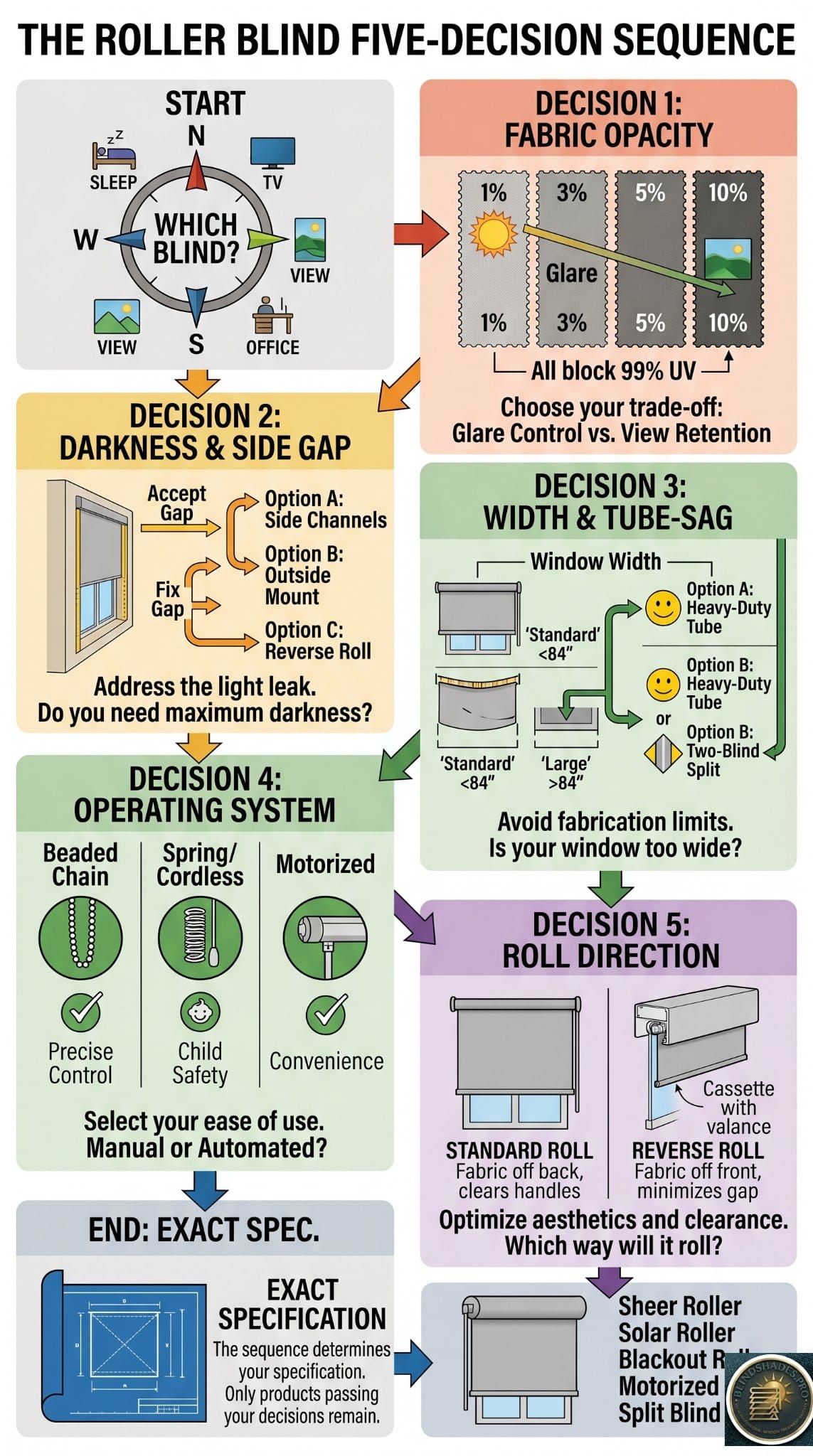
Best roller blinds 2026: the roller blind vs roller shade distinction; why standard rollers can’t do true blackout (the side gap); openness factor 1-10%; the 72-84 inch tube-sag limit; spring vs clutch vs cordless vs motorized; ANSI/WCMA child-safety rule.
By the Editorial Team at BlindShades.pro | Updated 2026 | 30 Years of Home Improvement Expertise
Key Takeaways
- A “roller blind” and a “roller shade” are the same mechanism, and confusing them is the most common buying mistake. Both are one panel that winds onto a tube; “roller shade” usually means a soft fabric panel, while “roller blind” is the older, British-English term that also covers stiffened vinyl and PVC. Performance is decided not by the word but by the fabric opacity class — sheer, light-filtering, room-darkening, blackout, or solar — and the operating system. Choose opacity for the room first, then the operating system, then the finish.
- A standard roller blind physically cannot deliver true blackout, and no listicle tells buyers why. Even a 100% opaque blackout fabric leaves a light gap of roughly 3/8 to 5/8 inch on each side of an inside-mounted blind, because the fabric must be narrower than the brackets it hangs between. The U.S. Department of Energy notes that around 30% of a home’s heating and cooling energy moves through its windows, and those same edge gaps that leak light also leak conditioned air. The only way to reach near-total darkness with a roller is to add side channels (light-blocking tracks) or to specify an outside mount that overlaps the frame by 2 to 3 inches per side.
- Solar (screen) roller fabrics are rated by an “openness factor,” and that single number — not the color — controls glare, view, and UV. Openness factor is the percentage of the weave that is open: 1% for maximum glare control with minimal view; 3% for east- and west-facing rooms with direct sun; 5% for general glare management with a strong view; 10% for shaded north-facing rooms where view is the priority. Solar screen fabrics from manufacturers such as Phifer (SheerWeave) block up to 99% of UV regardless of openness factor, protecting flooring and furniture from fade.
- Operating system, not fabric, is where roller blinds fail — and child safety is now regulated, not optional. Continuous-cord (chain) clutches can slip or jump the sprocket over time; spring rollers gradually lose tension and stop holding position; cordless spring-assist mechanisms are the most reliable but limit maximum size; motorized rollers run quietest and integrate with home automation, with rechargeable batteries typically lasting 4 to 6 months per charge. The ANSI/WCMA A100.1-2018 standard, supported by the U.S. Consumer Product Safety Commission, requires stock window coverings sold to consumers to be cordless or to have inaccessible or short cords — so a corded stock roller blind is generally non-compliant.
- Roller blinds are the most affordable custom window treatment, but width has a hard engineering limit. A standard manual fabric roller for a typical 2-by-4-foot window runs roughly $60 to $260 installed; motorizing the same window pushes it to $350 to $1,000. The constraint most buyers never hear about is tube deflection: a standard 1.5-inch tube rolls straight up to roughly 72 to 84 inches wide, but beyond that the loaded tube sags in the middle and the fabric telescopes (drifts to one side) unless you upgrade to a heavy-duty tube or split the opening into two blinds.
⭐ Quick Answer — The Best Roller Blinds Buying Guide 2026
- Choose the fabric opacity before anything else — it is the one decision that determines whether the blind does its job. The best roller blinds are matched to the room: sheer for a soft daytime glow, light-filtering for living rooms and kitchens, room-darkening for media rooms, blackout for bedrooms, and solar/screen for screens and view windows where the openness factor (1%, 3%, 5%, or 10%) is the defining spec. The complaint “it still lets light in” comes from expecting a blackout fabric to perform like a blackout system — which it cannot without side channels.
- Know the roller blind vs roller shade distinction so you buy the right product. They are the same mechanism — a panel that winds onto a tube. “Roller blind” is the older, British-English and stiffened/PVC-leaning term; “roller shade” is the U.S. soft-fabric term. The decisions are identical for both. For the soft-fabric version, see our Roller Shades Buying Guide.
- For true darkness, the side gap is the enemy — plan for it before you order. An inside-mounted roller leaves a 3/8-to-5/8-inch light gap on each side because the fabric must be narrower than its brackets. The fixes: side channels, an outside mount overlapping the frame by 2–3 inches per side, or a reverse roll that sits the fabric closer to the glass. The U.S. Department of Energy notes windows account for about 30% of heating and cooling energy — the same edge gaps leak light and conditioned air. See Why Is Light Coming Through the Sides of My Roller Blind.
- Match the operating system to the window, and confirm it is cordless for child safety. Spring rollers are cheapest but lose tension; chain clutches position precisely but can slip; cordless spring-assist is the most reliable for standard windows; motorized suits large, high, or numerous windows (battery 4–6 months per charge, or hardwired). The Window Covering Manufacturers Association (ANSI/WCMA A100.1-2018) requires stock products to be cordless — treat a corded stock roller blind as a red flag. See Are Motorized Roller Blinds Worth It.
- Cost is the lowest of any custom treatment, but the tube and fabric weight decide whether a wide blind works at all. Expect roughly $60–$260 installed for a manual fabric roller and $350–$1,000 motorized. A standard 1.5-inch tube rolls straight to about 72–84 inches wide; past that you need a heavy-duty tube or a two-blind split with a 2-inch center overlap, or it will sag and telescope. Solar screen fabrics such as Phifer SheerWeave block up to 99% of UV. See Best Roller Blinds for Large Windows.
- Best picks 2026: Bali (best overall), SelectBlinds or Achim (best budget), Graber blackout with side channels (best blackout), SmartWings (best value motorized) or Lutron Serena with 3–5 year battery (best premium motorized). Insist on fabric weight (GSM) — the quality spec most retailers never advertise.
📚 The 10 Roller Blind Topics Covered In This Buying Guide
- Why Won’t My Roller Blind Roll Up Straight? — Telescoping diagnosed: fabric tracking, tube level, and the width-to-tube-diameter limit
- Why Is Light Coming Through the Sides of My Roller Blind? — The 3/8-to-5/8-inch side gap; side channels and reverse roll as the fix
- Why Won’t My Roller Blind Stay Up? — Spring and Clutch Fix — Spring tension loss vs clutch slip; rewinding and replacement
- Roller Blinds vs Roller Shades — What Is the Difference? — Same mechanism, different fabric language; when to choose each
- Roller Blinds vs Venetian Blinds — Which Is Better? — Light control, cleaning, cost, and room-by-room verdict
- Are Motorized Roller Blinds Worth It? — Cost, battery life, automation ROI, and when manual wins
- Are Blackout Roller Blinds Worth It Without Side Channels? — What blackout fabric does and does not buy you
- What Are the Best Roller Blinds for a Bathroom? — Moisture, mold, and the correct PVC or polyester specification
- What Are the Best Roller Blinds for Large Windows? — Tube sag, fabric weight, and the two-blind split
- How Do You Measure for Roller Blinds? — Inside vs outside mount, the deduction, and roll direction
💡 Quick Specification Reference — Roller Blinds by Room and Priority
- Bedroom / nursery (darkness priority): Blackout fabric + side channels + cassette headrail; reverse roll to tighten the panel to the glass. Blackout fabric alone leaves a 3/8-to-5/8-inch light band on each side.
- Living room / kitchen (everyday light): Light-filtering fabric for diffused daylight and daytime privacy without a fishbowl effect; vinyl or PVC-coated fabric in a kitchen for wipe-clean moisture tolerance.
- Home office / screen glare: Solar/screen fabric at 3-5% openness factor, light color (white/cream/grey); blocks up to 99% UV and cuts glare while keeping the view.
- Bathroom (moisture priority): Vinyl or PVC-coated or 100% polyester fabric — never paper or untreated cotton; smooth wipe-clean surface to resist mold.
- Wide window (over 84 inches): Heavy-duty 2-inch-plus tube or a two-blind split with a 2-inch center overlap, or the blind will sag and telescope.
- Child safety (all rooms): Cordless or motorized lift only — required for stock products under ANSI/WCMA A100.1-2018.
- Sunny south/west window (fade priority): Polyester or fiberglass solar fabric, not bargain PVC, which can yellow within 12-24 months of direct sun.
📖 Read the Complete Guide Below For:
The roller blind vs roller shade distinction (same mechanism, different fabric language); the five-decision specification sequence; fabric opacity classes (sheer, light-filtering, room-darkening, blackout, solar) matched to each room; the openness factor table (1%, 3%, 5%, 10%) for solar fabric; why a standard roller cannot achieve true blackout (the 3/8-to-5/8-inch side gap) and the side-channel, outside-mount, and reverse-roll fixes; the 72-to-84-inch tube-sag width limit and when to specify a heavy-duty tube or a two-blind split; the four operating systems (spring, chain clutch, cordless, motorized) with lifespan and failure modes; the ANSI/WCMA A100.1-2018 child-safety rule; fabric fade and yellowing timelines by material; standard vs reverse roll; open-roll vs cassette vs valance finishes; 2026 installed cost ranges; and how to measure for inside vs outside mount.
The Roller Blind Five-Decision Sequence
The named framework this guide is built on — make these five calls in order and the right product falls out.
Roller blinds look simple, which is exactly why buyers skip the decisions that determine whether the blind performs. We organize every roller specification as The Roller Blind Five-Decision Sequence, made in this order: (1) Opacity — what light behavior the room needs; (2) Darkness strategy — whether the side gap must be sealed; (3) Width and tube — whether the span exceeds the standard tube limit; (4) Operating system — how the blind is raised and whether it is child-safe; and (5) Roll direction and finish — how the fabric sits and how the top is enclosed. Each section below maps to one decision. Make them in order and you avoid the two most common outcomes: a “blackout” blind that leaks light, and a wide blind that won’t roll up straight.
Best Roller Blinds 2026 — Our Picks
The products that pass the Five-Decision Sequence, by use case — with the one spec most retailers hide.
Direct answer: for most homes the best all-round roller blind is a custom Bali roller in the right opacity, the best value is SelectBlinds custom or an Achim trim-to-fit vinyl for renters, the best true blackout is a Graber blackout roller paired with side channels, and the best motorized is SmartWings for value or Lutron Serena for a whole-home system. The single spec to insist on and that most retailers never advertise is fabric weight (GSM) — heavier fabric (roughly 300 GSM and up) hangs flatter, blocks more light, and resists curling. Prices below are indicative U.S. ranges as of 2026 and vary by size, fabric, and sales.
| Pick | Product | Why it wins | Indicative price (per window) |
|---|---|---|---|
| Best Overall | Bali Roller Shades (Springs Window Fashions) | Full opacity range sheer→blackout, custom-sized, reliable and DIY-friendly; sold at Costco, Lowe’s, Home Depot | ~$72 for 24″×36″; ~$45–$130 |
| Best Budget (custom) | SelectBlinds Cordless Roller | Custom sizing with a MeasureSafe mis-measure guarantee and a wide fabric range | ~$20–$70 |
| Best Budget (renter) | Achim Tear-Down Vinyl Roller | Cordless, trim-to-fit vinyl, room-darkening; no-tools, wipe-clean, lease-friendly | ~$12–$20 |
| Best Blackout | Graber Blackout Roller (300+ GSM) | True 300+ GSM blackout fabric and a smooth cordless mechanism; pair with side channels for a light-tight bedroom | ~$40–$120 |
| Best Motorized (value) | SmartWings Motorized Roller | Matter-over-Thread, battery / hardwired / solar power options, 100+ fabrics, quiet motor | from ~$160 |
| Best Motorized (premium) | Lutron Serena Motorized Roller | 3–5 year battery life, whisper-quiet, perfect multi-shade alignment; one Power Panel runs up to 10 shades | ~$500–$640 |
| Best for Large Windows | SelectBlinds / Graber custom + heavy-duty tube | Custom widths on a 2″+ tube to prevent sag; or a two-blind split with a 2″ center overlap | varies by width |
| Best for Bathrooms | SelectBlinds Classic Vinyl / Bali vinyl roller | Wipe-clean PVC/vinyl fabric that tolerates moisture and resists mold | ~$25–$80 |
How we chose: each pick is matched to one decision in the Five-Decision Sequence rather than ranked on price alone — opacity for the room, a darkness strategy where blackout is required, a tube rated for the width, a child-safe cordless or motorized lift, and a fabric weight that justifies the price. For motorized specifically, the deciding spec is battery life: SmartWings and similar value motors run 3–6 months per charge, while Lutron Serena runs 3–5 years, which is why Serena is the pick for hard-to-reach or whole-home installations even at the higher price. For the full ROI math, see Are Motorized Roller Blinds Worth It.
Shop links: Bali · SelectBlinds · Graber · SmartWings · Lutron Serena
What Is the Difference Between a Roller Blind and a Roller Shade?
Decision 1, part one — the terminology that decides which product you are actually buying.
A roller blind and a roller shade are the same piece of hardware: a single panel of material wound onto a horizontal tube that retracts up and out of sight when raised. The difference lives entirely in the language and, by extension, the fabric people expect each word to describe.
In British and Australian English, “roller blind” is the default term and it covers everything from soft printed cottons to stiffened, wipe-clean PVC panels. In U.S. usage, “roller shade” became the marketing-preferred phrase for soft fabric panels, while “roller blind” lingered for the stiffer, more utilitarian versions — the kind you find in a rental kitchen or a workshop. Neither word is technically wrong, which is exactly why search results and product catalogs use them interchangeably and leave buyers confused.
Because the mechanism is identical, the decisions that matter are identical too: the fabric opacity class, the operating system, the roll direction, and the headrail finish. If you want a soft, drapery-adjacent fabric panel with texture and pattern, that is what most U.S. retailers list under roller shades. If you want a stiffened, moisture-tolerant, wipe-clean panel for a bathroom, kitchen, or utility space, ask for a roller blind in a vinyl or PVC-coated fabric. The rest of this guide applies to both, because physically they are one product.
Does the Word You Use Change the Price or the Performance?
No. A blackout-lined fabric roller costs and performs the same whether a salesperson calls it a blind or a shade. The variables that move price and performance are fabric weight, opacity, width, operating system, and finish — covered in the sections below. Treat the terminology as a clue to the fabric the seller has in mind, then verify the actual opacity rating and operating system before you order. For the full side-by-side and the cases where each name points to the right product, see Roller Blinds vs Roller Shades — What Is the Difference.
What Fabric Opacity Do You Actually Need?
Decision 1, part two — the single choice that determines whether the blind does the job you bought it for.
The opacity class is the most important decision, because it determines whether the blind does the job you bought it for. There are five practical classes, and matching the class to the room prevents the most common complaint of all — that the blind “lets in too much” or “blocks too much” light. Blindsgalore notes that roller fabrics run the full range from semi-sheer to semi-opaque to blackout, which is why naming the opacity class — not just the product — is what gets you the right blind.
Sheer fabrics keep a soft daytime glow and a retained outward view while providing daytime-only privacy; at night, with interior lights on, a sheer roller provides little privacy. Light-filtering fabrics diffuse daylight evenly, soften glare, and give daytime privacy without darkening a room — the right choice for most living rooms and kitchens. Room-darkening fabrics block the large majority of light but are not light-tight, suiting guest rooms, nurseries used for daytime naps, and media rooms that tolerate a faint glow. Blackout fabrics use an opaque or foam-backed construction that blocks light through the fabric itself; they are correct for bedrooms and shift-worker spaces, with the critical caveat about side gaps below. Solar/screen fabrics are an engineered open weave designed to cut glare and UV while preserving the view, rated by openness factor.
| Opacity Class | Privacy | Light Control | Daytime View | Best Room |
|---|---|---|---|---|
| Sheer | Low (day only) | Low | High | Living room, sunroom |
| Light-filtering | Medium (day) | Medium | Medium | Kitchen, living room |
| Room-darkening | High | High | Low | Guest room, media room |
| Blackout | Maximum | Maximum (with side channels) | None | Bedroom, nursery |
| Solar / screen | Day only (one-way) | Glare + UV, keeps view | High | Home office, view windows |
What Does Openness Factor Mean for a Solar Roller Blind?
Openness factor is the percentage of a solar fabric’s surface that is open weave, and it is the defining specification for any screen roller. A lower number blocks more glare and gives more privacy at the cost of view; a higher number preserves the view at the cost of glare control. The practical guide:
| Openness Factor | Best For | View | Glare Control |
|---|---|---|---|
| 1% | Direct south/west sun, screen-heavy rooms | Minimal | Maximum |
| 3% | East/west windows with direct morning or afternoon sun | Moderate | Strong |
| 5% | General south-facing rooms wanting view + glare control | Strong | Good |
| 10% | Shaded north-facing rooms prioritizing the view | Maximum | Light |
Solar fabrics from manufacturers such as Phifer (the SheerWeave line) block up to 99% of UV across every openness factor, so even a 10% open fabric still protects flooring and artwork from fade. Lighter fabric colors reflect solar energy and control glare better than dark colors, which absorb heat and re-radiate it into the room. For whether a blackout fabric alone earns its place or needs the side-channel upgrade, see Are Blackout Roller Blinds Worth It Without Side Channels.
Why Won’t a Standard Roller Blind Give You True Blackout?
Decision 2 — the side gap is structural, so plan the darkness strategy before you order.
A standard roller blind cannot produce true blackout, and the reason is structural rather than a fault in the fabric. The fabric panel must be narrower than the brackets it hangs between so that the tube can turn freely, which leaves a light gap of roughly 3/8 to 5/8 inch on each side of an inside-mounted blind. Even a fully opaque blackout fabric will leak a visible band of daylight down both edges through that gap.
This is the most consistently reported roller-blind disappointment, and product reviews across SelectBlinds, Blinds.com, and independent testers confirm the same point: roller fabric alone cannot reach 100% blackout because of the fabric-to-bracket gap. Hunter Douglas states the same limitation in its own roller buyer’s guide, cautioning that an inside mount may leave a small light gap on the sides of the shade. The U.S. Department of Energy’s observation that roughly 30% of residential heating and cooling energy passes through windows is relevant here too — the same perimeter gaps that leak light also leak conditioned air, so closing them improves both darkness and efficiency.
How Do You Actually Achieve Blackout With a Roller Blind?
There are three fixes, and they can be combined. First, specify side channels — aluminum tracks mounted on the window jambs that the fabric edges run inside, sealing the side gaps and adding a measurable insulation benefit. Second, use an outside mount that overlaps the window frame by 2 to 3 inches on each side and top, so the leaked band falls on the wall rather than the glass. Third, choose a reverse roll, where the fabric feeds off the back of the tube and sits closer to the glass, which tightens the panel against the window and shrinks the gap. For a true blackout bedroom, the correct specification is a blackout fabric plus side channels plus a top valance or cassette to seal the gap above the tube — not blackout fabric on its own. The energy benefit is not just marketing: the Attachments Energy Rating Council (AERC), the independent body that energy-rates window attachments in the U.S., recognizes edge-sealing and air-gap construction for the insulation value it adds. For the full diagnosis of edge light leakage and the three fixes ranked, see Why Is Light Coming Through the Sides of My Roller Blind.
How Wide Can a Roller Blind Go Before the Tube Sags?
Decision 3 — the width limit competitors never mention, and the cause of a blind that won’t roll up straight.
A roller blind on a standard 1.5-inch tube rolls straight and holds its shape up to roughly 72 to 84 inches wide; beyond that, the loaded tube deflects in the middle and the fabric begins to telescope — drift toward one side each time it is raised. This width limit is almost never mentioned in product listings, yet it is the single biggest cause of a blind that “won’t roll up straight.”
Three variables push the limit: the tube diameter, the fabric weight, and the span. A heavier fabric — a foam-backed blackout or a vinyl panel — loads the tube more than a light voile and sags sooner. For wide openings you have three options: upgrade to a heavy-duty tube of 2 inches or more, which resists deflection; split the opening into two blinds with a 2-inch center overlap to eliminate the gap; or accept a lighter fabric to reduce the load. As a rule, any opening wider than about 84 inches should be quoted as either a heavy-duty tube or a two-blind configuration. To diagnose a blind that already telescopes or won’t roll up level, see Why Won’t My Roller Blind Roll Up Straight; for the complete wide-window specification, see What Are the Best Roller Blinds for Large Windows.
Which Operating System Should You Choose — Spring, Chain Clutch, Cordless, or Motorized?
Decision 4 — where roller blinds actually fail, and where child safety is now the law for stock products.
The operating system, not the fabric, is where roller blinds most often fail, so it deserves more attention than buyers usually give it. There are four mainstream choices, each with a distinct failure mode and lifespan profile.
| System | Best For | Strength | Failure Mode |
|---|---|---|---|
| Spring roller | Budget, small windows | Cheapest, no visible cord | Loses tension; stops holding position |
| Continuous chain clutch | Precise mid-window positioning | Holds any height accurately | Chain can slip or jump the sprocket |
| Cordless spring-assist | Standard windows, child safety | Most reliable, clean look | Size-limited; harder on very wide blinds |
| Motorized | Large, high, or many windows | Quietest, automatable | Battery recharge every 4-6 months |
A spring roller is the least expensive but the least durable; the spring gradually relaxes and the blind starts creeping down. A continuous-chain clutch gives the precise, hold-anywhere positioning that designers prefer, but the bead chain can slip under a heavy fabric. A cordless spring-assist mechanism is the most reliable choice for a standard window and the cleanest-looking, though it becomes harder to operate smoothly as width and weight increase. Motorized rollers are the answer for large, high, hard-to-reach, or numerous windows, run almost silently, and integrate with home-automation platforms; SmartWings (2026) reports its rechargeable battery roller models run about 4 to 6 months per charge, while hardwired models never need charging. For the full motorized cost-and-ROI breakdown and the window count at which it pays off, see Are Motorized Roller Blinds Worth It; to fix a roller that creeps down or won’t hold its position, see Why Won’t My Roller Blind Stay Up — Spring and Clutch Fix.
Are Cordless Roller Blinds a Legal Requirement Now?
Effectively, yes, for stock products. The ANSI/WCMA A100.1-2018 standard, developed by the Window Covering Manufacturers Association and supported by the U.S. Consumer Product Safety Commission, requires window coverings sold as stock items to consumers to be cordless or to have inaccessible or short cords, because accessible pull cords are a documented strangulation hazard for young children. Custom-order products have more latitude, but any reputable retailer’s in-stock roller blind should already ship as a cordless or motorized lift. If you are offered a corded stock roller blind, treat it as a sign the product is outdated or non-compliant.
Standard Roll vs Reverse Roll — Which Do You Need?
Decision 5, part one — a small specification with a real impact on light control and clearance.
Roll direction is a small specification with a real impact on light control and obstruction clearance. In a standard roll, the fabric comes off the front of the tube, sitting slightly away from the glass; in a reverse roll, the fabric feeds off the back of the tube, sitting closer to the glass.
Choose a reverse roll when you want to minimize the side light gap — the fabric sits tighter to the window — or when a window crank, handle, or deep sill would otherwise foul a front-rolling panel. Choose a standard roll when there is a projecting obstruction at the base of the window that the fabric needs to clear, or when an inside-mounted blind would otherwise rub the glass. For blackout bedrooms, reverse roll is usually the better default because it tightens the panel against the window and reduces edge leakage; for a window with a protruding lock or handle, standard roll provides the clearance.
Open Roll, Cassette, or Valance — Which Headrail Finish?
Decision 5, part two — the top of the blind controls the last light gap and how much dust the roll collects.
The headrail finish controls how the top of the blind looks and how well it seals light and dust. An open roll exposes the bare tube and wrapped fabric; it is the cheapest, the most industrial in appearance, and leaves a light gap above the fabric where it meets the tube. A cassette (also called a fascia) is an enclosure that wraps the tube in a slim housing, giving a clean finished edge, sealing the top light gap, and keeping dust off the roll. A fabric-wrapped valance covers the tube in the same fabric as the blind for a softer, more decorative finish.
For a blackout bedroom, a cassette is the correct choice because it seals the gap above the tube that an open roll leaves; combined with side channels, a cassette closes the last major light path. For a utility space or a budget project, an open roll is perfectly serviceable. For a decorative living room, a fabric valance ties the blind into the room’s textiles.
Do Roller Blinds Fade or Yellow Over Time?
The fabric choice at purchase decides how the blind looks in five years.
Roller blinds fade and yellow at very different rates depending on the fabric, and the choice you make at purchase determines how the blind looks in five years. PVC and vinyl roller panels contain plasticizers that ultraviolet light breaks down through oxidation; on south- and west-facing windows with direct sun, these materials can begin to yellow or turn amber within 12 to 24 months, and once that photodegradation occurs it cannot be cleaned out — replacement is the only fix.
Polyester fabric panels and fiberglass-core solar screen fabrics resist this far better. Engineered solar fabrics such as Phifer’s SheerWeave are formulated specifically for UV stability and hold their color for many years of direct exposure. The practical rule: for any window with strong direct sun, specify a polyester or fiberglass-based fabric rather than a bargain PVC panel, and favor lighter colors, which both reflect solar heat and show less fade contrast over time. A separate, cleanable form of yellowing — a film from cooking grease, smoke, or airborne particulates — affects any fabric near a kitchen and is best handled by choosing a smooth, wipe-clean fabric rather than a textured weave that traps particles. For the moisture, mold, and wipe-clean fabric specification in a wet room, see What Are the Best Roller Blinds for a Bathroom.
How Much Do Roller Blinds Cost in 2026?
The operating system and fabric weight move the price more than the pattern does.
Roller blinds are the most affordable custom window treatment, but the operating system and fabric weight move the price more than the fabric pattern does. Typical installed costs for a standard 2-by-4-foot window:
| Configuration | Installed Cost (per standard window) |
|---|---|
| Manual fabric roller, standard fabric | $60 – $260 |
| Premium fabric or blackout upgrade | $100 – $260 |
| Battery motorized, remote | $350 – $650 |
| Hardwired or integrated motorized | $700 – $1,000 |
| Installation labor only | $60 – $260 |
A single 2-by-4-foot manual fabric roller commonly lands around $100 to $160 installed; larger 3-by-6-foot or 4-by-8-foot openings run $180 to $350 manual. Motorizing a window adds roughly $300 to $800 on top of the fabric cost, plus $50 to $100 per unit for smart-home integration. Side channels, a cassette, and a heavy-duty tube each add modest line items that are worth specifying up front rather than discovering you need them later. When comparing quotes, ask for itemized pricing — fabric, tube, operating system, finish, and labor as separate lines — so you can compare like with like. If a slatted, tilt-adjustable alternative is on your shortlist at a similar price point, see Roller Blinds vs Venetian Blinds — Which Is Better.
How Do You Measure and Mount Roller Blinds?
The mount type is the first measurement decision and it changes everything that follows.
The mount type is the first decision and it changes every measurement that follows. An inside mount sits the blind within the window frame for a clean, built-in look, but it leaves the 3/8-to-5/8-inch side light gap and requires adequate frame depth. An outside mount fixes the blind to the wall or trim above the window and overlaps the opening, hiding the gap and giving better light control at the cost of the recessed look.
For an inside mount, measure the width at the top, middle, and bottom of the opening and use the narrowest figure; measure the height at the left, center, and right and use the longest. The factory applies a small deduction so the blind clears the frame. For an outside mount, add 2 to 3 inches to each side of the opening for overlap and position the headrail 2 to 3 inches above the frame, with no deduction. Confirm the frame depth for an inside mount and choose your roll direction at the same time, since a reverse roll changes how close the fabric sits to the glass. Full step-by-step measuring, including the deduction math and roll-direction decision, is covered in How Do You Measure for Roller Blinds.
Roller Blind Technical Specifications (For Architects, Facility Managers & Specifiers)
Scan-ready spec data for project sheets — present as category ranges; confirm project-exact values on the manufacturer cut sheet.
For commercial specification, roller window shades fall under CSI MasterFormat Section 12 24 13 — Roller Window Shades (window blinds generally sit under 12 21 00). The table below is a category reference for early specification and product comparison; pull final dimensional, fabric-weight, and energy values from the selected manufacturer’s AERC-rated cut sheet. Use the Roller Blind Sizing & Split Calculator to size openings and flag two-blind splits before drafting the schedule.
Roller Blind Sizing & Split Calculator
Enter your opening to get tube, two-blind-split, fabric area, and an indicative cost band. For architects, facility managers & specifiers.
| Specification | Typical range / options |
|---|---|
| CSI section | 12 24 13 (Roller Window Shades) |
| Fabric composition | Polyester, PVC-coated polyester, fiberglass-core (solar), vinyl |
| Fabric weight (GSM) | ~250–500 GSM typical (fabric-dependent; verify) |
| Opacity classes | Sheer, light-filtering, room-darkening, blackout |
| Openness factor (solar) | 1%, 3%, 5%, 10% |
| UV block (solar fabrics) | Up to 99% |
| Single-blind width | ~12–84 in on a standard 1.5 in tube; to ~120 in+ on heavy-duty tube |
| Height | To ~120 in+ (fabric and tube dependent) |
| Tube diameter | 1.5 in standard; 2 in+ heavy-duty (wide spans) |
| Inside-mount flat depth | ~1.5–3 in minimum (product-dependent) |
| Inside-mount side light gap | 3/8–5/8 in per side (specify side channels to seal) |
| Operating systems | Spring, continuous chain clutch, cordless spring-assist, motorized |
| Motor power | Rechargeable battery (~4–6 months), hardwired, or solar |
| Control protocols (motorized) | RF remote, Zigbee / Z-Wave / Thread / Matter, or proprietary (e.g., Lutron Clear Connect); commercial BMS via dry contact / RS-485 / BACnet (product-dependent) |
| Warranty | Varies; commonly multi-year on fabric and mechanism, separate motor warranty |
Compliance & Certifications to Verify
Roller shade products and fabrics commonly carry the certifications below, but each is product- and fabric-specific — confirm on the cut sheet for the exact item being specified.
| Standard | Covers | Specifier note |
|---|---|---|
| NFPA 701 | Flame propagation for window treatments | Commonly required for commercial and assembly occupancies |
| ANSI/WCMA A100.1-2018 | Corded window covering child safety | Stock products must be cordless or have inaccessible cords |
| GREENGUARD / GREENGUARD Gold | Low-VOC indoor air quality | Relevant for schools, healthcare, and LEED projects |
| AERC | Attachments Energy Rating Council energy performance | Source of rated SHGC and Tv values for energy modeling |
| CA Title 24 / Prop 65 | Energy code / chemical disclosure | Solar shading can contribute to Title 24 compliance |
| ADA | Operable parts without tight grasping or twisting | Cordless and motorized lifts satisfy reach/operation requirements |
| LEED v4 / v4.1 | Green building credits | May contribute to EQ (daylight, quality views) and EA (energy) credits |
Energy Performance Data
The energy values architects model are the openness factor (1–10% for solar fabrics), the solar heat gain coefficient (SHGC) reduction, visible transmittance (Tv), and shading coefficient. These are fabric- and product-specific: pull the project values from the manufacturer's AERC-rated cut sheet rather than a category estimate. As a planning rule, a lower openness factor and a lighter fabric color reduce solar heat gain and glare; all solar openness factors block up to 99% of UV.
The 10 Roller Blind Articles in This Buying Guide
Each topic below is covered in depth in its own dedicated article:
- Why Won't My Roller Blind Roll Up Straight? — Telescoping diagnosed: fabric tracking off-center, an out-of-level tube, and the width-to-tube-diameter limit that causes the loaded tube to sag past 84 inches; the heavy-duty-tube and two-blind fixes.
- Why Is Light Coming Through the Sides of My Roller Blind? — The 3/8-to-5/8-inch structural side gap explained; side channels, outside-mount overlap, and reverse roll as the three fixes, ranked.
- Why Won't My Roller Blind Stay Up? — Spring and Clutch Fix — Diagnosing spring tension loss versus chain-clutch slip; how to rewind a spring roller and when the clutch must be replaced.
- Roller Blinds vs Roller Shades — What Is the Difference? — The same mechanism in different fabric language; when the stiffened PVC blind and when the soft fabric shade is the correct specification.
- Roller Blinds vs Venetian Blinds — Which Is Better? — Light control, privacy, cleaning, durability, and cost across both, with a room-by-room verdict.
- Are Motorized Roller Blinds Worth It? — Battery life, cost premium, automation ROI, and the window count at which motorization pays for itself versus a cordless manual lift.
- Are Blackout Roller Blinds Worth It Without Side Channels? — Exactly what blackout fabric delivers on its own, and why the side-channel upgrade is the deciding factor for a true blackout bedroom.
- What Are the Best Roller Blinds for a Bathroom? — Moisture and mold resistance; why a vinyl, PVC-coated, or 100% polyester fabric is the correct specification and paper or untreated cotton is not.
- What Are the Best Roller Blinds for Large Windows? — The tube-sag math, fabric-weight trade-offs, and how to specify a heavy-duty tube or a two-blind split with a center overlap.
- How Do You Measure for Roller Blinds? — Inside versus outside mount, the factory deduction, frame-depth requirements, and choosing roll direction during measurement.
Frequently Asked Questions
What is the difference between a roller blind and a roller shade?
They are the same mechanism — a fabric or vinyl panel that winds onto a tube. "Roller blind" is the British-English and stiffened/PVC-leaning term; "roller shade" is the U.S. soft-fabric term. The decisions that matter — opacity, operating system, roll direction, finish — are identical for both.
Can a roller blind be fully blackout?
The fabric can be blackout, but a standard roller still leaks light through the 3/8-to-5/8-inch side gaps. For true blackout you need blackout fabric plus side channels or an overlapping outside mount, ideally with a cassette to seal the top.
Why won't my roller blind roll up straight?
The most common cause is the blind being wider than a standard 1.5-inch tube can support, so the loaded tube sags and the fabric telescopes to one side. Wide openings need a heavy-duty tube or a two-blind split. A tube that is not mounted level will also cause tracking.
Are motorized roller blinds worth it?
For large, high, hard-to-reach, or numerous windows, and for homes with automation, motorized rollers justify their cost in convenience, safety, and energy management. For one or two easily reached standard windows, a cordless manual lift is usually the better value.
What openness factor should I choose for a solar roller blind?
Use 1% for direct south or west sun and screen-heavy rooms, 3% for east/west windows with direct sun, 5% for general south-facing rooms wanting both view and glare control, and 10% for shaded north-facing rooms where the view matters most.
Do roller blinds block UV?
Solar screen roller fabrics block up to 99% of UV across all openness factors, protecting flooring and furniture from fade even when you can still see through them. Standard opaque fabrics block UV by blocking the view entirely.
Are roller blinds child-safe?
Cordless and motorized roller blinds are child-safe and are required for stock products under the ANSI/WCMA A100.1-2018 standard. Avoid any corded stock roller blind, and for older corded blinds use a cord cleat or upgrade to cordless.
How long do roller blinds last?
A quality fabric roller with a cordless or motorized lift typically lasts well over a decade. PVC and vinyl panels on sunny windows can yellow within 12 to 24 months; polyester and fiberglass solar fabrics resist fade far longer. The operating system usually fails before the fabric does.
Related Buying Guides on BlindShades.pro
- The Best Roller Shades Buying Guide — the soft-fabric version of this product
- The Best Venetian Blinds Buying Guide — slatted alternative with adjustable tilt
- The Best Vertical Blinds Buying Guide — for wide openings and sliding doors
- The Best Solar Shades Buying Guide — dedicated guide to openness factor and glare
- The Best Blackout Blinds & Shades Buying Guide — for true room darkening with side channels
References
- U.S. Department of Energy — Energy Saver, window treatments and energy efficiency: energy.gov/energysaver/window-treatments
- Window Covering Manufacturers Association (WCMA) — ANSI/WCMA A100.1-2018 corded window covering safety standard: windowcoverings.org
- U.S. Consumer Product Safety Commission (CPSC) — window covering cord strangulation hazard guidance: cpsc.gov
- Attachments Energy Rating Council (AERC) — energy ratings for window attachments: aercnet.org
- Phifer — SheerWeave solar shade fabrics and openness factor ratings: phifer.com
Disclosure
This article contains affiliate links. If you purchase through these links, BlindShades.pro may earn a commission at no extra cost to you. All recommendations are based on independent research and 30 years of hands-on home improvement expertise.
