Best Balloon & Austrian Shades (2026): The Soft Shade Guide

Authored By Michael Turner -30 Years Home Improvement Expertise | Updated 2026 | BlindShades.pro
Updated on July 20, 2026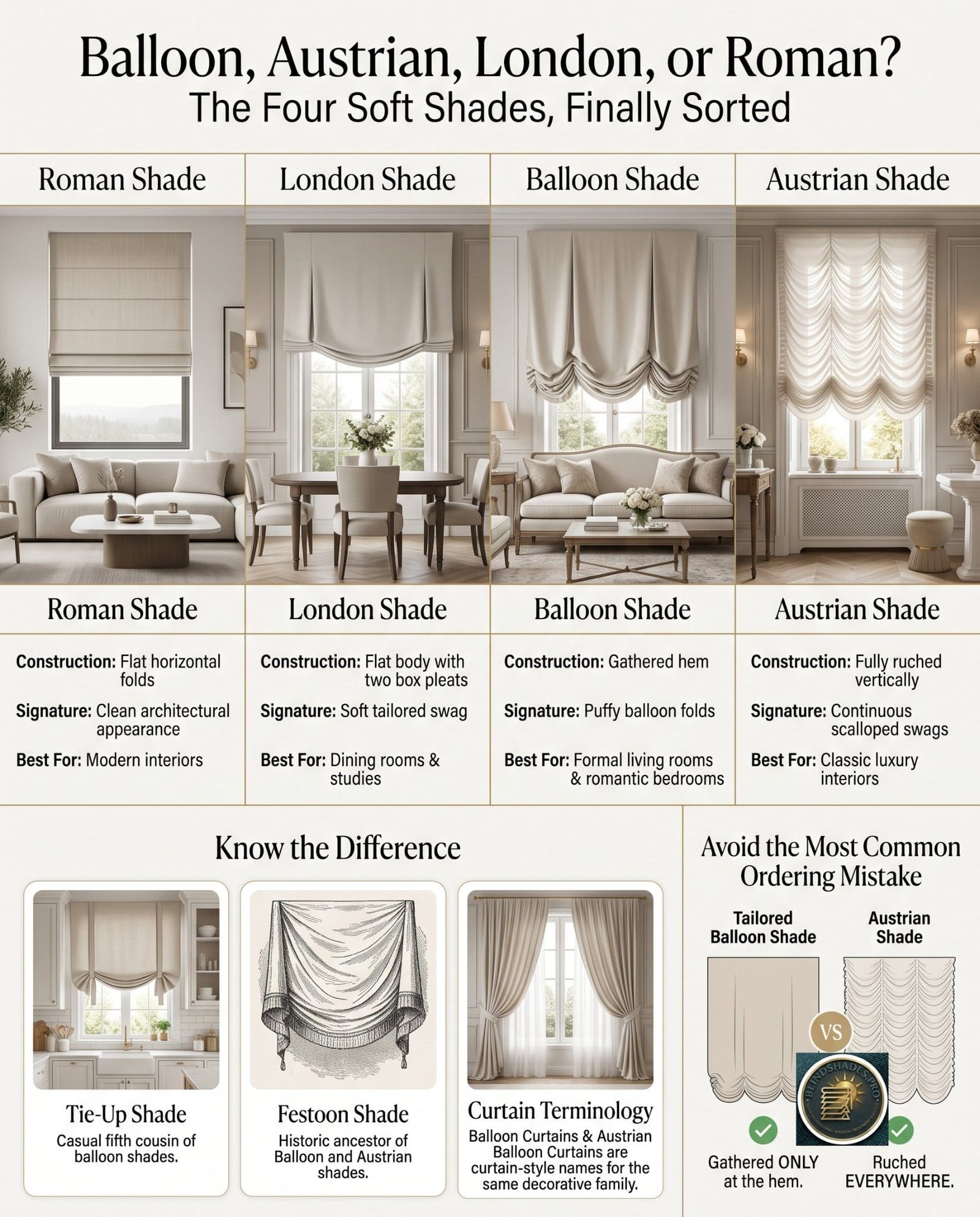
By Michael Turner — 30 years in the window treatment industry
Balloon and Austrian shades are the gathered aristocrats of the soft-shade family — and the first thing this market never tells you is which one you actually mean: a balloon shade gathers into poufs at the hem (gathered or tailored), while a true Austrian shade is shirred vertically from top to bottom, sheer or semi-sheer, and traditionally unlined — the Old-World look in its purest form. The second thing it never tells you: this is a custom-sewn category with exactly one mass-market product, so the real buying decision is choosing your maker lane — the thirteen-dollar tie-up entry, the Etsy ateliers, the best-kept secret of C.O.M. sewing (your fabric, their labor, from about twenty-five), or the trade customs with measure-and-install. Run the Soft Shade Test — Silhouette, Sheerness, Source — and a query Google currently answers with nothing but scattered listings becomes a decision made in one read.
Key Takeaways
- Four soft shades share this family and buyers conflate all of them: Roman folds flat, London swags at two pleats, Balloon poufs across the full width, Austrian shirrs from top to hem — the taxonomy table below is the map this SERP never assembled.
- The revival is real and it has rules: the design press’s 2025 verdict is that balloon and real Austrian shades can be really full — soft and lovely without so much fussy fullness — which in practice means tailored over shirred, linen over chintz, and one statement shade instead of layered swags.
- This is a maker economy, not a product aisle: one mass listing (four point five across nineteen), then straight to custom — and the C.O.M. lane (customer’s own material) sews your fabric into a finished shade for about twenty-five to thirty-five in labor, the field’s best-kept bargain.
- Sheerness is the Austrian’s identity, not an option: the classic is unlined voile that washes; the lined balloon is a different animal that vacuums — care follows construction.
- Thin review bases are this category’s norm, stated plainly: nineteen reviews is the biggest base in the field; buy on return windows, mockup photos, and maker communication — the warning table shows how.
⭐ Quick Answer — The Best Balloon & Austrian Shades
The best balloon austrian shades pass the Soft Shade Test — Silhouette (hem poufs = balloon; full shirring = Austrian), Sheerness (unlined voile tradition vs lined body), Source (the maker lanes) — in a category with one mass product and makers all the way up:
- The entry door: the Mainstays tie-up balloon shade — four point five across nineteen, about thirteen — the field’s only mass-market listing and its biggest review base, honestly stated.
- The value secret: C.O.M. sewing — your fabric, a maker’s labor from about twenty-five — commissioned through the ateliers at Etsy or the trade programs at BestWindowTreatments (C.O.M. accepted, thirty-day returns).
- The revival rule: really full, soft and lovely — without so much fussy fullness, per the 2025 trend verdict at Veranda: tailored gathers, plain linen, one statement shade.
- The parent silhouette: a balloon is a roman that gathers — the flat-fold family lives in the roman shades guide, and the Austrian’s sheer fabric world in the window sheers guide.
- Commission it right: the measure-three-times discipline and yardage take-up rules follow the made to measure blinds guide — and shirring eats fabric, so order fifteen to twenty percent extra.
Quick Specification Reference
| Specification | Balloon & Austrian reality (2026) |
|---|---|
| The silhouettes | Balloon (hem poufs, gathered or tailored) · Austrian (shirred throughout, sheer, unlined) |
| The cousins | Roman (flat folds) · London (two pleats, swagged tail) · tie-up (the casual entry) |
| The market shape | One mass product; everything else is custom-sewn |
| The price lanes | About thirteen (tie-up) · twenty-five-plus (C.O.M. labor) · one sixty-two-plus (ready-made) · one seventy-five to nine fifty (Etsy) · three ninety-five to thousands (trade) |
| The fabric tradition | Voile and sheers for Austrian; linen, cotton, silk, and crush fabrics for balloon |
| The 2026 styling rule | Full without fussy — tailored gathers, natural fibers, single-shade drama |
| The lining rule | Austrian = unlined by definition; balloon lines for body, blackout, and fade defense |
| Care | Unlined sheers machine-wash gentle; lined poufs vacuum with a brush head |
| The historical name | Festoon shades — the eighteenth-century original both silhouettes descend from, still used in UK sources |
Read the complete guide below for: the six picks across every lane with the thin-base honesty this field requires, the Soft Shade Test, the four-soft-shades taxonomy finally sorted, the revival styling rules, the fabric table, the maker-economy buying lanes with C.O.M. decoded, the measure-and-commission checklist, and the warning table.
What Are the Best Balloon & Austrian Shades in 2026? — Our Picks
Review volumes are stated exactly as the market shows them — and in this category that honesty cuts deep: nineteen reviews is the biggest base in the field, because nearly everything here is sewn to order.
| Pick | Product | Rating / reviews | Price (words) | The lane |
|---|---|---|---|---|
| Best Entry | Mainstays Tie-Up Balloon Shade, Pole Top | 4.5 across 19 | About thirteen | The one mass-market door — the tie-up cousin at its most accessible |
| Best Value Secret | Custom Austrian shade, C.O.M. (LindasWindow class) | Maker-rated lane; per-order | About twenty-five (your fabric) to thirty-five (fabric included) | Your material, their labor — the field’s quiet bargain |
| Best Ready-Made | Green Austrian Curtains, Crush fabric (velvetdrapery) | Per-order | About one sixty-two; thirty-day returns | The stylish-drama stage curtain, in the seller’s own framing — when draperies are simply too much |
| Best Etsy Linen | Linen White Balloon Shades, Custom Puffed (Sheloomes class) | Per-order | About one seventy-five | The revival look in its natural fiber |
| Best Statement | Austrian shades, French Marquise class (AspectCreative) | Per-order | About three sixteen to six ten | The full Old-World theater |
| Best Trade Lane | Custom Specialty Shades — Shirred Balloon Pleat, Box Pleated, Austrian (BestWindowTreatments) | Trade program | From about three ninety-five; C.O.M. accepted; thirty-day returns | Shirred, box-pleat, and Austrian construction with 2-to-5-day delivery |
The honest frame for all six: per-order makers carry shop reputations rather than product review bases, so this category’s due diligence is different — photos of past commissions, a fabric mockup before sewing, stated return terms, and responsive messages are the review count here. The trade tier’s own listing language tells you the range: custom Austrian shades around five hundred, starting near three ninety-five — and the high customs at French-country houses run to nearly four thousand with measure-and-install service and fourteen-day returns, which is drapery-workroom money for drapery-workroom construction.
The Soft Shade Test: Silhouette · Sheerness · Source
Three questions in order — which shape you actually mean, how much light lives in the fabric, and which of the four lanes sews it — sort a category Google currently serves with fragments.
| Soft Shade Test step | The question | The failure it prevents |
|---|---|---|
| Silhouette | Balloon, Austrian, London, or the roman you really wanted? | The full-shirred Austrian ordered for a room that wanted two restrained pleats |
| Sheerness | Unlined voile glow, or lined body? | The washable sheer that was supposed to darken a bedroom |
| Source | Tie-up, Etsy, C.O.M., or trade? | Paying trade money for a casual kitchen — or Etsy lead times for next weekend |
Balloon, Austrian, London, or Roman? The Four Soft Shades, Finally Sorted
The taxonomy this SERP buries at the bottom of page one, promoted to the top of ours — four constructions, four looks, one decoder.
| Shade | The construction | The tell | The room it suits |
|---|---|---|---|
| Roman shade | Flat fabric folding in horizontal pleats | Crisp, architectural, no gathering | The modern default — the full family lives in our roman shades guide |
| London shade | Flat body with TWO inverted box pleats; the hem swags between them | Restraint with one soft gesture — the tailored swag tail | Studies, dining rooms, the transitional house |
| Balloon shade | Gathered or tailored across the FULL width; hem billows into poufs | The pouf row — deep, luxurious, balloon-like folds in the trade’s own words | Formal living rooms, bays, romantic bedrooms |
| Austrian shade | Shirred vertically from top to bottom, entire face ruched; sheer or semi-sheer and unlined | Scalloped swags running the whole drop — the Old-World signature | Salons, powder rooms, anywhere the light itself should be dressed |
Three footnotes the table earns. The tie-up shade — a flat panel rolled up and held by fabric ties — is the family’s casual fifth cousin and the mass market’s whole representation; charming in kitchens and nurseries, honest about being a simpler thing, and searchable by its shelf name: the tie up balloon shade with a pole top. The historical name for the whole gathered line is the festoon shade, the eighteenth-century original both descend from — useful when reading older decorating books and UK sources. A naming sweep for the search bar’s other habits: balloon curtains and austrian balloon curtains are the curtain-register synonyms for the same sewn products (Etsy’s own listings say sheer Austrian balloon curtains), and this guide treats all of it as one family. And the boundary that causes most mis-orders: a balloon shade GATHERS AT THE HEM while its body can stay smooth (the tailored version), whereas the Austrian is ruched EVERYWHERE — if you love the scalloped column look, you want Austrian; if you love a clean face with a billowed hemline, you want a tailored balloon, and the maker needs to hear those exact words.
How Do You Style Balloon Shades in 2026? The Revival Rules
The design press has re-opened this category — balloon shades and real Austrian shades can be really full, soft and lovely without so much fussy fullness — and that sentence is the whole modern brief.
| The 1987 version | The 2026 revival | Why it works now |
|---|---|---|
| Shirred chintz, everywhere | Tailored gathers in plain linen | Fullness reads as texture, not costume |
| Layered under swags and jabots | One statement shade, bare frame | The pouf IS the ornament — let it work alone |
| Matched to wallpaper florals | Solid naturals; crush fabrics for evening rooms | The velvet-drapery positioning line says it: elegant when draperies are simply too much |
| Sill-length everywhere, always inflated | Raised to a soft valance position by day | The balloon doubles as its own valance — the trade’s oldest trick, newly relevant |
| Austrian sheers behind heavy drapes | Austrian voile ALONE on the glass | The shirred sheer as the room’s light fixture — the same daylight logic as our window sheers guide, in fancy dress |
One placement note from the classic playbook: the balloon’s natural stage is the formal bay — one shade per panel, poufs aligned, the alcove crowned — and the measuring discipline for angled runs is our bay window blinds guide’s territory. And the casual end of the revival belongs to the kitchen café window, where a tie-up or small tailored balloon over the sink is the tradition that never left — the room’s wider rules live in our kitchen window blinds guide. A last styling calibration for the cautious: run the revival math on ONE window first — the powder room or the landing — before committing a whole facade; balloon fullness photographs bigger than it lives, and a single trial shade teaches your eye the tailored-versus-gathered difference faster than any picture board will.
Which Fabric Makes the Best Balloon or Austrian Shade?
The silhouette chooses the fiber: shirring wants sheerness, poufs want body — and the fade rule applies double to fabric that never comes down.
| Fabric | The silhouette it serves | The note |
|---|---|---|
| Voile and sheers | The Austrian’s native skin — unlined, glowing | Machine-wash gentle; the whole sheer-care drill applies |
| Linen and linen-blends | The revival balloon — tailored, textured | The Etsy tier’s favorite; wrinkles as character |
| Cotton and blends | The workhorse balloon | Lines well; takes blackout lining for bedrooms — the darkness science is our blackout blinds guide’s |
| Silk and taffeta | The statement tier | Line it always — sun eats silk; this is the nine-fifty lane’s material |
| Crush fabrics | The ready-made evening look | The one-sixty-two lane’s signature |
| Box-pleat variants | The trade’s structured cousin | Box pleated construction where gathers would be too soft — the pleat logic borrowed from our pleated shades guide |
Where Do You Buy a Custom-Sewn Category? The Maker Economy
One mass product, then makers all the way up — the four lanes, priced, timed, and decoded, including the C.O.M. secret.
| Lane | The price shape | Lead time | The decode |
|---|---|---|---|
| The tie-up entry | About thirteen | Off the shelf | The thirteen-dollar proof of concept before commissioning |
| Etsy makers | About one seventy-five to nine fifty | Two to six weeks, per shop | Shop reputation replaces review bases; mockups before money |
| C.O.M. — customer’s own material | About twenty-five to thirty-five in LABOR | Ship your fabric, wait the queue | The field’s best value: your seven-yards of clearance linen becomes a custom Austrian for lunch money |
| Ready-made specialty | About one sixty-two | Seven-to-ten-day delivery, thirty-day returns | The one lane with normal e-commerce terms |
| Trade custom | From three ninety-five to nearly four thousand | Two-to-five-day express to full workroom schedules | Measure-and-install service exists here; fourteen-day returns at the top end — read them before commissioning |
The C.O.M. paragraph this category owes its readers: customer’s own material is the workroom tradition where YOU supply the fabric and the maker supplies construction — and at twenty-five to thirty-five in labor for an Austrian shade, it converts a fabric-store remnant or an heirloom bolt into the most personal treatment on this entire site. The catch is on you: order fifteen to twenty percent extra yardage for shirring take-up (Austrians eat fabric — full shirring can demand two to three times the flat width), pre-wash anything you’ll ever wash finished, and ship with a note stating face side and pattern direction. Two more C.O.M. courtesies that makers reward: confirm the fabric’s weight class before shipping (workroom machines and voile settings differ from upholstery settings, and a maker warned is a maker on schedule), and ask whether they return the offcuts — a yard of your remnant back in the box sews matching tiebacks or a café half-curtain later, and most shops send it happily when asked at order time. The custom discipline — measure three times, smallest figures govern — is the same one every made-to-order product on this site inherits from our made to measure blinds guide.
How Do You Measure and Commission a Balloon or Austrian Shade?
What to send a maker, in the order a workroom wants it — the checklist that separates a beloved commission from a dispute thread.
| Send | The detail | Why |
|---|---|---|
| Mount decision | Inside the reveal or outside on the frame | Changes every other number |
| Width | Three measurements, smallest governs (inside) or glass-plus-overlap (outside) | The gathered hem hides nothing about a crooked width |
| Drop | Sill, apron, or the raised valance height you’ll actually keep it at | Balloons live half-inflated — measure for the look you’ll SEE |
| Fullness spec | Tailored or gathered (balloon); shirring density (Austrian) | The taxonomy words from this guide, verbatim — makers speak them |
| Fabric or C.O.M. plan | Swatch photos in daylight, or your yardage math | The mockup conversation starts here |
| Hardware | Board mount, rings-and-cord, or cordless lift preference | Corded soft shades follow the same child-safety rules as every corded product — cleats high, cords short |
| The photos to request | The maker’s past work in YOUR silhouette + a pinned mockup | This category’s review count |
Can You Make a Balloon Shade Yourself? The Panel Conversion
Yes — and it is the family’s oldest workroom shortcut: a flat curtain panel plus ring tape equals a balloon, which makes this the rare custom category with a genuine weekend door.
The conversion, in one paragraph: take a rod-pocket panel one-and-a-half to two times your window’s width (the fullness you’d order anyway), sew or iron-bond two vertical runs of ring tape up the back — one near each edge, plus one per twenty inches of width for wider windows — thread a lift cord up each run, over screw eyes on a mounting board, and off to a side cleat, then raise until the hem billows into its poufs and dress them by hand. Total materials beyond the panel: ring tape, cord, board, and cleat — under twenty. The tie-up version is even simpler (two ribbon pairs over a rod, no cords at all), and a sheer panel run through the same conversion produces a credible informal Austrian if you shirr the heading tight. Three honesty notes keep the weekend honest: hand-dressed poufs are the difference between homemade and workroom (spend the five minutes every raise), any corded DIY follows the same child-safety rules as every corded product on this site — cord short, cleat high, or choose the tie-up for kids’ rooms — and know the ceiling: past about forty-eight inches of width or any pattern-matching ambition, the C.O.M. lane above sews it straighter than a weekend will, for twenty-five dollars more than your ring tape cost. The conversion’s real gift is cheap certainty — prove the silhouette on your own window before commissioning it in silk.
The Warning Table — and One Wry Note
| Warning | The listing pattern | The rule |
|---|---|---|
| Thin bases everywhere | 4.5 across 19 is the FIELD’S biggest; 5.0 across 1 appears | Normal here — judge makers by portfolio and terms, not stars |
| The one-dollar teasers | Listings at one to two dollars for “shade curtains” | Swatch or dropship bait — the real price is in the variant menu |
| Lead-time surprises | Custom quoted in days that means weeks | Get the date in the order notes |
| Yardage under-buys | C.O.M. orders short of shirring take-up | The fifteen-to-twenty-percent rule above |
| SERP oddities | A sunglasses listing ranks mid-page in this market | A wry measure of how underserved this query is — and why a real guide wins it |
Related Buying Guides
- Best Roman Shades — the flat-fold parent of the whole soft family
- Best Window Sheers — the Austrian’s fabric world, un-shirred
- Best Bay Window Blinds & Shades — the balloon’s formal stage
- Best Kitchen Window Blinds & Shades — the café-window tradition
- Best Made to Measure Blinds — the custom discipline every commission inherits
- Best Blackout Blinds & Shades — lining the balloon for real darkness
- Best Pleated Shades — the box-pleat cousin’s logic
- Best Sheer Shades — the vane product that shares only a word with sheer Austrians
- Best Day-Night Blinds — soft light control without a workroom
- Best Woven Wood & Bamboo Shades — texture’s other tradition
FAQ
What is the difference between balloon shades and Austrian shades? A balloon shade gathers into poufs at the hem while its body can stay smooth (the tailored version) or gathered; a true Austrian shade is shirred vertically from top to bottom — the entire face ruched into scalloped columns — and is traditionally sheer or semi-sheer and unlined. Hem poufs: balloon. All-over ruching: Austrian.
Are balloon shades in style in 2026? Yes — the design press’s revival verdict is that balloon and real Austrian shades can be really full, soft and lovely without so much fussy fullness. The modern brief: tailored gathers over all-over shirring, plain linen over chintz, one statement shade instead of layered swags, and the day position raised so the shade doubles as its own valance.
Where can you buy Austrian shades? One mass-market tie-up balloon exists (about thirteen, the category’s entry door); everything else is made to order — Etsy ateliers from about one seventy-five, C.O.M. workrooms that sew YOUR fabric from about twenty-five in labor, ready-made specialty lanes near one sixty-two with thirty-day returns, and trade customs from three ninety-five with measure-and-install at the top.
What fabric is best for Austrian shades? Voile and sheer weaves — the Austrian is unlined by tradition, and the shirring is designed to dress daylight itself. Balloons take body: linen for the revival look, cotton for the workhorse (and for blackout lining in bedrooms), silk and taffeta — always lined — for the statement tier.
How much fabric does an Austrian shade need? More than the window suggests: full vertical shirring can consume two to three times the flat width, so C.O.M. commissions should ship fifteen to twenty percent beyond the maker’s stated yardage. Pre-wash anything you intend to wash finished, and mark face side and pattern direction on the bolt.
Can you wash balloon and Austrian shades? Unlined sheer Austrians generally machine-wash on gentle and rehang damp, exactly like sheer curtains. Lined balloons don’t — vacuum the poufs with a brush head seasonally and spot-clean; the lining, interlining, and any silk face make them dry-clean-or-dust territory.
The Bottom Line
Name the silhouette and the rest follows. Silhouette: poufs at the hem are a balloon, ruching everywhere is an Austrian, two restrained pleats are a London, and if you flinched at all three, the roman was your answer all along. Sheerness: let the Austrian stay sheer and washable as tradition built it; line the balloon when the bedroom needs dark or the silk needs defending. Source: prove the look for thirteen dollars, then commission it properly — and remember the C.O.M. secret, where the fabric you already love becomes the most personal shade on this site for the price of a takeout dinner. The SERP for this query is an empty stage with beautiful costumes and no script; this guide is the script, and the revival’s one rule holds the whole performance together — full, soft, and never fussy.
