Best Bay Window Blinds & Shades (2026): The Panel Plan for Every Angle

Authored By Michael Turner -30 Years Home Improvement Expertise | Updated 2026 | BlindShades.pro
Updated on July 18, 2026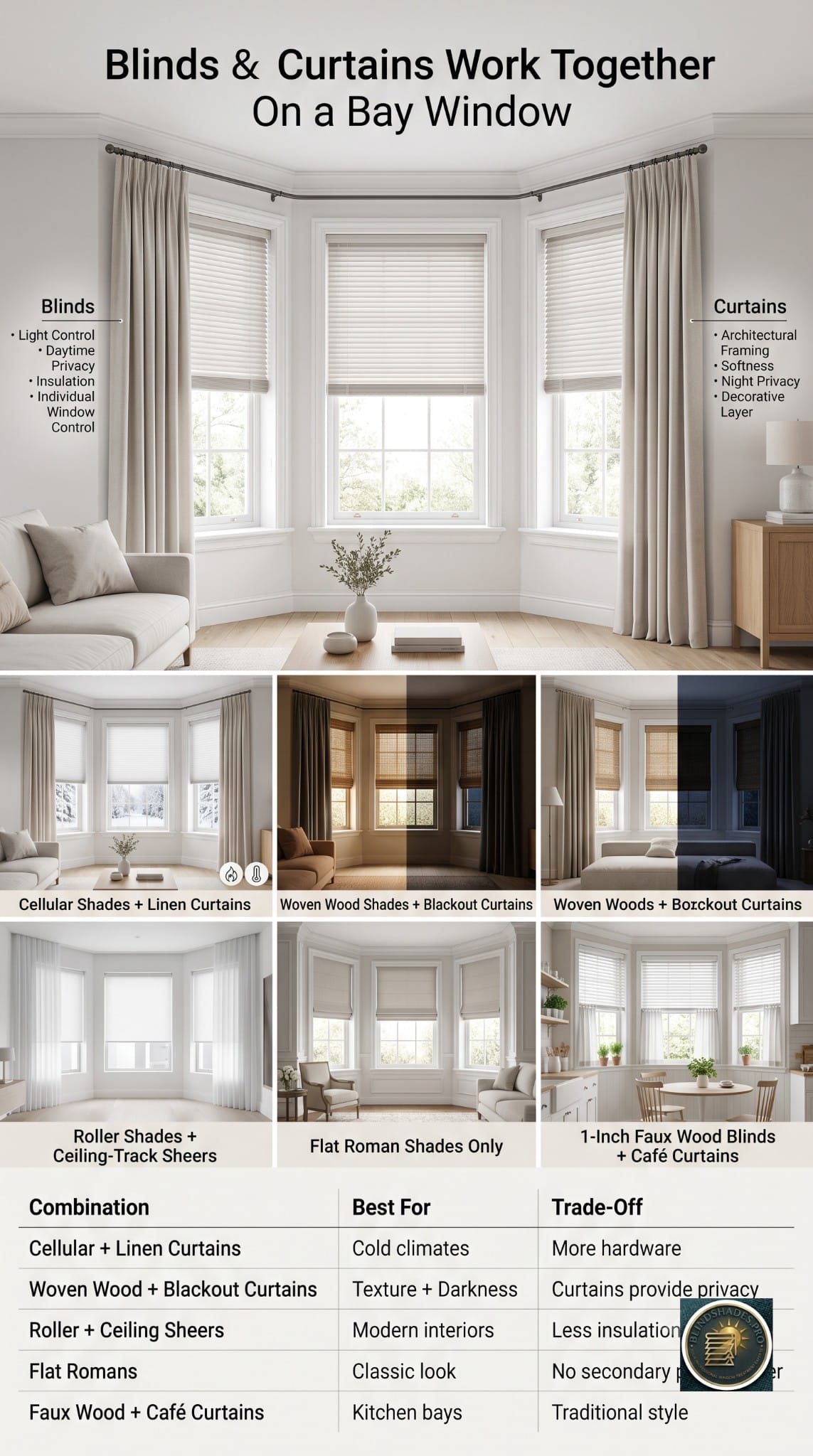
By Michael Turner — 30 years in the window treatment industry
The best bay window blinds treat a bay as what it really is — three or more separate windows meeting at angles — which means per-panel treatments, inside mounts, and corner clearance decide success before style ever enters the room. Every ranked list in this market names the same four finalists — Roman shades, cellular shades, roller shades, and faux wood blinds — but none of them teaches the part that actually goes wrong: the corners. This guide runs the Panel Plan (Measure · Angle · Align), does the corner math by product and bay angle, separates bay from bow honestly, and then — only then — talks style.
Key Takeaways
- A bay is a set of windows, not a window. Measure each panel separately, mount inside each frame, and let the angles dictate what fits before taste votes.
- Corners eat projection. Deep slats and bulky stacks collide where panels meet at an angle — the reason the market’s own guidance keeps pointing at one-inch slats and slim cellular stacks for tight corner clearance.
- Bay and bow are different problems. A bay’s three angled panels take individual treatments cleanly; a bow’s continuous curve of four or five narrow panels rewards per-panel shades or shutters, not one wide unit.
- Cellular shades are the insulation pick for a reason: a bay takes sun and heat on three sides, and the honeycomb’s slim, flat stack is the friendliest geometry a tight corner will meet.
- Layering answers the privacy complaint. The most-upvoted community warning in this SERP is that woven shades without a liner are genuinely see-through — the second layer, or a curtain over blinds, is the fix.
⭐ Quick Answer — The Best Bay Window Blinds & Shades
The best bay window blinds are per-panel, inside-mount treatments chosen by corner clearance first — run the Panel Plan (Measure each panel · Angle-audit the corners · Align the row) before any style vote:
- The corner survivors: slim-stack honeycombs clear the tightest joints while insulating a bay’s three sun-facing sides — the cell science is in the cellular and honeycomb shades guide.
- The classic: flat-fold Romans warm the multi-panel look without crowding corners — fold styles compared in the roman shades guide; bay-specific custom linen versions run about three hundred seventy at 3HLinen.
- The biggest review base: Bali’s natural woven wood shades — four point three across six hundred ninety-five reviews, about one hundred ten on sale — carry the texture verdict the design community keeps repeating at HGTV.
- The custom lane: angled and curved bays are made-to-size territory — custom-fitted per-panel programs at Blinds To Go (store rated four point six across thirteen hundred), with the measuring protocol in the made to measure blinds guide.
- The minimalist row: individual roller shades across each panel read clean and consistent — and a bow’s four-to-five-panel curve follows the same per-panel rule, one narrow shade at a time.
Quick Specification Reference
| Specification | Bay window reality (2026) |
|---|---|
| The mount | Inside mount, every panel — the market’s unanimous rule for tight angles |
| The unit count | One treatment per panel; three for a typical bay, four to five for a bow |
| Corner-friendly picks | Slim cellular stacks, flat-fold Romans, one-inch slats |
| Corner-hostile picks | Two-inch slats, bulky lined Romans, deep-cassette rollers |
| The heat problem | Sun on three sides — insulation matters more than on a flat window |
| Bay vs bow | Bay = three angled panels; bow = curved run of four-plus narrow panels |
| Custom threshold | Angled and curved bays are custom territory; standard sizes rarely land |
| Typical price band | About forty-eight budget to three hundred seventy-plus custom, per the live market |
| The layering rule | Blinds control light; curtains frame the alcove and add the privacy layer |
Read the complete guide below for: the six picks with their real review bases, the Panel Plan (Measure · Angle · Align) that turns three windows into one composition, the Corner Math no competitor publishes, the honest bay-versus-bow split, every style scored for bay behavior, the blinds-and-curtains layering answer, where to buy from Amazon to a custom program, and the room-by-room ideas the searches keep asking for.
What Are the Best Blinds for Bay Windows in 2026? — Our Picks
Review volumes below are stated exactly as the market shows them, and thin bases are flagged — one pick in this SERP carries a five-star rating across a single review, and we say so.
| Pick | Product | Rating / reviews | Price (words) | Why it wins |
|---|---|---|---|---|
| Best Overall (Woven) | Bali Natural Woven Wood Shades | 4.3 across 695 | About one hundred ten on sale, from one ninety-nine | The SERP’s only large review base; the texture the design community keeps recommending for bays |
| Best Custom Fit | Blinds To Go bay program | Store: 4.6 across ~1,300 | Around one hundred fifty typical | Custom-fitted per panel — the only honest route for angled and curved bays |
| Best Roman | 3HLinen Linen Roman Shades for Bay Windows | No public base shown — flagged | About three hundred seventy | Bay-specific custom Romans in natural linen; flat folds that respect corners |
| Best Light Control | Affordable Blinds Top Down Bottom Up Roman | Base not shown — flagged | About one hundred thirty | TDBU privacy-below, light-above — the window-seat solution |
| Best Budget | Aosky Zebra Cordless Day & Night | Base not shown — flagged | About forty-eight | Dual-layer light filtering per panel at the price of one dinner |
| Best Motorized | WEFFORT Motorized Bamboo Woven Wood | 4.5 across 33 / 5.0 across 37 (thin — flagged) | About two hundred eleven | One remote for the whole row solves the three-shades-a-day problem |
One honesty note the table earns: Guard’s total blackout blind appears in this market at five point zero across exactly one review — a single data point, not a verdict, and exactly the kind of listing the review-volume rule exists to catch. And the custom ceiling is real: bay-specific linen Romans price near three hundred seventy per the live listings, which is why the corner math below matters — it tells you which windows genuinely need that spend and which can take the forty-eight-dollar class.
The Panel Plan: Measure · Angle · Align
Treat the bay as a composition of separate windows — measure each one, audit the angles between them, then align the row so it reads as a single design.
Measure. Every panel gets its own numbers: width three times, drop three times, steel tape, recorded in the maker’s unit — and depth once per panel, because bay frames vary panel to panel more than people expect. The full measuring protocol, the inside-versus-outside decision, and the deduction question that prevents remakes are covered in our made to measure blinds guide — a bay is simply that protocol run three times.
Angle. Before ordering anything, stand at each corner and ask what will occupy it from both sides. Two treatments meeting at an angled joint each project into the same wedge of space; the Corner Math section below turns that into product choices. This is also where the market’s inside-mount rule comes from — the AI-summarized consensus across this SERP is that bay windows require inside mounts to accommodate tight angles and prevent overlap at the corners, and the physics agrees.
Align. The bay reads as one window from the sofa, so the row must agree with itself: identical products panel to panel, headrails at one height, fabrics from one dye lot (order together, not across sales), and — if you take the roller route — the per-panel logic one competitor states well: SmartWings’ July 2026 guide argues a row of individual roller shades across the panels reads clean and consistent. That is the Align principle in one sentence, from a brand that sells it.
| Panel Plan step | The question | The failure it prevents |
|---|---|---|
| Measure | What are this panel’s exact numbers and depth? | The remake — bays are custom territory, and guessing is expensive |
| Angle | What meets at each corner, from both sides? | The corner collision — slats and stacks that cannot both open |
| Align | Does the row read as one composition? | The patchwork bay — mismatched heights, lots, and mechanisms |
The Corner Math: Why Bay Corners Eat Blinds
The corner is a wedge of shared space — two treatments project into it at an angle, and the products that survive are the ones with the shallowest projection.
Here is the mechanism nobody in this SERP writes down. A typical angled bay joins panels at roughly one hundred thirty-five degrees; a boxed bay joins them at ninety. When two inside-mounted treatments approach that joint, each one’s projection — slat depth when tilted, stack thickness when raised, cassette depth always — occupies the shared wedge. The tighter the angle and the deeper the projection, the sooner they collide. This is exactly why the market’s own guidance, echoed in the AI summary of this SERP, points at one-inch slats over two-inch for bays: a one-inch faux wood slat tilted open projects roughly half the depth into the corner wedge, which is the difference between two blinds that operate freely and two that clip each other every morning. The one-inch logic and the warp-resistance case both live in our faux wood blinds guide — and the same slat geometry governs the classic slatted format in the venetian blinds guide.
| Product | Corner projection | Verdict at a 135-degree joint | Verdict at a 90-degree (boxed) joint |
|---|---|---|---|
| Cellular / honeycomb | Slimmest stack in the market | Clears easily | Clears |
| Flat-fold Roman | Shallow, flat panels | Clears | Clears with care |
| Roller shade (compact tube) | Small cassette | Clears | Clears |
| One-inch faux wood / venetian | Half-depth slats | Clears | Tight but workable |
| Two-inch slat blinds | Full-depth slats tilted | Frequent collisions | Avoid |
| Bulky lined Roman | Deep folded stack | Crowds the corner | Avoid |
| Deep-cassette roller | Large headbox | Depends on frame depth | Usually avoid |
Two of the table’s winners deserve their evidence. On cellular shades for bay windows: Blindster’s February 2025 bay write-up calls cellular shades a premium choice for bay windows on superior insulation grounds — and the geometry doubles the case, because a bay takes sun and heat on three sides, so the honeycomb’s R-value works three times per alcove; the cell-size and insulation science is in our cellular and honeycomb shades guide. On roller shades for bay windows, the compact-tube caveat in the table is the whole trick — small cassettes clear corners that deep decorative headboxes cannot. On Romans: the flat-fold qualifier matters — the same AI-summarized consensus that crowns Romans for elegance immediately warns they can be bulky and steers bays toward flat-fold or custom versions, which is the corner math wearing a style vocabulary.
Bay vs Bow: Different Curves, Different Answers
A bay is three windows at angles; a bow is four or five narrow windows faking a curve — and the right treatment list changes when the geometry does.
Bow window blinds are this family’s quiet second search, and almost nobody answers it separately. A bow’s panels are narrower and more numerous, its joints gentler, its curve continuous — which changes the calculus three ways. First, per-panel treatments get easier (gentler angles, less corner conflict) but more numerous: budget for four or five units, not three. Second, one-wide-unit solutions get worse: a straight blind across a curved bow leaves a crescent of dead space and kills the architecture you paid for. Third, the shutter case strengthens — Norman’s product line pitches custom shutters, faux wood blinds, and roller shades as the bay-and-bow fits, and hinged shutter panels genuinely follow a curve better than any single soft treatment; the panel-by-panel logic is argued in our interior shutters coverage. Curved bow window blinds in the literal sense — bent headrails tracking the curve — exist as a specialty custom order, priced accordingly, and are worth it mainly for shallow bows where five separate stacks would look busy.
| Question | Bay (angled, 3 panels) | Bow (curved, 4–5 panels) |
|---|---|---|
| Unit count | Three | Four to five |
| Corner risk | Real — do the Corner Math | Gentler joints, more of them |
| One-unit-across option | Poor — fights the angles | Worse — fights the curve |
| Strongest formats | Cellular, flat Roman, roller, one-inch slat | Per-panel shades, shutters, curved-rail customs |
| Budget shape | Fewer, wider units | More, narrower units |
If you searched shades for bow windows or blinds for bow windows ideas: the Panel Plan applies unchanged — measure every panel, respect every joint, align the row — you simply run it five times instead of three.
Which Styles Actually Work in a Bay? The Full Map
Every style in the market’s ranked lists, scored for bay behavior rather than catalog appeal.
A naming note first, because this family answers to every word order English allows: bay window blinds, blinds for bay windows, bay window shades, window blinds for bay windows, window blinds bay window, bay windows blinds, blinds bay windows, blinds for a bay window, shades for a bay window — plus the modern bay window blinds and angled bay window blinds phrasings that describe canted contemporary bays, and the whole roller cluster (bay window roller shades, bay window roller blinds, roller blind bay window — the same question in three word orders, answered by the SmartWings-style per-panel row). Searchers hunting blinds for bay window ideas will find the layouts in the room table further down. One product family, many names.
| Style | Bay behavior | The evidence |
|---|---|---|
| Roman shades | The classic — soft folds warm the multi-panel look; flat-fold only | Lakeway’s April 2025 ranking leads with Romans as timeless; our roman shades guide covers fold styles |
| Cellular shades | The engineer’s pick — slim stack, three-sided insulation | Blindster’s premium-choice claim + the corner math above |
| Roller shades | The minimalist row — per-panel consistency | SmartWings’ clean-row argument; solar versions block UV on south-facing bays per The Shade Store’s May 2026 options guide |
| Faux wood blinds | The budget structural pick — one-inch slats only | The AI-consensus corner tip; kitchen-adjacent bays favor warp resistance |
| Woven wood shades | The texture verdict — rattan and bamboo | HGTV calls woven rattan or bamboo Romans a failproof bay addition; community threads agree, with one warning below |
| Sheer shades | Soft light for living-room bays | The horizontal-vane logic in our sheer shades guide |
| Zebra / day-night | Budget dual-layer control per panel | The Aosky class at about forty-eight; the striped mechanism is explained in our zebra blinds guide |
| TDBU | The window-seat answer — privacy below, sky above | Hunter Douglas’s own material notes the top-down/bottom-up option on woven shades for light control; full mechanism in our top-down bottom-up guide |
The one warning: the most-upvoted community note in this SERP’s Reddit thread is that woven and rattan shades without the privacy layer are genuinely transparent after dark — the commenter’s phrasing amounts to “and I do mean transparent.” Order the liner, or plan the curtain layer below.
Do Blinds and Curtains Work Together on a Bay Window?
Yes — and the combination answers the two problems a bay creates at once: blinds run the light panel by panel, curtains frame the alcove and add the after-dark privacy layer.
Bay window blinds and curtains ideas is its own living search family, and the design logic is simple division of labor. The blinds do the daily work — glare, privacy, insulation, per panel. The curtains do the architectural work — a track or bay-shaped rod following the alcove, panels stacking at the outer returns, framing the composition without touching the glass. The pairing also solves the woven-shade transparency warning honestly: texture by day, drawn fabric by night.
| Combination | Where it wins | The trade |
|---|---|---|
| Cellular + linen curtains | Cold climates, three-sided heat loss | Busiest hardware count |
| Woven wood + blackout curtains | Texture by day, real darkness by night | The curtain does the privacy work |
| Roller row + ceiling-track sheers | Modern bay window treatments — the clean look | Minimal insulation |
| Flat Romans + no curtain | Purist classic | No second layer — lined Romans only |
| One-inch faux wood + café curtains | Kitchen bays | Style-specific |
For the modern bay window treatment ideas pictures searcher: the roller-plus-track-sheer row is the look the photographs usually show — individual shades aligned at one height, a single sheer run tracing the curve, nothing touching the floor of the window seat.
Where Should You Buy Bay Window Blinds?
Angled bays are custom territory more often than not — here is every buying lane, honestly scored.
| The lane | The honest answer |
|---|---|
| Best bay window blinds shades Amazon | Fine for per-panel standard sizes (the Aosky zebra class); weak for angled customs — check each panel’s size against stock ranges before assuming the bay is standard |
| Custom online programs | The main lane: Blinds To Go’s custom-fitted bay service (store 4.6 across ~1,300), bay-specific makers like 3HLinen for linen Romans — per-panel made-to-size with the deduction question handled |
| Home Depot / Lowe’s | The Bali woven wood lane (4.3 across 695) and budget day/night rollers — strong for standard-size panels |
| Consultation sellers | 3 Day Blinds’ March 2026 guide tiers cellular, Roman, and faux wood as the mid-range step-up — useful framing, but the consultation model prices in the visit |
| Brand direct | Hunter Douglas and Norman for shutters and premium customs — the bow-window shutter case especially |
| The measuring rule | Whoever you buy from: the Panel Plan runs first, and blinds made to measure beat forced-fit stock in any angled bay |
Strike-through pricing is everywhere in this market — forty-four percent off here, twenty percent there — so the standing rule applies: list prices are anchors, and the recurring sale price is the real price.
Which Rooms Change the Bay Answer?
The same bay wants different treatments in a living room, a kitchen, and a bedroom window seat.
| The bay | The pick | Why |
|---|---|---|
| Blinds for bay window in living room | Sheers or woven wood + curtain layer | Soft daylight for the room the bay was built to showcase |
| Kitchen-adjacent bay | One-inch faux wood | Warp resistance near heat and steam — the AI-consensus kitchen tip |
| Bedroom bay / window seat | TDBU or cellular + blackout curtain | Privacy below, light above; real darkness at night |
| South-facing sun trap | Solar roller row | UV control per The Shade Store’s options guide — the openness science is in the solar lane |
| Curved bow in a period home | Shutters or per-panel wovens | Follows the curve; honors the architecture |
Motorization earns a sentence here rather than a section: a three-to-five-panel bay is the single best residential case for one-remote control — nobody raises and lowers five shades by hand twice a day for long — and the WEFFORT-class motorized wovens plus the retrofit options are covered in our motorized and smart blinds guide.
Related Buying Guides
- Best Cellular & Honeycomb Shades — the three-sided-sun insulation pick
- Best Roman Shades — the bay classic, flat-fold and otherwise
- Best Faux Wood Blinds — the one-inch corner survivor
- Best Woven Wood Shades — the texture verdict, liner included
- Best Sheer Shades — living-room light
- Best Made to Measure Blinds — the measuring protocol bays depend on
- Best Top Down Bottom Up Blinds — the window-seat mechanism
- Best Zebra & Banded Blinds — the budget dual-layer lane
- Best Venetian Blinds — slat geometry, explained
- Best Motorized & Smart Blinds — one remote, five panels
FAQ
What are the best blinds for bay windows? Per-panel inside-mount treatments chosen by corner clearance: slim cellular shades for insulation, flat-fold Roman shades for the classic look, individual roller shades for a clean minimal row, and one-inch faux wood where corners are tight. The strongest review base in the current market is Bali’s natural woven wood at four point three across six hundred ninety-five.
Should bay window blinds be inside or outside mount? Inside mount, on every panel — the market consensus and the geometry agree, because inside mounts accommodate the tight angles and prevent treatments from overlapping at the corners. Outside mounting a bay flattens the architecture and creates corner collisions.
Can you put one blind across a bay window? Almost never well. A straight treatment across an angled bay leaves triangular gaps, blocks the window seat, and fights the reason you have a bay. The workable exceptions are a curtain layer framing the whole alcove over per-panel blinds, and specialty curved rails on shallow bows.
What is the difference between bay and bow window blinds? A bay is typically three panels meeting at angles; a bow is a continuous curve of four or five narrower panels. Bays need the corner math and take three treatments; bows need four or five narrower units — or shutters, which follow a curve better than any single soft treatment.
How do you measure a bay window for blinds? Run the full protocol per panel: width three times, drop three times, depth once, steel tape, exact units — then answer the deduction question (opening size versus finished size) with the maker. Angled and curved panels are custom territory; assume made-to-measure until a stock size genuinely lands.
Do blinds and curtains work together on a bay window? Yes — it is the strongest bay formula: blinds run daily light control panel by panel, while a track or bay-shaped rod carries curtains that frame the alcove and add the after-dark privacy layer that unlined woven shades famously lack.
The Bottom Line
A bay rewards the buyer who respects its geometry. Run the Panel Plan before the cart: Measure every panel as its own window, Angle-audit the corners against the projection table, Align the row into one composition. Choose slim stacks and shallow slats where panels meet, order every unit together from one maker, and let the curtain layer carry the after-dark privacy that texture-first shades honestly cannot. Do that, and the style question — Roman warmth, cellular efficiency, roller minimalism, woven texture — becomes the easy part it should have been all along.
