




The Best Basement Window Blinds & Shades Buying Guide 2026

Authored By Michael Turner -30 Years Home Improvement Expertise | Updated 2026 | BlindShades.pro
Updated on June 16, 2026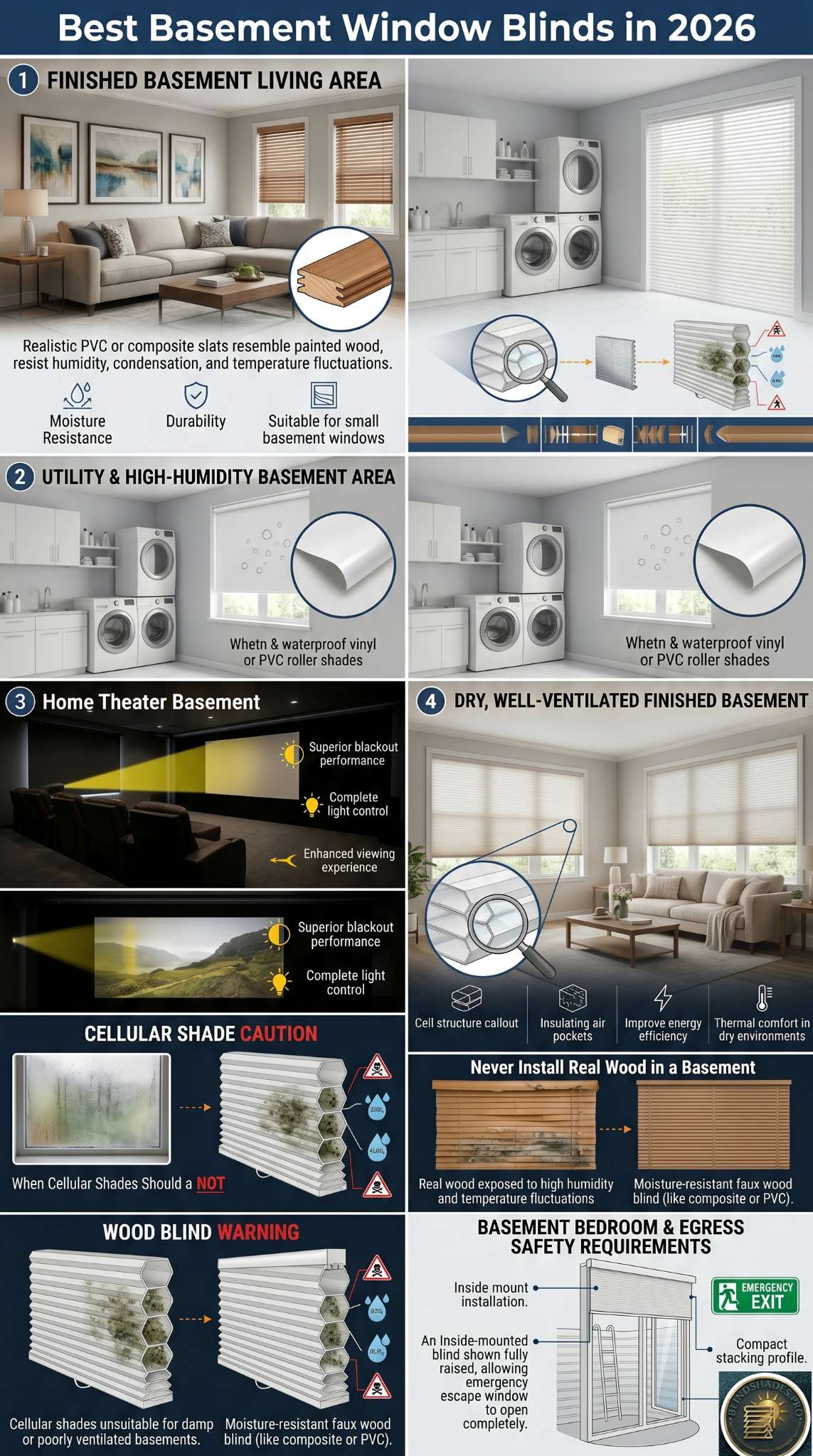
Best basement window blinds 2026: faux wood for humidity; egress compliance rules; hopper windows; home theater blackout; cellular shade dry-only warning; ground-level privacy.
By the Editorial Team at BlindShades.pro | Updated 2026 | 30 Years of Home Improvement Expertise
Key Takeaways:
- Basements present five window treatment challenges that no other room combines simultaneously: higher-than-average humidity from below-grade moisture intrusion (basements are inherently more humid than upper floors even with dehumidification, as confirmed by Journeyman HQ March 2026 — “it doesn’t matter if you have a dehumidifier running 24/7; basements are inherently more humid than the rest of your house”); small and non-standard window sizes including hopper windows, narrow egress windows, and basement sliders that often fall below the minimum dimensions of standard off-the-shelf blinds; limited natural light from the below-grade position that requires careful light-management specification to avoid the basement feeling darker than necessary; ground-level or below-ground windows that create privacy and security concerns not present at upper floors; and purpose-specific requirements that vary dramatically by room use — a home theater requires complete blackout, a basement bedroom requires egress compliance plus either light-filtering or blackout, a utility room requires moisture resistance above all, and a finished basement living room requires a balance of privacy, light, and aesthetics; the correct material hierarchy for basement windows across all these challenges is: faux wood (PVC or composite) for general finished basement windows; vinyl or PVC roller shades for high-humidity or utility basement windows; aluminium mini blinds for the most budget-conscious specification in utility zones; and cellular shades in DRY, well-ventilated finished basements only
- The single most important basement window treatment specification fact that most guides omit is the distinction between cellular shades in DRY basements versus HUMID basements: in a dry, well-ventilated finished basement, double-cell honeycomb shades are an excellent specification — Journeyman HQ (June 2025) confirms double-cell designs provide superior temperature control with R-values up to 7.0, and Wholesale Blind Factory confirms they “help keep the basement warmer in the winter” by trapping air in the honeycomb structure; HOWEVER, Factory Direct Blinds (January 2026) confirms the crucial caveat: “cellular shades are usually not the best choice for basement windows unless the room is very dry” — in a basement that traps moisture or experiences condensation, the same honeycomb air pockets that provide insulation in dry conditions become moisture traps where mold and mildew develop inside the cell structure where standard cleaning cannot reach; Milton Blinds (February 2026) confirms: “cellular shades, wood, and fabrics may all not be the ideal choice for a basement with serious moisture issues”; the correct rule is: specify cellular shades only in basements that have been actively managed for moisture control with working dehumidification, mechanical ventilation, and no history of condensation or water intrusion
- Egress windows are a life-safety specification that takes absolute priority over all aesthetic and light control decisions: building codes require egress windows in any basement room used as a bedroom or living space, providing an emergency escape route; the window treatment installed on an egress window must not impede emergency escape under any circumstances; SmartBlindsPro (March 2026) confirms the standard: “Always install egress window treatments as inside mounts with compact stacking. Test that the window opens fully and quickly with the treatment installed. If there is any doubt, consult your local building inspector”; the compact stacking requirement means that when the egress window treatment is fully raised, the stacked pile of fabric or slats must be small enough to allow the window to open fully without obstruction; cordless and motorized lifts are preferred for egress windows because they can be raised and lowered quickly without manipulating a cord mechanism during an emergency
- Real wood blinds should never be installed in a basement, and the reasoning goes beyond aesthetics: Journeyman HQ (March 2026) confirms the core problem — “unlike real wood, which swells, warps, and cracks with humidity swings, vinyl is completely waterproof”; even finished basements with controlled humidity experience moisture levels higher than upper floors; real wood blinds installed in basements will begin warping within months of installation and will eventually develop mold within the wood fibres themselves; the porous surface of real wood provides an organic food source for mold spores that PVC, vinyl, and aluminium do not; faux wood is the universally correct replacement, delivering the same visual appearance using PVC or polymer composite slats that are dimensionally stable at any basement humidity level; for buyers who want the warmth of wood grain in a basement setting, faux wood with a wood-grain embossed finish is visually indistinguishable at normal viewing distances
- Home theater basements require a specific multi-element blackout specification that goes beyond simply ordering blackout fabric: Persilux (February 2026) confirms that “even a tiny bit of glimmer will disturb your watching experience” and that “choosing suitable blackout window treatment is important”; Factory Direct Blinds confirms: “these shades reduce 99 percent or more of incoming light, creating near-total darkness — for theater rooms, always choose blackout”; blackout roller shades are the “undisputed champion” for home theater light control per Persilux (February 2026); however, a blackout fabric roller shade alone does not guarantee complete darkness — the four light gap sources (top gap between headrail and ceiling, side gaps at fabric edges, bottom hem gap, and center gap if two treatments are used) must all be addressed through outside mount installation with side channels or light-blocking tape; Persilux further confirms that darker interior fabric colours on the blind reduce reflections from the screen itself, improving contrast and viewing experience; Blinds Chalet confirms double-cell blackout shades add acoustic dampening alongside light blocking, addressing both picture and sound quality in a home theater basement
⭐ Quick Answer — The Best Basement Window Blinds & Shades Buying Guide 2026
- The Five Basement Window Challenges and the Material Hierarchy That Addresses All of Them: The best basement window blinds must solve five simultaneous constraints that no other room combines: higher-than-average humidity from below-grade moisture intrusion; small and non-standard window sizes including hopper windows, narrow egress openings, and basement sliders; limited natural light from the below-grade position; ground-level privacy and security exposure; and purpose-specific requirements that vary dramatically by room use. Journeyman HQ (March 2026) confirms the humidity reality: “It doesn’t matter if you have a dehumidifier running 24/7; basements are inherently more humid than the rest of your house.” This eliminates real wood, natural fabrics, and cellular shades in humid conditions before any stylistic consideration. The correct material hierarchy for basement windows: Faux wood blinds — the gold standard for finished basement windows; PVC or composite slats available from 12 inches wide to accommodate narrow basement openings; dimensionally stable at any basement humidity level; adjustable slats for stepless light control in light-limited below-grade rooms; SmartBlindsPro (March 2026) confirms faux wood as “the gold standard for basement windows.” Vinyl or PVC roller shades — fully waterproof for utility and high-humidity areas; blackout option for bedrooms and home theaters; flat surface with no slats or folds for moisture accumulation. Aluminium mini blinds — most affordable fully moisture-proof option; 1-inch slat well-proportioned for narrow basement windows; completely rust-resistant. Cellular (honeycomb) shades — excellent insulation in DRY, well-ventilated finished basements (R-values up to 7.0 double-cell — Journeyman HQ June 2025); NOT acceptable in humid or damp basements where moisture traps inside the honeycomb pockets. Real wood — NEVER in any basement zone regardless of finish level or dehumidification
- The Cellular Shade Basement Distinction — Why the Same Shade That Excels Upstairs Is Conditional in a Basement: Cellular honeycomb shades are among the most recommended window treatments for upper-floor bedrooms and living rooms, but require a specific qualification before specification in basement windows. In a dry, well-ventilated finished basement, double-cell cellular shades are an excellent specification — Journeyman HQ (June 2025) confirms double-cell designs provide “superior temperature control with R-values up to 7.0,” meaningfully reducing heating costs in cold-climate basements. However, Factory Direct Blinds (January 2026) states the crucial caveat directly: “Cellular shades are usually not the best choice for basement windows unless the room is very dry.” Milton Blinds (February 2026) confirms: “Cellular shades, wood, and fabrics may not be the ideal choice for a basement with serious moisture issues.” The mechanism is the same as in bathroom cellular shade installations: the honeycomb air pockets that trap still air for insulation in dry conditions also trap humid air from the below-grade environment in damp basements, creating mold conditions inside the cell structure where standard cleaning cannot reach. The correct cellular shade basement rule: specify cellular shades only in finished basements with working dehumidification, mechanical ventilation, no history of condensation on the windows, and confirmed humidity levels consistently below 60 percent. In any basement where the windows show condensation, the floor is slab-on-grade with moisture penetration risk, or the humidity has not been actively managed, specify faux wood or vinyl roller shade instead. For the full cellular shade basement specification, see Are Cellular Shades Good for Basement Windows
- Egress Window Life-Safety Rules and Hopper Window Mounting — Two Basement-Specific Installation Requirements: Two installation requirements unique to basements that most buying guides fail to address. Egress windows: Any basement room used as a bedroom is legally required by building code to have an egress window providing an emergency escape route. The window treatment on an egress window must never impede this escape. SmartBlindsPro (March 2026) confirms the complete basement window blind egress standard: “Always install egress window treatments as inside mounts with compact stacking. Test that the window opens fully and quickly with the treatment installed. If there is any doubt, consult your local building inspector.” The compact stacking requirement means the raised blind must clear the window opening completely with no fabric or slat overhang blocking the sash. Cordless or motorized lifts are preferred for egress windows — the absence of a cord mechanism allows faster deployment during an emergency. Inside mount positions the blind within the frame so the window sash opens around it; outside mount would interfere with the outward swing of a casement egress window. Hopper windows: Hopper windows are hinged at the bottom and swing inward and upward when opened — the most common window type in basements. A standard inside-mount blind installed within a hopper window frame will be struck by the opening sash on every ventilation use. The correct specification for hopper windows is outside mount on the wall above the window frame, so the blind lifts clear of the swing arc when raised, or frosted window film applied directly to the glass for permanent privacy with no mechanism to conflict with the window opening. For the full hopper window specification, see What Are the Best Blinds for a Hopper Window and What Window Treatments Work With Egress Windows
- Home Theater Blackout Specification and Ground-Level Privacy — The Two Most Demanding Basement Light-Control Requirements: Home theater basement blinds: Basement home theaters require the most demanding blackout specification of any room in the house. Persilux (February 2026) confirms: “Even a tiny bit of glimmer will disturb your watching experience.” Factory Direct Blinds confirms: “These shades reduce 99 percent or more of incoming light, creating near-total darkness — for theater rooms, always choose blackout.” Persilux (February 2026) identifies blackout roller shades as the “undisputed champion” for home theater light control — the flat single-layer fabric provides the most complete surface blockage. However, blackout fabric alone is insufficient for cinema-grade darkness: the four light gap sources (top gap / side gaps / bottom gap / center gap) must be addressed through outside mount installation with side channels or light-blocking tape to seal the fabric edges. Persilux (February 2026) adds a home-theater-specific detail: “Darker colors on the interior side of the blinds can help reduce reflections from the screen itself, further improving your viewing experience.” A dark charcoal or navy interior surface absorbs rather than reflects screen light, improving contrast. Blinds Chalet confirms double-cell blackout cellular shades add acoustic dampening in dry basement home theaters, softening echo without replacing room acoustic panels. Ground-level privacy: Basement windows at foot-traffic height from outside create security exposure invisible from upper-floor windows — anyone walking past can see directly into the basement without effort. Solutions: blackout roller shade (complete visual block when lowered); frosted window film (permanent privacy with full light transmission — the best option when privacy is always needed and no light control is required); bottom-up shade configuration (shade raised from the bottom to block the lower window section at ground viewing height while the upper section stays open for light); solar shade (daytime one-way mirror privacy only — nighttime reversal applies). For the full specifications, see What Are the Best Blinds for a Home Theater Basement and How Do You Add Privacy to Ground-Level Basement Windows
- Natural Light, Real Wood Ban, Mold Prevention and Basement Bedroom Specification: Natural light maximisation: Basement window blinds should not block more light than the basement already lacks from its below-grade position. Key light-maximising choices: light-filtering fabric over room-darkening; inside mount preserves the full glass area (outside mount covers some wall area, reducing effective window size); 1-inch slat mini blinds for narrow windows where 2-inch slats are disproportionate; light colours reflect available natural light back into the room; tilt slats upward to bounce light off the ceiling. Frosted window film maximises light while providing permanent privacy — the ideal specification for basement windows where privacy is always needed and no light control adjustment is ever wanted. Real wood absolute ban: Journeyman HQ (March 2026) confirms: “Unlike real wood, which swells, warps, and cracks with humidity swings, vinyl is completely waterproof.” Even well-managed finished basements are more humid than upper floors — real wood will warp, crack, and develop mold in any basement installation. Faux wood with embossed grain finish is visually indistinguishable from real wood and completely immune to basement humidity. Mold prevention: specify faux wood, vinyl, or aluminium for non-porous surfaces that provide no organic food for mold; maintain basement humidity below 60 percent; wipe blinds monthly with vinegar-and-water solution; avoid cellular shades in damp basements where honeycomb moisture trapping is the risk. Basement bedroom: two non-negotiable requirements simultaneously — egress compliance (inside mount, compact stacking, window opens fully) PLUS light control matching the occupant (light-filtering faux wood for daylight use; blackout roller for shift workers or sleep-sensitive occupants). For all related specifications, see What Are the Best Window Treatments for a Basement Bedroom, Can You Use Real Wood Blinds in a Basement, and Do Basement Blinds Get Moldy
- Best Sources: “Faux wood gold standard for basement windows; available from 12 inches wide; egress: always inside mount compact stacking; test window opens fully with treatment installed; consult building inspector if in doubt” → SmartBlindsPro — best basement window treatments (March 2026) · “It doesn’t matter if dehumidifier running 24/7; basements inherently more humid; real wood swells warps cracks; vinyl completely waterproof; double-cell designs R-values up to 7.0” → Journeyman HQ — basement window treatment ideas (June 2025) · “Cellular shades usually not best choice for basement windows unless room very dry; home theaters need blackout for complete darkness; vinyl roller shades complete moisture resistance” → Factory Direct Blinds — choosing blinds for small basement windows (January 2026)
📚 The 10 Basement Window Blind Topics Covered In This Buying Guide:
1. What Are the Best Blinds for Basement Windows? — Full material ranking; faux wood from 12 inches wide; vinyl roller for humidity; aluminium for budget; purpose-by-purpose zone guide for finished vs utility vs bedroom vs theater
2. What Are the Best Blinds for a Hopper Window? — Hopper window mechanics (hinged at bottom, swings inward); why inside mount fails; outside mount roller shade above frame; tension mount; frosted film as permanent alternative
3. Can You Use Real Wood Blinds in a Basement? — Absolute humidity ban; warping, cracking, mold in organic wood fibres; why even finished basements are too humid; faux wood embossed grain as indistinguishable visual replacement
4. How Do You Add Privacy to Ground-Level Basement Windows? — Three privacy levels (complete/daytime/adjustable); blackout roller; frosted window film (privacy + full light); bottom-up configuration for ground sightline blocking; solar shade nighttime caveat
5. What Window Treatments Work With Egress Windows? — Life-safety rule; inside mount with compact stacking required; test window opens fully; cordless preferred; correct and incorrect egress specifications; building inspector consultation
6. How Do You Maximize Natural Light in a Basement With Blinds? — Light-filtering over room-darkening; inside mount preserves glass area; 1-inch slats for small windows; light colours reflect light; slat-up angle; frosted film for maximum light with permanent privacy
7. Are Cellular Shades Good for Basement Windows? — DRY vs HUMID basement distinction; R-values up to 7.0 double-cell; Factory Direct Blinds dry-only warning (Jan 2026); when cellular is excellent vs when honeycomb becomes a mold risk
8. What Are the Best Window Treatments for a Basement Bedroom? — Egress compliance first (inside mount compact stacking); light-filtering vs blackout by occupant need; cordless specification; shift worker blackout; two-requirement simultaneous specification
9. Do Basement Blinds Get Moldy? — Basement mold triangle; inorganic materials prevent organic food source; humidity below 60%; monthly maintenance protocol; cellular honeycomb moisture trap risk; dehumidifier recommendation
10. What Are the Best Blinds for a Home Theater Basement? — Blackout roller “undisputed champion” (Persilux Feb 2026); outside mount side channels for true seal; dark interior fabric reduces screen reflections; double-cell adds acoustic dampening (Blinds Chalet)
💡 Basement Window Blind Specification at a Glance — Best Basement Window Blinds by Room Use: Finished basement (living room/office): faux wood blinds PVC or composite, cordless, inside mount to preserve glass area; OR vinyl roller shade for a cleaner modern look; both moisture-resistant and adjustable for limited natural light. Basement utility room/laundry: aluminium mini blinds — most affordable fully moisture-proof option; 1-inch slat for narrow windows; wipe-clean metal surface; no organic mold surface. Basement bedroom: cordless blackout roller shade for egress window (inside mount, compact stacking, test window opens fully); OR cordless faux wood blinds if light-filtering suits the occupant; egress compliance takes priority over all aesthetic decisions. Home theater basement: blackout roller shade outside mount with side channels for true seal; dark charcoal or navy interior fabric to reduce screen reflections (Persilux Feb 2026 confirmed); consider double-cell blackout cellular in dry basements for added acoustic dampening. Hopper window: outside mount roller shade above frame OR frosted window film — never inside mount (window sash strikes the blind when opened). Egress window: any treatment must allow window to open fully — always inside mount with compact stacking; always cordless; always test with treatment installed; consult building inspector if in doubt (SmartBlindsPro Mar 2026 confirmed). Cellular shades: YES in finished, climate-controlled, dehumidified dry basements (R-value up to 7.0, excellent insulation); NO in damp, poorly ventilated, or condensation-prone basements (honeycomb moisture trap). Real wood: NEVER in any basement zone — faux wood embossed grain is the indistinguishable visual replacement. Ground-level privacy: frosted film (privacy + full light permanently) or blackout roller (complete block when lowered) or bottom-up shade configuration (cover lower section at foot-height viewing angle).
📖 Read the complete guide below for: the five basement challenges (humidity + small windows + limited light + ground-level privacy + purpose-specific requirements); the material hierarchy (faux wood from 12 inches wide; vinyl roller waterproof; aluminium budget; cellular DRY ONLY; real wood NEVER); the cellular DRY vs HUMID distinction (R-values up to 7.0 in dry basements per Journeyman HQ June 2025; Factory Direct Blinds Jan 2026 dry-only caveat; Milton Blinds Feb 2026 confirmed); egress window life-safety rules (inside mount compact stacking; test opens fully; cordless preferred; building inspector consultation — SmartBlindsPro Mar 2026); hopper window mechanics and outside mount specification; ground-level privacy solutions (frosted film; bottom-up configuration; blackout roller); natural light maximisation (light-filtering; inside mount; 1-inch slats; light colours; slat-up angle; frosted film for permanent light + privacy); home theater specification (blackout roller undisputed champion — Persilux Feb 2026; outside mount side channels; dark interior fabric reduces screen reflections; Blinds Chalet acoustic dampening); basement bedroom dual requirement (egress compliance + light control); and mold prevention (inorganic materials; humidity below 60%; monthly vinegar maintenance; cellular honeycomb moisture risk).
The Five Basement Window Challenges and Why They Demand a Different Specification
No other room in the house presents all five of these simultaneously.
The best basement window blinds must address a combination of constraints that none of the other buying guides in this series encounter together:
Challenge 1 — Persistent higher humidity: Basements are inherently more humid than upper floors regardless of dehumidification. Journeyman HQ (March 2026) confirms: “It doesn’t matter if you have a dehumidifier running 24/7; basements are inherently more humid than the rest of your house.” This eliminates real wood, natural fabrics, and standard honeycomb cellular shades in humid basement conditions.
Challenge 2 — Non-standard small windows: Hopper windows (hinged at the bottom, swinging inward from the top), narrow egress windows, and basement sliders often fall below the minimum dimensions of standard off-the-shelf blinds — frequently as narrow as 12 to 18 inches. SmartBlindsPro (March 2026) confirms faux wood blinds are available from 12 inches wide, accommodating even small basement openings.
Challenge 3 — Limited natural light: Below-grade windows receive less direct sunlight than windows on upper floors. The treatment specification must not block more light than necessary — inside mount preserves the maximum glass area; light colours reflect more light; light-filtering fabric rather than room-darkening is often the better specification.
Challenge 4 — Ground-level privacy: Basement windows sit at or below ground level, putting the glass at foot-traffic height from the exterior. Anyone walking past can see directly into the basement at eye level or below. This creates a security and privacy requirement not present on upper floors.
Challenge 5 — Purpose-specific requirements: No two basement rooms need the same specification. A home theater requires complete blackout. A basement bedroom requires egress compliance plus light control. A utility room or laundry room requires moisture resistance above all else. A finished basement living room or home office needs a balance of privacy, light management, and aesthetics.
The Best Basement Window Blind Materials — Ranked
1 — Faux Wood Blinds (Best All-Around for Finished Basements)
SmartBlindsPro (March 2026) confirms: “Faux wood blinds are the gold standard for basement windows. Made from PVC composite or moisture-resistant polymers, they look like real wood but handle humidity without warping, cracking, or deteriorating.”
Why faux wood leads for basements:
- PVC or polymer composite construction is dimensionally stable at any basement humidity level
- Available from 12 inches wide — accommodating the narrow hopper and slider windows common in basements
- Adjustable slats provide stepless light control — crucial in light-limited below-grade rooms
- Tilt slats to maximum open position to admit every lumen of available natural light; close for privacy
- Hard non-porous surface provides no food source for basement mold
- 1-inch slat option available for very small basement windows where 2-inch slats look disproportionate
2 — Vinyl and PVC Roller Shades (Best for Utility Zones; Best Waterproof Option)
Vinyl roller shades with fully synthetic fabric are completely waterproof — the correct specification for basement utility rooms, laundry rooms, and any zone where direct moisture contact is possible. The flat continuous surface has no slats or folds where basement condensation can accumulate.
Factory Direct Blinds confirms: “Vinyl roller blinds offer complete moisture resistance, making them perfect for high-humidity areas; these window shades come in blackout, light-filtering, and solar screen options.”
For finished basement bedrooms and home theaters, blackout vinyl roller shades address both the light control and moisture resistance requirements simultaneously.
3 — Aluminium Mini Blinds (Best Budget Option; Utility Basements)
Aluminium mini blinds are the most affordable fully moisture-proof basement window blind. The 1-inch aluminium slat profile is well-proportioned for small basement windows and provides precise light control. Milton Blinds confirms aluminium as a strong budget-friendly basement specification: “CityLights Aluminum Mini Blinds are moisture-resistant and budget-friendly.”
For unfinished utility basements, workshop areas, and laundry rooms where aesthetics are secondary to function and budget, aluminium mini blinds are the practical default.
4 — Cellular (Honeycomb) Shades — DRY BASEMENTS ONLY
Cellular shades provide the most insulation of any window treatment category — Journeyman HQ (June 2025) confirms double-cell designs provide R-values up to 7.0. For cold-climate basements, this insulation value is meaningful for comfort and energy savings.
The critical caveat: Factory Direct Blinds (January 2026) states directly: “Cellular shades are usually not the best choice for basement windows unless the room is very dry.” Milton Blinds (February 2026) confirms: “Cellular shades, wood, and fabrics may not be the ideal choice for a basement with serious moisture issues.”
The honeycomb air pockets that provide insulation in dry conditions become moisture traps in humid basements — condensation and damp air penetrate the cells and create mold incubators inside the structure where cleaning cannot reach. The correct rule: specify cellular shades only in finished basements with working dehumidification, mechanical ventilation, and no history of condensation or water intrusion.
For the complete cellular shade basement specification, see Are Cellular Shades Good for Basement Windows.
5 — Composite Shutters (Premium; Architectural)
Composite or PVC shutters are completely waterproof, extremely durable, and add an architectural built-in appearance to finished basement windows. SmartBlindsPro (March 2026) confirms: “Completely waterproof, architectural aesthetic, extremely long lifespan. Ideal for: High-end finished basements, basement apartments, in-law suites.”
The premium cost is offset by the extremely long lifespan and the value they add to a finished basement renovation.
What Must Never Be Installed in a Basement
Two absolute bans with the same root cause: organic materials in a persistently humid environment.
Real Wood — The Basement Absolute Ban
Journeyman HQ (March 2026) states the mechanism: “Unlike real wood, which swells, warps, and cracks with humidity swings, vinyl is completely waterproof.” Every basement — even a well-managed finished basement with dehumidification — experiences higher humidity than upper floors. Real wood blinds installed in basements will warp through repeated expansion and contraction cycles, develop cracking in the finish, and eventually grow mold within the wood fibres.
The porous surface of natural wood provides the organic food source that faux wood and aluminium do not, making real wood the single most mold-prone material choice for a basement window treatment.
The correct replacement: Faux wood with embossed grain finish is visually indistinguishable from real wood at normal viewing distances and completely immune to basement humidity.
For the full real wood basement analysis, see Can You Use Real Wood Blinds in a Basement.
Untreated Natural Fabrics Without Moisture Barrier
Cotton, linen, and bamboo woven window treatments absorb basement moisture into the fibres, creating permanent staining, odour, and mold growth. If fabric aesthetics are desired in a finished basement setting, specify polyester or synthetic fabrics with moisture-resistant coating rather than natural fibres.
Egress Windows — The Life-Safety Specification
The rule that overrides every aesthetic and light control decision.
Egress windows are required by building code in any basement room used as a bedroom, and they must be accessible for emergency escape under all conditions. The window treatment on an egress window must not impede that escape.
SmartBlindsPro (March 2026) confirms the complete egress window treatment standard:
- Always inside mount with compact stacking: the treatment must stack so compactly when raised that it does not obstruct the window opening
- Test the window fully opens: with the treatment installed, raise it and confirm the window can be opened to its full egress dimension
- Consult the local building inspector if in doubt: egress requirements vary by jurisdiction
- Cordless or motorized preferred: quick release without cord manipulation during an emergency
Correct egress window treatment specifications:
- Cordless roller shade: compact tube profile when raised; minimal clearance required
- Cordless faux wood blinds: raise to compact stack; leave adequate clearance above the window opening
- Cordless cellular shades: compact stack when raised (dry basements only)
Incorrect for egress windows: Any treatment that stacks to a pile larger than the clearance above the window frame; any Roman shade that creates fabric bulk when raised; any treatment mounted in a way that requires tool removal in an emergency
For the complete egress window treatment specification, see What Window Treatments Work With Egress Windows.
Hopper Windows — The Basement-Specific Window Type
The window hinged at the bottom that swings inward — and why standard mounting fails.
Hopper windows are among the most common window types in basements. They are hinged at the bottom and swing inward and upward when opened. A standard inside-mounted blind installed inside the window frame would be struck by the window sash every time the window is opened — potentially damaging the blind and preventing proper ventilation.
SmartBlindsPro (March 2026) confirms hopper windows require creative mounting solutions and recommends outside mount as the standard approach: mount the blind on the wall above the window frame rather than inside the frame, so the blind lifts clear of the window’s swing arc when raised.
Correct hopper window specifications:
- Outside mount roller shade: mounted above the window frame on the wall; rolls up completely above the opening; the window swings inward without touching the blind when raised
- Tension-mounted flat shade: a shade tensioned between the window sill and the top frame that can be removed in seconds if the window needs to be opened — practical for privacy in windows rarely opened for ventilation
- Frosted window film: permanent privacy solution applied directly to the glass; the window opens and closes normally; no blind mechanism needed
For the complete hopper window specification, see What Are the Best Blinds for a Hopper Window.
Ground-Level Privacy — The Security and Privacy Specification
Why basement windows create a unique privacy problem that upstairs windows do not.
Basement windows sit at or below exterior ground level, placing the glass within the sightline of anyone walking past the house. Anyone can see directly into the basement at eye level or below without any particular effort.
Blinds To Go confirms: “Blinds resolve security concerns for ground-level basement windows: solid materials block exterior visibility, solving privacy issues in converted living spaces.”
Privacy solutions by need level:
Complete privacy (bedroom, changing area, bathroom):
- Blackout roller shade: complete light and view blockage when lowered; inside mount with compact stack for egress compliance
- Blackout faux wood blinds: vanes closed provide 95%+ privacy; adjustable for partial light
- Frosted window film: permanent privacy without any blind mechanism; the film diffuses the view while allowing full light transmission — the best solution for basement windows where complete privacy is always needed and no light control is required
Daytime privacy with natural light:
- Bottom-up shades: raise the shade from the bottom upward to cover the lower portion of the window (the section that faces the exterior at foot level) while leaving the upper portion uncovered for light; note that this is the reverse of standard shade operation — the bottom of the window is covered, blocking ground-level sightlines, while the top lets in light
- Solar shades: one-way mirror effect during daylight provides daytime privacy with view to the outside; note nighttime reversal applies
- Top-down cellular (in dry basements): top section open for light; bottom section closed for privacy against ground-level sightlines
For the full ground-level privacy specification, see How Do You Add Privacy to Ground-Level Basement Windows.
Maximising Natural Light in a Basement With Blinds
How to specify treatments that enhance rather than reduce the limited light available below grade.
Basements already receive less direct sunlight than upper floors due to the below-grade position. The wrong window treatment specification makes this significantly worse.
Light-maximising specification choices:
1 — Light-filtering over room-darkening: Room-darkening fabric in a basement reduces the already-limited natural light. Light-filtering fabric diffuses and passes sunlight into the basement while maintaining privacy.
2 — Inside mount preserves maximum glass area: SmartBlindsPro (March 2026) confirms: “Inside mount when possible: inside mount preserves the maximum glass area for light entry.” Outside mount covers part of the wall area, reducing the effective window size and light admitted.
3 — 1-inch slats for small basement windows: SmartBlindsPro confirms: “Choose narrow slats: 1-inch slats in mini blinds provide better proportions on small windows than 2-inch slats.” The 1-inch slat also admits slightly more light when tilted to the open position because there is less slat material per window area.
4 — Light colours reflect more light: White and light-coloured faux wood or vinyl blinds reflect the available light back into the basement room, amplifying the effect of the limited natural light available through the window.
5 — Tilt slat angle toward the ceiling: Angling Venetian slats upward bounces incoming light off the ceiling and back into the room, creating a diffused natural light effect rather than direct sunlight entering at window height.
6 — Frosted film plus no blind: For basement windows where privacy is the only requirement and light control is not needed, frosted window film provides permanent privacy while admitting every available lumen of natural light — the maximum light-admission solution.
For the complete natural light maximisation specification, see How Do You Maximize Natural Light in a Basement With Blinds.
Basement Bedrooms — The Two-Requirement Specification
Why the basement bedroom has the most demanding window treatment specification of any room type.
A basement bedroom requires two non-negotiable specifications that must be satisfied simultaneously:
Requirement 1 — Egress compliance: The window treatment must not impede emergency escape from the egress window. See the Egress Windows section above for the complete specification.
Requirement 2 — Light control appropriate to the occupant’s needs: A basement bedroom typically has little or no natural light blockage from the exterior environment — no tree canopy, no overhang, no upper-storey shading. The below-grade position also means morning light can enter from an unexpected angle. The light control specification depends on the occupant:
- Standard occupant: light-filtering faux wood or roller shade allows natural light for normal daytime use while providing privacy
- Shift workers or sleep-sensitive occupants: blackout roller shade or blackout cellular (dry basement only) for complete darkness during daytime sleeping hours
The basement bedroom specification:
- Cordless blackout roller shade for egress window: compact stacking, full egress clearance when raised, blackout fabric for darkness
- OR cordless faux wood blinds: moisture-resistant, adjustable light via slat angle, compact stacking for egress compliance
For the full basement bedroom specification including egress compliance and light control options, see What Are the Best Window Treatments for a Basement Bedroom.
Home Theater Basements — The Complete Blackout Specification
Why basement home theaters require more than blackout fabric.
Basement home theaters are the ideal application for basement blackout blinds — the below-grade position already blocks some external light, and the right treatment eliminates the rest.
Persilux (February 2026) states: “Even a tiny bit of glimmer will disturb your watching experience. Choosing the suitable blackout window treatment is important.” Factory Direct Blinds confirms: “These shades reduce 99 percent or more of incoming light, creating near-total darkness. For theater rooms, always choose blackout.”
Blackout roller shades as the primary home theater specification: Persilux (February 2026) confirms blackout roller shades as the “undisputed champion” for home theater light control. The flat single-layer fabric provides the most complete surface blockage of any window treatment type.
Additional home theater considerations:
1 — Outside mount with side channels: inside mount leaves the light gaps at the fabric edges that appear as bright lines in a darkened theater room. Outside mount with side channels or light-blocking tape seals these gaps for true cinema-level darkness.
2 — Dark interior fabric colour: Persilux (February 2026) confirms: “Darker colors on the interior side of the blinds can help reduce reflections from the screen itself, further improving your viewing experience.” A dark charcoal or navy interior surface absorbs rather than reflects the screen light.
3 — Acoustic benefit: Blinds Chalet confirms: “Double-cell blackout shades absorb echo and tame high-frequency reflections. They don’t replace room acoustics, but they noticeably soften the space.” A double-cell blackout cellular shade in a dry basement theater addresses both picture (light blocking) and sound (acoustic absorption) simultaneously.
For the full home theater basement specification, see What Are the Best Blinds for a Home Theater Basement.
Preventing Mold on Basement Blinds
Why basements are the highest-mold-risk environment for window treatments and the correct prevention specification.
Basements combine every factor in the mold growth equation: above-average humidity from below-grade moisture; limited airflow in finished basement spaces; and small window areas that concentrate condensation in a confined zone.
Milton Blinds (February 2026) confirms the three-part specification for mold prevention in basements:
- Material: specify non-porous inorganic materials — PVC faux wood, vinyl, or aluminium — that provide no organic food source for mold spores; avoid real wood, natural cotton, and untreated woven materials
- Ventilation: maintain basement airflow with mechanical ventilation, exhaust fans, and dehumidification; maintain indoor humidity below 60 percent where mold cannot establish
- Maintenance: wipe faux wood and vinyl blinds monthly with a damp cloth and mild vinegar solution; the non-porous surface means mold must grow on surface deposits (dust, condensation film) rather than the material itself — regular surface cleaning prevents this
The mold-specific warning on cellular shades: even with inorganic fabric treatment, the honeycomb air pockets can trap moisture-laden air against the window in a humid basement, creating ideal mold conditions inside the structure. This is why Factory Direct Blinds specifies: “cellular shades are usually not the best choice for basement windows unless the room is very dry.”
For the full basement mold prevention specification, see Do Basement Blinds Get Moldy.
The 10 Basement Window Blinds Articles in This Buying Guide
Each topic below is covered in depth in its own dedicated article:
- What Are the Best Blinds for Basement Windows? — Full material ranking; faux wood from 12 inches wide; vinyl roller for humidity; aluminium for budget; purpose-by-purpose zone guide for finished vs utility vs bedroom vs theater
- What Are the Best Blinds for a Hopper Window? — Hopper window mechanics (hinged at bottom, swings inward); why standard inside mount fails; outside mount roller shade; tension mount; frosted film as permanent alternative
- Can You Use Real Wood Blinds in a Basement? — Absolute ban confirmed; warping in humidity; organic mold food source; faux wood embossed grain as indistinguishable visual replacement; why even finished basements are too humid for real wood
- How Do You Add Privacy to Ground-Level Basement Windows? — Three privacy levels (complete / daytime-only / adjustable); blackout roller; frosted window film; bottom-up shade configuration for ground sightline blocking; solar shade nighttime caveat
- What Window Treatments Work With Egress Windows? — Life-safety rule; inside mount + compact stacking required; full-open test; cordless or motorized preferred; building inspector consultation; correct and incorrect egress window specifications
- How Do You Maximize Natural Light in a Basement With Blinds? — Light-filtering over room-darkening; inside mount preserves glass area; 1-inch slats for small windows; light colours reflect available light; slat-up angle; frosted film for maximum light with no control needed
- Are Cellular Shades Good for Basement Windows? — DRY vs HUMID basement distinction; R-values up to 7.0 double-cell; Factory Direct Blinds dry-only caveat; when cellular is the excellent specification and when it becomes a mold risk; acoustic dampening in home theater
- What Are the Best Window Treatments for a Basement Bedroom? — Egress compliance first; light-filtering vs blackout by occupant need; cordless specification; shift worker blackout; inside mount compact stacking for egress clearance
- Do Basement Blinds Get Moldy? — Basement mold triangle; inorganic materials prevent food source; humidity below 60%; monthly maintenance protocol; cellular honeycomb mold risk in humid basements; dehumidifier recommendation
- What Are the Best Blinds for a Home Theater Basement? — Blackout roller as “undisputed champion”; outside mount side channels for true seal; dark interior fabric reduces screen reflections; double-cell blackout cellular adds acoustic dampening; complete specification for cinema-grade darkness
Frequently Asked Questions
What are the best blinds for basement windows? Faux wood blinds are the best all-around basement window treatment — PVC or composite slats that handle basement humidity without warping, available from 12 inches wide for small basement windows, with adjustable slats for light control in light-limited below-grade spaces. For utility rooms and high-humidity areas, vinyl roller shades provide fully waterproof fabric with no grease-trapping structure. For budget-conscious utility basements, aluminium mini blinds are moisture-proof and low-maintenance. Cellular shades are excellent in dry, well-ventilated finished basements for insulation, but must not be used in damp or poorly ventilated basements where mold can develop inside the honeycomb pockets.
Can I use real wood blinds in my basement? No. Real wood blinds must never be installed in a basement. Every basement — even finished, climate-controlled basement spaces — is more humid than upper floors. Real wood warps and develops mold from the persistent humidity differential. The correct replacement is faux wood with embossed grain finish, which is visually indistinguishable from real wood and completely immune to basement humidity.
What window treatment do I need for an egress basement window? Egress window treatments must allow the window to open fully for emergency escape without any impediment from the window covering. The correct specification is a cordless roller shade or cordless faux wood blinds on an inside mount with a compact stacking profile. Before installation, raise the treatment fully and confirm the window can be opened to its complete egress dimension. Consult your local building inspector if there is any doubt about compliance.
Are cellular shades good for basement windows? Only in dry, finished basements with working dehumidification. In a dry basement, double-cell cellular shades provide R-values up to 7.0 and meaningful insulation against cold basement temperatures. In a humid or damp basement, the honeycomb air pockets trap moisture and can develop mold inside the cell structure where cleaning cannot reach. Factory Direct Blinds confirms: “Cellular shades are usually not the best choice for basement windows unless the room is very dry.”
Related Buying Guides on BlindShades.pro
- The Best Bathroom Window Blinds & Shades Buying Guide
- The Best Bedroom Blinds & Shades Buying Guide
- The Best Kitchen Window Blinds & Shades Buying Guide
- The Best Skylight Blinds & Shades Buying Guide
- The Best Sliding Glass Door Blinds & Shades Buying Guide
By Michael Turner | 30 Years Home Improvement Expertise | Updated 2026 | BlindShades.pro
