Are Motorized Roller Shades Worth It in 2026? An Honest Verdict

Authored By Michael Turner -30 Years Home Improvement Expertise | Updated 2026 | BlindShades.pro
Updated on July 12, 2026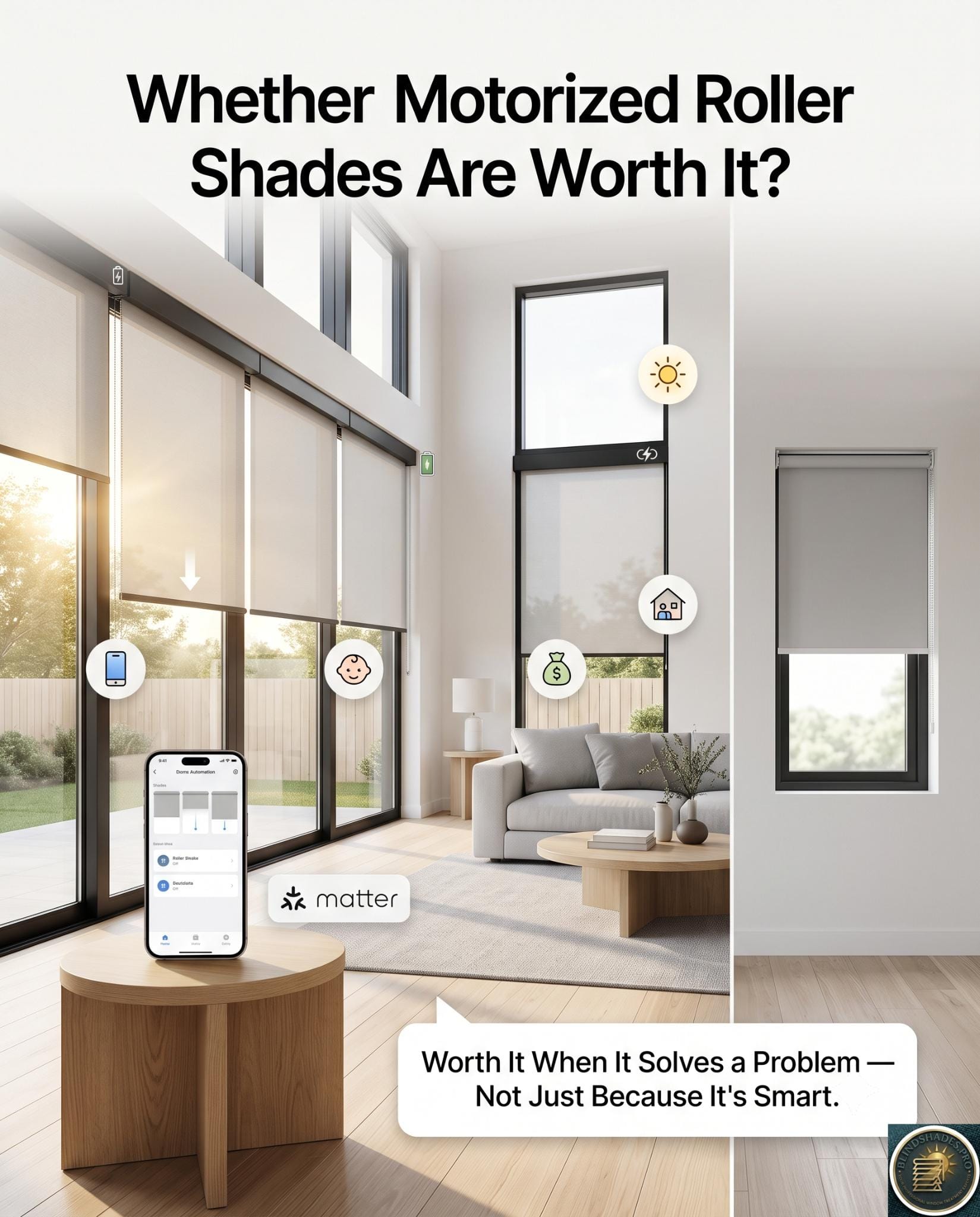
By Michael Turner | 30 years in window treatments
Are motorized roller shades worth it? For most homes, only for the right windows — motorization is clearly worth it when three or more specific conditions apply, and a waste of money when they don’t. The honest verdict the vendor pages dance around is conditional: on tall, hard-to-reach glass, in a genuinely used smart home, or on big sun-facing windows, motors pay for themselves in convenience, comfort, and energy. On cheap, reachable windows you open twice a year, they are an expensive gadget. This guide gives you a scorecard to decide for your home, not a blanket yes.
🎯 5 Key Takeaways
- The answer is conditional, not universal. Motorized roller shades are worth it when at least three of five conditions apply — hard-to-reach windows, real smart-home use, large solar-heat glass, a child-safety need, or multi-shade scenes. Fewer than three, and you are paying for convenience you won’t use.
- Motorize selectively, not whole-house. The biggest money mistake is automating every window. Motorize the few high-impact windows — tall, sun-blasted, or hard to reach — and leave cheap reachable windows manual.
- Power architecture is the real decision. Battery motors are the affordable retrofit; hardwired and Power-over-Ethernet suit new builds and whole-home systems. Choosing the wrong one is where regret and rewiring costs come from.
- The 2026 fix for “they don’t stay in sync” is the Matter standard. Most reliability complaints online trace to flaky proprietary links; shades using Matter over Thread hold their connection far better across ecosystems.
- They are as reliable as manual shades, with the added electronics being the new — but rare — failure points. Quality motors last for years; the battery is the part you will service, and it typically runs months to over a year per charge.
⭐ Quick Answer
Are motorized roller shades worth it? Yes, but only for the right windows, which is a scorecard decision rather than a blanket yes. The short version:
- Worth it when three or more conditions apply: the window is tall or hard to reach, you truly use smart-home routines, the glass drives cooling costs (pair with a cellular shade), you need cordless child safety in a bedroom, or you want multi-shade scenes; AOSKY calls them a luxury worth it only if you use the features.
- Not worth it on cheap, easily reached windows you rarely adjust, so motorize a few high-impact windows rather than the whole house.
- Choose the power type first — battery for retrofits and renters, hardwired or Power-over-Ethernet for whole-home installs; see all operation types in our roller shades guide.
- For reliability in 2026, buy Matter, which prevents most of the out-of-sync problems owners report, a point 3 Day Blinds and smart-home guidance echo.
- They are as reliable as manual shades, per Blinds.com; the rechargeable battery is the part you service, typically months to over a year per charge.
Related guides: the best motorized & smart blinds guide — retrofit vs replace, power plans, and protocol picks.
Are Motorized Roller Shades Worth It for Most Homes?
Yes for the right windows, no for the wrong ones — motorization earns its premium on tall, hard-to-reach, or sun-facing glass and in genuinely automated homes, and wastes it on cheap windows you rarely touch.
The vendor consensus is real but incomplete. Blinds.com calls motorization a worthwhile investment in comfort and efficiency, especially for tall or hard-to-reach windows. AOSKY puts it more bluntly and more honestly: motorized roller shades are a luxury that can absolutely be worth it, but only if you will actually use the features. Both are right, and both point to the same truth the “it depends” answers never operationalize: worth-it is a function of your specific windows and habits, not the product.
So instead of asking “are motorized roller shades worth it” in the abstract, ask it window by window. A shade over a stairwell you physically cannot reach is worth motorizing at almost any price. A bedroom window at arm’s length that you open once and forget is not. The rest of this guide turns that instinct into a scorecard.
When Are Motorized Roller Shades Worth It?
The Worth-It Scorecard: motorized roller shades are worth it when three or more of five conditions apply — and the more that stack, the clearer the yes.
This is the framework the ranked pages lack. Rather than a vague “if you value convenience,” score your window against these five. Three or more, and motorization pays back. Fewer, and you should motorize selectively or skip it.
| Condition | Why it tips to “worth it” |
|---|---|
| Hard-to-reach window | Stairwells, tall, or behind furniture — motor replaces a ladder or pole; value is highest here |
| Genuine smart-home use | You already run routines/scenes; shades join schedules for real daily benefit |
| Large solar-heat glass | Big south/west windows — automated scheduling cuts cooling load and protects furnishings |
| Cordless child safety need | Nursery or kids’ rooms — motorized removes cords entirely, the safest option |
| Multi-shade scenes | A wall or room of windows you want to move together with one tap |
3 Day Blinds’ case for investing lines up with this: the value shows up in comfort, protection from sun, and daily convenience — all of which are strongest exactly where these conditions cluster. A great-room wall of tall, west-facing windows hits four of five and is an easy yes. A single reachable window hits zero and is an easy no.
When Are Motorized Roller Shades NOT Worth It?
Skip motorization on cheap, reachable windows you rarely adjust — and never automate the whole house when a few windows deliver most of the benefit.
Nobody selling shades tells you where not to spend, so here it is. Motorization is poor value on small, low, easily reached windows that you set once and leave, on rental situations where hardwiring makes no sense, and — most expensively — as a whole-house default. The single biggest way buyers overspend is motorizing every window when only a handful are hard to reach or sun-critical. Automate those; leave the rest manual or cordless. You capture the real convenience and comfort gains at a fraction of the cost.
For the broader specification picture across all operation types, see our best roller shades buying guide.
Which Power Type Should You Choose?
The power architecture — battery, hardwired, or Power-over-Ethernet — is the decision that actually determines cost, upkeep, and whether you’ll be happy in five years.
This is what forum threads really argue about, and it deserves a clear table. Match the power source to your situation before you shop brands.
| Power type | How it works | Best for | Trade-off |
|---|---|---|---|
| Battery (rechargeable) | Lithium battery drives the motor | Retrofits, renters, no wiring | Recharge every several months to a year |
| Hardwired | Mains power to each motor | New builds, permanent installs | Requires electrical work |
| Power over Ethernet (PoE) | Power and data over one Cat cable | Whole-home, many windows | Requires structured cabling |
| Solar-assisted charging | A small panel tops up the battery | Sunny windows, less recharging | Depends on light exposure |
Battery motors are the affordable entry point and why motorization went mainstream — no wiring, and as one long-time Houzz owner noted, batteries can last over a year between charges. For a house full of windows you plan to keep for a decade, hardwired or PoE avoids a lifetime of recharging. Decide this first, because you wire a home once.
Do Motorized Roller Shades Actually Save Energy?
They can, but the savings concentrate on specific windows — automated scheduling pays back fastest on large south- and west-facing glass, not on every window in the house.
Energy is the most over-generalized claim in this category. Industry figures put automated-scheduling savings at up to roughly 15% of heating and cooling costs, but that figure only materializes where there is real solar heat to manage. The payback is concentrated, not spread evenly across the house.
| Window type | Motorization payback | Why |
|---|---|---|
| Tall / hard-to-reach | Highest | Replaces a ladder or pole; convenience value peaks |
| Large south / west glass | High | Scheduling cuts cooling load and protects furnishings |
| Multi-window wall | High | One tap moves a whole room; scene control |
| Small, low, reachable | Low | Little convenience gain to justify the premium |
| North-facing / shaded | Low | Minimal solar heat for scheduling to manage |
Automating a big west-facing great-room window that bakes every afternoon delivers genuine cooling savings and furniture protection; automating a small north window saves almost nothing. So treat energy as a reason to motorize your worst solar windows, not a blanket justification. This is the same targeted logic behind pairing motorization with the right fabric — an insulating option like a cellular honeycomb shade compounds the effect on problem glass.
How Long Do Motorized Roller Shades Last and Do They Break Easily?
They last as long as manual shades and are just as reliable — the motor and battery are the added parts, and both are long-lived, with the battery being the one you’ll occasionally service.
The “do they break easily” worry comes straight from old forum horror stories, so here is the honest component breakdown. Blinds.com states plainly that motorized window treatments are just as reliable as standard ones; the electronics simply add new, rare failure points.
| Component | Typical lifespan | What can fail | The fix |
|---|---|---|---|
| Fabric & mechanism | Years, same as manual | Wear, fabric sag on wide spans | Choose heavier fabric |
| Motor | Many years, rated for high cycle counts | Rare motor failure | Warranty replacement |
| Rechargeable battery | Months to over a year per charge; years of service life | Loses capacity over time | Recharge or replace battery |
| Hub / connectivity | Software-dependent | Pairing drops, out-of-sync shades | Use Matter; re-pair or update firmware |
The “loud” and “don’t stay in sync” complaints that dominate old Reddit threads are mostly two things: cheap motors, and flaky proprietary radios. Quality motors run quietly, and the Matter standard from the Connectivity Standards Alliance now keeps shades in sync across ecosystems far better than the older systems those complaints came from. Buy quality and buy Matter, and the classic failure stories largely disappear.
What Are the Disadvantages of Motorized Roller Shades?
The real drawbacks are higher upfront cost, battery upkeep, and setup complexity — each manageable, but worth knowing before you buy.
The honest disadvantages, with the practical response to each: the upfront cost is significantly higher than manual roller shades, which is why selective motorization matters; battery units need periodic recharging or eventual replacement, mitigated by solar-assist or hardwiring; and integrating into a wider smart-home ecosystem can require a hub and some setup, minimized by choosing Matter-compatible shades. None of these is a dealbreaker on the windows that score well; all of them make motorizing a cheap, reachable window a poor trade. For a child-safety-driven install, note that cordless-or-motorized is now the safety default regardless — see darkness-first bedroom setups in our best roller shades for a bedroom guide, and the top-gap-sealing cassette headrail that pairs well with motorized units.
Related Buying Guides
- The Best Roller Shades Buying Guide — all operation types compared
- The Best Cellular Honeycomb Shades Buying Guide — pair motorization with insulation
- The Best Roller Shades for a Bedroom — cordless and motorized safety
- What Is a Cassette Headrail? — a clean finish for motorized shades
Frequently Asked Questions
Are motorized roller shades worth it? They are worth it when at least three of five conditions apply: the window is hard to reach, you genuinely use smart-home routines, the glass drives heat or cooling costs, you need cordless child safety, or you want multi-shade scenes. On cheap, easily reached windows you rarely adjust, motorization is an expensive convenience you won’t use. The smart move is to motorize a few high-impact windows rather than the whole house.
What are the disadvantages of motorized blinds? The main disadvantages are a significantly higher upfront cost than manual shades, ongoing battery upkeep on battery-powered units, and some setup complexity when integrating into a smart-home ecosystem. Each is manageable: motorize selectively to control cost, choose solar-assist or hardwiring to reduce battery upkeep, and buy Matter-compatible shades to simplify integration.
How long do motorized roller shades last? The fabric and mechanism last as long as a manual shade — years — while the motor is rated for high cycle counts and typically lasts many years. The rechargeable battery is the part you service: it runs from several months to over a year per charge and holds up for years before replacement. Overall, they are considered just as reliable as standard shades.
Do motorized shades break easily? No more than manual shades. The added electronics introduce new but rare failure points, and quality motors are reliable and quiet. Most “they broke” or “they won’t stay in sync” complaints trace to cheap motors or older proprietary radios; choosing a quality motor and a Matter-compatible system prevents the majority of those issues.
Do motorized roller shades need to be plugged in? Not necessarily. Battery-powered motorized shades need no wiring and simply require periodic recharging, which is why they suit retrofits and renters. Hardwired and Power-over-Ethernet options are permanently powered and better for new builds and whole-home installs, but they require electrical or cabling work.
Are motorized roller shades worth it for a living room? Often yes, because living rooms tend to have the large, sun-facing, or hard-to-reach windows where motorization scores well — automated scheduling manages afternoon glare and heat, and multi-shade scenes move a whole wall of windows at once. If the living-room windows are small, low, and easily reached, the value drops and manual or cordless shades may serve just as well.
