Best Arched & Specialty Windows 2026

Authored By Michael Turner -30 Years Home Improvement Expertise | Updated 2026 | BlindShades.pro
Updated on July 18, 2026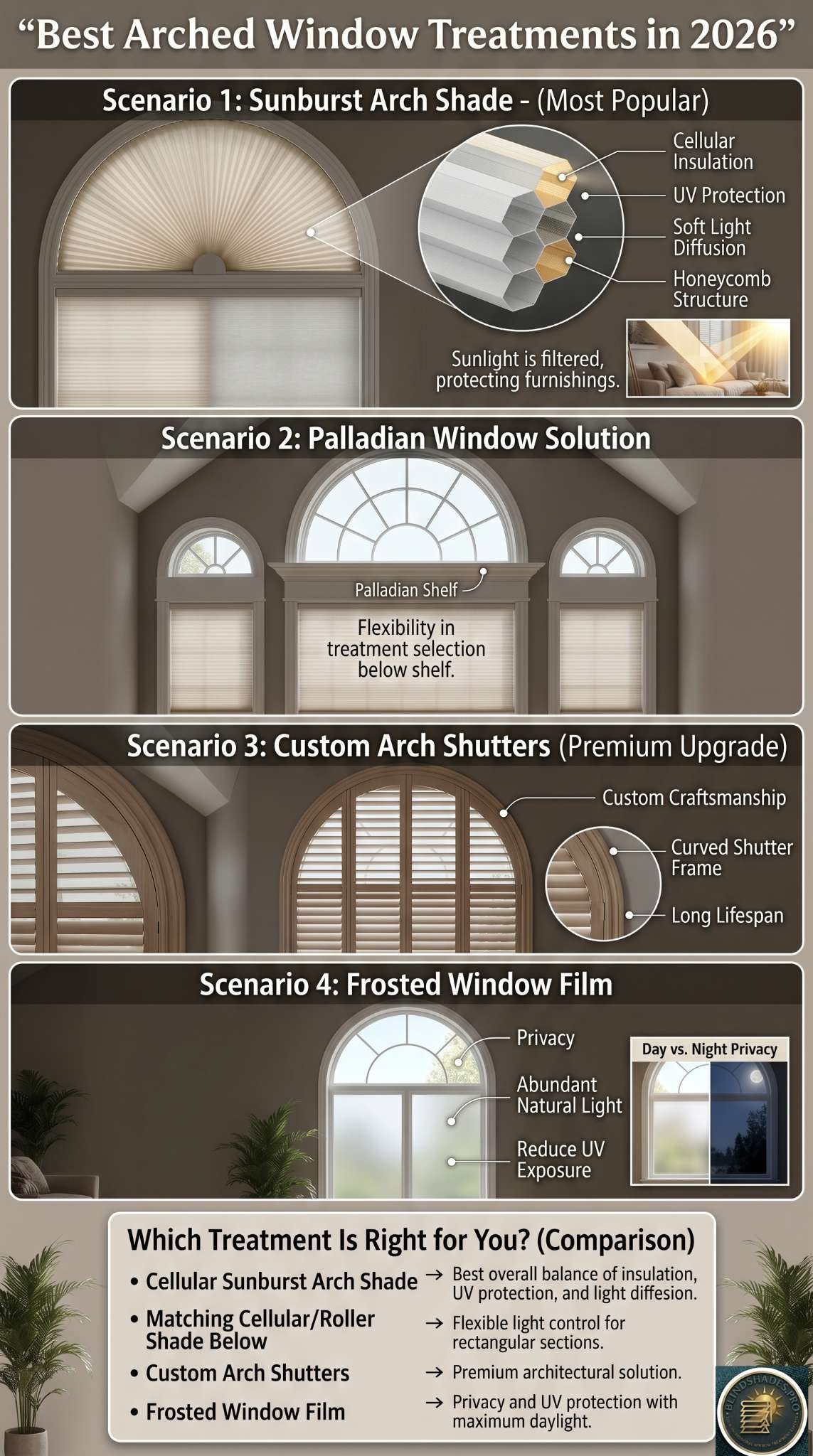
By Michael Turner — 30 years in the window treatment industry
The cellular honeycomb sunburst shade is the single most popular treatment for the arched window — and the rest of the specialty-shape decision follows a rule this guide names: Shape first, Operation second, Light last. Every seller in this market agrees on the sunburst and stops there. What they will not tell you is which arches should stay bare, which genuinely need blinds that open and close, and how a quarter round, an eyebrow, and an elongated arch each change the answer. This 2026 update keeps our rankings, deepens every one of them, and adds the two sections the rest of the market cannot write.
Key Takeaways
- The sunburst consensus is real: honeycomb fabric naturally fans out to follow a curve, which is why cellular arch shades dominate every retailer’s specialty page — and our Ranked 1 spot, again.
- Most arch treatments do not move. The default sunburst is stationary; arch window blinds that open and close are a genuine product class, but a smaller and costlier one — know which you need before you price anything.
- Some arches should stay bare. The design community’s most-upvoted answer in this market is not a product — it is “don’t hide those beautiful arches.” We take that seriously below, fade caveat included.
- Shape decides everything. A perfect half-circle takes stock arch products; elongated, eyebrow, and angled shapes are template-and-custom territory — the measuring section shows the rise-to-width test.
- Review-base honesty matters most in specialty products: this SERP contains both a twenty-five-dollar arch shade with twelve hundred reviews and a seven-hundred-dollar arch blind with a single one-star review. We name both.
⭐ Quick Answer — The Best Arched & Specialty Window Blinds
The best arched window blinds start with the custom cellular sunburst shade — the market’s unanimous Ranked 1, because honeycomb fabric fans naturally along a curve — then follow the Arch Rule: Shape first, Operation second, Light last:
- The consensus fabric: cellular arch shades from about thirty-eight to one twenty-five, with free thirty-day returns, at Blindsgalore — the cell science is in the cellular and honeycomb shades guide.
- The value verdict: Redi Shade’s trim-to-fit arch pleated shade — four point three across roughly twelve hundred reviews at about twenty-five — via The Home Depot; the pleat family is covered in the pleated shades guide.
- The half-width test: rise equal to half the width means stock products fit; anything else — elongated, eyebrow, quarter round — is template territory, run by the rules in the made to measure blinds guide.
- Blinds that open and close: movable-rail cellulars, motorized smart arches, and fully operable fabricated shapes — arched, angled, triangular, pentagon — from specialists like BCC Specialties.
- The honest option: some arches should stay bare — the design community’s own verdict — with a curtain hung well above and the fade caveat taken seriously.
Quick Specification Reference
| Specification | Arched & specialty reality (2026) |
|---|---|
| The consensus product | Custom cellular sunburst — honeycomb fans to follow the curve |
| Fixed vs operable | Default arch treatments are stationary; operable arches are a smaller, costlier class |
| The shapes | Half-circle, elongated arch, eyebrow (shallow), quarter round, angled / triangle / pentagon |
| Stock-size threshold | True half-circles can take stock arch products; everything else is template territory |
| The value class | Pleated fabric arch shades from about twenty-two to twenty-five |
| The custom band | Roughly forty to three hundred twenty per the live market, shape-dependent |
| The motorized lane | Smart arched blinds and fabricated operables for arched, angled, triangular, pentagon, quarter round |
| The honest alternative | Leaving the arch bare, with a curtain hung well above — the community’s own verdict |
| Blackout in an arch | Possible — operable or layered only; a fixed filtering sunburst cannot darken a bedroom |
Read the complete guide below for: the 2026 rankings with real review bases, the Arch Rule (Shape · Operation · Light), the shape taxonomy from half-circle to pentagon, the open-and-close question answered honestly, the bare-arch case no seller will make, the rise-to-width measuring test, and every buying lane from Home Depot to a fabricator.
The 2026 Rankings — Best Arched & Specialty Window Treatments
Review volumes below are stated exactly as the market shows them; thin bases are flagged, and one listing is named as a warning.
| Rank | Product | Rating / reviews | Price (words) | The lane |
|---|---|---|---|---|
| 1 | Custom Cellular Sunburst Shade | Category consensus across every major retailer | About thirty-eight to one twenty-five per the leading store ranges | The most popular arched treatment — see below |
| 2 | Redi Shade Original Arch Light Pleated | 4.3 across ~1,200 | About twenty-five | The value verdict — the biggest review base in the entire arch market |
| 3 | Graywind Smart Arched Blinds | 4.4 across 38 (modest base — flagged) | About two hundred sixty-six | The operable, motorized answer |
| 4 | Bali Cellular Arch Shade | 4.8 across 11 at Blindsgalore / 3.5 across 69 at Home Depot — the split stated honestly | About sixty-five to one twenty-five by seller | The brand-name arch cellular |
| 5 | American Blinds custom arch program | Store: 4.8 across 680 | About seventy to two thirty-four, quoted by shape | The custom lane for semicircular and odd shapes |
| 6 | Blindsgalore Select Arch Cellular | 5.0 across 3 (very thin — flagged) | About thirty-eight on sale | The budget custom-cellular entry |
Ranked 1 — Custom Cellular Sunburst Shade (Most Popular)
The cellular honeycomb sunburst shade is the single most popular treatment for the arched window. The reason is mechanical, not fashionable: pleated honeycomb fabric naturally fans out to follow curves — Blindsgalore’s own arch page (store rated four point seven across forty-six hundred) leads with exactly that explanation, Blinds.com’s arch category (four point seven across twenty-six hundred) calls cellular a great arched choice for its insulating and light-filtering benefits, and Norman’s specialty line names cellular its go-to arched pick. Three competitors, one verdict, and the physics on their side: the honeycomb’s air pockets insulate a shape that is usually mounted high, where heat gathers. The cell-size science and the double-cell question live in our cellular and honeycomb shades guide. The one honest limit: the standard sunburst is stationary — it filters beautifully and moves never, which is why Rankings 3 and the operable section below exist.
Ranked 2 — The Value Verdict: Redi Shade’s Arch Pleated
Twelve hundred buyers make this the arch market’s only mass-verified product: about twenty-five, paper-pleated, trims to fit, and installs without hardware. It is not custom, it is not permanent-grade, and its cordless pleated cousin runs about twenty-two to twenty-five in cellular fabric (four point two across four — thin, flagged) — but as the test-the-look move before commissioning a custom sunburst, nothing else comes close. The pleat family’s fabric logic is in our pleated shades guide.
Ranked 3 — The Operable Lane: Graywind Smart Arched
Graywind’s motorized arched blinds (four point four across thirty-eight) are the mainstream answer to the question this market’s searchers ask most — arch window blinds that open and close — with app and voice control in the arch itself. Above it sits the fabricator tier: BCC Specialties builds fully operable motorized blinds for arched, angled, triangular, pentagon, quarter round, and most other window shapes — the bespoke ceiling of this category. The retrofit-versus-hardwired decision tree is in our motorized and smart blinds guide.
Ranked 4 — The Brand Cellular: Bali’s Arch Shade
One product, two stories — and we tell both: four point eight across eleven reviews at Blindsgalore, three point five across sixty-nine at Home Depot. The larger base is the truer one; read the critical reviews there before ordering, most of which concern fit on not-quite-half-circle openings — which is a measuring problem this guide solves, not a fabric problem. And the cautionary tale sits in the same brand family: Bali’s one-inch aluminum mini blinds for arched windows appear at about seven hundred twelve with a one point zero rating across exactly one review — a listing, not a verdict, and precisely why the review-volume rule exists.
Ranked 5 — The Custom Program: American Blinds
For elongated arches, eyebrows, and anything the stock half-circle products refuse: American Blinds’ arch program (store four point eight across six hundred eighty) customizes coverings to complement semicircular windows, ships free swatches, and runs fourteen-day returns — the shortest return window in this comparison, stated plainly. Custom arched window blinds are quoted by shape, roughly seventy to two thirty-four in the live listings, and the deduction-question discipline from our made to measure blinds guide applies letter for letter.
Ranked 6 — The Budget Custom: Blindsgalore Select
About thirty-eight on sale for a made-to-size arch cellular — the cheapest custom entry in the market — carrying a five point zero across three reviews, which we flag as a promising sample rather than proof. It is the right first quote for a true half-circle on a budget, and its store backing matters more than its product base: the same four point seven, forty-six-hundred-review operation behind Ranked 1’s fabric consensus, with the thirty-day return window doing the risk-carrying a three-review product cannot.
The Arch Rule: Shape · Operation · Light
Every specialty-shape decision resolves in this order — what shape is it, does it need to move, and how much light should it pass — and answering out of order is how arches end up with the wrong product.
| Arch Rule step | The question | Wrong-order failure |
|---|---|---|
| Shape | Half-circle, elongated, eyebrow, quarter round, or angled? | Ordering a stock sunburst for a not-quite-half-circle — the commonest critical review in this market |
| Operation | Does this window ever need to change state? | Paying the operable premium for a hallway arch that never would — or fixing a bedroom arch shut with light forever filtering in |
| Light | Filter, black out, or leave bare? | Fighting a blackout problem with a filtering product |
What Shape Is Your Arch? The Specialty Taxonomy
Specialty arch windows are a family of shapes, not one product size — and the shape class decides stock versus template before any catalog opens.
A naming note, because this category wears many labels: arched window treatments, arched window coverings, arch shades, sunburst shades, fan shades, and specialty-shape blinds all describe one product family — and American Blinds’ own line that arched window coverings can be customized to complement semicircular windows is the market’s plainest statement of the custom default. The taxonomy below is the map under all those names.
| Shape | The test | The honest answer |
|---|---|---|
| Perfect half-circle | Rise equals half the width | The stock lane works — sunbursts and arch pleats fit |
| Elongated arch | Rise exceeds half the width | Template territory — an elongated arch window shade is a custom order, always |
| Eyebrow / shallow arch | Rise well under half the width | The hardest fit in the family — custom template, or the bare-arch case below |
| Quarter round | One vertical side, one curve | Custom; fabricator lane for operable versions |
| Angled / triangle / pentagon | Straight lines, odd angles | The fabricated-shapes lane — the same shops that build operable arches cut these |
Run the test with a steel tape: width across the base, rise from base center to the peak. Equal-to-half means the shape is a true semicircle and stock products apply; anything else gets a paper template — trace the opening, ship the template, let the maker cut to it. This is the single step that prevents the fit complaints filling the critical reviews of every stock arch product in this SERP.
Do Arch Window Blinds That Open and Close Exist?
Yes — but they are the exception, not the default, and knowing which you need is the highest-value decision in this guide.
The best arch window blinds that open and close come in three tiers. Movable-rail cellular arches — the sunburst’s operable cousin — fan open and closed on a pivoting bottom rail. Motorized arch window shades, the Graywind class, put the movement on an app or a voice command; Home Depot’s Veneta designer cordless arch cellulars sit in the same premium-fit lane for curved openings. And the fabricated tier — the BCC class — builds fully operable blinds for any shape on the taxonomy table, priced accordingly (the Weffort motorized arched cellular lists around three hundred seventeen). Below all three sits the honest default: the fixed sunburst, which most arches should actually get, because most arches are decorative top-lights that never need to change state. One planning note for the operable tiers: power and reach. A motorized arch mounted eight feet up wants its charging or wiring plan decided before the order, not after — rechargeable motors mean a ladder twice a year, hardwired means an electrician once — and a manual movable-rail arch at the same height needs a control wand long enough to actually reach the rail, a detail the listings reliably omit.
| Class | Moves? | The case | Watch for |
|---|---|---|---|
| Fixed sunburst | No | Decorative top-lights, hallway arches, transoms | Cannot darken anything |
| Movable-rail cellular | Fans open/shut | Living spaces wanting occasional control | Manual reach — high arches need a pole |
| Motorized smart arch | Yes, app/voice | High arches, daily-change rooms | The premium and the power question |
| Fabricated operable | Yes, any shape | Angled, pentagon, quarter round needing function | Quote-based pricing |
| Layered (fixed + drapery) | The layer moves | Bedroom arches needing blackout | Covers the arch shape at night |
The blackout corollary answers its own PASF: an arch window shade blackout solution is either an operable blackout-fabric arch or a fixed filter layered under blackout drapery mounted above the whole opening — the sleep-science case for true darkness is in our blackout blinds guide. What it is never: a stock filtering sunburst, whatever the listing title implies.
Should You Cover an Arched Window at All?
The design community’s most-upvoted answer in this market is not a product — and a guide that sells product should still tell you when they are right.
In the Facebook design threads Google surfaces for this exact search, the top-voted responses argue against covering at all: the arch is the architecture, one stager’s answer amounts to why hide it, and the practical compromise offered is a curtain hung well above the arch — treating the rectangle below and letting the curve stay bare. A parallel voice in the same threads votes custom plantation shutters for those who do cover; that lane gets its full hearing when our interior shutters coverage is updated. Here is the honest scorecard the sellers in this SERP cannot print:
| Leave it bare when | Cover it when |
|---|---|
| The arch is a decorative top-light above a covered rectangle | The room needs real darkness (bedrooms, media rooms) |
| The room faces north or is shaded — no glare, mild fade risk | West or south exposure is fading floors and fabric |
| The arch is the room’s best architectural feature | Privacy sightlines reach the arch (street-facing, upstairs neighbors) |
| Budget is finite — spend it on the windows you touch daily | The HVAC bill says the top-light is a heat gate |
The one caveat the bare-arch camp underweights: ultraviolet does not care about architecture. An uncovered south-facing arch fades what sits beneath it, and the honeycomb’s insulation case — the same physics from Ranked 1 — argues for at least a filtering sunburst on hard-sun exposures. Say it plainly: bare is a legitimate choice, not a free one.
There is also a middle path the threads themselves model without naming it: treat the arch seasonally. A trim-to-fit pleated arch at the twenty-five-dollar class goes up for the brutal-sun months and comes down for the rest of the year — no hardware, no commitment, the architecture bare when the light is kind. It is the cheapest resolution of the whole bare-versus-covered argument, and only the value tier makes it possible; nobody seasonally rotates a three-hundred-dollar custom.
How Do You Measure an Arched Window?
Width, rise, depth, and — for every shape past the half-circle — a paper template.
| Step | How | Why |
|---|---|---|
| Width | Across the base, three times, steel tape | The base governs every arch product |
| Rise | Base center to peak | The half-width test: equal = stock lane; unequal = template |
| Depth | Frame recess at three points | Inside mounts need the honeycomb’s stack depth |
| Squareness | Check where the arch meets the casing | Old frames drift; templates absorb it |
| Template | Trace the opening on paper, ship it | The only honest fit for elongated, eyebrow, and angled shapes |
| The deduction question | Opening size vs finished size — ask | The same rule that governs all custom orders |
Wood and faux wood deserve their sentence here, because the PASF asks: wood blinds for arched windows exist as custom-cut stationary fans and as the traditional lane one Texas shop has recommended since 2020 — warm, permanent, and heavier on the wallet; the slat-material decision is argued in our faux wood blinds guide. And the whole specialty family shares one measuring culture with the site’s other odd-glass hubs — the overhead version of this problem lives in our skylight blinds guide, and the tall-narrow version flanking entry doors — sidelight glass beside an arched front door is this guide’s nearest cousin — gets its own treatment next in this series.
Where Should You Buy Arched Window Blinds?
Every lane in the live market, honestly scored.
| The lane | The honest answer |
|---|---|
| Blinds for arched windows Home Depot | The walk-in lane: Veneta designer arch cellulars, Bali arch products, Redi Shade pleats — with free in-store returns; read the larger review bases (the 3.5-across-69, not the 4.8-across-11) |
| Blindsgalore / Blinds.com | The custom-cellular core: thirty-eight to one twenty-five and eighty to seven hundred one respectively, both stores at four point seven, both running thirty-day returns |
| American Blinds | The odd-shape custom program — free swatches, fourteen-day returns (the short window, noted) |
| Graywind / Weffort direct | The motorized arch lane |
| Fabricators (BCC class) | Operable anything — arched, angled, triangular, pentagon, quarter round — by quote |
| Stoneside and consultation sellers | Romans-for-arches is their June 2026 claim; note the claim crowning them top custom choice is their own quote, and price the consultation accordingly |
| Local shops | Template-friendly and measure-in-person — the right lane for eyebrows and elongated shapes |
Pricing honesty, one table early and once:
| The pattern | The rule |
|---|---|
| Forty-five to forty-nine percent “off” on half this SERP’s listings | List prices are anchors; the recurring sale price is the real price |
| The same Bali arch at sixty-five and one twenty-five by seller | Cross-shop the identical SKU before any cart |
| A seven-hundred-twelve-dollar arch mini with one review | Review volume before price tag, every time |
Related Buying Guides
- Best Cellular & Honeycomb Shades — the sunburst’s fabric, explained
- Best Pleated Shades — the value-lane fabric family
- Best Motorized & Smart Blinds — the operable arch’s control layer
- Best Made to Measure Blinds — the template-and-deduction discipline
- Best Faux Wood Blinds — the traditional-arch slat lane
- Best Skylight Blinds & Shades — the overhead specialty cousin
- Best Blackout Blinds & Shades — when the arch must go dark
- Best Bay Window Blinds & Shades — the multi-panel specialty cousin
- Best Bathroom Window Blinds — arched transoms over tubs, moisture rules
- Best Kitchen Window Blinds & Shades — the room where arch top-lights meet steam
FAQ
What is the most popular treatment for arched windows? The cellular honeycomb sunburst shade is the single most popular treatment for the arched window — the pleated fabric fans naturally along the curve, insulates the high glass, and every major retailer’s arch page leads with it. Our Ranked 1, unchanged for 2026.
Do arch window blinds that open and close exist? Yes, in three tiers: movable-rail cellular arches that fan on a pivoting bottom rail, motorized smart arches with app and voice control, and fabricated operables built to any shape including angled, pentagon, and quarter round. The default sunburst, by contrast, is stationary — most decorative arches genuinely never need to move.
Can you get blackout shades for an arched window? Yes — as an operable blackout-fabric arch, or as a fixed filtering arch layered under blackout drapery mounted above the whole opening. A stock light-filtering sunburst cannot darken a room regardless of how the listing reads.
How do you measure an arched window for blinds? Width across the base three times, rise from base center to peak, depth at three points — then run the half-width test: rise equal to half the width means a true semicircle and stock products fit; anything else needs a paper template traced from the opening and a custom order.
Should you cover an arched window at all? Not always — the design community’s honest answer. Decorative top-lights in shaded or north-facing rooms can stay bare, with a curtain hung well above treating only the rectangle beneath. Cover the arch when the room needs darkness, when hard sun is fading the floor, or when privacy sightlines reach the glass.
How much do arched window blinds cost? About twenty-two to twenty-five for trim-to-fit pleated arch shades, thirty-eight to one twenty-five for stock and semi-custom cellular sunbursts, roughly seventy to two thirty-four for shape-customs, and about two sixty-six to three twenty for the motorized smart-arch class — with fabricated operable shapes quoted individually.
The Bottom Line
Run the Arch Rule and the decision runs itself. Shape: take the half-width test, and template anything that fails it. Operation: pay for movement only where the room changes state — and let hallway arches keep the fixed sunburst the whole market rightly ranks first. Light: filter hard sun, engineer real blackout with the layered method, and grant the beautiful bare arch its honest place. The sunburst stays Ranked 1 for 2026 because the physics has not changed; everything around it just got the guide it deserved.
