The Best Bathroom Window Blinds & Shades: Steam, Sightline, and Surface Before Style

Authored By Michael Turner -30 Years Home Improvement Expertise | Updated 2026 | BlindShades.pro
Updated on July 17, 2026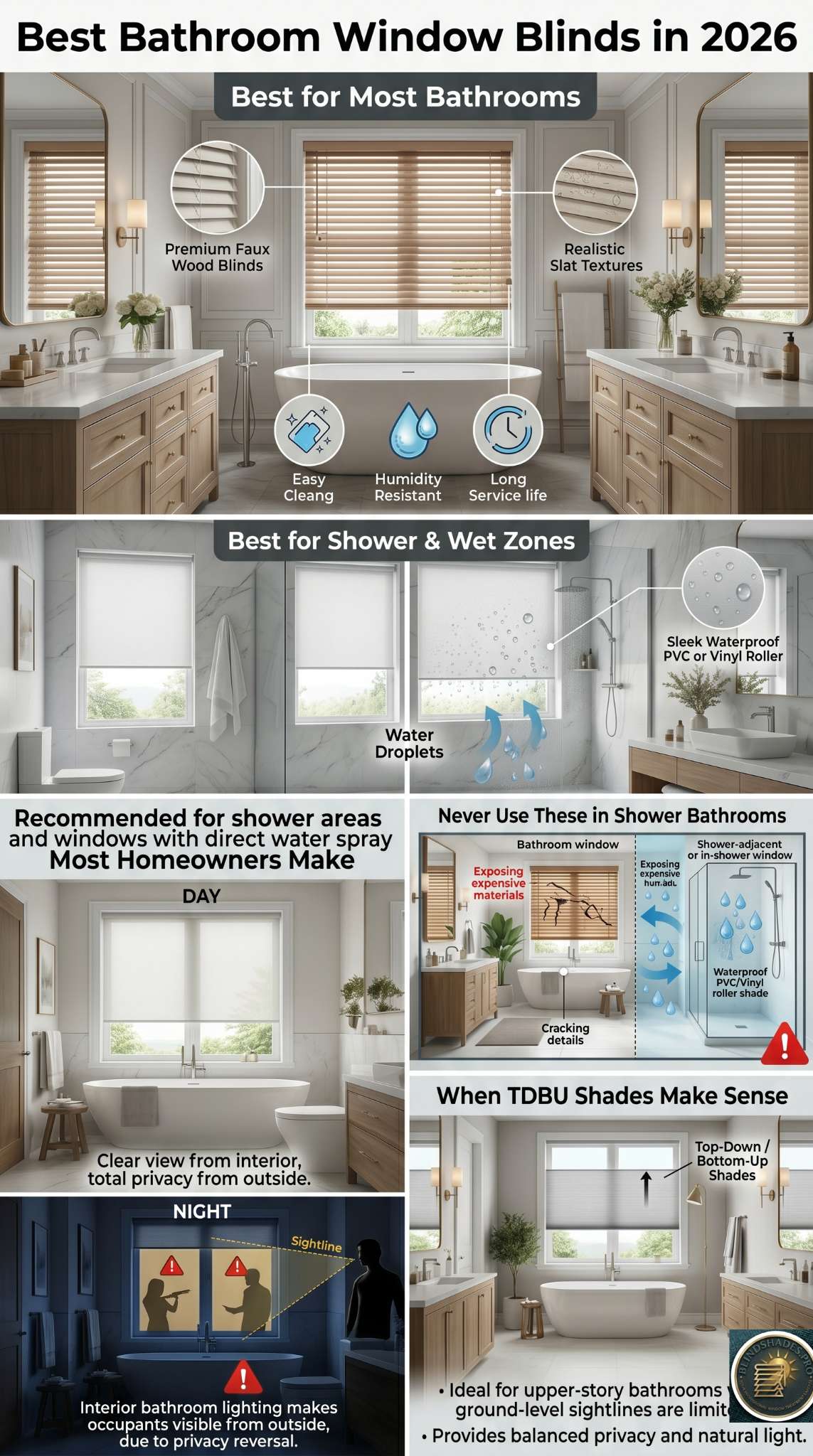
Authored by Michael Turner — 30 Years of Home Improvement Expertise | BlindShades.pro | Complete Buying Guide, Updated for 2026
The best bathroom window blinds are chosen by three questions the style lists skip: how wet the window actually gets, who can actually see through it, and what surface you are allowed to mount into. Bathrooms are the only room where the window gets rained on from the inside — every shower spikes the air to saturation, the glass is the coldest surface in the room, and condensation forms there first and runs — which is why the market’s verdicts converge on materials that absorb nothing: vinyl and PVC, aluminum, faux wood, and waterproof-fabric cellular, with real wood and ordinary fabric on the banned list near steam. Privacy is the second law, and the most-upvoted community answer on this entire topic — keep the bottom frosted, the top clear — is really a geometry lesson this guide turns into three buildable options. Add the mounting reality (tile walls, fiberglass surrounds, rentals that forbid drilling) and you have the three gates that pick the right treatment before any brand name enters the room.
⭐ Quick Answer — The Best Bathroom Window Blinds & Shades
The best bathroom window blinds are chosen at three gates — Steam (how wet the window gets), Sightline (who can see in), and Surface (what you may mount into):
- The material law is absorb-nothing: cordless faux wood for looks, vinyl/PVC and aluminum for full waterproofing, waterproof-fabric cellular for condensation control — the top-three verdict per Blindsgalore and the vinyl-or-aluminum rule per Blindster.
- The window gets rained on from the inside: shower steam condenses on the cold glass and runs — so mold-proof materials and fan discipline matter as much as splash; the playbook is in bathroom blinds and mold prevention.
- Privacy is a band, not a wall: cover the lower sightline zone and keep the top clear — built as frosted film, café height, or top-down-bottom-up shades per bathroom privacy without losing light.
- The shower window has its own rules: frosted film first, waterproof PVC roller or vinyl mini second, nothing fabric or corded — the wet-zone list is in best blinds for a shower window.
- Tile and rentals: no-drill tension and magnetic mounts spare tile, fiberglass surrounds, and deposits — and per The Spruce’s roundup habits, always check the exact SKU’s rating before buying (a page-one roller here sits at 3.3 stars).
Key Takeaways
- The window gets rained on from the inside. Shower steam saturates the air, the glass is the room’s coldest surface, and condensation forms there first — so even a treatment the shower never touches lives in running water, which is why the material law is absorb-nothing: per Blindster’s water-resistant guidance, vinyl/PVC and aluminum are the humid-room picks precisely because they do not absorb water.
- The market’s top three are stable. Faux wood (the high-end look that will not warp or crack in humidity), cellular (privacy, insulation, and condensation control — in waterproof fabrics for wet zones), and moisture-resistant roller shades are Blindsgalore’s named top three for bathrooms, and the same trio anchors every serious list on this market.
- Privacy is a band, not a wall. The most-upvoted answer in the ranking community threads — roughly nine hundred sixty-six votes for keeping the bottom frosted and the top clear — is the privacy-band geometry this guide builds three ways: frosted film or glass, top-down-bottom-up shades, and café-height treatments, each with an honest night-time caveat.
- Mold is a menu problem. Mold needs moisture plus organic food; PVC, aluminum, and sealed faux wood starve it, while cloth, cords, and raw wood feed it — which turns the material matrix into a mold-prevention plan, not just a durability chart.
- The shower window and the tile wall are their own problems. A window inside the splash arc allows only waterproof, wipeable, mold-proof builds (PVC roller, vinyl mini, film), and tile or fiberglass surrounds plus rental rules push toward no-drill tension and magnetic mounts — both cases get dedicated sections and dedicated deep-dives below.
Quick Specification Reference
| Spec | The short answer |
|---|---|
| The three gates | Steam (how wet — splash arc, steam cloud, or powder room) → Sightline (who can see in, and where) → Surface (what you may mount into: tile, surround, frame, or nothing) |
| The material law | Absorb-nothing in wet zones: vinyl/PVC, aluminum, faux wood, waterproof-fabric cellular |
| The banned list near steam | Real wood (warps), ordinary fabric and Roman (absorbs, molds), untreated woven woods |
| The top three | Faux wood, cellular, and moisture-resistant roller — the category verdict across the market |
| Privacy geometry | Cover the sightline band, keep the sky: frosted film/glass, top-down-bottom-up, or café-height |
| The shower-arc rule | Inside the splash arc: waterproof PVC roller, vinyl mini, or film only |
| Mounting reality | Inside mount for tight reveals; outside mount to clear tile; no-drill tension/magnetic for rentals and surrounds |
| Light strategy | Light-filtering or tiltable slats; blackout only where a streetlight or shift-sleep argues for it |
| Price band | Budget vinyl minis in the low tens of dollars through custom faux and waterproof cellular mid-range — stated in words throughout, per our no-fabricated-prices rule |
| Store-rating snapshot | Blindsgalore 4.7 across roughly 4,600 reviews; Blindster 4.6 across roughly 6,600 with sixty-day returns; Lowe’s category 4.6 across roughly 1,600 |
Read the complete guide below for: the Steam–Sightline–Surface Test; six verified picks; the steam-zone map; the steam cycle that explains every “moisture-resistant” adjective on this market; the material matrix with its mold-risk column; the frosted-glass question answered three ways; the shower and over-tub window rules; the mounting and no-drill playbook; the color and blackout call; and the where-to-buy comparison with one honest rating warning.
What Are the Best Bathroom Window Blinds & Shades? Our Picks
Six verified picks — one per job, because the splash arc, the steam cloud, and the powder room are different rooms.
| Pick | Product / style | Gate it wins | The attributed case |
|---|---|---|---|
| Best Overall | Cordless faux wood blinds | Steam (cloud zone) + looks | The market consensus: the warm look of wood that will not warp or crack in humid environments, with tilt-slat privacy — Blindster’s deluxe cordless faux line carries a 4.6 across roughly 4,500 reviews |
| Best Budget Waterproof | Vinyl mini blinds | Steam (anywhere) + budget | The fully water-resistant budget verdict, ideal near showers per the market’s own framing; stock vinyl room-darkening minis rate 4.3 across roughly 550 reviews |
| Best Near Shower / Tub | Waterproof PVC roller shade | Steam (splash arc) | The wet-zone specialist: one wipeable surface in a fabric that absorbs nothing — the vinyl/PVC-or-aluminum rule per Blindster’s water-resistant guidance |
| Best Privacy-with-Light | Top-down-bottom-up cellular | Sightline | The AI answer’s own top type for bathrooms — light over a closed privacy band — and the community’s second-favorite answer at roughly three hundred eighty-four votes for cordless top-down |
| Best Condensation & No-Drill | Waterproof cordless cellular in no-drill mounts | Steam + Surface | The SKU class built for this room: waterproof honeycomb fabrics that insulate the glass against condensation, in tension/no-drill mounts that spare tile and rentals |
| Best Durable Metal | Bali cordless 1-inch aluminum mini | Steam + decades of service | The metal answer: Home Depot’s custom Bali aluminum line rates 4.1 across roughly 885 reviews — nonporous, splash-proof, mold-starving |
Read the table by zones: the splash arc takes only the waterproof rows, the steam cloud opens up to faux wood and cellular, and a windowless-shower powder room can borrow from any room in the house. Deep dives per style live in their own guides — faux wood’s full physics in the best faux wood blinds guide (built on exactly these rooms), the bathroom roller build in the best roller blinds for bathrooms, the slatted-metal case in the best venetian blinds for bathrooms, and the mini-blind family in the best mini blinds guide. For the fastest answer — picks only — our short-form spoke best blinds for the bathroom window stays the quick list; this page is the room-level decision.
How Do You Choose Bathroom Blinds? The Steam–Sightline–Surface Test
Three gates in order: how wet the window gets, who can see through it, and what you are allowed to mount into.
| Gate | The question | What the answer decides |
|---|---|---|
| Steam | Is the window inside the splash arc, in the steam cloud, or in a dry powder room? | The material shortlist — waterproof-only in the arc, absorb-nothing in the cloud, anything in the powder room |
| Sightline | Who can actually see in — a neighbor at level, a passerby below, or nobody? | The privacy build: full coverage, a lower band (film, TDBU, café), or honest nothing |
| Surface | What is around the window — tile, fiberglass surround, vinyl frame, a rental agreement? | Inside vs outside mount, screw vs no-drill tension/magnetic, and whether film beats hardware entirely |
The gates exist because bathroom regrets are gate-skips wearing style choices: the Roman shade that grew speckled mold in a season (a Steam miss — fabric in the cloud zone), the beautiful full-height blind kept permanently closed because the neighbor’s window sits at level (a Sightline miss that turned a bright room dark), and the drilled tile that cracked for a blind a tension mount would have carried (a Surface miss with a repair bill). Google’s answer for this exact search ends by asking three questions it cannot answer — blackout or light-filtering, inside or outside mount, size and budget — and the mount question is the Surface gate verbatim, while the light question gets its own honest section below. Run the gates in order; the rest of this guide arms each one. And a scope note: this room’s physics twin is the kitchen — steam here, grease there, wipeable surfaces winning both — and the pair is deliberately built as a set with the kitchen window blinds and shades guide.
How Wet Is Your Window? The Steam-Zone Map
One bathroom, three environments — the splash arc, the steam cloud, and the dry corner.
| Zone | What happens there | The material law | Best answers |
|---|---|---|---|
| Splash arc — inside or beside the shower/tub | Direct water hits, constant wet-dry cycling, soap residue | Waterproof only; nothing organic, nothing absorbent | Waterproof PVC roller, vinyl mini, or frosted film instead of hardware — the dedicated builds are in best blinds for a shower window and window treatments for the bathroom bathtub |
| Steam cloud — the main room | Saturation spikes at every shower; condensation runs on the glass; slow drying | Absorb-nothing: faux wood, aluminum, vinyl, waterproof cellular | The top-three trio lives here — faux wood for looks, waterproof cellular for condensation control, moisture-resistant roller for minimalism |
| Powder room / dry corner | Ordinary room conditions with occasional humidity | Rules relax; fabric returns | Any style the sightline allows — including the fabric and wood looks banned elsewhere, with the timber case argued honestly in real wood blinds in bathrooms |
Ventilation moves the boundaries, exactly as the range hood does in the kitchen: a working exhaust fan run during and after showers shrinks the steam cloud dramatically, shortens the wet minutes on the glass, and upgrades borderline materials from risky to reasonable — while a dead fan or a no-fan bathroom expands the cloud to the whole room and hardens the absorb-nothing law. Before spending on treatments, spend ten minutes confirming the fan actually moves air; it is the cheapest moisture upgrade in the room.
Why Do Bathroom Windows Get Wet from the Inside? The Steam Cycle
The mechanism behind every “moisture-resistant” adjective on this market — and the honest version of the condensation claim.
Here is what actually happens, shower by shower. Hot water loads the air with vapor until the room approaches saturation. That vapor condenses on the first surface colder than the air’s dew point — and in almost every bathroom, the coldest surface is the window glass, because it faces the outdoors. So water beads on the glass, gathers, and runs: down the pane, onto the frame, onto the sill, and onto whatever treatment hangs there. This is why a blind the shower never touches still lives a wet life, why frames and sills rot first, and why “moisture-resistant” is not marketing filler but the room’s entry requirement.
It is also the honest mechanism behind the claim Google’s answer makes without explanation — that cellular shades “reduce condensation.” An insulating honeycomb lowered over the glass keeps warm room air off the cold pane, so the glass-side air stays drier and less water forms; that part is true and useful, especially on cold-climate windows that weep all winter. The caveat the sellers omit: ordinary cellular fabric is exactly the porous material the steam cloud punishes, and cells that take splash or heavy condensation can trap water inside where it never dries. The resolution is the waterproof-cellular SKU class — honeycombs woven from water-shedding fabric — which is why that specific product, not cellular in general, earns the condensation pick in our table. Ordinary fabric cellular belongs in the powder-room zone.
The last consequence is the mold law, and it makes the next section’s matrix more than a durability chart. Mold needs two things: sustained moisture and organic food. The steam cycle supplies the moisture on a schedule; the treatment decides the menu. Cloth, operating cords, paper-faced materials, and raw wood are food; PVC, aluminum, glass film, and sealed faux wood are not — a starved surface can stay damp and still stay clean. The full prevention playbook — fan discipline, wipe-downs, the early speckle check, and what to do when spots appear — is in bathroom blinds and mold prevention.
What Is the Best Material for Bathroom Window Shades?
The moisture matrix — with the column that matters most: what mold can eat.
| Material | Water behavior | Mold risk | Zone permit | The record |
|---|---|---|---|---|
| Vinyl / PVC (rollers, minis) | Absorbs nothing; fully wipeable | Starved — no food | All zones, including the splash arc | The humid-room rule per Blindster: vinyl/PVC or aluminum because they do not absorb water |
| Aluminum (minis, venetians) | Nonporous metal | Starved | All zones | The durability verdict across the listicles; Bali’s custom aluminum line rates 4.1 across roughly 885 reviews |
| Faux wood / composite | Sealed slats shed water | Very low — sealed surface | Steam cloud and drier | The high-end-look consensus: will not warp or crack in humidity; the aluminum-vs-faux bathroom matchup is settled in faux wood vs aluminum blinds for bathrooms |
| Waterproof-fabric cellular | Sheds water; insulates the glass | Low in waterproof weaves | Steam cloud | The condensation-control pick — the honest version of the cellular claim, per the steam-cycle section above |
| Ordinary fabric / Roman | Absorbs and holds | High — food plus moisture | Powder room only | The category every con-side source warns about in wet rooms |
| Real wood | Absorbs at every unsealed edge; warps | Moderate-high | Powder room, well-ventilated only | The banned-list headliner near steam — the full when-it-works case is in the real-wood bathroom guide linked above |
| Frosted film (on glass) | Is the glass | None | All zones | The zero-hardware answer the next section takes seriously |
Two rows deserve one sentence each. Operating cords are fabric even when the blind is not — a corded lift in the steam cloud is a mold wick, which quietly strengthens the cordless default this room already wants for its wet-hands ergonomics. And solar-shade fabric earns a niche mention: a top-mounted openness-weave shade keeps daytime view and light with meaningful privacy, a combination explored in solar shades for bathroom privacy — with the same night caveat every mesh product carries.
Frosted Glass, Film, or Blind? The Privacy-Band Question
The most-upvoted answer on this entire topic is a geometry lesson — here are the three ways to build it.
The ranking community thread on bathroom windows contains the best single answer on this SERP, at roughly nine hundred sixty-six votes: keep the bottom of the window frosted for privacy and the top clear for light and view. That is privacy-band geometry — cover the zone a sightline can reach, keep the sky — and it can be built three ways, each with different maintenance, flexibility, and night behavior:
| Build | How it works | Wins when | The honest caveat |
|---|---|---|---|
| Frosted film or frosted glass (lower band) | The glass itself is the privacy layer | Splash-arc windows where nothing should hang; rentals (film peels off); zero-maintenance buyers | Fixed forever — no clear view ever, no full blackout ever; film edges need clean application |
| Top-down-bottom-up shade | The adjustable version of the same band — lower the top for sky, keep the band closed | Light needs that change hour to hour; the AI answer’s own top bathroom type, and the community’s second choice | Costs more; fabric choice must still obey the steam law — the bathroom-specific build is in top down bottom up shades for the bathroom and the pleated variant in TDBU pleated shades for bathroom windows |
| Café-height treatment | A half-height blind or curtain covers the lower sash | Cottage styles; tall windows where the band is naturally low | Fabric café curtains obey powder-room rules only; hard café-height blinds are the wet-zone version |
| Full-height treatment (reference row) | Cover everything, tilt or lift for light | Level facing neighbors — where a band is not enough | The bright-room cost: full privacy at the price of full light, the trade the band exists to avoid |
The decision rule is the sightline, and it takes one minute to run: stand where the viewer stands. A passerby below your window cannot see over a lower band — the geometry that makes all three band builds work — while a neighbor’s window at your level defeats the band and argues for full coverage or the solar-fabric compromise. The complete sightline treatment, including the measure-the-band method, is in bathroom privacy without losing light. And the night caveat applies to every build honestly: after dark with the lights on, the imbalance flips — clear upper glass shows the room to the street, and mesh fabrics turn translucent. If the window faces close neighbors, plan the band for daytime and a full-coverage layer for night.
What Can You Hang in a Shower or Over-Tub Window?
The splash arc is the strictest zone in the house — short list, strict rules, and one non-hardware answer.
A window inside a shower enclosure or over a tub takes direct water, soap, and daily wet-dry cycling. The permit list:
| Option | Splash-arc verdict | Why |
|---|---|---|
| Frosted film (or factory frosted/textured glass) | The first-choice answer | Nothing to hang, nothing to mold, nothing to clean but glass — privacy is in the pane itself |
| Waterproof PVC roller | Yes | One wipeable surface in absorb-nothing fabric; mount high enough that the rolled tube stays out of direct spray |
| Vinyl mini blind | Yes | Fully waterproof slats; expect to wipe soap residue; cordless only |
| Waterproof cellular | Conditional | Only the waterproof-fabric class, and only where spray is incidental — standing water in cells is the failure mode |
| Faux wood | Edge of the arc only | Sealed slats shrug humidity, but daily direct spray tests every edge and route hole |
| Any fabric, wood, or corded build | No | Food plus moisture on a schedule — the mold section already wrote this ending |
Two practical notes finish the zone. Mount for the water, not the window: an outside mount that clears the tile line, or a high inside mount that keeps hardware above the spray line, doubles the life of anything in this zone. And moisture aside, remember the reach: over-tub windows are the bathroom’s version of the over-sink problem, and a motorized build — done to the room’s safety standard, covered in motorized blinds and bathroom safety — ends the wet-footed stretch across a tub the way it ends the counter lean in the kitchen. The full wet-zone treatments, window by window, are in the shower-window and bathtub guides linked in the zone map above.
Inside or Outside Mount — and What If You Can’t Drill?
The Surface gate: tile, fiberglass, vinyl frames, and rental rules decide more installs than style does.
| Situation | The mounting answer | The detail |
|---|---|---|
| Deep wooden or drywall reveal | Inside mount | The clean default — measure depth against the blind’s minimum, and mind the condensation runs on the sill |
| Tile surround at the window | Outside mount above the tile line | Drilling tile risks cracks and voids rental deposits; mounting into the wall above keeps the tile whole |
| Fiberglass or acrylic surround | No-drill only | Screws in a surround are a leak waiting to happen — tension or magnetic mounts, or film |
| Rental with a no-holes rule | No-drill tension or magnetic mounts; film | The whole product class exists for this: the market’s waterproof no-drill cellular SKUs are its bathroom face, and the full category — tension rods, magnetic brackets, what holds and what sags — is the best no-drill, tension, and magnetic blinds guide |
| Vinyl replacement-window frame | Light no-drill or careful inside mount | Vinyl frames tolerate small screws poorly; tension fits the shallow channel well |
Inside versus outside is also the AI answer’s own unanswered question, and the bathroom tiebreaker is water: inside mounts sit in the condensation path (water runs down the glass onto the bottom rail and sill), while outside mounts clear the runs but need wall space and read larger. In the steam cloud with absorb-nothing materials, either works; in the splash arc, mount to keep hardware out of spray, whatever that takes. Measure twice against the maker’s minimum-depth spec — bathroom reveals are routinely shallower than they look once tile enters the frame.
Related guides: humidity-proof mounting without a single screw — adhesive, tension, and headrail systems compared frame-by-frame — is covered in the complete no drill blinds guide.
What Is the Best Color for Bathroom Blinds — and Do You Need Blackout?
White wins for physics, not just fashion — and blackout is a special order, not a default.
Color first, because it is a real PAA and has a real answer: white and light neutrals dominate bathroom treatments for three practical reasons. They hide the water-spot and mineral hazing that every steam-cloud treatment eventually collects (dark slats show every dried droplet); they reflect light in what is usually the smallest, most privacy-darkened room in the house; and they read clean — which in a bathroom is the aesthetic. Match whites to the fixtures rather than the walls (a warm white blind against cool white porcelain reads dingy), and order swatches for anything custom: faux wood whites vary more than the thumbnails admit.
Light strategy second, answering the AI’s first question honestly: light-filtering or tiltable slats for almost every bathroom. This room wants brightness and privacy simultaneously — the whole point of the band geometry — and blackout works against both. The exceptions are real but narrow: a streetlight directly outside, a shift-sleeper’s ensuite where dawn leaks through to the bedroom, or a glass-heavy bathroom on a bright corner; in those cases a blackout roller or blackout cellular in waterproof fabric does the job, and the room-darkening logic lives with our blackout coverage. Everyone else should keep the light and let the band do the privacy.
Where Is the Best Place to Buy Bathroom Blinds & Shades?
Related guides: vinyl is the bathroom’s reference material — every plastic lane from frosted film to PVC rollers is ranked in the plastic & vinyl window covers guide.
A stock-friendly room with two custom exceptions — and one honest rating warning.
| Channel | The record | Wins when |
|---|---|---|
| Custom online — bathroom category pages | Blindsgalore’s bathroom page (4.7 across roughly 4,600, thirty-day returns) names the faux/cellular/roller top three; Blindster’s water-resistant collection (4.6 across roughly 6,600, sixty-day returns) leads with the absorb-nothing rule | Exact-fit inside mounts, waterproof cellular, TDBU builds |
| Big-box stock | Lowe’s moisture-resistant category (4.6 across roughly 1,600, ninety-day returns on much of it); stock faux and vinyl SKUs from the allen + roth and Magne class | Standard windows, weekend timelines, rentals |
| Marketplace / brand stock | Blindster’s stock faux rows (4.6 across roughly 4,500 and 4.5 across roughly 2,500); Bali custom aluminum via Home Depot (4.1 across roughly 885); waterproof no-drill cellular from the specialist SKU class | The no-drill and waterproof-cellular niches |
| Premium / design | The Spruce’s semi-independent fifteen-best roundup (June 30, 2025) draws its picks from SelectBlinds and Blinds.com | Design-led powder rooms |
One honest warning the shopping data hands us: a cordless roller shade ranks on this very page at 3.3 across roughly 347 reviews — page-one placement is not a quality signal, and in no room does build quality matter more than the one that steams the mechanism twice a day. Check the rating and the recent reviews on the exact SKU, prefer the houses with long return windows (sixty and ninety days appear on this market), and let the spec sheet from this guide travel with you: zone, absorb-nothing material, cordless, band geometry, and a mount the surface allows.
Supporting Articles in This Cluster
- Best Blinds for the Bathroom Window — the quick-picks list
- Bathroom Privacy Without Losing Light
- Best Roller Blinds for Bathrooms
- Best Venetian Blinds for Bathrooms
- Faux Wood vs Aluminum Blinds for Bathrooms
- Real Wood Blinds in Bathrooms
- Top Down Bottom Up Shades for the Bathroom
- TDBU Pleated Shades for Bathroom Windows
- Solar Shades for Bathroom Privacy
- Best Blinds for a Shower Window
- Window Treatments for the Bathroom Bathtub
- Bathroom Blinds and Mold Prevention
- Motorized Blinds and Bathroom Safety
Related Buying Guides
- The Best Faux Wood Blinds Buying Guide — this room’s best-overall material
- The Best Kitchen Window Blinds & Shades Buying Guide — the other wet room
- The Best Top Down Bottom Up Shades Buying Guide
- The Best Cellular & Honeycomb Shades Buying Guide
- The Best Mini Blinds Buying Guide
- The Best No-Drill, Tension & Magnetic Blinds Buying Guide
- The Best Motorized & Smart Blinds Buying Guide
Frequently Asked Questions
What type of blinds are best for a bathroom?
The absorb-nothing types: cordless faux wood for the best looks-to-durability balance (it will not warp or crack in humidity), vinyl or PVC rollers and minis for full waterproofing on any budget, aluminum minis for decades of splash-proof service, and waterproof-fabric cellular where condensation control and softness both matter. Ordinary fabric, Roman shades, and real wood belong only in dry powder rooms — the steam cloud feeds mold exactly what those materials are made of.
What are the best bathroom window blinds for privacy?
Build a privacy band rather than a wall: the most effective answers cover the lower portion of the window a sightline can reach while keeping the top clear for light. Top-down-bottom-up cellular shades are the adjustable version; frosted film or frosted glass on the lower pane is the zero-maintenance version (and the top-voted community answer); café-height treatments are the style version. A neighbor’s window at your level defeats the band — that case wants full coverage or a solar-fabric compromise — and every build shares the night caveat: with interior lights on, plan a full-coverage layer for after dark.
What is the best color for bathroom blinds?
White and light neutrals, for physics as much as fashion: they hide the water spots and mineral hazing every bathroom treatment collects, they reflect light in the house’s smallest and most privacy-darkened room, and they read clean. Match the white to your fixtures rather than the walls — a warm white against cool porcelain looks dingy — and order swatches for custom faux wood, where whites vary more than thumbnails admit.
What is the best material for bathroom window shades?
Materials that absorb nothing: vinyl/PVC and aluminum are the strictest answers (the humid-room rule on the market is exactly those two, because they do not absorb water), sealed faux wood adds the high-end look at nearly the same safety, and waterproof-fabric cellular adds insulation that genuinely reduces window condensation. The mold test is the tiebreaker: mold needs organic food plus moisture, so cloth, cords, and raw wood feed it while PVC, aluminum, film, and sealed composites starve it.
What can you put on a window in the shower?
The strictest short list in the house: frosted film or factory-frosted glass first (privacy in the pane itself, nothing to hang or mold), then a waterproof PVC roller mounted above the spray line, then a cordless vinyl mini you are willing to wipe. Waterproof cellular passes only where spray is incidental. Everything fabric, wooden, or corded fails the zone — and mounting matters as much as material: keep hardware out of direct spray and never screw into a fiberglass surround.
How do you install bathroom blinds without drilling?
Use the no-drill class built for exactly this: tension mounts that press inside the window reveal, and magnetic brackets for metal frames — the waterproof no-drill cellular SKUs on this market are the bathroom’s face of the category. They spare tile (which cracks), fiberglass surrounds (which leak when punctured), and rental agreements (which remember every hole). Frosted film is the other no-hardware answer for lower-band privacy. Fit and weight limits matter — tension holds light shades well and heavy blinds poorly — and the full category guide covers what holds, what sags, and how to measure.
By Michael Turner | 30 Years Home Improvement Expertise | Updated 2026 | BlindShades.pro
