The Best Bedroom Blinds & Shades: Sleep, Sun, and System Before Style

Authored By Michael Turner -30 Years Home Improvement Expertise | Updated 2026 | BlindShades.pro
Updated on July 17, 2026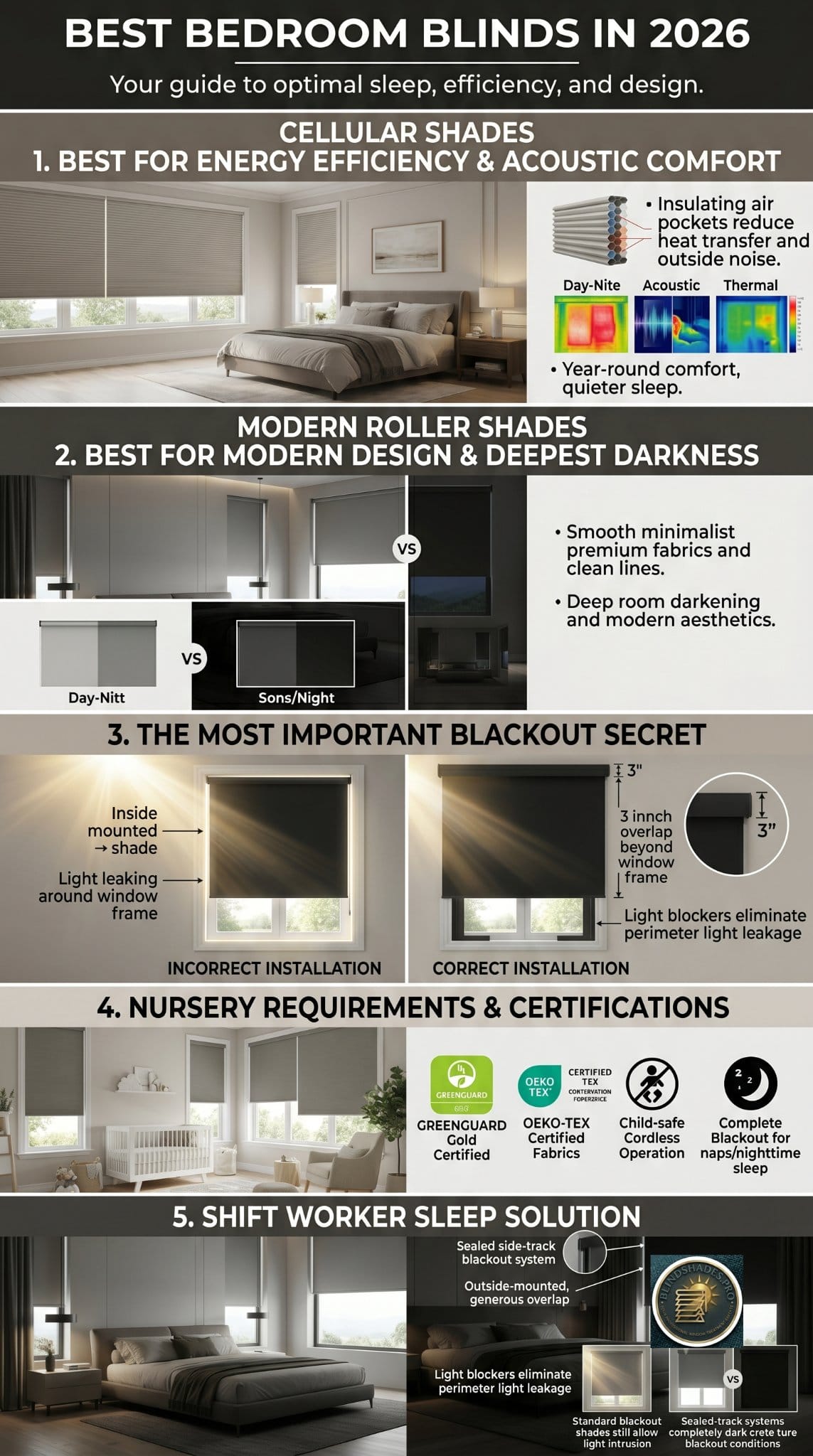
Authored by Michael Turner — 30 Years of Home Improvement Expertise | BlindShades.pro | Complete Buying Guide, Updated for 2026
The best bedroom blinds are chosen by three questions no product page asks: who sleeps in this room and how dark they actually need it, which direction the window faces and when light attacks it, and whether the job wants one product or two layers. The market’s verdicts are stable — blackout cellular shades are the most popular bedroom choice for good reason (the honeycomb insulates against heat, cold, and a measure of noise), blackout rollers are the budget darkness champions, Romans with blackout lining carry the designer vote, and zebra duals own the adjustable middle. But the single best piece of advice on this entire topic comes from a community thread, not a catalog: go with a combo — light-filtering blinds at the glass plus blackout curtains over them. This guide turns that verdict into architecture: the three sleep tiers that grade how dark is dark enough, the sun map that matches treatment to orientation, the two-layer system with its hardware rules and its mold warning, and the light-gap fixes for the halos that defeat single-layer blackout.
⭐ Quick Answer — The Best Bedroom Blinds & Shades
The best bedroom blinds are chosen at three gates — Sleep (which darkness tier the sleeper needs), Sun (which way the window faces), and System (one layer or two):
- Grade the sleeper first: room-darkening genuinely serves ordinary sleepers; light-sensitive and east-facing sleepers want true blackout plus edge management — the worth-it math is in are blackout blinds worth it for sleep; shift workers and nurseries need the total-darkness build.
- The most popular pick: blackout cellular shades — per Blindsgalore the bedroom favorite, insulating against heat, cold, and a measure of noise; blackout rollers are the budget darkness champions around the mid-forty-dollar mark.
- The top-voted answer is a combo: a light-filtering layer at the glass plus wide-mounted blackout curtains that wrap past the frame and kill the edge halos no single shade can — the leak-by-leak fixes are in why light comes through the sides of blackout blinds.
- Smart lifts are sleep tools here: a shade that opens at wake time is a light alarm — Wirecutter’s 2026 picks are SmartWings for shades and Lutron Caséta for smart wood blinds.
- The designer layer: relaxed Romans with blackout lining per Emily Henderson’s cheat sheet — and in any nursery, cordless or motorized only, no exceptions, per the best blinds for a nursery.
Key Takeaways
- Darkness is a spectrum with three tiers, not a checkbox. Ordinary sleepers are genuinely served by room-darkening; light-sensitive, streetlit, and east-facing sleepers need true blackout plus edge management; shift workers and nap-schedule nurseries need the total-darkness build — and the price difference between tiers is real money, so grade the sleeper before buying the spec.
- The top-voted answer is a system, not a product. The standing community verdict — light-filtering blinds with blackout curtains over them — wins because it splits the job: the glass layer handles daytime privacy and softness, the curtain layer wraps past the frame and kills the edge halos that defeat every single-layer blackout shade.
- The category’s most popular pick has a mechanism. Blackout cellular shades lead bedroom sales per Blindsgalore because the honeycomb traps air — stabilizing temperature against heat and cold and taking a modest edge off high-frequency noise — which is also why the AI answer’s insulating picks are cellular at every budget, from IKEA’s Trippevals to Bali’s blackout line.
- Sun direction picks the strategy before style does. East windows fight dawn (the top-down and blackout plays), west windows fight evening heat and glare, streetlit windows fight all night at low intensity, and true-dark rooms need honesty most of all: they can skip the blackout premium entirely.
- Smart lifts earn their keep on schedules. Wirecutter’s 2026 smart picks (SmartWings for shades, Lutron Caséta for wood blinds) matter in bedrooms for one reason above the gadgetry: a shade that opens itself at wake time is a light alarm — and one that closes itself at dusk keeps the streetlight tier honest without a nightly ritual.
Quick Specification Reference
| Spec | The short answer |
|---|---|
| The three gates | Sleep (who sleeps here, which darkness tier) → Sun (which direction, when does light attack) → System (one layer or two; manual, cordless, or smart) |
| The most popular pick | Blackout cellular — insulation against heat, cold, and a measure of noise |
| The budget darkness pick | Blackout roller shades — the market’s priced best-overall answer sits around the mid-forty-dollar mark per the current citations |
| The designer pick | Relaxed Roman with blackout lining — the standing style-guide verdict |
| The adjustable pick | Zebra dual shades — alternating sheer and solid bands for daytime tuning |
| The system verdict | Light-filtering layer at the glass + blackout curtain layer over it, rod mounted wider and higher than the frame |
| The halo problem | Every inside-mounted shade leaks at its edges; manage with outside mounts, side channels, or the curtain layer |
| Nursery rule | Cordless or motorized only — no accessible cords, full stop |
| Price band | Budget rollers in the tens of dollars through custom cellular and smart builds — stated in words throughout, per our no-fabricated-prices rule |
| Store-rating snapshot | Blindsgalore 4.7 across roughly 4,600 reviews; zebra duals at 4.5 across roughly 576; the recurring warning: a page-one roller sits at 3.3 across roughly 347 |
Read the complete guide below for: the Sleep–Sun–System Test; six verified picks with independent and designer citations; the three sleep tiers with a build per tier; the two-layer system with its hardware rules and mold warning; the sun-orientation map; the style matrix; the light-gap fix table; the smart-bedroom verdict; and the where-to-buy comparison.
What Are the Best Bedroom Blinds & Shades? Our Picks
Six verified picks — one per job, because a nursery, a shift worker, and a design-first primary suite are three different briefs.
| Pick | Product / style | Gate it wins | The attributed case |
|---|---|---|---|
| Best Overall Blackout | ChrisDowa blackout roller | Sleep (tiers 2–3 on a budget) | The market’s priced best-overall blackout citation — around forty-four dollars via Amazon — budget-friendly, insulating, and effective at darkening |
| Best Insulating | Bali Blackout Cellular — with IKEA Trippevals as the budget footnote | Sleep + energy | The cellular consensus: honeycomb traps air to stabilize room temperature, cited around one hundred ninety-seven dollars custom (Bali) and around sixty-five for the flat-pack Trippevals, with The Spruce among the sources behind the pick |
| Best Smart | SmartWings motorized roller — Lutron Caséta Smart Wood Blinds on the blinds side | System (schedules) | Wirecutter’s 2026 smart-window verdicts (May 8, 2026): SmartWings for smart shades and drapery, Lutron Caséta for smart wood blinds |
| Best Soft / Designer | Relaxed Roman with blackout lining | Style + tier 2 | The standing designer verdict — Emily Henderson’s whole-home cheat sheet (February 28, 2024) runs linen relaxed Romans with blackout lining in the bedrooms |
| Best Day/Night Adjustable | Zebra dual-band shades | Sun (tunable daylight) | The adjustable-stripe pick in the AI answer, with the strongest zebra rating on the market at 4.5 across roughly 576 reviews (Blindster’s dual line) |
| Best Room-Darkening Slats | Cordless room-darkening faux wood | Tier 1 + rentals | The slat answer for daytime privacy plus honest tier-1 darkness — the allen + roth class rates 4.3 across roughly 214 reviews |
Read the table by tier and system, not top to bottom: a tier-1 sleeper is done at the last row, a tier-3 shift worker starts at the first row plus the curtain layer, and every pick’s deep dive lives in its home guide — the blackout build itself in the best blackout blinds and shades guide (that hub is product-first: how to build darkness; this page is room-first: who needs which darkness), cellular fabrics in the cellular and honeycomb hub, the zebra mechanism in the best zebra banded shades guide, Romans in the best Roman shades guide, and slats in the faux wood hub.
How Do You Choose Bedroom Blinds? The Sleep–Sun–System Test
Three gates in order: grade the sleeper, map the sun, then decide one layer or two.
| Gate | The question | What the answer decides |
|---|---|---|
| Sleep | Who sleeps here — and which of the three darkness tiers do they need? | The spec and the budget: room-darkening (tier 1), blackout plus edge management (tier 2), or the total-darkness system (tier 3) |
| Sun | Which way does the window face, and when does light attack — dawn, evening, all-night streetlight, or never? | The strategy: top-down morning control, west-heat fabrics, low-intensity night sealing, or the honest skip |
| System | One product or two layers — and manual, cordless, or smart? | The architecture: single shade for tiers 1–2 in kind orientations, the two-layer combo for serious darkness, smart lifts where schedules rule |
The gates exist because bedroom regrets are almost always tier mismatches. The most common: paying the blackout premium for a tier-1 sleeper in a dark-facing room (money that wanted to be fabric quality instead), and its mirror — expecting a single inside-mounted blackout shade to deliver tier-3 darkness, then discovering the halo of light around all four edges at five in the morning. Google’s answer for this exact search ends by asking three questions it cannot answer — blackout or light-filtering, budget, standard sizes — and the first two are the Sleep and System gates wearing shopping clothes. Run the gates in order; the sections below arm each one, starting with the question nobody on this market defines.
How Dark Is Dark Enough? The Three Sleep Tiers
“Blackout” is sold as one thing; sleepers need three different things — and the price gaps between them are real.
| Tier | Who it is | The build | The dedicated deep-dive |
|---|---|---|---|
| Tier 1 — the ordinary sleeper | Sleeps through moderate light; wants morning dimness, not a cave | Room-darkening shades or slats — genuinely enough, and meaningfully cheaper | The distinction that saves the money: blackout vs room-darkening shades |
| Tier 2 — the light-sensitive sleeper | Wakes at dawn glow, streetlight, headlight sweeps; east-facing rooms live here | A true blackout shade plus edge management (outside mount or the curtain layer) | Whether the upgrade pays: are blackout blinds worth it for sleep — and the dawn-specific play in the east-facing bedroom guide |
| Tier 3 — the daylight sleeper | Shift workers, and nurseries running daytime naps | The total-darkness system: blackout layer + sealed edges + the two-layer combo; smart lifts for schedule sanity | The full builds: shift-worker bedroom blackout blinds and the best blinds for a nursery — where the safety rule is absolute: cordless or motorized only |
Two honest notes complete the tiers. First, the fabric question inside tier 2: blackout is a property of the fabric or liner, not the style — rollers, cellulars, Romans, and pleated shades all offer it, and the family comparisons are already settled spoke by spoke: blackout roller vs blackout cellular for bedrooms, blackout pleated vs blackout cellular, can pleated shades be blackout, and are blackout roller blinds worth it. Second, the noise claim deserves its honest size: the category’s most popular pick is marketed as insulating against heat, cold, and noise, and the mechanism is real — trapped air in the honeycomb damps high-frequency sound modestly — but it makes a softer room, not a quiet one; sleepers fighting traffic noise should spend on window sealing and mass, not expect a shade to do acoustic work.
Why Is the Top-Voted Bedroom Answer a Combo? The Two-Layer System
The standing community verdict — light-filtering blinds plus blackout curtains — wins on physics, and no product page will tell you why.
The most useful sentence on this entire search results page is six years old and top-voted in a homeowners thread: go with a combo — light-filtering blinds with blackout curtains over them. Here is why it beats a single premium blackout shade at the thing blackout shades are for. Any shade mounted inside the window frame leaks light around all four edges — the halo — because fabric cannot touch frame on every side and still move. Make the fabric more opaque and the halo gets more visible by contrast, not less. The combo splits the job instead: a light-filtering or privacy layer lives at the glass and handles the daytime (soft light, privacy, view control, looks), while a blackout curtain layer mounts on the wall — wider and higher than the window — and wraps past the frame entirely, closing the halo from outside the shade’s geometry. Each layer does one job at full strength.
| Layer | The job | Budget build | Better build | The rules |
|---|---|---|---|---|
| Glass layer | Daytime privacy, light softening, view tuning | Light-filtering roller or cordless room-darkening faux | Light-filtering cellular (adds the insulation), zebra dual (adds tunability), or top-down-bottom-up for morning-light craft per the TDBU guide | Cordless as default; inside mount is fine here — the halo is the next layer’s problem |
| Darkness layer | Night; kill the halo | Blackout curtain panels on a wall rod | Blackout drapery with wraparound (return) rods; motorized drapery at the top end | The sixty-vote hardware rule from the design threads: mount the rod wider and higher than the frame so panels stack off the glass by day and overlap the frame by night — floor-length, generous fullness |
One warning from the same community thread deserves its own paragraph, because it is the bathroom’s steam physics visiting the bedroom: a homeowner reported black mold blooming above the curtains, and the mechanism checks out. Heavy blackout panels closed all night trap a pocket of humid room air against the coldest surface in the room — the glass — and condensation forms behind the curtain where it never dries. The fixes are habits and geometry, not products: open the panels fully by day so the glass dries, keep a small standoff rather than pressing fabric to the frame, run winter humidity sensibly, and in chronically weepy windows let an insulating glass layer (cellular) warm the pane the way our condensation coverage describes. The combo is still the right answer — it just wants daylight discipline.
Which Way Does Your Bedroom Face? The Sun Map
Orientation picks the strategy before any style enters the room.
| The window | When light attacks | The strategy |
|---|---|---|
| East-facing | Dawn — low, horizontal, and early | The tier-2 classic: blackout or the two-layer combo for sleep-ins, or the craftier play — drop the top of a TDBU for soft sky while the band holds the sightline; the full morning playbook is the east-facing bedroom treatment guide |
| West-facing | Late afternoon and evening — heat plus glare at bedtime hours | Insulating fabrics earn their keep: blackout cellular stabilizes the room against the evening heat load before sleep |
| North-facing (and shaded south) | Rarely — the honest tier | Skip the blackout premium; spend on fabric quality, privacy, and looks — tier 1 by geography |
| Streetlit / urban any-direction | All night at low intensity | Constant low light defeats half-measures worse than dawn does: true blackout fabric plus edge management, and a smart dusk-close schedule keeps it effortless |
| Sliding glass doors in the bedroom | Whole-wall exposure | The door-scale version of this fight is its own build: blackout blinds for sliding glass doors |
| Basement bedrooms | Little light — but privacy at grade level | The reverse brief: modest darkness needs, serious sightline needs — covered in basement bedroom window treatments |
The map’s quiet money lesson sits in the north-facing row: a large share of bedrooms simply do not need the blackout premium, and a guide willing to say so buys the trust that the tier-3 sections spend. Measure the actual problem — stand in the dark room at the worst hour and look — before paying to solve a theoretical one. When blackout is the answer, measure for it properly; edge geometry decides performance, and the method is in how to measure windows for blackout blinds.
Which Bedroom Blind or Shade Style Fits Your Build?
The style matrix — every serious option among the best bedroom blinds and shades, placed by tier and layer.
| Style | Darkness ceiling | Best bedroom role | The note |
|---|---|---|---|
| Blackout roller | Tier 2 alone; tier 3 in the combo | The budget darkness workhorse | The market’s priced best-overall pick; minimal and clean |
| Blackout cellular | Tier 2 alone; adds insulation | The most popular bedroom shade, per the category’s own data | Heat, cold, and modest noise damping from the honeycomb |
| Roman with blackout lining | Tier 2 | The designer layer — soft folds, serious lining | The style-guide verdict; the bedroom build is blackout Roman shades for bedrooms |
| Zebra dual-band | Tier 1 | The daytime tuner — sheer and solid bands align or offset | Pair with a darkness layer for sleepers past tier 1; the mechanism is in the zebra shades guide |
| Room-darkening faux/wood slats | Tier 1 | Daytime privacy plus honest dimness; the rental answer | Slats always leak at the route holes and edges — that is the ceiling |
| Top-down-bottom-up | Tier 1–2 (fabric-dependent) | The morning-light craftsman’s pick | Sky above, privacy band below |
| Curtains / drapery | Tier 3 as the outer layer | The halo-killer | Never the glass layer alone — the mold paragraph explains why |
| Motorized anything | Inherits its fabric’s tier | The schedule layer | The bedroom-specific build is motorized blackout blinds for bedrooms |
Why Is Light Leaking Around Your Blackout Blinds? The Gap Table
The halo is geometry, not defect — and each edge has its own fix.
| The leak | Why it happens | The fix |
|---|---|---|
| Side halos | Inside-mount clearance — fabric cannot touch the frame and still travel | Outside mount with generous overlap; side channels/tracks on the frame; or the curtain layer wrapping past the edges — the full diagnosis is in why light comes through the sides of blackout blinds |
| Top gap | Light spills over the headrail — the “cover the top” problem shoppers keep searching | An L-shaped light-blocking strip above the headrail, a deeper valance/cornice, or mounting the shade higher with overlap |
| Bottom glow | Sill gap under the rail | Outside mount running past the sill; a weighted hem kissing the sill on the combo’s curtain layer |
| The whole-window halo | A premium blackout fabric making every edge leak more visible by contrast | The system answer: stop asking one layer to do two jobs — the two-layer combo section above |
The gap table is also the honest sales pitch for the combo: side channels and cornices solve edges piecemeal at hardware prices, while one wall-mounted curtain layer solves all four edges at once and adds the design layer the room probably wanted anyway. Renters take note: every fix in the table has a no-drill variant (tension-mounted glass layer, damage-free rod hardware), so tier-2 darkness is achievable without touching the deposit.
Are Smart Blinds Worth It in a Bedroom?
More than in any other room — because a bedroom shade on a schedule is a sleep tool, not a gadget.
The bedroom is where motorization stops being convenience and starts being sleep hygiene. A shade that opens itself at wake time is a gentle light alarm — morning light on schedule, no phone involved; one that closes at sunset keeps a streetlit room’s darkness automatic; and a shift worker’s blackout that seals itself at eight in the morning removes the one ritual standing between a night shift and bed. The independent verdicts to buy against are current and specific: Wirecutter’s 2026 smart-window testing (May 8, 2026) picks SmartWings for motorized shades and drapery and Lutron Caséta for smart wood blinds — the drapery pick mattering here because the two-layer combo’s curtain layer can be motorized too. Route, power, and protocol decisions (battery vs wired, remote vs app vs voice) are room-agnostic and live in the motorized and smart blinds guide; the bedroom-specific blackout build is in the motorized-blackout spoke linked in the style matrix. The honest counterweight: a tier-1 sleeper with a reachable window gains little — spend the motor budget on the fabric.
Where Is the Best Place to Buy Bedroom Blinds & Shades?
The search box says Amazon and IKEA; the custom houses say cellular — both are right, by tier.
| Channel | The record | Wins when |
|---|---|---|
| Marketplace (Amazon) | The priced best-overall blackout roller citation lives here (around forty-four dollars); zebra and roller stock with deep review counts | Tier 1–2 on standard windows; fast, cheap, returnable |
| Flat-pack (IKEA) | The Trippevals blackout cellular around sixty-five dollars; category rated 4.2 | The budget cellular entry |
| Custom online | Blindsgalore’s bedroom category (4.7 across roughly 4,600; thirty-day returns) with the most-popular cellular verdict; Blindster’s zebra line at 4.5 across roughly 576; Blinds.com’s custom range | Exact fits, blackout cellular, lined Romans, TDBU |
| Big-box | Bali blackout cellular custom (around one hundred ninety-seven cited); allen + roth room-darkening faux 4.3 across roughly 214 | Standard sizes with a storefront |
| Smart | The Wirecutter pair: SmartWings and Lutron Caséta | Schedule-driven bedrooms |
| Premium dealer | Hunter Douglas Duette — marketed as absorbing or deflecting nearly all incoming light | Design-led primary suites |
The recurring warning applies here more than anywhere: a cordless roller shade ranks on this very page at 3.3 across roughly 347 reviews, and a bedroom is the last room to gamble on a 3.3 — the mechanism gets cycled twice a day forever and the fabric’s opacity is the entire product. Check the exact SKU’s rating and recent reviews, prefer long return windows, and shop with the spec sheet this guide built: the best bedroom blinds order is tier, orientation strategy, one layer or two, cordless or smart, and the gap plan.
Related guides: striped shades in a sleep room need the room-darkening band option — the fork is explained in the complete guide to zebra and banded shades.
Supporting Articles in This Cluster
- Are Blackout Blinds Worth It for Sleep?
- Blackout Shades vs Room-Darkening Shades
- Best Window Treatment for an East-Facing Bedroom
- Shift-Worker Bedroom Blackout Blinds
- Best Blinds for a Nursery
- Blackout Roller vs Cellular Shades for Bedrooms
- Blackout Roman Shades for Bedrooms
- Blackout Pleated vs Blackout Cellular
- Can Pleated Shades Be Blackout?
- Are Blackout Roller Blinds Worth It?
- Motorized Blackout Blinds for Bedrooms
- Why Light Comes Through the Sides of Blackout Blinds
- How to Measure Windows for Blackout Blinds
- Blackout Blinds for Sliding Glass Doors
- Basement Bedroom Window Treatments
- Best Zebra Banded Shades
Related Buying Guides
- The Best Blackout Blinds & Shades Buying Guide — product-first: how darkness is built
- The Best Cellular & Honeycomb Shades Buying Guide
- The Best Top Down Bottom Up Shades Buying Guide
- The Best Roman Shades Buying Guide
- The Best Motorized & Smart Blinds Buying Guide
- The Best Faux Wood Blinds Buying Guide
Frequently Asked Questions
What are the best blinds for a bedroom?
Grade the sleeper first. Ordinary (tier 1) sleepers are well served by room-darkening shades or cordless room-darkening slats — genuinely enough, and cheaper. Light-sensitive and east-facing (tier 2) sleepers want a true blackout shade — the priced market favorites are blackout rollers at the budget end and blackout cellular (the most popular bedroom shade, with insulation as the bonus) in the middle — plus edge management. Shift workers and nurseries (tier 3) need the system: a blackout layer plus wide-mounted blackout curtains that seal the edge halos, with cordless-only hardware in any child’s room.
Do I need blackout or just room-darkening shades?
Run the one-minute test: stand in the dark room at the worst light hour (dawn for east windows, night for streetlit ones) and judge honestly. If moderate glow does not wake you, room-darkening saves real money and keeps mornings pleasant. If dawn or streetlight wakes you, buy true blackout fabric — but know that the fabric alone leaves edge halos, so pair it with an outside mount, side management, or the curtain layer. North-facing and well-shaded bedrooms frequently need no blackout at all; spend on fabric quality instead.
How do you stop light coming in around blackout blinds?
Treat each edge: side halos want an outside mount with generous overlap, side channels, or curtains wrapping past the frame; the top gap wants a light-blocking strip or cornice above the headrail; the bottom glow wants the shade run past the sill or a weighted curtain hem. The one-move answer is the two-layer system — a wall-mounted blackout curtain layer, rod wider and higher than the frame, closes all four edges at once, which is exactly why the top-voted community advice is a combo rather than a single premium shade.
Are cellular shades good for bedrooms?
They are the category’s most popular bedroom shade, and the mechanism is honest: the honeycomb traps air, which stabilizes the room against heat and cold (east and west bedrooms feel this most) and damps high-frequency noise modestly — a softer room, not a soundproofed one. Blackout cellular fabrics reach tier-2 darkness; pair with edge management or the curtain layer for tier 3. Budget versions start at flat-pack prices and custom blackout cellular sits in the mid-hundreds, per the current market citations.
What blinds are safest for a nursery?
Cordless or motorized only — no accessible operating cords of any kind, no exceptions; the industry’s safety standard moved the whole stock market cordless for exactly this hazard. Beyond the rule: blackout matters more in nurseries than anywhere (daytime naps are tier-3 darkness), fabrics should be wipeable, and a motorized shade on a nap schedule earns its cost in silence — no rattling a sleeping baby’s window. The full room build is in our nursery guide.
Should I use blackout curtains and blinds together?
For serious darkness, yes — that is the system this guide is built around. The shade at the glass handles daytime privacy and light tuning; the blackout curtains on a wide, high rod handle night and kill the edge halos no single shade can. Hang the rod wider and higher than the frame, run panels to the floor with generous fullness, and open them fully each morning — both for the light and to let the glass dry, which prevents the trapped-condensation mold the community threads warn about.
By Michael Turner | 30 Years Home Improvement Expertise | Updated 2026 | BlindShades.pro
