Best Integral & Between-Glass Blinds (2026): Windows With Blinds Built In

Authored By Michael Turner -30 Years Home Improvement Expertise | Updated 2026 | BlindShades.pro
Updated on July 20, 2026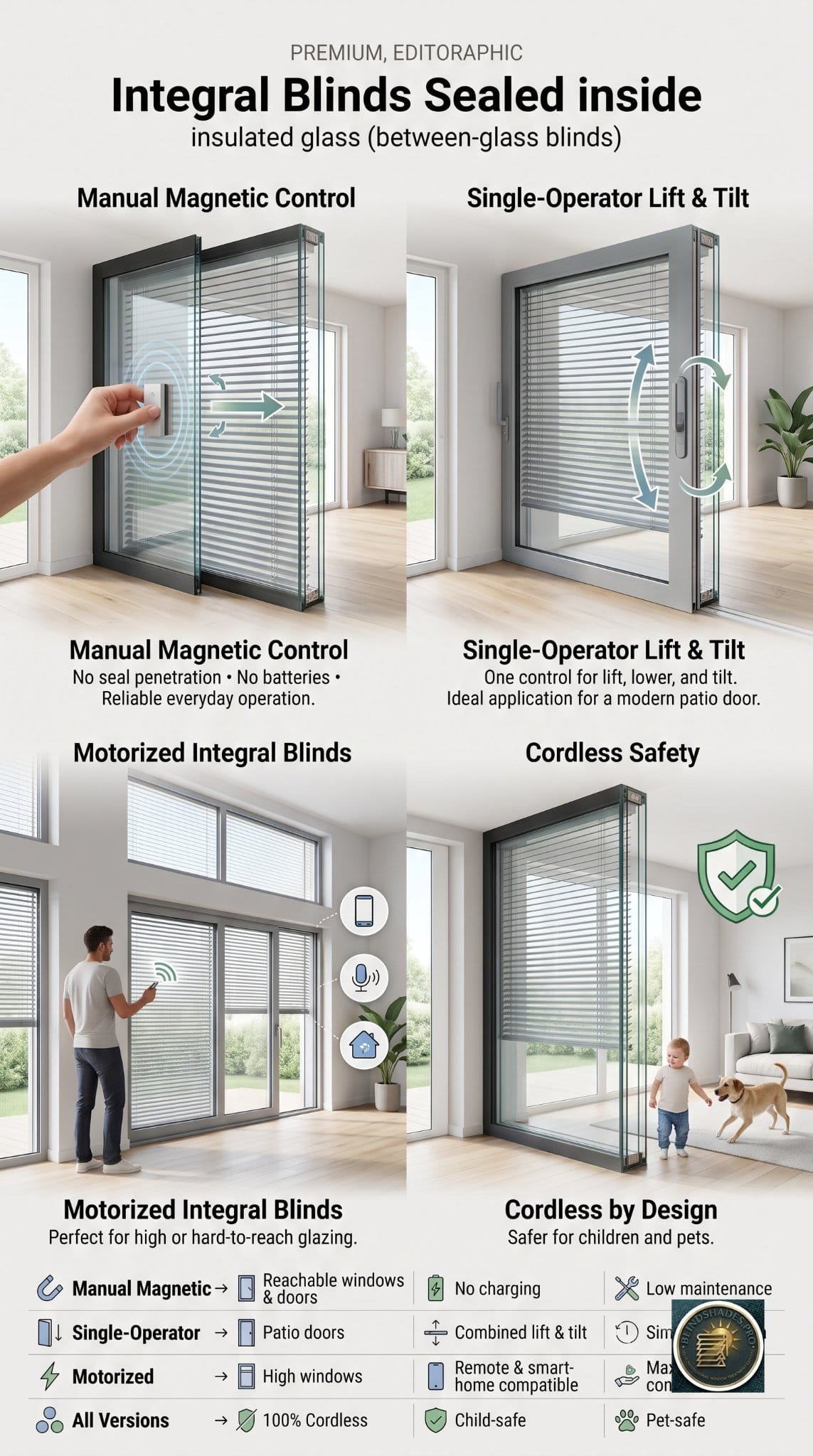
By Michael Turner — 30 years in the window treatment industry
Integral blinds — blinds between the glass — are sealed inside a double-pane unit at the factory, which makes them the only product on this site you mostly cannot buy as a blind: you buy them as a window, a door, or a glass insert, and that single fact reorganizes every decision that follows. The market’s own summary states the benefits cleanly (no dusting ever, no dangling cords by construction, Low-E and argon insulation) and buries the cost in one sentence this guide promotes to a headline: if the internal mechanism breaks, you will often need to replace the entire sealed glass unit rather than just the blind. So run the Between-Glass Test — Buy-In (which of the three doors into the category), Benefit (what the seal genuinely buys you), Breakdown (what failure costs, priced before purchase) — and this manufacturer-dominated field becomes a decision a homeowner can actually make.
Key Takeaways
- You’re buying a window, not a blind. True integral blinds arrive as sealed units from window and door makers — quoted per opening, installed as glazing — which is why “who makes windows with blinds between the glass” is the category’s smartest search.
- There are three ways in, at three commitment levels: factory-sealed units (new windows and doors), glass-insert replacement (the door middle path), and add-on enclosed units (the reversible aftermarket champion carrying four point seven across thirty-six hundred reviews).
- The breakdown math is the real spec sheet: a jammed integral blind can mean a new sealed unit, so the mechanism warranty term — not the fabric color — is the number to negotiate before signing.
- The benefits are genuinely structural: dust-free forever, cordless child-and-pet safety by construction, and glazing-grade insulation — the three claims every manufacturer makes and the seal actually delivers.
- The retrofit skeptics are right about scope: converting an existing house means re-glazing it — which is why this category’s natural home is new construction, door replacement, and one insert at a time.
⭐ Quick Answer — The Best Integral & Between-Glass Blinds
The best integral blinds pass the Between-Glass Test — Buy-In (factory-sealed, glass insert, or add-on), Benefit (dust-free, cord-free, best summer-shading position), Breakdown (the mechanism warranty term, priced before signing):
- The aftermarket verdict: ODL’s add-on enclosed blinds — four point seven across roughly thirty-six hundred reviews at about one forty-five — reversible, an hour’s install, the same enclosed lane ranked second in the sidelights and front door blinds guide.
- The factory tier: blinds tucked between the panes on custom windows and patio doors at Pella and sliding built-ins at Andersen — bought as windows, judged by the mechanism warranty term.
- The trade truth: much of the category is fabricated by INTIGRAL, the fenestration industry’s integrated-blinds resource — which is why the who-makes question is the right one.
- The breakdown math first: a failed internal mechanism often means replacing the entire sealed unit — get the warranty term in years, in the quote; the powered tier’s wider logic is in the motorized and smart blinds guide.
- The patio-door decision in full: sliders, bi-folds, and their between-glass options are mapped in the sliding glass door blinds guide.
Quick Specification Reference
| Specification | Between-glass reality (2026) |
|---|---|
| What it is | Blinds sealed between two panes of tempered glass — sold as windows, doors, and inserts |
| The three ways in | Factory-sealed units · glass-insert replacement · add-on enclosed (surface-mounted) |
| The controls | Manual magnetic operators (sliding, no glass penetration) or motorized (remote, app, smart hub) |
| The structural benefits | Zero dusting · no dangling cords · Low-E and argon glazing insulation |
| The breakdown truth | Mechanism failure often means replacing the entire sealed unit — warranty terms first |
| The price shape | About eighty-two to seven thirty-five for door products; factory units quoted per opening |
| Who makes them | Pella, Andersen, ProVia, Milgard, ODL — with INTIGRAL as the trade’s fabricator |
| The retrofit reality | Whole-house conversion = whole-house re-glazing; the category grows one door at a time |
| The natural homes | New construction, patio and entry door replacement, high transoms, child-safety-first rooms |
Read the complete guide below for: the six picks across all three ways in, the Between-Glass Test (Buy-In · Benefit · Breakdown), the who-makes manufacturer table with the replacement-parts question answered, the three-doors routing map, magnetic versus motorized, the energy claims examined, the breakdown math priced honestly, and the warning table this SERP earns.
What Are the Best Between-Glass Blinds in 2026? — Our Picks
Review volumes are stated exactly as the market shows them; the factory tier is quoted, not rated, and the table says so.
| Pick | Product | Rating / reviews | Price (words) | The lane |
|---|---|---|---|---|
| Best Aftermarket (the verdict) | ODL Cordless Add-On Enclosed Aluminum Blinds | 4.7 across ~3,600 | About one forty-five | Surface-mounted over door glass — reversible, an hour’s install |
| Best for Steel & Fiberglass Doors | ODL Enclosed Blind, steel/fiberglass version | 4.7 across 206 | About one forty-five | The same champion, door-material matched |
| Best Glass-Insert Path | ODL Blinds Between Glass Low-E Insert (22-in class) | 4.5 across 70 | About six thirty | Replaces the door’s glass unit — true between-glass, one door at a time |
| Best Custom-Window Tier | Pella Between-the-Glass program | Manufacturer-quoted | Per opening | The built-in system for custom windows and patio doors |
| Best Patio-Door Tier | Andersen Built-In Blinds | Manufacturer-quoted | Per opening | Sliding blinds between the glass on patio doors — insulated, secure, in the maker’s words |
| Best Budget Door Blind | EaseEase Glass Door Blinds | 4.5 across 8 — flagged thin | About eighty-two | The entry experiment, bought on the return window |
Two honesty notes before the framework. First, the factory tier carries no public review bases because it is sold as fenestration — judged by window-brand reputation and, crucially, by warranty language rather than star counts; INTIGRAL, which describes itself as the fenestration industry’s fully integrated blinds resource with custom-manufactured dimensions, is the fabricator behind much of what the brands sell, which tells you how trade-shaped this category is. Second, this SERP contains a between-glass door insert at one point zero across two reviews for about seven thirty-five — the most expensive one-star listing this site has ever flagged, and the warning table gives it the ceremony it deserves.
The Between-Glass Test: Buy-In · Benefit · Breakdown
Three questions in order — how you enter the category, what the seal genuinely buys, and what failure costs — and the third one belongs in the purchase conversation, not the repair one.
| Between-Glass Test step | The question | The failure it prevents |
|---|---|---|
| Buy-In | New sealed units, a glass insert, or an add-on? | Re-glazing a house that only needed one enclosed door blind |
| Benefit | Is dust-free, cord-free, and insulated worth the premium HERE? | Paying glazing prices for a guest-room window nobody touches |
| Breakdown | What does the mechanism warranty say, in years and in scope? | The jammed blind that becomes a new sealed unit at your expense |
Who Makes Windows with Blinds Between the Glass? The Manufacturer Table
The who-makes question is the category’s smartest search, because the blinds between glass manufacturers list IS the shopping list — windows with built in blinds are bought by brand and warranty, and the replacement-parts question gets its honest answer here too.
| Maker | The lane | The claim, in their words |
|---|---|---|
| Pella | Custom windows and patio doors | Blinds tucked between panes of glass, protected from dust and damage — and still accessible if service is needed |
| Andersen | Patio doors and windows | Sliding blinds between the glass — privacy or full light, in a well-insulated, secure frame |
| ProVia | Entry-door and window internals | Internal blinds made with sturdy aluminum, custom fit to each window’s exact dimensions |
| Milgard | Windows with magnetic operators | Sealed in the glass unit, clean and free of debris — a sliding magnetic operator moves the blinds without piercing the glass |
| ODL (and ODL Blink) | Doors — inserts and add-ons | Widely regarded as the premier aftermarket and replacement option; one operator lifts, lowers, and tilts |
| INTIGRAL | The trade fabricator | The fenestration industry’s fully integrated blinds resource, custom-manufactured dimensions |
| Privacy Glass Solutions | Sealed panels | An integral system that seals the blinds between two glass panels against dust, damage, and wear |
The Pella blinds between the glass replacement parts question, answered honestly: operators, magnetic sliders, clips, and exterior handles are orderable parts; the blind assembly inside the sealed unit generally is not — service on the blind itself typically means the glass unit, which is the breakdown section’s whole argument. And the Reddit skeptic’s point deserves its full hearing: are these any good? — the top answer’s caveat is that you’ve got to replace all the glass panels in all your doors and windows to get them, and that is exactly right as a retrofit description. This category’s economics work one opening at a time: the new patio door, the replaced entry glass, the addition’s window package — not the whole-house conversion. (The sightings are still encouraging: the same thread’s second answer has seen them on a friend’s bi-folds and calls them decent, which matches the category’s quiet growth on exactly such doors.)
The Three Ways In: Sealed Unit, Glass Insert, or Add-On?
One phrase, three products, three commitment levels — the routing map nobody in this market draws.
| The way in | What it is | Cost shape | Commitment | Breakdown exposure |
|---|---|---|---|---|
| Factory-sealed integral | Blinds built into new windows/doors at manufacture | Quoted per opening — glazing money | Permanent; installed as fenestration | Highest — the unit IS the product; warranty term is everything |
| Glass-insert replacement | The door’s glass unit swapped for a between-glass one | About six hundred to seven fifty per door | Semi-permanent; a glazier’s afternoon | The insert replaces as a unit — mid exposure |
| Add-on enclosed | A framed blind unit surface-mounted OVER the existing glass | About eighty to one fifty per door | Reversible; screws and an hour | Lowest — a failed unit unscrews; the glass never changes |
The synthesis: the add-on lane is where this category meets ordinary buyers — thirty-six hundred reviews say so — and it delivers most of the sealed benefits (enclosed against dust, cordless, slam-proof) at a tenth of the insert’s price with none of the glazing commitment; it is the same enclosed lane that earned Ranked 2 in our sidelights and front door blinds guide, now given its full family tree. The insert lane is the honest middle path for a door you love with glass you don’t. And the factory lane is for openings being bought anyway — where the incremental cost of blinds-in-the-glass is a line item on a window order, not a project of its own. One more routing note the naming soup demands: windows with built in blinds is the plain-English phrase for the factory lane, internal blinds is the UK-leaning synonym the manufacturer pages use, and enclosed blinds usually means the add-on lane — three registers of the same family, mapped once here so no reader shops the wrong one. If your search began with a search bar’s autocomplete rather than a project plan, the table above is the two-minute version: match your commitment level first, and the price band follows.
Magnetic or Motorized: How Should Integral Blinds Operate?
Two control families, both cordless by construction — and the choice is really about reach and rooms.
| Control | How it works | Best for | The note |
|---|---|---|---|
| Manual magnetic | A sliding magnetic operator on the glass face moves the blinds inside — no penetration of the seal | Reachable windows and doors | The Milgard-class mechanism; nothing to charge, little to fail |
| Single-operator lift/tilt | One control raises, lowers, AND tilts | Doors — the ODL Blink pattern | The aftermarket standard’s whole pitch |
| Motorized integral | Remote, smartphone app, or smart-home hubs | High transoms, tall patio doors, whole-wall glazing | The market’s own use-case: hard-to-reach glass — the wider powered logic is in our motorized and smart blinds guide |
| The safety constant | No dangling lift cords in ANY version | Nurseries, playrooms, pet homes | The child-and-pet recommendation the category earns by construction |
Do Integral Blinds Insulate? The Energy Claims, Examined
The glazing does the insulating; the blind does the shading — and the honest answer to the double-glazing heat question is “yes, usefully, via both.”
The DIY forums ask it directly — double glazing integral blinds, good for keeping out heat? The mechanics: the sealed unit’s insulation comes from the glazing itself — the market’s own guidance says to look for Low-E coatings and argon gas to maximize insulation and control heat transmission — while the blind inside adds solar shading at the ideal position: behind the outer pane, where absorbed heat is partially rejected back out before entering the room. That between-panes position genuinely beats an interior blind for summer heat, modestly, and matters most on west glass and big sliders. What integral blinds do NOT add is the dead-air cellular effect — a closed honeycomb still wins winter nights, per our thermal and insulating blinds guide — so the honest energy frame is: buy the Low-E/argon spec for insulation, enjoy the blind’s between-glass shading as summer’s bonus, and let curtains or cellulars do the winter-night shift where that matters.
| Claim | The verdict |
|---|---|
| Low-E + argon insulation | Real — and it’s the GLAZING spec; demand it in the quote |
| Between-glass solar shading | Real, modest, best-in-class position for summer |
| Winter-night insulation from the blind | Not its job — the honeycomb’s territory |
| Frame insulation (patio doors) | The Andersen-class claim; judge the door as a door |
One condensation myth worth retiring while we’re here: fogging BETWEEN the panes is seal failure, full stop — the blind neither causes nor cures it, and any dealer blaming the blind for a fogged unit is describing their warranty exposure, not the physics. Fogging on the room-side face is ordinary household humidity, same as any winter window, and answers to ventilation rather than glazing.
What Happens When Integral Blinds Break? The Breakdown Math
The category’s buried sentence, promoted: mechanism failure often means replacing the entire sealed glass unit — so price the failure before the purchase.
| What fails | What it usually means | The pre-purchase move |
|---|---|---|
| The magnetic operator or external control | An orderable part — the good outcome | Confirm parts availability in writing (the Pella-parts answer above) |
| The internal lift/tilt mechanism | Often the whole sealed unit | Demand the mechanism warranty TERM in years — this is the negotiation |
| The seal itself (fogging) | The unit, full stop — same as any failed IGU | Standard glazing warranty applies; ask how blinds affect it |
| An add-on enclosed unit | Unscrew, replace, done | The reversibility dividend — about one forty-five, not a glazier visit |
| An insert | The insert swaps as a unit | Mid-cost, no wall surgery |
The framing that keeps this fair: sealed-unit replacement is not a scandal — it is the same physics as any double-pane window, plus a mechanism. The scandal would be discovering it in year six with a two-year mechanism warranty. Ten-year mechanism terms exist in this market; the buyer’s job is to make the quote say so. Two more numbers worth extracting during that conversation: the unit replacement cost itself, quoted NOW for the exact sizes being ordered (a dealer who quotes it readily is telling you the failure path is routine; one who won’t is telling you something too), and the expected parts-availability horizon — magnetic operators and handles for a discontinued line become unobtainium faster than the glass fails, and the Reddit parts-hunters in every window brand’s forum are the proof. Write both answers on the quote. Paper remembers what showrooms forget.
What Does Install Day Look Like, Lane by Lane?
Three ways in, three very different afternoons — and knowing which one you signed up for is half the satisfaction score.
The add-on lane is a homeowner’s hour: the enclosed unit screws to the door face over the existing glass insert — measure the visible glass AND the raised frame first, pilot-drill fiberglass, use every screw in the box — and the thirty-six-hundred-review base is full of exactly that Saturday. The insert lane is a glazier’s (or a confident DIYer’s) afternoon: the door’s glass unit comes out as a cassette — retaining frame unscrewed from the interior side, old unit lifted, new between-glass unit set and re-framed — no wall surgery, but a second pair of hands and a door left standing open for an hour, so pick your weather. The factory lane is a window installation, full stop: the trades do it, the opening is flashed and sealed like any glazing job, and your role is the pre-signing homework this guide keeps repeating — the mechanism warranty term in writing, plus one question worth asking the installer directly: who services the blind side, the window dealer or the blind fabricator? (In this category the honest answer is often the dealer orders a unit from the fabricator — which is fine, as long as somebody’s name is on it.) One expectation-setting note for all three lanes: between-glass slats are slimmer and lighter than room-side venetians and read slightly smaller through two panes of glass — buyers who expect the chunky wood-blind look are the category’s commonest mild disappointment, and a showroom visit before a whole-house factory order prevents it entirely.
Where Should You Buy — and the Warning Table
The lanes: the add-on and insert products through Home Depot and Lowe’s (the ODL fleet lives there), factory-sealed programs through Pella, Andersen, ProVia, and Milgard dealers with the warranty conversation above, and the trade path through fabricators for custom projects. Note for UK readers who arrive here — integral blinds are a far bigger retrofit market there, with dedicated specialists; this guide’s pricing and lanes are US-market.
| Warning | The listing | The rule |
|---|---|---|
| The expensive one-star | A between-glass door insert at 1.0 across 2, about seven thirty-five | Two reviews agreeing it failed, at insert money — pass, loudly |
| One-review five-stars | Total-blackout door units at 5.0 across 1 | An anecdote at any price |
| Thin budget entries | 4.5 across 8 at about eighty-two | Buy on the return window |
| The naming soup | Integral, built-in, internal, enclosed, between-glass — five names, three products | The Three-Ways-In table is the decoder |
| Quoted-tier opacity | Factory programs publish no prices | Get the mechanism warranty term IN the quote before comparing |
Related Buying Guides
- Best Sidelights & Front Door Blinds — where the enclosed add-on lane earned Ranked 2
- Best French Door Blinds — the door-glass family’s operable alternatives
- Best Sliding Glass Door Blinds — the patio-door decision in full
- Best Motorized & Smart Blinds — the powered tier’s wider logic
- Best Thermal & Insulating Blinds — where winter-night insulation actually lives
- Best Interior Window Shutters — the dust-collector debate that ends in built-ins
- Best Blackout Blinds & Shades — when total darkness is the assignment
- Best Venetian Blinds — the slat geometry, outside the glass
- Best Mini Blinds — the aluminum slat family the enclosed units seal
- Best Made to Measure Blinds — custom dimensions, the ordinary way
FAQ
What are integral blinds? Blinds sealed between two panes of tempered glass at the factory — sold as windows, patio doors, and glass inserts rather than as standalone blinds — operated magnetically or by motor, never dusted, and cordless by construction.
Who makes windows with blinds between the glass? Pella and Andersen for custom windows and patio doors, ProVia with sturdy aluminum internals, Milgard with magnetic-operator units, and ODL as the premier aftermarket and door-insert maker — with INTIGRAL fabricating for the trade. The brand’s mechanism warranty term is the spec to compare.
Are blinds between the glass worth it? Where an opening is being bought anyway — new construction, a replaced patio or entry door — genuinely yes: dust-free, cord-safe, and shaded in the best position summer offers. As a whole-house retrofit, the skeptics are right: it means re-glazing the house, and the add-on enclosed lane delivers most benefits reversibly for about one forty-five a door.
What happens if integral blinds break? External operators and clips are orderable parts; an internal mechanism failure often means replacing the entire sealed glass unit. Price that before purchase: demand the mechanism warranty term in years, in the quote — ten-year terms exist, and the difference between two and ten is the real cost of the product.
Do integral blinds keep heat out? Usefully, yes — the Low-E and argon glazing does the insulating, and the blind’s between-panes position rejects summer solar gain better than any interior blind. They don’t replace winter-night insulation; a closed cellular still owns that job.
Can you add blinds between glass to existing windows? Not to the existing glass itself — but three paths exist: replace the door’s glass with a between-glass insert (about six hundred to seven fifty), surface-mount an add-on enclosed unit over the glass (about eighty to one fifty, reversible, the thirty-six-hundred-review favorite), or order the next replacement window or door with blinds built in.
The Bottom Line
Enter through the right door and this category is excellent; enter through the wrong one and it’s a re-glazing project wearing a blind’s name. Buy-In: add-on enclosed for existing doors (the arithmetic’s landslide), inserts for glass you’re ready to swap, factory-sealed for openings being purchased anyway. Benefit: take the dust-free, cord-free, best-shading-position wins at face value — they’re real and structural. Breakdown: promote the buried sentence the way this guide did — the mechanism warranty term is the price tag’s second half, and it’s negotiable exactly once, before you sign. The blinds live between the glass; make sure the fine print doesn’t.
