The Best Office & Commercial Blinds & Shades: Space, Spec, and Scale Before Style

Authored By Michael Turner -30 Years Home Improvement Expertise | Updated 2026 | BlindShades.pro
Updated on July 15, 2026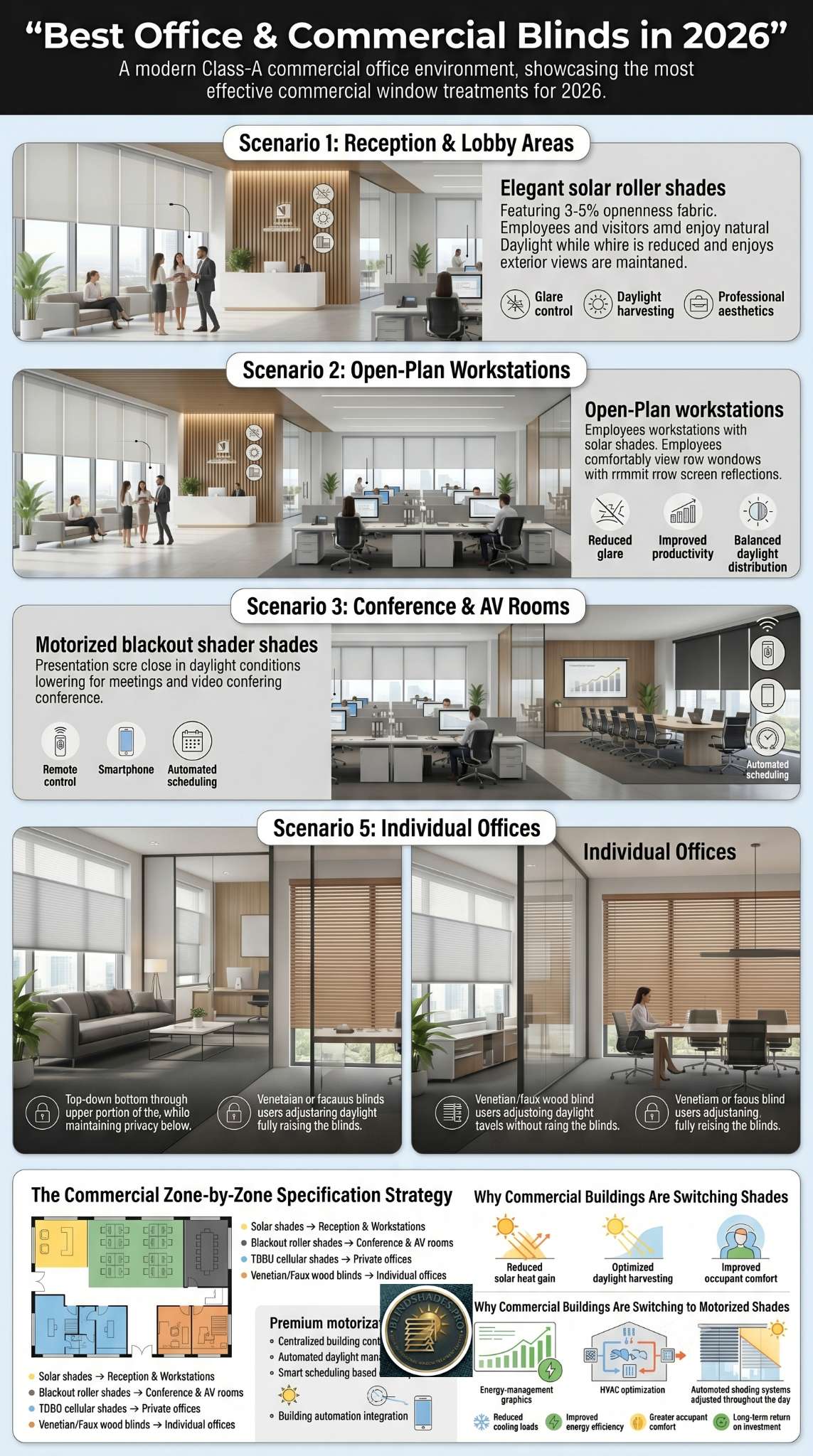
Authored by Michael Turner — 30 Years of Home Improvement Expertise | BlindShades.pro | Complete Buying Guide, Updated for 2026
The best office blinds are chosen the way commercial projects are actually bought: by space, by specification, and by scale — not by scrolling a residential catalog with a bigger budget. The market’s verdicts are consistent and correct as far as they go: commercial solar roller shades at three-to-five-percent openness are the top choice wherever computer screens live, commercial-grade vinyl blackout rollers own conference and media rooms, motorized systems earn their premium on tall glass and building-automation schedules, and cellular shades take the boardrooms where echo and extreme climate meet. What no ranking page provides is the layer underneath: the compliance stack a real commercial spec demands (NFPA 701 fire performance, cord-safety standards and their tensioner rule, low-emissions certification), the MasterFormat language procurement runs on, the contract-grade hardware distinction that decides whether shades survive daily duty cycles, and the glare geometry that explains why three-percent openness exists at all. This guide carries both layers — the office manager’s and the specifier’s — space by space.
⭐ Quick Answer — The Best Office & Commercial Blinds & Shades
The best office blinds are chosen at three gates — Space (which environment), Spec (fire, safety, and fabric documentation), and Scale (quantity, motorization, automation):
- The default: commercial solar rollers at three-to-five-percent openness — per Blindsgalore’s commercial line, the top choice for offices with computer screens; the desk-level fixes are in how to reduce computer screen glare from office windows.
- Conference and media rooms: commercial vinyl blackout rollers — or the dual-roller pocket (solar by day, blackout for presentations).
- The spec layer nobody else covers: NFPA 701 fire documentation, ANSI/WCMA A100.1 cord safety (tensioners on every loop), and GREENGUARD emissions — all verified on manufacturer cut sheets, with energy claims routed through Efficient Window Coverings rather than seller banners.
- Scale decides motorization: tall glass, curved facades, and building-automation schedules are where motors pay — Lutron’s commercial systems own the engineered end; the numbers live in motorized vs manual commercial blinds ROI.
- Buy contract-grade: metal internals, fade-warranted fabrics, warranties in writing — cheap vinyl yellows in the sun, and why office blinds turn yellow is the visible proof.
Key Takeaways
- The best office blinds are bought through three gates. Space (which environment — open-plan, conference, classroom, medical, restaurant, storefront), Spec (the fabric and compliance sheet — openness, fire performance, certifications, contract-grade hardware), and Scale (quantity, motorization, building-automation integration, and installation access) — and the order matters, because the space defines the spec and the spec defines what scale costs.
- The screen-glare verdict has a mechanism. Solar shades are the top choice for offices with computer screens per the category’s own leading seller — and the reason is geometry: tight weaves in the three-to-five-percent openness band kill both direct window glare and the veiling reflections that wash out monitors, while keeping the outward view that walls of glass were bought for.
- Compliance is the invisible half of every commercial spec. NFPA 701 flame-propagation performance is the near-universal fabric requirement in commercial interiors, cord-safety rules (ANSI/WCMA A100.1) are why commercial pages tell you to install the tensioner on any continuous loop, and low-emissions certification matters in occupied buildings — all verified on manufacturer cut sheets, never assumed from marketing copy.
- Motorization is a scale decision, not a gadget decision. On tall glass, curved facades, and multi-floor schedules, motors eliminate loose chains (a safety win the standards care about), integrate with building automation to cut HVAC load by time of day, and remove the daily labor nobody budgets — which is why the ROI math deserves its own table rather than a feeling.
- Contract-grade is a real category, not a markup. Commercial-duty shades differ from residential in the parts you cannot see — metal internals, larger tubes, heavier fabric weights, published cycle expectations — and the cheapest ranked products on this market (one page-one roller sits at 3.9 across roughly 467 reviews) are how offices end up re-buying window treatments in year two.
Quick Specification Reference
| Spec | The short answer |
|---|---|
| The three gates | Space (which environment) → Spec (openness, fire, certifications, hardware grade) → Scale (quantity, motorization, BAS, access) |
| The default product | Commercial solar roller, three-to-five-percent openness, wherever screens live |
| Conference & media | Commercial vinyl blackout roller — or the dual-roller pocket (solar + blackout) |
| Tall glass & schedules | Motorized roller/solar with building-automation integration |
| Boardrooms & extreme climates | Cellular — insulation plus a modest acoustic buffer |
| Large windows & glass walls | Vertical systems — the standing large-format answer |
| The compliance stack | NFPA 701 (fabric fire), ANSI/WCMA A100.1 (cord safety; tensioners on loops), GREENGUARD (emissions), ADA (controls reach), Title 24/LEED where applicable — verify all on cut sheets |
| The spec language | CSI MasterFormat Division 12 — window shades 12 24 00, roller shades 12 24 13 |
| Price band | Stock commercial rollers from the low tens of dollars through engineered motorized systems — stated in words throughout, per our no-fabricated-prices rule |
| Store-rating snapshot | Blindsgalore commercial 4.7 across roughly 4,600; Blinds Chalet office 4.7 across roughly 1,100; Factory Direct 4.2 across roughly 537 |
Read the complete guide below for: the Space–Spec–Scale Test; six verified picks; the establishment matrix from open-plan to storefront; the screen-glare geometry behind the three-percent verdict; the specification gap section written in procurement language; the compliance and certification table; the contract-grade fabric and hardware standards (including why cheap office blinds turn yellow); the motorization ROI table; and the commercial buying channels.
What Are the Best Office & Commercial Blinds & Shades? Our Picks
Six verified picks for the best office blinds and commercial shades — one per space, because an open-plan floor, a media room, and a storefront are different procurement problems.
| Pick | Product / system | Space it wins | The attributed case |
|---|---|---|---|
| Best Overall Commercial | Commercial solar roller, three-to-five-percent openness | Open-plan, lobbies, street-facing glass | The category verdict on record: solar shades are the top choice for offices with computer screens (Blindsgalore commercial, 4.7 across roughly 4,600) — glare down, view kept, solar heat gain cut |
| Best Conference / Media | Commercial-grade vinyl blackout roller | Presentation rooms | The AI-cited standard for darkening rooms completely; the architect-class blackout roller lines at the big custom houses are the on-record examples |
| Best Automated | Lutron commercial systems; mid-market motorized solar/roller per the Vela verdict | Tall glass, curved facades, BAS schedules | Lutron’s commercial line is positioned precisely for large windows and curved facades; the independent mid-market verdict (September 12, 2025): the best commercial motorized blinds are durable, quiet, automated solar or roller shades |
| Best Insulation / Acoustic | Commercial cellular (honeycomb) | Boardrooms, extreme climates | The trapped-air structure cuts commercial power bills and buffers boardroom echo per the current consensus — honestly sized below |
| Best Large Windows & Glass Walls | Vertical blind systems | Sliding walls, floor-to-ceiling spans | The standing large-format verdict (“if it’s large, go vertical”) — the full system decision lives in our vertical blinds hub |
| Best Budget Durable | Aluminum and faux wood horizontals | Classrooms, back-of-house, high-traffic small windows | The classroom tradition for a reason: fits any window size, survives abuse, wipes clean — the head-to-head with rollers is settled in roller shades vs venetian blinds for commercial offices |
Read the table by space, then send each pick through the Spec gate below — the same solar roller that wins open-plan flunks a spec that demands NFPA 701 documentation the SKU cannot produce. Product-family deep dives live in their hubs: solar shades (and their exterior sibling, solar screens, for the heat-first buildings), blackout systems, cellular, and motorized and smart controls.
How Do You Choose Commercial Blinds? The Space–Spec–Scale Test
Three gates in procurement order: the environment, the sheet, the rollout.
| Gate | The question | What the answer decides |
|---|---|---|
| Space | Which environment is this window in — open-plan, conference, classroom, medical, restaurant, storefront? | The product class and the openness/darkness target; each space carries different glare, privacy, hygiene, and code pressure |
| Spec | What must the fabric and hardware prove — fire performance, emissions, cord safety, antimicrobial, contract-grade internals? | The cut-sheet checklist; this gate is where residential lookalikes wash out |
| Scale | How many openings, how tall, motorized or manual, integrated with building automation or standalone? | The budget shape, the installation plan, and the manual-vs-motor ROI |
The gates exist because commercial regrets are procurement mistakes wearing product names: the residential-grade rollers that looked identical on day one and rattled loose by month eighteen of forty-cycle weeks (a Spec miss), the west wall of five-percent solar fabric that still washes out monitors every afternoon (a Space miss — that glass wanted three), and the fourth-floor glass that needed a lift rental every time a manual shade jammed (a Scale miss motorization would have retired). Google’s answer for this exact search ends by asking three questions — window direction, budget, standard windows or glass walls — and they are the Space and Scale gates in shopping clothes. The sections below arm all three, starting with the matrix the older guides sketched and abandoned.
Which Treatment Fits Which Space? The Establishment Matrix
Six commercial environments, six different pressure profiles — the best office blinds are the ones matched to the row, not the catalog page.
| Space | The pressures | The specification |
|---|---|---|
| Open-plan office | Screen glare, HVAC load, daylight morale | Solar rollers at three-to-five-percent openness; dual-roller where west glass punishes; the privacy question — glass partitions, sightlines from corridors — is its own decision, settled in what type of blinds are best for office privacy |
| Conference & media | True dark on demand, video-call presentability | Commercial blackout roller or the dual pocket (solar for daytime, blackout for presentations); motorize where the table blocks the window |
| Classroom & institutional | Abuse tolerance, any-size windows, budget | The horizontal-blind tradition (aluminum/faux) still earns its seat; cordless or tensioned loops only, per the safety standard |
| Medical & dental | Hygiene, wipe-down cycles, calm | Wipeable, antimicrobial-optioned fabrics; the waiting-room build is best window treatments for a medical office waiting room and the fabric science is in pleated shades and antimicrobial commercial fabrics |
| Restaurant & hospitality | Ambience by daypart, grease/humidity near kitchens, brand look | Solar or banded fabrics front-of-house; wipeable hard treatments back-of-house; the PASF demand (“commercial blinds for restaurants”) is this row |
| Storefront & retail glass doors | Security sightlines, after-hours privacy, door-mounted hardware | Commercial rollers sized for door glass; exterior-thinking (screens) where heat is the enemy |
| Home office (the seventh space) | A commercial glare problem with a camera in it | The hybrid-work row: the Zoom-lighting build — glare control that also flatters the webcam |
Why Do Offices Buy 3% Openness? The Screen-Glare Problem
The most-repeated claim on this market has a geometry lesson inside it — and the geometry, not the product, is what you are actually buying.
Office glare is two different problems that shoppers buy one product to solve. Direct glare is a bright window in the worker’s field of view — the eye adapts to the window’s brightness and the monitor in front of it reads dim and punishing. Veiling reflection is the opposite geometry: the bright window behind the worker reflects off the screen surface and washes the image out. Both scale with window luminance, which is why the fix is the same fabric physics: a tight solar weave drops the window’s brightness by an order of magnitude while preserving the view through it. That is the entire content of the category verdict — solar shades as the top choice for offices with computer screens — and it is why the openness number is the spec that matters:
| Situation | Openness call | Why |
|---|---|---|
| Screen-dense floors; west or south glass | Three percent | Maximum luminance cut where the sun and the monitors collide |
| View-priority spaces with moderate screen use | Five percent | The balance point the AI answer’s range describes |
| Lobbies, corridors, screen-light spaces | Ten percent | Brightness and view where nobody is reading a monitor |
| Conference rooms | Dual roller: solar + blackout | Glare control all day; true dark on demand for presentations |
| The window behind the presenter’s camera | Solar plus a light-filtering layer | The hybrid-work case — backlight is the video call’s enemy |
Two honest notes complete the section. Orientation beats product: the same three-percent fabric that tames a west wall is overkill on a north one — map the glare hours before writing the openness column, and remember the numbers decode the same way as the whole solar family (openness percent = weave that is open; the exterior-screen convention runs the other way, as our solar screens guide explains). And glare is a system: monitor placement, screen brightness, and shade fabric interact — the full desk-level playbook, including the placement fixes that cost nothing, is in how to reduce computer screen glare from office windows.
What Do Specifiers Know That Office Managers Don’t? The Specification Gap
Commercial window treatments are procured in a language no page on this market speaks — here it is, condensed.
In a real commercial project, window shades are not a shopping category; they are a specification section. The language is CSI MasterFormat: Division 12 (Furnishings), where window treatments live at 12 24 00 and roller window shades specifically at 12 24 13 — the section number an architect’s spec, a GC’s submittal, and a manufacturer’s cut sheet all reference. Inside that section, a competent spec asks for the same handful of proofs every time, and knowing them turns a catalog shopper into a qualified buyer:
The five cut-sheet questions. (1) Fire: is the fabric tested to NFPA 701 for flame propagation — the near-universal requirement for fabrics in commercial interiors? (2) Safety: does the operating system comply with ANSI/WCMA A100.1 — which in practice means cordless, motorized, or a continuous loop with its tensioner installed (the rule the commercial seller pages quietly repeat)? (3) Air: is the assembly GREENGUARD-certified for low emissions in occupied spaces? (4) Access: are controls reachable and operable to ADA expectations for the mounting height? (5) Energy: what are the fabric’s openness and solar-optical properties — and modeled against which glazing? On the last one, honesty is the differentiator: shading performance is a fabric-plus-glass system, so serious energy claims route through the Attachments Energy Rating Council ecosystem at efficientwindowcoverings.org rather than a seller’s banner, and Title 24 or LEED daylighting credits are project-level determinations, not product stickers.
For Specifiers — the jump box. Section 12 24 13 roller shades: specify fabric by openness percent and NFPA 701 test documentation; hardware by contract grade (metal brackets and clutches, tube diameter sized to span); controls per A100.1 (tensioners on all loops) with motorized options listing their BAS protocol; submittals to include cut sheets, fabric samples, and warranty terms in writing. Every claim above is a verify-on-cut-sheet item — this guide states category standards, and Lutron, the custom houses, and the fabric mills publish the per-SKU numbers.
The compliance stack, itemized:
| Standard / certification | What it governs | When it applies | The verification |
|---|---|---|---|
| NFPA 701 | Flame propagation of the fabric | Near-universal for fabrics in commercial interiors; mandatory posture for institutional and inspected occupancies | The test line on the manufacturer’s cut sheet — never the word “commercial” in a product name |
| ANSI/WCMA A100.1 | Corded-window-covering safety | All operating systems; in practice: cordless, motorized, or continuous loops with tensioners installed | The compliance statement plus the tensioner in the box |
| GREENGUARD / GREENGUARD Gold | Low chemical emissions | Occupied interiors; healthcare and education lean Gold | The certificate number per product line — listings vary by SKU |
| ADA (controls reach & operation) | Accessible operation | Public accommodations and workplaces | Mounting-height and control-force review at design |
| CA Title 24 / LEED daylighting | Energy and daylight credits | Project-level, jurisdiction- and rating-dependent | Modeled with the glazing — via the AERC ecosystem, not seller claims |
The gap this section closes is the market’s oldest: office managers buy windows one at a time from residential catalogs, then discover at year two what the spec language was protecting against. Which is exactly the next section’s subject.
Which Fabrics and Hardware Survive Commercial Duty? (And Why Cheap Office Blinds Turn Yellow)
Contract-grade is the difference you cannot see on day one.
| Component | Residential grade | Contract grade | Why it matters at commercial scale |
|---|---|---|---|
| Fabric | Decor-weight polyester/PVC blends | Heavier basis weights, fade-warranted yarns, NFPA 701-documented | Forty open-close cycles a week and all-day sun are a different duty rating |
| Tube & internals | Small tubes, plastic clutches | Larger tubes sized to span, metal clutches and brackets | Wide office glass sags small tubes into telescoping fabric within a year |
| Bottom rail & finish | Light rails | Fabric-wrapped or weighted rails (the polished finish the commercial catalogs advertise) | Straight hang across wide spans; presentability at lobby scale |
| Warranty | One to a few years typical | Longer commercial terms in writing | The real price difference, amortized |
The yellowing question earns its own paragraph because it is the visible symptom of the invisible difference. Cheap vinyl and low-grade polyester treatments yellow because UV exposure and heat break down the polymer and its brighteners — a chemistry problem baked in at purchase, accelerated on south and west glass, and impossible to clean off because the material itself has discolored. Fade-warranted commercial fabrics (the hundred-percent-polyester, fade-resistant construction the commercial catalogs lead with) resist it by formulation. A wall of uniformly yellowed blinds is the most public sign a building bought residential; the full diagnosis — which materials yellow, which resist, and what to do with a yellowed installation — is in why office blinds turn yellow. The acoustic claim deserves its honest sizing here too: cellular fabric buffers echo — trapped air damps high frequencies and softens a boardroom’s liveness — but it is acoustic treatment’s junior partner, not a substitute for it.
Is Motorization Worth It in a Commercial Office? The ROI Table
A scale decision with four inputs — safety, labor, energy, and access — and the honest answer differs by floor.
| Input | Manual | Motorized | The commercial reality |
|---|---|---|---|
| Safety & compliance | Loops require tensioners per A100.1; cords are audit items | No loose chains — the safety line the AI answer itself flags | Motorization retires a whole compliance category |
| Daily labor | Someone adjusts every shade, twice a day, or nobody does | Scheduled positions by time and sun | Unadjusted manual shades default to always-closed — daylight and HVAC savings evaporate |
| Energy & BAS | Static | Integrates with building automation; positions follow the sun; supports LEED-pattern daylighting strategies | The AI’s smart-building case, honestly project-dependent |
| Access | Lifts or poles for tall glass; jams mean ladders | Set at install, serviced on schedule | The tall-glass and curved-facade case the premium systems are built for |
The verdicts, by scale: ground-floor standard windows in a small office — manual cordless is honest value; conference rooms — motorize the room, not the floor; tall glass, atriums, multi-floor rollouts — motorization pays in labor and energy before the safety benefit is even counted. The full numbers framework is already built spoke-deep: motorized vs manual commercial blinds ROI runs the model, is a motorized window treatment worth it commercially argues the edge cases, and the systems themselves — protocols, power, and control ecosystems — live in the motorized and smart blinds guide.
Where Do You Buy Commercial Blinds & Shades?
Two procurement lanes — direct purchase and specified projects — and the rating discipline applies double at scale.
| Channel | The record | Wins when |
|---|---|---|
| Custom online, commercial lines | Blindsgalore commercial (4.7 across roughly 4,600; fade-resistant polyester, fabric-wrapped rails), Blinds Chalet office (4.7 across roughly 1,100; the tensioner-rule page), Factory Direct’s office collection (4.2 across roughly 537) | Direct purchase: offices buying tens of openings without an architect in the loop |
| Commercial-focused vendors | The motorized-first houses (the Vela class) and dual-roller specialists | Conference-room packages, mid-market automation |
| Engineered systems | Lutron commercial — precision drives, curved facades, BAS-native | Specified projects, Class A space, atriums |
| Big-box & marketplace stock | The zebra and roller stock rows (a dual-layer zebra rates 4.5 across roughly 575) | Back-of-house, budget refreshes |
| The warning row | A room-darkening roller ranks on this page at 3.9 across roughly 467 reviews | Nowhere — at forty cycles a week, a 3.9 is a subscription, not a purchase |
The lane test is simple: if the project has a spec section, buy through it (submittals, cut sheets, warranty in writing); if it does not, shop the best office blinds the commercial lines offer with this guide’s Spec gate as your submittal — openness by space, NFPA 701 documentation, A100.1-compliant controls, contract-grade internals, and the warranty term in writing. Restaurants and storefronts — the loudest terms in this market’s related searches — buy exactly like offices with two edits: hospitality fabrics front-of-house for ambience, and door-glass hardware rated for slamming.
Best Sources
- Blindsgalore, Commercial Roller Shades & Office Window Blinds (2026) — the category verdict: solar shades as the top choice for offices with computer screens; fade-resistant commercial fabric construction on record.
- Blinds Chalet, Office Blinds & Shades (2026) — the cord-safety practice note: cordless and motorized systems remove loose cords; continuous loops get the included tensioner installed.
- Vela Blinds, “The Best Motorized Blinds for Commercial Offices” (September 12, 2025) — the motorized verdict: durable, quiet, automated solar or roller shades.
- Lutron, Commercial Shades & Drapery (2026) — the engineered-systems positioning: precision-built for large windows and curved facades.
- Efficient Window Coverings (efficientwindowcoverings.org) — the AERC-ecosystem energy reference this guide routes all shading-performance claims through.
- ShadeMonster, “The Best Commercial Blinds for Your Business” (December 22, 2021) and The Window Valet, “Best Blinds for Office Windows” (August 15, 2022) — the by-establishment and by-type frames this guide’s matrix supersedes.
Supporting Articles in This Cluster
- What Type of Blinds Are Best for Office Privacy?
- How to Reduce Computer Screen Glare from Office Windows
- Best Blinds for Home Office Zoom Lighting
- Are Solar Shades Worth It for a Commercial Office?
- Roller Shades vs Venetian Blinds for Commercial Offices
- Best Window Treatments for a Medical Office Waiting Room
- Pleated Shades and Antimicrobial Commercial Fabrics
- Motorized vs Manual Commercial Blinds: The ROI
- Is a Motorized Window Treatment Worth It Commercially?
- Why Are Office Blinds Yellowing?
Related Buying Guides
- The Best Solar Shades Buying Guide — the open-plan default, in full
- The Best Solar Screens Buying Guide — the exterior, heat-first sibling
- The Best Blackout Blinds & Shades Buying Guide
- The Best Motorized & Smart Blinds Buying Guide
- The Best Cellular & Honeycomb Shades Buying Guide
- The Best Vertical Blinds Buying Guide — the large-format answer
Frequently Asked Questions
What are the best blinds for an office?
Commercial solar roller shades at three-to-five-percent openness are the default for any space with computer screens — they cut window luminance enough to kill both direct glare and screen reflections while keeping the view and reducing solar heat gain. Conference and media rooms add a commercial vinyl blackout roller (or a dual-roller pocket combining both), large glass walls go vertical, boardrooms and extreme climates justify cellular, and classrooms still buy aluminum horizontals for abuse tolerance. The right answer is space-first: match the product to the environment, then hold it to the commercial spec — fire documentation, safe controls, contract-grade hardware.
What blinds reduce computer screen glare best?
Tight-weave solar shades — three percent openness for screen-dense floors and harsh west or south glass, five percent where view matters and screens are moderate. The mechanism is luminance: glare (both the direct kind from a window in your field of view and the veiling reflections that wash out the display) scales with how bright the window is, and a tight solar weave drops that brightness dramatically while preserving the view. Pair the fabric with desk geometry — screens perpendicular to windows beat any fabric — for the complete fix.
Are vertical or roller blinds better for offices?
By window, not by preference: rollers win standard windows and screen-adjacent glass (cleaner lines, solar and blackout fabric options, easy motorization), while verticals win large formats — glass walls, sliding doors, floor-to-ceiling spans — where a single roller would be enormous and a vertical system traverses naturally. Many offices correctly run both. The head-to-head against slatted horizontals is its own decision (durability and any-size fit versus fabric performance), settled in our roller-vs-venetian commercial comparison.
Do office blinds need to be fire-rated?
In most commercial interiors, the fabric is expected to carry NFPA 701 flame-propagation test documentation — it is the near-universal requirement written into specifications, and buildings with fire-marshal inspections or institutional occupancies should treat it as mandatory. The practical rule: require the NFPA 701 line on the manufacturer’s cut sheet before purchase (never assume it from the word “commercial” in a product name), and keep the documentation with the building’s compliance records. Cord safety runs parallel: ANSI/WCMA A100.1 means cordless, motorized, or tensioned continuous loops.
Are motorized blinds worth it for a commercial office?
By scale. Ground-floor standard windows in a small office: manual cordless is honest value. Conference rooms: motorize the room — the table blocks the window and presentations need one-touch dark. Tall glass, atriums, and multi-floor rollouts: motorization pays before the safety benefit is counted — scheduled positions capture daylight and HVAC savings that unadjusted manual shades never deliver, building-automation integration puts shades on the energy plan, and loose-chain compliance issues disappear. The independent verdict for the mid-market is durable, quiet, automated solar or roller shades; the engineered end is Lutron territory.
What window treatments work for restaurants and storefronts?
The office playbook with two edits. Restaurants: solar or banded fabrics front-of-house for daypart ambience (bright lunch, moody dinner), strictly wipeable hard treatments anywhere near the kitchen’s grease zone, and hospitality-grade fabrics for brand color. Storefronts and commercial glass doors: commercial rollers sized and mounted for door glass (hardware rated for daily slamming), after-hours privacy balanced against security sightlines — police guidance often favors partial visibility — and exterior solar screens where afternoon heat is the real enemy.
By Michael Turner | 30 Years Home Improvement Expertise | Updated 2026 | BlindShades.pro
