Best RV Blinds & Shades (2026): The Road-Test Guide to Camper Window Coverings

Authored By Michael Turner -30 Years Home Improvement Expertise | Updated 2026 | BlindShades.pro
Updated on July 17, 2026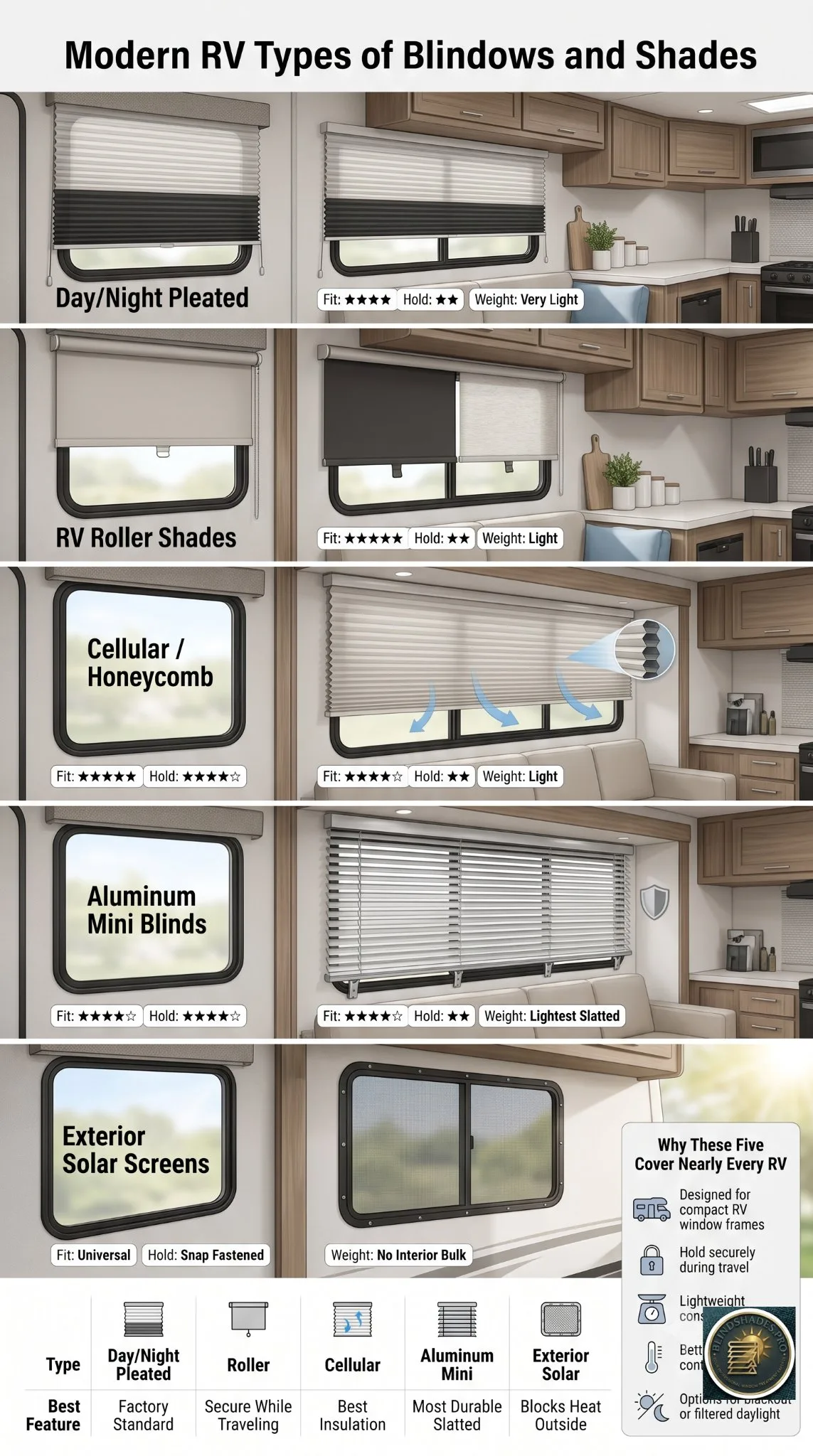
By Michael Turner — 30 years in the window treatment industry
The best RV blinds and shades are the ones that pass three tests a house never asks: they fit a shallow camper frame, they stay put at highway speed, and they don’t add weight your rig has to carry. Day/night pleated shades remain the factory standard in most motorhomes and travel trailers, RV-specific roller shades are the community’s favorite upgrade, and the whole decision — repair the factory shades, replace them like-for-like, or convert to rollers — comes down to a decision this guide walks you through window by window.
Key Takeaways
- Day/night pleated shades are the RV native format — a sheer “day” layer and an opaque “night” layer on one string ladder — and when the strings sag, restringing is often cheaper than replacing.
- RV-specific roller shades are the most recommended upgrade on owner forums, led by RecPro, whose store carries a four point six rating across roughly twenty-five thousand reviews.
- Frame depth decides more than style does. Camper window frames are shallower than household frames, which is why “can I use regular blinds in an RV” usually ends in a custom or RV-specific order.
- Weight and hold matter in a vehicle. Lightweight aluminum minis and pleated fabrics dominate RV use because they travel well; anything loose becomes a rattle at sixty-five miles per hour.
- Exterior solar shades are a separate decision from interior privacy shades — one aftermarket exterior system claims to block up to ninety percent of the sun’s heat before it reaches the glass.
⭐ Quick Answer — The Best RV Blinds & Shades
The best RV blinds pass three tests a house never asks — Fit (shallow camper frames), Hold (stays put at highway speed), and Weight (what your rig carries) — and the market’s answer runs through one specialist’s catalog:
- Best overall: RV-specific roller shades at four point six across one hundred seventy-four reviews — from a store rated four point six across roughly twenty-five thousand — at RecPro, the community’s most-recommended dealer alternative.
- The custom lane: made-to-size camper shades with free samples and a four point seven store rating across forty-six hundred reviews at Blindsgalore.
- The repair secret: a sagging factory day/night shade usually needs a restring kit, not a replacement — the two-layer format itself is explained in the day-night blinds guide.
- The weight champions: lightweight aluminum minis travel best — the slatted case is argued in the mini blinds guide — and the deepest owner threads on makers live at iRV2 Forums.
- Heat is an exterior problem: snap-on outside screens intercept sun before the glass — the science behind that choice is in the solar shades guide.
Quick Specification Reference
| Specification | RV reality (2026) |
|---|---|
| Native factory format | Day/night pleated shades (sheer + blackout on one cord ladder) |
| Most recommended upgrade | RV-specific roller shades (blackout or light-filtering) |
| Typical RV-specific price band | Roughly eleven to three hundred fifty, stated by seller ranges |
| Frame depth | Shallower than household windows — measure before choosing any product |
| Weight class winners | Aluminum mini blinds and pleated fabric shades |
| Travel retention | Hold-down brackets, snap tabs, or spring tension required for road use |
| Power option | Twelve-volt motorized rollers for coach batteries |
| Exterior option | Snap-on solar screens; one maker claims up to ninety percent heat blocked |
| Repair path | Restring kits for day/night shades — often the cheapest fix of all |
Read the complete guide below for: the six picks with their real review bases, the Road Test (Fit · Hold · Weight) framework for choosing by window, every RV shade type compared with frame-depth and weight notes, the repair-or-replace decision for sagging factory day/night shades, the maker map including which longtime names owners report as gone, where to buy from Amazon to Camping World to a local shop, the interior-versus-exterior split, and a zone-by-zone plan from the cab to the roof vent.
What Are the Best RV Blinds and Shades in 2026? — Our Picks
One line before the table: review volumes below are stated exactly as the market shows them, and thin bases are flagged — a five-star rating across three reviews is a promising sample, not a verdict.
| Pick | Product | Rating / reviews | Price (words) | Why it wins |
|---|---|---|---|---|
| Best Overall | RecPro RV Roller Shades | 4.6 across 174 (store: 4.6 across ~25,000) | About one hundred five | The forum-recommended RV specialist; sized for camper frames, thirty-day returns |
| Best Day/Night | RecPro RV Day & Night Roller Shades | 4.4 across 86 | About one hundred sixty-five | The native RV format, modernized on rollers instead of strings |
| Best Blackout | NitePro Blackout Nighttime RV Roller | 4.5 across 35 (thin base — flagged) | About one hundred ten | Purpose-built sleep-side darkness for over-bed windows |
| Best Custom | Blindsgalore RV & Motorhome program | Store: 4.7 across ~4,600 (product listings as thin as 5.0 across 3 — flagged) | Twenty-six to three hundred fifty-two, per seller | Made-to-size for odd camper windows, free samples, free thirty-day returns |
| Best Budget Hack | IKEA SCHOTTIS pleated | 4.4 across ~4,300 | About six | The honest cheap fix — a household paper-pleat pressed into RV duty, not RV-rated |
| Best Exterior/Solar | Levolor Solar Roller Shades | 4.3 across 236 | About eighty on sale | Glare and heat control; pairs with the snap-on exterior lane below |
A premium alternative sits above the table: ShadePro’s LEGACY day/night combo rollers carry a four point five rating across thirty-one reviews at roughly two hundred thirty to two hundred eighty — a small base, flagged accordingly, but it is the most complete factory-look modernization on the market. And the community’s own voice matters here: owner threads on iRV2 dating back years keep converging on the same shortlist of RV specialists rather than household brands, which is exactly what the review bases above reflect.
The Road Test: Fit · Hold · Weight
Every RV window covering should pass three gates a sticks-and-bricks house never asks about — fit the shallow frame, hold through road vibration, and stay inside the rig’s weight budget.
Fit. Camper window frames are shallower than household frames — Blinds Chalet, one of the few household retailers with a dedicated RV line, describes its RV products as built specifically for shallow frames, road vibration, and travel. Measure your frame depth before you fall in love with any product; a household roller cassette that needs multiple inches of depth simply has nowhere to go in many rigs. Mounting surface matters as much as depth: RV walls are thin laminate over framing, so screws want to land in solid backing, and this is where no-drill approaches earn their keep — the adhesive and tension systems covered in our no-drill blinds guide translate naturally to thin-walled campers.
Hold. A shade that swings freely in a house becomes a percussion instrument on the interstate. Look for hold-down brackets on the bottom rail, snap tabs, or spring tension that keeps fabric taut in transit. This is why owners on the Jayco forum, asked what they actually wanted in a replacement, answered with conventional pull-down shades with easy operation and lasting quality — nothing loose, nothing fussy.
Weight. Every pound on the window is a pound the chassis carries. Blindsgalore’s own November 2025 write-up calls lightweight aluminum blinds the champion of RV applications for exactly this reason — light, durable, and resistant to the temperature swings a parked rig endures. Pleated fabric shades sit in the same lightweight class, which is a large part of why the factories chose them.
| Road Test gate | What to check | Passes easily | Struggles |
|---|---|---|---|
| Fit | Frame depth, mounting surface, odd sizes | RV-specific rollers, pleated day/night, custom programs | Deep-cassette household rollers, wide-slat household blinds |
| Hold | Hold-downs, snap tabs, tension, cordless locks | RV rollers with retention, snap-fit pleated, tension minis | Free-hanging household shades, loose vertical vanes |
| Weight | Per-window weight, hardware weight | Aluminum minis, pleated fabric, solar screen mesh | Real wood, heavy lined fabrics |
A note on power: twelve-volt motorized RV rollers exist for coach-battery operation, and the motorized decision tree — hardwired versus rechargeable, app versus remote — works the same way it does in our motorized and smart blinds guide, with the added constraint that your power budget is a battery bank, not a wall outlet.
What Types of Blinds and Shades Work in an RV?
Five formats cover virtually every rig: day/night pleated shades, RV roller shades, cellular shades, aluminum mini blinds, and exterior solar screens — each with a different Fit · Hold · Weight profile.
One naming paragraph before the table, because this category answers to many names: RV blinds, camper blinds, motorhome blinds, travel trailer shades, fifth-wheel window shades, RV window shades interior and exterior — they all describe the same small family of products, and “RV day night shades” and “RV pleated shades” usually refer to the same factory-style two-layer pleat.
| Type | What it is | Fit | Hold | Weight | Best guide for depth |
|---|---|---|---|---|---|
| Day/night pleated | Factory-standard two-layer pleat on cord ladders | Excellent — made for RV frames | Good with snap retention | Very light | Day/night blinds guide |
| RV roller shades | Camper-sized rollers, blackout or filtering | Excellent in RV sizing | Excellent with hold-downs | Light | Pleated shades guide for the pleat-vs-roller call |
| Cellular / honeycomb | Insulating air-pocket fabric | Very good — slim stacks | Good cordless | Light | Cellular & honeycomb guide |
| Aluminum mini blinds | Slatted metal, the weight champion | Good in shallow frames | Good with hold-downs | Lightest slatted option | Mini blinds guide |
| Exterior solar screens | Snap-on outside mesh | Universal — mounts outside | Snap-fastened for travel removal | Adds nothing inside | Solar shades guide |
Two of these deserve a sentence of evidence. Rvblinds.com’s own category page names blackout roller shades and cellular honeycomb shades as its top-rated formats for privacy, insulation, and durability — insulation being the quiet win, because an air-pocket cell does for a thin camper wall what it does for a house, and the R-value logic in the cellular guide applies double in a vehicle. And Budget Blinds’ April 2025 RV write-up makes the case for aluminum blinds on durability and affordability grounds — the franchise voice agreeing with Blindsgalore’s lightweight-champion verdict from the other side of the market.
Should You Repair or Replace Your RV Day/Night Shades?
The most common RV shade failure is not a broken shade — it is a stretched or snapped string in a perfectly good day/night pleat, and a restring kit is often the cheapest fix in this entire guide.
Walk any owner forum and the pattern repeats: the pleated fabric is fine, the rail is fine, but the shade sags on one side or will not hold position because the cord ladder inside has stretched. That is a repair, not a replacement. Restring kits with pre-cut cord and threading needles are sold widely by RV suppliers, and the job is patient tabletop work rather than skilled labor.
| Situation | Repair or replace? | The honest math |
|---|---|---|
| Sagging or non-holding day/night shade, fabric intact | Repair — restring | A cord kit costs a fraction of any shade in this guide |
| Sun-rotted, torn, or stained pleats | Replace like-for-like | Day/night pleats remain available custom-sized |
| Strings failed twice already | Convert to rollers | This is the “replace RV blinds with roller shades” upgrade the search data shows owners making |
| Odd-size or curved window | Custom program | Blindsgalore-style made-to-size, with samples first |
| Whole-rig refresh on a budget | Mixed | Rollers on main windows, restring the rest |
The conversion row is the real decision of 2026. Replacing RV blinds with roller shades — cordless, no ladder to stretch, easier to clean — is the single most visible upgrade trend in the community, and it is why RecPro’s roller line anchors our picks. The counterargument is honest too: a day/night pleat gives you two light levels in one shade, and no single roller does that without stepping up to a dual product like ShadePro’s LEGACY combo. If you sleep in your rig in bright campgrounds, weigh that trade before abandoning the format — and if true darkness is the goal, the sleep-science case for opaque window coverings is argued in our blackout blinds guide.
Who Makes RV Blinds and Shades?
A short bench of RV specialists makes most of what fits a camper — and owners’ forums are blunt about which longtime names have left the field.
| Maker / program | Lane | What the market shows |
|---|---|---|
| RecPro | RV specialist, rollers + day/night | Store rated 4.6 across ~25,000; sells roughly eleven to one hundred fifteen; thirty-day returns |
| ShadePro | Premium day/night combo rollers | LEGACY combo at 4.5 across 31 (thin base) |
| United Shade | OEM-style custom day/night | Sold via Camping World at 3.3 across 45 — a middling base worth reading before ordering |
| Irvine Shade and Door | OEM-style shades | Named by Forest River members in June 2025 as a reputable dealer alternative |
| Blindsgalore RV program | Custom-size household-quality | Store 4.7 across ~4,600; free samples; free thirty-day returns |
| Blinds.com | Custom minis and shades in RV sizes | Custom white mini at 4.1 across 197; also forum-recommended |
| Factory-RV suppliers (factoryrv and similar) | Custom day/night and rollers | Product bases from 3.7 across 7 to 4.5 across 35 — small, flagged |
Provenance matters in this category more than most, because the bench keeps shrinking. A long-running iRV2 replacement thread pointed members to United Shade, Irvine Shades, and Specialty — with the last of those flagged as out of business in that same discussion. Treat any maker recommendation older than a couple of seasons as a lead to verify, not an order to place; the June 2025 Forest River thread naming recpro.com, blinds.com, and Irvine Shade and Door as dealer alternatives is the freshest community shortlist in this SERP, and Forest River RV window shades themselves — the factory units in those rigs — are exactly the day/night pleats the repair section above teaches you to restring before replacing.
Where Should You Buy RV Blinds?
Every retail phrase people actually search has a specific best answer — here they all are by name.
| The search | The honest answer |
|---|---|
| RV blinds Amazon | Fast and fine for standard-size rollers and restring kits; weak for custom sizing — check return terms on cut-to-size items |
| RV blinds near me | Local blinds shops rarely stock RV-depth product; a mobile RV service or dealer can measure, but you pay for the visit |
| Camping World | Carries United Shade custom day/night (3.3 across 45) — convenient, but read that review base first |
| Lowe’s / Home Depot | Household product with a few RV crossovers (Levolor cordless roller at 3.3 across 347; VEVOR RV blinds at Home Depot) — apply the Road Test hard here |
| Blinds.com / Blindsgalore | The custom lane: made-to-size, samples, structured return policies, forum-endorsed |
| RecPro / ShadePro direct | The specialist lane: RV-sized by default, RV-rated retention hardware |
| Dealer parts counter | Like-for-like OEM replacements at the highest markup — the Forest River thread exists precisely because owners wanted alternatives |
Two buying rules travel with you regardless of door. First, the strike-through prices in shopping results — forty-nine percent off here, forty-four percent off there — recur constantly in this category, so treat list prices as anchors and the discounted figure as the real market price. Second, measure before any cart: width and drop three times each, frame depth once, and note whether the seller wants opening size or finished shade size — the same deduction question that governs every custom order.
Interior vs Exterior RV Shades: Which Problem Are You Solving?
Interior shades solve privacy and sleep; exterior shades solve heat before it reaches the glass — many full-timers end up wanting both.
RV shades outside the glass are their own product family: snap-on solar screen panels that mount to the exterior wall and intercept sunlight before it loads the window. The heat case is dramatic — a My Grand RV community write-up from August 2025 describes the EZ Snap exterior system as blocking up to ninety percent of the sun’s heat while preserving the view, installed drill-free with adhesive fasteners on the skin of the rig. That is manufacturer-claimed performance relayed through an owner community, so treat the specific percentage as a claim rather than a measurement — but the physics direction is right, and it is the same exterior-beats-interior logic that governs patio and porch installations in our outdoor and patio blinds guide.
| Question | Interior shades | Exterior solar screens |
|---|---|---|
| Privacy at night | Yes — the core job | Limited — mesh reads one-way in daylight only |
| Sleep darkness | Blackout rollers and night pleats | No |
| Heat control | Moderate — heat is already inside the glass | Strong — intercepts sun before the glass |
| Travel | Rides inside, retention required | Removed or snap-secured before driving |
| Install | Screws or no-drill mounts | Snap fasteners on the exterior skin |
A word on the darkness end of the interior lane, because the shopping data is unambiguous about where the money goes: RV blackout shades are the category’s fastest-moving upgrade, from NitePro’s purpose-built nighttime rollers (four point five across thirty-five reviews) to blackout versions of nearly every roller in the RecPro and RV Blinds catalogs. If your rig sleeps under campground floodlights or summer high-latitude skies, buy the blackout version of whatever roller passes your Road Test — the price step over light-filtering is small, and unlike a house, an RV bedroom cannot borrow darkness from a hallway. The one caution: blackout fabric shows every light gap, so edge fit matters more here than anywhere else in the rig.
The right mental model: interior shades are furniture, exterior screens are equipment. Glare on the dinette in a desert campground is a solar problem — the openness-factor logic from the solar shades guide applies — while the over-bed window at a bright rally is a blackout problem, and no exterior mesh fixes it.
Which Shade Goes on Which Window? A Zone-by-Zone Plan
A rig is five different window problems wearing one silhouette — solve each zone on its own terms.
| Zone | The problem | The pick |
|---|---|---|
| Cab / windshield | Heat soak and glare while parked | Reflective windshield covers plus exterior screens; interior shades cannot win this fight alone |
| Over-bed windows | Sleep-side darkness | Blackout RV rollers (NitePro-style) or the night layer of a day/night pleat |
| Dinette and slide-out | Daytime glare with view | Light-filtering rollers or the day layer; watch slide clearance on depth |
| Entry door window | Privacy at eye level | Snap-fit mini or compact pleat — this is where aluminum minis shine, and where an RV mini blinds replacement is usually a direct-fit part |
| Roof vents / skylights | Overhead heat and light | Vent-sized shades and insulating pillows — the overhead logic is covered in our skylight blinds guide |
One more crossover worth naming: top-down/bottom-up operation — privacy below, light above — exists in RV-market shades too, and if that mode of living appeals to you at home, our top-down bottom-up guide explains the mechanism the RV versions inherit.
Best Sources on RV Window Coverings
- iRV2 Forums — the deepest replacement-shade discussions in the hobby, including the maker-availability warnings (thread activity from 2019 through 2021 and beyond).
- Forest River Forums (June 12, 2025) — the freshest community shortlist of dealer alternatives: recpro.com, blinds.com, Irvine Shade and Door.
- Blindsgalore blog (November 3, 2025) — the lightweight-aluminum case for RV applications, from a retailer that runs a dedicated RV program.
- My Grand RV (August 28, 2025) — the exterior solar-screen experience report carrying the up-to-ninety-percent heat claim.
- Budget Blinds (April 2, 2025) — the franchise-side argument for aluminum blinds in RV service.
Related Buying Guides
- Best Day-Night Blinds — the two-layer format RVs made famous
- Best Pleated Shades — the fabric family behind the factory shade
- Best Mini Blinds — the lightweight slatted option
- Best Cellular & Honeycomb Shades — insulation for thin walls
- Best Solar Shades — the heat-and-glare science
- Best Skylight Blinds & Shades — overhead openings, including vents
- Best No-Drill Blinds — thin-wall-friendly mounting
- Best Blackout Blinds & Shades — the sleep case
- Best Outdoor & Patio Blinds — exterior shading logic
- Best Motorized & Smart Blinds — the twelve-volt decision tree
FAQ
What are the best RV blinds? The best RV blinds for most rigs are RV-specific roller shades from RecPro — rated four point six across one hundred seventy-four reviews, from a store rated four point six across roughly twenty-five thousand — with factory-style day/night pleated shades as the like-for-like lane and Blindsgalore’s custom RV program for odd sizes.
Can you use regular household blinds in an RV? Sometimes, but the Road Test usually says no: camper frames are shallower than household frames, walls are thin, and anything without travel retention rattles. Household products that do cross over are the lightweight ones — aluminum minis and compact pleats — and even those need hold-downs added.
How do you measure RV windows for blinds? Width three times, drop three times, frame depth once, with a steel tape — and confirm whether the seller builds to your opening size or your finished size before ordering. Custom RV programs will send free samples; use them, because fabric that looks right online can read differently against a rig’s interior.
Should I restring or replace my day/night shades? If the fabric is intact and only the shade sags or will not hold, restring — cord kits cost a fraction of any replacement. Replace when pleats are torn or sun-rotted, and consider converting to roller shades if strings have failed more than once.
How much do RV blinds cost? RV-specific rollers run from roughly forty to one hundred sixty-five per window across the RecPro and NitePro class, premium day/night combos reach two hundred eighty, custom programs quote by size from about twenty-six upward, and the budget floor is a six-dollar-class household pleat pressed into service.
Do RV shades go inside or outside? Both exist and solve different problems: interior shades handle privacy and sleep, exterior snap-on solar screens intercept heat before the glass — with one system’s owner-reported claim of blocking up to ninety percent of the sun’s heat. Full-timers in hot climates frequently run both.
