Best Sidelights & Front Door Blinds

Authored By Michael Turner -30 Years Home Improvement Expertise | Updated 2026 | BlindShades.pro
Updated on July 19, 2026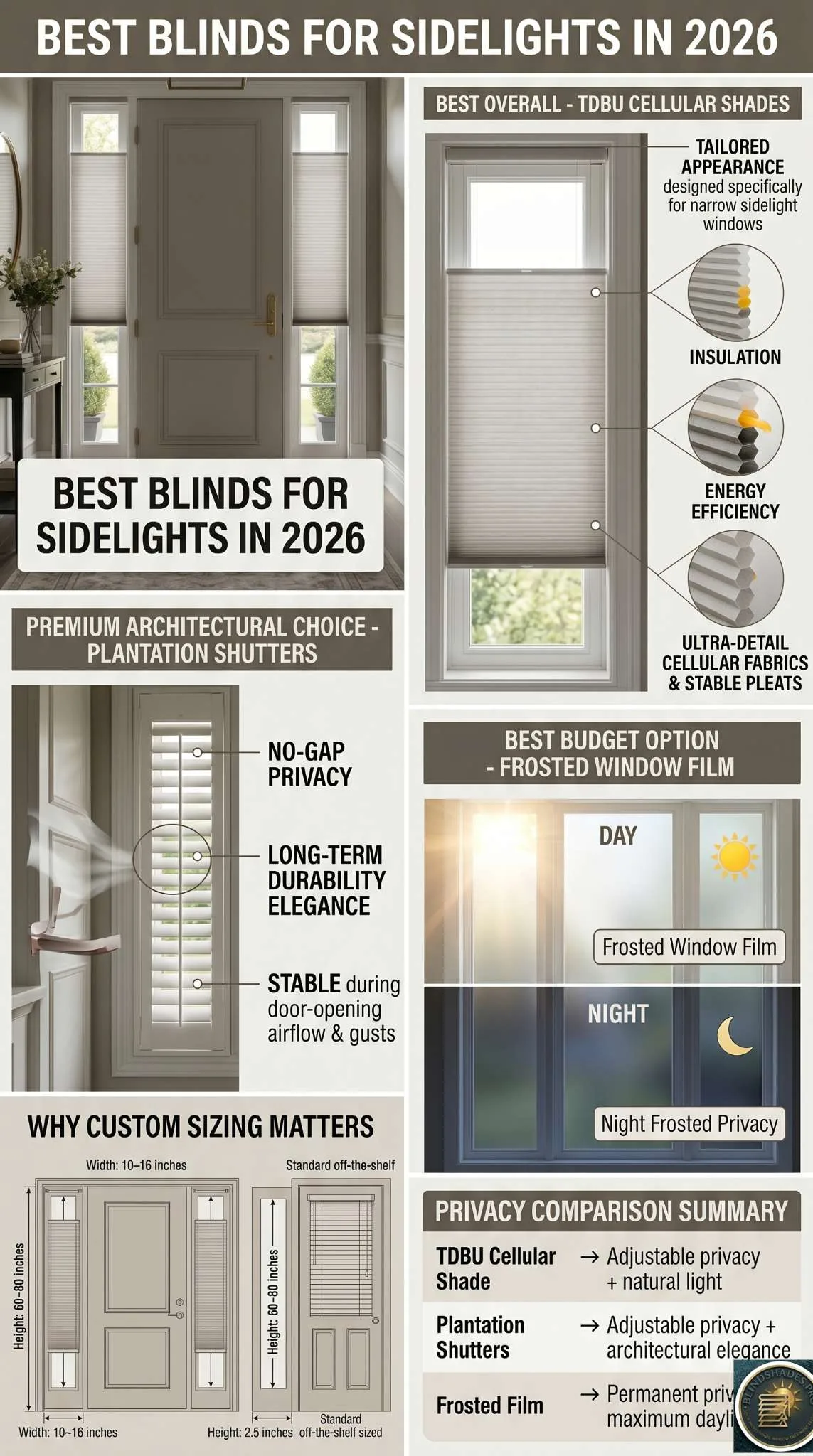
By Michael Turner — 30 years in the window treatment industry
Sidelight blinds provide adjustable privacy and light control for the narrow glass beside your entry door — and the best ones pass the Entry Test: Width first (under ten inches, the product list changes), Operation second (will you ever actually adjust it?), Permanence third (film, blind, or glass). The rankings below stand as the market’s verdict, led again by the TDBU cellular. What’s new for this update is everything around them: the width table the searches keep asking for inch by inch, the door-glass add-on lane with the biggest review base in the category, and an honest accounting of the community’s top-voted answers — which, we’ll say plainly, are not blinds at all.
Key Takeaways
- TDBU cellular shades keep the crown: privacy at eye level with daylight above it is exactly what an entryway wants, and no other format does both at once.
- Width is the first question, not the style. Two-inch slats need openings ten inches or wider by the market’s own fitting rule — so six-, seven-, and nine-inch sidelights shop a different list than eleven- and twelve-inch ones.
- The enclosed add-on lane is the category’s quiet giant: ODL’s door-glass blinds carry review bases in the thousands, and they solve the slam-rattle problem surface-mounted blinds inherit on a moving door.
- The community’s podium contains zero blinds. In the biggest entry-door thread this market has, the top three answers — by 275, 151, and 138 votes — are privacy film, a glass swap, and shutters. We score all three honestly below.
- Beware the one-review listing. This SERP carries cut-to-width products rated on one or two reviews, including a one-star-across-two; review volume before price tag, every time.
⭐ Quick Answer — The Best Sidelights & Front Door Blinds
The best sidelight blinds pass the Entry Test — Width first (under ten inches the product list changes), Operation second (will you ever adjust it?), Permanence third (film, blind, or glass) — and the rankings hold:
- Ranked 1 again: top-down/bottom-up cellular shades — daylight above, privacy at eye level, in one shade — custom-sized from about sixty-one at Blindsgalore; the mechanism is explained in the top-down bottom-up guide.
- The width rule: two-inch slats need glass ten inches or wider — the fitting guidance stated plainly at Factory Direct Blinds — so six-to-nine-inch sidelights take the one-inch minis covered in the mini blinds guide.
- The door-glass verdict: ODL’s enclosed add-on blinds — four point seven across roughly thirty-six hundred reviews — frame the blind against the glass insert, sealed from dust and door-slam rattle.
- The threshold material: faux wood shrugs off entry-door humidity where real wood warps — the case is argued in the faux wood blinds guide — with a ninety-day return window on the category at Lowe’s.
- The honest alternative: the community’s 275-vote top answer is twenty-dollar privacy film — and for glass nobody ever operates, the votes are right.
Quick Specification Reference
| Specification | Sidelight & front door reality (2026) |
|---|---|
| The defining constraint | Narrow glass — typically six to fourteen inches wide beside entry and patio doors |
| The width rule | Two-inch slats fit openings ten inches or wider; below that, minis, cellulars, and film take over |
| The ranked winner | TDBU cellular — privacy below, daylight above, in one shade |
| The door-glass lane | Enclosed add-on blinds mounted over (or between) the door’s glass insert |
| The renter lane | Peel-and-stick privacy film and magnetic sidelight blinds — zero holes |
| The moisture rule | Faux wood over real wood near exterior doors — humidity swings at the threshold |
| Typical price band | About seventeen to two hundred forty for blinds; frame kits and between-glass systems run higher |
| The community’s podium | Film (275 votes), glass swap (151), shutters (138) — scored honestly below |
| Return-window spread | Ninety days at one big-box store versus fourteen to thirty elsewhere — it matters on custom cuts |
Read the complete guide below for: the six ranked treatments with real review bases, the Entry Test (Width · Operation · Permanence), the inch-by-inch width table, the enclosed door-glass lane, the 275-vote honesty section, the moisture-and-materials case, every buying lane with its return window, and the thin-review warning list.
The Six Best Sidelight Window Treatment Options
Review volumes are stated exactly as the market shows them; thin bases are flagged, and the warning table near the end names the listings to avoid.
| Rank | Treatment | Rating / reviews | Price (words) | The lane |
|---|---|---|---|---|
| 1 | TDBU Cellular Shades | Category consensus; custom programs from the leading stores | About sixty-one up, custom-quoted | Most popular; best balance of light and privacy |
| 2 | ODL Add-On Door Blinds (enclosed) | 4.7 across ~3,600 (raised-frame) / 4.6 across ~1,100 (enclosed door) | About one forty-five to two forty | The door-glass verdict |
| 3 | Levolor 2-inch Faux Wood | 4.3 across ~1,900 | About ninety-eight | The wide-sidelight classic, ten inches and up |
| 4 | Home Decorators Cordless Faux Wood | 4.6 across 931 | About sixty-nine | The value cut-to-width lane |
| 5 | Bali Light Filtering Roller | 4.7 across 254 | About one hundred five | The minimalist filter |
| 6 | Custom Soft-Fold Fabric Shade (Etsy) | 4.9 across 36 (modest base — flagged) | About one seventy-six | The handmade custom lane |
Ranked 1 — TDBU Cellular Shades (Most Popular; Best Balance of Light and Privacy)
Blindsgalore’s custom sidelight program (store rated four point seven across forty-six hundred, sixty-one to three-seventy, free thirty-day returns) anchors the format that keeps winning this category: the top-down/bottom-up cellular. The mechanism is the argument — lower the top for daylight in the entry, raise the bottom for privacy at eye level, both at once, all day. Alexander Blank’s April 2026 entryway write-up credits Duette-class cellular shades with exceptional insulation and versatility for exactly this use, and the honeycomb’s thermal case matters more at a door than anywhere else in the house: the entry is the envelope’s leakiest wall. Sizing note for the narrow class: cellular stacks stay slim at any width, which is why the TDBU cellular is the rare Ranked-1 pick that survives the width table intact — it fits the six-inch lane and the twelve-inch lane alike, changing only its price. The full mechanism is in our top-down bottom-up guide, and the cell science in our cellular and honeycomb shades guide.
Ranked 2 — The Door-Glass Verdict: ODL’s Add-On Enclosed Blinds
The category’s quiet giant. ODL’s add-on blinds for raised-frame doors carry four point seven across roughly thirty-six hundred reviews at about one forty-five, with the enclosed-door version at four point six across eleven hundred — the two largest bases in this entire SERP. The design solves the problem every surface-mounted door blind inherits: the door moves, the blind slams, the slats rattle. An enclosed unit frames the blind against the glass insert — blinds for doors with glass insert, answered by name — operated by a slide, sealed from dust and from the door’s own violence. Above this lane sit the built-in systems: frame kits from the Pease class (four point nine across thirteen, quote-level pricing into the hundreds and beyond for hurricane-impact versions) and true between-glass inserts — a manufacturing lane, not an aftermarket one, and the site’s full treatment of windows with blinds built inside the glass is coming next in this series.
Ranked 3 — The Wide-Sidelight Classic: Levolor Faux Wood
Nineteen hundred reviews at four point three, about ninety-eight, and the market’s own fitting rule attached: Factory Direct Blinds states the two-inch slat class fits openings ten inches or wider — which is why this pick belongs to eleven- and twelve-inch sidelights and not their narrower cousins. The moisture argument travels with it: faux wood coordinates with wood doors and resists the humidity swings at an exterior threshold, the case argued in full in our faux wood blinds guide.
Ranked 4 — The Value Lane: Home Decorators Cordless Faux
Four point six across nine hundred thirty-one at about sixty-nine — the strongest rating-to-price ratio in the category, cordless by default (a genuine safety point at a door children run through), and widely cut-to-width. Its nearest deal-store rival at about forty carries no meaningful base yet, which is the value lane’s whole lesson in one comparison. Pair it with the width table below before ordering; cut-to-width forgives many sins but not a slat class too deep for the glass.
Ranked 5 — The Minimalist Filter: Bali’s Roller
Four point seven across two hundred fifty-four, about one hundred five, and the right answer when the entry wants softened light more than operated privacy — a frosted-glass effect that still lifts away entirely. The sheer-fabric alternative Designing Windows’ guide calls an excellent middle ground for sidelights lives one degree softer; that lane is compared in our sheer shades guide.
Ranked 6 — The Handmade Custom: Soft-Fold Fabric Shades
The Etsy lane, led by custom soft-folded shades for sidelight front doors at four point nine across thirty-six — a modest base, flagged as such — around one seventy-six. This is where fabric, pattern, and a maker’s tape meet the one glass shape big-box lines serve worst, and where custom sidelight blinds stops meaning “the same faux wood, cut narrower.”
The Entry Test: Width · Operation · Permanence
Three questions, asked in order, sort every entryway before a single product page opens.
| Entry Test step | The question | The failure it prevents |
|---|---|---|
| Width | What does the glass actually measure? | The ten-inch rule violated — deep slats crammed into narrow frames |
| Operation | Will anyone adjust this weekly — or ever? | Paying operable prices for what should be film |
| Permanence | Renter, owner, or forever home? | Drilling a rental door; filming a forever entry that deserved glass |
Width is the section below — it has its own table because the searches ask for it inch by inch. Operation is the honest fork: a sidelight nobody touches wants a fixed solution (film, frosted panel, fixed sheer), while a sidelight that manages afternoon glare and porch-light privacy earns a real blind — Lowe’s category line, adjustable privacy and light control for narrow windows beside entry and patio doors, is the operable case in one sentence. Permanence decides the mounting: peel-and-stick and magnetic sidelight blinds for renters — magnetic frames and tension mounts drill nothing, the same zero-hole logic as our no-drill blinds guide — enclosed add-ons for owners, and the glass itself for the forever house.
What Size Blinds Fit a 6, 7, 9, 11, or 12-Inch Sidelight? The Width Table
The market’s searches are a size chart nobody built — so here it is, inch by inch, with the fitting rule applied.
| Glass width | What fits | What doesn’t | The move |
|---|---|---|---|
| 6 inch sidelight blinds | Mini blinds, slim cellular, film | Any two-inch slat | The narrowest lane — one-inch minis or skip to film |
| 7 inch sidelight blinds | Minis, slim cellular, narrow rollers | Two-inch slats, most Romans | Cut-to-width minis; measure the flat glass, not the trim |
| 9 inch sidelight blinds | Minis, cellular, narrow faux (one-inch class) | Two-inch slats — one inch under the rule | The commonest width; the one-inch slat’s home turf |
| Sidelight blinds 11 inch | Everything above plus two-inch faux wood | — | The rule clears: the Levolor class fits from here |
| 12 inch sidelight blinds | The full menu — faux, cellular, TDBU, rollers | — | Shop on style; width no longer filters |
Three notes the table compresses. First, the rule’s source: the ten-inches-or-wider threshold for two-inch slats is the market’s own fitting guidance, not ours — we just applied it per width. Second, measure the glass and the frame separately; sidelight trim steals more width than people expect, and cut-to-width orders live or die on that half inch. Third, the one-inch mini’s dominance below ten inches is why the decade-old Houzz question — mini blinds or something else? — keeps getting asked; the slat logic is in our mini blinds guide, and the honest answer is “minis until eleven inches, then choose.”
What Do People Put on Sidelights Instead of Blinds? The 275-Vote Answer
In the biggest entry-door thread this market has — five hundred seventy comments and counting — the three top-voted answers are not blinds, and a guide worth ranking first should say so.
A naming aside before the votes, because this category answers to a small crowd of labels: sidelight blinds, door sidelight blinds, front door blinds, entry door side-light treatments, and sidelites in builder spelling — all one narrow-glass product family, with the transom overhead as its horizontal cousin and the arch above premium entries covered in our arched and specialty windows guide.
The podium, by the thread’s own arithmetic: vinyl peel-and-stick privacy film at 275 votes (the top answer, picked up at a big-box store), swapping the clear glass for leaded or frosted glass at 151, and shutters at 138. A twelve-year-old Bogleheads thread reached the same first answer — film that mimics frosted or stained glass, in dozens of designs. Here is the honest scorecard:
| The answer | Wins when | Loses when |
|---|---|---|
| Privacy film (275 votes) | The sidelight is never operated; renters; frosted-look wanted; budget near twenty | You want the option of clear glass back daily — film is all-or-nothing until removed |
| Glass swap to leaded/frosted (151) | Forever homes; architecture-first owners; zero hardware forever | Budget — it is glasswork, not a blind purchase |
| Shutters (138) | Craftsman and cottage entries; durability-first buyers | Narrow glass — shutter frames eat width the six-to-nine-inch class cannot spare |
| A blind (this guide) | The light actually gets managed — glare by afternoon, privacy by night, daylight by morning | Nobody ever touches it — then film was the right buy |
That last row is the Entry Test’s Operation question wearing vote totals. We rank blinds because operated glass earns them; we say out loud that unoperated glass does not. And the fourth path — sidelights that look like frosted or stained glass permanently — circles back to the film-versus-glasswork budget fork above. One synthesis the thread never quite states: the podium and the rankings agree more than they argue. Film at twenty dollars, a mini at seventeen, and a TDBU cellular at sixty-one are answering three different Operation verdicts on the same glass — never, rarely, and daily — which is exactly the order this guide would send you to them in.
Which Materials Survive Next to a Front Door?
The threshold is the house’s roughest microclimate — humidity gusts, temperature swings, slammed frames — and the material choice should admit it.
| Material | At the entry door | Verdict |
|---|---|---|
| Faux wood / PVC | Shrugs off humidity and door-slam vibration | The default — the market’s own coordination-with-wood-doors case |
| Real wood | Warps and checks with threshold humidity | Save it for interior rooms |
| Aluminum mini | Immune to moisture; the narrow-width workhorse | The under-ten-inch default |
| Cellular fabric | Fine in enclosed or protected mounts | Watch condensation contact on single-pane sidelights |
| Fabric Romans/soft folds | Beautiful; launder-conscious | The handmade lane, eyes open |
How Do You Install Blinds on a Sidelight or Door?
Five mounting methods cover every entry — and the door itself is the deciding variable, because glass that swings punishes lazy mounting.
| Method | How it holds | Best for | The catch |
|---|---|---|---|
| Screw-mount brackets | Screws into the frame or casing | Owned homes, fixed sidelights | Holes forever; pilot-drill fiberglass, never freehand it |
| Magnetic frames | Magnets grip a steel door or steel-framed lite | Steel entry doors, renters | Wood and fiberglass doors carry no grip — check with a fridge magnet first |
| Tension mounts | Spring pressure inside the frame reveal | Rentals, shallow-reveal sidelights | Needs a true inside reveal; slips on out-of-square frames |
| Adhesive / peel-and-stick | High-bond strips or static film | Film, ultralight shades, rentals | Heat by the glass tests cheap adhesive — buy the branded strips |
| Enclosed add-on kits | A framed unit screwed over the door’s glass insert | Doors with glass inserts, high-traffic entries | An hour’s careful work; measure the insert’s visible glass AND its raised frame |
Two door-specific rules the methods share. First, hold-downs are not optional on a swinging door: whatever the mount, the blind’s bottom rail wants a retention clip at each lower corner, or every arrival home becomes a percussion event — the same physics lesson the enclosed lane solves by design. Second, respect the door’s warranty: some fiberglass and steel door makers void finish warranties over field-drilled holes, which quietly strengthens the case for magnetic, tension, and enclosed systems on newer doors. On the sidelight itself — fixed glass, no slam — the calculus relaxes, and a simple inside-mount with the width table’s product does the job; the drill-free lanes remain available for renters, with the full magnetic-and-tension toolbox in the no-drill guide linked above.
Where Should You Buy Sidelight Blinds?
Every lane, with the return windows stated — they differ more here than in any category we cover.
| The lane | The honest answer |
|---|---|
| Sidelight blinds for front door — custom programs | Blindsgalore (4.7/4.6K, sixty-one to three-seventy, thirty-day returns) and Blinds.com (4.7/2.6K, from about one hundred one, thirty-day) — the made-to-width core |
| Lowe’s | 4.6 across sixteen hundred, about one-oh-three to one-oh-nine — and a ninety-day return window, the category’s longest |
| Home Depot / big-box | The ODL add-on lane and the value faux woods; also the twenty-dollar film class the 275 votes endorsed |
| Kohl’s / JCPenney / Walmart / Wayfair | Deal-cycle cut-to-width — check the review base FIRST (see the warning table) |
| Factory Direct Blinds | Fifty-six to one twenty-nine, the ten-inch fitting rule stated plainly on the collection |
| Etsy makers | The custom fabric lane, 4.9-class satisfaction on modest volumes |
| The strike-through rule | Half this SERP wears forty-eight to sixty percent “off” — the recurring sale price is the real price, as ever |
And the warning table this SERP earns more than any before it:
| Listing pattern | Example bases seen | The rule |
|---|---|---|
| Cut-to-width one-review listings | 3.0 across 1 · 5.0 across 1 | One review is an anecdote, not a rating |
| The one-star pair | 1.0 across 2 | Two reviews agreeing it failed is worth believing |
| Tiny-base film and shade kits | 3.8 across 4 · 4.8 across 5 | Promising, unproven — buy on the return window, not the stars |
Related Buying Guides
- Best Top Down Bottom Up Blinds — Ranked 1’s mechanism, in full
- Best Cellular & Honeycomb Shades — the insulating fabric at the leaky wall
- Best Faux Wood Blinds — the threshold material case
- Best Mini Blinds — the under-ten-inch workhorse
- Best Sheer Shades — the soft middle ground
- Best French Door Blinds — the entryway’s double-door cousin
- Best No Drill Blinds — magnetic and tension mounts for rented doors
- Best Made to Measure Blinds — the cut-to-width discipline
- Best Arched & Specialty Windows — the transom and arch above the same door
- Best Blackout Blinds & Shades — when the entry hall needs real darkness
FAQ
What are the best blinds for sidelight windows? Top-down/bottom-up cellular shades — Ranked 1 for the balance of light and privacy no other format matches — with ODL’s enclosed add-on blinds (four point seven across thirty-six hundred reviews) as the door-glass pick, Levolor’s two-inch faux wood for sidelights eleven inches and wider, and one-inch minis or cellulars below ten inches.
What size blinds fit a sidelight window? Measure the glass first: two-inch slats need openings ten inches or wider by the market’s fitting rule, so six-, seven-, and nine-inch sidelights take one-inch minis, slim cellulars, or film, while eleven- and twelve-inch sidelights open the full menu including standard faux wood.
Do magnetic sidelight blinds work? Yes, on steel doors and steel-framed sidelights — magnetic frames and tension mounts hold light blinds without a single hole, which makes them the renter’s lane alongside peel-and-stick film. On wood and fiberglass frames, use the tension or adhesive versions instead.
What do people put on front door sidelights instead of blinds? The community’s top-voted answers, in order: vinyl peel-and-stick privacy film (275 votes in the market’s biggest thread), swapping the clear pane for leaded or frosted glass (151), and shutters (138). Film wins for never-operated glass; a blind wins the moment you actually manage light daily.
Can you put blinds on a door with a glass insert? Yes — the enclosed add-on lane exists for exactly this: framed units that mount over the door’s glass insert, sealed against dust and door-slam rattle, operated by a slide. It carries the category’s biggest review bases, and built-in between-glass systems sit one step further up.
How much do sidelight blinds cost? About seventeen to forty-five for cut-to-width minis and value faux at the deal stores, roughly seventy to one forty for the big-base faux and roller classes, about one forty-five to two forty for enclosed add-on door units, and custom program pricing from about sixty-one to three-seventy — with film near twenty as the fixed-privacy floor.
The Bottom Line
Defend the measurement and the rest defends itself. Run the Entry Test: Width — tape the glass, respect the ten-inch rule, and let the width table hand you the real shortlist; Operation — give operated glass a real blind and unoperated glass the twenty-dollar film the votes endorsed; Permanence — renters drill nothing, owners enclose, forever homes may deserve the glass itself. The TDBU cellular stays Ranked 1 because the entryway’s twin demands — light in, eyes out — haven’t changed. Everything else here just makes the runner-up choices as honest as the winner. And if the width table sent you below ten inches, take the consolation it implies: the narrowest sidelights are the cheapest to treat well — a seventeen-dollar mini or a twenty-dollar film does for a six-inch lite what a custom program charges three hundred to do for a picture window, and it does it this weekend.
