The Best Skylight Blinds & Shades Buying Guide

Authored By Michael Turner
Updated on May 6, 2026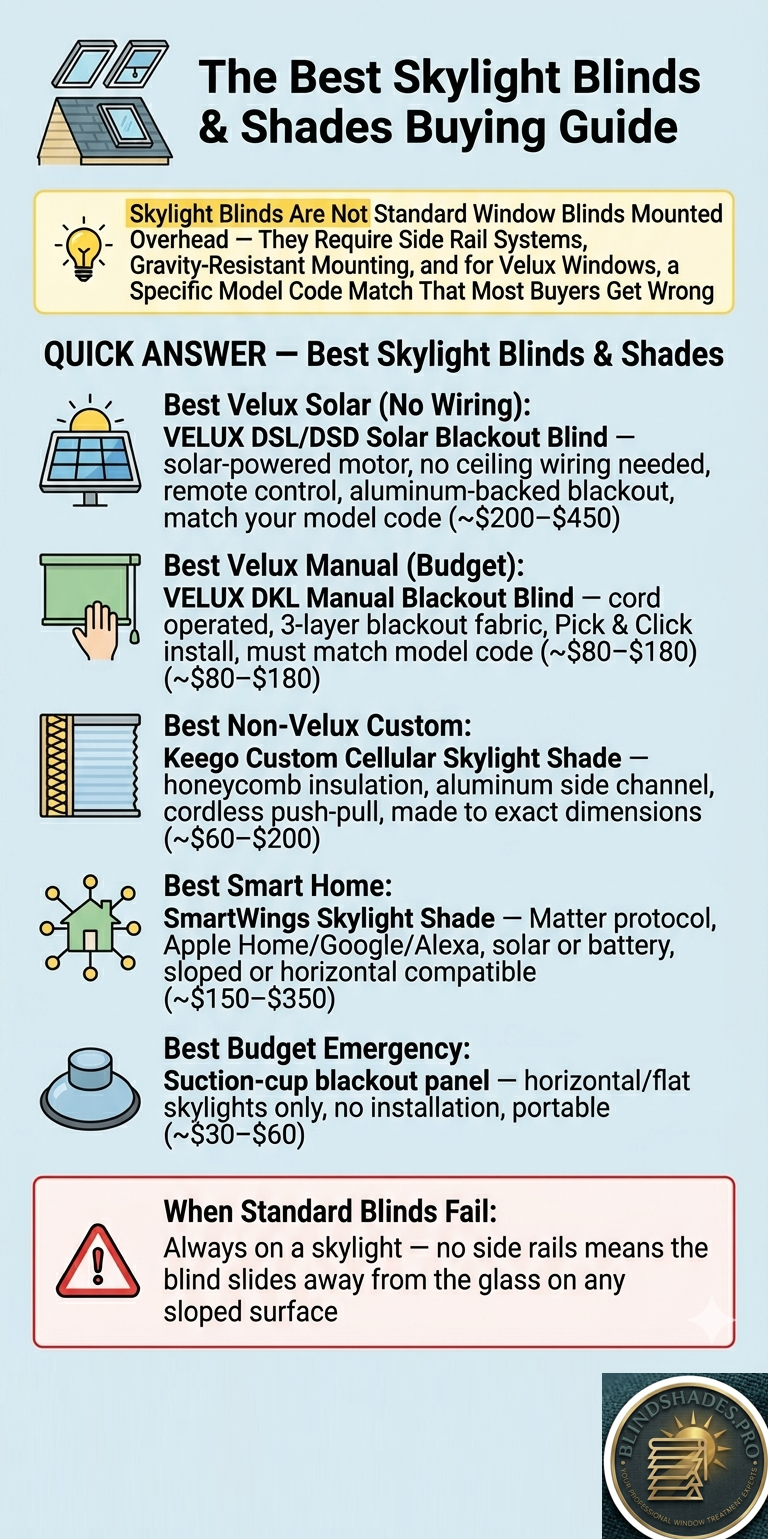
Skylight Blinds Are Not Standard Window Blinds Mounted Overhead — They Require Side Rail Systems, Gravity-Resistant Mounting, and for Velux Windows, a Specific Model Code Match That Most Buyers Get Wrong
By the Editorial Team at BlindShades.pro | Updated 2026 | 30 Years of Home Improvement Expertise
⭐ Quick Answer — Best Skylight Blinds & Shades
- Best Velux Solar (No Wiring): VELUX DSL/DSD Solar Blackout Blind — solar-powered motor, no ceiling wiring needed, remote control, aluminum-backed blackout, match your model code (~$200–$450)
- Best Velux Manual (Budget): VELUX DKL Manual Blackout Blind — cord operated, 3-layer blackout fabric, Pick & Click install, must match model code (~$80–$180)
- Best Non-Velux Custom: Keego Custom Cellular Skylight Shade — honeycomb insulation, aluminum side channel, cordless push-pull, made to exact dimensions (~$60–$200)
- Best Smart Home: SmartWings Skylight Shade — Matter protocol, Apple Home/Google/Alexa, solar or battery, sloped or horizontal compatible (~$150–$350)
- Best Budget Emergency: Suction-cup blackout panel — horizontal/flat skylights only, no installation, portable (~$30–$60)
- When Standard Blinds Fail: Always on a skylight — no side rails means the blind slides away from the glass on any sloped surface
⚠️ Two Things That Catch Most Buyers Out: (1) Regular roller shades fall off skylights — without aluminum side rail channels to grip the glass on a sloped surface, any standard blind will slide away. Skylight-specific blinds with side channels are the only correct specification. (2) Velux blinds must match your model code — not just dimensions. Open your skylight frame and find the sticker: FK06, MK04, CK02, SK06, etc. Order by that code. Ordering by dimension alone risks incompatibility with your specific frame generation. See the full side rail and Velux code guide below.
💡 Your Skylight Is Colder at Night Than You Think — and More Heat in Summer: On a clear winter night, the area beneath a skylight can be 5–10°F colder than the rest of the room due to clear-night-sky re-radiation. In summer, an overhead skylight transmits up to 50% more solar heat per square foot than a vertical window (per Lawrence Berkeley National Laboratory data). A cellular honeycomb skylight blind addresses both — R-2 to R-3 insulation overhead. See the full thermal guide below.
📖 Before you spend a dollar — read the complete guide below. Covers 6 skylight types (fixed/vented/flat/tubular/pyramid/roof window), the Velux model code system (FK06/MK04 etc.), side rail channel requirement, clear-night-sky re-radiation physics, overhead heat gain data, exterior vs interior shade performance, solar motor wiring savings, 5 brand reviews & 10 FAQs.
Why Skylight Blinds Are a Completely Different Product Category
This is the most important clarification in this guide — and the one that costs buyers the most money when they get it wrong.
A standard window blind hangs vertically. Gravity holds the fabric against the window frame and the bottom rail hangs straight down. The entire system relies on gravity to keep the blind in position against the window.
A skylight is installed in a roof — sloped at the roof pitch angle (typically 15–45°) or flat (horizontal in flat roof applications). When you mount any window treatment overhead on a sloped surface:
Gravity works against the blind, not for it. Without a mechanical restraint, the blind slides or falls away from the glass surface.
The solution: Side rail channels. Skylight blinds use aluminum side channels that run the full height of the skylight frame. The blind’s side edges are captured inside these channels, preventing the blind from separating from the glass surface regardless of angle or orientation.
Standard blinds without side rails cannot be used on skylights. The most common skylight blind purchase mistake is ordering a standard roller shade or cellular shade for a skylight and discovering it will not stay against the glass surface.
The 6 Skylight Types — Which Blind Works With Each
Type 1 — Fixed Roof Skylight (Most Common)
A non-operable glass panel set into the roof structure at the roof pitch angle. Standard residential fixed skylights from Velux, Andersen, and Sun-Tek are typically 15°–40° from vertical (steeply pitched) to nearly flat.
Blind compatibility: All skylight blind types work on fixed roof skylights — roller, pleated, cellular, Venetian, and blackout. Side channels are required on all. The sloped angle means the blind must resist downward sliding along the channel.
Type 2 — Vented / Operable Roof Skylight
Opens for ventilation — either on a manual crank or motorized. The most common residential operable skylight is the Velux “Fresh Air” series.
Blind compatibility: Velux Original blinds (DKL, DSL, FHL, FMK series) are specifically designed to work with operable Velux skylights — they remain installed while the skylight opens and closes. Universal custom blinds from non-Velux sources typically cannot accommodate the opening mechanism and must be removed before ventilation.
Critical note: A Velux skylight with a ventilation function requires a Velux-compatible blind that accommodates the opening mechanism. A universal custom blind that blocks the opening mechanism cannot be used on an operable skylight.
Type 3 — Flat Roof / Horizontal Skylight
Installed in a nearly horizontal orientation (0°–15° from flat). Most often seen in commercial buildings but also in residential flat-roof extensions and some modern homes.
Blind compatibility: The most demanding application for skylight blinds. The nearly horizontal surface means the side channel must provide full support along the blind’s entire travel. Motorized systems are strongly preferred — a manual pull mechanism on a horizontal skylight requires reaching overhead and is difficult to operate reliably.
Dust and debris consideration: Horizontal skylight blinds accumulate dust on their upward-facing surface at a significantly higher rate than sloped or vertical blinds. Specify wipe-clean fabrics (aluminum-backed, polyester) rather than woven or fabric materials for horizontal skylights.
Type 4 — Tubular Skylight / Sun Tunnel
A highly reflective tube (typically 10–14 inches in diameter) running from the roof surface to the interior ceiling, with a diffuser lens at the ceiling level. Used in rooms where a traditional skylight cannot be installed directly.
Blind compatibility: Tubular skylights cannot use conventional skylight blinds. The only coverage option is a diffuser cover or a dimmer attachment at the ceiling lens — not a blind or shade in the traditional sense.
Type 5 — Pyramid / Lantern Skylight
Multi-faceted glass panels in a pyramid, lantern, or square structure typically rising above a flat roof surface. Often seen in kitchen extensions, orangeries, and conservatories.
Blind compatibility: Each facet panel requires a custom blind matched to its specific angle and dimensions. Motorized systems are strongly preferred for pyramid skylights — manual operation of multiple panels at different orientations is impractical. Specialist skylight blind suppliers handle pyramid configurations.
Type 6 — Roof Window (Velux-Style Operable Panel)
A large, operable roof panel typically used in converted lofts and attic rooms. Similar to a vented skylight but often larger (full-sized room window set into the roof slope). This is the primary application for Velux blinds in residential use.
Blind compatibility: Velux Original blinds matched to the specific Velux model code. The most important application covered in this guide.
The Velux Model Code System — The Most Common Purchase Mistake
If you have a Velux skylight — this is the most important section in this guide. Velux blinds are not interchangeable between skylight models. Each Velux blind is designed for specific Velux skylight configurations, and the model code on the skylight frame is the definitive identifier.
How to Find Your Velux Model Code
- Look at the inside of the skylight frame — the model code is typically printed on a sticker or plate on the frame
- The code looks like: FK06, MK04, CK02, SK06, PK10, etc.
- The first two letters indicate the size category; the two numbers indicate the specific size within that category
Example Velux Size Codes:
| Code | Width × Height (mm) | Width × Height (inches, approx.) |
|---|---|---|
| CK02 | 550 × 780 | 21.7″ × 30.7″ |
| FK06 | 660 × 1180 | 26″ × 46.5″ |
| MK04 | 780 × 980 | 30.7″ × 38.6″ |
| PK10 | 940 × 1600 | 37″ × 63″ |
| SK06 | 1140 × 1180 | 44.9″ × 46.5″ |
Why the code, not the dimensions: Velux skylights with the same interior glass dimensions may have different frame configurations depending on the production era and model series. A blind designed for FK06 from a 2015-era skylight may not physically mount on an FK06 from a 2023 unit without adapter strips. Always use the full model code — not just the dimensions — when ordering.
The “K” designation warning: Velux frames with a model code containing the letter “K” (e.g., the new “K” series from recent years) may require adapter strips or are not compatible with older Velux blind accessories. Some third-party blind suppliers specifically note “not suitable for new VELUX K series” on their product pages.
Clear-Night-Sky Re-Radiation — The Hidden Thermal Loss Problem
This is the energy performance fact about skylights that almost no buying guide explains — and it directly justifies the purchase of insulating skylight blinds.
Clear-night-sky re-radiation is a physical phenomenon where a glass surface facing a clear night sky loses heat by radiating thermal energy directly to the cold sky. The clear night sky acts as an effective thermal sink at approximately -40°F to -70°F equivalent temperature — meaning the glass surface radiates heat toward this effectively frigid target.
The measurable effect: According to research cited in home energy studies, the area directly beneath a skylight can be 5–10°F colder than the ambient room temperature on a clear winter night — even with a well-insulated room — due to radiant cooling through the glass.
Why skylight blinds address this: An insulating skylight blind (cellular/honeycomb construction) creates an air barrier between the room and the glass surface. This air barrier interrupts the radiant heat loss path, bringing the temperature below the skylight significantly closer to ambient room temperature.
The energy case for cellular skylight blinds: A single-glazed skylight (still common in older homes) has a U-value of approximately 1.3. A double-glazed skylight improves this to approximately 0.5. Adding a cellular skylight blind with 3/8″ honeycomb construction provides an additional effective R-value of R-2 to R-3 — the equivalent of adding a third layer of effective glazing.
Heat Gain — Why Overhead Solar Radiation Matters More Than You Think
A skylight on a south-facing roof receives direct overhead solar radiation during peak hours — the sun is high in the sky and the radiation strikes the glass at near-perpendicular incidence. This is the maximum possible solar heat gain per square foot of glass.
The comparison: A south-facing vertical window receives solar radiation at an angle (especially at midday when the sun is high). The same square footage of horizontal or near-horizontal skylight receives significantly more solar heat gain.
According to the Lawrence Berkeley National Laboratory’s Window 7 data, a south-facing flat roof skylight can transmit up to 50% more solar heat per square foot per year than a south-facing vertical window with identical glass specifications.
The practical implication: A 4-square-foot skylight in a bedroom can contribute as much heat to the room as a 6-square-foot south-facing window. For bedrooms and media rooms where heat control is a priority — a blackout or solar-blocking skylight blind is not optional; it is a meaningful thermal management tool.
Exterior vs Interior Skylight Shades — Why Exterior Works Better
This distinction is not covered in most residential skylight blind guides — but it explains why exterior skylight products exist despite their higher cost and installation complexity.
Interior skylight blind: Mounted inside the room, below the skylight glass. The glass still receives all incoming solar radiation. The sun’s energy heats the glass, which radiates heat into the room. The interior blind blocks visible light but cannot undo the heat that has already entered through the glass.
Exterior skylight shade / awning: Mounted outside on the roof surface above the skylight glass. Blocks solar radiation before it reaches the glass. The glass never heats up, dramatically reducing heat transfer into the room.
The performance difference:
- Interior cellular skylight blind: reduces heat gain through room insulation — approximately 30–50% improvement
- Exterior skylight awning: reduces solar heat gain at source — approximately 70–85% improvement
For homeowners in climates where summer heat gain through skylights is a primary problem — an exterior skylight awning or retractable exterior screen provides meaningfully better performance than any interior treatment. Velux offers integrated exterior awning accessories for their Fresh Air and solar-powered skylight series.
Interior blinds remain the correct specification for light control, blackout functionality, nighttime insulation, and decorative purposes — they outperform exterior awnings on these dimensions.
Motorization Is Strongly Recommended for Skylights — The Access Problem
Most skylights are installed at ceiling height or above — the shade surface is typically 8–12+ feet above the floor. Manual operation of a skylight blind requires:
- A long reach pole or crank rod (Velux sells telescoping crank rods for their manual series)
- The physical ability to reach the operating mechanism
- Daily pole retrieval to operate the blind
Solar-powered motorized skylights eliminate this problem entirely — the blind is operated by remote control, app, or scheduled automation.
Velux Solar Blackout Blind (DSL/DSD series): Solar-powered motor using a small photovoltaic panel in the skylight frame. The panel charges a battery that powers the motor — no wiring through the ceiling required. The most elegant motorized skylight solution because it requires no electrical work whatsoever.
SmartWings Skylight Shade with solar panel: Matter protocol, Apple HomeKit / Google Home / Alexa compatible, solar or battery powered, custom sizing for non-Velux skylights.
What to Look For When Buying Skylight Blinds — Checklist
✅ 1. Identify Your Skylight Type (Fixed / Vented / Flat / Tubular / Pyramid / Roof Window)
Tubular skylights cannot use standard blinds. Vented/operable skylights require blinds specifically compatible with the opening mechanism. Pyramid skylights require custom per-panel specification.
✅ 2. For Velux Skylights — Find the Model Code, Not Just the Dimensions
Open the skylight. Look inside the frame for the sticker or plate with the model code (FK06, MK04, etc.). Order by code — not by dimension. Confirm “K series” compatibility if your skylight is recent production.
✅ 3. Confirm Side Rail/Channel System Is Included
Any skylight blind without a side rail system will not stay against the glass on a sloped surface. “Inside mount without rails” means standard window mounting — not appropriate for a skylight.
✅ 4. Specify Solar-Powered Motor If Ceiling Wiring Is Not Accessible
Running electrical wiring through an insulated ceiling to a skylight location costs $200–$800+ in labor. A solar-powered blind motor eliminates this cost entirely. Velux Solar Blackout Blind is the most reliable solar motor solution for Velux skylights.
✅ 5. Choose Blackout for Bedrooms — Light-Filtering for Living Areas
Overhead skylights in bedrooms transmit direct morning sunlight that disrupts sleep from dawn. Blackout with aluminum backing is the correct bedroom specification. For living rooms and kitchens — light-filtering cellular or pleated shades diffuse light without full blockage.
✅ 6. Specify Cellular (Honeycomb) for Maximum Insulation
Cellular construction provides both nighttime insulation (R-2 to R-3) and daytime heat reduction. For skylights in cold climates where clear-night-sky re-radiation is a heating cost issue — cellular specification is justified over simpler roller or pleated alternatives.
Top Skylight Blind Sources Reviewed
🏆 VELUX Original Skylight Blinds — Solar and Manual (~$80–$450)
The definitive specification for Velux skylight owners. Available in 5 series:
- DSL/DSD — Solar Blackout: Solar-powered motor, no wiring required, remote control or app, full blackout with aluminum backing
- DKL — Manual Blackout: Manual cord, 3-layer blackout fabric, Pick & Click installation
- FHL — Manual Pleated: Light-filtering pleated fabric, diffuses rather than blocks
- FMK — Manual Venetian: Aluminum Venetian slats, adjustable for light direction, moisture-resistant
- FPC — Manual Blackout Duo: Double-layer day/night configuration
Honest assessment: The only specification that guarantees mechanical compatibility with Velux operable skylights. For operable (vented) Velux skylights — Velux Original blinds are the correct and often the only practical specification. The solar series specifically addresses the wiring-through-ceiling installation cost problem.
🥈 Keego Custom Cellular Skylight Shades (~$60–$200)
The most reliable custom-size cellular skylight shade for non-Velux skylights. Made to exact dimensions with full-perimeter side channel and aluminum frame. Honeycomb construction for insulation. Cordless push-pull operation. Remote control available. Compatible with flat and sloped installations.
Honest assessment: The correct specification for non-Velux skylights where a custom size is required. The cellular construction addresses both the insulation and the side-channel-mounting requirements simultaneously.
🥉 MiLin Custom Blackout Skylight Cellular Shades (~$50–$180)
MiLin’s skylight-specific cellular shade with aluminum reinforced frame designed for sloped and horizontal orientations. Cordless pull mechanism. Blackout fabric with UV protection. Custom sizing.
Honest assessment: A reliable alternative to Keego for custom-sized non-Velux skylight applications. The reinforced aluminum frame provides corrosion resistance for humid environments — appropriate for bathroom skylights and kitchen extensions.
SmartWings Skylight Shade with Matter Motor (~$150–$350)
The most accessible smart-home-integrated skylight shade for non-Velux applications. Compatible with vertical, sloped, and horizontal orientations. Matter protocol with Apple HomeKit, Google Home, and Alexa native support. Solar panel available. Custom sizing to 1/8 inch.
Honest assessment: The correct specification for smart home users who want skylight shades integrated with their existing automation systems on non-Velux skylights.
Suction Cup Blackout (Sleepout, BERISSA) — Emergency / Rental (~$30–$60)
Blackout fabric panels with suction cups or adhesive strips — press to the skylight glass surface. No installation hardware. No side channels. Not suitable for sloped skylights (will slide). Appropriate only for horizontal or near-flat skylights, or as a temporary solution.
Honest assessment: The correct temporary or rental solution when permanent installation is not possible. Limited to horizontal or near-flat orientations where gravity does not cause sliding.
10 Skylight Blind FAQs
Q: Can I use a regular roller shade on a skylight? A: No. A standard roller shade has no mechanism to stay against the glass surface on a sloped or horizontal skylight. Without side rail channels, the shade will slide away from the glass or fall away entirely. Skylight-specific blinds use aluminum side channels that capture the shade’s edges and prevent movement regardless of the skylight’s angle.
Q: How do I find the right Velux blind for my skylight? A: Find the model code sticker inside your Velux skylight frame — it looks like FK06, MK04, CK02, etc. Order the Velux Original blind using the exact model code. Do not order by dimension alone. For recent Velux “K series” production — confirm K-series compatibility before ordering.
Q: Why is it colder near my skylight at night? A: This is the clear-night-sky re-radiation effect. On a clear night, your skylight glass radiates heat toward the very cold clear sky (equivalent to approximately -40°F as a thermal target). The area beneath a skylight can be 5 to 10 degrees Fahrenheit colder than the rest of the room on clear winter nights. An insulating cellular skylight blind creates an air barrier that significantly reduces this radiant heat loss.
Q: Do I need a motorized skylight blind? A: Strongly recommended. Most skylights are installed at ceiling height — 8 to 12 or more feet above the floor. Manual operation requires a long reach pole or crank rod. Solar-powered motorized blinds such as the Velux Solar Blackout series use a small photovoltaic panel in the skylight frame to charge the motor — no ceiling wiring required. For most residential applications, the motorized solar option is more practical than any manual alternative.
Q: What is the best skylight blind for a bedroom? A: Blackout specification with aluminum backing — the Velux DSL/DSD Solar Blackout for Velux skylights, or Keego Custom Cellular Blackout for non-Velux. A bedroom skylight faces direct overhead morning sunlight that begins at dawn. Without blackout, sunrise is the room’s alarm clock regardless of the occupant’s preference.
Q: Can skylight blinds be installed on a flat (horizontal) skylight? A: Yes — but motorization is strongly recommended because manual operation overhead is impractical. Specify wipe-clean fabric (aluminum-backed or polyester) rather than fabric because horizontal skylights accumulate dust on the upward-facing surface. The side channel system must provide full support along the entire panel for a horizontal installation.
Q: What is the difference between a Velux DKL and DSL blind? A: The DKL (or DKU) series is manual — operated by a cord or crank pole. The DSL (or DSD) series is solar-powered — a photovoltaic panel on the blind frame charges a battery that powers the motorized operation, with remote control or wall switch. Both provide blackout performance with aluminum-backed fabric. The solar motor eliminates the need to route electrical wiring through the ceiling.
Q: Do skylight blinds block heat as well as light? A: Interior skylight blinds reduce heat gain primarily through insulation — the cellular air gap reduces the amount of heat that transfers from the hot glass into the room. They do not block solar energy before it enters the glass. Exterior skylight awnings block solar radiation before it hits the glass — providing 70 to 85 percent solar heat reduction compared to 30 to 50 percent for interior cellular blinds.
Q: Can I install a skylight blind on a tubular skylight or sun tunnel? A: Not with a conventional blind. Tubular skylights use a reflective tube to channel light and do not have a standard window frame for blind installation. The only coverage option is a dimmer attachment at the ceiling diffuser lens — not a shade or blind.
Q: What happens if I order a Velux blind by dimension rather than by model code? A: You risk receiving a blind that does not physically mount on your specific skylight frame. Velux skylights with identical interior glass dimensions may have different frame configurations requiring different bracket spacings. A blind designed for FK06 from a 2015 production skylight may not mount on an FK06 from a 2023 unit without adapter strips. Always order by the full model code printed on the skylight frame sticker.
2026 Skylight Blind Trends
Solar-powered motors are eliminating the wiring cost barrier. Velux’s Solar Blackout series and SmartWings’ solar panel accessory have made motorized skylight blinds accessible without electrical work. The $200–$800 electrical work cost that previously deterred buyers from motorized skylight blinds is no longer necessary.
Matter protocol integration is growing. SmartWings and select Velux accessories support Matter — enabling skylight blinds to be controlled through Apple Home, Google Home, and Alexa simultaneously. Automated schedules based on time of day and season are increasingly the operational standard for skylight blinds.
Cellular (honeycomb) specification is becoming the default over roller. As awareness of clear-night-sky re-radiation and skylight heat gain grows, buyers are increasingly specifying cellular over simpler roller or pleated alternatives for insulation performance.
Custom-size cellular shades (Keego, MiLin) are growing for non-Velux skylights. The proliferation of non-Velux skylights from Anderson, Sun-Tek, and others in new construction has expanded the custom-size skylight shade market.
Related Buying Guides on BlindShades.pro
- The Best Thermal & Insulated Blinds Buying Guide — the insulation rationale for cellular skylight shades (Guide #26)
- The Best Blackout Blinds & Shades Buying Guide — full blackout for bedroom skylights (Guide #24)
- The Best Motorized & Smart Blinds Buying Guide — motorized protocols for skylight automation (Guide #23)
- The Best Cellular Shades Buying Guide — the honeycomb construction that works overhead (Guide #9)
- The Best Integral & Between-Glass Blinds Buying Guide — Pella skylights with between-glass blind option (Guide #38)
Supporting Articles — Zone 3 Click-Worthy Only
- (Coming Soon) How to Find the Right Velux Blind for Your Skylight — The Model Code System Explained
- (Coming Soon) Why Is It Colder Under My Skylight at Night — Clear-Sky Re-Radiation Explained
- (Coming Soon) Velux DKL vs DSL Solar Blind — Manual vs Motorized Comparison
- (Coming Soon) Do Skylight Blinds Actually Reduce Heat — Interior vs Exterior Performance
- (Coming Soon) Best Skylight Blind for a Bedroom — Why Blackout Is Not Optional
- (Coming Soon) Can I Use a Regular Roller Shade on a Skylight — The Side Channel Problem
- (Coming Soon) How to Operate a Skylight Blind Without a Motor — The Reach Pole Guide
- (Coming Soon) Best Skylight Blind for a Flat (Horizontal) Skylight — The Different Specification
- (Coming Soon) Velux K Series Compatibility — Why the New Skylights Need Different Blinds
- (Coming Soon) Keego vs MiLin Custom Skylight Shades — Which Custom Brand Is Better?
Final Verdict
Best for Velux skylight (operable): Velux DSL Solar Blackout — solar motor eliminates ceiling wiring, full blackout with aluminum backing, remote operated, matches Velux model code exactly. Order by code, not dimension.
Best for Velux skylight (budget manual): Velux DKL Manual Blackout — the correctly-specified manual alternative at lower cost. Same code-matching requirement applies.
Best for non-Velux fixed skylight: Keego Custom Cellular Skylight Shade — custom dimensions, honeycomb insulation, aluminum side channel system, cordless.
Best smart home integration: SmartWings Skylight Shade with Matter — Apple HomeKit/Google Home/Alexa native, solar panel option, custom sizing.
Best bedroom skylight specification: Any of the above in blackout fabric — morning overhead sun is the most intrusive light source in any bedroom and blackout is the non-negotiable specification.
The single most important action before any purchase: For Velux skylights — find the model code sticker inside the skylight frame. For non-Velux skylights — measure to 1/8 inch precision and confirm the supplier offers a side-channel system. Without either of these steps — the most common and most expensive skylight blind purchasing mistakes occur.
Last updated: 2026 | www.blindshades.pro
