The Best Sliding Glass Door Blinds & Shades Buying Guide 2026

Authored By Michael Turner -30 Years Home Improvement Expertise | Updated 2026 | BlindShades.pro
Updated on July 17, 2026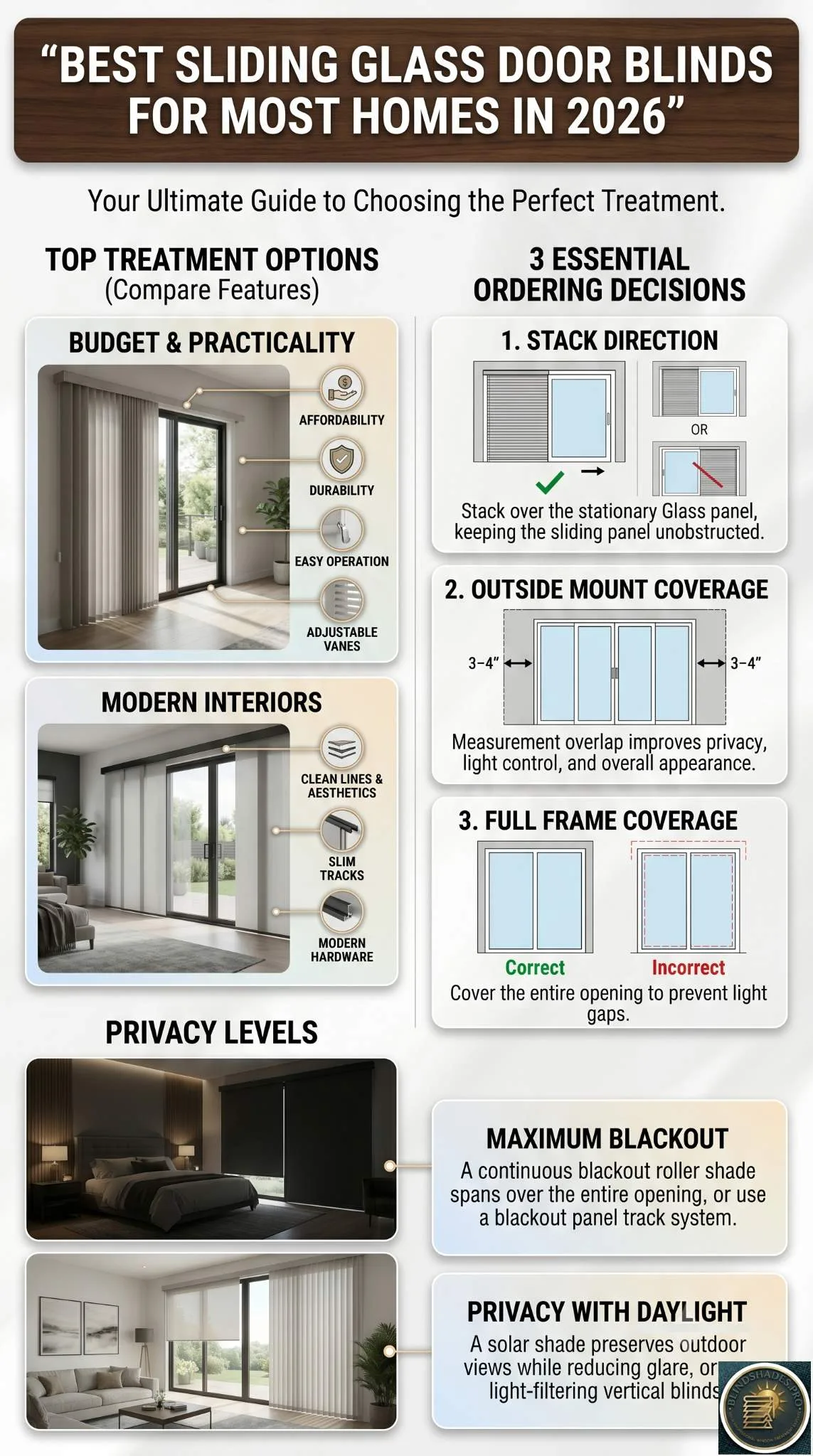
By Michael Turner, 30 years in the window treatment industry
The best sliding glass door blinds are side-stacking treatments that park on the fixed-panel side of the door — panel track blinds for a modern look, vertical cellular shades for insulation, classic vertical blinds for budget durability, and wide roller shades where the view matters most. But the type is only the third decision. Before any brand, a sliding door treatment has to pass three gates: where the stack parks, how the track mounts, and how much traffic the door carries. Get those three right and almost any of the four families works; get them wrong and even a premium system curtains off your own doorway.
Key Takeaways
- Stack placement decides everything. A side-stacking treatment must park over the fixed panel, not the sliding one — and the draw direction must match the door’s slide direction, the single spec buyers most often get wrong.
- Mount outside or above, almost never inside. Sliding doors rarely have usable inside-mount depth; wall mounting above the frame (or ceiling mounting for tall doors) keeps the headrail clear of the door’s own track.
- Match the treatment to traffic. A daily-use patio door needs wand or cordless durability and pet-proof materials; a rarely-opened slider unlocks options — including horizontal ones — that the standard advice refuses to consider.
- Vertical cellular is the insulation king. Honeycomb shades that traverse sideways, led by Hunter Douglas’s Duette Vertiglide system, trap air across the largest glass surface in most homes — a verdict Budget Blinds (March 24, 2025) and Hunter Douglas (January 14, 2021) both reach independently.
- Check the review volume, not just the stars. The same Chicology sliding panel appears on this market at three different ratings across near-identical listings — three point six, four point one, and four point zero — so weight the listing with the largest review base.
⭐ Quick Answer — The Best Sliding Glass Door Blinds & Shades
The best sliding glass door blinds are chosen at three gates — Stack (where the treatment parks), Track (how it mounts), and Traffic (how often the door is used):
- The stack rule: side-stacking treatments must park over the fixed panel, and the draw direction must match the door’s slide direction — the spec buyers most often get wrong, explained in the stacking-math section of this guide.
- The style consensus: panel track for modern rooms, vertical cellular for insulation (the Duette Vertiglide class at Hunter Douglas), and classic verticals for budget durability — the full case in vertical blinds for sliding glass doors.
- The market verdict: side-to-side solutions from twenty-six to three hundred fifty-five dollars per Blindsgalore’s category, with honeycomb named the efficiency pick in Budget Blinds’ five-treatment roundup.
- The view-first exit: extra-wide or split roller shades stack nowhere at all — the zero-stack method for rarely-opened sliders is in roller shades for sliding glass doors.
- Measure the overlap, not just the glass: three to four inches per side where the wall allows, headrail above the frame, handle clearance confirmed — the sequence is in how to measure sliding glass door blinds.
Quick Specification Reference
| Specification | The Short Answer |
|---|---|
| Best overall | Chicology Adjustable Sliding Panels — around ninety-nine dollars at Home Depot, four point zero across four hundred seventy-eight reviews |
| Best budget | Hampton Bay Crown Room Darkening Vertical Kit — around fifty-nine dollars, four point one across one thousand six hundred reviews |
| Best insulation | Hunter Douglas Duette Vertiglide vertical cellular (custom-quoted) |
| Best motorized | Graywind panel track class — around ninety dollars manual, motorized options from Yoolax listed at one seventy-nine to three eighty-nine |
| Typical cost range | Twenty-six to three hundred fifty-five dollars per Blindsgalore’s category listing; custom options from forty-two dollars per Affordable Blinds |
| Stack rule | Park over the fixed panel; draw direction matches slide direction |
| Mount rule | Outside (wall) mount above the frame, or ceiling mount; inside mount almost never fits a slider |
| Best for pets | Vertical blinds in vinyl or PVC — the community-consensus survivor for cat households |
Read the complete guide below for: the full Diamond picks with the ratings-split warning, the Stack-Track-Traffic Test that sorts every treatment type in three questions, the stacking math no retailer publishes, measuring and mounting rules door by door, the honest motorized and horizontal-blinds answers the rest of this category skips, and the blackout, privacy, and pet playbooks — each with a dedicated deep-dive guide linked in place.
What Are the Best Sliding Glass Door Blinds & Shades? Our Picks
Six picks, one per job — each verified against live market listings, with the ratings fine print stated where it matters.
The best sliding glass door blinds for most homes is the treatment that matches the door’s job, not the prettiest photo. These six cover every lane; full comparisons live in the linked guides throughout this page.
Best Overall — Chicology Adjustable Sliding Panels. The modern default: wide fabric panels gliding on a top-mounted track, stacking flat to the side. Listed around ninety-nine dollars at Home Depot with a four point zero rating across four hundred seventy-eight reviews. One honest caveat baked into this pick: the same product family appears across near-identical listings at three point six (seven reviews), four point one (one hundred twenty-five reviews), and four point zero (four hundred seventy-eight reviews) — judge it by the largest review base, and see the where-to-buy table below for why.
Best Budget — Hampton Bay Crown Room Darkening Vertical Sliding Kit. Around fifty-nine dollars for a complete kit, rated four point one across roughly one thousand six hundred reviews — the largest review base of anything ranked on this market. It is the classic answer for a reason: durable, replaceable vane by vane, and the cheapest full-coverage option per inch of glass.
Best Custom Vertical — Blindsgalore Custom Vertical Blind. Around sixty-two dollars at half off, carrying a four point nine rating across one hundred eighty-one buyers — the highest rating-with-volume in the category. A Reddit r/InteriorDesign homeowner covering three sliding doors called Blindsgalore the cheapest custom source they found, and the store’s own rating sits at four point seven across four thousand six hundred reviews.
Best Insulation — Hunter Douglas Duette Vertiglide. The vertical cellular flagship: honeycomb fabric that traverses sideways, sealing the largest glass opening in the house behind trapped-air cells. Hunter Douglas has positioned it as the energy answer for sliding doors since at least January 2021, and Budget Blinds’ March 2025 roundup independently lands on honeycomb as the efficiency pick. Custom-quoted; the buyable off-the-shelf route is Blindsgalore’s Gallery Vertical Cellular, listed around three thirty-five at half off with a four point four rating.
Best Motorized — Graywind Manual/Motorized Panel Track class. Graywind’s manual panel track lists around ninety dollars at four point six across thirty-five reviews, with motorized upgrades available; Yoolax’s motorized sliding-door collection runs one seventy-nine to three eighty-nine with a four point four store rating. Motorization matters more on a slider than a window — the full case is two sections down.
Best Blackout — Bali blackout roller and sliding panels. Bali’s blackout roller shades are the AI-era consensus name for opacity on sliders, and Bali Sliding Panels list around three hundred eleven at American Blinds (four point one, one hundred thirty-six reviews). On a door, blackout is a system problem, not a fabric problem — the side-light reality is covered in blackout blinds for sliding glass doors.
| Pick | Product | Approx. Price (as listed) | Rating / Reviews | Wins the gate for |
|---|---|---|---|---|
| Best Overall | Chicology Adjustable Sliding Panels | Around ninety-nine dollars | 4.0 / 478 (largest listing) | Modern looks + clean stacking |
| Best Budget | Hampton Bay Crown Vertical Kit | Around fifty-nine dollars | 4.1 / 1,600 | Cost per inch of glass |
| Best Custom Vertical | Blindsgalore Custom Vertical | Around sixty-two dollars (sale) | 4.9 / 181 | Fit + fabric choice |
| Best Insulation | Hunter Douglas Duette Vertiglide | Custom-quoted | Brand flagship | Energy efficiency |
| Best Motorized | Graywind / Yoolax panel track | Ninety to three eighty-nine range | 4.6 / 35 · 4.4 / 43 store | Daily-traffic convenience |
| Best Blackout | Bali blackout roller / sliding panels | Around three hundred eleven (panels) | 4.1 / 136 | Bedroom-grade darkness |
For a ranked shortlist without the full theory, the quick-picks spoke covers the best blinds for large sliding glass doors — oversized and multi-panel doors included.
How Do You Choose? The Stack-Track-Traffic Test
Three gates, in order: where the stack parks, how the track mounts, how much traffic the door carries. Every treatment type either passes or routes elsewhere.
Every ranked page on this topic lists the same four treatment families and stops. None of them tells you the three questions that actually sort those families for your door. Here is the test this guide is built on.
Gate 1 — Stack. A sliding door is two panels: one fixed, one moving. Any side-stacking treatment must park its folded bulk over the fixed panel, leaving the operable panel and the walk lane clear. That sounds obvious; it eliminates half the configurations sold. A center-split draw on a two-panel slider parks half the stack over your doorway. A one-way draw pulling the wrong direction does the same. The stack question is also a width question — covered in the stacking math section next.
Gate 2 — Track. Sliding doors almost never offer usable inside-mount depth: the frame is shallow and the door’s own track occupies it. That routes nearly every installation to an outside (wall) mount above the frame, or a ceiling mount where the wall space is tight or the doors run tall. The headrail also has to clear the door handle and any protruding lock hardware as panels traverse.
Gate 3 — Traffic. A patio slider used five times a day is a machine part, not décor. High-traffic doors punish flimsy controls, tangle-prone cords, and fabrics a pet can reach — a Facebook Home Design and Decor thread with more than twenty comments lands on exactly this, with the top answer admitting that much-mocked vertical blinds are “the only thing that really works” in a cat household. Low-traffic doors — the slider behind the dining table that opens twice a summer — flip the logic and unlock view-first options, including the horizontal ones addressed later in this guide.
| Gate | The question | Pass looks like | Fail routes to |
|---|---|---|---|
| Stack | Where does the folded treatment park? | Over the fixed panel, clear of the walk lane | Re-spec the draw side or panel count |
| Track | Where does the headrail mount? | Wall mount above frame, or ceiling mount | Check handle clearance; avoid inside mount |
| Traffic | How often does the door operate? | Controls and materials rated for daily use, pet-safe if needed | Low traffic unlocks wide rollers and horizontal options |
The two vertical-blind deep dives apply this test to the classic option: vertical blinds for sliding glass doors for the full treatment, and the best vertical blinds for sliding doors for the product shortlist.
What Is the Stacking Math on a Sliding Glass Door?
Stack width is predictable arithmetic, not luck — and the draw direction is the spec that decides whether “easy access” is real.
No store page publishes this, which is strange, because it is the difference between a treatment that disappears when open and one that permanently shades a third of your glass.
Vertical blinds stack tightest of the side-stacking family. Open, the vanes rotate parallel and compress into roughly one-seventh to one-eighth of the track width as a category norm — on a seventy-two-inch door, call it a stack in the nine-to-ten-inch class. That efficiency is why the format has survived fifty years of style complaints.
Panel track blinds park in full panel widths. Each panel layers behind the next, so the parked stack is approximately one panel wide no matter how many panels traverse — but one panel on a big slider is wide. A four-panel system across ninety-six inches parks a stack roughly twenty-four inches wide plus track hardware. Modern, yes; compact, no. Plan for it.
Vertical cellular shades compress dramatically — the honeycomb pleats concertina sideways into a slim bundle a few inches deep, which is a large part of the Vertiglide system’s appeal on wide openings.
Roller shades don’t side-stack at all — they vanish upward into the cassette. That makes them the zero-stack option, with the trade-off that raising and lowering a shade every time you use the door gets old fast on high-traffic sliders. The multi-panel split method — two or three independent rollers across one opening so only the door-lane roller moves — solves that, and our roller blind sizing and split calculator does the panel arithmetic for any door width.
Then the spec everyone gets wrong: draw direction. A one-way-draw treatment must pull toward the fixed panel — the same direction the door slides open. Order it mirrored and every trip through the door means dragging the treatment across your own path. When ordering, stand inside facing the door, confirm which side the operable panel slides toward, and specify the draw accordingly; custom retailers ask, big-box kits often assume.
| Treatment | Parked stack width (category norm) | Park-side rule | Draw options |
|---|---|---|---|
| Vertical blinds | Roughly one-seventh to one-eighth of track width | Over the fixed panel | One-way (either side) or center-split |
| Panel track | About one full panel width plus hardware | Over the fixed panel or adjacent wall | One-way or bi-parting |
| Vertical cellular | A few inches — tightest compression | Over the fixed panel | One-way or center-stack |
| Roller shades | None (rolls up into cassette) | N/A — vertical travel | Single wide or multi-panel split |
Exact deductions and the measuring sequence live in how to measure sliding glass door blinds.
Which Style Fits Your Priority?
Name the door’s job first — insulation, pets, budget, view, or a rental lease — and the style picks itself.
| Your priority | Best lane | Why it wins | Deep dive |
|---|---|---|---|
| Energy efficiency | Vertical cellular (Duette Vertiglide class) | Trapped-air honeycomb across the home’s largest glass | Cellular & honeycomb shades guide |
| Pets and kids | Vinyl/PVC vertical blinds, cordless | Replaceable vanes, no climbable fabric, community-proven with cats | Vertical blinds for sliding glass doors |
| Tightest budget | Vertical blind kits (Hampton Bay class) | Around fifty-nine dollars for full coverage, 1,600-review track record | Best vertical blinds for sliding doors |
| Modern minimalism | Panel track | Flat fabric planes, hotel-suite geometry | Panel track blinds for sliding glass doors |
| Preserving the view | Wide or split roller shades | Zero side-stack; disappears upward | Roller shades for sliding glass doors |
| Softness / formal rooms | Roman shades (low-traffic doors only) | Fabric warmth; raise-to-open discipline required | Roman shades for sliding glass doors |
| Renters / no-drill | Tension and adhesive systems within weight limits | Deposit-safe; hold light treatments only | Blinds inside sliding glass door options |
Two of those lanes deserve a sentence of honesty. Roman shades on a slider are a style purchase that demands a habit change — every pass through the door means raising the shade — so they belong on low-traffic doors; the full case is in Roman shades for sliding glass doors. And enclosed blinds-between-glass systems, which solve dusting and flapping on French doors, exist for sliders too but usually mean replacing the door panel itself — blinds inside sliding glass door maps when that trade makes sense.
How Do You Measure and Mount Blinds on a Sliding Glass Door?
Measure the opening plus overlap, mount above the frame, and clear the handle — in that order.
Sliding doors are more forgiving to measure than French doors (no swing arc, no protruding lever at glass height) but less forgiving than windows, because coverage gaps show at eye level and light-leak strips telegraph across a whole room.
| Step / Spec | The rule |
|---|---|
| Width | Frame width plus three to four inches of overlap per side where wall space allows — light control and privacy live in the overlap |
| Height | From mounting height (headrail above the frame) to the floor, less about half an inch of clearance so vanes and panels don’t drag |
| Mount | Wall mount above the frame is the default; ceiling mount for tall doors, transoms, or shallow header walls |
| Handle clearance | Confirm the headrail depth lets panels traverse past the door handle and any auxiliary locks |
| Draw side | Stand inside, note which way the operable panel slides, order the draw to match |
| Multi-panel splits | For split roller setups, divide the opening so one roller owns the door lane — the sizing and split calculator does the math |
The full tape-measure sequence, with the deduction table by treatment type, is in how to measure sliding glass door blinds, and the bracket-by-bracket walkthrough — including ceiling-mount anchoring and the two mistakes that make tracks bind — is in how to install sliding glass door blinds.
Are Motorized Blinds Worth It for Sliding Glass Doors?
On a daily-traffic door, motorization earns its price faster than on any window in the house — and this is the one lane the editorial results skip entirely.
Curiously, the store pages sell motorized sliding-door systems by the thousands while the ranked articles barely mention them. The market data is public: Yoolax’s motorized sliding-door collection runs one hundred seventy-nine to three hundred eighty-nine dollars with a four point four store rating across forty-three reviews, Graywind’s panel tracks start around ninety dollars manual with motorized upgrades, and Affordable Blinds lists custom sliding-door treatments from forty-two dollars with motorization as an add-on (store rating four point five across two hundred ninety-nine reviews).
The case for a motor is stronger on a slider than a window for one mechanical reason: the treatment is big. A ninety-six-inch vertical or panel system carries real fabric weight, and dragging it open and closed several times a day is exactly the repetitive stress that wears wands, tilters, and shoulders. A motor also removes the dangling-control problem entirely — relevant to the same pet-and-kid households that drive this category’s community threads.
| Motorized option | Listed price range (as published) | Power route | Best for |
|---|---|---|---|
| Motorized panel track (Graywind class) | From around ninety dollars manual; motor upgrade priced per order | Rechargeable battery or wired | Modern rooms, wide openings |
| Motorized vertical / sheer vertical (Yoolax class) | One seventy-nine to three eighty-nine | Rechargeable battery, remote or app | Daily-traffic family doors |
| Motorized wide roller | Custom-quoted by width | Battery or wired; check torque rating at width | View-first, low-stack rooms |
Protocols, power planning, and whether your door needs an outlet at all are covered in the complete motorized and smart blinds guide — including the app-ecosystem decisions that matter more than the hardware.
Can You Use Horizontal Blinds on a Sliding Glass Door?
Honest answer: usually no — but “usually” is doing real work in that sentence, and nobody ranked on this topic will tell you when the answer is yes.
“Horizontal blinds for sliding glass doors” is a live search on this exact topic, and every ranked page answers it by ignoring it: go vertical, next question. The reflex is right for most doors and wrong for a meaningful minority, so here is the actual decision.
Horizontal treatments fail on sliders for two reasons: traffic and travel. A horizontal blind must fully raise before anyone walks through — slow, repetitive, and hard on lift mechanisms sized for windows. And at patio-door widths, a single horizontal blind is heavy enough that lift systems strain and slats bow.
Both objections dissolve on the right door. A slider that functions as a picture window — opened rarely, stared through daily — has no traffic problem. And the width problem has two engineering answers: extra-wide single roller shades, which Bali and others offer in what the market fairly calls massive sizing and opacity variations, and the multi-panel split, where two or three independent shades share the opening so only the door-lane shade ever moves. The split method is the quiet winner for view-first rooms: zero side stack, one small shade to raise when you use the door, and the sizing and split calculator turns any opening width into panel dimensions in seconds. For oversized single-shade routes and their real weight limits, see the best blinds for large sliding glass doors, and for the full roller playbook on doors, roller shades for sliding glass doors.
| Situation | Vertical / side-stacking verdict | Horizontal verdict |
|---|---|---|
| Daily-traffic patio door | Correct default — clear walk lane in one pull | Wrong tool: full raise before every pass |
| Rarely opened, view-first slider | Works, but stack sits in the view | Wide roller or split rollers win — zero side stack |
| Very wide openings (ninety-six inches plus) | Panel track or vertical, engineered for width | Single horizontal strains; split into panels instead |
| Renters, no-drill | Vertical tension systems where rated | Light split rollers on damage-free hardware |
What About Blackout, Privacy, and Pets?
A door-sized opening is a door-sized light and sightline problem — solve it as a system, not a fabric swatch.
Blackout on a slider obeys the same physics as any big opening: opaque fabric handles the field, but the edges leak. Side-stacking treatments add a wrinkle — vanes and panel edges create repeating slit-lines rather than one perimeter halo. The door-specific fixes, from wraparound overlap to layering, are in blackout blinds for sliding glass doors, and the whole-room strategy — including when the honest answer is a curtain layer over the treatment — is in the complete blackout blinds and shades guide.
Privacy is a night-time geometry problem: a lit room behind seventy square feet of glass is a stage. Sheer verticals and light-filtering panels that read private by day go transparent at dusk. The day/night playbook, film-versus-fabric comparisons, and the frosted-glass option are in sliding glass door window treatments for privacy.
Pets and kids settle most sliding-door debates before style gets a vote. The community record is blunt — a twenty-plus-comment thread on the topic crowns vinyl vertical blinds precisely because a cat can push through vanes without destroying them and a destroyed vane costs a few dollars to replace, not a whole treatment. Cordless or motorized controls remove the loop hazard; PVC and vinyl shrug off claws that shred fabric panels. If the household is furry, weight this section over every table above it.
What If Your Door Swings Instead of Slides?
A French door swings; a sliding door traverses — and the two demand opposite engineering.
This guide’s three gates assume a door that moves sideways past its treatment. A hinged patio or French door moves with its treatment — the blind rides the door through every swing, which is why that category obsesses over outside mounts on the door face, profiles under one inch to clear the handle, and hold-down brackets to stop the flap. None of those rules applies here, and none of this guide’s stacking math applies there. If your glass door swings on hinges, the parallel system — mounting mechanics, style picks, and the tracked and enclosed upgrades — is in the complete French door blinds and shades guide.
Where Should You Buy Sliding Glass Door Blinds?
Buy custom where fit matters, big-box where speed matters — and read review counts before stars, because this category’s listings split.
| Retailer / Route | Listed range (as published) | Rating shown | Watch-out |
|---|---|---|---|
| Blindsgalore (custom direct) | Twenty-six to three fifty-five | 4.7 store / 4,600 reviews | Sales are steep and frequent — the half-off price is the real price |
| Home Depot (big-box) | Fifty-nine to four thirty-nine across brands | Per-product | Same product, multiple listings — compare review volume |
| Affordable Blinds (custom direct) | From forty-two dollars | 4.5 store / 299 reviews | Motorization priced as add-on |
| Yoolax (motorized specialist) | One seventy-nine to three eighty-nine | 4.4 store / 43 reviews | Smaller review base; check protocol compatibility |
| American Blinds (brand custom) | Bali panels around three eleven on sale | 4.1 / 136 | Brand-line pricing swings with promotions |
The double-ratings warning, spelled out: the Chicology sliding panel — this guide’s Best Overall — appears on the current market at three point six stars across seven reviews, four point one across one hundred twenty-five, and four point zero across four hundred seventy-eight, near-identical product, different listings. That is not a quality signal; it is a listing-fragmentation signal, and it is common across big-box window treatment catalogs. The defense is mechanical: sort by review count, read the one-star page of the biggest listing, and treat any rating under about thirty reviews as provisional.
Related guides: slider openings are custom territory — measure once with the complete guide to made to measure blinds.
Related Buying Guides
- Best French Door Blinds & Shades — if your door swings instead of slides
- Best Vertical Blinds — the full vertical category beyond doors
- Best Panel Track Blinds — panel systems for doors, windows, and room dividers
- Best Motorized & Smart Blinds — power, protocols, and app ecosystems
- Best Blackout Blinds & Shades — the whole-home darkness playbook
- Best Cellular & Honeycomb Shades — the insulation science behind Vertiglide
Complete Sliding Glass Door Guide Library
- Best Blinds for Large Sliding Glass Doors — the quick-picks shortlist, oversized doors included
- Vertical Blinds for Sliding Glass Doors — the classic option, fully argued
- Best Vertical Blinds for Sliding Doors — the vertical product shortlist
- Panel Track Blinds for Sliding Glass Doors — the modern lane
- Roller Shades for Sliding Glass Doors — zero-stack and split methods
- Roman Shades for Sliding Glass Doors — softness on low-traffic doors
- Blackout Blinds for Sliding Glass Doors — edge-light engineering
- Sliding Glass Door Window Treatments for Privacy — day/night sightlines
- How to Measure Sliding Glass Door Blinds — tape-measure sequence and deductions
- How to Install Sliding Glass Door Blinds — brackets, ceiling mounts, and binding fixes
- Blinds Inside Sliding Glass Door — the enclosed, between-glass route
Frequently Asked Questions
What kind of blinds are best for sliding patio doors? Side-stacking treatments that park over the fixed panel: vertical blinds for budget and pet durability, panel track for modern rooms, vertical cellular for insulation, and wide or split roller shades where the view leads. The best sliding glass door blinds for your home is whichever of those passes the Stack-Track-Traffic Test above.
How do you choose the right color for sliding glass door blinds? Treat the treatment as wall, not window. A door-sized panel is the largest single color block in most rooms, so match or slightly deepen the wall tone for a built-in look, or match trim white for a clean architectural read. Save statement colors for panel-track fabrics, where flat planes wear color like art; on verticals, strong colors stripe when the vanes rotate.
Should I use curtains or blinds on a sliding glass door? Blinds and shades win on function — precise light control, clean stacking, no floor puddle in the walk lane. Curtains win on softness and width forgiveness, and a curtain layer over a blackout treatment is the honest fix for edge light in bedrooms. Many rooms run both: a functional treatment on the door, stationary drapery panels framing it.
Are vertical blinds outdated for sliding glass doors? The style debate is real; the function verdict isn’t. Community threads keep reaching the same reluctant conclusion — for high-traffic and pet households, verticals are the option that simply works, and modern fabric vanes and S-curve PVC profiles have quietly closed most of the style gap.
What do sliding glass door blinds cost? The live market runs from twenty-six dollars for basic verticals to around three hundred fifty-five for premium custom systems per Blindsgalore’s listings, with complete big-box kits around fifty-nine dollars, custom entries from forty-two per Affordable Blinds, and motorized systems from about one seventy-nine to three eighty-nine per Yoolax’s published range. Vertical cellular flagship systems are custom-quoted above those bands.
Can renters put blinds on a sliding glass door without drilling? Yes, within weight limits: tension-mounted vertical systems and damage-free adhesive hardware hold light treatments like split roller shades, and heavier verticals and panel tracks generally cannot be safely no-drilled. The enclosed alternative — treatments already inside the glass — is mapped in the blinds-inside guide above.
