The Best Solar Shades Buying Guide: Openness, Color, and the Honest Trade-Offs

Authored By Michael Turner -30 Years Home Improvement Expertise | Updated 2026 | BlindShades.pro
Updated on July 17, 2026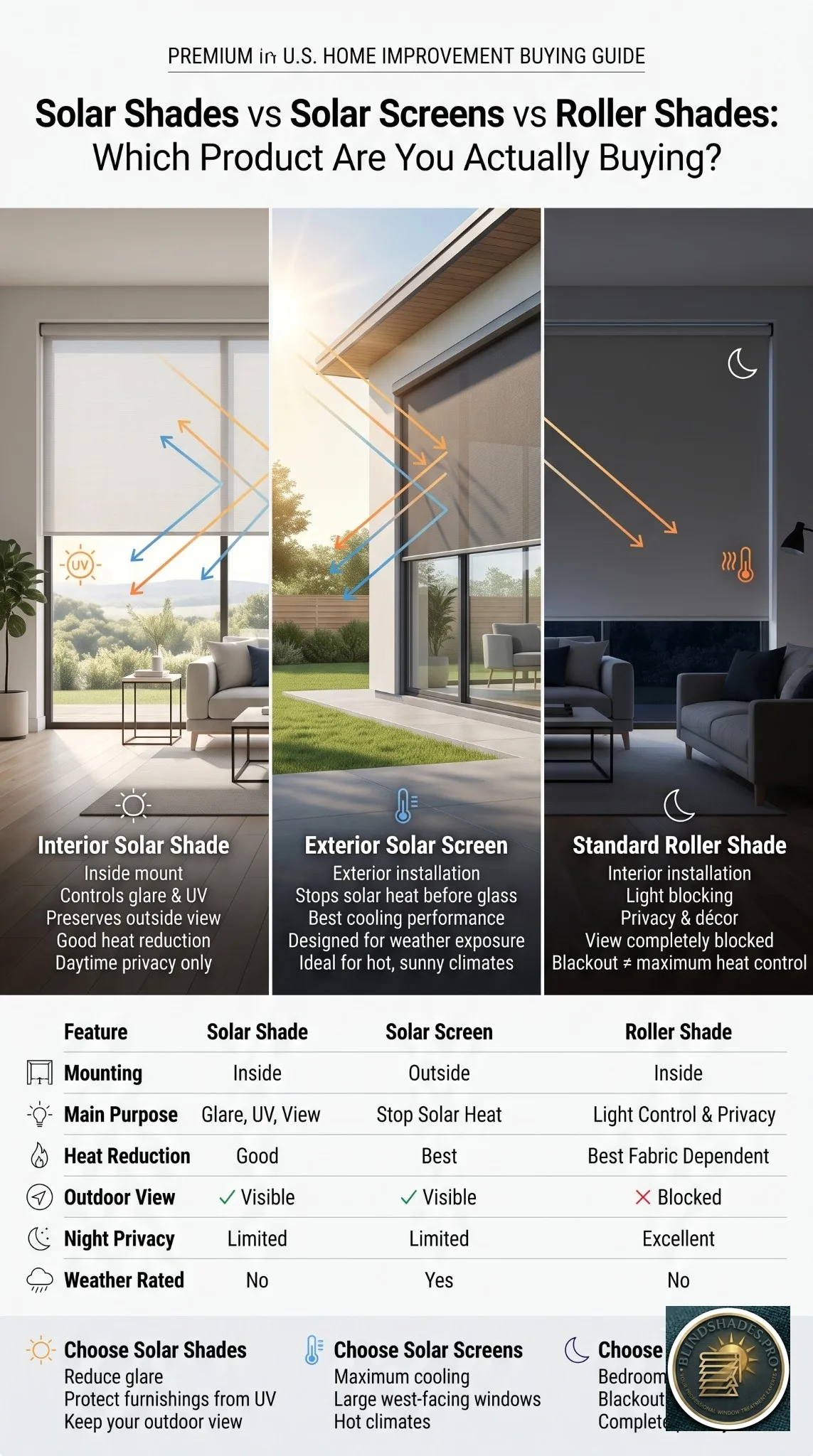
Authored by Michael Turner — 30 Years of Home Improvement Expertise | BlindShades.pro
The best solar shades block up to 95 percent of UV while keeping your view — but every solar shade purchase is governed by a triangle nobody at the sample counter draws for you: View, Heat, and Privacy, and you can maximize any two, never all three. Openness percentage sets your position on that triangle, fabric color tilts the glare-versus-heat balance in ways the standard advice gets half wrong, and nightfall flips the privacy corner entirely — the betrayal behind a 194-post Reddit thread from owners sold “privacy” shades that turn transparent after dark. This guide gives you the verified picks, the openness and color decisions with the physics attached, the specifier-grade technical data, and the honest sections the catalogs skip.
⭐ Quick Answer — The Best Solar Shades
The best solar shades block up to 95 percent of UV while keeping your view — but every choice sits on a triangle: View, Heat, Privacy — pick two:
- Top picks: Hunter Douglas Designer Solar (best overall, dealer-fitted — the category per the Hunter Douglas buyers guide), Blindster Deluxe (budget), The Shade Store (premium custom, 100+ materials, limited lifetime warranty), SmartWings Motorized (the NYT Wirecutter top smart-shade pick, May 2026), SelectBlinds (value custom).
- Openness first: 1–3 percent blocks the most heat with the strongest daytime privacy; 5–10 percent keeps the clearest view — 3 percent is the household default; the room-by-room math is in what percentage solar shade for a living room.
- The color paradox: dark fabrics kill glare and sharpen the view; light fabrics reflect heat back outside — choose by window orientation, or buy dual-sided fabric and refuse the trade.
- The honest warning: solar privacy is daytime-only — after dark with lights on, the one-way mirror reverses; see can you see through solar shades from outside before buying for bedrooms or bathrooms.
- Buying for cooling? Exterior screens stop heat before the glass and beat any interior fabric — compare the solar screens buying guide first.
Related guides: for the exterior half of the solar family — mesh screens that reject heat before the glass — see the best solar screens guide.
Key Takeaways
- Openness percentage is the master decision. A 1–3 percent weave blocks the most heat and gives the strongest daytime privacy; a 5–10 percent weave keeps a clearer, brighter view — the industry-consensus split Google’s own summary reports. Everything else in the purchase adjusts around this number.
- The color advice is a paradox, and both halves are true. Darker fabrics absorb light — best glare kill, clearest see-through view — while lighter fabrics reflect solar energy back outside and keep the room cooler. Dark for view, light for heat: pick by window orientation, or buy a dual-sided fabric and refuse the trade.
- Solar shades are daytime-only privacy. In daylight they behave like a one-way mirror; after dark, with interior lights on, the effect reverses and the street can see in — the honest warning Hunter Douglas’s own guide carries and the source of the loudest owner-regret thread in this market.
- The verified picks: Hunter Douglas Designer Solar as the flagship, Blindster Deluxe for budget, The Shade Store for premium custom, SmartWings Motorized as the smart pick (The New York Times’ Wirecutter names it the top smart shade, May 2026), SelectBlinds for value custom.
- Solar shades and solar screens are different products. Interior solar shades manage glare, UV, and view; exterior solar screens stop heat before the glass and beat any interior fabric in cooling-dominated climates — the line this guide draws explicitly, with a full handoff.
Quick Specification Reference
| Spec | The short answer |
|---|---|
| What it is | A roller shade in openness-woven mesh fabric — Hunter Douglas defines the category as roller shades in a specially designed weave that blocks UV while preserving view |
| UV blocking | Up to 95 percent, openness-dependent |
| Openness range | 1% (max heat/privacy) to 10% (max view) — 3% and 5% are the household defaults |
| Color rule | Dark = glare and view; light = heat reflection; dual-sided = both |
| Privacy | Daytime only — reverses after dark with lights on |
| Night privacy fix | Layer with a blackout roller, drapery, or dual-shade bracket |
| Best rooms | Living rooms, home offices, sunrooms, west/south glass walls |
| Wrong rooms | Bedrooms needing darkness, bathrooms, any night-privacy window as the only layer |
| Mount | Inside mount for the clean look; outside mount for wider coverage |
| Standards to ask for | ANSI/WCMA A100.1 safety, NFPA 701 flame resistance (commercial), GREENGUARD certification, AERC-rated fabrics |
Read the complete guide below for: the View–Heat–Privacy Triangle that organizes every choice; the five verified picks with what each is actually best at; the openness selector table; the Color Paradox resolved; interior shades versus exterior screens; room-by-room verdicts including the honest “don’t” rows; the specifier-grade technical and compliance layer; and the night-reversal section every catalog omits.
What Are the Best Solar Shades? Our Picks
Five verified names, each the best at one corner of the triangle — not one “best at everything,” because that shade doesn’t exist.
| Pick | Product | Best for | Why it earns the slot |
|---|---|---|---|
| Best Overall | Hunter Douglas Designer Solar Shades | Whole-home quality with dealer fit | The flagship line a dealer measures and installs; praised across the market (Classic Blinds & Shutters, March 2026) for heat blocking with polished design |
| Best Budget | Blindster Deluxe Light Filtering Solar Shades | Value custom sizing | Highly rated for blocking heat and lowering cooling loads, with free cordless or spring-roller upgrades and a full openness range |
| Best Premium Custom | The Shade Store Solar Shades | Design-led projects | Over 100 high-end, sustainably sourced materials and a limited lifetime warranty |
| Best Smart / Motorized | SmartWings Motorized Solar Shades | Smart homes | The New York Times’ Wirecutter top smart-shade pick (May 8, 2026); Alexa, Google, SmartThings, and Matter support with rechargeable batteries that can trickle-charge from small solar panels |
| Best Value Custom | SelectBlinds Neutral Solar Shades | Budget custom in neutral palettes | Strong owner ratings at entry pricing in the exact fabrics most rooms want |
Two honest notes before you click anything. First, the Designer Solar premium buys the dealer channel — measurement, install, and in-home warranty service — more than a fabric miracle; if you’re a confident self-measurer, the custom online tier delivers most of the performance. Second, whichever brand you buy, the openness percentage and color you choose matter more than the badge — which is why the next three sections are the real buying guide.
How Do You Choose Openness Percentage? The Triangle’s Main Dial
Openness is the percentage of the weave that is literally open — and it sets your position between View, Heat, and Privacy.
| Openness | Heat & UV blocking | View through | Daytime privacy | Best fit |
|---|---|---|---|---|
| 1% | Maximum — the blackout end of solar | Silhouettes only | Strongest | Brutal west sun, media-adjacent rooms, close neighbors |
| 3% | Strong | Good in daylight | Strong | The all-round household default; the “1% or 3%?” answer for most rooms is 3% unless heat is extreme |
| 5% | Moderate | Clear, bright | Moderate | View-priority rooms; the Houzz owner’s verdict on white 5% — opaque enough to cut glare without darkening the room — is the lived-in case |
| 10% | Light | Panoramic | Light | Sunrooms and view walls where the window is the point |
The percentage question is the single most-asked in this category — it has its own People-Also-Ask slot — and the fuller treatment, including room-by-room percentage recommendations, lives in our dedicated spoke: what percentage solar shade for a living room. The hub rule of thumb: pick the highest openness your heat and privacy needs allow, because view is the reason you chose solar over a standard roller in the first place.
Dark or Light Fabric? The Color Paradox, Resolved
Both halves of the standard advice are true — dark for view, light for heat — because they describe two different physical jobs.
A dark solar fabric absorbs visible light. That kills glare (nothing bounces into your eyes) and raises see-through contrast — the outside world reads clearly through a charcoal weave. But absorbed energy doesn’t vanish: the fabric warms and re-radiates part of that heat into the room. A light fabric does the opposite: it reflects solar radiation back out the glass — measurably cooler room — at the cost of a brighter, slightly washed-out fabric surface that fights the view and can sheen in direct sun.
| Your priority | Choose | Physics | The catch |
|---|---|---|---|
| Screen glare, TV rooms, home office | Dark (charcoal, black, bronze) | Absorption kills bounce-back and sharpens view contrast | Fabric re-radiates some heat inward |
| Cooling bills, west/south exposure | Light (white, beige, pearl) | Reflection sends radiation back out | Washed-out view, daytime sheen |
| Both, genuinely | Dual-sided / metallized-back fabrics | Reflective white back faces the glass, dark face faces the room | Smaller fabric selection, modest premium |
| Undecided | Match orientation | North/east glass rarely needs the reflection; west/south does | — |
The honest counter-example belongs in every color section and appears in none: the Houzz owner who chose white at 5 percent and reported it opaque enough to cut direct-sun glare while keeping the room bright (April 2021). Context beats rules — a white fabric in a moderate exposure can satisfy a glare brief that the charcoal-only advice would have overspent on. Sample both colors against your actual window before ordering; every custom brand in the picks table ships free swatches.
Solar Shades vs Solar Screens vs Roller Shades: Which Product Are You Actually Buying?
Three products share this aisle, and the names blur — here is the line between them.
| Factor | Interior solar shade (this guide) | Exterior solar screen | Standard roller shade |
|---|---|---|---|
| Mounts | Inside the room | Outside the glass | Inside the room |
| Core job | Glare, UV, view preservation | Stopping heat before the glass | Light control, privacy, décor |
| Heat performance | Good — but intercepts radiation after it’s through the glass | Best — the only option that prevents solar gain at the source | Fabric-dependent; blackout stops light, not heat |
| View when deployed | Preserved (openness-dependent) | Preserved from inside | Blocked |
| Night privacy | Reverses — see below | Similar daytime bias | Full when opaque |
| Weather exposure | None | Built for it | None |
| Best climate case | Mixed climates; glare-driven buys | Cooling-dominated homes, big west glass | Rooms wanting darkness or décor |
The rule that follows: if your motive is cooling a hot room, compare exterior first — once radiation has passed the glass, an interior fabric can only re-release part of what it absorbs indoors, the same asymmetry that governs cellular shades’ summer numbers. The exterior field is covered in our solar screens buying guide; if your motive is glare, UV, and view, you’re in the right guide. And if what you actually want is an opaque fabric on a roller tube, that’s the roller shades buying guide.
The Night Reversal: The Warning Behind a 194-Post Owner Thread
Solar shades are one-way mirrors that switch sides at sunset — buy them knowing it.
The daytime behavior is the selling point: with more light outside than in, the mesh reads as opaque from the street and transparent from your sofa. Hunter Douglas’s own buyers guide states the flip honestly — at night, with interior lights on, the effect reverses and the shades will not provide privacy. The lived version is the July 2025 Reddit thread, 194 posts deep, from owners sold solar shades for bathroom privacy — the room where the reversal matters most and where the product should never have been the only layer.
What to do about it, honestly:
| Situation | The fix |
|---|---|
| Street-facing living room | Accept it — evenings mean visible silhouettes at most; add sheers or drapery if that bothers you |
| Bedroom | Solar alone is the wrong product — layer a blackout roller behind or in a dual-shade bracket, or skip solar; full options in the bedroom blinds guide |
| Bathroom | Never as the only treatment — the reversal plus wet-room stakes make this the classic mis-sell; the dedicated analysis is in can solar shades be used in a bathroom |
| Home office on video calls | Fine — calls happen in daylight; the glare control is the win, per how to reduce screen glare from office windows |
| Ground-floor anywhere | Plan the night layer at purchase time, not after the first evening surprise |
The deeper mechanics — exactly what’s visible from outside at each openness, day and night — are in can you see through solar shades from outside.
Which Rooms Should and Shouldn’t Get Solar Shades?
The verdicts, including the ones that cost us affiliate clicks.
| Room | Verdict | Reasoning |
|---|---|---|
| Living room with a view | Yes — the home game | 3–5% openness, color by orientation; view preserved, glare gone |
| Home office | Yes | Dark fabric, 3%; screen glare is the enemy solar was built for |
| Sunroom / glass walls | Yes | 5–10% keeps the panorama; UV protection saves the furniture |
| Commercial office | Yes — with spec discipline | See the specifier layer below; glare, WELL-aligned daylighting, and the commercial worth-it analysis |
| Kitchen | Yes, away from splash | Wipeable mesh, view to the yard |
| Bedroom | No, not alone | The night reversal plus zero darkness — blackout first, solar as a day layer if budget allows |
| Bathroom | No, not alone | The mis-sell room; treated fully in the bathroom spoke |
| Media room | No | You want darkness; 1% solar is still not blackout |
Do Solar Shades Stop UV and Furniture Fading?
Mostly yes — and it’s the quietest reason to buy them.
Fading is cumulative UV plus visible-light exposure, and hardwood floors, rugs, artwork, and upholstery pay the bill in any sun-facing room. Solar fabrics are built for exactly this: category data puts UV blocking up to 95 percent even at household openness levels, with tight 1–3 percent weaves reaching the high end, and Levolor’s product documentation leads with built-in UV protection for the home’s décor as the core claim. Two honest qualifiers keep the promise accurate. First, blocking is openness-dependent — a 10 percent view weave passes meaningfully more UV than a 3 percent, so rooms with irreplaceable finishes should sit at the tight end of the range. Second, no interior fabric reaches 100 percent, and visible light itself fades aggressive dyes over years; for museum-grade protection, solar shades are the daily layer and window film or low-E glazing is the belt-and-suspenders addition. For everything short of that — the oak floor, the sofa, the rug — the best solar shades earn their keep silently, every sunny day, whether or not anyone lowers them for glare.
Related guides: parked glass soaks heat exactly like a west window at home — the interior-versus-exterior split for vehicles is settled in our RV window shades guide.
How Do You Mount and Measure Solar Shades?
Solar shades are roller shades in build — so the roller rules apply, with one view-specific twist.
Inside mount gives the recessed, architectural look and needs a level frame with enough depth for the tube and bracket; outside mount overlaps the opening for wider coverage and forgives out-of-square frames. The view twist: because you bought this product to see through it, light gaps at the edges matter less than with blackout fabric — the standard inside-mount deduction is fine, and you don’t need side channels. Measure width in three places and height in three, order to the manufacturer’s instructions for your chosen mount, and if the span crosses roughly eight feet, ask the brand about fiberglass-core fabric or a split-on-one-headrail configuration to keep the fabric flat. The full tape-measure discipline transfers directly from our how to measure for roller blinds walkthrough — same tube, same brackets, same three-measurement rule. For motorization, all five picks offer it; SmartWings leads the smart-home tier, and the wiring-versus-battery decision plus ecosystem comparison lives in the motorized guide linked below.
A word on value before the specifier layer. Solar shades occupy the sensible middle of the window-treatment market — the shopping listings in this very search run from budget-custom entries in the tens of dollars to premium and exterior builds in the low hundreds per shade, with dealer lines quoted per job — and the price you pay tracks fabric grade, size, and motorization far more than raw performance. The performance you keep, though, tracks your choices: a correctly chosen openness and color in a mid-tier fabric will beat a premium fabric bought one openness too clear or one shade too dark for the exposure. Spend on the decision first, the badge second — and order the free swatches every custom brand in the picks table offers, because a fabric held against your actual glass at 4 p.m. answers questions no chart can.
For Specifiers: Technical and Compliance Layer
Jump box: openness/SHGC guidance · fabric composition · certifications · CSI reference · RFQ path.
Honest category ranges and the certifications that exist — precise values always come from the manufacturer cut sheet for the exact fabric.
| Technical parameter | Category range / note |
|---|---|
| Openness factor | 1%–10% standard commercial range; 3% and 5% dominate office specs |
| Fabric composition | Vinyl-coated polyester and vinyl-coated fiberglass dominate; fiberglass cores for dimensional stability on large spans |
| UV blocking | Up to 95–99% at 1–3% openness, per published category data |
| Solar/optical properties | Ts, Rs, As and SHGC vary per fabric and color — specify from the manufacturer’s tested cut sheet, never from category averages |
| Width limits | Railroading and seamless widths vary by fabric line; verify before specifying mullion-free spans |
| Compliance item | Relevance |
|---|---|
| NFPA 701 | Flame-propagation standard commercial interiors will be asked for |
| ANSI/WCMA A100.1 | The window-covering safety standard; cordless/motorized satisfies it by design |
| GREENGUARD / GREENGUARD Gold | Low-emission certification common on major solar fabric lines |
| AERC rating | The energy label to compare fabrics on, where offered |
| LEED / WELL | Daylighting and glare-control credits are where solar fabrics contribute; openness selection is the design variable |
| CSI MasterFormat | Section 12 24 13 — Roller Window Shades |
For motorization planning (PoE vs battery vs plug-in, group control, BMS integration) the motorized and smart blinds guide carries the ecosystem comparison; for project quotes, request cut sheets and an RFQ through any picks-table brand’s commercial desk.
Best Sources
- Hunter Douglas — Solar Shades buyers guide — the category definition and the on-record night-reversal warning.
- The New York Times / Wirecutter (May 8, 2026) — SmartWings Motorized as the top smart-shade recommendation.
- Google AI Overview consensus (Blindster, Shade Store, SmartWings sources) — the 95 percent UV figure, openness split, and pick set validated across retailers.
- Houzz — white solar shades thread (April 15, 2021) — the owner-tested white-5% counter-example.
- Reddit r/homeautomation (2025) — SmartWings Matter shades field reports, internal batteries with solar recharge.
- Reddit — bathroom privacy thread (July 28, 2025, 194 posts) — the night-reversal mis-sell in owners’ own words.
- Classic Blinds & Shutters (March 27, 2026) — Hunter Douglas Designer Solar market positioning.
- Levolor product documentation — mesh construction and built-in UV protection claims.
Supporting Articles in This Cluster
- What Percentage Solar Shade for a Living Room
- Can You See Through Solar Shades From Outside — The Office Privacy Answer
- Can Solar Shades Be Used in a Bathroom — The Night Privacy Problem
- Are Solar Shades Worth It for a Commercial Office
- How Do I Reduce Computer Screen Glare From Office Windows
Related Buying Guides
- The Best Solar Screens Buying Guide
- The Best Roller Shades Buying Guide
- The Best Bedroom Blinds & Shades Buying Guide
- The Best Office & Commercial Blinds Buying Guide
- The Best Cellular & Honeycomb Shades Buying Guide
Frequently Asked Questions
What are the disadvantages of solar shades?
Three honest ones. Privacy reverses at night — with interior lights on, the daytime one-way mirror flips and the street can see in, which disqualifies solar as the only treatment on bedroom, bathroom, and ground-floor night windows. They never produce darkness — even 1 percent openness admits a glow, so sleep rooms need a blackout layer. And their heat performance, while real, is intercepted after the glass: for cooling-dominated climates, exterior solar screens stop the heat earlier and do the job better.
Is 1% or 3% solar shade better?
Three percent for most rooms. It blocks strongly, holds daytime privacy, and keeps a usable view — the balance point of the triangle. Choose 1 percent when heat or privacy is extreme: brutal west exposures, close neighbors, screens that can’t tolerate any glare. Choose 5 percent or more when the view is the point and the exposure is moderate. The rule: buy the highest openness your heat and privacy needs allow, because the view is why you chose solar in the first place.
Do solar shades really work?
Yes, for the jobs they’re built for: category fabrics block up to 95 percent of UV, cut screen and eye glare dramatically, and reduce solar heat gain while preserving the view — which is the combination no other interior treatment offers. They do not darken rooms, they do not provide night privacy, and they are second-best to exterior screens for pure cooling. Buyers disappointed with solar shades almost always bought them for one of those three wrong jobs.
What is the best material for solar shades?
Vinyl-coated polyester and vinyl-coated fiberglass dominate the category; fiberglass-core fabrics hold flatter on large spans, and metallized or dual-sided weaves add reflective backing for hot exposures. More useful than the fiber question: pick the openness first, then the color by orientation (dark for glare and view, light for heat reflection), then confirm the exact fabric’s tested numbers — and for commercial work, its NFPA 701 and GREENGUARD paperwork — on the manufacturer cut sheet.
Are solar shades good for bedrooms?
Not alone. They admit light at every openness — no sleep-grade darkness — and after dark with a lamp on, their privacy reverses. The workable bedroom pattern is a layered one: solar shade for daytime glare and view, blackout roller or drapery behind it for night. If the budget covers one treatment, the bedroom buys blackout first; the full field is in our bedroom blinds and shades guide.
What’s the difference between solar shades and solar screens?
Location, and therefore physics. Solar shades mount inside and intercept sunlight after it has passed the glass — best for glare, UV, and view preservation. Solar screens mount outside and stop radiation before the glass — the stronger pure-cooling tool, built to live in the weather. Hot-climate buyers chasing cooling bills should compare exterior screens first; view-and-glare buyers belong with interior solar shades.
