The Best Venetian Blinds Buying Guide

Authored By Michael Turner -30 Years Home Improvement Expertise | Updated 2026 | BlindShades.pro
Updated on July 17, 2026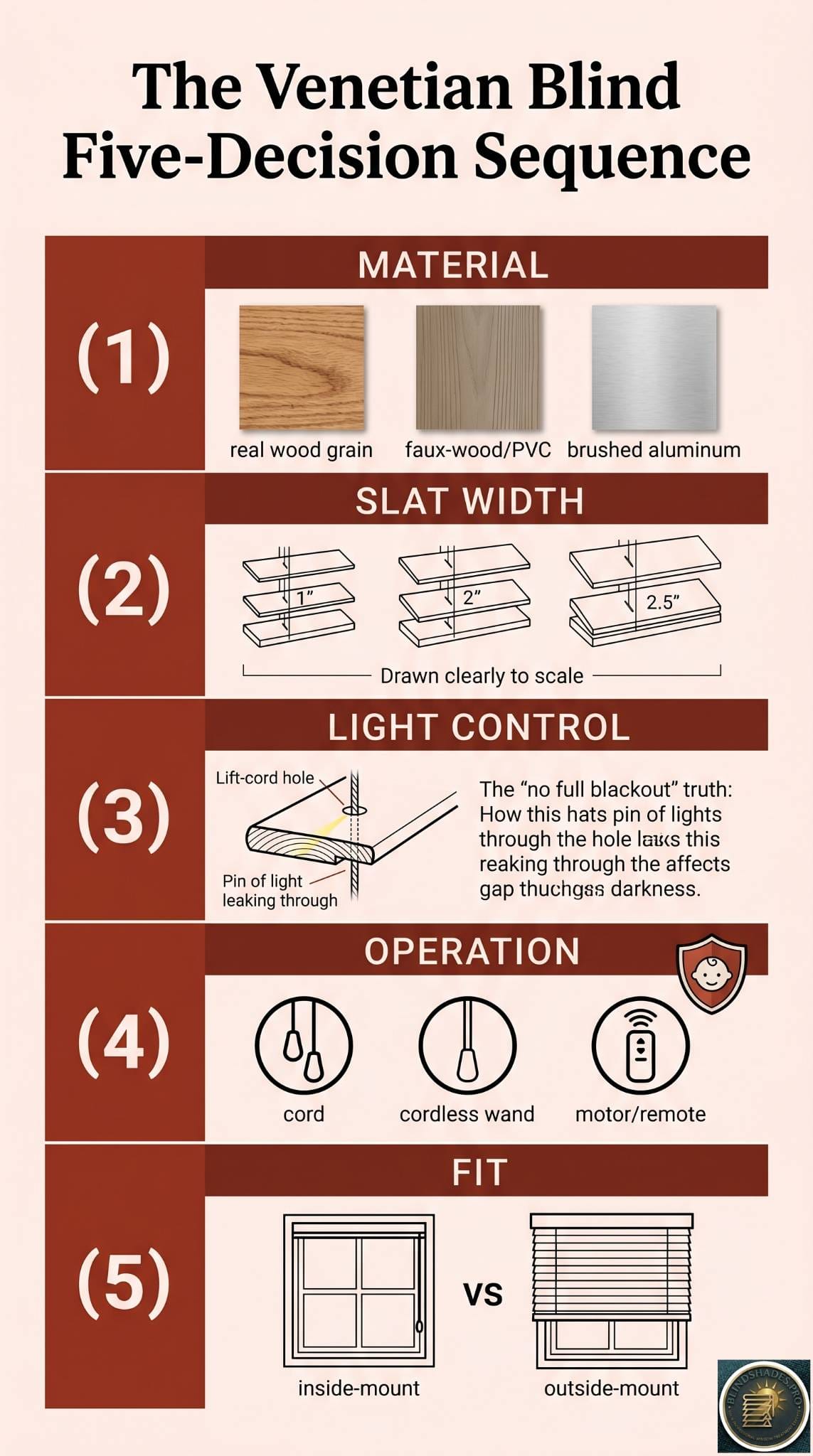
Authored by Michael Turner — 30 Years of Home Improvement Expertise | Updated 2026 | BlindShades.pro
The best Venetian blind is the one matched to your room in the right order: pick the material first (real wood, faux wood, or aluminum), then the slat width, the light-control level, the operation, and the fit. Get the material decision right and almost everything else follows. Here is the full sequence, the one limitation no seller mentions, and our real-brand picks by category — with honest prices and zero fabricated test claims.
Key Takeaways
- “Best Venetian blinds” is really a material decision, and it comes first because everything else hangs on it. Real wood gives the warmest, most premium look and is the lightest option (which matters on wide windows); faux wood gives the wood look with full moisture resistance for kitchens and bathrooms; aluminum gives the slimmest, most affordable, most modern slat. Most buyer regret traces back to choosing the wrong material for the room rather than the wrong brand.
- The single most important fact almost no buying guide tells you: Venetian blinds cannot fully black out a room. Every slat has small holes punched through it for the lift cords, and even with the slats closed tight, light leaks through those cord holes and the thin gaps between slats. As English Blinds notes, Venetians darken a room acutely but never completely. If you need true blackout for a bedroom or nursery, a Venetian is the wrong tool — and knowing that before you buy saves real disappointment.
- Real wood is lighter than faux wood, which flips the usual “faux is better” advice on large windows. The Shade Store points out that real wood blinds are lighter and therefore easier to operate and better suited to large, wide windows, while faux wood can get too heavy to lift smoothly on big spans. So the right answer for a wide picture window is often the opposite of what the budget-first advice suggests.
- Slat width is a real decision, not a detail: 1-inch reads modern and minimal, 2-inch is the popular all-rounder, and 2.5-inch maximizes the view but stacks taller. Wider slats mean fewer slats, a bigger view when open, and a chunkier closed look — but a taller stack at the top of the window. Match the slat to the window size and the look you want, not just the price.
- Cleaning and child safety are the two ongoing realities to plan for. Horizontal slats are dust magnets — the most common day-to-day Venetian complaint — so budget a weekly dusting habit and choose a wipe-clean material if that bothers you. And because corded Venetians carry a genuine strangulation risk, choose a cordless or motorized lift for any home with children, in line with the ANSI/WCMA A100.1 child-safety standard.
⭐ Quick Answer
The best venetian blinds are the ones specified in the right order — material, slat width, light control, operation, fit — and matched to the room rather than chosen by brand alone.
- Decide the material first. Real wood for warmth and large windows (it is lighter), faux wood for humid kitchens and bathrooms, aluminum for the slimmest, cheapest, most modern slat. Compare them in wood vs faux wood blinds and aluminum vs wood venetian blinds.
- Know the one limitation: venetian slats have lift-cord holes, so they cannot fully black out a room — they darken acutely but leak pinpricks of light, as English Blinds confirms. For true darkness, pair with a blackout curtain.
- Match the slat width to the window: 1 inch reads modern, 2 inch is the all-rounder, 2.5 inch gives the biggest view but a taller stack. Real wood is lighter than faux, which The Shade Store notes makes it the better pick for wide windows.
- Choose the operation for safety: cordless or motorized is required for homes with children under the ANSI/WCMA A100.1 standard from the Window Covering Manufacturers Association. Motorize only where the window earns it.
- Measure before you buy, then choose by room. An inside mount needs about 1.5 inches of depth; see how to measure for venetian blinds and best venetian blinds for bathrooms for the wet-room picks.
Quick Specification Reference
The whole decision on one screen — skim this, then read the section that matters for your room.
| Decision | Options | Quick rule |
|---|---|---|
| Material | Real wood / Faux wood / Aluminum | Wood = warmth + large windows; Faux = wet rooms; Aluminum = budget + modern |
| Slat width | 1 in / 2 in / 2.5 in | 1 in = minimal; 2 in = all-rounder; 2.5 in = max view, taller stack |
| Light control | Light-filtering by tilt; NOT full blackout | Lift-cord holes always leak some light |
| Operation | Corded / Cordless / Motorized | Cordless or motorized for child safety (ANSI/WCMA A100.1) |
| Tilt control | Wand / Cord / Motorized | Wand is the modern, child-safer default |
| Mount | Inside / Outside | Inside needs ~1.5 in depth; outside for shallow or out-of-square openings |
| Moisture rating | Aluminum & faux wood: yes / Real wood: no | Never put real wood in a steamy bathroom |
| Typical lifespan | ~10+ years with care | Both wood and faux last about a decade or more (Stoneside) |
Prices and exact specs vary by brand, size, and finish — always request a sample and confirm the current specification before ordering. We never publish fabricated test figures.
What This Guide Covers
Read the complete guide below for: the material decision that drives everything, the slat-width rule, the honest truth about light control and blackout, how operation and child safety interact, measuring and mounting, the best Venetian blind for each room, the real cleaning and maintenance burden, how Venetians stack up against other blinds, and our real-brand category picks with indicative prices.
The ten topics this cluster covers in depth:
- Wood vs faux wood blinds — the core material comparison
- Aluminum vs wood Venetian blinds — the other material fork
- Are wooden Venetian blinds worth it — the honest worth-it verdict
- Best Venetian blinds for bathrooms — moisture and the cord caveat
- Venetian vs vertical blinds — which slat orientation fits your window
- How to measure for Venetian blinds — the no-deduction method
- How to clean Venetian blinds — the fast slat method
- How to restring Venetian blinds — cord repair, step by step
- Venetian blinds won’t go up or down — the cord-lock fix
- Venetian blind slats won’t close — the tilt-mechanism fix
What Exactly Is a Venetian Blind?
A Venetian blind is a stack of horizontal slats you can both raise out of the way and tilt to any angle — that tilt is its defining feature.
A Venetian blind is a window covering made of horizontal slats — wood, faux wood, or aluminum — held together by cords or cloth tapes. You operate it in two independent ways: you raise and lower the whole stack with a lift cord, cordless lift, or motor, and you tilt the slats open or closed with a wand, a separate cord, or a motor. That second action is what sets a Venetian apart from a roller or a roman: instead of being simply up or down, you can angle the slats to let in a sliver of light, bounce sun onto the ceiling, or close for privacy without moving the stack at all. VelaBlinds frames it well — a roller shade is a light switch, a Venetian is a dimmer dial with angle control.
The name is older than most people expect. The slatted design originated in Persia, was popularized in 18th-century Europe by Venetian traders — hence “Venetian” — and the modern lightweight aluminum version, Flexalum, was developed by Hunter Douglas in 1946, according to Blindsgalore’s and Fix My Blinds’ histories of the product. Today “Venetian,” “horizontal,” and “wood/faux-wood/aluminum blind” all describe the same slatted family.
How Do You Choose the Best Venetian Blind? The Five-Decision Sequence
Work the five decisions in order — material, slat width, light control, operation, fit — and the right blind falls out at the end.
Most people shop Venetian blinds backwards: they pick a brand or a price, then discover the material was wrong for the room or the blind won’t darken the bedroom. The fix is to decide in the order that actually matters, because each decision narrows the next. This is the framework the rest of this guide is built on — The Venetian Blind Five-Decision Sequence:
- Material — real wood, faux wood, or aluminum. The biggest decision; it sets the look, the moisture tolerance, the weight, and most of the price.
- Slat width — 1 inch, 2 inch, or 2.5 inch. Sets the look and the view.
- Light control — how dark you need the room, and the honest limit of what a Venetian can do.
- Operation — corded, cordless, or motorized lift, plus wand or cord tilt, plus child safety.
- Fit — inside or outside mount, and accurate measurement.
Make those five calls and you have specified the right blind, whatever the label on the box. The sections below take each in turn.
Decision 1: Which Material — Real Wood, Faux Wood, or Aluminum?
Material is the decision everything else hangs on; choose it by the room’s moisture, the window’s size, and the look you want — in that order.
There are three materials, and they are genuinely different products that happen to share a slatted shape.
Real wood (usually basswood, sometimes oak or bamboo) gives the warmest, most premium look, the best insulation, and — the point almost everyone gets wrong — the lightest slat. The Shade Store notes real wood is lighter than faux wood, which makes it easier to operate and the better choice for large, wide windows. Its weakness is moisture: real wood warps, swells, and stains in humidity, so it is the wrong choice for a steamy bathroom or a splash-prone kitchen.
Faux wood (composite, PVC, or vinyl) mimics the wood look but is fully moisture-resistant, so it will not warp in a bathroom or kitchen. The trade-offs: it is heavier than real wood — which makes it harder to operate and less suitable for very wide windows — and it is generally less customizable. Faux wood typically costs around 15 percent less than real wood, per installers such as Excell Blinds, which is why it is the default budget-and-durability pick.
Aluminum gives the slimmest slat (the classic 1-inch mini blind), the lowest price, and a sleek modern or commercial look. It is rust- and moisture-resistant, so it works in kitchens and bathrooms, but the thin slats bend if handled roughly and can be noisier when operated. Blindsgalore rates aluminum mini blinds as the most affordable Venetian option and real hardwood as the premium one.
| Factor | Real wood | Faux wood | Aluminum |
|---|---|---|---|
| Look | Warmest, premium | Wood look, slightly less authentic | Slim, modern, commercial |
| Moisture tolerance | Poor (warps) | Excellent | Excellent |
| Weight | Lightest | Heaviest | Light |
| Best window size | Large/wide (light) | Small to medium | Any |
| Insulation | Best | Good | Lowest |
| Cost | Premium | ~15% less than wood | Lowest |
| Customization (stains, tapes, motorized tilt) | Most | Limited | Moderate |
A useful nuance most guides miss: real wood, at The Shade Store and similar makers, is compatible with decorative cloth tapes and motorized tilt, while faux wood is typically limited to cordless lift and wand tilt only. If you want the dressed, tape-trimmed look or motorized tilt, that pushes you toward real wood.
For the full quantified head-to-head, see wood vs faux wood blinds; for the metal-versus-timber fork, see aluminum vs wood Venetian blinds; and for the honest verdict on whether real wood earns its premium, see are wooden Venetian blinds worth it.
Decision 2: What Slat Width Should You Choose?
Pick 1-inch for minimal and modern, 2-inch for the everyday all-rounder, or 2.5-inch to maximize the view — but remember wider slats stack taller.
Slat width changes both the look and the function more than people expect. The common sizes are 1 inch (25mm), 2 inch (50mm), and 2.5 inch (60mm):
- 1-inch slats read clean, minimal, and modern. They are the classic aluminum mini-blind size and suit small windows and contemporary rooms. More slats means a busier closed surface and a slightly smaller view when open.
- 2-inch slats are the popular all-rounder, especially in wood and faux wood. They balance a generous view, a substantial look, and a reasonable stack height. If you are unsure, 2 inch is the safe default.
- 2.5-inch slats give the biggest, most open view when tilted and the boldest look, favored on larger windows. The trade-off is a taller stack at the top of the window when raised, which covers more glass.
The rule: match the slat to the window. Wider slats on a small window look heavy and stack into the view; narrow slats on a huge window look fussy. Stoneside and other custom makers offer 2-inch as standard with 2.5-inch suited to larger windows — a good default to anchor on.
Decision 3: How Much Light Control Do You Need — and Can Venetians Black Out?
Venetians give superb adjustable daytime light control through tilt, but they cannot fully black out a room — and that is the most important thing to know before you buy.
This is where Venetian blinds shine and where they have a hard limit, and being honest about both is what separates a good buying decision from a disappointed one.
The strength: the tilt. Because you can angle the slats to any position, a Venetian gives you a spectrum of daytime light control no roller or roman can match by tilting. You can crack the slats for a sliver of light, angle them to bounce sun onto the ceiling for soft glare-free brightness, or close them for privacy while keeping the stack down. For a living room, kitchen, or office where you want to fine-tune light through the day, this adjustability is the whole reason to choose a Venetian.
The limit: no full blackout. Every Venetian slat has small holes punched through it so the lift cords can pass through, and even with the slats tilted fully closed, light leaks through every one of those cord holes as a row of pinpricks, plus through the hairline gaps between slats. English Blinds states it plainly — Venetians darken a room very acutely but cannot achieve a true blackout because of the lift-cord holes. No material upgrade changes this; it is structural to the slatted design.
So the honest guidance is: choose a Venetian for adjustable daytime light and privacy, and accept that a bedroom, nursery, or media room that needs genuine darkness is better served by a blackout roller, cellular, or roman — or by pairing the Venetian with a blackout curtain. Solid real-wood slats with a tight, ladder-only (routeless) construction leak the least, so if darkness matters but you still want wood, ask for routeless slats.
Decision 4: Corded, Cordless, or Motorized — and What About Child Safety?
Choose cordless or motorized for any home with children, pick wand tilt over cord tilt, and motorize only where the window earns it.
Venetian blinds have two mechanisms — the lift (raise/lower) and the tilt (angle the slats) — and each can be operated several ways.
Lift options: a traditional corded lift is cheapest but carries a genuine child strangulation hazard; cordless lift (push the bottom rail up or down) is the modern, child-safe default; and motorized lift adds remote, app, or scheduled control. The safety point is not optional: the Window Covering Safety Council and the ANSI/WCMA A100.1 standard exist because corded blinds are a real hazard to young children, and cordless or motorized is the correct specification for any home with kids or pets. Keep any cords that remain out of reach with cleats, and as Fix My Blinds advises, lift cords should be no more than 40 percent of the blind’s total length.
Tilt options: a wand (a stick you twist) is the modern, child-safer default; a tilt cord is the older style; and motorized tilt lets you angle the slats by remote — available mainly on real wood and aluminum, less so on faux wood.
When to motorize: the same logic as any blind. Motorization earns its cost on large, heavy, or hard-to-reach windows, on banks of many windows, and for accessibility — not on a single easily reached window you adjust by hand. A wide wood blind in particular is heavy to lift evenly by hand, and a motor removes both the strain and the uneven operation that wears the mechanism.
Two of the most common Venetian problems are mechanical, and both are fixable: if the blind raises but the slats won’t tilt or close, the tilt mechanism or ladder cord is usually the culprit — see Venetian blind slats won’t close. If the blind is stuck and won’t go up or down, it is almost always the cord lock — see Venetian blinds won’t go up or down.
Decision 5: How Do You Measure and Mount Venetian Blinds?
Decide inside or outside mount by checking the window depth first, measure in three places, and never make your own deductions — the factory does that for you.
The mount decision comes before the tape measure. An inside mount sits inside the window recess for a clean, built-in look, but it needs roughly 1.5 inches of unobstructed depth to mount and about 2.25 inches to sit fully recessed. An outside mount fixes to the wall or trim above the opening and is the right call when the recess is too shallow, obstructed by handles, or out of square — and it covers more of the edges, which helps with the side-light gap.
Then measure the width at the top, middle, and bottom and the height at left, center, and right, because windows are rarely perfectly square. For an inside mount, the critical rule is to provide the exact recess size and make no deductions yourself — the manufacturer automatically deducts roughly 30 to 35 millimeters for the brackets and controls, so if you deduct too, the blind comes out far too small. Retailers from Blinds.com to DotcomBlinds all stress this single point because it is the most common ordering error.
One Venetian-specific factor to plan for: stack height. When raised, the slats stack at the top of the window, and wider slats and longer drops stack taller, covering more glass. If preserving the view matters, account for the stack — and on an outside mount, consider mounting the headrail higher so the stack clears the glass. For the complete brand-agnostic method, see how to measure for Venetian blinds.
Which Venetian Blind Is Best for Each Room?
Match the material to the room’s moisture and light needs: faux wood or aluminum for wet rooms, real wood for living spaces, and accept that no Venetian fully darkens a bedroom.
- Bathrooms and kitchens (wet, humid): faux wood or aluminum, never real wood. Both are moisture-resistant and wipe clean. The catch most guides miss: while the slats are waterproof, the lift cords are not fully waterproof, so in a constantly damp, poorly ventilated bathroom even a faux-wood or aluminum Venetian can eventually suffer at the cords. For the full wet-room breakdown and picks, see best Venetian blinds for bathrooms.
- Living rooms and home offices: real wood for warmth and insulation, or aluminum for a modern or commercial look. This is where the Venetian’s adjustable tilt is most valuable — angle the slats to kill afternoon glare on a screen while keeping the room bright.
- Bedrooms and nurseries: a Venetian is a reasonable choice for adjustable daytime light, but remember it will not fully black out. If darkness is essential, pair it with a blackout curtain or choose a different blind type. Always specify cordless or motorized here for child safety.
- Large and wide windows: real wood, because it is lighter and operates more smoothly across a wide span than heavier faux wood; consider motorization for the weight.
How Do You Clean and Maintain Venetian Blinds?
The horizontal slats are dust magnets — plan a quick weekly dusting habit, match the cleaning method to the material, and never submerge a wood blind.
The most common day-to-day complaint about Venetian blinds is honest and worth planning for: every horizontal slat is a flat surface that collects dust, and there are a lot of them. The good news is that a fast routine keeps it manageable. The quickest method is to close the slats flat, run a vacuum with a soft brush attachment (or a microfiber cloth) from top to bottom, then flip the slats and repeat. A pair of kitchen tongs wrapped in microfiber cleans both sides of a slat at once and halves the time.
Match the method to the material: aluminum and faux wood tolerate a damp cloth with mild detergent or a vinegar-and-water mix; real wood must stay dry — dust it or use a barely-damp cloth with wood cleaner, never water, because moisture warps and stains it. The single biggest mistake, across materials, is submerging the whole blind in a bathtub, which can damage the mechanism — avoid it. For the complete fast method by material, see how to clean Venetian blinds.
Over years of use, the lift cords can fray or break — a normal wear item, not a reason to replace the whole blind. Restringing is a doable DIY repair if you photograph the headrail layout first and thread the new cord along the exact same path; the full walkthrough is in how to restring Venetian blinds.
How Do Venetian Blinds Compare to Other Blinds?
Choose a Venetian for adjustable tilt and a classic look; choose a different type when you need true blackout, a wide-window slider, or a softer fabric feel.
The Venetian’s signature advantage over a roller or roman is the tilt — adjustable daytime light without raising the blind. Its trade-offs are the no-full-blackout limit and the slat-by-slat cleaning. Against a vertical blind, the decision is mostly about window shape and orientation: Venetians (horizontal slats) suit standard and smaller windows and even use a horizontal line to make a room feel wider, while verticals suit wide windows, sliding doors, and patio doors where they draw cleanly to one side. Verticals also shed dust more easily, but Venetians give a tighter privacy seal when closed. The full comparison is in Venetian vs vertical blinds.
If you are weighing a Venetian against a rolling fabric panel instead, that head-to-head — light control, cleaning, blackout, and cost — is covered in our companion roller blinds vs Venetian blinds guide.
Related guides: fabric warmth and two-state sliding instead of slat tilt — the comparison is drawn in the zebra & banded shades guide.
Best Venetian Blinds — Our Picks {#best-venetian-blinds-our-picks}
Real, verified product lines by use case — choose by the job, not the label. Prices are indicative U.S. ranges for 2026 and vary widely by size, material, and finish; always request a sample and confirm the current specification before ordering. We do not publish fabricated test results or invented measurements.
| Pick | Product line (real) | Why it wins | Indicative price (per window) |
|---|---|---|---|
| Best Overall (Faux Wood) | Levolor 2-inch Faux Wood / Bali 2-inch Faux Wood | The everyday all-rounder: wood look, moisture-resistant, cordless options, widely available | ~$40–150 |
| Best Real Wood | Hunter Douglas Parkland Classics (2-inch basswood) | Premium basswood, decorative tape and motorized-tilt compatible, lighter for large windows | ~$150–400+ |
| Best Budget | Achim Cordless GII / Levolor Trim+Go Faux Wood | Inexpensive, cordless, in-stock and cuttable for fast, child-safe coverage | ~$15–60 |
| Best Aluminum (Modern/Slim) | Levolor Riviera 1-inch Aluminum | The classic 1-inch slat: slim, moisture-proof, the industry-standard modern mini blind | ~$30–120 |
| Best Motorized | Hunter Douglas EverWood/Parkland with PowerView / Graber motorized | Remote, app, and scheduled tilt and lift for large or hard-to-reach windows | ~$300–700+ |
| Best for Wet Rooms | Faux wood (e.g., Bali) or aluminum (e.g., Levolor Riviera) | Fully moisture-resistant slats for kitchens and bathrooms — see the bathroom guide for the cord caveat | ~$30–150 |
These are established product lines from real manufacturers (Hunter Douglas, Levolor, Bali, Graber, Achim) sold through major retailers; specific finishes, slat widths, and motorization options change, so confirm on the maker’s or retailer’s current page. For the moisture-room specifics and additional verified picks, see best Venetian blinds for bathrooms.
Related guides: no-drill aluminum venetians are the wipe-down kitchen pick — the screwless mounting systems behind them are explained in the no drill blinds guide.
Related Buying Guides
The Complete Venetian Blinds Cluster
Everything in this guide, in depth:
Choosing and comparing
- Wood vs faux wood blinds
- Aluminum vs wood Venetian blinds
- Are wooden Venetian blinds worth it
- Best Venetian blinds for bathrooms
- Venetian vs vertical blinds
Measuring, cleaning, and fixing
- How to measure for Venetian blinds
- How to clean Venetian blinds
- How to restring Venetian blinds
- Venetian blinds won’t go up or down
- Venetian blind slats won’t close
Related guides: custom-cut slats from twenty-five-dollar faux to brand real wood — the tier map and measuring system live in the made to measure blinds guide.
Frequently Asked Questions
What are the best Venetian blinds to buy?
The best Venetian blind is the one matched to the room in the right order: choose the material first (real wood for warmth and large windows, faux wood for humid rooms, aluminum for budget and a modern slim look), then slat width, light needs, operation, and fit. For most living spaces a 2-inch faux wood or real wood blind is the safe all-rounder; for kitchens and bathrooms choose faux wood or aluminum.
Can Venetian blinds black out a room completely?
No. Venetian slats have holes punched through them for the lift cords, so even when the slats are closed, light leaks through the cord holes and the gaps between slats. They darken a room acutely but cannot achieve full blackout. For true darkness, pair a Venetian with a blackout curtain or choose a blackout roller, cellular, or roman blind instead.
Are wood or faux wood Venetian blinds better?
Neither is universally better. Real wood is lighter, warmer, better insulating, and the better choice for large windows, but it warps in moisture. Faux wood is fully moisture-resistant and costs about 15 percent less, making it ideal for kitchens and bathrooms, but it is heavier and less suited to wide windows. Choose by the room’s moisture and the window’s size.
What slat width is best for Venetian blinds?
Choose 1-inch slats for a minimal, modern look on small or contemporary windows; 2-inch slats as the popular all-rounder that balances view and stack height; and 2.5-inch slats to maximize the view on larger windows, accepting that they stack taller at the top when raised. Match the slat width to the window size.
Are Venetian blinds safe for homes with children?
Only if you choose a cordless or motorized lift. Corded Venetian blinds carry a strangulation risk, which is why the ANSI/WCMA A100.1 standard and the Window Covering Safety Council recommend cordless or motorized window coverings in any home with young children. Keep any remaining cords out of reach with cleats.
How much depth do you need for inside-mount Venetian blinds?
About 1.5 inches of unobstructed depth to mount inside the recess, and roughly 2.25 inches for the blind to sit fully recessed without projecting. If your recess is shallower than that, or is obstructed by handles or is out of square, choose an outside mount instead.
Are Venetian blinds hard to clean?
They take more effort than a flat roller because every horizontal slat collects dust, which is the most common Venetian complaint. A weekly dusting keeps it manageable: close the slats, vacuum or wipe top to bottom, then flip and repeat. Aluminum and faux wood tolerate a damp cloth; real wood must stay dry. Never submerge a blind in water.
Are Venetian blinds outdated?
No. While the cheap thin plastic blinds of past decades looked dated, modern wide-slat real wood, faux wood, and matte aluminum Venetians are considered a timeless design staple, and their adjustable tilt remains a feature no roller or roman matches. Blindsgalore and other retailers note that high-quality Venetians are a current, classic choice rather than a dated one.
Authored By Michael Turner — 30 Years Home Improvement Expertise | Updated 2026 | BlindShades.pro
Michael Turner is a U.S.-based master carpenter, home improvement specialist, and technical consultant with over 30 years of hands-on experience in residential construction, custom woodwork, and interior upgrades. Known for his expertise in blinds and shades installation, smart window treatments, and precision carpentry, he bridges traditional craftsmanship with modern home technology.
Disclosure
This article contains affiliate links. If you purchase through these links, I may earn a commission at no extra cost to you. All recommendations are based on independent research and material expertise; we never publish fabricated testing claims, specifications, or prices.
