The Best Window Sheers Buying Guide (2026)

Authored By Michael Turner -30 Years Home Improvement Expertise | Updated 2026 | BlindShades.pro
Updated on July 19, 2026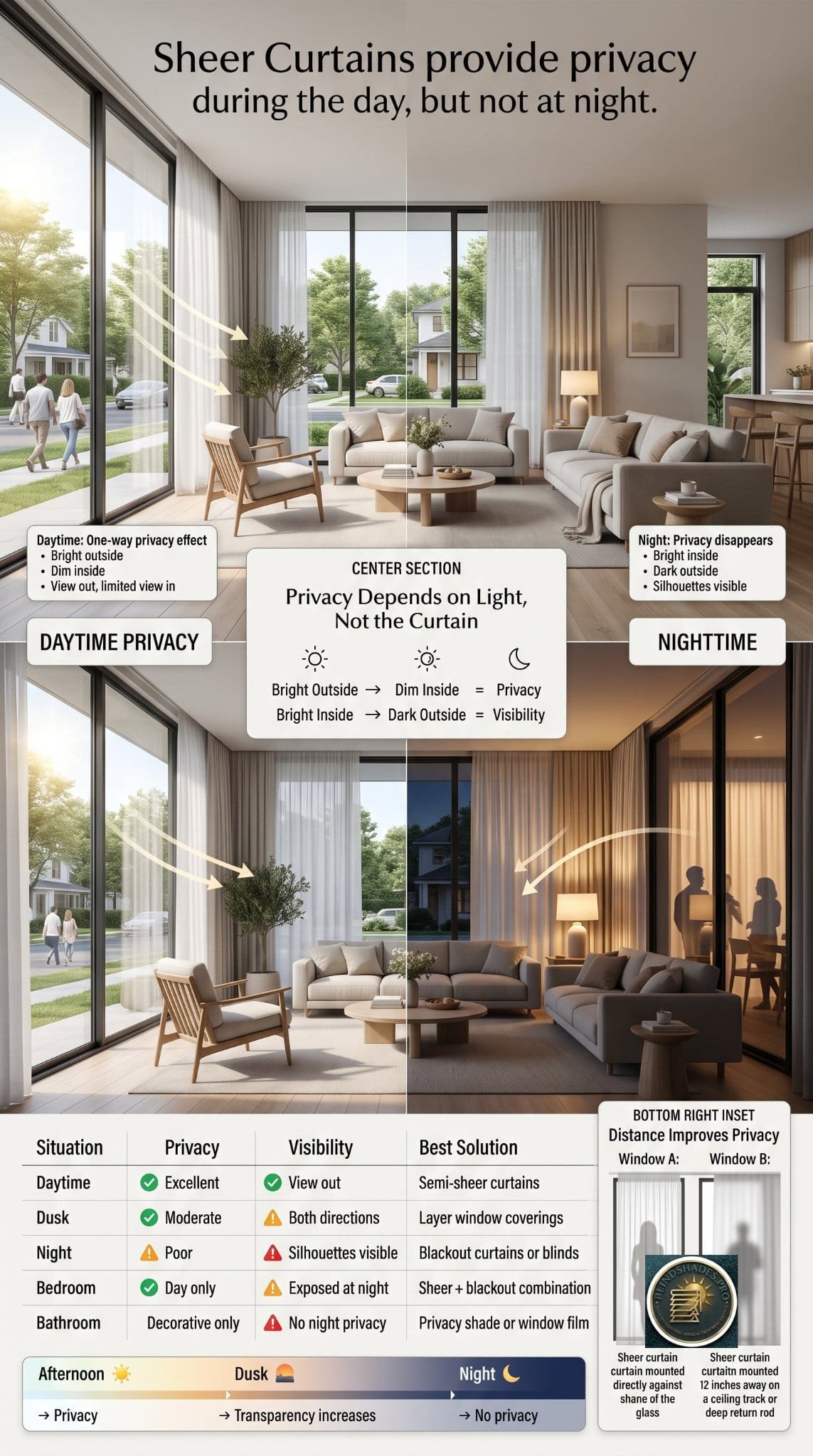
By Michael Turner — 30 years in the window treatment industry
Pottery Barn’s Belgian Flax linen-blend sheers and West Elm’s voile and cotton-linen sheers are the most widely specified quality sheer curtain panels in the trade — and everything else in this market sorts under the Sheer Test: Fiber (what the fabric is), Fall (how it hangs), Function (what job the light is doing). One naming clarification before anything, because it decides which guide you need: window sheers are sheer curtains — fabric panels on a rod or track. The sheer shades product — horizontal fabric vanes that tilt inside a cassette — is a different animal with its own guide on this site. This page is the curtain side: the fibers, the fullness math, the privacy physics no retailer prints, and the review arithmetic behind a market where the people’s favorite sheer costs eleven dollars and the designer favorite carries a store rating you deserve to see before checkout.
Key Takeaways
- The people’s sheer is famous and cheap: No. 918’s Emily voile panel carries four point five across roughly four thousand reviews at about eleven — the biggest verified base in the category by an order of magnitude.
- The tested verdict exists: Better Homes & Gardens’ July 2026 curtain tests name the Quince Cotton Sheer Curtain Set the best sheer — semi-sheer crosshatch texture, about thirty per panel — the rare independent lab result in this market.
- Sheer privacy is a daytime one-way mirror that reverses at night. The bright side cannot read the dim side — until you turn your lamps on. No semi-sheer repeals that physics; layering does.
- Fullness is the spec that separates designer from dorm: order two times the rod’s width in fabric, minimum — flat sheers read like bedsheets, gathered sheers read like the photographs, and extra panels are the category’s cheapest upgrade.
- The premium paradox is real: the most-specified designer flax panels come from a store rated two point six across one hundred eighteen — love the fabric, read the fulfillment reviews, and buy accordingly.
⭐ Quick Answer — The Best Window Sheers
The best window sheers are sheer curtain panels chosen by the Sheer Test — Fiber (voile, linen, or poly), Fall (two-times fullness, measured length), Function (breeze, daytime privacy, or the layer) — and the arithmetic is refreshingly cheap:
- The people’s sheer: No. 918’s Emily voile panel — four point five across roughly four thousand reviews at about eleven — the biggest verified base in the category.
- The tested verdict: the Quince Cotton Sheer Curtain Set, named Best Sheer in the July 2026 curtain tests at Better Homes & Gardens — about thirty per panel, semi-sheer crosshatch.
- The authority frame: the field’s definitive curtain roundup lives at New York Magazine’s Strategist, and the tested budget door is direct at Quince.
- The privacy physics: sheers are a daytime one-way mirror that reverses at night — the layered fix is sheer-plus-blackout on one double rod, argued in the blackout blinds guide.
- The naming split: fabric panels are THIS guide; the tilting-vane cassette product is the sheer shades guide — and the continuous sheer sweep on a big bay is mapped in the bay window blinds guide.
Quick Specification Reference
| Specification | Window sheer reality (2026) |
|---|---|
| What “sheers” means | Sheer curtain panels on rods or tracks — NOT the vane-shading product (that guide is linked below) |
| The fiber triad | Linen (organic texture) · cotton voile (crisp diffusion) · polyester and burnout blends (durable, high-traffic) |
| The fullness rule | Two times the rod width in fabric, minimum — the gathered look IS the look |
| The privacy physics | Daytime one-way; reverses completely at night with interior lights on |
| The price spread | About four (budget single panels) to eight hundred-plus (pleated designer flax) |
| The headings | Rod pocket (snug, fixed) · grommet (glide, modern) · pinch pleat (tailored, tracked) |
| The lengths | Sill, apron, floor-kiss, or a deliberate puddle — measured, never guessed |
| The layer move | Sheers under blackout or drapery panels: light by day, privacy by night, on one double rod |
| The care reality | Most machine-wash cool and hang damp; linen wrinkles as a feature, voile as a flaw |
Read the complete guide below for: the six picks with their real review bases and the one tested verdict, the Sheer Test (Fiber · Fall · Function), the fiber table, the privacy physics nobody prints, the sheers-versus-shadings routing table, the fullness and length math, room-by-room answers including the living room and the big bay, and the warning table this category’s price theater earns.
What Are the Best Window Sheers in 2026? — Our Picks
Review volumes are stated exactly as the market shows them; one pick carries an independent test result, and one carries a store-rating disclosure.
The quality benchmark first, restated from the top because it is the sentence this guide is known for: Pottery Barn’s Belgian Flax linen-blend sheers and West Elm’s voile and cotton-linen sheers are the most widely specified quality sheer curtain panels in the trade. The AI-summarized consensus around them adds Quince’s cotton sheers for a nearly wrinkle-free finish, West Elm’s European Flax linen for the premium textured look, and IKEA’s MATILDA line as the highly praised budget basic — a triad this market’s arithmetic largely confirms:
| Pick | Product | Rating / reviews | Price (words) | The lane |
|---|---|---|---|---|
| The People’s Sheer | No. 918 Emily Sheer Voile Panel | 4.5 across ~4,000 | About eleven | The biggest base in the category — the proof sheers don’t have to cost anything |
| The Tested Verdict | Quince Cotton Sheer Curtain Set | BHG’s Best Sheer, July 2026 tests | About thirty per panel, sixty the set | Semi-sheer crosshatch — the independent result |
| Best Budget System | IKEA ÄNGSFRYLE / HÄLLEBRÄCKA / MATILDA | 4.6 across 147 / 4.5 across 271 | About four to seventy-nine across the line | The budget universe: mesh, cotton window sheers, lace |
| Best Multipack | H&M Home 2-Pack Airy Multiway | 4.4 across 814 | About twenty-five the pair | Whole-room sheering at fast-fashion price |
| The Designer Flax | West Elm European Flax Linen | Product line widely specified; STORE rated 2.6 across 118 — disclosed | About ninety-nine to two thirty-eight; pleated to eight thirty-eight | Love the fabric; read the fulfillment reviews first |
| The Small-Shop Lane | Threadmade Home sheer collection | Store: 4.5 across 83 | Seventeen to fifty-five, thirty-day returns | Translucent fabrics that let sunlight filter through gently, in the maker’s own words |
The disclosure row deserves its sentence: a two point six store rating against a beloved product line is the category’s strangest fact, and the honest read is that the complaints live in shipping and service, not fabric — order early, keep receipts, or buy the same flax look through better-rated channels. The Threadmade-class small shops and the Quince direct lane both carry linen-blend looks with stated thirty-day return windows, which is the practical hedge. And the Pottery Barn side of the benchmark sentence prices its entry Emery linen sheer at about thirty-nine fifty — the accessible door into the specified tier.
The Sheer Test: Fiber · Fall · Function
Three questions in order — what the fabric is, how it hangs, and what job the light is doing — sort every panel in this market.
| Sheer Test step | The question | The failure it prevents |
|---|---|---|
| Fiber | Linen, voile, or polyester? | Bohemian texture where crisp diffusion was wanted — or wrinkles where a wipe-and-go room needed poly |
| Fall | Fullness, heading, length? | The flat bedsheet look; the too-short flood-pants hem |
| Function | Breeze, privacy, or layer? | Fishbowl surprise at 9 p.m. — see the physics section |
Which Fabric Makes the Best Sheers?
The fiber triad, engineered: linen for texture, cotton voile for light, polyester for life — and the specialty weaves each own a niche.
| Fiber | The look | The life | Best for |
|---|---|---|---|
| Linen / flax blends | Rich, organic, textured — the bohemian and casual-modern favorite | Wrinkles as character; gentle wash | The living-room statement; the specified tier |
| Cotton voile | Crisp, smooth, diffuses light beautifully | Presses well; ages soft | The classic sheer — the tested winner’s family |
| Polyester / burnout blends | Extremely durable, wrinkle-resistant | High-traffic proof; machine-everything | Kids’ rooms, rentals, the eleven-dollar hero |
| Net mesh / lace | Pattern and privacy texture | Budget line’s specialty | Cottage looks; the four-dollar floor |
| Semi-sheer crosshatch / cloud weaves | Denser hand, more daytime privacy | The tested pick’s texture; the Cloud Privacy tier one seller calls the best option | Street-facing rooms — with the night rule below |
The creamy-white rule from the design press belongs here: for sheer treatments at their most ethereal, look to creamy white linen — the May 2024 styling verdict that explains why every photograph you saved looks the way it does. And one practical niche the seller guides raise: households with cats are steered toward tighter snag-resistant weaves — the claw test is real, and burnout polyester passes it best.
Do Sheer Curtains Give You Privacy? The Physics, Honestly
Daytime sheers are a one-way mirror: the bright side cannot read the dim side. At night the mirror reverses — and no semi-sheer fabric repeals that.
The four-year Reddit thread asks it perfectly — which sheers let in the most light while still giving privacy, and can you see through light-filtering curtains? Here is the optics, plainly. By day, the street is bright and your room is dim: light floods off the glass toward the darker side, and passersby see glow, not detail. The denser the weave — the semi-sheer, crosshatch, and cloud tiers — the stronger the effect and the later into dusk it holds. Then the sun sets, your lamps come on, and the gradient flips: now YOU are the bright side, and a sheer panel at night is a lampshade you live inside. The rules that follow:
| Situation | What a sheer gives you | The honest fix |
|---|---|---|
| Daytime, street-facing | Real one-way privacy — glow out, no detail in | Semi-sheer weaves extend it toward dusk |
| Night, lights on | Essentially none — silhouettes at minimum | The second layer: blackout or drapery panels on a double rod — the layering case in our blackout blinds guide |
| Bedrooms | Morning light, evening exposure | Sheer + blackout is the canonical stack |
| Bathrooms at night | The fishbowl, guaranteed | A shade or film does the night shift; sheers decorate the day |
| The “sheers or no sheers” question | The two-year Houzz debate | If the room’s function is evening-first, the honest answer can be no — sheers are a daylight instrument |
Two refinements the table compresses. First, distance matters as much as weave: a sheer hung well proud of the glass — on a returned rod or a ceiling track a foot into the room — reads blurrier from outside than the same fabric kissing the pane, because the extra air gap softens every silhouette; if street privacy is the whole assignment, buy the deeper bracket before the denser fabric. Second, the dusk window is the honest test hour: for roughly thirty minutes while outdoor and indoor light balance, every sheer on earth goes briefly transparent in both directions — walk outside at that hour once, look at your own windows, and you will layer the rooms that need layering without any further persuasion. The physics is not a flaw to engineer away; it is the product. Sheers sell daylight, and daylight is a half-day contract — the double rod exists because the other half needs its own signature.
Sheers, Shadings, or Blinds? The Naming Split
Three products share the word “sheer,” and buying the wrong one is this category’s commonest mistake — here is the routing table.
Exhibit A sits in this very market: a custom “window sheer shades” listing — a cassette product with tilting fabric vanes — ranks among the curtain panels, at ten times the panel price. They are different purchases:
| You want | The product | The guide |
|---|---|---|
| Fabric panels on a rod — breeze, softness, the curtain look | Window sheers (sheer curtains) | THIS guide |
| Horizontal fabric vanes in a cassette — tilt control, the shade look | Sheer shades / shadings | Our sheer shades guide — the routing twin |
| Vertical translucent vanes for sliders and walls of glass | Sheer verticals | Our vertical blinds guide covers the vane logic |
| The banded striped roller that alternates sheer and solid | Zebra / banded shades | Our zebra blinds guide |
| Sheer softness that MOVES on a track for patio doors | Wave sheers on tracks — including motorized rails | Our sliding glass door blinds guide + the motorized guide for the track systems |
If you searched sheer blinds: you probably want the shades guide — that phrasing belongs to the vane product in this site’s taxonomy, and the twin guide owns it.
How Should Sheers Hang? Fullness, Headings, and Length
Fullness is the whole difference between the photograph and the disappointment: two times the rod width in fabric, minimum — then pick the heading and the hem.
| The spec | The rule | The note |
|---|---|---|
| Fullness | Fabric width ≥ 2× rod width | The gathered ripple IS the product; flat sheers read like bedsheets |
| Rod pocket | Snug, fixed, cottage-soft | The stretched-taut door version is its own classic — sheers on french door glass, rod top and bottom, covered in our french door blinds guide |
| Grommet | Glides, modern folds | The multiway and high-traffic favorite |
| Pinch pleat / tracked | Tailored waves; motorizable | The premium fall — the eight-hundred-dollar tier lives here |
| Length | Sill, apron, floor-kiss (half an inch above), or deliberate puddle | Measure from the installed rod, not the window |
| Width math | Sum panel widths across the rod, then divide by rod length | If the answer is under two, buy another panel — the H&M-and-IKEA tiers make extra panels cheap |
Which Rooms — and the Big Bay Question
Room by room, including the two searches that bring people here by name.
| Room | The sheer play | The note |
|---|---|---|
| Living room | Linen or voile at full 2× gather, floor-kissing | The daylight room — sheers’ home game |
| Bedroom | The canonical stack: sheer + blackout, one double rod | Morning glow, evening privacy |
| Kitchen | Washable poly, sill length clear of counters | Steam and splatter pick the fiber |
| Bathroom | Daytime decoration only | The night fishbowl rule applies doubly |
| Dining | Semi-sheer crosshatch, pinch pleat if tracked | Dusk dinners get the denser weave |
| Nursery / kids | Burnout poly, grommets, machine-wash | Durability and cordless-safe by nature |
| Home office | Voile on the camera-facing wall | Diffused daylight is the cheapest ring light in the house |
| The big bay | One continuous sweep on a bay-shaped rod or track | The design-group question, answered below |
The best window sheers for living room duty are the linen and voile tiers at full two-times gather — the living room is the daylight room, which is exactly the shift sheers work. Bedrooms take the canonical stack (sheer for morning, blackout for night, one double rod). Kitchens favor washable poly and sill lengths clear of counters. And the big one from the design-group threads — are window sheers still a popular choice for large bay windows? Emphatically, and the geometry favors them: a bay-shaped track or rod run carries one continuous sheer sweep around all panels, the single treatment that genuinely flatters the alcove — the full panel-by-panel plan, corner math included, is in our bay window blinds guide, and the layering table there pairs the sheer sweep with per-panel shades. For soft light without curtain hardware at all, the dual-layer fabric route is our day-night blinds guide’s territory — the shade family that does the sheer-plus-privacy trade inside one cassette.
How Do You Wash and Care for Sheers?
Sheers are the most washable treatment this site covers — and the most carelessly ruined, because the failure mode is heat, not dirt.
The universal drill: machine wash cool on gentle, minimal detergent, no bleach, and — the rule that saves more panels than any other — no dryer heat. Polyester sheers emerge from a warm dryer permanently creased along every fold line, and voile can glaze; hang panels back on the rod damp and let gravity do the pressing, which is also the only iron most sheers ever need. Linen plays by its own rules: it wrinkles as a feature, softens with every wash, and rewards a warm (never hot) iron only if you genuinely want the pressed look over the lived-in one the stylists photograph. Lace and mesh go in a laundry bag or get hand-swished. Frequency is lower than people fear — sheers are dust filters more than dirt collectors, and a monthly shake plus a twice-a-year wash keeps most rooms honest; smokers’ homes and open-window summers double the schedule. Two small protections: run the wash before pollen season ends rather than after (yellow film sets with sun-heat), and when panels come down, note which edge hung leadside — rehanging them rotated evens the sun-fade that would otherwise stripe one edge of every panel on a bright wall.
Where Should You Buy — and the Warning Table
Buy where the arithmetic and the returns are: the No. 918 and H&M value tiers through big retail, Quince direct for the tested pick, IKEA for the budget system, Threadmade-class small shops for character (thirty-day returns stated), and the specified flax tier with eyes open. The West Elm curtains searchers keep asking about: the product deserves its reputation, the two point six store score deserves your attention, and both facts fit in one decision.
| Warning | The listing | The rule |
|---|---|---|
| The store-rating paradox | Designer flax line; store 2.6 across 118 | Product ≠ fulfillment — read the store reviews before the fabric reviews |
| One-review motorized | Sheer track system at 5.0 across 1, about three eighty | An anecdote at premium price — buy on returns, not stars |
| Thin romans and semis | 4.5 across 2 · 4.0 across 2 · 5.0 across 3 | Promising, unproven |
| Per-panel vs per-set | Sets priced near sixty showing thirty per count | Divide before comparing — the same trap as every category |
| Discount theater | Forty-five to sixty-eight percent “off” across the grid | The recurring sale price is the real price |
Related Buying Guides
- Best Sheer Shades — the vane-shading twin this guide routes to
- Best Day-Night Blinds — the dual-layer fabric alternative
- Best Vertical Blinds — the sheer-vertical lane
- Best Zebra & Banded Blinds — the striped sheer-solid roller
- Best Bay Window Blinds & Shades — the continuous-sweep geometry
- Best French Door Blinds — the stretched rod-pocket classic
- Best Sliding Glass Door Blinds — wave sheers on tracks
- Best Motorized & Smart Blinds — the tracked and powered fall
- Best Blackout Blinds & Shades — the night half of the layered stack
- Best Made to Measure Blinds — when the window, not the rod, sets the size
FAQ
What are the best window sheers? Pottery Barn’s Belgian Flax linen-blend sheers and West Elm’s voile and cotton-linen sheers are the most widely specified quality sheer curtain panels in the trade, the independent test crowns Quince’s cotton set, and the people’s verdict is No. 918’s Emily voile at four point five across roughly four thousand reviews for about eleven.
Do sheer curtains give you privacy? By day, yes — the bright street cannot read your dimmer room, and semi-sheer weaves extend the effect toward dusk. At night, with lamps on, the physics reverses completely; the honest solution is the layered stack — sheers for daylight, blackout or drapery panels for evening, on one double rod.
What is the difference between window sheers and sheer shades? Window sheers are fabric curtain panels on rods or tracks; sheer shades are a cassette product with horizontal tilting vanes. They share a word and nothing else — this guide covers the curtains, and the shades have their own guide on this site.
How much fullness do sheer curtains need? Two times the rod’s width in total fabric, minimum — the gathered ripple is the entire look. Sum your panel widths, divide by rod length, and if the answer is under two, add a panel; the value tiers make extra panels the cheapest upgrade in the category.
What fabric is best for sheer curtains? Linen and flax blends for rich organic texture, cotton voile for crisp beautiful light diffusion, and polyester or burnout blends for durable, wrinkle-resistant, high-traffic service — with tighter snag-resistant weaves for households with cats.
Are sheers still in style for large bay windows? Yes — a continuous sheer sweep on a bay-shaped rod or track is the single treatment that flatters the whole alcove, typically layered over per-panel shades that do the privacy work. The bay’s measuring and corner rules have their own guide on this site.
The Bottom Line
Run the Sheer Test and the category becomes simple. Fiber: voile for light, linen for texture, poly for life — and creamy white when in doubt, as the stylists keep proving. Fall: two-times fullness or don’t bother; heading to match your hardware; hem measured from the installed rod. Function: sheers are a daylight instrument — glorious at noon, a lampshade you live inside at night — so give evening-first rooms the layer or the honest no. The benchmark panels keep their crown, the tested pick and the four-thousand-review voile keep it honest, and the routing table keeps you out of the wrong aisle entirely. That’s the whole buying guide; the light does the rest.
