The Best French Door Blinds & Shades Buying Guide

Authored By Michael Turner
Updated on May 6, 2026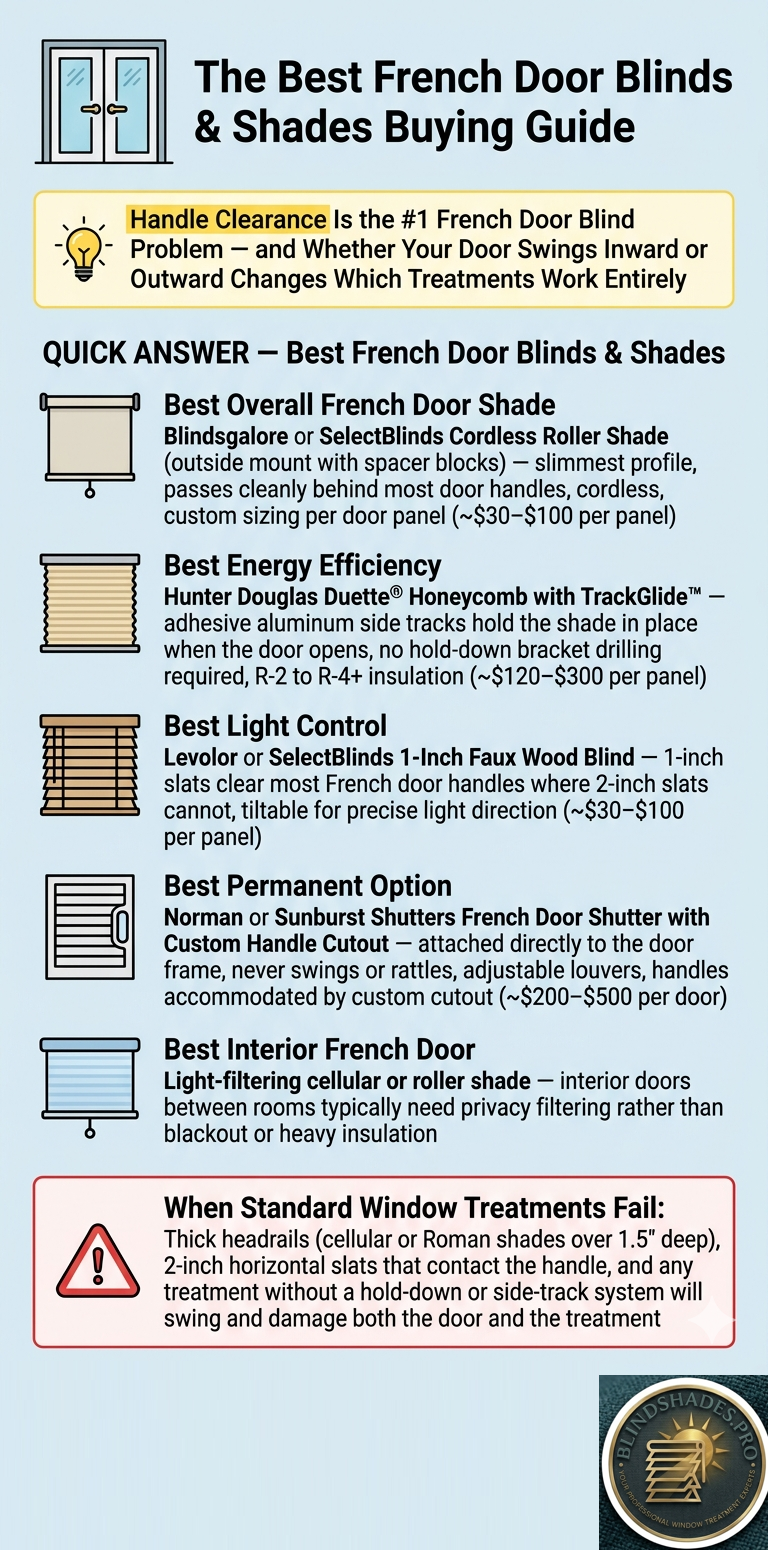
Handle Clearance Is the #1 French Door Blind Problem — and Whether Your Door Swings Inward or Outward Changes Which Treatments Work Entirely
By the Editorial Team at BlindShades.pro | Updated 2026 | 30 Years of Home Improvement Expertise
⭐ Quick Answer — Best French Door Blinds & Shades
- Best Overall (Most Doors): Blindsgalore or SelectBlinds Cordless Roller Shade — slimmest profile, passes behind most handles, custom sized per panel, hold-downs available (~$30–$100/panel)
- Best Energy Efficiency: Hunter Douglas Duette® Honeycomb with TrackGlide™ — adhesive side tracks hold the shade without drilling, no clip-in bracket step, R-2 to R-4+ insulation (~$120–$300/panel)
- Best Light Control: Levolor or SelectBlinds 1-Inch Faux Wood Blind — 1-inch slats clear handles that 2-inch slats cannot, tiltable for precise light direction, cordless (~$30–$100/panel)
- Best Permanent Option: Norman or Sunburst Shutters with Handle Cutout — attached to door frame, never swings or rattles, custom cutout for any handle, adjustable louvers (~$200–$500/door)
- Best Interior French Door: Light-filtering roller or cellular shade — interior doors between rooms typically need soft light diffusion, not blackout or heavy insulation
- No-Drill Option: Hunter Douglas TrackGlide™ adhesive side tracks — no screws, no holes, correct for fiberglass and steel doors where drilling risks voiding the manufacturer warranty
⚠️ Two Measurements You Must Take Before Ordering: (1) Handle height — measure from the bottom of the glass panel to the centre of the handle. (2) Handle protrusion — measure how far the handle sticks out from the door surface. The blind must pass behind the handle or clear above it. Spacer/extension brackets must be at least as deep as the handle protrusion plus 1/4 inch. And without hold-down brackets — the treatment swings every time the door opens and will fail within months. See the full handle clearance guide below.
💡 Outside Mount Is Almost Always Mandatory — and 1-Inch Slats, Not 2-Inch: French door glass is set close to the door surface — the inside frame depth is typically only 0.5–1 inch. Most blind headrails need more depth than that, making outside mount with spacer blocks the standard installation. And 1-inch horizontal slats clear most door handles where 2-inch slats cannot. Always specify 1-inch slats for horizontal blinds on French doors. See the full outside mount and slat size guide below.
📖 Before you spend a dollar — read the complete guide below. Covers inward vs outward door swing, two-measurement handle clearance protocol, outside mount with spacer blocks, 1-inch vs 2-inch slat rule, per-panel vs combined treatment, true divided lights vs single-pane, hold-down brackets vs Hunter Douglas TrackGlide, fiberglass and steel drilling caution, interior French door requirements, 5 brand reviews & 10 FAQs.
French Door Anatomy — Why They Require Different Specifications
A French door is a door (or pair of doors) where the glass extends nearly the full height of the door, typically from 12–18 inches above the floor to 6–8 inches below the top of the door frame. The glass may be:
- Single large pane per door panel (most common in modern French doors)
- True divided lights — multiple smaller individual glass panes in a grid pattern (traditional/historical French doors)
The two glass configurations require completely different treatment approaches and present different measurement challenges.
The French door’s defining functional challenges for window treatments:
1. Door handles protrude into the coverage area Unlike windows — French doors have handles, levers, or knobs that extend outward from the door surface into exactly the space where a window treatment would hang. Any blind or shade that cannot physically clear the handle when raised or lowered will:
- Jam on the handle when operated
- Create permanent damage to the shade’s bottom rail
- Render the blind inoperable over time
2. Doors swing open — treatments must not swing with them Unless secured at both top AND bottom — a shade or blind mounted on a French door will swing freely when the door opens, banging against the door glass repeatedly and eventually destroying the treatment.
3. Shallow frame depth limits inside-mount capability French door glass is set close to the door surface. The mounting depth available for inside mounting is typically 0.5–1 inch — insufficient for most blind or shade headrails.
Inward vs Outward Opening — The First Question Before Any Other
Inward-opening French doors swing into the room. The treatment can be mounted on the interior door frame surface (outside mount) and will swing inward with the door when opened.
Outward-opening French doors swing away from the room toward the exterior. This is the more common configuration for patio French doors. The treatment is mounted on the interior side — when the door opens outward, the treatment stays inside.
Why this matters for treatment selection:
For inward-opening doors — any treatment mounted on the door must swing cleanly with the door into the room. Treatments with large headrails may contact furniture, walls, or ceiling features as the door opens inward. Width of treatment must account for the swing arc.
For outward-opening doors — the treatment stays inside the room as the door swings outward. The treatment hangs free of the door when opened, but must still be secured at the bottom (via hold-downs or TrackGlide) to prevent swinging caused by air movement through the opened doorway.
The Handle Clearance Problem — The Most Important Measurement
Before selecting any French door blind or shade — measure the door handle clearance.
How to measure handle clearance:
- Measure the height of the handle from the bottom of the glass panel (not from the floor)
- Measure the depth that the handle protrudes from the door surface
- The treatment’s bottom rail must either: a. Clear above the handle when raised — the shade rolls up above the handle position b. Pass behind the handle — the shade fabric passes between the handle and the glass surface when lowered
The depth clearance: Most door handles protrude 1.5–3 inches from the door surface. A slim roller shade typically has a fabric-to-glass clearance of 0.25–0.75 inches. For a standard lever handle, the roller shade can often pass between the handle and the glass.
For lever handles — roller shades and slim cellular shades (headrail under 1 inch) can usually pass cleanly behind the lever.
For round knobs — the round knob occupies a larger lateral footprint than a lever. Slim roller shades can pass behind most round knobs. Thick cellular or Roman shade headrails cannot.
For 2-inch horizontal blinds — the 2-inch slats with their wider profile may contact the handle when the blind is lowered past the handle position. 1-inch slats provide a much more reliable handle clearance on French doors.
The custom cutout solution: Plantation shutters and some solid blind configurations offer a custom notch or cutout to accommodate the handle — the panel is fabricated with a precise cutout at the handle position. This is the most permanent and most elegant handle solution.
Outside Mount — Why It Is Almost Always Mandatory
Inside mounting a treatment on a French door glass panel requires sufficient depth between the glass surface and the face of the door frame. On most French doors — this depth is 0.5–1 inch. Standard blind and shade headrails are 1–3 inches deep.
The standard recommendation: Mount outside the frame — on the door surface itself, above the glass panel. The treatment covers the full glass area and the frame edge, eliminating edge light gaps.
Spacer/extension brackets: When mounting outside the frame — spacer blocks or extension brackets are used to set the headrail away from the door surface far enough to clear the handle depth. The spacer depth must match or exceed the handle protrusion from the door surface.
Standard spacer depths available: 1/4″, 1/2″, 3/4″, 1″, 1.5″, 2″. The spacer must be deep enough that the headrail clears the handle when the door is opened and closed.
Two Panels vs One — Per-Panel or Combined Treatment?
A standard pair of French doors has two individual door panels — each typically 15–24 inches wide (for a standard 30–48 inch wide door pair).
Option 1 — Individual treatment per panel (Recommended)
Each door panel receives its own shade or blind, sized to fit that panel’s glass area.
Advantages:
- Each treatment moves with its door panel when the door is opened
- Handle clearance is measured per panel
- The treatment stays centered on the glass regardless of how the doors are positioned
- More precise fit per panel
Measurement note: The two panels of a French door pair are often NOT identical widths — measure each panel independently.
Option 2 — Single treatment across both panels
One wide treatment spans the full width of both closed door panels.
Advantages: One continuous visual without a center seam. Lower cost (one treatment vs two).
Critical limitation: When either door is opened — the single treatment must be pushed to one side, uncovering one entire door panel. For frequently used French doors — a single combined treatment is impractical.
Best for: Interior French doors between rooms that are rarely opened, or decorative exterior French doors that function primarily as windows.
The Hold-Down Bracket vs TrackGlide System — Both Solutions Explained
Any treatment mounted on a French door must be secured at the bottom to prevent swinging when the door opens. Two systems accomplish this:
System 1 — Hold-Down Brackets (HDB)
Small clips that mount at the bottom of the glass panel. The shade’s bottom rail clicks into the clip and releases with a downward pull.
Installation: Requires two small screw holes at the bottom of the door (in the wood or frame, not the glass).
Operation: Press the bottom rail into the clips when lowering the shade. Pull the bottom rail out of the clips before raising. This adds one step to every operation.
Best for: Roller shades, pleated shades, and cellular shades where the user will regularly raise and lower the shade fully.
System 2 — Hunter Douglas TrackGlide™ (Adhesive Side Tracks)
Aluminum side tracks attach to the glass surface via adhesive strips — no screws, no holes. The shade fabric runs inside the side tracks, which keep it aligned and prevent swinging.
Installation: Peel-and-stick adhesive — no drilling required. The shade’s edges are captured in the aluminum track channels.
Operation: The shade raises and lowers within the tracks normally. The tracks hold the shade in place when the door swings — no clip-in step required.
Best for: Hunter Douglas Duette® Honeycomb shades with the TrackGlide system. The most convenient French door shade operation available.
The premium: TrackGlide is a Hunter Douglas-specific proprietary system. The equivalent no-drill convenience is not available from budget manufacturers — hold-down brackets are the standard alternative.
True Divided Lights — The Multi-Pane Challenge
Traditional French doors have true divided lights — multiple small individual glass panes in a grid (typically 6, 9, 10, 12, or 15 panes per door panel). This creates a specific challenge: the window treatment must cover the full glass area while the muntins (wooden grid dividers) remain visible on the door.
Options for true divided lights French doors:
Option 1 — Single shade covering the full glass area Mount a shade or blind across the entire glass area, covering the muntins. When the shade is lowered, the muntin pattern is hidden. When raised, the full door glass grid is visible.
This is the most common approach and works with any shade type.
Option 2 — Individual pane coverings A decorative solution only — frosted privacy film, small Roman shades, or café curtains for each individual pane. Labor-intensive, rarely functional for daily light control.
Option 3 — Plantation shutters Shutters mounted on true divided light French doors can be fabricated to coordinate with the muntin spacing — the louvered panels can align with the glass pane grid for a harmonious appearance. The most architecturally appropriate permanent solution for traditional true-divided-light French doors.
The Drilling Caution — Fiberglass and Steel French Doors
Many modern exterior French doors are fiberglass or steel construction rather than wood.
Drilling caution:
- Some fiberglass door manufacturers specify that drilling into the door surface voids the door’s weatherproofing warranty
- Steel doors can rust at drill points if the coating is compromised
- Always confirm with your door manufacturer whether surface drilling is permitted before installing any treatment that requires screw mounting
No-drill solutions for fiberglass and steel doors:
- Hunter Douglas TrackGlide adhesive tracks (no drilling)
- Hold-down brackets using adhesive mounting rather than screw mounting
- Plantation shutters attached to the door frame (not the door surface)

What to Look For When Buying French Door Blinds — Checklist
✅ 1. Measure Handle Clearance Before Choosing Product
Measure handle height from bottom of glass and handle protrusion from door surface. Confirm the chosen treatment can pass behind the handle OR clear above it when operated.
✅ 2. Choose Outside Mount — Plan Spacer Block Depth
Measure door handle protrusion depth. Add 1/4 inch. That is the minimum spacer/extension bracket depth needed for the headrail to clear the handle.
✅ 3. Specify 1-Inch Slats for Horizontal Blinds
On French doors — 1-inch aluminum or faux wood slats clear handles that 2-inch slats cannot. For faux wood — confirm 1-inch slats are available (not all manufacturers offer them).
✅ 4. Choose a Hold-Down or TrackGlide System
Confirm hold-down brackets or a side-track system is included or available. Any French door treatment without bottom securing will swing and fail.
✅ 5. Measure Each Door Panel Independently
The two panels of a French door pair are often different widths. Measure each independently at three points (top, middle, bottom) — use the narrowest for inside mount.
✅ 6. Specify Cordless
Operating cords on French doors catch on handles, door hardware, and adjacent door panels when both doors are opened. Cordless is effectively mandatory for French door treatments.
✅ 7. Confirm Drilling Compatibility With Door Material
For fiberglass or steel doors — verify that drilling for hold-down brackets or headrail mounting does not void the door manufacturer’s warranty.
Top French Door Blind and Shade Sources Reviewed
🏆 Hunter Douglas Duette® Honeycomb Shade with TrackGlide™ (~$120–$300 per panel)
The most engineered French door window treatment — specifically designed for the swing-and-secure challenge. The TrackGlide adhesive side track system eliminates drilling and hold-down bracket clip-in steps. Honeycomb cells provide R-2 to R-4+ insulation. Available in 3/8″, 3/4″, and 1-1/4″ cell sizes for varying headrail depths. Multiple opacity levels. PowerView motorization available for hands-free operation.
Honest assessment: The most refined French door treatment available. The TrackGlide system solves the swing and hold-down problem without drilling. The premium pricing is justified by the engineering for this specific application.
🥈 Blindsgalore or SelectBlinds Cordless Roller Shade (~$30–$100 per panel)
The most accessible correct specification for most French doors. The slim roller shade profile (typically 1-inch headrail) clears most door handles and provides the lowest visual profile of any treatment. Custom sizing to 1/8 inch per panel. Hold-down brackets available. Blackout and light-filtering fabric options.
Honest assessment: The correct starting specification for most French door buyers. The slim headrail, wide fabric selection, and hold-down bracket availability make it the most practical mid-range option.
🥉 Levolor or SelectBlinds 1-Inch Faux Wood Blind (~$30–$100 per panel)
The 1-inch slat specification for French doors where tiltable light control is preferred. Faux wood construction resists the humidity exposure of patio French doors. Cordless standard. Custom sizing. Hold-down brackets available.
Honest assessment: The correct specification when tilting slats for light direction is a priority. The 1-inch slat size is critical — confirm availability in this size before ordering. Most online retailers offer 1-inch faux wood in custom sizes.
Norman Shutters with Handle Cutout (~$200–$500 per door)
Plantation shutters are the most permanent French door solution. Mounted directly on the door frame and glass surface — they never swing or rattle. Adjustable louvers provide light control from fully open to fully closed. Custom handle cutout accommodates any hardware configuration. Divider rail allows independent top and bottom louver adjustment.
Honest assessment: The premium permanent solution for formal living rooms and dining rooms where French doors are a primary architectural feature.
Budget Blinds French Door Consultation Service
Budget Blinds’ in-home consultation service measures French doors on-site and recommends specific treatment configurations based on handle clearance, door swing direction, and glass configuration. The in-home measurement service is particularly valuable for atypical French doors (unusual handle placement, true divided lights, steel or fiberglass construction).
Honest assessment: The correct service for complex or atypical French door configurations where measurement and specification confidence is the priority.
Interior French Doors — Different Requirements
French doors between interior rooms (dining room to living room, hallway to study) have different treatment requirements than exterior patio French doors.
Exterior French door needs: Privacy from outside, UV protection, insulation, weather-related light control.
Interior French door needs: Privacy between rooms, light transmission between spaces, aesthetic coordination with both rooms.
Interior French door treatment spectrum:
- No treatment — many interior French doors need no covering; the glass allows light between rooms without privacy concern
- Sheer or light-filtering shade — allows diffused light transmission between rooms while providing visual separation
- Blackout shade — for bedroom interior French doors or media rooms where full light blocking from adjacent spaces is needed
- Frosted privacy film — decorative and functional; allows light while obscuring view; no raising/lowering required
The common mistake: Specifying a heavy blackout treatment on an interior French door where the original purpose of the door — sharing light between rooms — is completely negated.
10 French Door Blind FAQs
Q: Can you put blinds on French doors? A: Yes — any blind or shade can work on a French door if it is specified correctly for handle clearance, mounted with appropriate spacer blocks, and secured with hold-down brackets or a side-track system. The most common failures are treatments that contact the door handle, treatments with headrails too deep for the door frame, and treatments without bottom securing that swing when the door opens.
Q: How do you measure French door blinds? A: For each door panel: measure the glass width at the top, middle, and bottom — use the narrowest for inside mount. Measure the glass height at the left, center, and right — use the longest. Measure the handle position from the bottom of the glass and the handle depth from the door surface. Measure the available frame width above the glass for outside mount headrail placement.
Q: What is the best blind for a French door with a lever handle? A: A cordless roller shade with outside mount and spacer blocks matched to the lever depth. The slim roller shade fabric typically passes cleanly between a lever handle and the glass surface. Confirm clearance by measuring the gap between the back of the lever and the glass surface — the roller shade fabric and spacer block together must fit within that gap.
Q: Do French door blinds need hold-down brackets? A: Yes — for any treatment that is not a plantation shutter or a fixed film. Without hold-down brackets or a side-track system such as Hunter Douglas TrackGlide, the shade or blind will swing freely when the door opens and close, repeatedly contacting the glass and door hardware.
Q: What size blind slats are best for French doors? A: 1-inch slats for horizontal blinds on French doors — the 1-inch profile clears door handles that 2-inch slats cannot pass behind. For roller shades and cellular shades — the slim headrail (under 1-inch depth) is the appropriate specification.
Q: Can I use curtains on French doors? A: Yes — for doors that are opened infrequently or for decorative use. Curtains must be hung from rods that extend well beyond the door width on each side so the fabric can be fully pushed off the glass when the door is used. For doors opened daily — curtains are impractical as they must be manually cleared on both sides every time.
Q: How do I cover a French door without drilling? A: Hunter Douglas TrackGlide adhesive side tracks provide a no-drill hold-down system for cellular shades. Adhesive mounting options for hold-down brackets are available from some manufacturers. Plantation shutters can be screwed into the door frame trim rather than the door surface.
Q: What is the difference between interior and exterior French doors for window treatment purposes? A: Exterior French doors require privacy, UV protection, insulation, and weather-related light control. Interior French doors primarily require privacy between rooms and may need only a light-filtering shade or no treatment at all. Blackout treatments on interior French doors can eliminate the door’s primary function of sharing light between spaces.
Q: Can I use one shade across both French door panels? A: Yes — for doors that are rarely opened. A single wide shade covering both panels provides a seamless appearance without a center seam. For frequently used doors — a single treatment must be pushed entirely to one side every time either panel is opened, making per-panel individual treatments more practical.
Q: How do plantation shutters work on French doors? A: Plantation shutters are mounted directly to the door frame or door surface with a custom panel size fitting the glass area. They do not swing or rattle — the shutter panel is fixed to the door and moves with it. Adjustable louvers provide light and privacy control. A custom cutout accommodates the door handle. The divider rail option allows the top and bottom louvered sections to adjust independently.
2026 French Door Blind Trends
Motorized cellular shades are the 2026 premium French door specification. Hunter Douglas Duette with TrackGlide and PowerView motorization — raising and lowering via remote without any manual interaction with the door hardware — is the aspirational French door specification in new construction primary living rooms.
Cordless is now the default, not the upgrade. The practical problems of cord-on-French-door (cords catching on handles, cords between paired door panels) have made cordless the standard specification rather than an upgrade option.
Roller shades are displacing cellular in the mid-market. The slim roller shade profile — which passes cleanly behind most lever handles without spacer blocks — has made it the default mid-market French door specification, displacing the slightly deeper cellular headrail for buyers where a spacer block is undesirable.
Custom handle cutout shutters are growing. As shutter manufacturers have made custom handle cutout shutters increasingly accessible, the permanent shutter solution for French doors is growing in popularity for formal living and dining rooms.
Interior French doors are increasingly left uncovered. Design trends toward open-plan interiors and light sharing between spaces are driving more interior French doors to remain uncovered — the glass door used as a light-sharing architectural element rather than a privacy barrier.
Related Buying Guides on BlindShades.pro
- The Best Sliding Glass Door Blinds & Shades Buying Guide — sliding patio doors vs French patio doors compared (Guide #40)
- The Best Cordless Blinds & Shades Buying Guide — the safety and convenience standard for door-mounted treatments (Guide #27)
- The Best Cellular Shades Buying Guide — the energy performance standard for French door treatment (Guide #9)
- The Best Plantation Shutters Buying Guide — permanent shutter solution for French doors (Guide #17)
- The Best Roller Shades Buying Guide — the slim-profile French door standard (Guide #7)
- The Best No-Drill, Tension & Magnetic Blinds Buying Guide — no-drill options for fiberglass and steel French doors (Guide #28)
Supporting Articles — Zone 3 Click-Worthy Only
- (Coming Soon) French Door Blinds With Handles — The Exact Clearance Measurement Process
- (Coming Soon) Roller Shade vs Cellular Shade for a French Door — Which Actually Works Better?
- (Coming Soon) Do French Door Blinds Really Need Hold-Down Brackets?
- (Coming Soon) Hunter Douglas TrackGlide vs Hold-Down Brackets — Which System Is Easier?
- (Coming Soon) One Shade Across Both French Door Panels or Two Separate — Which Is Right?
- (Coming Soon) Can I Drill Into a Fiberglass French Door for Blinds — The Warranty Check
- (Coming Soon) Best Plantation Shutter for a French Door With a Lever Handle
- (Coming Soon) Interior French Door — Do You Actually Need a Window Treatment?
- (Coming Soon) How to Mount French Door Blinds Without a Frame — The Spacer Block Guide
- (Coming Soon) 1-Inch vs 2-Inch Blinds for French Doors — The Handle Clearance Comparison
Final Verdict
Best for most French doors: Blindsgalore or SelectBlinds cordless roller shade per panel — outside mount with appropriate spacer blocks matching handle depth, hold-down brackets, custom size per panel. The correct specification for 80% of residential French door applications.
Best energy performance: Hunter Douglas Duette Honeycomb with TrackGlide — no drilling, no clip-in operation, R-2 to R-4+ insulation, PowerView motorization available.
Best light control: Levolor 1-inch faux wood cordless blind — tilting slats, handle-clearing profile, moisture-resistant construction for patio applications.
Best permanent: Norman or Sunburst plantation shutters with custom handle cutout — 15–25 year lifespan, never swing or rattle, most architecturally appropriate for formal rooms.
The most important step before ordering anything: Measure the door handle height from the bottom of the glass panel, and the handle protrusion depth from the door surface. These two numbers determine which treatments physically fit your French door.
Last updated: 2026 | www.blindshades.pro
