How to Measure for Mini Blinds

Authored By Michael Turner -30 Years Home Improvement Expertise | Updated 2026 | BlindShades.pro
Updated on June 25, 2026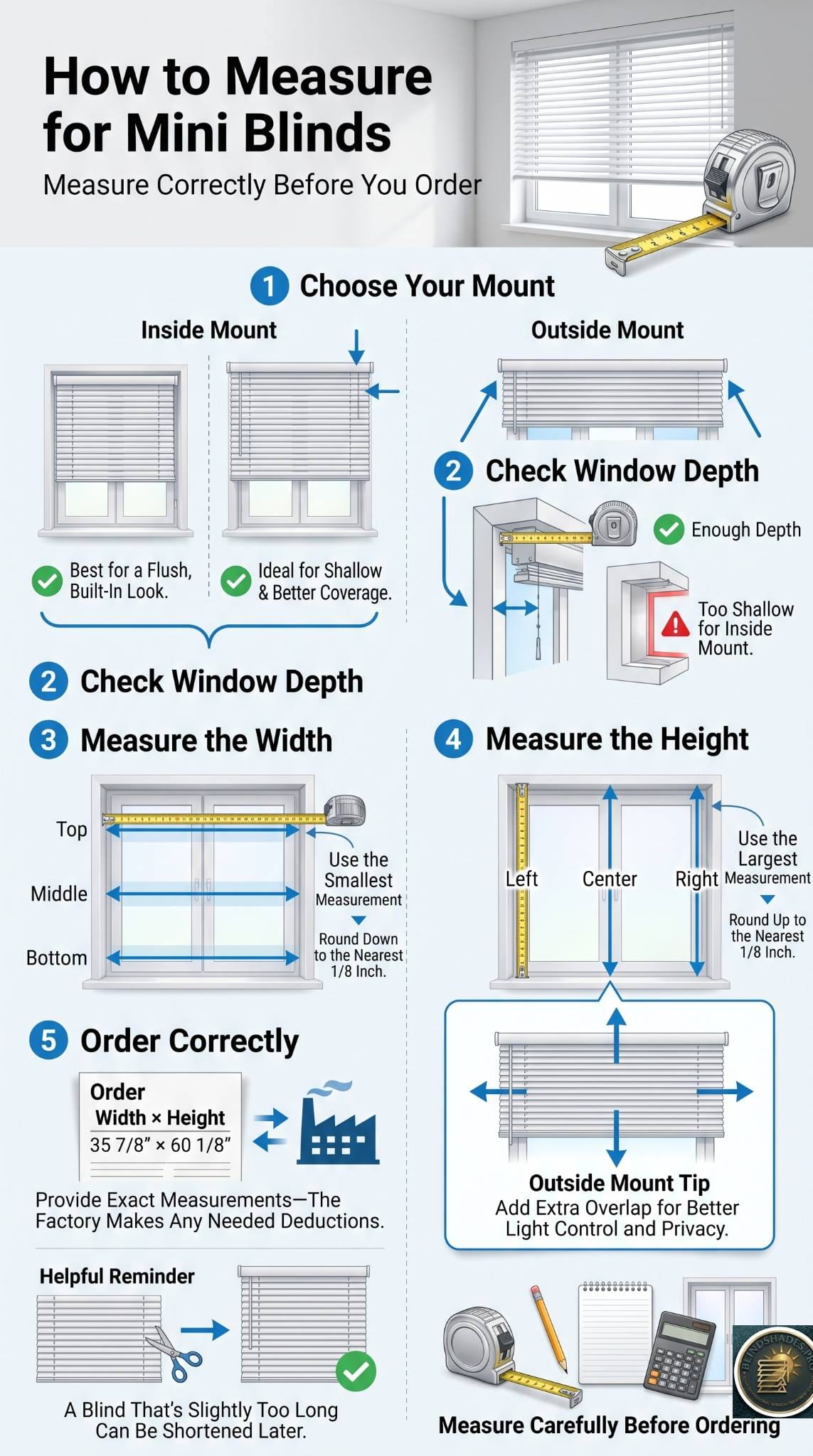
Authored by Michael Turner — 30 Years of Home Improvement Expertise | BlindShades.pro
To measure for mini blinds, first decide between an inside mount, which sits inside the window frame, and an outside mount, which covers the opening from the wall. For an inside mount, check the frame is deep enough, then measure the width in three places and use the smallest, and the height in three places and use the largest, recording everything to the nearest one-eighth inch with a steel tape. For an outside mount, measure the area you want to cover and add overlap on each side. The single most important rule: give your exact measurements and never make your own deductions, because the factory deducts for inside mounts automatically. This guide walks through both mounts, the depth check, and the mistakes that cause ill-fitting blinds.
Key Takeaways
- Decide inside or outside mount first. An inside mount gives a clean, built-in look but needs enough frame depth; an outside mount covers shallow, out-of-square, or obstructed windows and blocks more light.
- Measure in three places, every time. Windows are rarely perfectly square, so measure width at the top, middle, and bottom, and height at the left, center, and right, then apply the right rule.
- Smallest width, largest height for inside mounts. Use the smallest of the three widths so the blind clears the frame, and the largest height so it covers the opening; round width down and height up to the nearest one-eighth inch.
- Never make your own deductions. Submit your exact measurements; the factory automatically deducts for inside mounts so the blind operates freely. Deducting yourself, or adding to compensate, causes a poor fit.
- Use a steel tape and label width by height. Cloth tapes stretch, and mixing up width and height is the most common ordering error, so always record as width by height.
⭐ Quick Answer
To learn how to measure for mini blinds, choose your mount, check the depth, then measure in three places, using a steel tape and recording to the nearest one-eighth inch.
- Choose the mount: inside for a built-in look if the frame is deep enough, or outside to cover a shallow or uneven window.
- Check the depth: mini blinds need a minimum recess for the headrail, as Lowe’s notes; too shallow means an outside mount.
- Width, three points: measure the top, middle, and bottom and use the smallest, rounding down so the blind clears the frame, the method Blinds.com teaches.
- Height, three points: measure the left, center, and right and use the largest, rounding up so it covers the opening.
- Never deduct yourself: give exact measurements and let the factory deduct for inside mounts, as SelectBlinds advises. Then order from our best mini blinds guide, choose a material in aluminum vs vinyl mini blinds, or trim a long blind with how to shorten mini blinds.
Inside or Outside Mount? Decide First
Your mount choice changes how you measure, so settle it up front.
Before measuring, choose how the blind will mount, because the method differs for each:
| Choose inside mount if | Choose outside mount if |
|---|---|
| The frame is deep enough for the headrail | The frame is too shallow for an inside mount |
| You want a clean, built-in look | The window is noticeably out of square |
| The window is reasonably square | There are obstructions in the frame |
| You want to show off the trim | You want to cover more for light control or privacy |
Inside-mount blinds sit within the window frame for a sleek, recessed look that showcases the trim. Outside-mount blinds attach to the wall or molding above and around the opening, covering more of the window, blocking more light, and working where the recess is too shallow or uneven. When in doubt, an outside mount is the more forgiving option.
Check the Window Depth First
An inside mount only works if the frame is deep enough.
For an inside mount, the first thing to confirm is depth, because the headrail needs room to sit inside the frame. Measure from the front edge of the window opening straight back to the glass. Mini blinds, with their slim profile, need less depth than chunkier blinds: a minimum of roughly three-quarters of an inch for the headrail to fit, and around one and three-quarter inches to fully recess a cordless mini blind so nothing protrudes. By comparison, two-inch faux wood blinds can need two and three-quarter inches or more. If your frame is shallower than the minimum, choose an outside mount. Always check the exact minimum on the specific product’s specifications, since it varies by collection.
What You’ll Need
The right tape makes the difference.
Use a steel tape measure, never a cloth one, because cloth stretches and gives inaccurate readings. Have a pencil and a simple worksheet or note to record numbers, since a written record prevents mixing up width and height. A step stool or small ladder helps you measure straight across tall windows rather than at an angle, and a second person makes long spans easier and more accurate.
How to Measure for Inside Mount Mini Blinds
Three readings each for width and height, then apply the rule.
- Confirm the depth is sufficient for an inside mount, as above.
- Measure the width inside the window frame at three points: the top, the middle, and the bottom. Write down all three.
- Use the smallest width, rounding down to the nearest one-eighth inch, so the blind clears the sides of the frame.
- Measure the height inside the frame at three points: the left, the center, and the right, from the top down to the sill. Write down all three.
- Use the largest height, rounding up to the nearest one-eighth inch, so the blind covers the full opening.
- Record as width by height and submit these exact measurements without any deductions.
Measuring in three places is not just for accuracy; it also reveals whether the window is out of square, which matters for your final choice.
How to Measure for Outside Mount Mini Blinds
Measure the area to cover, then add overlap.
- Confirm a flat mounting surface of about two and a half inches above or around the window for the brackets.
- Measure the width of the area you want to cover; if you have trim, measure to its outer edges, or if not, plan to overlap the opening on each side.
- Add overlap to the width so the blind blocks light at the edges.
- Measure the height from where the top bracket will sit, above the opening, down to the sill or your desired length.
- Add overlap above and below, then record as width by height and submit exact measurements.
Here is how much to add for an outside mount:
| Dimension | Add |
|---|---|
| Width, each side | 1.5 to 2 inches |
| Height, above the opening | 2 to 3 inches |
| Height, below the opening | To the sill or lower as desired |
Outside-mount blinds are made to your exact size with no factory deductions, so the overlap you add is the coverage you get.
Don’t Make Your Own Deductions
Give exact measurements — the factory handles the rest.
This is the rule that prevents the most ill-fitting blinds: when you order, submit your exact window measurements and do not subtract anything yourself. For an inside mount, the factory automatically deducts a small amount, usually about one-eighth to one-quarter inch from the width, so the blind operates freely inside the frame. If you also deduct, the blind ends up too small and leaves light gaps; if you add width to compensate for a deduction you imagine, it ends up too big to fit. For an outside mount, no deductions are made, so the blind is built to the exact size you provide, overlap included. Either way, measure precisely and let the factory do the math.
Which Measurement Do You Use?
The complete rule grid in one place.
The rules for which reading to use and how to round can be confusing, so here they are together:
| Mount and dimension | Which reading | Rounding | Deductions |
|---|---|---|---|
| Inside, width | Smallest of three | Round down | Factory deducts |
| Inside, height | Largest of three | Round up | None |
| Outside, width | Area to cover plus overlap | As measured | None |
| Outside, height | Area to cover plus overlap | As measured | None |
The logic is simple: for an inside mount you want the smallest width so it clears the frame and the largest height so it covers the opening, while for an outside mount you give the exact coverage size including your overlap. If a particular retailer’s order form asks for something slightly different, follow its specific instructions.
Checking for Square and Obstructions
The three-point measurement does double duty.
Measuring at three points tells you more than the size; if the three width readings differ noticeably, the window is out of square, which is a sign to favor an outside mount that can cover the unevenness cleanly. Before committing to an inside mount, also check for obstructions inside the frame that could interfere with the headrail or the slats as they raise and tilt:
- Window handles, cranks, and latches
- Door locks and deadbolts on door windows
- Protruding tile, trim, or sills
- Alarm sensors or cables
If any of these sit in the way, an outside mount usually solves the problem.
Common Measuring Mistakes
Most fit problems trace back to a handful of slips.
| Mistake | Consequence |
|---|---|
| Measuring only once | Misses an out-of-square frame, blind binds or gaps |
| Mixing up width and height | Wrong-shaped blind ordered |
| Making your own deductions | Blind too small, light gaps |
| Using a cloth tape | Stretchy, inaccurate readings |
| Measuring at an angle | Reading too large, blind will not fit |
| Ignoring depth | Inside mount that will not fit the frame |
| Assuming windows match | Each window varies; measure all individually |
From Measurement to Order
Accurate numbers turn into the right blind.
With your width and height recorded correctly and your mount chosen, you are ready to order the right size with confidence. Take your measurements to a set you like in our best mini blinds guide, where you can also weigh material in aluminum vs vinyl mini blinds and choose a safer lift in best cordless mini blinds. If a stock blind comes a little long, you can trim it to fit using how to shorten mini blinds, and if mini blinds are not quite right for the window, compare other styles in alternatives to mini blinds.
Best Sources
- Blinds.com — on measuring the width at three points and using the smallest, checking depth from the front of the opening to the glass, the width-by-height format with no deductions, and measuring each window individually.
- Lowe’s — on the minimum depth for an inside-mount one-inch cordless mini blind and the three-point width to the nearest one-eighth inch.
- SelectBlinds — on rounding the smallest width down, letting the factory make deductions, and the flat surface needed for an outside mount.
- American Blinds — on choosing outside mount for out-of-square windows, the automatic inside-mount deduction, and overlap of about one and a half inches per side.
- Factory Direct Blinds — on measuring depth from glass to casing, using the tallest height, and adding two to three inches of overlap for outside mounts.
- Arizona Window Coverings Center — on smallest width and largest height, detecting out-of-square windows, and never making your own deductions.
Related Guides
- Best Mini Blinds Buying Guide
- How to Shorten Mini Blinds
- Aluminum vs Vinyl Mini Blinds
- Best Cordless Mini Blinds
Frequently Asked Questions
How do you measure for inside mount mini blinds?
For an inside mount, first confirm the frame is deep enough for the headrail. Measure the width inside the frame at the top, middle, and bottom, and use the smallest of the three, rounding down to the nearest one-eighth inch so the blind clears the sides. Measure the height at the left, center, and right from the top to the sill, and use the largest, rounding up. Submit these exact measurements in width by height format and let the factory make its deductions.
Should you use the smallest or largest measurement for blinds?
For an inside mount, use the smallest width and the largest height. The smallest width ensures the blind clears the sides of the frame so it does not bind, while the largest height ensures it covers the full opening down to the sill. Round the width down and the height up to the nearest one-eighth inch. For an outside mount, you instead use the size of the area you want to cover plus your chosen overlap, with no smallest-or-largest rule.
How much should outside mount blinds overlap the window?
For an outside mount, add about one and a half to two inches of width on each side of the opening to block light gaps and provide privacy. For height, add roughly two to three inches above the opening for the mounting hardware and to let the blind stack clear of the glass, and extend down to the sill or below as you prefer. Outside-mount blinds are made to your exact size with no deductions, so the overlap you add is the coverage you get.
How deep does a window need to be for inside mount mini blinds?
Mini blinds need a minimum window depth for an inside mount, roughly three-quarters of an inch for the headrail to fit and about one and three-quarter inches to fully recess a cordless mini blind. This is less than chunkier blinds like two-inch faux wood, which can need two and three-quarter inches or more. Measure from the front edge of the opening straight back to the glass, and if your frame is shallower than the minimum, choose an outside mount instead. Always check the exact requirement on the product specifications.
Do you subtract anything when measuring for blinds?
No, you should not subtract anything yourself. Submit your exact window measurements, and for an inside mount the factory automatically deducts a small amount, usually about one-eighth to one-quarter inch from the width, so the blind operates freely. If you deduct as well, the blind comes out too small with light gaps, and if you add width to offset an imagined deduction, it comes out too big to fit. For outside mounts, no deductions are made at all.
