Why Is Light Coming Through the Sides of My Roller Blind?

Authored By Michael Turner -30 Years Home Improvement Expertise | Updated 2026 | BlindShades.pro
Updated on June 18, 2026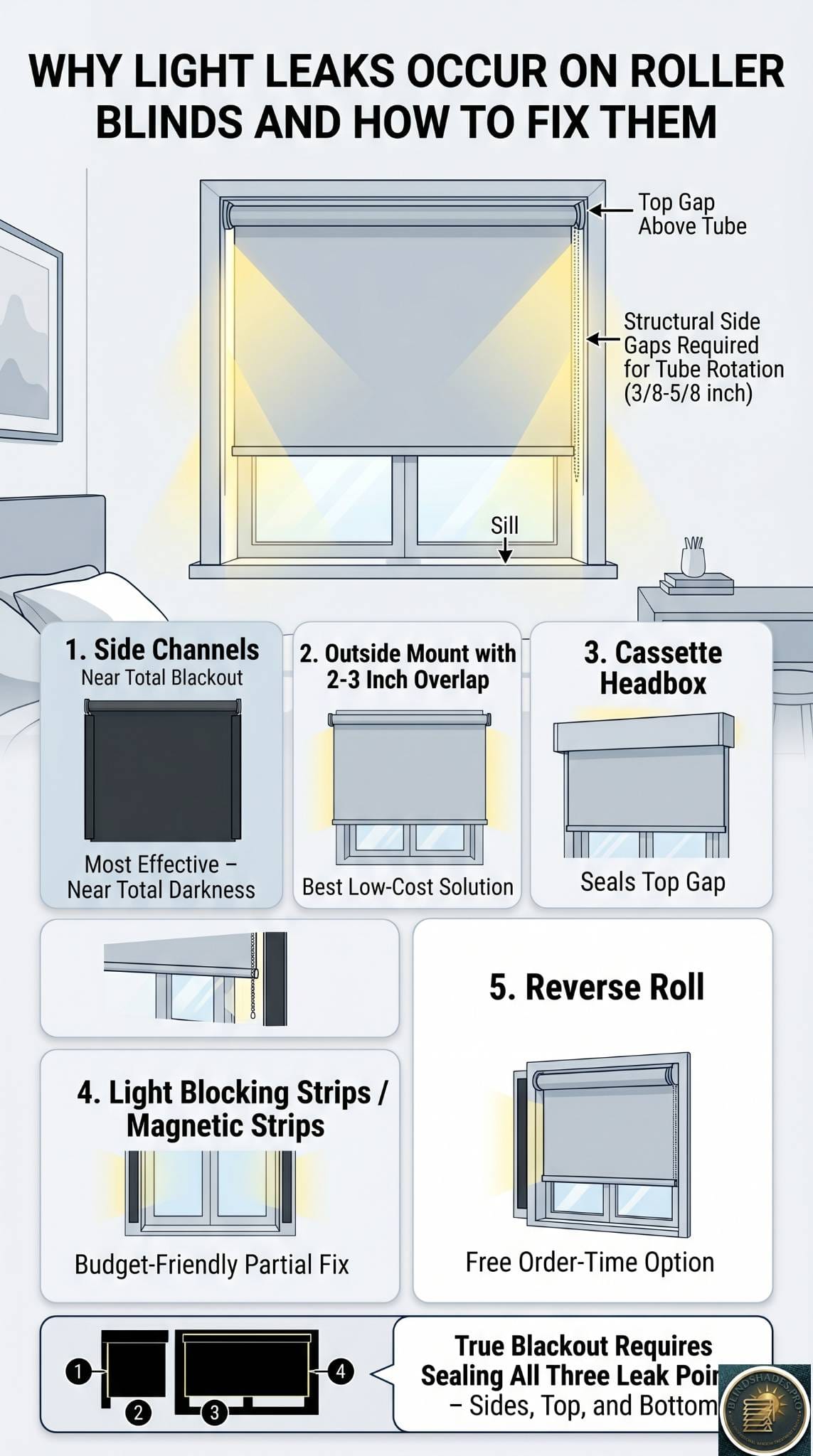
Authored by Michael Turner — 30 Years of Home Improvement Expertise | Updated 2026 | BlindShades.pro
Light leaks down the sides of a roller blind because the fabric must be narrower than its brackets — a 3/8 to 5/8 inch gap per side that even blackout fabric cannot close. Here are the fixes, ranked by how much light they actually block.
Key Takeaways
- Light comes through the sides of a roller blind for a structural reason, not because the blind is faulty: the fabric must be narrower than the brackets it hangs between so the tube can turn freely. That leaves a gap of roughly 3/8 to 5/8 inch on each side of an inside-mounted blind, and even a 100% opaque blackout fabric will leak a visible band of daylight down both edges through it. The gap is normal physics, which is why no fabric upgrade alone removes it.
- The fixes are not equal, and most guides list them without ranking them. From most to least effective: side channels (near-total blackout, the most reliable), an outside mount overlapping the frame by 2 to 3 inches (the best free-or-cheap lever), a cassette plus channels to seal top and sides together, then light-blocking strips and magnetic or Velcro strips (cheap and partial). A reverse roll, which sits the fabric closer to the glass, is a free order-time choice that shrinks the gap and is almost never mentioned.
- Darkness leaks from three places, not one: the sides, the top (above the roller tube), and the bottom (at the sill). Sealing only the sides still leaves a glow from the top and bottom. A true blackout setup seals all three: side channels for the edges, a cassette for the top, and an extended length or sill seal for the bottom.
- Blackout fabric does most of the work, but not all of it. A quality blackout fabric blocks roughly 95 to 99% of light through the material itself; the remaining glow is almost entirely the perimeter gaps. Adding side channels closes that last few percent and is the difference between a dim room and a genuinely dark one. UBlockout notes that sealed-track systems are what eliminate the side gaps entirely.
- Decide between retrofitting and ordering channels with the blind, because it changes the fit. Factory side channels are sized to the fabric and seal best; retrofit channels need a small clearance to work, with removable magnetic versions requiring about a 3/8 inch side gap and slimmer adhesive versions about 1/4 inch, per side-channel makers such as SleepyTime Tracks. For a new blackout bedroom, specify channels at order time.
⭐ Quick Answer
Light coming through the sides of a roller blind is structural, not a defect: the fabric must be narrower than its brackets so the tube can turn, leaving a 3/8 to 5/8 inch gap on each side. Even blackout fabric leaks light there. Here are the fixes, ranked by how much light they block.
- Side channels (best for true blackout): U-shaped tracks on the jambs that capture the fabric edges and block the side light almost completely. Blackout specialists such as UBlockout and SolaSolv point to sealed-track systems as the only reliable route to near-total darkness.
- Outside mount (best value): order the blind wider and taller than the opening and mount it on the wall so it overlaps the frame by 2 to 3 inches per side. The leaked band falls on the wall, not into the room — and it costs nothing extra at order time. Getting the overlap right starts with how to measure for roller blinds.
- Light-blocking strips (best retrofit): L-shaped plastic strips that stick to the jamb and cover the uncovered window. Blinds.com sells these as Light Blockers; magnetic or Velcro versions are the removable, renter-friendly option.
- Reverse roll (free, overlooked): ordering a reverse roll sits the fabric closer to the glass and shrinks the side gap. It costs nothing and stacks with the other fixes.
- Seal all three leak points: sides (channels), top above the tube (a cassette), and the bottom at the sill. A blackout fabric blocks about 95 to 99% of light on its own; the perimeter gaps are the rest. For whether the blackout upgrade is worth the cost, see are blackout roller blinds worth it, and the full spec is in the Roller Blinds Buying Guide.
Why Does Light Come Through the Sides of a Roller Blind?
Light comes through the sides of a roller blind because of how the blind is built, not because anything is broken. A roller blind is a single sheet of fabric wound onto a tube, and that tube spins inside two mounting brackets. For the tube to turn freely, the fabric has to be cut narrower than the bracket-to-bracket span — which means there is always a strip of uncovered window on each side where the fabric ends and the bracket begins.
On a typical inside-mounted blind, each bracket protrudes about half an inch into the window opening, leaving a gap of roughly 3/8 to 5/8 inch per side. Daylight pours straight through those two strips, producing the bright vertical bands you see down the edges of the blind. This is the single most common roller-blind complaint, and it has nothing to do with the quality of the fabric: even a fully opaque blackout fabric leaks light at the edges because the gap is beside the fabric, not through it.
It is the same reason curtains and other inside-mounted treatments leak at the edges — any covering that mounts within the opening sits inboard of the frame. The difference with a roller blind is that the gap is narrow and sharply defined, which makes the light bands especially noticeable.
Is the Side Gap a Defect or Is It Normal?
It is normal. A side gap on an inside-mounted roller blind is expected physics, not a manufacturing fault, so it is not grounds for a warranty claim. What would be a defect is fabric cut out of square or a blind far narrower than ordered. If you want to confirm yours is within normal range, the gap should be roughly even on both sides and in the 3/8 to 5/8 inch range; a much larger gap on one side points to an off-center tube or an out-of-level mount, which is a different issue covered in why your roller blind won’t roll up straight.
Where Does the Light Actually Leak — Sides, Top, or Bottom?
Most people focus on the side gaps because they are the most visible, but a roller blind leaks light from three places, and sealing only the sides leaves a frustrating residual glow. Diagnosing all three is what separates a dim room from a dark one.
- The sides — the 3/8 to 5/8 inch gaps on each edge. The biggest and most obvious leak.
- The top — the space above the fabric where it wraps the exposed roller tube. An open-roll blind leaves a gap here; a cassette or fascia closes it.
- The bottom — where the bottom bar meets the sill. If the blind is cut a touch short or the sill is uneven, light spills underneath.
A true blackout setup addresses all three: side channels for the edges, a cassette for the top, and either an extended drop length or a sill seal for the bottom. Plan for all three before you start buying accessories, or you will fix the sides and still be kept awake by a line of light along the top.
What’s the Best Way to Block Light From the Sides?
Here is the part the competing guides leave out: the fixes are not equal. This table ranks them by how much light they block, what they cost, and whether they are permanent.
| Fix | Light blocked | Cost | Permanence | Best for |
|---|---|---|---|---|
| Side channels (tracks) | Near-total | $$ | Permanent or removable | True blackout bedrooms, media rooms |
| Outside mount (+2-3″ overlap) | High | Free at order time | Permanent | New blinds, best value |
| Cassette + channels | Near-total (top + sides) | $$$ | Permanent | Complete blackout systems |
| Reverse roll | Moderate (shrinks gap) | Free at order time | Permanent | Any blackout order |
| Light-blocking strips | Partial to high | $ | Semi-permanent | Retrofitting existing inside-mount blinds |
| Magnetic / Velcro strips | Partial | $ | Removable | Renters, temporary fixes |
The headline takeaways: if you are buying a new blind, an outside mount with 2 to 3 inches of overlap is the single most effective free lever, and adding a reverse roll costs nothing. If you need genuine blackout, side channels are the only fix that reliably gets you there. If you are working with a blind you already own, light-blocking strips are the practical retrofit, and magnetic strips are the renter-friendly option.
How Do Side Channels Work, and Are They Worth Installing?
Side channels — also called side rails or sealed tracks — are U-shaped tracks mounted on the window jambs that the fabric edges run inside. Because the fabric is captured within the channel, there is no open gap for light to pass through, which is why retailers like SolaSolv and blackout specialists like UBlockout point to sealed-track systems as the only reliable route to near-total darkness with a roller blind.
They are worth installing when darkness genuinely matters — a shift worker’s bedroom, a nursery used for daytime naps, or a home theater. A quality blackout fabric already blocks roughly 95 to 99% of light through the material; side channels close the perimeter glow that makes up the remaining few percent, and they add a measurable insulation benefit by sealing the air gap at the edges. The trade-off is appearance and cost: channels are visible tracks on the jambs and add to the price. For whether that upgrade earns its keep versus bare blackout fabric, see are blackout roller blinds worth it.
Retrofit or Order Them With the Blind?
Factory-fitted channels are sized to the fabric and seal best, so for a new blackout blind, specify them at order time. Retrofit channels work too, but they need a small clearance to slide over the existing blind: removable magnetic versions typically need about a 3/8 inch side gap, while slimmer adhesive versions need about 1/4 inch, according to side-channel makers such as SleepyTime Tracks. Measure your existing gap before buying a retrofit kit.
Should You Just Use an Outside Mount Instead?
For many people, the simplest and cheapest fix is to avoid the gap altogether with an outside mount. An outside-mounted blind fixes to the wall or trim above the window and is made wider and taller than the opening, so it overlaps the frame by 2 to 3 inches on each side and the top. The leaked band of light then falls on the wall behind the blind rather than into the room.
This is the best value fix because it costs nothing extra at order time — you simply order a larger blind and mount it outside the recess. The trade-offs are aesthetic: an outside mount sits proud of the wall rather than recessed in the frame, and it covers part of the surrounding trim. For a bedroom where darkness beats the built-in look, an outside mount with generous overlap, ideally combined with a blackout fabric, solves the side-light problem without any add-on accessories. Getting the overlap right starts with measurement — see how to measure for roller blinds.
Do Light-Blocking Strips Actually Work?
Light-blocking strips are the practical retrofit for a blind you already own and cannot easily replace. Blinds.com sells these as “Light Blockers” — L-shaped pieces of plastic that stick to the window jamb in front of or behind the blind and cover the uncovered strip of window. They trim to length with scissors, peel-and-stick in minutes, and block most of the side light for a few dollars per window.
They work well, with two caveats: they are visible up close, and they block “most” rather than “all” of the side light unless carefully aligned tight to the fabric edge. For a child’s room or a guest room where good-enough darkness is the goal, they are the right tool. For a true blackout bedroom, side channels do a cleaner, more complete job. Magnetic and Velcro strips are a similar idea in removable form, useful for renters who cannot drill or adhere anything permanent.
Can a Reverse Roll Reduce the Side Gap?
Yes, and almost no one mentions it. Roll direction is a free choice you make at order time, and it affects how close the fabric sits to the glass. In a standard roll, the fabric feeds off the front of the tube and sits slightly away from the window; in a reverse roll, it feeds off the back and sits closer to the glass.
A reverse roll pulls the fabric tighter against the window plane, which narrows the effective side gap and reduces edge leakage. It will not eliminate the gap the way channels do, but it costs nothing and stacks with the other fixes. For a blackout order, a reverse roll plus side channels plus a cassette is the complete specification. The one time to avoid reverse roll is when a window handle, crank, or deep sill would foul the fabric — then a standard roll gives the needed clearance.
How Do You Seal the Top and Bottom Gaps Too?
Once the sides are handled, the top and bottom are what is left between you and a fully dark room.
For the top, an open-roll blind leaves a gap above the fabric where it wraps the tube. A cassette (also called a fascia) is a slim housing that encloses the tube and seals that top gap while hiding the roll; it is the standard top-light fix and pairs naturally with side channels. For the bottom, make sure the blind is dropped to or slightly past the sill, and if the sill is uneven, a thin foam or rubber sill seal closes the line of light underneath. The complete blackout stack, in order of impact, is: blackout fabric, side channels, cassette, reverse roll, and a sill seal. Specify as many of these as your darkness requirement justifies — the full decision is laid out in the Roller Blinds Buying Guide.
Frequently Asked Questions
Is it normal for light to come through the sides of a roller blind?
Yes. The fabric must be narrower than its brackets so the tube can turn, leaving a 3/8 to 5/8 inch gap on each side of an inside-mounted blind. It is structural and normal, not a defect, and even blackout fabric leaks light there until you add side channels or use an outside mount.
How do I stop light coming through the sides of my roller blind?
The most effective fix is side channels — U-shaped tracks the fabric runs inside. The cheapest effective fix is an outside mount that overlaps the frame by 2 to 3 inches. For a blind you already own, light-blocking strips or magnetic strips on the jamb block most of the side light.
Will blackout roller blinds stop all the light?
Not on their own. Blackout fabric blocks roughly 95 to 99% of light through the material, but the perimeter gaps at the sides, top, and bottom still leak. To reach near-total darkness, add side channels for the edges, a cassette for the top, and seal the bottom at the sill.
Do side channels really make a roller blind blackout?
Side channels capture the fabric edges so no light passes at the sides, which is the only reliable way to get near-total darkness from a roller blind. Combined with a blackout fabric and a cassette to seal the top, they produce a genuinely dark room and also improve edge insulation.
What is the cheapest way to block side light on an existing roller blind?
Light-blocking strips, or “Light Blockers,” are L-shaped plastic pieces that stick to the window jamb and cover the uncovered strip of window for a few dollars per window. Magnetic strips are the removable, renter-friendly alternative. Both block most side light, though side channels do a more complete job.
This article is part of the Roller Blinds Buying Guide cluster on BlindShades.pro. Related: Are blackout roller blinds worth it? · Why won’t my roller blind roll up straight? · How to measure for roller blinds
