How to Measure for Roller Blinds ?

Authored By Michael Turner -30 Years Home Improvement Expertise | Updated 2026 | BlindShades.pro
Updated on June 17, 2026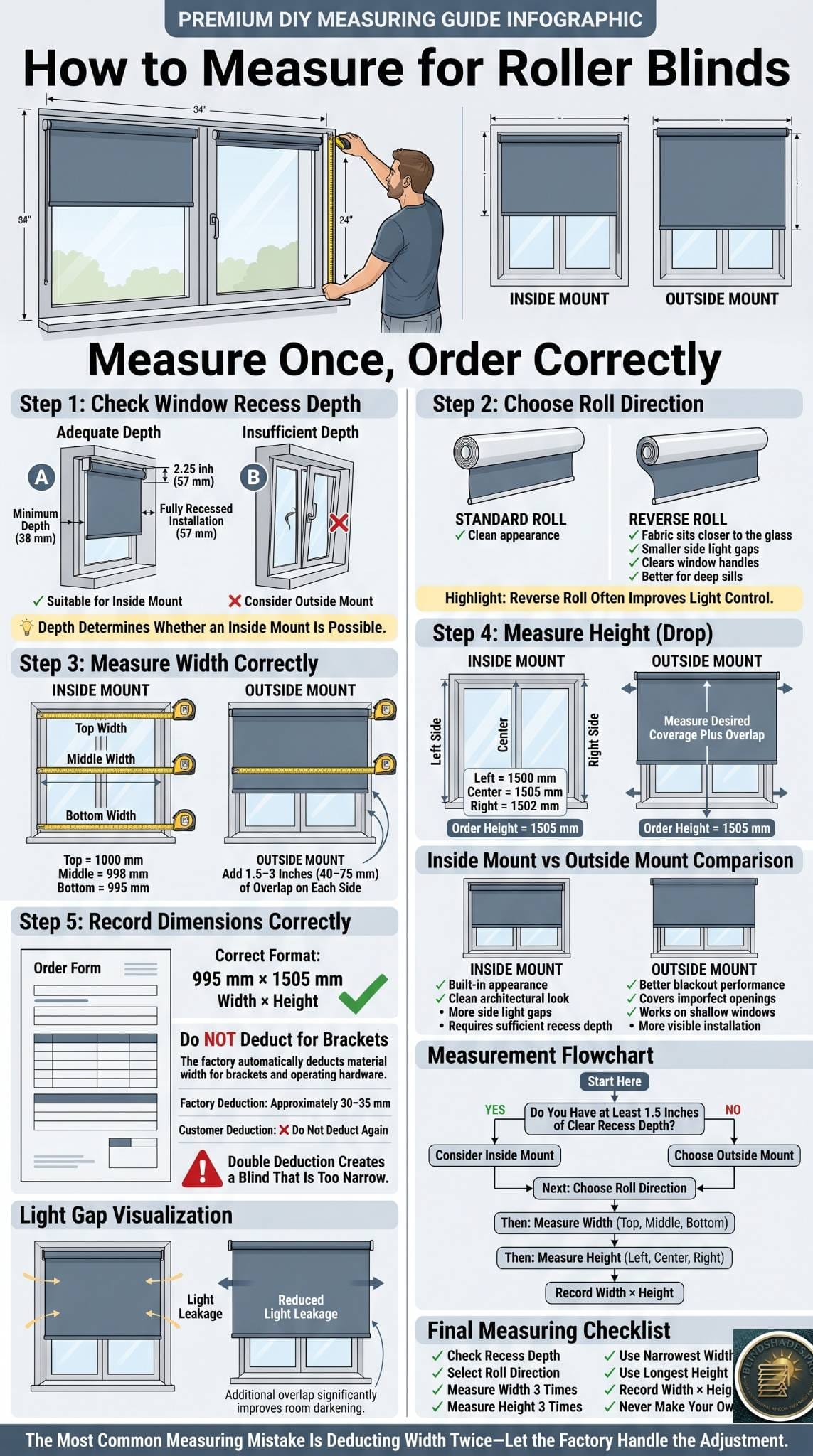
Authored by Michael Turner — 30 Years of Home Improvement Expertise | Updated 2026 | BlindShades.pro
To measure for roller blinds, decide the mount by checking your window depth first, choose your roll direction, measure width and height in three places each, and record width by height without ever making your own deductions. Here’s the complete brand-agnostic method, including the two steps most guides skip.
Key Takeaways
- Measuring a roller blind is a five-step sequence, and it starts with a depth check, not a tape measure across the window. Before anything else, measure how deep your window recess is, because that decides whether you can mount inside the frame at all. Most roller blinds need roughly 1.5 inches of unobstructed depth for an inside mount, and around 2.25 inches to sit fully recessed. If you do not have it, the decision is made for you: outside mount.
- Choose your roll direction at measuring time, because it is the step almost every guide skips and it changes the result. A standard roll has the fabric coming off the back of the tube; a reverse roll brings the fabric off the front, closer to the glass. Reverse roll reduces the side light gap and helps clear a deep sill, handles, or trim, so decide it now, while you are looking at the window and its obstructions.
- Measure width and height in three places each, and apply the right rule for your mount. For an inside mount, measure the width at the top, middle, and bottom and use the narrowest, and measure the height at left, center, and right and use the longest. For an outside mount, measure the area you want to cover and add an overlap of about 1.5 to 3 inches on each side for light control.
- Never make your own deductions on an inside mount; the factory does it, and doing it yourself causes a double deduction. The single most common DIY error is subtracting for the brackets before ordering. The manufacturer automatically deducts about 30 to 35 millimeters (1.25 to 1.4 inches) for the brackets and controls, so if you deduct too, your blind comes out far too small and leaves a large light gap. Provide the exact recess size and let the factory deduct.
- An inside mount always leaves a small light gap, so plan for it. Because the fabric ends up about 30 to 35 millimeters narrower than the recess, an inside-mounted roller leaves roughly a 5/8-inch gap on each side where light leaks in. If round-the-clock darkness matters, choose a reverse roll, an outside mount, or side channels rather than being surprised by the halo later.
⭐ Quick Answer
How to measure for roller blinds in five steps: check the depth, choose the mount and roll direction, measure in three places, and record width by height without ever deducting yourself.
- Step 1 — check the depth, choose the mount: an inside mount needs about 1.5 in of unobstructed depth (2.25 in to sit fully recessed). If the recess is shallow, obstructed by handles, or out of square, go outside mount — American Blinds recommends it for out-of-square windows.
- Step 2 — choose the roll direction: the step most guides skip. A reverse roll brings the fabric closer to the glass to narrow the side light gap and clear a deep sill or handles. DotcomBlinds ties this to checking the recess for obstructions.
- Steps 3 & 4 — measure in three places: width at the top, middle, and bottom; height at the left, center, and right. For an inside mount use the narrowest width and longest height; for an outside mount add 1.5 to 3 in of overlap each side (SelectBlinds suggests about 2 in per side).
- Step 5 — record width by height, never deduct yourself: the factory automatically removes about 30 to 35 mm for brackets and controls, so if you deduct too, the blind comes out far too small. Measure the space, not the fabric.
- Plan for the light gap: an inside mount leaves roughly a 5/8 in gap each side where light leaks in. Beat it with a reverse roll, an outside mount, or side channels — see why light comes through the sides of a roller blind. Full spec in the Roller Blinds Buying Guide.
What You Need Before You Measure
Two tools and two decisions. The tools: a metal tape measure (never cloth, which stretches and lies) and a spirit level to check whether the window is square. The decisions you will make as you go: the mount type (inside or outside) and the roll direction (standard or reverse). Get those two decisions right and the measurements themselves are simple. The steps below take them in the order that matters, because the depth check can settle the mount decision before you measure anything else.
Step 1: Inside or Outside Mount? Check the Depth First
The mount decision comes first because it changes every measurement after it, and the fastest way to make it is to measure your window’s depth. An inside mount sits inside the window recess for a clean, built-in look, but it needs enough unobstructed depth: roughly 1.5 inches for most rollers to mount at all, and around 2.25 inches for the blind to sit fully recessed without projecting past the frame.
Choose an outside mount — on the wall or trim above and around the window — if any of these are true: your recess is shallower than about 1.5 inches; there are obstructions in the recess like window handles, cranks, locks, or tiles; the window is noticeably out of square; or you simply want maximum light control, since an outside mount overlaps the edges and covers the gaps an inside mount leaves. American Blinds and others recommend outside mount specifically for out-of-square windows and shallow or obstructed frames. So before you measure the opening, measure the depth and look for obstructions — that often makes the decision for you.
Step 2: Choose Your Roll Direction
This is the step almost every measuring guide leaves out, and it is a genuine measuring-time decision. A roller blind can be hung with a standard roll, where the fabric unwinds off the back of the tube (closest to the glass), or a reverse roll, where it unwinds off the front.
It matters for two reasons. First, light: a reverse roll brings the fabric forward, closer to the glass on an outside mount or tighter to the frame, which narrows the side light gap. Second, clearance: if you have a deep sill, a protruding handle, or trim that the fabric would otherwise rub against, a standard roll keeps the fabric back against the glass and clear of the obstruction, while a reverse roll pushes it forward over a sill. Decide it now, while you are looking at the window, because the right choice depends on your specific obstructions and whether you are prioritizing a tight light seal or clearance. DotcomBlinds notes that checking the recess for obstructions and squareness feeds directly into the roll-direction decision.
Step 3: Measure the Width in Three Places
Windows are rarely perfectly square, so you measure the width three times — at the top, middle, and bottom of the opening — and record all three to the nearest 1/8 inch (or the nearest millimeter).
- Inside mount: use the narrowest of the three measurements. This guarantees the blind clears the frame at its tightest point and will not jam. Provide this exact recess width when ordering.
- Outside mount: measure the full area you want to cover and add an overlap of about 1.5 to 3 inches on each side. More overlap means better light control; SelectBlinds suggests adding about 2 inches per side, Bali up to 3, and American Blinds about 1.5. The width you provide is the bracket-to-bracket span.
Step 4: Measure the Height (Drop) in Three Places
Measure the height — also called the drop — at three points across the window, on the left, center, and right, again recording each to the nearest 1/8 inch.
- Inside mount: use the longest of the three measurements, taken from the top of the recess to the sill, so the blind covers the full height.
- Outside mount: decide where you want the top of the blind (mark it, typically a couple of inches above the opening so the headrail clears it) and measure from that mark down to the sill or your desired bottom point, adding overlap at the bottom if you want it.
Step 5: Record Width by Height, and Never Deduct Yourself
Write your final numbers as width by height (W x H) — always width first, because mixing them up is one of the most common ordering errors. Then follow the rule that saves more orders than any other: on an inside mount, provide the exact recess size and do not make any deductions yourself.
Here is why it matters. The manufacturer automatically deducts about 30 to 35 millimeters (1.25 to 1.4 inches) from your recess width to leave room for the brackets and the chain or motor control, so the finished fabric is narrower than the opening. If you also subtract a margin before ordering, you double-deduct: the blind comes out far too small, with a wide light gap on both sides. As DotcomBlinds and Ministry of Blinds both stress, you measure the space, not the fabric, and the factory handles the deduction. For an outside mount, the opposite holds: no deduction is taken, so the size you give is the size you get, which is why you add the overlap yourself.
How Much Light Gap Will an Inside Mount Leave?
Enough to notice, which is why you should plan for it rather than discover it. Because the finished fabric ends up about 30 to 35 millimeters narrower than the recess, an inside-mounted roller leaves roughly a 5/8-inch gap on each side between the fabric edge and the frame, and light leaks straight through it. Ministry of Blinds describes a client who measured a master bedroom for an inside mount, did not account for the fabric gap, and ended up with a glowing halo of light around the edges that woke them at 7 AM every day.
If full darkness matters, you have three options, all decided at measuring time: choose a reverse roll to pull the fabric tighter and narrow the gap, choose an outside mount that overlaps the frame and covers the gap entirely, or plan for side channels. This is the same side-gap problem covered in depth in why light comes through the sides of a roller blind — measuring is simply where you first get the chance to prevent it.
What If My Window Isn’t Deep Enough for an Inside Mount?
Then you mount outside, and it is not a compromise. If your recess is shallower than about 1.5 inches, or obstructions like handles and cranks eat into the usable depth, an outside mount on the wall or trim is the correct and often better choice: it gives you more flexibility on size, covers an unattractive or out-of-square window, makes the window look larger, and crucially overlaps the edges for far better light control. You lose the inset, built-in look of an inside mount, but you gain a cleaner light seal. Just remember to add your overlap (Step 3) and to choose a headrail position that clears any obstruction.
Inside vs Outside Mount: Measurement Summary
| Step | Inside mount | Outside mount |
|---|---|---|
| Depth needed | ~1.5 in (2.25 in fully recessed) | Any (mounts on wall) |
| Width rule | Narrowest of 3 | Coverage + 1.5-3 in each side |
| Height rule | Longest of 3 | Marked top to sill + overlap |
| Deductions | Factory deducts ~30-35 mm; you deduct nothing | None; size given is size made |
| Light gap | ~5/8 in each side | Minimal (overlap covers it) |
| Best for | Clean look, deep square windows | Shallow, obstructed, out-of-square, max darkness |
The Bottom Line
Measuring for roller blinds is reliable if you do it in order: check the depth and choose the mount, choose the roll direction, measure width and height in three places each, and record width by height without deducting anything yourself on an inside mount. Remember that an inside mount leaves about a 5/8-inch light gap per side, and that a reverse roll or an outside mount is how you beat it. Take three measurements, use a metal tape, write width first, and let the factory handle the deductions. The full fabric, mount, and operation specification is in the Roller Blinds Buying Guide.
Frequently Asked Questions
How do you measure for roller blinds?
Check your window depth and choose inside or outside mount, choose a standard or reverse roll direction, then measure width at the top, middle, and bottom and height at the left, center, and right. For an inside mount use the narrowest width and longest height and make no deductions; for an outside mount add about 1.5 to 3 inches of overlap on each side. Record the result as width by height.
Do I deduct anything when measuring for an inside-mount roller blind?
No. Provide the exact recess size and let the manufacturer make the deduction. The factory automatically removes about 30 to 35 millimeters for the brackets and controls, so if you deduct as well, the blind comes out too small and leaves a large light gap. You only add measurements yourself on an outside mount, where you add the overlap.
How much depth do I need for an inside-mount roller blind?
Most roller blinds need about 1.5 inches of unobstructed depth to mount inside the recess, and around 2.25 inches for the blind to sit fully recessed without projecting past the frame. Check for obstructions like handles and cranks that reduce usable depth. If you do not have enough, mount the blind outside the recess instead.
Why is there a light gap around my inside-mounted roller blind?
Because the finished fabric is about 30 to 35 millimeters narrower than the recess to allow for the brackets and controls, leaving roughly a 5/8-inch gap on each side where light leaks in. To reduce or eliminate it, choose a reverse roll to pull the fabric tighter, switch to an outside mount that overlaps the frame, or add side channels.
Should roller blinds be inside or outside mount?
Inside mount gives a clean, built-in look but needs about 1.5 inches of unobstructed depth and leaves a small side light gap. Outside mount is better for shallow, obstructed, or out-of-square windows and for maximum darkness, because it overlaps the frame and covers the side gaps. Check your depth and obstructions first, then decide.
This article is part of the Roller Blinds Buying Guide cluster on BlindShades.pro. Related: Why is light coming through the sides of my roller blind? · Best roller blinds for large windows · Are blackout roller blinds worth it?
