What Are the Best Roller Blinds for Large Windows?

Authored By Michael Turner -30 Years Home Improvement Expertise | Updated 2026 | BlindShades.pro
Updated on June 17, 2026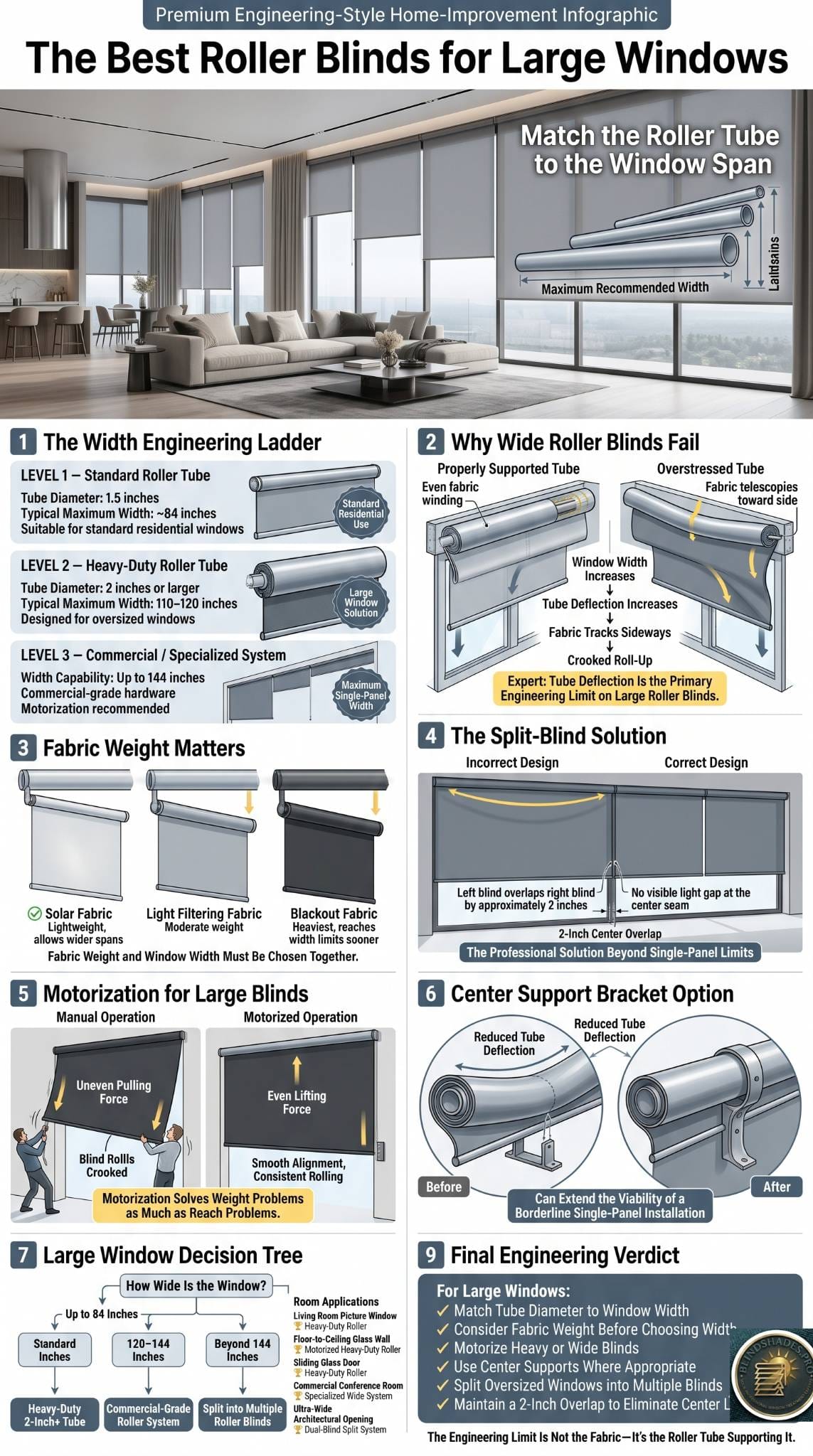
Authored by Michael Turner — 30 Years of Home Improvement Expertise | Updated 2026 | BlindShades.pro
The best roller blind for a large window is a heavy-duty-tube roller sized to the span: a standard tube rolls straight to about 84 inches, a heavy-duty tube to roughly 110 to 120, and beyond that you split into two. Here’s the engineering, the fabric-weight trade-off, and real picks with their actual width limits.
Key Takeaways
- The best roller blind for a large window is one engineered for the span, and the single most important spec is the tube. A standard 1.5-inch tube rolls straight only to about 84 inches; past that the loaded tube deflects in the middle under the weight of the fabric, the blind sags, and it telescopes. A heavy-duty 2-inch-plus tube extends the single-panel limit to roughly 110 to 120 inches, and specialized systems reach up to 144 inches. As DotcomBlinds notes, quality makers automatically upgrade to a larger-diameter barrel for big blinds, while cheaper retailers skip this and leave you with a weak barrel that bows in the middle.
- Beyond the single-panel limit, you split into two blinds on one headrail with a center overlap. When a window is wider than a heavy-duty tube can span, the correct solution is two roller panels meeting at the center with about a 2-inch overlap so no light gap appears at the seam. Blindsgalore makes its custom rollers up to about 115 inches on a single headrail and recommends splitting beyond that for easier operation and structural integrity.
- Fabric weight interacts with width: a heavy blackout fabric sags sooner than a light solar fabric. The wider the blind, the more the fabric weighs, and a dense blackout or vinyl fabric loads the tube far more than a light solar or light-filtering weave. On a very wide window, a lighter fabric can span more before sagging, so the fabric choice and the width limit are not independent decisions.
- Motorize a large roller blind for the weight, not just the reach. A wide, heavy manual roller is genuinely hard to raise smoothly by hand, and uneven hand operation is exactly what causes a big blind to roll up crooked over time. A motor lifts the whole width evenly and removes the strain on the mechanism, which is why motorization is recommended for large windows even when they are easy to reach.
- A center support bracket can rescue a borderline-width single blind. For a window near the upper limit of a single panel, a mid-span support bracket under the tube prevents the bow that causes sagging, as Louvolite recommends, letting one clean blind cover a span that would otherwise need splitting.
⭐ Quick Answer
The best roller blinds for large windows are heavy-duty-tube rollers sized to the span. The single most important spec is the tube, and the limit is a ladder, not one number.
- The width ladder: a standard 1.5 in tube rolls straight to about 84 in; a heavy-duty 2 in+ tube reaches roughly 110 to 120 in; specialized systems hit 144 in; beyond that you split into two panels. Blindsgalore makes single-headrail rollers to about 115 in, then recommends splitting.
- Why wide blinds sag: the tube acts as a beam and bows in the middle under the fabric’s weight, so the blind telescopes. DotcomBlinds upgrades to a larger barrel for big blinds; budget sellers leave a weak barrel that bows. Same root cause as a blind that won’t roll up straight.
- Three fixes, in order: a heavy-duty larger-diameter tube, then a center support bracket (which Louvolite recommends near the limit), then splitting into two blinds with a 2 in center overlap so no light gap shows at the seam.
- The fabric-weight trade-off: a heavy blackout fabric sags sooner than a light solar one, so a lighter fabric spans wider on a single panel. Choose fabric and tube together, not separately.
- Motorize for the weight, not just reach: uneven hand operation makes big blinds roll up crooked, while a motor lifts the full width evenly — see are motorized roller blinds worth it. Full spec and picks in the Roller Blinds Buying Guide.
What Makes a Roller Blind Work on a Large Window?
Roller blinds suit large windows for a reason that has nothing to do with size and everything to do with how they behave: they are a single, clean sheet of fabric that rolls completely out of sight when raised, preserving the dramatic glass expanse that made the window worth having. There are no slats to break up the view, and the minimal stack when raised means the window all but disappears. That is why roller blinds are a favorite for floor-to-ceiling and picture windows.
But the simplicity hides an engineering problem that only appears at width. A roller blind is a cantilevered tube carrying a hanging sheet of fabric, and the wider it gets, the more that tube has to resist bowing under the fabric’s weight. On a normal window this is a non-issue; on a large window it becomes the central decision. Get the tube and fabric right for the span and a roller is the best large-window treatment there is. Get it wrong and you have a blind that sags, telescopes, and rolls up crooked. The rest of this guide is about getting it right.
How Wide Can a Single Roller Blind Go?
This is the core question, and the honest answer is a ladder, not a single number, because it depends on the tube and the fabric. Here is the engineering decision by width:
| Window width | Solution | Why |
|---|---|---|
| Up to ~84 in | Standard 1.5 in tube | Rolls straight without sagging |
| ~84-110 in | Heavy-duty 2 in+ tube | Larger barrel resists deflection |
| ~110-120 in | Heavy-duty tube + center support, or split | At the upper single-panel limit |
| ~120-144 in | Specialized wide system or split | Few single tubes span this reliably |
| Beyond ~144 in | Two or more blinds on one headrail | No single tube stays rigid |
Real-world maximums vary by manufacturer and fabric. Blindsgalore makes many custom rollers up to about 115 inches on a single headrail and its Envision rollers up to 110 inches on a single tube; Graber offers roller shades in widths up to 144 inches; and specialist makers like DotcomBlinds go further still with extra-wide barrels. Always check the specific product’s maximum, because a heavier fabric will lower it. The pattern to remember: standard tube to about 84 inches, heavy-duty tube to roughly 110 to 120, and split beyond.
Why Do Wide Roller Blinds Sag, and How Do You Prevent It?
A wide roller blind sags for a simple mechanical reason: the tube is a beam, and a beam carrying weight across a long span bends in the middle. The fabric hanging from the tube is the load, so as the blind gets wider and the fabric heavier, the tube deflects downward at its center. That bow does two bad things — it makes the fabric hang unevenly, and it tips the geometry so the fabric walks toward one end and telescopes, the same root cause behind a blind that won’t roll up straight.
There are three fixes, in order of how much width they buy you:
- A heavy-duty tube. A larger-diameter barrel (2 inches or more) is far stiffer and resists deflection across a wider span. This is the first and most important upgrade, and as DotcomBlinds points out, good manufacturers fit it automatically on large blinds while budget sellers leave you with a barrel that bows.
- A center support bracket. For a window near the single-panel limit, a mid-span bracket under the tube props it at the middle and prevents the bow, as Louvolite recommends. This can let one blind cover a span that would otherwise sag.
- Splitting into two blinds. Beyond what a tube and a support can handle, you stop fighting physics and split the window into two panels.
How Does Fabric Weight Affect a Wide Roller Blind?
Fabric weight is the hidden variable in the width limit, and it is why two blinds of the same width can behave completely differently. The load on the tube is the fabric’s weight, so a dense, heavy fabric reaches the sagging point at a narrower width than a light one. A foam-backed blackout fabric or a vinyl is among the heaviest; a solar screen or a light-filtering weave is among the lightest.
The practical consequence: on a very wide window, the fabric you choose can decide whether a single panel works. A light solar fabric might span the full width cleanly on a heavy-duty tube, while a blackout fabric of the same width sags and forces you to split or step up the tube further. If you need blackout on a very wide window — a large media room, for example — plan for the extra weight from the start by specifying the heaviest-duty tube or accepting a split. If you want maximum single-panel width and can use a lighter fabric, a solar or light-filtering roller will get you there more easily. This trade-off is why fabric and tube must be chosen together, not separately.
When Should You Split Into Two Blinds?
You split when the window is wider than a heavy-duty tube plus a center support can reliably span — generally beyond about 120 inches for a heavy fabric, or 144 inches for almost anything. Splitting is not a compromise; on a very wide window it is the structurally correct answer, and done well it is nearly invisible.
The key is the overlap. Two roller panels are mounted to meet at the center, and you specify about a 2-inch overlap at the seam so the fabric edges cross rather than leaving a gap — otherwise a line of light shows straight down the middle. Each panel covers a little more than half the window: for a 120-inch window, two panels of about 61 inches each give you the 2-inch center overlap. Both panels can share a single headrail for a clean look and can be operated independently or, with motorization, together. The result is two manageable, rigid blinds that behave perfectly where one giant blind would have sagged.
Best Roller Blinds for Large Windows — Our Picks
Here are real, wide-capable roller options with their actual single-panel width limits. Prices are indicative U.S. ranges for 2026 and vary by size and fabric; confirm the current maximum width for your chosen fabric before ordering.
| Pick | Product | Max single-panel width | Why it wins |
|---|---|---|---|
| Best Overall Wide | Blindsgalore Envision Roller (light-filtering or blackout) | ~110 in single tube | Heavy-duty tube, 45 colors, heights to 120 in |
| Widest Single Panel | Graber Roller / Solar Shades | up to 144 in | One of the widest single-tube rollers available |
| Best for Splits | Blindsgalore custom on one headrail | ~115 in, then split | Splits cleanly on a shared headrail beyond the limit |
| Best Extra-Wide (custom) | DotcomBlinds Premium XL (UK) | up to ~185 in (4.7 m) | Upgraded large-diameter barrel for very wide spans |
| Best Motorized Wide | SmartWings / Lutron motorized roller | varies by tube | Even, powered lift for heavy wide blinds |
| Best Solar for Big Views | Bali / SelectBlinds solar roller | wide custom | Light solar fabric spans wider before sagging |
These are genuine products from established makers, not fabricated specs; the actual maximum for any of them drops with a heavier fabric, so request the spec for your exact fabric. The selection framework is in the Roller Blinds Buying Guide.
Should You Motorize a Large Roller Blind?
For most large windows, yes, and the reason is weight more than reach. A wide, heavy roller is physically hard to raise smoothly by hand, and the uneven pull of hand operation across a big span is exactly what makes a large blind roll up crooked and wear unevenly over time. A motor lifts the entire width at once, evenly, which keeps the fabric tracking straight and removes the strain that shortens a manual mechanism’s life on a big blind.
Reach is the second reason: large windows are often tall or high, and operating a heavy blind above head height by chain is awkward at best. A motor controls it from the ground or on a schedule. The cost-benefit of motorization, including battery life and power options, is covered in are motorized roller blinds worth it — but for a genuinely large, heavy roller, the case is stronger than for an ordinary window because it protects the blind from the uneven-rolling failure mode, not just your convenience.
How Do You Measure and Mount a Large Roller Blind?
Large blinds are less forgiving of measurement and mounting errors, so precision matters more. Take width and height in three places and use the appropriate value for your mount type, exactly as for any roller. Two extra points apply at size: first, use a level and take your time, because as Louvolite notes, the bigger the blind, the more obvious any lean will be. Second, if the window is near the single-panel width limit, plan the center support bracket into the mount, or plan the split. For an outside mount on a large window, overlap the frame by a few inches on each side for light control. The full method is in how to measure for roller blinds.
The Bottom Line
The best roller blind for a large window is one whose tube and fabric are matched to the span. Stay on a standard tube up to about 84 inches, step up to a heavy-duty tube to roughly 110 to 120, add a center support bracket near the limit, and split into two overlapping panels beyond it. Remember that a heavy blackout fabric sags sooner than a light solar one, so choose fabric and tube together, and motorize a big blind for even lifting, not just reach. Get the engineering right and a roller blind is the cleanest, most view-preserving way to dress a large window. The full specification is in the Roller Blinds Buying Guide.
Frequently Asked Questions
What are the best roller blinds for large windows?
Heavy-duty-tube rollers sized to the span. A standard tube rolls straight to about 84 inches, a heavy-duty 2-inch-plus tube to roughly 110 to 120 inches, and specialized systems to 144 inches; beyond that, split into two panels on one headrail. Choose a lighter fabric for maximum single-panel width and motorize for even lifting on heavy blinds.
How wide can a roller blind be?
A standard 1.5-inch tube rolls straight to about 84 inches. A heavy-duty tube extends a single panel to roughly 110 to 120 inches, and some specialized rollers reach 144 inches or, in custom extra-wide systems, much more. Beyond the single-panel limit, the window is split into two or more blinds with a center overlap.
Why does my wide roller blind sag in the middle?
The tube is acting as a beam and bending under the fabric’s weight across the wide span. A standard tube cannot stay rigid past about 84 inches, so it bows and the fabric telescopes. Fix it with a heavy-duty larger-diameter tube, a center support bracket, or by splitting the window into two narrower blinds.
Should large roller blinds be split into two?
Split when the window is wider than a heavy-duty tube and center support can reliably span, generally beyond about 120 inches for a heavy fabric or 144 inches for most fabrics. Use two panels on one headrail with about a 2-inch center overlap so no light gap shows at the seam.
Do large roller blinds need to be motorized?
Not strictly, but it is strongly recommended. A wide, heavy roller is hard to raise evenly by hand, and uneven hand operation makes big blinds roll up crooked and wear out faster. A motor lifts the full width evenly, protecting the blind and making tall or high large windows easy to operate.
This article is part of the Roller Blinds Buying Guide cluster on BlindShades.pro. Related: Why won’t my roller blind roll up straight? · Are motorized roller blinds worth it? · How to measure for roller blinds
