Are Motorized Roller Blinds Worth It?

Authored By Michael Turner -30 Years Home Improvement Expertise | Updated 2026 | BlindShades.pro
Updated on July 13, 2026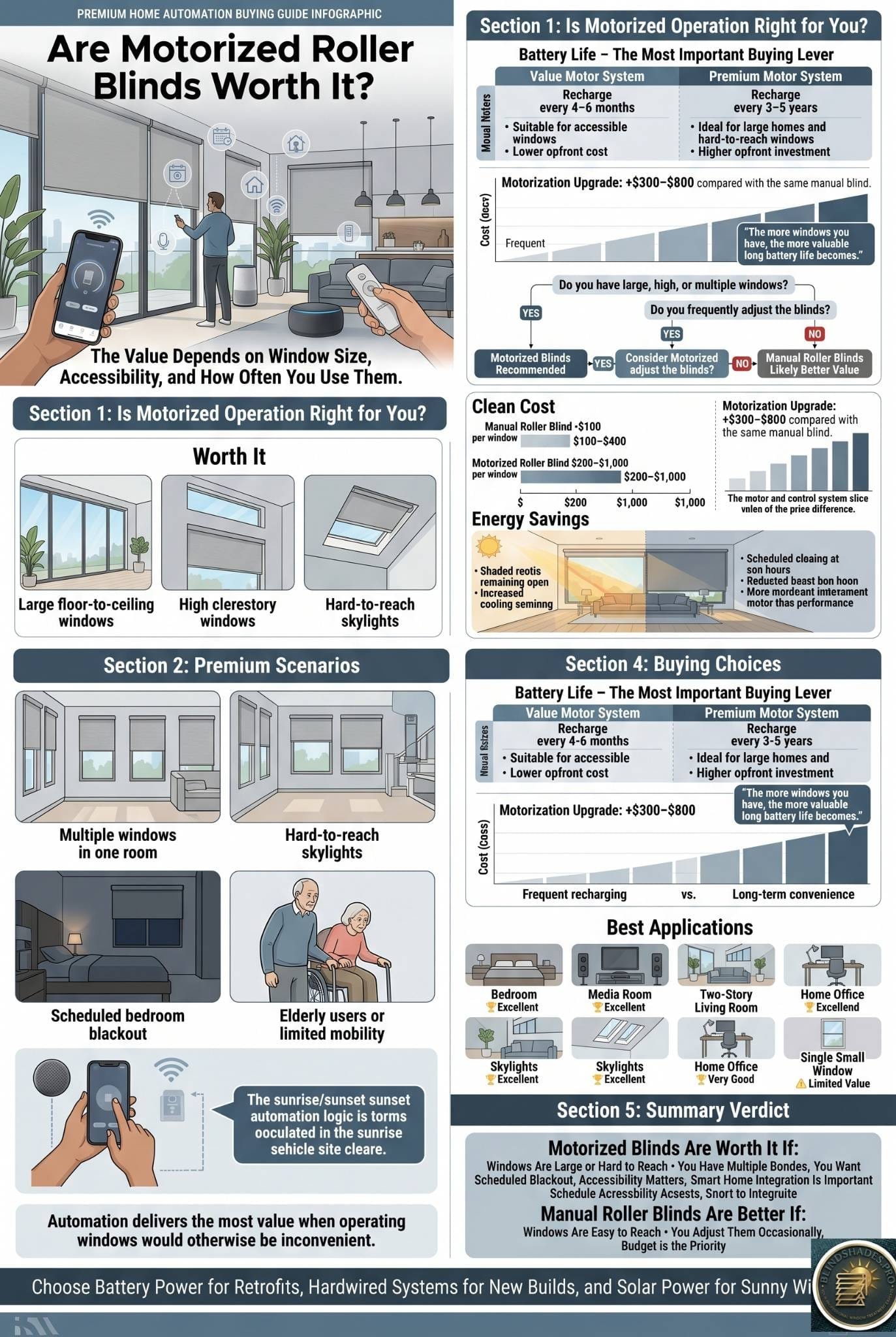
Authored by Michael Turner — 30 Years of Home Improvement Expertise | Updated 2026 | BlindShades.pro
Motorized roller blinds are worth it for the right windows — large, high, hard-to-reach, numerous, or in a bedroom — and over-spending for one or two easily reached windows. Here’s the honest decision framework, the battery economics no one explains, and the real energy story.
Key Takeaways
- Motorized roller blinds are worth it when the window is hard to operate manually or when you will genuinely use the automation, and they are over-spending when they are not. The honest decision is situational, not a blanket yes. They earn their cost on large, high, or hard-to-reach windows, in homes with many windows, in bedrooms that benefit from scheduled blackout, and for anyone with mobility limitations. For one or two easily reached standard windows that you adjust occasionally, a cordless manual lift gives most of the convenience for a fraction of the price.
- The battery-life difference between value and premium motors is the buying lever no one explains. Affordable motors, such as SmartWings, run roughly 4 to 6 months per rechargeable charge; premium systems like Lutron Serena run 3 to 5 years on a battery. If you have many windows or hard-to-reach ones, the premium battery life is the reason to pay more — recharging twenty value motors three times a year is a real chore, while a 3-to-5-year battery is effectively set-and-forget.
- The real energy benefit comes from the shades actually getting used, not from magic insulation. A manual shade left open all day saves nothing; a motorized shade on a schedule automatically closes against the west-facing afternoon sun and reopens later, cutting the solar heat gain that drives cooling load. Savings depend heavily on exposure, climate, fabric, and programming — one Vancouver case study saw a 20% summer cooling drop on west-facing windows — so treat energy as a bonus, not the justification.
- Expect roughly $200 to $1,000 per window, with motorization adding about $300 to $800 over the same manual blind. Battery-powered is the cheapest and most DIY-friendly (components from around $80 to $183 per window), hardwired costs more but never needs charging, and solar sits in between. Smart-home integration adds about $50 to $150 per unit. Quality motors last 10 or more years, so the hardware itself is a long-term purchase.
- Choose the power source by your situation: battery for retrofits and apartments, hardwired for renovations and new builds, solar for sunny windows. Battery systems install without an electrician, which is why they are the practical winner for most existing homes; hardwired is best specified during construction; solar reduces recharging on windows that get good direct sun.
⭐ Quick Answer: Motorized roller blinds are worth it when your windows are large, high, hard to reach, or numerous, when you want scheduled blackout in a bedroom, or when mobility makes manual operation difficult — and they are over-spending for one or two easily reached standard windows you adjust only occasionally.
- Best-fit scenarios: tall or skylight-adjacent windows, banks of three or more windows, scheduled bedroom blackout, and accessibility needs — these are the cases where motorization earns its premium.
- Budget: plan on roughly two hundred to one thousand dollars per window, with motorization adding about three hundred to eight hundred dollars over the same blind in manual form.
- Battery life is the real buying lever: value motors from SmartWings typically recharge every 4 to 6 months, while premium systems like Lutron Serena run 3 to 5 years per charge — the premium pays off across many or hard-to-reach windows.
- Energy honesty: the U.S. Department of Energy ties window-attachment savings to actual operation — a scheduled shade closes against the afternoon sun automatically, where a manual one stays open. For insulation-first rooms, compare the Cellular Shades Buying Guide.
- Power choice: battery for retrofits, hardwired for new builds, solar for sunny windows. For the complete specification, see the Roller Blinds Buying Guide, and for fabric and light-control options the Roller Shades Buying Guide.
Related guides: compare every route and ecosystem in our motorized blinds buying guide.
Are Motorized Roller Blinds Worth It? The Short Answer
Motorized roller blinds are worth it when they solve a real operating problem or when you will genuinely use the automation — and not worth it when they are convenience you will rarely touch. Most buying guides answer this question with an enthusiastic “yes,” but that is the retailer’s answer, not the honest one. The honest answer depends on your windows and your habits.
Here is the test. Ask two questions: Is this window annoying or impossible to operate manually? And will I actually use scheduling, voice, or app control? If the answer to either is a clear yes — a tall stairwell window, a bank of ten windows, a bedroom you want dark on a schedule — motorization earns its cost. If both answers are no — a single living-room window you reach in two steps and adjust twice a day — you are paying several hundred dollars for a remote you will use like a manual pull. The sections below turn that test into a concrete framework.
When Are Motorized Roller Blinds Worth It?
Motorization clearly earns its cost in these situations:
- Large or heavy windows, where a wide, heavy roller is physically hard to raise smoothly by hand — a motor removes the strain and the uneven-rolling that plagues big manual blinds. See best roller blinds for large windows.
- High or hard-to-reach windows — stairwells, clerestory windows, skylights, and anything above furniture. Controlling these from the ground is the single most common reason people are glad they motorized.
- Many windows — once you are operating a dozen or more shades, manual adjustment across the home becomes a daily chore, and one-button or scheduled control of all of them is a genuine quality-of-life upgrade.
- Bedrooms and media rooms — a motorized blackout roller can close on a schedule before bed and open gently at wake time, and pairs naturally with the blackout systems covered in are blackout roller blinds worth it.
- Mobility or accessibility needs — for anyone who finds reaching, pulling, or twisting difficult, motorization is not a luxury but an enabler.
- Child-safety priority — motorized rollers are completely cordless, removing the strangulation hazard of pull cords.
If one or more of these describes your situation, motorized roller blinds are very likely worth it.
When Is Manual the Smarter Choice?
The honest counter, which the sales-driven guides skip: manual is the better value in several common cases.
- One to three easily reached standard windows that you adjust at a normal daily frequency — a cordless manual lift gives you the clean, safe, cordless look without the motor cost.
- Tight budgets, where the $300 to $800 per-window motor premium is better spent elsewhere — and you can often buy a motor-ready blind now and add the motor later.
- Infrequently adjusted windows — a guest room or formal dining room blind you touch once a week does not justify a motor.
- Rentals where you cannot wire, and you do not want to manage battery recharging across several windows.
There is no shame in manual. A quality cordless spring-assist roller is reliable, child-safe, and a fraction of the price; motorization is an upgrade for specific problems, not a requirement.
How Much Do Motorized Roller Blinds Cost?
Expect a single motorized roller blind to land between roughly $200 and $1,000, depending on size, fabric, motor, and control system. The motorization itself adds about $300 to $800 over the same blind in manual form. Here is the breakdown:
| Cost element | Typical range |
|---|---|
| Battery-powered components (per window) | ~$80 – $183 |
| Complete motorized roller (per window) | ~$200 – $1,000 |
| Motorization premium over manual | ~$300 – $800 |
| Hardwired professional install | ~$300 – $1,000 |
| Smart-home hub / integration | +$50 – $150 per unit |
| Quality motor lifespan | 10+ years |
Figures are drawn from AOSKY, Blindster, and Alluring Window’s published ranges. The big swing factors are window size (bigger windows need bigger motors), fabric (blackout and designer fabrics cost more), power source (hardwired adds install cost), and how much smart-home integration you want. Because quality motors last 10 or more years, the hardware is a long-term purchase rather than a recurring cost.
How Long Do the Batteries Last — and Why It Matters?
This is the factor that should drive your motor choice, and almost no guide treats it as a decision lever. Rechargeable battery life varies enormously by the quality and design of the motor:
- Value motors (for example, SmartWings) run roughly 4 to 6 months per charge.
- Premium systems (for example, Lutron Serena) run roughly 3 to 5 years per charge.
That is not a small difference. On one or two windows, recharging every 4 to 6 months is a minor task and a value motor is fine. But across ten or twenty windows, or on hard-to-reach windows where taking the shade down to charge it is a hassle, the premium battery life is the entire reason to pay more — a 3-to-5-year battery is effectively set-and-forget. Battery life also depends on how often you operate the shade and how big and heavy it is, since a large blackout shade draws more power per cycle than a small light-filtering one. If recharging will annoy you, either pay up for long-life motors, choose solar charging on sunny windows, or go hardwired so the question disappears.
Do Motorized Roller Blinds Actually Save Energy?
Yes, but not in the way the marketing implies — and being honest about this matters. Motorized roller blinds do not insulate better than the same manual blind; the fabric is identical. The energy benefit comes from the shades actually getting used. As Alluring Window puts it, a manual shade that stays open all day does nothing, while a motorized shade that automatically lowers during peak sun protects the room and cuts cooling load.
The mechanism is simple: on a schedule or a sun sensor, the shade closes against the west-facing afternoon sun and the east-facing morning sun, reducing the solar heat gain that drives your air conditioning, then reopens when the sun passes. One Vancouver case study reported a 20% drop in summer cooling costs on west-facing windows after installing scheduled motorized blackout rollers. But the real number depends heavily on your exposure, climate, fabric, and how well you program it — a south-facing room in a hot climate with a solar or blackout fabric on a tight schedule will save meaningfully, while a shaded north window will save little. Treat energy savings as a real bonus that helps justify the cost, not as the whole justification.
Battery, Hardwired, or Solar — Which Power Source?
The power source is a practical decision based on your home, not just budget:
- Battery — rechargeable and DIY-friendly, no electrician needed. The practical winner for most existing homes and apartments because you can add it without construction. The trade-off is periodic recharging (see battery life above).
- Hardwired — continuous power, never needs charging, and the cleanest long-term solution, but it requires professional installation and is best specified during a renovation or new build when the walls are open.
- Solar — a small solar panel charges the battery from the window’s own light, minimizing recharging. Ideal for windows that get good direct sun, less effective on shaded or north-facing windows.
For most retrofits, battery is the answer; for new construction, hardwire it; for a bright, sunny window where you would rather not recharge, solar is worth the small premium.
What About Child Safety and Accessibility?
Two benefits that are easy to undervalue until they apply to you. On safety, motorized roller blinds are completely cordless, which removes the pull-cord strangulation hazard that makes corded blinds dangerous in homes with young children — the same reason the ANSI/WCMA A100.1-2018 standard pushes the whole industry toward cordless. On accessibility, motorization turns a physical task into a button press or a voice command, which is genuinely life-improving for anyone with limited mobility, strength, or reach. For these households, “worth it” is not really about cost-benefit at all — it is about independence and safety.
The Bottom Line: A Worth-It Checklist
Motorized roller blinds are worth it if you can tick one or more of these boxes:
- The window is large, high, hard to reach, or there are many of them.
- You want scheduled or automated light and blackout, and you will use it.
- Someone in the home benefits from cordless safety or hands-free accessibility.
- You are building or renovating and can hardwire cleanly.
If none apply, a cordless manual roller gives you most of the look and safety for far less. And if you do motorize, let battery life drive the motor choice: value motors for a few accessible windows, premium long-life or hardwired motors for many or hard-to-reach windows. The full specification, including motor and fabric selection, is in the Roller Blinds Buying Guide.
Frequently Asked Questions
Are motorized roller blinds worth the money?
They are worth it for large, high, hard-to-reach, or numerous windows, for scheduled bedroom blackout, and for accessibility, where they solve a real problem you will use daily. For one or two easily reached standard windows adjusted occasionally, a cordless manual lift gives most of the benefit for a fraction of the roughly $300 to $800 per-window motor premium.
How much do motorized roller blinds cost?
A single motorized roller blind typically costs $200 to $1,000, with the motor adding about $300 to $800 over the same manual blind. Battery components start around $80 to $183 per window, hardwired professional installation runs higher, and smart-home integration adds about $50 to $150 per unit.
How long do motorized roller blind batteries last?
It depends on the motor. Value motors recharge every 4 to 6 months, while premium systems like Lutron Serena last 3 to 5 years per charge. Larger, heavier shades and frequent use drain batteries faster. Solar charging or a hardwired motor removes the recharging task entirely.
Do motorized roller blinds really save energy?
They can, but the savings come from the shades getting used consistently rather than from better insulation. On a schedule, they close against peak sun to cut cooling load and reopen later. Real savings depend on exposure, climate, fabric, and programming, so treat energy as a bonus rather than the main reason to buy.
Are motorized or manual roller blinds better?
Motorized is better for large, high, numerous, or hard-to-reach windows and for automation and accessibility; manual is better for a few easily reached windows, tight budgets, and infrequently adjusted windows. A cordless manual roller is reliable, child-safe, and far cheaper, so motorize only where it solves a real problem.
This article is part of the Roller Blinds Buying Guide cluster on BlindShades.pro. Related: Are blackout roller blinds worth it? · Best roller blinds for large windows · Why won’t my roller blind stay up?
