The Best Motorized & Smart Blinds: Route, Power, and Protocol Before Brand

Authored By Michael Turner -30 Years Home Improvement Expertise | Updated 2026 | BlindShades.pro
Updated on July 12, 2026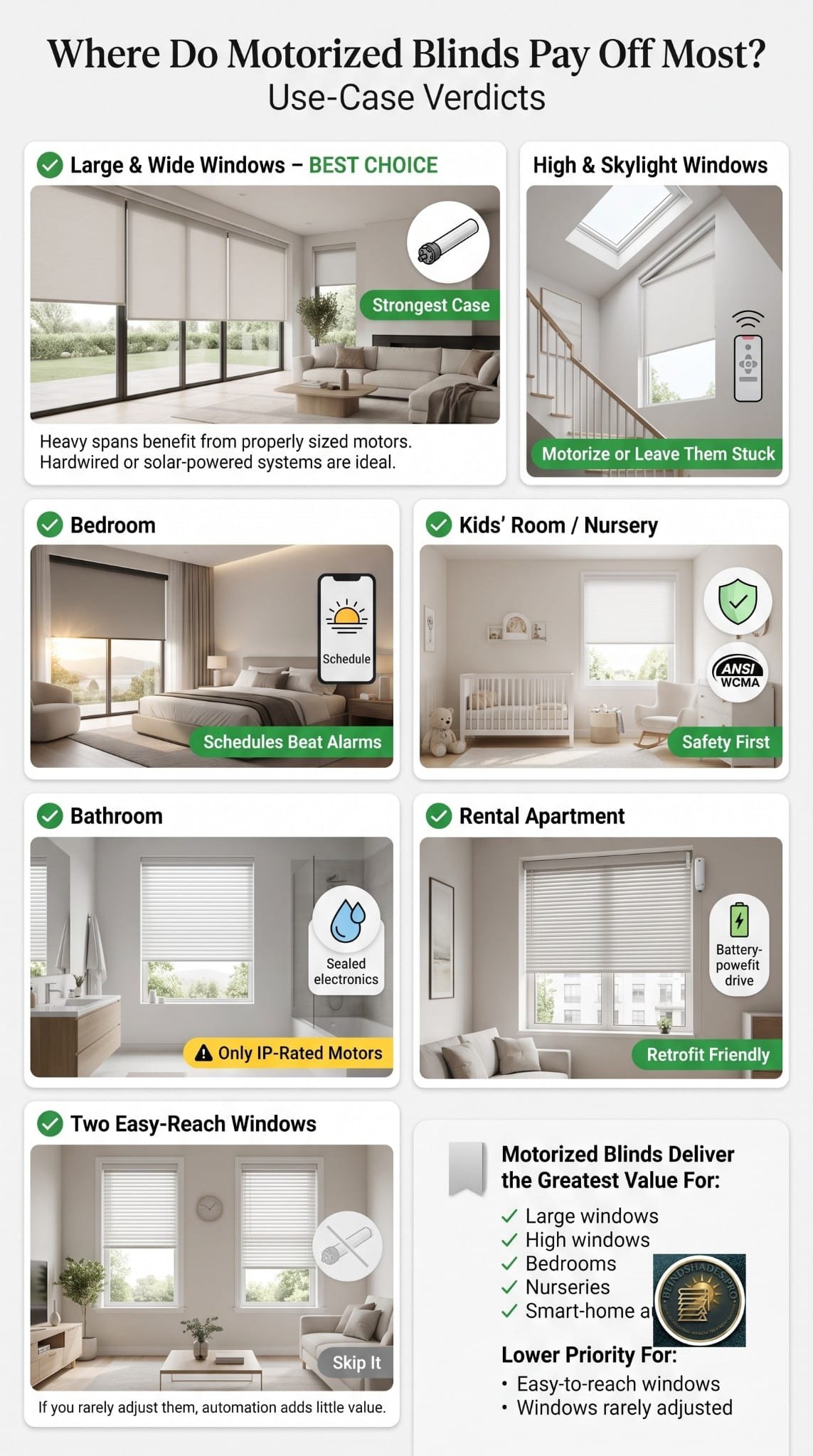
Authored by Michael Turner — 30 Years of Home Improvement Expertise | BlindShades.pro | Complete Buying Guide, Updated for 2026
The best motorized blinds are chosen at three gates, and brand is none of them. Gate one is Route: motorize the blinds you already own with a retrofit device, or replace them with motorized-native shades — the fork that splits the market’s biggest owner thread and that no roundup even acknowledges. Gate two is Power: hardwired, rechargeable, solar-trickle, or plug-in battery — the variable that decides whether year three of ownership is silent convenience or a recharging chore multiplied by every window in the house. Gate three is Protocol: Matter, Thread, Zigbee, plain WiFi, or a dumb remote — which determines whether your blinds join your smart home or just add another app. Answer the three gates and the brand shortlist picks itself; this guide runs you through all three, then gives the verified picks, the honest disadvantages, and the specifier-grade layer for commercial jobs.
⭐ Quick Answer — The Best Motorized & Smart Blinds
The best motorized blinds are chosen at three gates before any brand comparison — Route (retrofit vs replace), Power, and Protocol:
- Top tested picks: SmartWings Motorized Roller (top smart shade) and Lutron Caséta Smart Wood (top smart blind) per the NYT Wirecutter roundup (May 2026); IKEA’s motorized line is the affordability standout in CNET’s testing.
- The retrofit answer: SwitchBot Blind Tilt motorizes the horizontal blinds you already own — the owner-forum route for renters and good-condition blinds; Eve MotionBlinds is the Thread/Matter-native pick for Apple homes.
- Power decides year three: hardwired = zero chores, USB-rechargeable = a per-window charging routine, solar-trickle stays charged on sunny glass (owner reports at SmartWings), plug-in packs need no electrician.
- Where motors pay most: large and heavy spans, skylights and high glass, scheduled bedrooms — the per-format math is in are motorized roller shades worth it and motorized skylight blinds.
- Commercial jobs: low-voltage/PoE power, BMS integration, and the 10-year math in motorized vs manual commercial ROI.
Key Takeaways
- Retrofit is a legitimate first-class answer, not a compromise. In the market’s loudest owner thread, the second-most-voted answer motorized perfectly good existing blinds with a retrofit device instead of replacing them — the right call for renters, good-condition blinds, and anyone testing the water one window at a time.
- Power source decides long-term happiness more than brand. USB-rechargeable motors earn praise until the battery chore multiplies across a whole house; solar-trickle owners report shades that stay charged indefinitely; hardwired and plug-in options trade install effort for zero maintenance. Buy the power plan, not the promo.
- The tested picks are stable across independent reviewers: The New York Times’ Wirecutter (May 2026) names SmartWings’ motorized roller the top smart shade and Lutron Caséta wood blinds the top smart blind, while CNET’s testing crowns IKEA’s motorized line for affordability. Owner forums add SwitchBot for retrofit and Eve MotionBlinds for the Thread-native crowd.
- Motorization is the modern cord-safety gold standard. Under the ANSI/WCMA A100.1 safety standard, motorized and cordless operation is the design answer for homes with children and pets — the quiet second reason this category is growing beyond convenience.
- Smart is optional; the motor is the upgrade. A plain RF-remote motor delivers most of the daily benefit; app scheduling, voice control, and automation are protocol decisions worth making deliberately — not defaults worth paying for twice. And whichever tier you buy, the best motorized blinds put the strongest motor on the heaviest, most-used glass rather than spreading premium hardware across windows nobody adjusts.
Quick Specification Reference
| Spec | The short answer |
|---|---|
| The three gates | Route (retrofit vs replace) → Power (wired / rechargeable / solar / plug-in) → Protocol (Matter-Thread / Zigbee / WiFi / RF) |
| Retrofit option | Devices like SwitchBot Blind Tilt motorize existing horizontal blinds; retrofit roller kits exist for tubes |
| Power options | Hardwired or PoE (zero chores), USB-rechargeable (periodic charging), solar-trickle (self-sustaining on sunny windows), plug-in battery pack (IKEA route — no electrician) |
| Protocols | Matter/Thread (future-proof, HomeKit-friendly), Zigbee/Z-Wave (hub-based, reliable), WiFi (easy, crowded), RF remote only (cheapest, no smart features) |
| Ecosystems served | Alexa, Google Home, Apple Home, SmartThings, Home Assistant — verify per product, not per brand |
| Formats available | Roller, cellular, zebra, wood/faux-wood tilt, roman, vertical, skylight |
| Safety | Motorized/cordless = the ANSI/WCMA A100.1 answer for kids’ rooms |
| Wet rooms | Bathroom installs need IP-rated motors — see the bathroom-safe deep dive |
| Commercial | Low-voltage/PoE power, group control, dry-contact or BMS integration — specifier layer below |
| The honest disadvantages | Up-front cost, battery chores on the wrong power plan, protocol lock-in, motor noise on cheap units |
Read the complete guide below for: the three-gate decision that replaces brand-first shopping; the verified picks and what each won on; the retrofit-versus-replace fork; the Power Ledger showing how each option ages; the protocol matrix; use-case verdicts from large windows to rentals; which formats motorize and what install really involves; and the commercial specifier layer.
What Are the Best Motorized and Smart Blinds? Our Picks
Five verified picks — the best motorized blinds at each gate, not one “best at everything.”
| Pick | Product | Gate it wins | The attributed case |
|---|---|---|---|
| Best Smart Shade | SmartWings Motorized Roller Shades | New-shade route, flexible power | Wirecutter’s top smart-shade recommendation (May 8, 2026); owner-forum favorite for Home Assistant integration, with USB-rechargeable and solar-trickle options praised for staying charged |
| Best Smart Slatted Blind | Lutron Caséta Smart Wood Blinds | New-blind route, premium protocol | Wirecutter’s top smart-blind pick; Lutron’s ecosystem spans roller, wood, and honeycomb with the industry’s most reliable bridge |
| Best Budget New | IKEA Motorized Blinds | New route, plug-in power | CNET’s affordability verdict — extremely affordable for the category — with a plug-in battery-pack design that needs no permanent wiring |
| Best Retrofit | SwitchBot Blind Tilt | Retrofit route | Motorizes the horizontal blinds you already own for the price of a family dinner; the owner-thread retrofit answer made product |
| Best Thread-Native | Eve MotionBlinds (Persilux) | Protocol gate — Matter/Thread | The HomeKit-first pick: Thread-native motors for automation without a proprietary bridge |
Read the table by your gates, not top to bottom: a renter with good blinds starts at SwitchBot; a whole-home smart build starts at Lutron or SmartWings; a single hot bedroom window starts at IKEA. The gates come next.
Retrofit or Replace? The Fork Every Roundup Skips
The market’s own top forum thread splits on this — and it’s the first money decision, not the last.
The 130-comment “which motorized blinds are actually worth the money” thread contains the fork in miniature: the top answer (32 votes) installed new SmartWings shades and praised the USB-rechargeable integration; the second camp’s answer began, in effect, my blinds were in perfectly good condition, so I opted for a retrofit solution. Both were right — for their situations. The decision table:
| Your situation | Route | Why |
|---|---|---|
| Existing blinds in good condition | Retrofit | You’re buying motion, not fabric — a tilt robot or retrofit kit delivers it at a tenth of replacement cost |
| Renter | Retrofit | No-drill devices leave with you; the deposit survives |
| Testing the water | Retrofit one window | Cheapest possible experiment before committing the house |
| Blinds tired, dated, or wrong anyway | Replace | You were buying new treatments regardless — motorized-native adds the motor at its cheapest point |
| Noise, polish, and warranty matter | Replace | Native motors are quieter, hidden in the headrail, and warrantied as one unit |
| Whole-home automation build | Replace (mostly) | Uniform hardware, one protocol, group control — retrofit fleets get messy at scale |
| Skylights, high windows, huge spans | Replace | Retrofit devices don’t reach these; purpose-built motors do — see the skylight and large-window rows below |
The honest failure mode each way: retrofit devices move your blinds with their motor — worn tilt mechanisms and heavy slats strain them, and the result is only as smooth as the blind underneath. Replacement’s failure mode is simpler: paying new-shade money on every window when three windows would have delivered 90 percent of the joy. Start where the thread’s second camp did — one retrofit on the window you adjust most — and let the experiment tell you whether the house deserves the fleet.
The Power Ledger: How Each Option Ages
Nobody regrets a motor in month one. The power plan decides year three.
| Power source | Install day | The ongoing chore | Ages best when | The catch |
|---|---|---|---|---|
| Hardwired / low-voltage | Electrician or new-build wiring | None — ever | New construction, renovations, commercial | The one-time cost and wall-fishing; overkill for two windows |
| USB-rechargeable battery | None — charge and hang | Recharge every few months, per window | One to four windows | Multiply the chore by fifteen windows and the smart home needs a charging calendar |
| Solar-trickle panel | None — small panel sits at the glass | Effectively none on sunny windows | Sun-facing windows; the owner-reported “stays fully charged” path | North-facing and shaded windows starve the panel; the panel is visible |
| Plug-in battery pack / adapter | Plug into a nearby outlet | None | Windows near outlets; the IKEA no-electrician route | A visible cord drop unless you channel it; outlet placement rules the layout |
Two ledger notes the listings won’t volunteer. First, battery count is the real spec: a home with twelve rechargeable shades has signed up for a rolling maintenance job, which is exactly why the solar-trickle owner reports in this SERP read like relief. Second, the quietest-blinds question — a People-Also-Ask with no editorial answer anywhere — is a motor-class property, not a brand secret: premium native motors (the Lutron and Somfy class) run quieter than budget WiFi motors, tube motors run quieter than strained retrofit devices, and any motor gets louder when it’s lifting more weight than its duty cycle wants. If quiet matters — bedrooms, nurseries — buy the better motor class and the lighter fabric, and skip the bargain tube motor whose hum you’ll hear at 6 a.m. daily.
One more ledger column buyers rarely price: reliability over years. Motors are the long-lived part — quality tube motors are rated for many years of daily cycles — while the failure reports in owner forums cluster around three softer points: rechargeable batteries that hold less charge each season (budget for eventual replacement packs on battery fleets), WiFi motors that drop off crowded networks or lean on a cloud service that may not outlive the shade, and pairing quirks after hub or firmware updates. The pattern that ages best is boring on purpose: a well-known motor class, local-first control (Thread, Zigbee, or a proven bridge), and a power plan with no chores. Warranty terms track the same hierarchy — premium native systems carry the longest motor coverage, retrofit gadgets the shortest — so on any window you expect to automate for a decade, read the motor warranty line before the feature list.
Which Protocol? The Matrix That Prevents the Second App
Smart is a language decision — pick the one your house already speaks.
| Protocol | Works with | Strengths | Watch for |
|---|---|---|---|
| Matter / Thread | Apple Home, Google, Alexa, SmartThings | The future-proof answer; local control, no proprietary bridge (Eve MotionBlinds class) | Newest ecosystem — verify the specific product’s Matter support, not the brand’s press release |
| Zigbee / Z-Wave | Hubs (SmartThings, Home Assistant, Hubitat) | Mature, reliable, mesh-networked; the enthusiast default | Needs a hub; pairing quirks vary by motor |
| Proprietary bridge (Lutron Caséta class) | All major ecosystems via the bridge | The reliability gold standard; rock-solid RF | One more hub on the shelf; ecosystem via bridge only |
| WiFi | Alexa, Google, apps | No hub, easy start | Crowded networks, cloud dependence, the second-app problem |
| RF remote only | Nothing smart | Cheapest; zero setup | No schedules, no voice, no automation — the motor without the smart |
The one-question shortcut: what already runs your home? Apple household → Thread/Matter or Lutron’s bridge. Home Assistant tinkerer → Zigbee/Z-Wave or the SmartWings-class motors the community documents well. No smart home and no plans → RF remote, honestly, and bank the difference. The worth-it math per format — where the motor premium pays and where it’s vanity — is worked through per product line in are motorized roller shades worth it, are motorized roller blinds worth it, and cordless vs motorized roman shades.
Where Do Motorized Blinds Pay Off Most? Use-Case Verdicts
The best motorized blinds for each situation — and the windows where the premium is a toy.
| Use case | Verdict | The build |
|---|---|---|
| Large and wide windows (the top related search) | The strongest case in the house | Heavy spans strain arms and cheap springs; tube motors carry weight indifferently — size the motor to the span and prefer hardwired or solar power on the big glass |
| High, awkward, and skylight windows | Motorize or leave them stuck | Purpose-built systems only; the full treatment is in are motorized skylight blinds worth the cost |
| Bedroom | Strong — schedules beat alarms | Sunrise-open automations are the feature owners keep; pair with blackout fabric per are motorized blackout blinds worth it for a bedroom |
| Kids’ rooms and nurseries | Safety case, not luxury | Motorized/cordless is the ANSI/WCMA A100.1 design answer — no reachable cords, ever |
| Bathroom | Only with IP-rated motors | Moisture and electronics need the ratings walkthrough in are motorized blinds safe for a bathroom |
| Rental | Retrofit route | SwitchBot-class devices and tension-mounted motorized shades leave no holes |
| Two easy-reach windows you rarely adjust | Skip it | The honest row: a motor you don’t command weekly is money parked in a headrail |
Which Formats Can Be Motorized — and How Hard Is Install?
Every major format now motorizes — the differences are weight, wet-rooms, and who does the wiring.
Rollers are the native home of the tube motor and the place the best motorized blinds shopping usually starts: the motor hides inside the tube, loads are predictable, and every power option exists. Cellular and zebra shades motorize nearly as cleanly — the owner thread’s top answer ran motorized zebra shades on Home Assistant without drama — with cellular adding its insulation bonus to the automation case. Wood and faux-wood blinds motorize the tilt (the Lutron Caséta wood pattern): slats angle on schedule, though full raise-and-lower on heavy wood spans demands stronger, pricier motors. Verticals and panel tracks motorize the traverse for sliding-door spans, romans motorize their lift with the caveat that fold weight varies wildly by style, and skylights are motorized-or-nothing territory.
Install effort follows power, not format. Battery and plug-in units are genuinely DIY — the same brackets as a manual shade plus a charging or outlet plan, which is exactly the IKEA pitch of no permanent electrical installation. Solar-trickle adds only the panel placement decision. Hardwired and PoE installs are an electrician visit or a new-build rough-in — worth it at whole-home scale, overkill for a bedroom experiment. Measure exactly as you would for the manual version of the same format — the discipline transfers from how to measure for roller blinds unchanged — then add one motorized-only check: confirm the headrail or cassette depth your frame offers fits the motor tube, because motors need a little more room than springs, and shallow colonial frames are the classic surprise. Details on cassette housings are in what is a cassette headrail.
A budgeting word before the specifier layer. The shopping grid in this very search runs from retrofit tilt devices around the cost of a takeout order, through budget motorized-native shades in the low-hundreds class, to custom and premium-ecosystem builds several multiples above — and almost none of that spread is motor quality alone. It’s fabric grade, customization, ecosystem, and power architecture. The corollary cuts both ways: a cheap motor on your most-used window delivers more daily value than a premium motor on a window nobody touches, and a premium ecosystem pays for itself only when the whole house joins it. Sequence the spend like the forum veterans do — one window first, the fleet after the experiment reports back — and put the best motor where the heaviest, highest, most-adjusted glass is, because that’s where motor class actually shows.
For Specifiers: Commercial Motorization Layer
Jump box: power architecture · control integration · duty cycles · standards · RFQ path.
Honest category guidance — precise motor specs always come from the manufacturer cut sheet.
| Parameter | Category guidance |
|---|---|
| Power architecture | Low-voltage DC home-run wiring or PoE shades for new builds; line-voltage where runs are long; battery fleets only for retrofit phases |
| Control integration | Dry-contact, RS-485, or IP/API integration into BMS; residential-grade WiFi motors don’t belong on a facilities network |
| Group and scene control | Zone-by-elevation for solar tracking; verify group latency on the chosen platform before committing floors |
| Duty cycle | Commercial motors are rated for far more daily cycles than residential — match the rating to automated solar-tracking schedules, which cycle shades many times per day |
| Fabric pairing | Motorization pairs naturally with solar fabrics for automated glare control — openness selection per the solar shades guide |
| Compliance item | Relevance |
|---|---|
| ANSI/WCMA A100.1 | The safety standard motorization satisfies by design |
| NFPA 701 | Flame-propagation rating for the fabrics the motors carry |
| UL / ETL listing | Required on motors, drivers, and power supplies |
| CA Title 24 | Automated shading contributes to daylighting and energy compliance strategies |
| CSI MasterFormat | 12 24 13 (roller shades) with motorized operation specified; coordinate with Division 26 for power |
The 10-year cost comparison against manual operation — including the maintenance and productivity lines facilities managers actually budget — is built out in motorized vs manual commercial blinds ROI, and the decision memo version in is motorized window treatment worth it for a commercial office.
Supporting Articles in This Cluster
- Are Motorized Roller Shades Worth It
- Are Motorized Roller Blinds Worth It
- Are Motorized Blackout Blinds Worth It for a Bedroom
- Motorized vs Manual Commercial Blinds — The 10-Year ROI
- Is Motorized Window Treatment Worth It for a Commercial Office
- Are Motorized Skylight Blinds Worth the Cost
- Are Motorized Blinds Safe for a Bathroom — IP Ratings
- Cordless vs Motorized Roman Shades
- What Is a Cassette Headrail
Related Buying Guides
- The Best Blackout Blinds & Shades Buying Guide
- The Best Solar Shades Buying Guide
- The Best Roller Shades Buying Guide
- The Best Office & Commercial Blinds Buying Guide
- The Best Skylight Blinds & Shades Buying Guide
Frequently Asked Questions
Are motorized blinds really worth it?
For the right windows, decisively — the best motorized blinds pay off on: large and heavy spans that strain arms, high and skylight glass nothing else reaches, bedrooms where sunrise schedules replace alarms, and any child’s room, where motorized or cordless operation is the ANSI/WCMA A100.1 safety answer. For two easy-reach windows you rarely adjust, honestly no — a motor you don’t command weekly is parked money. The per-format math lives in our worth-it series for rollers, romans, and blackout bedrooms.
How much do motorized blinds cost on average?
The category runs from retrofit devices at the price of a family dinner, through budget motorized-native lines — CNET’s testing highlights IKEA’s as extremely affordable for the category — to custom smart shades and premium ecosystems like Lutron quoted per window and rising with size, fabric, and power choices. The honest budgeting rule: price the power plan and window count, not the single-shade sticker — twelve rechargeable shades cost less up front and more in attention than six hardwired ones.
What are the disadvantages of motorized blinds?
Four honest ones. Up-front cost multiplies across windows faster than expected. The wrong power plan ages badly — rechargeable fleets become a recurring chore, which is why solar-trickle and wired options exist. Protocol lock-in is real: a WiFi motor that only speaks its own app adds clutter, not automation. And budget motors hum — noise is a motor-class property, so the cheapest tube motor in a bedroom is a purchase you’ll hear every morning.
What are the quietest motorized blinds?
Quiet tracks motor class, not marketing. Premium native motors — the Lutron and Somfy tier — run noticeably quieter than budget WiFi tube motors; purpose-built motors run quieter than retrofit devices straining someone else’s mechanism; and every motor gets louder as load rises, so oversized spans on undersized motors hum worst. For bedrooms and nurseries: better motor class, lighter fabric, correctly sized tube — and read owner noise reports for the specific model, because decibel claims are rarely published.
Can I motorize the blinds I already have?
Often, yes — that’s the retrofit route. Tilt robots like SwitchBot’s motorize the wand action of existing horizontal blinds, and retrofit kits exist for roller tubes; renters and owners of good-condition blinds get most of the daily benefit at a fraction of replacement cost. The limits: the result is only as smooth as the blind underneath, heavy or worn mechanisms strain the devices, and skylights or large spans need purpose-built motors.
Do smart blinds work with Alexa, Google Home, and Apple Home?
Ecosystem support is decided per product line, not per brand — verify before buying. The reliable patterns: Matter/Thread-native motors (the Eve class) speak to all major ecosystems including Apple Home; Lutron’s bridge covers everything with the category’s best reliability record; SmartWings and similar custom brands list per-model support for Alexa, Google, SmartThings, and Home Assistant. WiFi-only budget motors usually cover Alexa and Google but check Apple support specifically — it’s the one most often missing.
