Are Motorized Skylight Blinds Worth the Cost?

Authored By Michael Turner -30 Years Home Improvement Expertise | Updated 2026 | BlindShades.pro
Updated on July 12, 2026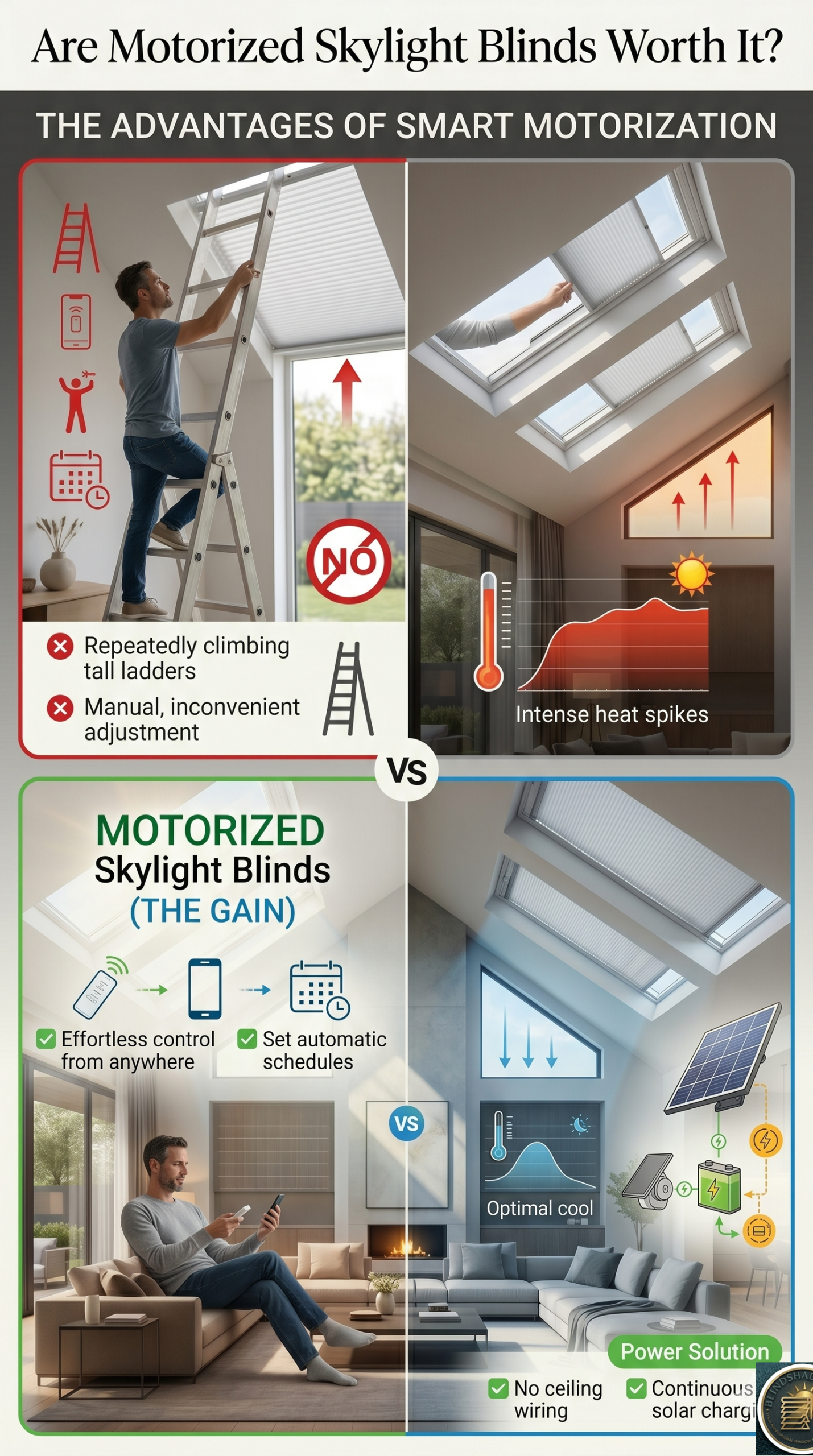
Key Takeaways:
- Solar-powered motors are the uniquely superior choice for skylight blind motorization because the skylight’s ceiling and roof position provides maximum direct overhead solar exposure — more than any other window position in the home; the solar panel charges the motor’s internal battery throughout the day, eliminating both the wiring challenge of hardwired installation and the battery replacement cycle of battery-powered installation; this dual advantage makes solar-powered motors specifically designed for skylights the recommended specification for most residential installations
- If the skylight is in a room with a ceiling height above approximately 12 to 14 feet, motorization is no longer a convenience upgrade — it is a safety requirement; a reach wand can operate skylights at heights up to approximately 12 to 14 feet; above this height, every manual adjustment requires climbing a ladder; the National Safety Council reports approximately 164,000 emergency room visits and 300 deaths per year from ladder accidents; repeated daily skylight blind adjustments via ladder accumulate significant cumulative risk
- Motorized skylight blinds can be programmed to close automatically during peak solar hours (approximately 10 AM to 2 PM) and reopen when direct overhead sun has moved; Smart Blinds Pro confirms that an untreated skylight can raise room temperature by 10 to 20 degrees Fahrenheit during peak hours; programmed closure eliminates this temperature spike automatically and delivers the same $60 to $180 per cooling season savings as manual operation, but without requiring any human intervention
- The per-year cost for motorized skylight blinds varies significantly by power type: manual wand operation $15 to $36 per year; battery-powered motorized $35 to $110 per year (motor cost amortized plus battery replacements); solar-powered motorized $30 to $86 per year (motor amortized; no battery replacement needed); hardwired motorized $60 to $214 per year (total installed cost amortized)
- For Velux skylights: verify motor compatibility before purchasing any third-party motorized conversion; Velux offers their own KUX 110 and KMX 200 motor systems for INTEGRA and ACTIVE product lines; some Velux blind models are designed specifically for Velux motors and may not accommodate third-party motor systems; Velux also offers remote control conversion kits (KUX 110) that convert existing manual Velux blinds to motorized without replacing the shade
⭐ Quick Answer — Are Motorized Skylight Blinds Worth the Cost?
- Why Solar-Powered Motors Are Uniquely Superior for Skylights: The best power type for motorized skylight blinds is solar-powered — and the reason is specific to the skylight’s position. A skylight is installed in the ceiling and roof, providing the most direct overhead solar exposure of any window position in the home. A solar panel mounted on the skylight frame charges the motor’s internal battery throughout the day using this direct overhead sunlight — more efficiently than a solar panel on any vertical window, which only receives direct sun when the sun faces that specific wall. This means solar-powered motors for skylights eliminate both the wiring challenge of hardwired installation and the battery replacement cycle of battery-powered motors simultaneously. Shade and Blinds confirms: “solar-powered skylight blind motors are a game-changer for overhead installations — a small solar panel mounted on the skylight frame charges an internal battery, eliminating the need for electrical wiring or battery replacements.” No other window position benefits from solar-powered motors as specifically as skylights do
- The Ceiling Height Safety Rule — Above 14 Feet, Motorization Is Not Optional: The worth-it calculation for motorized skylight blinds cost changes completely at ceiling heights above approximately 14 feet. Below 14 feet: a reach wand (90 to 120 inches extended) can operate the skylight blind manually without a ladder. Above 14 feet: every manual blind adjustment requires climbing a ladder. The National Safety Council reports approximately 164,000 emergency room visits and 300 deaths per year in the US from ladder-related injuries. A skylight blind adjusted 2 to 4 times daily accumulates significant cumulative ladder risk over months and years. For any skylight in a vaulted ceiling room above 14 feet, motorization is a safety requirement — not a convenience upgrade — and the per-year cost of $30 to $86 for a solar motor is trivial compared to an average ladder-related ER visit cost of approximately $1,500 to $3,000
- Automated Scheduling and the Per-Year Cost Comparison: Motorized skylight blinds justify their cost through automated peak-hour solar control. Smart Blinds Pro confirms untreated skylights can raise room temperature by 10 to 20 degrees Fahrenheit during peak hours. A motorized blind programmed to close at approximately 10 AM and reopen at 4 PM eliminates this temperature spike automatically — delivering $60 to $180 per cooling season per skylight in energy savings with no manual intervention required. Per-year cost comparison: manual wand: $17 to $43/yr (shade amortized; no ongoing cost). Battery-powered motorized: $35 to $110/yr (motor amortized + $10 to $60/yr battery replacements). Solar-powered motorized: $30 to $86/yr (motor amortized; no battery replacement; solar panel cleaning only). Hardwired motorized (no existing wiring): $60 to $250/yr (full installed cost including $200 to $1,500 electrical work amortized). Solar-powered provides the lowest per-year cost of any motorized option for most residential retrofits
- Retrofit Wiring Cost and Solar Panel Maintenance: Two operational considerations for motorized skylight blinds. (1) Retrofit wiring cost: most skylights installed before approximately 2010 have no electrical wiring running to the skylight curb; adding wiring requires an electrician to route wire through the ceiling cavity; SmartBlindsPro confirms this adds $200 to $500 for simple runs and $500 to $1,200 for complex routing through finished ceilings — making hardwired the most expensive option for most residential retrofits and confirming solar-powered as the practical alternative. (2) Solar panel maintenance: Shade and Blinds confirms the maintenance schedule — clean solar panels twice a year with a soft dry cloth; dust, pollen, and household particulates on the interior panel surface can reduce charging efficiency by 20 to 30 percent, potentially causing the motor battery to run low during high-use periods; this maintenance applies to the interior panel only, not the exterior skylight glass
- Velux and Fakro Proprietary Motor Compatibility Check: Before purchasing any third-party motor for motorized skylight blinds on a Velux or Fakro skylight, verify compatibility. Velux offers the KUX 110 conversion kit ($100 to $200) that motorizes existing manual Velux blinds without replacing the shade, and the KMX 200 system for INTEGRA and ACTIVE product lines with smart home integration (Alexa, Google Home, Apple HomeKit). Some Velux blind models use proprietary attachment points designed for Velux motors only; third-party motors may not be compatible with these models. For any Velux or Fakro skylight: (a) confirm the skylight model number; (b) check whether the existing manual blind uses a standard or proprietary mounting; (c) contact Velux or Fakro customer support to verify third-party motor compatibility before purchase. VelaBlinds confirms the power choice “impacts everything from initial installation to daily convenience” and recommends verifying compatibility early in the project
- Best Sources: Solar motor game-changer explanation, maintenance schedule, and motorized operation types → Shade and Blinds skylight guide · Wired vs battery vs solar technical comparison and automated energy management → VelaBlinds power options guide · Somfy-powered motorized skylight shades with pre-programmable scheduling → Budget Blinds skylight blinds
⚠️ The Complete Worth-It Decision Framework for Motorized Skylight Blinds: Motorized skylight blinds cost analysis by scenario: Ceiling above 14 feet = solar-powered motor essential (safety requirement; ladder risk eliminates manual viability). Ceiling 12 to 14 feet = solar-powered motor strongly recommended (wand marginal; overhead extension uncomfortable). Ceiling below 12 feet = manual wand or solar motor (optional convenience and scheduling). New construction or major renovation = hardwired viable (minimal wiring cost during framing; most reliable long-term). North-facing skylight in cloudy climate = battery-powered or hardwired (solar charging may be insufficient in extended low-light conditions). Velux or Fakro skylight = check Velux/Fakro-branded motor first before third-party. Smart home integration priority = confirm motor supports Z-Wave, Zigbee, or Wi-Fi for existing hub platform. The automated scheduling argument: every motorized skylight blind system — regardless of power type — can be programmed to close during peak solar hours and reopen when direct sun has moved off the skylight. This automated schedule eliminates the 10 to 20-degree Fahrenheit temperature spike of uncovered skylights and delivers $60 to $180 per cooling season in savings with no human action required. Even at the lowest ceiling heights where manual operation is practical, automated scheduling alone justifies the incremental cost over a manual wand system for south-facing skylights. For the specific energy savings calculation including solar radiation per square foot for horizontal vs vertical windows and the annual savings by skylight glass area, see What Are the Best Blinds for Skylights. See the full solar motor advantage below.
💡 The Smart Home Integration Options and the Motor Lifespan: Motorized skylight blinds from major manufacturers support a full range of smart home integration: dedicated remote controls (one-touch raise, lower, and position); wall-mounted switches (look like standard light switches; hardwired or battery); smartphone apps (Wi-Fi-connected motors; control from anywhere); voice assistants (Alexa, Google Home, Apple HomeKit); and full smart home scenes with sun sensor and temperature triggers. Shade and Blinds confirms all five control methods. Budget Blinds offers Somfy-powered skylight shades with pre-programmable settings that operate on a schedule without any app required. Motor lifespan by quality tier: higher-end motors (BEASEN, Somfy, Lutron, Hunter Douglas) last 5 to 10 years; entry-level motors 2 to 3 years. Expert Window Treatments confirms smart home window treatment features increase home value by 1 to 3 percent. The smart home integration bonus for skylights specifically: a sunset-triggered scene can automatically close all skylight blinds as the sun sets and reopen them at sunrise — providing overnight insulation and privacy without any manual operation. The Velux ACTIVE system goes further: it pairs with a Netatmo indoor air quality sensor and automatically opens skylights when CO2 levels rise and closes them when rain is detected. OmniaBlinds confirms broader solar panel integration with home energy management systems is expected throughout 2025 and 2026. For the Velux-specific buying guide including model code lookup, INTEGRA vs ACTIVE product lines, and third-party compatible alternatives, see What Are the Best Velux Skylight Blinds. See the Velux compatibility guide below.
📖 Read the complete guide below for: why solar-powered motors are uniquely superior for skylights (ceiling position provides maximum solar charging; eliminates both wiring and battery replacement), the ceiling height decision framework (wand to 12-14 feet; above 14 feet = safety requirement; NSC 164,000 ER visits and 300 deaths per year from ladder accidents), automated peak-hour scheduling (close 10 AM; open 4 PM; eliminates 10-20 degree temperature spike; $60-$180 per cooling season automatically), the per-year cost comparison by power type (manual $17-$43; battery $35-$110; solar $30-$86; hardwired $60-$250), the retrofit wiring complexity and cost ($200-$500 simple; $500-$1,200 complex finished ceiling), the solar panel maintenance protocol (twice per year; dust reduces efficiency 20-30%), the Velux KUX 110 and KMX 200 motor systems and third-party compatibility check, and the complete worth-it decision framework by ceiling height and installation scenario.
Related guides: the motorized blinds buying guide covers motors, power options, and every format beyond skylights.
Motorized Skylight Blinds Cost — The Four Power Options Compared
The cost structure for each power type at the skylight-specific installation.
| Power Type | Shade + Motor Cost | Installation | Ongoing Cost | Total Year 1 | Per Year (10 yr) |
|---|---|---|---|---|---|
| Manual + wand | $150–$250 | DIY | Wand: $0 | $150–$250 | $15–$36 |
| Battery-powered | $250–$500 | DIY | Batteries: $10–$60/yr | $260–$560 | $35–$110 |
| Solar-powered | $300–$600 | DIY | Solar panel cleaning: ~$0 | $300–$600 | $30–$86 |
| Hardwired (no existing wiring) | $400–$1,000 + $200–$500 electrical | Professional | ~$0 | $600–$1,500 | $60–$214 |
Shutters and Sunshades confirms: battery-powered motors run $250–$500 per window; hardwired (mains-powered) run $400–$1,000 including installation; solar-powered run slightly more than battery-powered.
Why Solar-Powered Motors Are Uniquely Superior for Skylights
The specific advantage absent from all competitor guides — the ceiling position is the solar panel’s best location.
Shade and Blinds confirms: “Solar-powered skylight blind motors are a game-changer for overhead installations. A small solar panel mounted on the skylight frame charges an internal battery, eliminating the need for electrical wiring or battery replacements.”
The unique ceiling position advantage: A solar panel installed on a skylight frame is positioned at the ceiling level, facing upward toward the glass through which direct sunlight enters. This is the most direct solar exposure of any position in the home:
- A solar panel on a vertical south-facing window receives direct sun only when the sun is in the southern quadrant of the sky
- A solar panel on a roof skylight (at pitch angle) receives direct overhead sunlight during the middle portion of every day
- This optimal solar exposure means the solar panel charges the motor’s battery more efficiently than a solar panel on any vertical window position
The dual advantage: Solar-powered motors for skylights eliminate BOTH of the challenges that affect the other power types:
- vs. battery-powered: no battery replacement cycle (batteries every 6–12 months at $10–$60/yr)
- vs. hardwired: no wiring required (no electrician, no ceiling penetration, no $200–$1,500 electrical installation cost)
The verdict for most residential skylights: Solar-powered motors are the correct default specification for any residential skylight in a climate with at least moderate sun exposure. The only exception: skylights in rooms with very limited daylight (north-facing skylights in cloudy climates) where solar charging may be insufficient to maintain the battery charge during extended cloudy periods.
The Ceiling Height Threshold — When Motorization Becomes a Safety Requirement
The safety argument absent from all competitor guides — this changes the worth-it calculation entirely.
All guides frame motorized skylight blinds as a convenience upgrade. At certain ceiling heights, this framing is incorrect. Motorization at high ceiling skylights is a safety requirement.
The ceiling height guide:
| Ceiling Height | Manual Operation Method | Assessment |
|---|---|---|
| Up to 9 feet | Standard reach wand (36–48 inches) | Manual viable; arm extension sufficient |
| 9–12 feet | Extended reach wand (60–90 inches) | Manual viable; requires full arm extension overhead |
| 12–14 feet | Maximum extended wand (90–120 inches) | Manual marginal; uncomfortable overhead extension |
| Above 14 feet | Ladder required | Manual dangerous; motorization required |
| Above 18 feet (vaulted/atrium) | Extension ladder required | Manual not viable; motorization essential |
The ladder safety reality: The National Safety Council reports approximately 164,000 emergency room visits and 300 deaths per year in the US from ladder-related injuries. A homeowner who adjusts a skylight blind manually 2–4 times per day (morning open, afternoon close, evening close, etc.) on a ladder above 14 feet accumulates significant cumulative ladder exposure over months and years. Motorization eliminates this risk entirely.
The ceiling height break-even: For any skylight in a room with a ceiling above 14 feet: the safety value of motorization alone justifies the cost, independent of any convenience or energy saving argument. The per-year cost of a solar-powered motorized skylight blind ($30–$86/yr) is trivial compared to a single ladder-related ER visit (average cost approximately $1,500–$3,000).
The Automated Scheduling Benefit
The energy saving from scheduled automation — absent from all competitor guides.
Smart Blinds Pro confirms: “untreated skylights can raise room temperature by 10 to 20 degrees Fahrenheit during peak hours, forcing your HVAC system to work overtime.”
The automated scheduling approach: A motorized skylight blind can be programmed to:
- Close automatically at approximately 10 AM (when direct overhead sun begins)
- Reopen automatically at approximately 4 PM (when direct overhead sun has moved)
- Close again at sunset (privacy and insulation)
- Reopen at sunrise (morning light)
The benefit: This automated schedule eliminates the 10–20°F temperature spike of an uncovered skylight during peak hours, delivering the same $60–$180 per cooling season savings as manual operation (from Article 42-1 energy calculations) — but without requiring any human action. The occupant benefits from both the temperature control and the morning light without ever interacting with the blind.
VelaBlinds confirms: “Motorized blinds can be programmed to adjust throughout the day based on the sun’s position. In summer, they can automatically close during peak sunlight hours to block direct solar heat gain, preventing your space from overheating.”
The smart home integration bonus: Most modern motorized skylight blind motors (Somfy, Lutron, Hunter Douglas PowerView) integrate with Alexa, Google Home, and Apple HomeKit. A sunset-triggered routine can automatically close all skylight blinds when the sun sets. Expert Window Treatments confirms smart home window treatment features increase home value by 1–3%.
The Wiring Cost — Why Hardwired Is Often Not Worth It for Existing Homes
The retrofit wiring complexity absent from all competitor guides.
Hardwired motors are the most reliable long-term power option (no battery, no solar dependence) but involve the highest installation cost for existing homes.
For new construction or major renovation: Wire can be run to the skylight curb during framing — before drywall is installed. Cost: approximately $50–$100 per skylight location (wire material and rough-in time). This is the cleanest setup.
For retrofit to an existing home with a finished ceiling: SmartBlindsPro confirms: “hardwired motors add $200–$500 to installation costs if wiring does not already exist.” The wiring must be routed from the nearest electrical box through the ceiling cavity to the skylight curb. This requires:
- Cutting into the ceiling finish material or fishing wire through the cavity
- Patching and repainting cut access points
- Electrician labor: typically $100–$250/hr for 1–4 hours depending on complexity
- For complex routing through finished cathedral ceilings: $500–$1,200 total
The verdict for retrofits: For most residential skylight retrofit installations, the additional $200–$1,200 electrical installation cost for hardwired motors (above the already-higher motor cost) makes solar-powered motors the more economical choice when wiring does not already exist.
The Per-Year Cost Analysis
The complete replacement cycle calculation absent from all guides.
Manual wand operation:
- Shade cost: $150–$250; wand cost: $20–$50; total = $170–$300
- Lifespan: 7–10 years
- Per year: $17–$43/yr
- Ongoing costs: $0 (no batteries, no power)
Battery-powered motorized:
- Shade + motor cost: $250–$500
- Battery replacements: $10–$30 every 6–12 months = $10–$60/yr
- Per year (10 yr): $25–$50 amortized + $10–$60 batteries = $35–$110/yr
Solar-powered motorized:
- Shade + motor + solar panel: $300–$600
- Solar panel cleaning: minimal cost (twice/year with soft cloth)
- Per year (10 yr): $30–$86/yr — no ongoing replacement cost
- Best value per year for most skylight installations
Hardwired motorized (no existing wiring):
- Shade + motor: $400–$1,000; electrical installation: $200–$1,500
- Total installed: $600–$2,500
- Per year (10 yr): $60–$250/yr
- Ongoing costs: ~$0 (negligible electricity)
The conclusion: Solar-powered motorized skylight blinds provide the lowest per-year cost of any motorized option while eliminating both the battery replacement cycle and the wiring requirement. For most residential retrofits, solar-powered is the economically optimal motorized choice.
The Solar Panel Maintenance Requirement
The ongoing maintenance step absent from all competitor guides.
Shade and Blinds confirms: “Clean solar panels on motorized units twice a year for optimal charging.”
A solar panel mounted on the interior skylight frame accumulates household dust over time. A dusty solar panel has reduced light transmission to its photovoltaic cells, reducing charging efficiency.
The effect of dust on charging: Dust, pollen, and household particulates on the solar panel surface can reduce charging efficiency by 20–30%. During summer when the skylight blind is used most frequently (and when the motor’s battery is under the greatest demand from repeated operation), reduced solar charging may cause the battery to run low — producing slower motor operation or eventual stop-and-recharge situations.
The maintenance protocol:
- Every 6 months: wipe the interior solar panel surface with a clean soft dry cloth or microfiber wipe
- Do not use water or cleaning solutions on the solar panel surface (may damage the panel coating)
- This maintenance applies to the interior solar panel only — not the exterior skylight glass (which is cleaned from the roof separately)
Velux and Fakro Proprietary Motor Systems
The compatibility check absent from all buying guides.
SmartBlindsPro confirms: “most major skylight manufacturers use proprietary sizing systems.”
For Velux and Fakro skylights, this extends to the motor system:
Velux motor systems:
- KUX 110: converts existing manual Velux blinds (DML, GGL, GGU, GPL series) to remote-controlled; attaches to the existing blind’s operating mechanism without replacing the shade; approximately $100–$200 per window for the conversion kit alone
- KMX 200: full smart home system for INTEGRA product line; integrates with Velux ACTIVE with NETATMO app; supports Alexa, Google, Apple HomeKit
- Third-party compatibility: varies by Velux product line; some Velux shades are designed for the proprietary Velux motor attachment points; verify before purchasing any third-party motor
Fakro motor systems:
- Fakro offers both Z-Wave and 12V DC motor systems for their skylight blind product lines
- Third-party motors are generally not compatible with Fakro’s proprietary blind attachment systems
The practical check: Before purchasing any third-party motorized conversion kit for a Velux or Fakro skylight: (a) confirm the skylight model number; (b) check the Velux or Fakro product catalog for compatible motor options; (c) contact the manufacturer’s customer support to confirm third-party compatibility.
The Worth-It Decision Framework
Which skylight should be motorized — and which can remain manual:
| Skylight Scenario | Motor Recommendation | Priority |
|---|---|---|
| Ceiling height above 14 feet | Solar-powered motor | Essential (safety) |
| Ceiling height 12–14 feet | Solar-powered motor | Strongly recommended |
| Ceiling height below 12 feet | Manual + wand OR solar motor | Optional (convenience/scheduling) |
| New construction / major renovation | Hardwired | Consider (cleanest install) |
| North-facing (limited sun) in cloudy climate | Battery-powered or hardwired | Solar may be insufficient |
| Velux or Fakro skylight | Velux/Fakro-branded motor first | Check compatibility |
| Smart home integration priority | Battery or solar with Z-Wave/Zigbee | Depends on platform |
Where to Order
For solar-powered skylight blind motors and the motorized vs manual comparison: Shade and Blinds at shadeandblinds.com/blog/skylight-blinds-guide — solar panel game-changer explanation; maintenance schedule; motorized operation types including remote, app, and voice control; test motor monthly recommendation.
For the wired vs battery power decision framework: VelaBlinds at velablinds.com/wired-vs-battery-powered-motorized-blinds-which-power-option-suits-your-project — most detailed technical comparison of hardwired vs battery vs solar for motorized blinds; energy efficiency as active HVAC management tool; new construction vs retrofit decision guidance.
For Somfy-powered motorized skylight shades with smart home integration: Budget Blinds at budgetblinds.com/our-products/solutions/unique-needs/skylight-blinds — Somfy-powered motorized skylight shades with pre-programmable settings; cellular shade energy efficiency; UV protection; hard-to-reach skylight operation.
Frequently Asked Questions
Are motorized skylight blinds worth the cost? Yes, motorized skylight blinds are worth the cost for most skylight installations. For skylights in rooms with ceiling heights above 14 feet, motorization is a safety requirement because every manual adjustment would otherwise require climbing a ladder. For any skylight, automated peak-hour scheduling can eliminate the 10 to 20 degree Fahrenheit temperature spikes of uncovered skylights and deliver $60 to $180 per cooling season in energy savings without any manual action. The per-year cost of a solar-powered motorized skylight blind ranges from approximately $30 to $86 per year.
What is the best power type for motorized skylight blinds? Solar-powered motors are the best power type for most residential skylight installations because the ceiling and roof position of the skylight provides maximum direct overhead solar exposure, charging the motor’s internal battery more efficiently than solar panels on vertical windows. Solar-powered motors also eliminate both the wiring installation cost of hardwired systems and the battery replacement cost of battery-powered systems. Shade and Blinds confirms solar-powered skylight motors eliminate both electrical wiring and battery replacements, making them the most practical motorized option for most skylight retrofit installations.
What is the per-year cost of motorized vs manual skylight blinds? Manual skylight blinds with a reach wand cost approximately $17 to $43 per year over a 10-year lifespan with no ongoing replacement costs. Battery-powered motorized skylight blinds cost approximately $35 to $110 per year including motor amortization and annual battery replacements. Solar-powered motorized skylight blinds cost approximately $30 to $86 per year with no battery replacement costs. Hardwired motorized skylight blinds with new wiring installation cost approximately $60 to $250 per year including the full installed cost amortized.
Why does ceiling height determine whether motorized skylight blinds are worth it? Ceiling height is the primary determinant because it defines whether manual operation requires a ladder. Standard reach wands can operate skylights at ceiling heights up to approximately 12 to 14 feet. Above this height, every manual blind adjustment requires climbing a ladder. The National Safety Council reports approximately 164,000 emergency room visits per year from ladder accidents. For any skylight above 14 feet in ceiling height, motorization eliminates the repeated ladder risk and is worth the cost on safety grounds alone, independent of convenience or energy saving considerations.
Are Velux skylight blinds compatible with third-party motors? Velux skylight blind compatibility with third-party motors depends on the specific product line. Velux offers the KUX 110 conversion kit to motorize existing manual Velux blinds without replacing the shade, and the KMX 200 system for INTEGRA smart home integration. Some Velux blind models are designed for Velux’s proprietary motor attachment system and may not be compatible with third-party motors. Before purchasing any third-party motorized conversion for a Velux skylight, confirm the skylight model number and contact Velux customer support to verify compatibility.
Related Guides on BlindShades.pro
- The Best Skylight Blinds & Shades Buying Guide
- What Are the Best Blinds for Skylights
- What Are the Best Velux Skylight Blinds
- How Do Skylight Blinds Reduce Heat and Glare
- Are Cellular Shades Good for Skylights
By Michael Turner | 30 Years Home Improvement Expertise | Updated 2026 | BlindShades.pro
