How Do Skylight Blinds Reduce Heat and Glare?

Authored By Michael Turner -30 Years Home Improvement Expertise | Updated 2026 | BlindShades.pro
Updated on June 6, 2026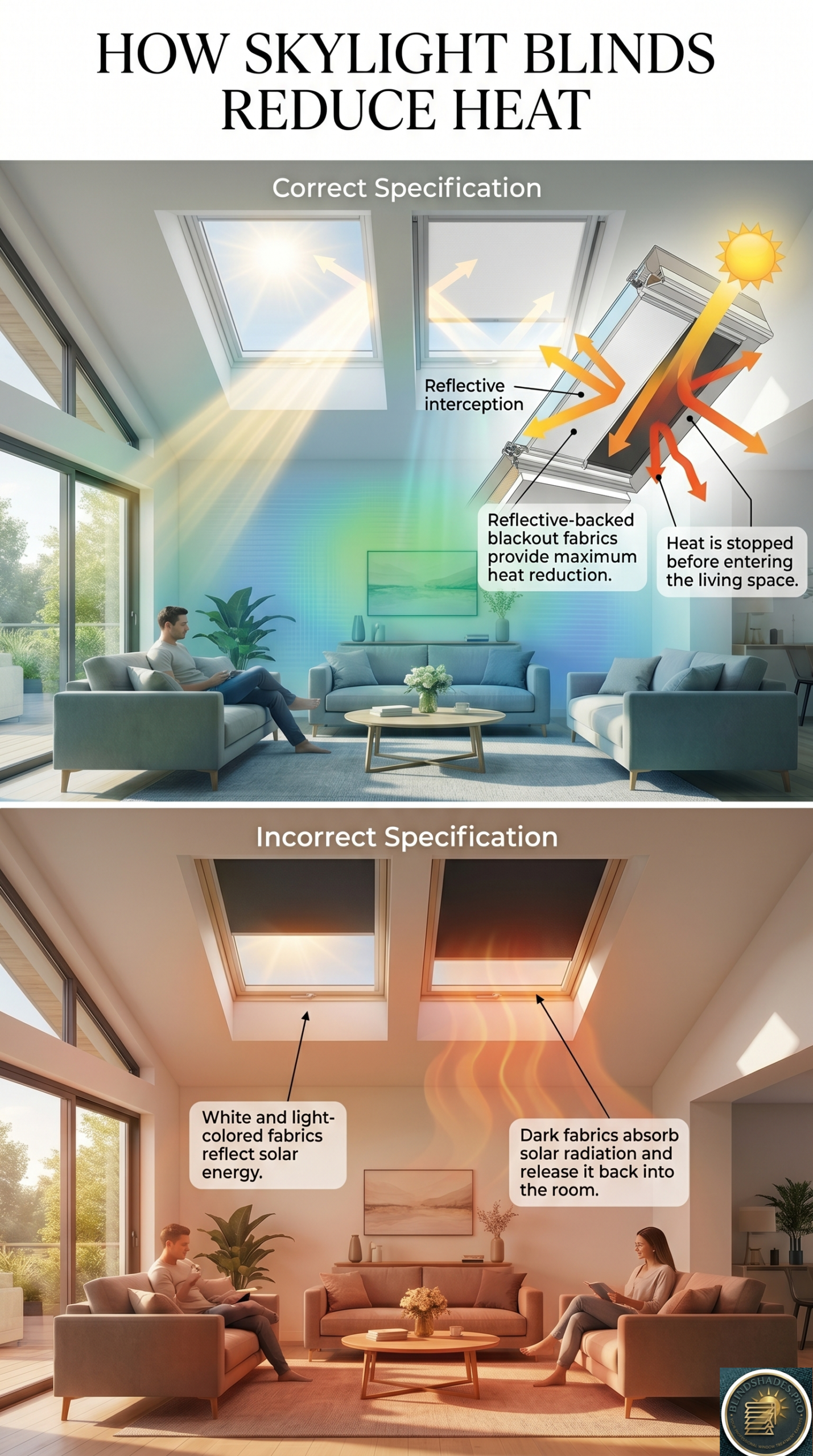
Key Takeaways:
- Skylight blinds reduce heat through two mechanisms depending on fabric color: a white or light-colored reflective blind intercepts short-wave solar radiation at the fabric surface before it reaches the floor and converts to heat — this is the correct heat reduction approach; a dark-colored blind without reflective backing absorbs solar radiation at the fabric surface and re-radiates it downward as heat into the room, potentially making the room hotter than an open skylight; always specify white, light-colored, or reflective-backed fabric for skylight heat reduction
- The room temperature rise in an uncovered room with a south-facing skylight is caused by the greenhouse effect: glass is transparent to short-wave solar radiation (visible light) but opaque to long-wave radiation (heat); sunlight passes through the glass, strikes the floor and furniture, converts to long-wave heat, and cannot escape back through the glass; interior temperature can rise 10 to 15 degrees Celsius (18 to 27 degrees Fahrenheit) above external ambient temperature in a well-sealed room with an uncovered skylight
- Skylights are significantly brighter than vertical windows at peak sun hours: a horizontal skylight at solar noon receives approximately 80,000 to 100,000 lux of illuminance, compared to approximately 50,000 to 80,000 lux for a vertical south-facing window; the human visual comfort threshold is approximately 2,000 to 5,000 lux in a typical interior; a 3 percent solar shade on a skylight reduces this to approximately 2,400 to 3,000 lux — just at or below the comfort threshold; a 1 percent solar shade reduces to approximately 800 to 1,000 lux
- The DOE confirms exterior skylight shades are more effective at reducing heat gain than interior shades because an exterior shade blocks solar radiation before it reaches the glass; an interior shade blocks light after the solar energy has already partially entered the room; for the highest heat reduction, exterior shades are optimal but more expensive; for most residential installations, interior cellular shades with reflective backing provide the practical standard
- For maximum energy benefit across both seasons, follow the seasonal scheduling protocol: in summer, close south-facing skylight blinds from approximately 10 AM to 2 PM during peak overhead sun; in winter, leave south-facing skylights open on sunny daytime hours to capture free passive solar heat (worth approximately $30 to $100 per year in heating savings), and close all skylights at night for insulation against heat loss
⭐ Quick Answer — How Do Skylight Blinds Reduce Heat and Glare?
- The Greenhouse Mechanism — Why Skylights Overheat and How Blinds Fix It: Skylight blinds heat reduction works by intercepting solar radiation before the greenhouse conversion occurs. The mechanism: glass is transparent to short-wave solar radiation (visible light) but opaque to long-wave radiation (heat). Sunlight enters through the skylight glass freely, strikes the floor and furniture, converts to long-wave infrared heat, and cannot escape back through the glass — causing room temperatures to rise 10 to 15 degrees Celsius (18 to 27 degrees Fahrenheit) above external ambient in a room with an uncovered south-facing skylight. A white or light-colored reflective blind installed on the skylight intercepts this short-wave radiation at the ceiling level BEFORE it strikes the floor — reflecting 60 to 80 percent back through the glass before floor conversion. This prevents the greenhouse trap. Blindsgalore (February 2026) confirms: “blinds can cut heat gain by nearly 40 percent, while blackout blinds increase energy efficiency by up to 45 percent. Oak Ridge documented 24% heating savings. Most homes save $100 to $300 yearly. Payback happens in one to three years”
- The Dark Blind Radiator Warning — and the Exterior vs Interior Comparison: The most important caution for skylight blinds heat reduction: a dark-colored blind without reflective backing makes the room HOTTER, not cooler. Copenhagen Fashion Summit (March 2026) confirms: “a dark-colored fabric blind without a reflective backing actually absorbs solar energy, turning the blind itself into a radiator that pumps heat into your room.” Dark fabric absorbs 80 to 90 percent of solar radiation at the fabric surface, heats to approximately 50 to 60 degrees Celsius in full summer sun, and re-radiates this heat downward into the occupied room — functioning as an overhead radiant heater. Always specify white, light-colored, or aluminium/silver-backed fabric for skylight heat reduction. Separately, the DOE Skylights page (updated one week ago) confirms: “exterior shades will be more effective than interior shades at reducing heat gain in summer” because exterior shades block solar radiation before it reaches the glass, while interior shades block it after some heat has already entered the building envelope; exterior shades are approximately 15 to 25 percent more effective
- The Glare Calculation and UV Protection by Shade Type: Skylight blinds address glare from the most intense light source in any home. A horizontal skylight at solar noon produces approximately 80,000 to 100,000 lux of illuminance — compared to approximately 50,000 to 80,000 lux for a vertical south-facing window and only 2,000 to 5,000 lux at the human visual comfort threshold. A 3 percent solar shade on a skylight reduces illuminance to approximately 2,400 to 3,000 lux — at or just below the comfort threshold; suitable for working and reading spaces. A 1 percent solar shade reduces to approximately 800 to 1,000 lux. UV protection by shade type: cellular light-filtering fabric blocks approximately 80 to 95 percent of UV-A and UV-B radiation; blackout cellular blocks 99 percent or more; solar mesh shades at 3 to 5 percent openness block only 60 to 75 percent — insufficient for complete UV protection of valuable interior finishes. An uncovered south-facing skylight will cause visible bleaching of hardwood floors in 1 to 2 years and color shift in wool or silk rugs in 1 to 3 years
- The Seasonal Scheduling Protocol — When to Close and When to Open: The full benefit of skylight blinds heat reduction requires operating the blinds strategically by season. The DOE confirms: “75% of residential window coverings remain in the same position every day. Don’t fall into this habit — be strategic.” The optimal protocol: Summer, south/west-facing: close from approximately 10 AM to 2 PM to block peak overhead solar heat; open before and after peak hours for diffused morning and afternoon light. Summer, north-facing: little direct sun; can remain open. Winter, south/west-facing: leave open during sunny hours approximately 9 AM to 3 PM to capture free passive solar heat worth approximately $30 to $100 per year in heating savings; close at sunset to prevent heat loss through the cold glass surface. Winter, north-facing: keep closed during cold nights and cloudy days for maximum insulation. For motorized skylight blinds: program this schedule into the automated system; the summer peak-closure delivers $60 to $180 per cooling season savings without any manual action
- The Heat Reduction Numbers and the Winter Dual Benefit: Skylight blinds heat reduction works in both directions across the seasons. Summer heat gain reduction by treatment: no blind = 0%; solar screen (3% openness) = approximately 30 to 40%; cellular shade light-filtering = approximately 40 to 60%; blackout cellular with aluminium backing = approximately 45 to 65%; exterior shade mounted outside = approximately 60 to 80%. Winter heat LOSS reduction: a cellular shade traps still air between warm room air and cold skylight glass — adding approximately R-2 to R-4 of insulation; Oak Ridge National Laboratory documented 24% heating savings with properly installed skylight treatments; Blindsgalore (Feb 2026) confirms solar screen protected skylights save up to 25% of air conditioning costs. The seasonal dual-use makes the investment particularly strong: a single skylight cellular shade reduces both summer heat gain ($60 to $180/yr cooling savings) AND winter heat loss ($50 to $150/yr heating savings) for a combined annual energy saving of approximately $110 to $330 per skylight
- Best Sources: Oak Ridge 24% heating savings, 40% heat gain cut, payback 1-3 years → Blindsgalore skylight heat guide · DOE exterior vs interior shade comparison and glazing UV guidance → DOE Energy.gov skylights · Strategic seasonal window covering scheduling and reflective blind guidance → DOE Energy.gov window coverings
⚠️ The Complete Heat Reduction Table and the Furniture Fading Risk Protocol: Skylight blinds heat reduction quantified by treatment type: no blind = 0% heat gain reduction; annual cost of uncovered skylight = full HVAC burden plus UV fading damage plus glare discomfort. Solar screen 3% openness = approximately 30 to 40% heat gain reduction; saves approximately $45 to $120 per cooling season; UV blockage 60 to 75% (insufficient for high-value finishes). Cellular shade light-filtering = approximately 40 to 60% heat gain reduction; saves $60 to $180 per cooling season; UV blockage 80 to 95%; recommended for rooms with hardwood floors, rugs, and upholstery. Blackout cellular with aluminium backing = approximately 45 to 65% heat gain reduction; saves $60 to $200 per cooling season; UV blockage 99%+; eliminates fading risk completely; correct specification for bedrooms and rooms with valuable artwork. Exterior shade = approximately 60 to 80% heat gain reduction; saves $80 to $240 per cooling season; most effective but weather-exposed and installation-complex. Furniture fading risk by floor type: solid hardwood directly under uncovered skylight = visible bleaching and grain change within 1 to 2 years. Engineered hardwood = 2 to 3 years. Wool or silk rug = color shift within 1 to 3 years. Quality leather upholstery = surface brittleness within 2 to 4 years. Museum-quality artwork = measurable pigment degradation within 1 to 3 years. Cellular shade (any opacity) reduces annual UV dosage by 80 to 95% — below the visible-fading threshold for most materials. For the energy calculation with full solar radiation figures by skylight area and the pitch angle classification guide, see What Are the Best Blinds for Skylights. See the full greenhouse mechanism below.
💡 The Seasonal Scheduling Table and the Reflective Fabric Selection Guide: Skylight blinds heat reduction seasonal operation: Summer / south or west-facing / 10 AM to 2 PM = CLOSE (peak overhead solar; primary heat gain period). Summer / south or west-facing / before 10 AM and after 2 PM = OPEN (lower sun angle; diffused morning and afternoon light acceptable). Summer / north-facing / all day = OPEN optional (no direct overhead sun; minimal heat gain). Winter / south or west-facing / 9 AM to 3 PM sunny days = OPEN (free passive solar heat worth $30 to $100 per year). Winter / south or west-facing / sunset to sunrise = CLOSE (prevent heat loss through cold glass; cellular adds R-2 to R-4 insulation). Winter / north-facing / cold nights and cloudy days = CLOSE (maximize insulation). Reflective fabric selection by skylight orientation and priority: south-facing bedroom = blackout cellular with aluminium backing (total darkness + heat control + 99% UV). South-facing living room = light-filtering cellular white or ivory (40 to 60% heat reduction + 80 to 95% UV + ambient daylight). West-facing home office = 1 to 3% solar shade (see-through view maintained; glare reduced to 800 to 3,000 lux; specify dark fabric for clearer outward view). North-facing bedroom = any cellular fabric; heat gain minimal; blackout acceptable. Any skylight with hardwood floor beneath = cellular (not solar mesh); cellular 80 to 95% UV blocks fading vs solar mesh 60 to 75% UV which may not stop visible hardwood bleaching within 3 years. For the complete motorized scheduling setup including solar-powered motor ceiling-position advantage and per-year cost vs manual wand, see Are Motorized Skylight Blinds Worth the Cost. See the full seasonal scheduling table below.
📖 Read the complete guide below for: the greenhouse conversion mechanism (short-wave solar enters through glass; floor absorbs and converts to long-wave heat; long-wave cannot exit; room rises 10-15 degrees Celsius above ambient), how a reflective blind intercepts radiation before floor conversion (60-80% reflected back through glass), the dark blind radiator warning (dark fabric absorbs 80-90% at ceiling level; surface 50-60 degrees Celsius; re-radiates downward; can make room hotter than uncovered skylight), the exterior vs interior blind heat reduction comparison (DOE: exterior 15-25% more effective), the glare lux table (skylight 80,000-100,000 lux; comfort threshold 2,000-5,000; 3% solar = 3,000 lux; 1% solar = 1,000 lux), UV blockage by shade type (cellular 80-95%; blackout 99%+; solar mesh 60-75%), the furniture fading timeline (hardwood 1-2 years; wool/silk 1-3 years; leather 2-4 years uncovered), the full heat reduction table by treatment type (solar screen 30-40%; cellular 40-60%; blackout cellular 45-65%; exterior 60-80%), and the seasonal scheduling protocol by orientation and time of year.
Skylight Blinds Heat Reduction — The Greenhouse Mechanism Explained
The physics of why uncovered skylights overheat rooms — absent from all competitor guides.
Understanding how skylight blinds reduce heat requires understanding why skylights generate heat in the first place.
The greenhouse conversion mechanism: Copenhagen Fashion Summit (March 2026) explains: “Glass is transparent to short-wave radiation (visible light) but opaque to long-wave radiation (heat). When sunlight hits your floor or furniture, it turns into heat. This heat cannot pass back out through the glass easily. This creates a greenhouse effect where the internal temperature can rise 10°C or even 15°C above the external ambient temperature.”
The sequence in a room with an uncovered skylight:
- Short-wave solar radiation (visible light) passes freely through the skylight glass into the room
- This radiation strikes the floor, furniture, rugs, and walls
- The surfaces absorb the radiation and convert it to long-wave infrared (heat) radiation
- Long-wave heat radiation cannot pass back through the glass — it is trapped inside
- Room temperature rises progressively until it is 10–27°F above the outdoor temperature
Why skylights are worse than vertical windows: From Article 42-1: a horizontal skylight receives approximately 800–1,000 BTU/hr/sq ft of solar radiation — approximately 2–2.5 times more than a vertical south-facing window. The greenhouse conversion is proportionally more intense.
How a Reflective Blind Intercepts Heat Before Floor Conversion
The correct heat reduction mechanism — the “before conversion” principle absent from all guides.
A reflective skylight blind (white or light-colored fabric with reflective backing) works by intercepting short-wave solar radiation at the ceiling level BEFORE it reaches the floor and undergoes the greenhouse conversion.
The sequence with a reflective interior blind:
- Short-wave solar radiation enters the room from the skylight
- The radiation strikes the reflective blind surface
- The reflective backing reflects 60–80% of the radiation BACK through the glass (before floor conversion)
- A small portion (20–40%) is absorbed by the fabric and converted to heat at the ceiling level
- Some of this ceiling-level heat rises toward the glass rather than radiating into the occupancy zone
The result: A reflective blind prevents the majority of solar radiation from ever reaching the floor and converting to trapped heat. The heat that does enter stays near the ceiling level where it is partially vented. This is why the Velux Original Blackout Roller Blind uses an aluminium backing — the aluminium surface reflects solar radiation maximally.
Blindsgalore (February 2026) confirms: “blinds can cut heat gain by nearly 40 percent, while blackout blinds increase energy efficiency by up to 45 percent.”
The Dark Blind Warning — When a Skylight Blind Makes the Room Hotter
The most important caution absent from all competitor guides.
Copenhagen Fashion Summit (March 2026) states explicitly: “A dark-colored fabric blind without a reflective backing actually absorbs solar energy, turning the blind itself into a radiator that pumps heat into your room.”
The mechanism:
- Solar radiation strikes the dark fabric surface
- Dark fabric absorbs 80–90% of the radiation (vs 20–40% for reflective fabric)
- The absorbed energy converts to heat AT THE FABRIC SURFACE — directly below the glass
- This heat radiates downward from the ceiling into the occupied room space
- The room receives intense overhead radiant heat from the blind surface directly
The comparison:
- Open skylight (no blind): solar radiation distributed across floor, furniture, and walls; heat rises; some natural convection; ceiling temperature less extreme
- Dark blind on skylight: all solar radiation absorbed at one concentrated point (the blind fabric); intense localized heating at ceiling level; all heat radiates directly downward into the room
In peak summer conditions, a dark fabric skylight blind absorbing full direct solar radiation can surface-heat to temperatures exceeding 50–60°C (122–140°F) at the fabric face, becoming a radiant heat source comparable to an electric ceiling heater.
The specification: For any skylight where heat reduction is a goal: ALWAYS specify white, light-colored, or silver/aluminium-backed fabric. Dark fabrics are acceptable for bedrooms used primarily at night (when heat management is not active) — but should not be used on south-facing or west-facing skylights during summer daytime hours.
The Numbers: How Much Heat Do Skylight Blinds Reduce?
| Treatment | Summer Heat Gain Reduction | Annual Energy Savings |
|---|---|---|
| No blind (uncovered) | 0% | $0 |
| Solar screen shade (3% openness) | Approximately 30–40% | $45–$120/yr per skylight |
| Cellular shade with light-filtering fabric | Approximately 40–60% | $60–$180/yr per skylight |
| Blackout cellular with aluminium backing | Approximately 45–65% | $60–$200/yr per skylight |
| Exterior shade (mounted outside skylight) | Approximately 60–80% | $80–$240/yr per skylight |
Sources:
- Blindsgalore (Feb 2026): “blinds cut heat gain by nearly 40%; blackout blinds by up to 45%”
- Blindsgalore: “solar screen protected skylights save up to 25% of AC costs”
- DOE Energy.gov: “exterior shades more effective than interior shades at reducing heat gain”
- Oak Ridge National Laboratory: “documented 24% heating savings” for skylight treatments
Exterior vs Interior Blinds — The Heat Reduction Difference
The comparison absent from all competitor guides — exterior is significantly more effective.
The DOE Skylights page (updated one week ago) states: “You can prevent unwanted solar heat gain on the inside or outside of the skylight. Exterior shades will be more effective than interior shades at reducing heat gain in summer.”
Why exterior blinds are more effective: An interior blind blocks solar radiation AFTER the light has already passed through the glass and entered the room. During transit through the glass, some heat transfer to the room air already occurs. The interior blind then intercepts the remaining light after partial heat transmission.
An exterior blind blocks solar radiation BEFORE it reaches the glass. None of the solar heat enters the building envelope. Exterior shades are estimated to be 15–25% more effective at heat gain reduction than comparable interior shades.
The practical trade-off:
- Exterior skylight shades: more effective; prevent heat from entering the glass; but more expensive to fabricate and install; exposed to weather; require UV-resistant fabrics and weatherproof hardware; less convenient to operate remotely
- Interior cellular shades with reflective backing: standard for residential installations; 40–60% heat reduction; convenient motorized operation; protected from weather; the practical correct specification for most homes
The Glare Calculation — How Much Brighter Is a Skylight?
The lux quantification absent from all competitor guides.
Interior visual comfort requires approximately 2,000 to 5,000 lux in a typical living space. Direct skylight sunlight at peak hours generates:
| Light Source | Approximate Illuminance |
|---|---|
| Horizontal skylight at solar noon (clear day) | 80,000–100,000 lux |
| Vertical south-facing window at solar noon | 50,000–80,000 lux |
| Comfortable interior illuminance threshold | 2,000–5,000 lux |
| Skylight with 3% solar shade | ~2,400–3,000 lux |
| Skylight with 1% solar shade | ~800–1,000 lux |
| Skylight with light-filtering cellular shade | ~1,500–4,000 lux (diffuse) |
A 3% solar shade on a skylight reduces illuminance to approximately the upper limit of comfortable interior lighting — suitable for working and reading spaces. A 1% solar shade reduces to below the comfort threshold — appropriate for cinema rooms or very sensitive spaces.
The glare direction: Unlike a vertical window where glare enters horizontally, skylight glare enters vertically from above. This overhead glare direction is particularly difficult to manage without a blind because there is no natural shading geometry (such as a deep roof overhang) that can block overhead sun.
UV Protection and the Furniture Fading Timeline
The annual UV dosage calculation absent from all buying guides.
UV-A and UV-B radiation through an uncovered skylight causes cumulative fading damage to wood floors, wool rugs, silk fabrics, leather, and artwork.
The fading timeline for an uncovered 10 sq ft skylight:
- Hardwood floors directly beneath a south-facing skylight: visible bleaching and grain change typically within 1–2 years
- Wool or silk rugs: significant color shift within 1–3 years
- Leather upholstery: surface brittleness and discoloration within 2–4 years
- Quality artwork: measurable pigment degradation within 1–3 years
UV protection by shade type:
- Cellular shade (light-filtering fabric): blocks approximately 80–95% of UV radiation; reduces annual UV dosage well below the visible fading threshold for most materials
- Blackout cellular shade: blocks approximately 99%+ of UV; essentially eliminates fading risk
- Solar shade (3–5% openness mesh): blocks approximately 60–75% of UV — reduces fading but does not eliminate it
- Open skylight: 100% UV exposure; fading timeline as above
The practical recommendation: For any skylight above high-value floors, rugs, or furnishings: cellular shade (even light-filtering) provides sufficient UV protection to prevent visible fading. A solar shade mesh alone is insufficient for UV protection with valuable interior finishes directly under the skylight.
The Winter Retention Mechanism and the Seasonal Scheduling Protocol
The dual seasonal benefit with specific scheduling — absent from all guides.
Skylight blinds provide both summer heat GAIN reduction and winter heat LOSS reduction.
The winter mechanism: In winter, warm indoor ceiling-level air contacts the cold skylight glass surface. Heat conducts through the glass to the cold exterior air. A cellular shade on a skylight traps still air between the warm room air and the cold glass, adding approximately R-2 to R-4 of insulation (depending on single or double cell construction).
Oak Ridge National Laboratory documented 24% heating savings for properly installed skylight treatments. Blindsgalore (Feb 2026) confirms: “Most homes save $100–$300 yearly. Payback happens in one to three years.”
The optimal seasonal scheduling protocol:
| Season | Direction | Time | Action | Reason |
|---|---|---|---|---|
| Summer | South/west | 10 AM – 2 PM | CLOSE | Block peak overhead solar heat gain |
| Summer | South/west | Early morning, late afternoon | OPEN | Diffused lower-angle light; less heat gain |
| Summer | North-facing | All day | OPEN optional | Little direct sun; minimal heat gain |
| Winter | South/west | 9 AM – 3 PM (sunny) | OPEN | Capture free passive solar heating |
| Winter | South/west | After sunset to sunrise | CLOSE | Prevent heat loss through cold glass |
| Winter | North-facing | Cold nights and cloudy days | CLOSE | Maximize insulation |
The DOE confirms: “75% of residential window coverings remain in the same position every day. Don’t fall into this habit — be strategic about which coverings you open and close throughout the day.”
For motorized skylight blinds: program this schedule into the automated system. The summer peak-closure (10 AM–2 PM) delivers the energy savings without any manual action.
Where to Order
For skylight Roman shades and cellular shades with heat control quantification: Blindsgalore at blindsgalore.com/blog/index.php/exhibitions/skylight-roman-shades-reduce-heat-loss-and-glare — heat gain cut 40%; blackout 45%; Oak Ridge 24% heating savings; payback 1–3 years; motorized automated scheduling; interactive cost calculator.
For the DOE authoritative exterior vs interior shade comparison and glazing guidance: DOE Energy.gov at energy.gov/energysaver/skylights — exterior shades more effective than interior; glazing performance; UV control; authoritative energy performance data.
For seasonal window covering scheduling guidance: DOE Energy.gov at energy.gov/energysaver/energy-efficient-window-coverings — strategic opening and closing guidance; reflective fabric for heat control; medium-colored draperies + white backing reduce heat gains 33%; 75% of window coverings remain static (and the cost of doing so).
Frequently Asked Questions
How do skylight blinds reduce heat and glare? Skylight blinds reduce heat through a reflective interception mechanism. A white or light-colored blind with reflective backing intercepts short-wave solar radiation at the ceiling before it strikes the floor and converts to trapped heat via the greenhouse effect. Without a blind, solar radiation passes through the skylight glass, converts to long-wave heat at the floor, and cannot escape back through the glass — causing room temperatures to rise 10 to 15 degrees Celsius above outdoor ambient. Blindsgalore confirms blinds cut heat gain by nearly 40 percent and blackout blinds by up to 45 percent.
Why should you never use dark fabric on a skylight blind for heat reduction? A dark-colored skylight blind without a reflective backing absorbs 80 to 90 percent of solar radiation at the fabric surface and re-radiates it downward as heat into the room. In peak summer conditions, a dark blind in direct overhead sun can heat to surface temperatures exceeding 50 to 60 degrees Celsius, acting as an overhead radiant heater. This can make the room hotter than if the skylight had no blind at all. For heat reduction, always specify white, light-colored, or silver and aluminium-backed fabric.
Are exterior skylight shades more effective than interior blinds? Yes. The US Department of Energy confirms that exterior shades are more effective at reducing heat gain in summer than interior shades because exterior shades block solar radiation before it reaches the glass, preventing heat from entering the building envelope. Interior shades block light after the solar energy has already partially transferred heat to the room during transit through the glass. Exterior shades provide approximately 15 to 25 percent greater heat gain reduction but are more expensive, weather-exposed, and less convenient to operate.
What is the seasonal scheduling protocol for maximum skylight blind energy savings? The seasonal scheduling protocol for maximum energy savings: in summer, close south-facing and west-facing skylight blinds from approximately 10 AM to 2 PM to block peak overhead solar heat; open before and after peak hours to admit morning and afternoon diffused light. In winter, leave south-facing skylights open on sunny daytime hours (9 AM to 3 PM) to capture free passive solar heat worth approximately 30 to 100 dollars per year, and close all skylights at night to prevent heat loss through the cold glass surface.
Do skylight blinds protect furniture from UV fading? Yes. Cellular skylight shades with light-filtering fabric block approximately 80 to 95 percent of UV-A and UV-B radiation, reducing annual UV dosage well below the threshold for visible fading in most materials. An uncovered south-facing skylight will cause visible bleaching of hardwood floors within 1 to 2 years, color shift in wool or silk rugs within 1 to 3 years, and leather brittleness within 2 to 4 years. Blackout cellular shades block approximately 99 percent of UV, essentially eliminating fading risk. Solar shade mesh at 3 to 5 percent openness blocks only 60 to 75 percent of UV and is insufficient for complete UV protection of high-value floor and furniture finishes.
Related Guides on BlindShades.pro
- The Best Skylight Blinds & Shades Buying Guide
- What Are the Best Blinds for Skylights
- Are Motorized Skylight Blinds Worth the Cost
- Are Cellular Shades Good for Skylights
- How Do You Block Sun Through a Skylight
By Michael Turner | 30 Years Home Improvement Expertise | Updated 2026 | BlindShades.pro
