What Are the Best Blinds for Skylights?

Authored By Michael Turner -30 Years Home Improvement Expertise | Updated 2026 | BlindShades.pro
Updated on July 15, 2026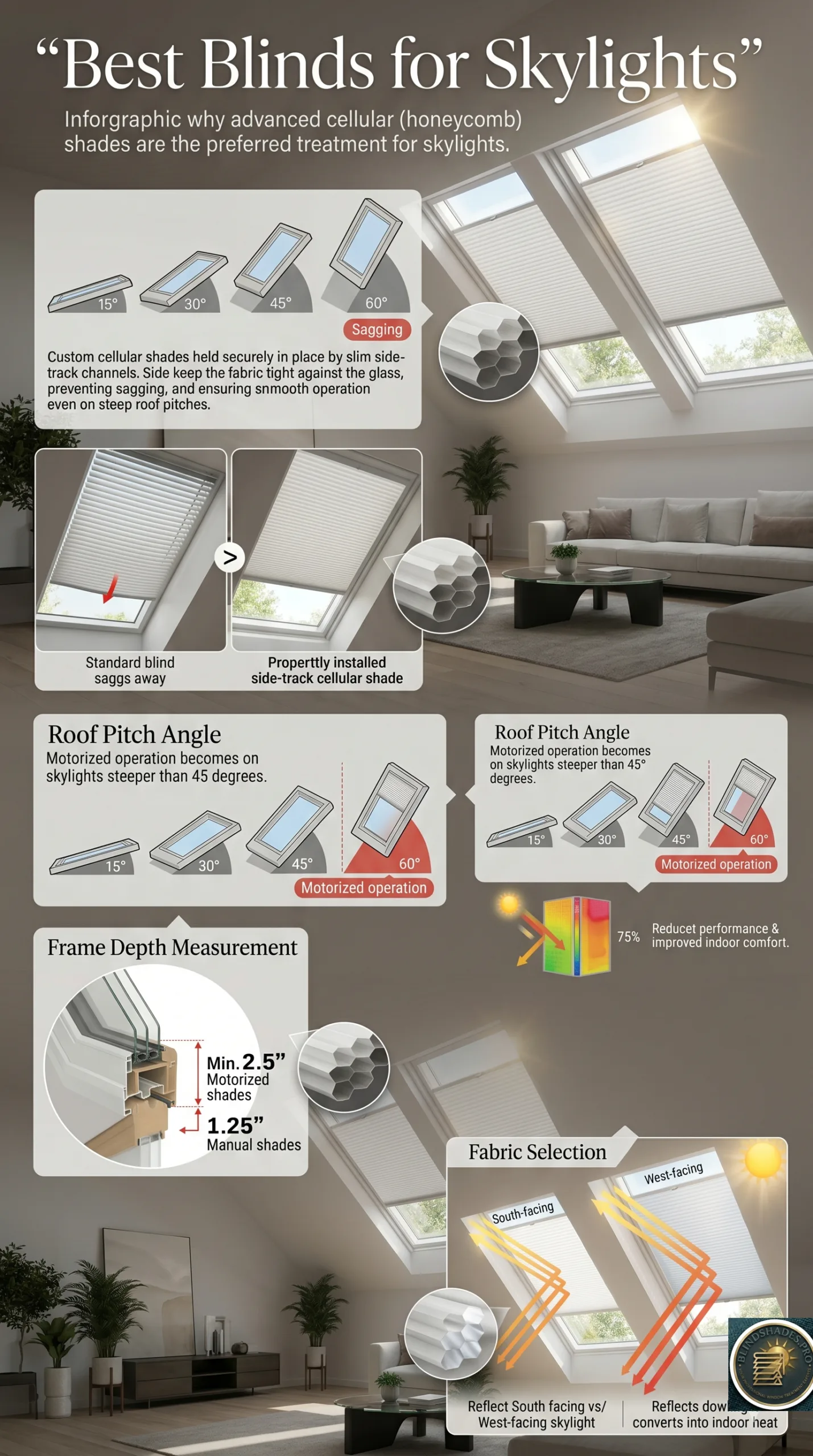
Key Takeaways:
- The best blinds for skylights are cellular (honeycomb) shades with side track channels; cellular shades are the only standard treatment whose track-guided structure prevents sagging on angled or horizontal glass; VelaBlinds confirms they perform reliably at skylight angles from 15 to 60 degrees; a standard corded or cordless blind installed in a skylight without a tension system will sag away from the glass within days, creating an air gap that eliminates the insulation benefit and allows light to leak around the edges
- The correct blind for a skylight depends on the roof pitch angle: flat skylights (0 to 10 degrees) require the strongest tension system because gravity pulls the fabric directly downward; low-pitch skylights (10 to 30 degrees) are the most common residential installation and accommodate cordless manual operation; standard-pitch skylights (30 to 45 degrees) make motorized operation highly recommended; steep-pitch skylights above 45 degrees make motorized operation essentially mandatory
- Before ordering any skylight blind, measure the inside frame depth at the shallowest point of the skylight curb; manual cordless cellular shades require a minimum inside frame depth of approximately 1.25 inches; motorized skylight shades require a minimum of approximately 2.5 inches; many older residential skylights have only 1 to 2 inches of inside frame depth, which limits the installation to manual operation only
- Specify white or light-colored fabric with reflective backing for any south-facing or west-facing skylight where heat reduction is the primary goal; dark-colored skylight shade fabric absorbs direct overhead solar radiation at the ceiling level and re-radiates it as heat into the room; white or reflective fabric reflects 60 to 80 percent of incoming solar radiation back through the glass before it converts to heat; Keego confirms all honeycomb skylight fabrics use white backing to reflect more sunlight
- A 10-square-foot skylight in a horizontal position receives approximately 800 to 1,000 BTU per hour per square foot of solar radiation on a clear summer day — significantly more than the approximately 450 BTU per hour per square foot that a vertical south-facing window receives; a 10-square-foot skylight generates approximately 6,880 to 8,600 BTU per hour of summer heat gain uncovered; cellular shades reduce this by 60 to 80 percent, saving approximately $60 to $180 per skylight per cooling season
Related guides: for the full decision — the side-channel rule, heat physics, the Velux fork and motor protocols — see the complete skylight blinds & shades guide.
⭐ Quick Answer — What Are the Best Blinds for Skylights?
- Why Standard Window Blinds Immediately Fail in Skylights — and the Correct Solution: The best blinds for skylights are custom cellular (honeycomb) shades with a side track channel system. Standard window blinds installed in a skylight without a tension system will sag away from the glass within days. The failure mechanism: a standard blind is designed for vertical use where gravity holds the bottom rail in place; in a skylight, gravity pulls the center of the fabric downward creating a visible “belly” that sags away from the glass. Alluring Window confirms: “if you put a standard blind up there, gravity will pull the middle down, creating a belly that looks terrible and lets light leak through the sides.” The belly creates an air gap between the fabric and glass — eliminating all insulation benefit and allowing light to leak around the fabric edges. The side track channel system forces the shade fabric to remain in contact with the glass at any angle. VelaBlinds confirms cellular shades perform reliably at skylight angles from 15 to 60 degrees
- The Pitch Angle Chart — Which Blinds and Operation Type Fit Each Skylight: The roof pitch angle determines the correct skylight blind specification. Flat skylights (0 to 10 degrees): horizontal or near-horizontal; gravity load is maximum; side track system required with strongest tension; motorized strongly recommended. Low-pitch skylights (10 to 30 degrees): most common residential fixed-glass skylights; moderate gravity effect; cordless manual operation with long wand is viable; cellular or pleated shades both work. Standard-pitch skylights (30 to 45 degrees): most common operable residential skylights including Velux FS and GGL series; motorized operation highly recommended; manual operation requires a 40 to 60-inch reach wand. Steep-pitch skylights (45 degrees and above): atrium windows and steeply angled roof windows; Shade and Blinds confirms “motorized operation is not just a luxury; it is often a practical necessity” for skylights at this angle and height
- The Three Mounting System Types and the Minimum Frame Depth Check: Before ordering any skylight blind, measure the inside frame depth at the shallowest point of the skylight curb. Manual cordless cellular shade: minimum approximately 1.25 inches inside frame depth (EaseEase: 1¼” confirmed). Motorized cellular shade: minimum approximately 2.5 inches (EaseEase: 2½” confirmed). Between-glass integrated blind: approximately 3 to 4 inches. Many older residential skylights have only 1 to 2 inches of inside frame depth — motorization is not possible without an extension frame kit. The three mounting system types: (1) Side track (channel) system — most reliable for all pitch angles; fabric slides within aluminum channels preventing sagging; recommended for any skylight above 15 degrees. (2) Guide wire (cable tension) system — simpler installation; suitable for smaller skylights at 10 to 45 degrees; requires precise tension calibration. (3) Frame-fit friction only — no tracks; suitable only for flat and near-flat skylights (0 to 15 degrees) where gravity is not strong enough to overcome frame friction
- White Reflective Fabric and the Thermal Stratification Advantage: For any south or west-facing skylight, specify white or light-colored fabric with reflective backing. VelaBlinds recommends “a light-colored reflective fabric” for maximum heat control. The reason: skylights receive approximately 800 to 1,000 BTU per hour per square foot of direct solar radiation on a clear summer day — approximately 2 to 2.5 times more than a vertical south-facing window (which receives approximately 450 BTU/hr/sq ft). Dark-colored skylight blind fabric absorbs 80 to 90 percent of this radiation and re-radiates it as heat into the room; white or reflective fabric reflects 60 to 80 percent back through the glass before heat conversion. Keego confirms “all honeycomb fabrics have white backing to reflect more sunlight.” The thermal stratification bonus: hot air rises to ceiling level where the skylight is positioned; a cellular shade at the ceiling creates a still air buffer at exactly the warmest air layer in the room, interrupting the convective heat loss that makes uncovered skylights particularly energy-inefficient in winter
- Energy Savings and Condensation Reduction for Skylights: The energy impact of cellular skylight blinds per square foot is significantly greater than for vertical windows. A typical 10-square-foot skylight uncovered at SHGC 0.86 generates approximately 6,880 to 8,600 BTU per hour of summer solar heat gain. With cellular honeycomb shades: reduced by 60 to 80 percent to approximately 1,376 to 3,440 BTU per hour. Annual cooling savings: approximately $60 to $180 per skylight per cooling season. A 15-square-foot skylight: approximately $90 to $270 per cooling season. Condensation bonus: an uncovered skylight in a bedroom or bathroom allows warm humid room air to contact the cold glass surface, causing condensation when glass temperature falls below the dew point. A cellular shade insulates the glass surface slightly above the dew point, reducing condensation on the inner glass surface — reducing moisture damage risk to surrounding finishes
- Best Sources: Custom cellular and pleated skylight shades with side channel system → Blindsgalore skylight shades · Full skylight blind engineering guide including track vs cable systems and angle compatibility → VelaBlinds skylight blind guide · Motorized vs manual comparison with installation and maintenance guidance → Shade and Blinds skylight guide
⚠️ The Complete Treatment Comparison Table for Skylights: Best blinds for skylights by treatment type: Double-cell cellular honeycomb shade — best overall; track-guided; reliable at 15 to 60-degree angles; R-3 to R-4 insulation; VelaBlinds top specification; all pitch angles with side track. Single-cell cellular honeycomb shade — good; lighter weight; better for manual TDBU on shallower pitches; R-2 to R-3. Pleated shade — good budget option; single fabric layer (less insulation than cellular); less sag resistance at steeper angles; 10 to 45-degree range. Roller shade (specialized) — marginal; requires cable-guided tension system; limited to low-pitch skylights (10 to 30 degrees); minimal insulation. Aluminum venetian or faux wood blind — NOT suitable; gravity causes immediate sagging; no tension system available for these product types. Standard corded or cordless shade (non-skylight rated) — NOT suitable; not designed for angled installation; will sag within days. The tension calibration warning: Alluring Window confirms “if the tension is too tight the motor burns out; if it is too loose the shade sags” — and this is “rarely a DIY-friendly project.” Six-month tension cable checks are recommended by Shade and Blinds to maintain proper shade position. For the motorized worth-it analysis including cost by motor type, remote options, smart home integration, and the break-even calculation vs wand-operated manual, see Are Motorized Skylight Blinds Worth the Cost. See the full failure mechanism and mounting guide below.
💡 The Skylight Energy Calculation Table and the Condensation Protocol: Skylight blinds energy savings by glass area: 6-square-foot skylight uncovered = approximately 4,128 to 5,160 BTU per hour; with cellular shades = 826 to 2,064 BTU per hour; annual cooling savings approximately $36 to $108 per cooling season. 10-square-foot skylight = approximately 6,880 to 8,600 BTU per hour uncovered; with cellular = 1,376 to 3,440 BTU per hour; savings $60 to $180 per cooling season. 15-square-foot skylight = approximately 10,320 to 12,900 BTU per hour uncovered; with cellular = 2,064 to 5,160 BTU per hour; savings $90 to $270 per cooling season. All figures at 800 to 1,000 BTU per hour per square foot for horizontal surface (versus 450 for vertical south-facing window); SHGC 0.86 uncovered; 60 to 80 percent reduction with cellular; $0.12 per kWh. Condensation protocol for bedroom and bathroom skylights: specify cellular shade (any opacity) as a condensation management measure; the insulating air layer keeps the inner glass surface above the typical dew point of inhabited rooms (approximately 50 to 55 degrees Fahrenheit at typical indoor relative humidity); Velux specifically notes skylight blinds reduce condensation risk by insulating the glass. Winter heating benefit: the DOE confirms tightly fitted cellular shades reduce window heat loss by 40 percent or more; at ceiling level where warm air accumulates (thermal stratification effect), the cellular shade may provide even greater heat retention benefit than the DOE’s figure for vertical windows. For the measurement protocol including how to measure inside-frame depth, glass dimensions for custom order, and the pitch angle confirmation method, see How Do You Measure a Skylight for Blinds. See the full pitch angle guide below.
📖 Read the complete guide below for: why cellular honeycomb shades with side track channels are the correct specification for any skylight (track-guided structure prevents gravity sag; reliable at 15 to 60-degree angles), the skylight pitch angle chart (flat 0-10 degrees strongest tension; low-pitch 10-30 degrees cordless viable; standard-pitch 30-45 degrees motorized recommended; steep 45-plus degrees motorized mandatory), why standard window blinds fail in skylights (gravity belly sag; air gap eliminates insulation; light leaks around edges), the three mounting system types (side track channel most reliable; guide wire for smaller skylights; frame-fit friction for flat only), the minimum inside frame depth requirements (manual 1.25 inches; motorized 2.5 inches; between-glass 3-4 inches), why white and reflective fabric is critical for south and west-facing skylights (dark fabric absorbs 80-90 percent; white reflects 60-80 percent), the thermal stratification effect at ceiling level, condensation reduction, and the energy savings calculation (10 square feet uncovered equals 6,880 to 8,600 BTU per hour; cellular saves 60 to 80 percent; $60 to $180 per cooling season).
Best Blinds for Skylights — Why Cellular Honeycomb Shades Win
Why skylights need specialist treatment that standard window blinds cannot provide.
A skylight is not a window — it is a glass aperture in a roof or ceiling, positioned at an angle ranging from nearly horizontal (flat skylights) to steeply pitched (atrium windows). Gravity constantly pulls any blind fabric downward and away from the glass surface. This fundamental difference means every standard window blind fails in a skylight.
VelaBlinds confirms: “The engineering behind skylight blinds differs completely from vertical window treatments. Gravity constantly pulls the blind fabric downward, requiring robust tracking systems or tensioned cables to maintain proper positioning.”
The cellular honeycomb shade advantage: Cellular shades excel in skylight applications because:
- Their track-guided operation prevents lateral movement and sagging regardless of installation angle
- Their honeycomb air-trapping structure creates insulation against the glass — the most critical function for a ceiling-positioned window
- They are available in custom-sized fabrication with the precision required for skylight frame dimensions
- They are available in blackout, room-darkening, and light-filtering fabrics for every skylight application
Blindsgalore confirms: “Cellular shades (honeycomb shades) are the top choice for skylights. Their air-trapping pockets act as a buffer against the glass, keeping your home cooler in summer and warmer in winter.”
The Skylight Pitch Angle Guide — The Treatment Specification Varies by Angle
The pitch angle classification and its treatment implications — absent from all competitor guides.
The roof pitch angle at which a skylight is installed determines which treatments are viable and what operation type is required.
Flat Skylights (0–10 Degrees)
A flat skylight is essentially horizontal — installed in a flat or near-flat roof. Gravity pulls the shade fabric directly downward at maximum force. This is the most challenging skylight installation.
Requirements:
- Strongest tension system: side track channels are required; guide wire systems may be insufficient for purely horizontal applications
- Motorized operation is strongly recommended (manual operation against gravity requires more force than on angled skylights)
- Precision tension calibration: Alluring Window confirms “if tension is too tight, the motor burns out; if too loose, the shade sags”
- Specialized flat skylight products (not all skylight shade lines are rated for horizontal installation)
Low-Pitch Skylights (10–30 Degrees)
The most common configuration for residential fixed-glass skylights. The moderate angle provides some gravitational support for the shade track mechanism.
Requirements:
- Side track system required
- Cordless manual operation typically viable
- Either double-cell cellular for maximum insulation or single-cell for lighter operation
Standard-Pitch Skylights (30–45 Degrees)
The most common configuration for operable residential skylights (including the popular Velux FS and GGL series). The 30-to-45-degree angle creates significant gravitational load on the shade mechanism.
Requirements:
- Side track or robust guide wire system required
- Motorized operation highly recommended; VelaBlinds confirms “cellular shades installed on skylights ranging from 15 to 60-degree angles with consistent success” — at 45 degrees, manual operation requires more effort
- A long wand (typically 100–150 cm / 40–60 inches) is required for manual operation from below
Steep-Pitch Skylights (45 Degrees and Above)
Skylights in steeply pitched roofs, atrium windows, roof lanterns, and greenhouse-style glazing. Gravity load is very high.
Requirements:
- Side track system essential; guide wire may be insufficient
- Motorized operation essentially mandatory; Shade and Blinds confirms “motorized operation is not just a luxury; it is often a practical necessity” for skylights at height and steep angles
- Double-cell cellular shade for maximum insulation and structural rigidity (honeycomb cell structure resists fabric distortion under high gravitational load)
Why Standard Blinds Fail on Skylights
The specific failure mechanism absent from all competitor guides.
Alluring Window confirms: “Unlike a standard blind that hangs down, a skylight shade often moves horizontally or at an angle. If you put a standard blind up there, gravity will pull the middle down, creating a ‘belly’ that looks terrible and lets light leak through the sides.”
The failure mechanism: A standard corded or cordless blind is designed for vertical installation. Its headrail is fixed to the top of the window frame and its bottom rail hangs freely under gravity — gravity and the lift mechanism work together in normal window use.
In a skylight installation:
- Gravity pulls the fabric downward (away from the glass surface and toward the room interior)
- Without a tension system: the center of the fabric sags, creating a visible “belly” between the top and bottom of the shade
- Consequences of the belly: an air gap forms between the fabric and the glass; warm air circulates through this gap, eliminating the shade’s insulation value; light leaks around the fabric edges where it no longer contacts the frame
The tension system solution: Side track channels or guide wires force the shade fabric to remain in contact with the skylight glass regardless of angle. The fabric cannot sag because it is constrained by the tracks on each side. This is why all properly designed skylight shades include a tension mechanism — it is not an optional upgrade; it is the functional requirement.
The Three Mounting System Types
The complete comparison absent from all competitor guides.
| System | Description | Best For | Limitation |
|---|---|---|---|
| Side track (channel) | Fabric slides within aluminum/PVC channels on each side of the frame | All pitch angles; most reliable; long-term performance | More installation steps; requires compatible frame dimensions |
| Guide wire (cable tension) | Stainless steel cables run through eyelets along fabric edges | Smaller skylights; 10–45 degrees | More precise tension calibration required; can develop uneven tension over time |
| Frame-fit (friction only) | Shade sized to fit within the frame with friction hold | Flat and near-flat skylights only (0–15 degrees) | Not suitable for angles above 15 degrees; gravity overcomes friction |
VelaBlinds confirms: “Track-guided systems provide the most reliable solution for most skylight applications. The blind fabric slides within aluminum tracks that prevent sagging and ensure smooth operation regardless of gravity effects.”
Blinds Chalet confirms for side track installation: “Side channels improve light control and insulation by preventing light leakage along the sides.”
The recommendation: For any skylight above 15 degrees pitch: specify the side track channel system. For flat skylights: specify side track with motorization.
The Minimum Frame Depth Requirement
The pre-order check absent from all guides — older skylights may not support motorization.
Before ordering any skylight blind, measure the inside frame depth at the shallowest point of the skylight curb. The curb is the raised wooden or PVC frame around the glass opening.
Minimum depth by product type:
- Manual cordless cellular skylight shade: approximately 1.25 inches (EaseEase confirms 1¼” minimum for manual lift)
- Motorized cellular skylight shade: approximately 2.5 inches (EaseEase confirms 2½” minimum for motorization)
- Between-glass integrated blind: approximately 3–4 inches (requires space within the insulating glass unit for the blind mechanism)
The practical consequence: Many older residential skylights (pre-2000 Velux, budget skylights, and some Fakro models) have inside frame depths of only 1 to 2 inches. These skylights are compatible with manual cordless cellular shades but cannot accommodate motorized shades.
If the frame depth is insufficient for a motorized shade, the options are:
- Specify manual cordless (with a reach wand for operation)
- Contact the skylight manufacturer for an extension frame kit that raises the curb height
- Replace the skylight with a unit that has a deeper curb
The Reflective Fabric Choice for Heat Control
The fabric color effect on solar heat gain — absent from all competitor guides.
VelaBlinds recommends: “For any skylight, the best solution is a motorized, double-cell honeycomb blind with a light-colored, reflective fabric. This combination provides maximum insulation, effortless operation, and effective heat control.”
Why fabric color matters for skylights:
A skylight positioned overhead receives the most intense solar radiation of any window position in a home. When this radiation strikes the shade fabric:
- Dark-colored fabric: absorbs 80–90% of incoming solar radiation; the fabric heats up significantly; this heat is then re-radiated into the room as thermal (infrared) radiation — delivering the heat into the room interior rather than keeping it out
- White or light-colored fabric with reflective backing: reflects 60–80% of incoming solar radiation back through the glass before it can be absorbed and converted to room heat
Keego confirms: “All honeycomb fabrics have white backing to reflect more sunlight.”
The specification:
- South-facing or west-facing skylights (maximum solar exposure): white or light-colored fabric with reflective backing — heat reflection priority
- North-facing skylights (diffuse light only): any color acceptable; blackout fabric may be specified for bedrooms without heat penalty
- Bedroom skylights requiring blackout: white or light-colored blackout fabric combines darkness with reflective heat control
The Thermal Stratification Effect — Why Skylights Lose More Energy Than Vertical Windows
The physics that makes skylight cellular shades particularly important — absent from all guides.
Hot air rises. In any heated room, the warmest air accumulates at the ceiling level. A skylight positioned in the ceiling creates a direct interface between the warmest indoor air layer and the cold glass surface above.
The consequence in winter: The temperature differential between ceiling-level warm air and the cold skylight glass is greater than the differential at a vertical wall window (where the warmest air layer may be several feet above the window). This higher differential drives faster heat loss through the skylight glass.
The cellular shade intervention: A cellular shade on a skylight creates a still air buffer between the warm ceiling-level room air and the cold glass. This trapped air has low thermal conductivity and interrupts the convection loop that would otherwise accelerate heat loss.
The DOE confirms cellular shades reduce window heat loss by 40% or more — for ceiling-positioned skylights, this benefit may be even more pronounced than for vertical windows because of the thermal stratification effect.
The condensation benefit: An uncovered skylight in a bedroom or bathroom allows warm humid room air to contact the cold glass surface. When the glass temperature falls below the dew point of the room air, condensation forms on the inner glass surface. A cellular shade keeps the inner glass surface slightly warmer (above the dew point), reducing condensation risk.
The Energy Calculation for Skylights
The specific calculation absent from all buying guides — skylights receive significantly more solar radiation than vertical windows.
A horizontal skylight surface receives approximately 800 to 1,000 BTU per hour per square foot of solar radiation on a clear summer day. A vertical south-facing window receives approximately 450 BTU per hour per square foot. Skylights receive approximately 2 to 2.5 times more direct solar radiation than vertical windows because they face the sky directly.
For a typical 10-square-foot residential skylight:
- Uncovered at SHGC approximately 0.86: approximately 6,880–8,600 BTU/hr of summer heat gain
- With cellular honeycomb shade: reduced by 60–80% to approximately 1,376–3,440 BTU/hr
- Annual cooling savings: approximately $60–$180 per skylight per cooling season (at $0.12/kWh)
For a larger 15-square-foot skylight:
- Uncovered: approximately 10,320–12,900 BTU/hr at peak summer
- With cellular shade: reduced to 2,064–5,160 BTU/hr
- Annual cooling savings: approximately $90–$270 per cooling season
The energy impact per square foot of skylight is significantly greater than per square foot of vertical window — making cellular shades a particularly high-return investment for skylights in hot climates.
Treatment Types Comparison
| Treatment | Skylight Compatibility | Best Pitch Range | Insulation | Notes |
|---|---|---|---|---|
| Double-cell cellular honeycomb shade | ✅ Best overall | All angles (15–60°) | R-3 to R-4 | Track system required; VelaBlinds top pick |
| Single-cell cellular honeycomb shade | ✅ Good | All angles | R-2 to R-3 | Lighter; better for manual/TDBU on shallower pitches |
| Pleated shade | ✅ Good (budget) | 10–45° | R-1 | Lower insulation than cellular; less sag resistance |
| Roller shade (specialized) | ⚠️ Marginal | 10–30° | Minimal | Requires cable-guided tension system; limited to low-pitch |
| Standard venetian/faux wood blind | ❌ Not suitable | N/A | None | Gravity causes immediate sagging; no tension system |
| Standard corded/cordless shade (non-skylight) | ❌ Not suitable | N/A | None | Not designed for angled installation |
Where to Order
For custom cellular and pleated skylight shades with side channel system: Blindsgalore at blindsgalore.com/skylights — the most comprehensive skylight shade selection; cellular and pleated options custom-built to exact dimensions; side channel system included; RV skylight shades also available; light-filtering and blackout fabric options.
For the full skylight blind engineering guide including track vs cable systems: VelaBlinds at velablinds.com/skylight-window-blinds-solutions-for-hard-to-reach-skylights — the most technical published guide on skylight blind systems; cellular vs pleated vs roller; track-guided vs cable-tensioned; installation angle compatibility; motorization guidance.
For motorized vs manual skylight blind comparison with installation guidance: Shade and Blinds at shadeandblinds.com/blog/skylight-blinds-guide — motorized vs manual options; tension cable installation steps; six-month tension check maintenance schedule; solar panel cleaning for motorized units.
Frequently Asked Questions
What are the best blinds for skylights? The best blinds for skylights are custom cellular (honeycomb) shades with a side track channel system. The side tracks hold the fabric against the glass at any pitch angle, preventing the sagging that makes standard window blinds non-functional in skylight applications. Cellular shades also provide the highest insulation value of any skylight treatment through their air-trapping honeycomb pockets, and they are available in light-filtering and blackout fabrics. VelaBlinds confirms cellular shades perform reliably at skylight angles from 15 to 60 degrees.
Why don’t standard window blinds work in skylights? Standard window blinds are designed for vertical installation where gravity helps hold the bottom rail in place. In a skylight, gravity pulls the blind fabric downward and away from the glass surface. Without a tension system (side track channels or guide wires), the fabric sags into a belly shape in the center of the opening. This belly creates an air gap between the fabric and the glass, eliminating the insulation benefit, and allows light to leak around the fabric edges where it no longer contacts the frame.
What is the minimum frame depth required for skylight blinds? Manual cordless cellular skylight shades require a minimum inside frame depth of approximately 1.25 inches. Motorized cellular skylight shades require a minimum inside frame depth of approximately 2.5 inches. Between-glass integrated blinds require approximately 3 to 4 inches. Many older residential skylights have inside frame depths of only 1 to 2 inches, which limits installations to manual operation only. Measure the inside frame depth before ordering to confirm whether motorization is possible.
Why should you choose light-colored fabric for a skylight blind? Light-colored and white fabric with reflective backing reflects 60 to 80 percent of incoming solar radiation back through the glass before it converts to heat in the room. Dark-colored fabric absorbs 80 to 90 percent of solar radiation, heating up and then re-radiating that heat into the room interior. Since skylights receive approximately two to two and a half times more direct solar radiation than vertical windows, the fabric color choice has a larger impact on heat control for skylights than for standard windows.
How much energy do cellular shades save on a skylight? Cellular shades on a typical 10-square-foot skylight save approximately $60 to $180 per cooling season. A horizontal skylight receives approximately 800 to 1,000 BTU per hour per square foot of solar radiation on a clear summer day, compared to approximately 450 BTU per hour per square foot for a vertical south-facing window. A 10-square-foot uncovered skylight generates approximately 6,880 to 8,600 BTU per hour of summer heat gain. Cellular shades reduce this by 60 to 80 percent, with annual cooling savings depending on climate and local utility rates.
Related Guides on BlindShades.pro
- The Best Skylight Blinds & Shades Buying Guide
- Are Motorized Skylight Blinds Worth the Cost
- How Do You Measure a Skylight for Blinds
- How Do Skylight Blinds Reduce Heat and Glare
- Are Cellular Shades Good for Skylights
By Michael Turner | 30 Years Home Improvement Expertise | Updated 2026 | BlindShades.pro
