Best Skylight Blinds & Shades 2026: The Complete Buying Guide

Authored By Michael Turner -30 Years Home Improvement Expertise | Updated 2026 | BlindShades.pro
Updated on July 16, 2026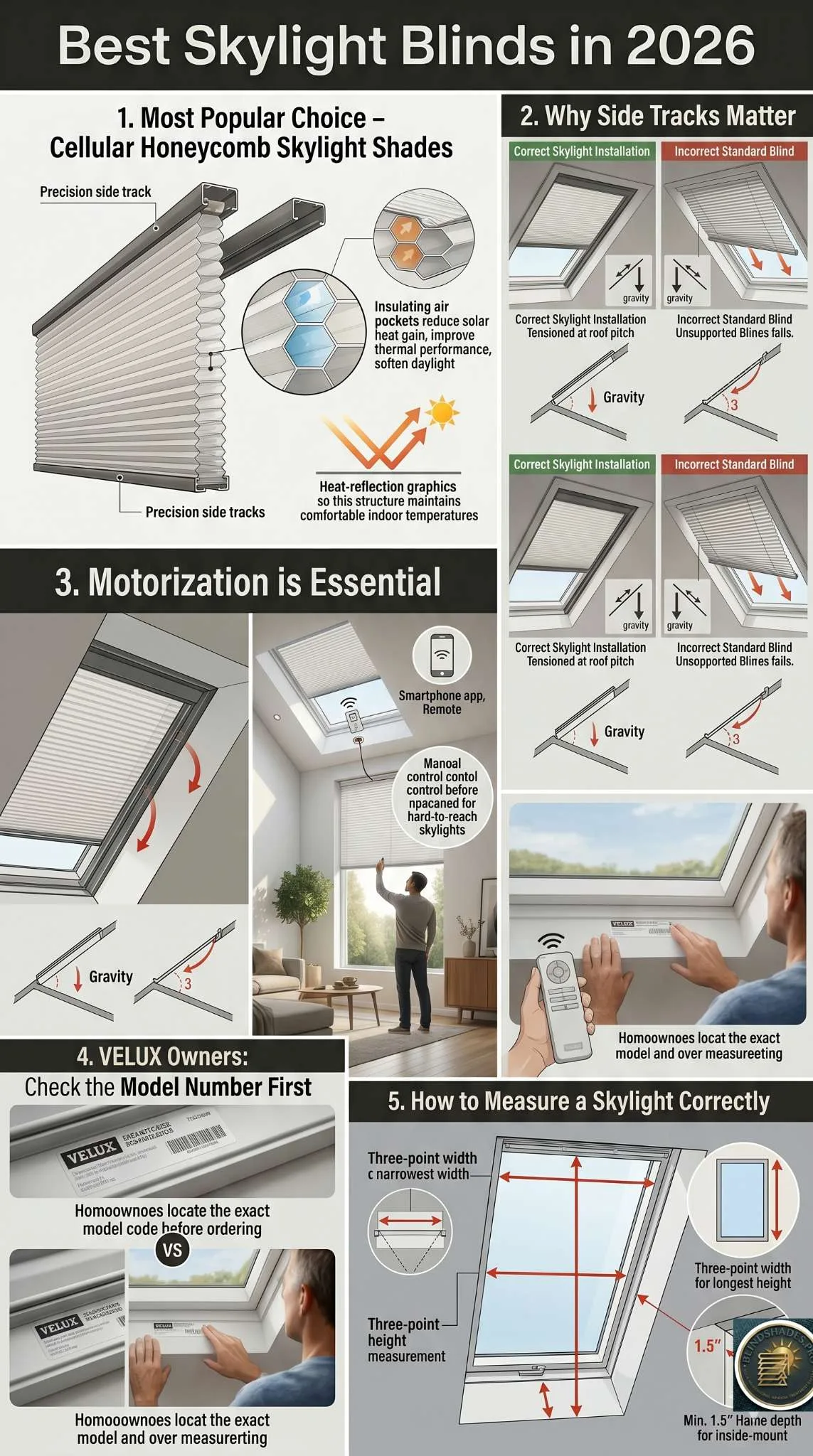
By Michael Turner, 30 years in the window treatment industry
Cellular honeycomb shades with side channels are the most popular and most recommended skylight blind — the channels hold the shade against gravity on sloped glass and seal the edges where heat sneaks past the fabric. That is the short answer. The complete answer runs through three gates: Slope (how the shade fights its own weight on angled glass), Seal (whether the edges actually stop heat, because opacity alone doesn’t), and Reach (how you’ll operate a window twelve feet overhead — pole, cordless, or motor). This guide covers all three, plus the two decisions the rest of this category skips: the Velux proprietary-versus-universal fork, and the exterior shades that stop heat before it ever touches the glass.
Key Takeaways
- Side channels are the qualifying spec, not an upgrade. On sloped or flat overhead glass, a shade must be held against its own weight across the span — channel-guided and tensioned systems are why cellular dominates this category.
- Skylights are the hottest glass in the house. Overhead glazing takes near-perpendicular summer sun while walls take glancing angles, and the room’s warmest air pools directly against the ceiling glass — so edge sealing beats fabric opacity for heat control.
- The Velux fork is real. Manufacturer-proprietary blinds guarantee exact size-code fit, track alignment, and warranty compatibility — at roughly triple the universal price; community threads name Smartwings as the credible alternative. Measure the data plate before ordering anything.
- Motorized is a three-decision purchase, not one. Solar, battery, or wired power; then wifi, Zigbee, Z-Wave, or HomeKit protocol — a March 2026 r/HomeImprovement thread puts the protocol choice ahead of the shade itself.
- Read the ratings inversion before paying premium. On the current market, custom skylight cellulars at over three hundred dollars rate as low as three point zero to three point three, while a twenty-eight-dollar trim-at-home shade holds three point nine across one hundred thirty-eight reviews — on sloped glass, fit failure, not fabric, drives disappointment.
⭐ Quick Answer — The Best Skylight Blinds & Shades
The best skylight blinds are cellular honeycomb shades with side channels — chosen at three gates: Slope (channels hold the shade against gravity), Seal (sealed edges stop heat that opacity alone cannot), and Reach (pole, cordless, or motor for glass overhead):
- The channel rule: on sloped glass a shade must be held, not hung — side channels are the qualifying spec, and they seal the edges where pooled ceiling heat leaks past any fabric; the buffer-cell science is on record at Blindsgalore.
- The editorial consensus: cellular first for insulation, motorized rollers for hard-to-reach glass — the ranked three-pick roundup is at Family Handyman (January 2025).
- The brand fork: manufactured skylights face the proprietary-vs-universal decision — exact size-code fit and warranty at Velux prices, or universal customs at a third of it; the playbook is in Velux skylight blinds.
- The heat truth: interior shades manage heat that already entered — exterior kits and sealed edges stop it earlier; the full thermal playbook is in skylight blinds for heat reduction.
- Start with the shortlist: ranked picks for every budget and reach are in the best blinds for skylights.
Quick Specification Reference
| Specification | The Short Answer |
|---|---|
| Best overall | Blindsgalore Gallery Skylight Cellular — around one hundred thirty-three dollars at half off, four point five across thirty-nine reviews |
| Best budget / temporary | IKEA SCHOTTIS pleated — around six dollars, four point one across two thousand five hundred reviews; Redi Shade trim-at-home around twenty-eight |
| Best motorized | Kurlax motorized roller — around one hundred thirty-nine dollars, four point seven across thirty-seven reviews |
| Best for Velux skylights | Velux solar-powered room-darkening — around three sixty-nine at Lowe’s, four point six across forty-six reviews; Smartwings the community alternative |
| Best for pure heat | Exterior shade kit (EZ Snap class, around sixty-seven dollars) — stops solar gain before the glass |
| Typical cost range | Eighty-two to two twenty-one per Blindsgalore’s category; one thirty-seven to seven-oh-five per American Blinds |
| The qualifying spec | Side channels or tension tracks — gravity control plus edge seal on sloped glass |
| Power/protocol | Solar, battery, or wired; wifi, Zigbee, Z-Wave, or HomeKit — decide before buying the shade |
Read the complete guide below for: the six Diamond picks with the premium-ratings warning, the Slope-Seal-Reach Test, the heat-interception physics that explains why skylights cook rooms and what actually stops it, the Velux proprietary-versus-universal decision, the motorized power and protocol matrix, measuring and installation rules for overhead glass, and where to buy — each section handing off to a dedicated deep-dive guide.
What Are the Best Skylight Blinds & Shades? Our Picks
Six picks, one per job — each verified against live market listings, with the ratings fine print stated where it matters most in this category.
The best skylight blinds for most homes is a channel-guided cellular shade, but “most homes” hides four forks — budget, motorization, brand lock-in, and heat-first buyers. These six cover the map.
Best Overall — Blindsgalore Gallery Skylight Cellular. Custom-sized honeycomb with the air-trapping cell structure Blindsgalore’s own category page describes as a buffer against the glass — listed around one hundred thirty-three dollars at half off with a four point five rating across thirty-nine reviews, from a store rated four point seven across four thousand six hundred buyers. The Select line runs cheaper (around eighty-two at half off, four point nine across fifteen).
Best Budget / Temporary — IKEA SCHOTTIS, with Redi Shade as the no-tools upgrade. Honesty first: the six-dollar SCHOTTIS pleated shade is a temporary fix, and it is also the single most-reviewed product on this market — four point one across two and a half thousand buyers. The Redi Shade Easy Lift trim-at-home cordless (around twenty-eight dollars, three point nine across one hundred thirty-eight) adds proper cordless lift and scissor-trim sizing. Neither has side channels; both are stopgaps that outscore several three-hundred-dollar customs below.
Best Motorized — Kurlax Motorized Skylight Roller. Around one hundred thirty-nine dollars — the exact price the market’s own consensus quotes as the motorized entry point — at four point seven across thirty-seven reviews, with light-filtering and automatic variants at the same price holding four point nine. The custom-fabric motorized route is Blindsgalore’s Smart Motorized Skylight at around one ninety-six half off, four point eight across fifteen.
Best for Velux Skylights — Velux Solar-Powered Room-Darkening Shade. Around three hundred sixty-nine dollars at Lowe’s, four point six across forty-six reviews: solar-charged, exact size-code fit, track alignment, and warranty compatibility — the whole proprietary case in one SKU. The community alternative, named in r/homeowners: Smartwings, which builds Velux-compatible motorized shades at a fraction of the price. The full fork is argued two sections down.
Best Blackout — Veneta Custom Cordless Blackout Skylight Cellular (via Home Depot). The ranked product page of this category: cordless blackout cellular, widths from nine to fifty-nine inches, multiple blackout fabrics. For overhead bedroom glass it pairs with the edge-seal logic in the heat section — blackout fabric with unsealed edges still glows at the perimeter.
Best Exterior / Heat-First — EZ Snap Exterior Skylight Shade Kit. Around sixty-seven dollars: an outside-mounted mesh that intercepts solar gain before the glazing — the only architecture that stops heat rather than managing it, and the honest answer for sunbelt rooms, RVs, and flat-roof bubbles alike.
| Pick | Product | Approx. Price (as listed) | Rating / Reviews | Wins the gate for |
|---|---|---|---|---|
| Best Overall | Blindsgalore Gallery Skylight Cellular | Around one thirty-three (half off) | 4.5 / 39 | Channel-sealed insulation, custom fit |
| Best Budget | IKEA SCHOTTIS · Redi Shade trim-at-home | Around six · around twenty-eight | 4.1 / 2,500 · 3.9 / 138 | Honest temporary coverage |
| Best Motorized | Kurlax motorized roller | Around one thirty-nine | 4.7 / 37 | Hard-to-reach glass, smart-home entry |
| Best for Velux | Velux solar room-darkening | Around three sixty-nine | 4.6 / 46 | Exact fit + warranty; Smartwings alternative |
| Best Blackout | Veneta cordless blackout cellular | Custom by size | Ranked product page | Bedroom-grade darkness overhead |
| Best Exterior | EZ Snap exterior kit | Around sixty-seven | Category pioneer | Stopping heat before the glass |
For the ranked shortlist without the theory, the quick-picks spoke is the best blinds for skylights.
How Do You Choose? The Slope-Seal-Reach Test
Three gates, in order: whether the shade can fight gravity, whether the edges actually seal, and how you’ll reach glass you cannot touch.
Gate 1 — Slope. A wall shade hangs; a skylight shade must be held. On angled or flat overhead glass, fabric sags across the span under its own weight unless side channels, tension tracks, or taut guide wires carry it. This single mechanical fact disqualifies most ordinary window products and explains why the category’s consensus pick is channel-guided cellular — the honeycomb is light, rigid across pleats, and made to run in tracks. It is also why trim-to-fit temporary shades, which tension into the frame, work better overhead than their price suggests.
Gate 2 — Seal. Heat control on a skylight is an edge problem before it is a fabric problem — the physics section next explains why. The practical rule: a channel-sealed light-filtering shade will out-perform an unsealed blackout shade for temperature, and the two together (sealed and opaque) are the bedroom answer.
Gate 3 — Reach. Be honest about the ceiling. Up to about ten feet, a telescoping pole crank or an extended cordless wand is fine daily. Past that — stairwells, vaulted great rooms, double-height entries — operation friction wins and the shade never moves, which is how skylights end up permanently baking rooms. Motorization is the fix, and it is a three-decision purchase covered below.
| Gate | The question | Pass looks like | Fail routes to |
|---|---|---|---|
| Slope | Can the shade hold flat on angled glass? | Side channels, tension track, or guide wires | Sagging fabric, light gaps, early failure |
| Seal | Do the edges stop convective heat? | Channel-sealed perimeter | Perimeter glow + heat leak past any fabric |
| Reach | Will you actually operate it? | Pole under ~10 ft; motor above | A shade that never moves |
Why Are Skylights the Hottest Glass in the House?
Two pieces of physics the ranked pages never explain: the angle of the sun, and where hot air goes.
First, geometry. In summer, the midday sun sits high — its rays strike vertical wall windows at a glancing angle, which reflects a meaningful share of the energy away. The same rays hit sloped and flat roof glass near-perpendicular, delivering close to maximum solar gain per square foot, for more hours, at the hottest time of day. Square foot for square foot, overhead glazing admits far more summer heat than any wall window in the house.
Second, the stack effect. Warm air rises and pools against the ceiling — directly against the skylight glass and whatever shade covers it. On a wall window, room air circulates past the treatment; overhead, the hottest air in the room presses continuously on the shade’s edges. Any unsealed gap becomes a convection channel, ferrying pooled heat around the fabric no matter how reflective or opaque it is. This is the mechanical reason side channels matter more than fabric spec, and it is the reason the same cellular shade genuinely performs differently overhead than it does on a wall.
Which leads to the interception question: where do you stop the heat?
| Layer | Where the sun is stopped | Effect | The honest trade |
|---|---|---|---|
| Exterior shade (EZ Snap / HeatBlocker class) | Before the glazing | Gain never enters — the strongest pure-heat play | Weather exposure; look; seasonal install |
| Between-glass blinds | Inside the glazing unit | Absorbed heat partly vents within the unit; zero dusting | Replacement-unit cost; tilt-only control |
| Interior shade (cellular etc.) | After the glass | Heat is already inside; sealed cells slow its entry into the room | Needs channel seal to work; re-radiates without it |
Exterior interception is the category’s open secret: a mesh screen outside the glass beats any interior fabric for pure heat, because it stops the gain before the glazing instead of arguing with it afterward. The full heat playbook — including the fabric-color and reflective-backing details — is in skylight blinds for heat reduction, the no-purchase and DIY fixes are in how to block sun through a skylight, and the sealed-unit route is mapped in blinds between skylight glass with the whole family covered in the integral between-glass blinds guide.
Should You Buy Velux Blinds or Universal Skylight Shades?
The fork every manufactured-skylight owner hits: exact fit and warranty at triple the price, or universal fit and choice at a third of it.
If your skylight is a Velux, a Fakro, or another manufactured unit, you are standing at a genuine fork, and the market’s own consensus states the proprietary case fairly: the manufacturer’s blind guarantees an exact fit, perfect track alignment, and warranty compatibility. Velux’s solar-powered room-darkening shade — around three hundred sixty-nine dollars, four point six across forty-six reviews — arrives sized to the unit’s code, clips into engineered tracks, charges itself, and never voids anything.
The counter-case is arithmetic. Universal custom skylight cellulars run eighty-two to two twenty-one on Blindsgalore’s board; motorized universals start around one thirty-nine. Three shades into a vaulted room, the proprietary premium buys a fourth skylight. And the middle path exists: r/homeowners’ recurring answer to “alternatives to Velux blinds” is Smartwings, which builds Velux-compatible motorized shades — size-code fit without the size-code price.
| Factor | Velux proprietary | Universal / compatible |
|---|---|---|
| Fit | Exact size-code, engineered tracks | Measured fit; channels adapt, precision is on your tape measure |
| Warranty | Preserves unit warranty | Neutral if no drilling into the frame; verify before drilling |
| Price | Around three sixty-nine per shade | Roughly eighty to two twenty custom; one thirty-nine motorized entry |
| Choice | The catalog is the catalog | Every fabric, cell size, and opacity on the market |
| Middle path | — | Smartwings-class Velux-compatible motorized |
| The rule | Read the data plate | Measure the glass AND the frame — twice |
Every manufactured skylight carries a data plate on the frame with its size code — read it before ordering anything, proprietary or not. The full brand playbook is in Velux skylight blinds, and the tape-measure sequence for universals is in how to measure skylight blinds.
Are Motorized Skylight Blinds Worth It — and Which Motor?
Above ten feet, motorization is not a luxury; it is the difference between a shade that works and a shade that decorates. The real decision is power and protocol.
A March 2026 r/HomeImprovement thread on this exact topic puts it plainly: go motorized, and choose the motor type — Zigbee, Z-Wave, or wifi. That is the correct order of operations, and a twenty-five-post r/homeautomation thread on HomeKit skylight shades confirms the fourth lane. The shade is fabric; the motor is the product.
Power first. Solar is the skylight’s natural answer — the panel sits on the sunniest glass in the house and never needs a ladder; it is how Velux’s own shade works. Rechargeable battery is the universal default (Kurlax class, around one thirty-nine) — plan on a top-up every few months via pole or ladder. Wired is forever but wants a wire run during construction or renovation, not after.
Protocol second. Wifi motors (most budget motorized, Kurlax included) pair fast with Alexa and Google Assistant — the two names the market consensus itself attaches to motorized skylight shades. Zigbee and Z-Wave ride a hub for better battery behavior and mesh reliability across many shades. HomeKit-native units are the scarce lane — the r/homeautomation thread exists because demand outruns supply — so Apple households should verify certification before buying, or bridge via hub.
| Decision | Options | Best for | Watch-out |
|---|---|---|---|
| Power | Solar · rechargeable battery · wired | Solar for sun-baked glass; battery for retrofits; wired for new builds | Battery top-ups need reach; wire runs need walls open |
| Protocol | Wifi · Zigbee · Z-Wave · HomeKit | Wifi for simple voice control; Z-Wave/Zigbee for whole-home meshes; HomeKit for Apple houses | HomeKit-native supply is thin — verify, don’t assume |
| Control | Remote · app · automation | Automation wins: close on heat, open at dawn | A shade on a schedule beats a shade on a remote |
Entry pricing is honest: Kurlax motorized rollers at one thirty-nine (four point seven across thirty-seven), Blindsgalore Smart Motorized around one ninety-six half off (four point eight), SelectBlinds no-drill motorized blackout around two-oh-seven at half off. The deep dive — hubs, scenes, torque, and the app-ecosystem decisions that outlast the fabric — is motorized skylight blinds, and the whole-home strategy lives in the complete motorized and smart blinds guide.
How Do You Operate a Skylight You Can’t Reach?
Match the operation to the ceiling height — and be honest about what you’ll still be doing in February.
| Ceiling / access | Operation that actually works | Notes |
|---|---|---|
| Reachable (≤ ~8 ft) | Cordless handle or crank | Any quality shade qualifies |
| Pole range (~8–10 ft) | Telescoping pole crank / pole-hook cordless | Buy the pole with the shade — matched hooks matter |
| Beyond pole (10 ft+) | Motorized (solar or battery) | The only answer used daily |
| Stairwells / over voids | Motorized, installed from scaffold once | Plan install access before ordering |
One category-specific honesty: hand-operated shades over stair voids and double-height spaces get operated exactly twice a year. If the budget forces manual there, choose light-filtering over blackout — a permanently closed blackout shade turns a skylight into a dark ceiling panel you paid to install.
How Do You Measure and Install Skylight Blinds?
Measure the glass and the frame separately, decide inside-frame or on-frame mounting, and respect the slope during install.
| Step / Spec | The rule |
|---|---|
| Manufactured units | Read the data plate size code first — it may end the measuring |
| Glass vs frame | Measure visible glass AND inside-frame width/length separately; channels mount to the frame |
| Squareness | Measure width at both ends and the middle — sloped frames rack; use the smallest |
| Mount | Inside-frame for channel systems; on-frame for tension and temporary shades |
| Depth | Confirm frame depth for the channel profile plus the shade stack |
| Install order | Channels first, square and parallel; shade cassette second; never force a racked channel |
The full sequence with the deduction table is in how to measure skylight blinds, and the bracket-by-bracket walkthrough — including working on a ladder against sloped glass safely — is in how to install skylight blinds. Flat-roof domes and modern flat glazing follow their own rules, mapped in flat roof skylight blinds. And if the skylight in question is on a trailer or motorhome — a live question in RV communities, where replacement units orphan old shades — that lane has its own constraints and its own guide coming in our RV blinds series: see the best RV blinds and shades.
Which Shade Type Wins for Insulation, Blackout, and Budget?
Cellular for insulation, sealed blackout cellular for bedrooms, pleated and roller for budget — with the fabric science living in the cellular guide.
The insulation verdict is the least contested in the category: honeycomb cells trap air against the glass, and every editorial and store source on the market — from Family Handyman’s January 2025 three-pick roundup to Blindsgalore’s buffer-cell explanation — lands on cellular first. The single-cell versus double-cell decision, R-value expectations, and fabric chemistry live in the complete cellular and honeycomb shades guide, with the skylight-specific application in cellular shades for skylights.
Blackout overhead follows the seal rule: opaque fabric plus channel-sealed edges, or the perimeter glows at sunrise like a picture frame. Veneta’s cordless blackout cellular (the category’s ranked product page, widths nine to fifty-nine inches) and Bali’s custom blackout cellular (around two twenty-three, three point eight across one hundred ninety-two) are the mainstream routes; the whole-room darkness strategy — including when a skylight makes true blackout impossible without between-glass or exterior help — is in the complete blackout blinds and shades guide.
Budget routes are the temporary tier above (SCHOTTIS, Redi Shade) plus honest mid-market customs: BlindsOnLine’s light-filtering skylight cellular at around seventy-five dollars in thirty-five colors (four point five across twenty-five) and Blinds.com’s Bali-built customs from around one nineteen (four point six across eighty-three).
Where Should You Buy Skylight Blinds — and Why Do Premium Ratings Invert?
Buy the channel system, not the fabric brand — and read this category’s strangest signal before spending three hundred dollars.
| Retailer / Route | Listed range (as published) | Rating shown | Watch-out |
|---|---|---|---|
| Blindsgalore (custom direct) | Eighty-two to two twenty-one | 4.7 store / 4,600 | Half-off is the real price |
| American Blinds (custom direct) | One thirty-seven to seven-oh-five | 4.8 store / 680 | Premium lines carry the seven-hundred ceiling |
| Home Depot / blinds.homedepot (Veneta, Bali, Levolor) | Two twenty-three to three forty-one customs | Per product — see inversion below | Same-brand listings split; sort by review count |
| Kurlax / Graywind (motorized direct) | One thirty-nine to two sixty-five | 4.7/37 vs 2.5/2 | Tiny review bases on some motorized lines |
| Lowe’s (Velux proprietary) | Around three sixty-nine | 4.6 / 46 | Size-code match is on you |
| IKEA / Redi Shade (temporary) | Six to twenty-eight | 4.1/2.5K · 3.9/138 | Stopgaps — no channels, no seal |
The inversion, spelled out: Levolor’s custom blackout skylight cellular at three hundred forty-one dollars rates three point three across forty-eight reviews, and its light-filtering twin at three thirty-two rates three point zero across forty-one — while the six-dollar IKEA holds four point one across two and a half thousand and the twenty-eight-dollar Redi Shade holds three point nine across one thirty-eight. Premium price, inverted satisfaction. The mechanism isn’t fabric quality; it is fit. A custom shade on sloped glass has zero tolerance — a racked channel or a measurement taken at one end of a non-square frame produces gaps, binding, and a one-star review, while a six-dollar tension shade is forgiven everything. The defense is unglamorous: the measuring section above, followed to the letter. Cheap shades get graded on effort; expensive shades get graded on precision.
Related guides: overhead glass loses winter heat like any window, only faster — the trap-and-seal system is in the thermal insulated blinds guide.
Related Buying Guides
- Best Cellular & Honeycomb Shades — the insulation science behind the category’s default answer
- Best Motorized & Smart Blinds — power, protocols, and app ecosystems
- Best Blackout Blinds & Shades — whole-home darkness strategy
- Best Integral Between-Glass Blinds — the sealed-unit family, skylights included
- Best RV Blinds & Shades — trailer and motorhome skylights live here
Complete Skylight Guide Library
- Best Blinds for Skylights — the quick-picks shortlist
- Cellular Shades for Skylights — the default answer, fully argued
- Motorized Skylight Blinds — motors, hubs, and automation
- Velux Skylight Blinds — the proprietary playbook
- Skylight Blinds for Heat Reduction — the full thermal playbook
- How to Block Sun Through a Skylight — DIY and no-purchase fixes
- Blinds Between Skylight Glass — the sealed-unit route
- How to Measure Skylight Blinds — data plates, glass vs frame, squareness
- How to Install Skylight Blinds — channels, cassettes, and ladder safety
- Flat Roof Skylight Blinds — domes and flat glazing
Frequently Asked Questions
What are the best blinds for skylights? Cellular honeycomb shades with side channels — the channels hold the shade flat against sloped-glass gravity and seal the edges where pooled ceiling heat leaks past any fabric. The best skylight blinds beyond that default: motorized rollers from around one thirty-nine for hard-to-reach glass, proprietary Velux shades where exact fit and warranty rule, and exterior shade kits where heat is the entire problem.
Do skylight shades really reduce heat? Yes — with two conditions. Interior shades must be edge-sealed (channel systems), or the room’s hottest air convects around the fabric; and expectations should be honest, because an interior shade manages heat that has already entered. For maximum reduction, intercept earlier: exterior shade kits stop solar gain before the glazing, and between-glass blinds absorb it inside the sealed unit.
Are Velux blinds worth the price? For a single hard-to-reach Velux where fit, track alignment, solar power, and warranty all matter — often yes. Across multiple skylights, the arithmetic favors universal customs at a third the price, or the middle path community threads recommend: Smartwings-class Velux-compatible motorized shades. Either way, read the frame’s data plate size code before ordering.
How do you operate a skylight blind you can’t reach? Up to about ten feet, a telescoping pole crank or pole-hook cordless shade works daily. Beyond that, motorize — solar-powered where the glass gets sun, rechargeable battery otherwise — because a shade that requires a ladder is a shade that never moves.
What do skylight blinds cost? The custom market runs eighty-two to two hundred twenty-one dollars per Blindsgalore’s listings and one thirty-seven to seven-oh-five per American Blinds’ premium lines. Motorized starts around one hundred thirty-nine, Velux proprietary runs around three sixty-nine, and honest temporary fixes run six to twenty-eight dollars.
Can you put blinds between skylight glass? Only as part of the glazing unit — between-glass blinds live inside a sealed unit, so the route is a replacement unit or a skylight ordered with integral blinds, not a retrofit onto existing glass. The trade is permanence for zero dusting and zero reach problems; the full decision is in our between-glass guides above.
