How Do You Block Sun Through a Skylight?

Authored By Michael Turner -30 Years Home Improvement Expertise | Updated 2026 | BlindShades.pro
Updated on July 15, 2026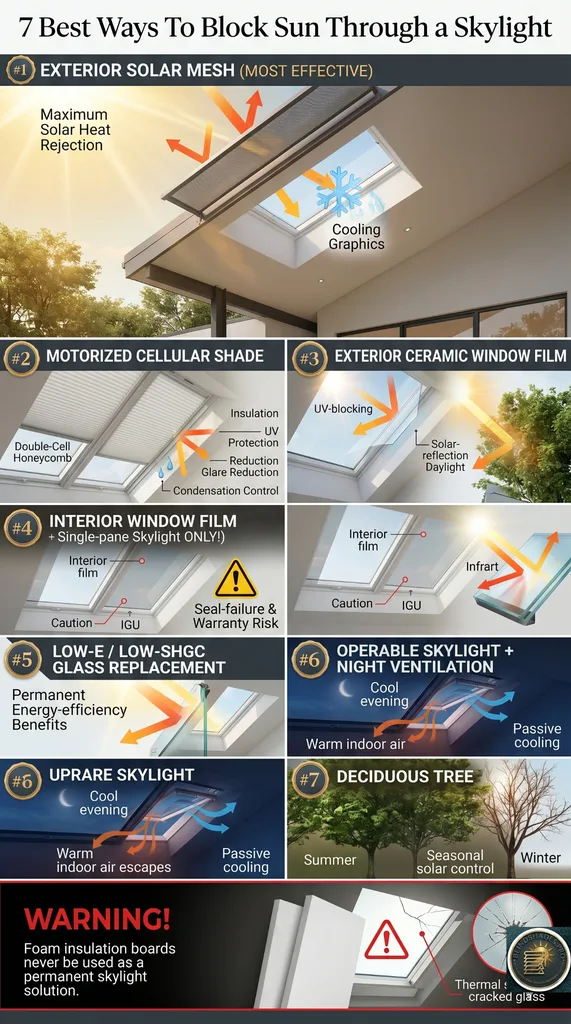
Key Takeaways:
- The US DOE confirms that skylights and windows are the source of up to 48 percent of summer heat buildup inside a home; EZ Snap confirms outdoor-mounted skylight shades have been proven by the DOE to be up to 7 times more effective than interior skylight blinds, shades, or tinting — the best method to block sun through a skylight is to intercept it before it reaches the glass
- Never apply window film to the interior surface of a double-pane skylight without confirming manufacturer warranty compliance; interior film reflects solar heat back into the skylight’s insulating glass unit seal; this thermal cycling (cold shade to full sun and back) stresses the seal and can cause it to fail; if the seal fails, moist warm interior air enters the space between the glass panes causing condensation and permanent loss of the skylight’s R-value; EZ Snap confirms this risk explicitly and most skylight manufacturers will not warranty skylights with interior film applied
- The foam insulation board method (cutting a foam board to fit inside the skylight shaft) carries a glass-cracking risk that is absent from most descriptions of this approach; EZ Snap warns: “the biggest drawback with this method is that you are now trapping all the heat between the skylight and the insulation; this heat can build up to the point that your seals could fail or your glass could crack”; use only as a temporary solution and never leave a foam board in place during high sun periods
- For a new skylight purchase or glass replacement, the Solar Heat Gain Coefficient (SHGC) is the single most important specification for blocking solar heat; SHGC is the fraction of solar radiation that becomes heat in the room; a skylight with SHGC 0.20 admits only 20 percent of solar radiation as heat (excellent for hot climates); a skylight with SHGC 0.60 admits 60 percent; selecting a low-SHGC skylight (0.20 to 0.30) can eliminate 60 to 80 percent of solar heat gain at the glass level without any separate treatment
- For operable (venting) skylights, opening the skylight at sunset and closing it at sunrise provides a free passive cooling strategy: hot room air rises through natural convection and exits through the open skylight (the stack effect), while cooler outdoor night air enters through lower windows; this can reduce the room temperature by 5 to 10 degrees Fahrenheit by morning, significantly reducing the next day’s starting temperature before solar gain begins
⭐ Quick Answer — How Do You Block Sun Through a Skylight?
- The Most Effective Method — Exterior Solar Mesh — and Why It Outperforms Interior Solutions: The best way to block sun through a skylight is to intercept the solar radiation before it reaches the glass. EZ Snap (January 2026) confirms: “outdoor mounted skylight shades have been proven by the U.S. Department of Energy to be up to 7 times more effective than interior skylight blinds, shades, or tinting.” An exterior solar mesh blocks up to 90% of the sun’s heat while still transmitting natural light. The DOE endorsement is significant: skylights and windows are typically the source of up to 48% of the heat buildup inside a home during summer (EZ Snap citing DOE). The exterior mesh stops this heat before it enters the glass — before the greenhouse conversion occurs — making it the most thermally effective option. EZ Snap also confirms exterior mesh “does not damage the skylight or void your warranty” because it does not contact the glass surface. For the interior equivalent, the best solution is a motorized double-cell cellular shade with light-colored reflective fabric — blocking 50 to 65% of heat gain with R-3 to R-5 insulation, UV protection, and condensation reduction
- The Interior Window Film Warning — Seal Failure and Warranty Voiding on Double-Pane Skylights: The most important caution when choosing how to block sun through a skylight: never apply window film to the interior surface of a double-pane insulating glass unit (IGU) skylight. EZ Snap explicitly confirms: “skylight tinting or glass film are installed on the inside and reflect heat back into the skylight’s weather seal. This can damage the seal, causing it to expand and contract every time there is a temperature change. If this continual super-heating and cooling of the skylight’s seal causes it to fail, moist warm inside air gets into the space between the layers of glass causing condensation and loss of the skylight’s insulation value or R-value.” The DoItYourself community confirms: “installed on the inside, [window film] reflects the heat back into the glass and will likely result in seal failure. Every window company I know of will not warranty windows with film applied.” The rule: exterior ceramic film (applied to outside glass surface) is safe — blocks 50%+ heat and 99% UV with maintained visibility (Finest Shade confirmed); interior film on double-pane IGU = seal failure risk and manufacturer warranty void
- The Foam Board Crack Risk and the Free Night Ventilation Strategy: Two lesser-known methods for those wanting to block sun through a skylight. (1) Foam insulation board risk: cutting a foam board to fit inside the skylight shaft blocks nearly all light and heat but carries a glass cracking risk. EZ Snap warns: “the biggest drawback with this method is that you are now trapping all the heat between the skylight and the insulation; this heat can build up to the point that your seals could fail or your glass could crack.” Use foam boards only as a temporary seasonal solution (e.g., winter months), never during high-sun summer periods when direct overhead radiation is intense. (2) Free night ventilation: for operable (venting) skylights, opening the skylight at sunset and closing it at sunrise provides free passive cooling via the stack effect — warm room air rises and exits through the open skylight; cooler outdoor night air enters through lower windows. OConnor Contracting (February 2026) confirms this passive ventilation approach. This can reduce room temperature by 5 to 10 degrees Fahrenheit by morning, significantly reducing the starting temperature before daytime solar gain begins
- Understanding SHGC — The Permanent Solution for New Skylight Purchases: For homeowners purchasing a new skylight or replacing existing glass, the Solar Heat Gain Coefficient (SHGC) is the most effective permanent way to block sun through a skylight. SHGC is the fraction of solar radiation admitted through the glass that becomes room heat. SHGC 0.20 = only 20% of solar radiation becomes heat (excellent for hot climates). SHGC 0.30 = 30% becomes heat. SHGC 0.60 = 60% becomes heat (limited solar control). A low-SHGC skylight with a Low-E coating (0.20 to 0.30) eliminates 60 to 80% of solar heat gain at the glass level — permanently, without any separate blind, film, or mesh treatment. Building America Solution Center recommends “high-performance low-e windows with a low solar heat gain coefficient” as the most effective permanent solution. For hot climates: specify SHGC ≤ 0.30 for new or replacement skylight glass. For cold climates where winter solar gain is beneficial: specify SHGC ≥ 0.45 and use interior cellular shades for summer management
- The Deciduous Tree Strategy and the Consequences of Paint and Tarp Methods: Two additional approaches for those wanting to block sun through a skylight. (1) Deciduous tree planting: Building America Solution Center confirms: “deciduous trees located on the south side of a house will block summer sun while allowing beneficial solar heat gain in winter.” A deciduous tree planted within 10 to 30 feet south of the home, with a high canopy that arches over the roof, blocks 40 to 80% of direct overhead solar radiation in summer when in full leaf; in winter, bare branches allow 70 to 90% of low-angle winter sunlight through for free passive heating. Cost: $50 to $300 for a young tree; 3 to 5 years to effective shading height. (2) Paint and tarp consequences: painting the skylight glass blocks all incoming light permanently — destroying the skylight’s function — and UV exposure blisters exterior paint within 1 to 2 years. A roof tarp blocks all light but creates a waterproofing risk (water pooling under the tarp) and can be removed by wind. Both DIY options are impractical as seasonal solutions. The practical recommendations remain exterior solar mesh (partial heat block; light maintained; reversible) and motorized cellular shade (interior; insulation; reversible)
- Best Sources: Exterior solar mesh with 90% heat block and DOE effectiveness confirmation → EZ Snap skylight exterior shades · DOE guidance on exterior vs interior shading, Low-E glass with low SHGC, and landscaping shading → Building America Solution Center shading guide · Passive ventilation, solar heat gain explanation, and insulated solar shade options → OConnor Contracting skylight heat guide
⚠️ The Complete 9-Method Comparison to Block Sun Through a Skylight: All methods to block sun through a skylight ranked by heat blocked: (1) Exterior solar mesh (EZ Snap): up to 90% heat; $100 to $300; reversible; no seal contact; does not void warranty; DOE 7x more effective than interior. (2) Motorized cellular shade: 50 to 65% heat; $150 to $400; reversible; R-3 to R-5 insulation; 80 to 95% UV; condensation reduction. (3) Ceramic window film on exterior glass surface: 50%+ heat; 99% UV; $50 to $200; maintains visibility; safe on double-pane IGU. (4) Interior window film on double-pane IGU: 30 to 50% heat; $30 to $150; DANGER: reflects heat into IGU seal; seal failure risk; voids manufacturer warranty; do NOT use on double-pane. (5) Low-E / low-SHGC glass replacement: 60 to 80% SHGC improvement; $500 to $2,000 per skylight; permanent; requires skylight glass replacement. (6) Operable skylight + night ventilation: 5 to 10°F overnight reduction; free (cost of venting skylight upgrade); reversible nightly. (7) Deciduous tree planting: 40 to 80% summer shade; $50 to $300 tree; 3 to 5 years to effective height; permanent; allows winter passive solar. (8) Foam insulation board: 95%+ (all light blocked); $20 to $30; DANGER: glass crack risk (EZ Snap confirmed); use temporary only; never in summer. (9) Paint on glass: 100% (all light blocked); $10 to $20; destroys skylight function; UV blistering within 1 to 2 years; not recommended. For the greenhouse mechanism explaining why exterior interception is 7x more effective than interior blocking, and the seasonal scheduling protocol for maximum energy savings, see How Do Skylight Blinds Reduce Heat and Glare. See the full 7-method comparison below.
💡 SHGC Selection Guide and the Night Ventilation Operating Protocol: For those looking to block sun through a skylight permanently through glass specification: SHGC by climate — hot climates (US South, Southwest, Australia): specify SHGC 0.20 to 0.25 (Low-E triple coating); this eliminates 75 to 80% of solar heat gain at the glass level with no additional treatment. Mixed climates (US Midwest, Mid-Atlantic, UK): specify SHGC 0.25 to 0.35 (Low-E double coating); pair with interior cellular shade for summer peak hours. Cold climates (northern US, Canada, northern Europe): specify SHGC 0.40 to 0.55 (low-e for U-factor improvement but higher SHGC for winter passive solar benefit); use interior cellular shade seasonally. Night ventilation operating protocol for operable skylights: (1) At sunset or when outdoor temperature drops below indoor temperature: open venting skylight and open windows on the opposite side of the home at ground level (cross ventilation). (2) Allow passive stack-effect ventilation to operate overnight — warm room air rises and exits the skylight; cooler outdoor air enters through lower windows. (3) Before sunrise: close the skylight and windows before solar gain begins to trap the overnight coolth in the room. (4) In high-humidity climates: close before morning dew point to prevent humid outdoor air from entering. For the best skylight type for passive ventilation in a retrofit, look for Velux or Fakro venting models with solar-powered motors and rain sensors that close automatically when rain is detected. EZ Snap confirms its exterior mesh can be used alongside operable skylights — the mesh provides daytime heat reduction while the skylight remains operable for overnight ventilation. For the complete motorized skylight worth-it analysis including the solar motor ceiling-position advantage and the per-year cost by power type, see Are Motorized Skylight Blinds Worth the Cost. See the full night ventilation strategy below.
📖 Read the complete guide below for: the 9-method comparison table (exterior mesh 90% heat / cellular shade 50-65% / exterior ceramic film 50%+ / interior film seal failure warning / Low-E SHGC glass replacement / night ventilation / deciduous tree / foam board crack risk / paint consequences), the DOE confirmation that skylights and windows are the source of up to 48% of summer home heat buildup, the interior window film seal failure mechanism (reflects heat into IGU seal; thermal cycling; seal fails; condensation between panes; R-value lost; voids manufacturer warranty), the foam board glass crack risk (heat trapped in sealed cavity; EZ Snap confirmed), the SHGC plain-language guide (0.20 = 20% solar becomes heat; low-SHGC glass eliminates 60-80% at glass level permanently), the night ventilation stack effect protocol (open at sunset; close at sunrise; 5-10°F overnight room temperature reduction), and the deciduous tree south-planting strategy (summer blocks high-angle sun; winter bare branches allow passive solar).
How to Block Sun Through a Skylight — The 7-Method Comparison
The complete method-by-method breakdown with effectiveness, cost, reversibility, and risks.
EZ Snap (January 2026) states: “Skylights and windows are typically the source for up to 48 percent of the heat buildup inside a home.” OConnor Contracting (February 2026) confirms: “Solar heat gain can raise indoor temperatures by 10 to 20 degrees on sunny days, making your air conditioning work harder and increasing energy costs.”
The 7-method comparison:
| Method | Heat Blocked | Approx Cost | Reversible | Key Risk |
|---|---|---|---|---|
| Exterior solar mesh | Up to 90% | $100–$300 | YES (seasonal) | None (no glass contact) |
| Motorized cellular shade | 50–65% | $150–$400 | YES | Ceiling-level dust (monthly clean) |
| Ceramic film (exterior glass surface) | 50%+ | $50–$200 | Difficult | Professional installation required |
| Interior window film | 30–50% | $30–$150 | Difficult | Seal failure risk on double-pane; voids warranty |
| Low-E / low-SHGC glass replacement | 60–80% improvement | $500–$2,000/skylight | NO | Requires skylight replacement |
| Operable skylight + night ventilation | 5–10°F night reduction | Cost of venting upgrade | YES (nightly) | None if closed before solar gain begins |
| Deciduous tree planting | 40–80% summer shade | $50–$300 (young tree) | NO (permanent plant) | 3–5 years to reach shading height |
| Foam insulation board | 95%+ (all light blocked) | $20–$30 | YES | Glass cracking risk; use temporary only |
| Paint on glass | 100% (no light) | $10–$20 | Difficult | Destroys skylight function; UV blistering |
Method 1 — Exterior Solar Mesh (Most Effective)
The DOE-confirmed top performer — absent from most interior-focused guides.
EZ Snap (January 2026) confirms: “Outdoor mounted skylight shades have been proven by the U.S. Department of Energy to be up to 7 times more effective than interior skylight blinds, shades, or tinting.”
How it works: Exterior solar mesh is installed on the outside of the skylight, above the glass surface. It intercepts solar radiation before it reaches the glass — blocking up to 90% of solar heat while still transmitting natural light into the room.
Why it is the most effective method: An interior blind blocks solar radiation AFTER it has already passed through the glass and partially heated the room. An exterior mesh blocks it BEFORE it enters the glass — preventing the greenhouse conversion entirely.
EZ Snap specific data:
- Blocks up to 90% of the sun’s heat
- Still allows natural light into the room
- Does not touch the glass — does not risk seal failure or void warranty
- DIY installation with no special tools required
The limitation: The exterior mesh is a more visible addition to the roof exterior and may not suit all aesthetic preferences. It must be UV-resistant and weatherproof.
Method 2 — Interior Motorized Cellular Shade (Best All-Purpose Interior Solution)
The top interior treatment combining heat blocking with insulation and UV protection.
From Article 42-9: a motorized double-cell cellular shade with light-colored reflective fabric provides 50–65% heat gain reduction, R-3 to R-5 insulation, 80–95% UV blockage, and condensation reduction — the most comprehensive single interior treatment.
VelaBlinds (September 2025) confirms: “for any skylight, the best solution is a motorized, double-cell honeycomb blind with a light-colored, reflective fabric.”
The advantages over other interior methods:
- Reversible: open during cloudy days or winter to admit light and passive solar heat
- Insulation: reduces winter heat loss as well as summer heat gain
- UV protection: 80–95% UV blockage protects floors, furniture, and artwork
- Condensation reduction: keeps glass above dew point in humid rooms
- No warranty or glass risk: mounted in the frame, not on the glass surface
The Interior Window Film Warning
The seal failure risk absent from all competitor guides.
EZ Snap (January 2026) states explicitly: “Skylight tinting or glass film are installed on the inside and reflect heat back into the skylight’s weather seal. This can damage the seal, causing it to expand and contract every time there is a temperature change — for example, cloud cover to full sun then back to cloud cover. If this continual super-heating and cooling of the skylight’s seal causes it to fail, moist warm inside air then gets into the space between the layers of glass causing condensation and loss of the skylight’s insulation value or R-value.”
DoItYourself community forum confirms: “Installed on the inside, [window film] reflects the heat back into the glass and will likely result in seal failure. Every window company I know of will not warranty windows with film applied.”
The distinction:
- Interior window film (applied to inside glass surface): reflects heat back into the IGU; thermal cycling stress on seal; risk of seal failure; voids warranty on double-pane skylights
- Exterior ceramic film (applied to outside glass surface): reflects heat AWAY from the glass; no trapped heat between film and glass; no seal stress; safer option; maintains clear view; Finest Shade confirms ceramic exterior film blocks 50%+ heat and 99% UV with high visibility maintained
The practical rule: For double-pane (IGU) skylights: only consider exterior film; never interior film. For single-pane skylights (older installations): interior film is acceptable (no IGU seal to damage).
The Foam Insulation Board Warning
The DIY crack risk absent from all guides.
EZ Snap explicitly warns: “The biggest drawback with [the foam insulation board] method is that you are now trapping all the heat between the skylight and the insulation. This heat can build up to the point that your seals could fail or your glass could crack, so proceed with caution.”
Why the crack risk exists: A foam insulation board placed inside the skylight shaft seals the air space between the board and the glass. Direct solar radiation enters through the glass and heats this sealed air pocket. With no airflow to dissipate the heat, temperatures can reach extreme levels (potentially exceeding 70–90°C / 158–194°F in a sealed cavity under direct overhead sun).
At these temperatures:
- The IGU seal can soften and fail
- Thermal stress differentials between the glass center (hot) and the glass edge (cooler) can crack the glass
Safe use: Foam board is acceptable as a temporary seasonal solution (e.g., covering a skylight from October to March when solar gain is not the problem). Never leave foam board in place during high-sun summer periods when direct overhead radiation is intense.
Understanding SHGC and Low-E Glass for New or Replacement Skylights
The glass specification explanation absent from all competitor guides — the most permanent solution.
For homeowners purchasing a new skylight or replacing existing skylight glass, the Solar Heat Gain Coefficient (SHGC) is the most important specification for managing solar heat.
SHGC explained in plain language: SHGC is a number between 0 and 1 representing the fraction of solar radiation admitted through the glass that becomes heat inside the room:
- SHGC 0.20: only 20% of solar radiation becomes room heat; excellent for hot climates
- SHGC 0.30: 30% becomes heat; good solar control
- SHGC 0.40: 40% becomes heat; moderate
- SHGC 0.60: 60% becomes heat; limited solar control
Low-E coatings: Wikipedia confirms: “Glass units typically include at least one low-emissivity (Low-E) coating applied to one or more glass surfaces to reduce the U-factor and especially SHGC by suppressing radiant heat flow.”
A low-SHGC skylight (0.20–0.30) can eliminate 60–80% of solar heat gain at the glass level before any blind, film, or shade is installed. Building America Solution Center recommends “high-performance low-emissivity (low-e) windows with a low solar heat gain coefficient” as the most effective permanent solution for hot climates.
The practical guidance: For new skylight purchases in climates with significant summer cooling loads (US South, Southwest, Australia): specify SHGC ≤ 0.30. For climates where winter heating is the priority and solar heat gain is beneficial: specify SHGC ≥ 0.45 and use interior cellular shades for summer management.
The Night Ventilation Strategy
The free passive cooling method using operable skylights — absent from all guides.
For rooms with operable (venting) skylights, opening the skylight at sunset and closing it at sunrise provides free passive cooling through the stack effect.
The stack effect mechanism: Hot air is less dense than cool air and naturally rises. During the day, solar heat gain warms the room air near the ceiling. At night, when outdoor temperature drops (typically 8–15°F below the daytime high), opening the skylight creates a convection loop:
- Warm light room air rises and exits through the open skylight
- Cooler outdoor air enters through lower open windows
- This natural airflow continues as long as outdoor temperature remains below indoor temperature
The cooling benefit: A room that reaches 82°F during the day can drop to 72–74°F by morning using overnight operable skylight ventilation. This 5–10°F reduction significantly reduces the next day’s cooling load and HVAC run time.
OConnor Contracting (February 2026) confirms: “passive ventilation uses natural airflow to remove heat from your attic. If heat is accumulating due to a skylight, vents allow hot air to escape while cooler air enters the space.”
The operating protocol:
- Open the skylight at sunset (or when outdoor temperature drops below indoor)
- Open lower windows on the opposite side of the home for cross-ventilation
- Close the skylight before sunrise (before solar gain begins)
- In high-humidity climates: close before moisture-heavy morning air enters
The Deciduous Tree Strategy
The natural seasonal shading method absent from all skylight guides.
Building America Solution Center states: “Deciduous trees located on the south side of a house will block summer sun while allowing beneficial solar heat gain in winter.”
How this applies to skylights: A deciduous tree (maple, oak, ash, etc.) planted to the south of the home, close enough that its summer canopy extends over the roof’s skylight position, provides natural seasonal shading:
- Summer: the tree is in full leaf; the dense canopy blocks 40–80% of direct overhead solar radiation before it reaches the skylight glass
- Winter: the tree has lost its leaves; the bare branches allow 70–90% of low-angle winter sunlight to pass through and enter the skylight, providing free passive solar heating
The practical specification:
- Plant a fast-growing deciduous species (red maple, silver maple, honey locust) within 10–30 feet south of the skylight position
- Choose a species with a high canopy (minimum 20 feet at maturity) that will arch over the roof line
- Young tree: $50–$300; reaches effective shading height in 3–5 years for fast-growing species
- Permanent once established; no maintenance needed for shading function
The limitation: Applicable only to ground-floor or first-floor skylights where adjacent tree planting is possible. Not applicable to commercial or high-rise buildings, or to skylights on flat roofs surrounded by other structures.
Paint and Tarp Options — Why They Are Not Recommended
The DIY consequence qualification absent from all guides.
EZ Snap mentions painting a skylight and weighted tarps as “under $100 fixes.” Both options are real but carry significant consequences:
Painting the skylight glass:
- Blocks nearly 100% of incoming light — the skylight loses its function entirely
- UV exposure causes exterior paint to blister and peel within 1–2 years
- Paint removal from glass is difficult and often leaves residue
- Not a reversible solution for any meaningful period
Exterior tarp or weighted material:
- Blocks 100% of light
- Creates a waterproofing risk: water can pool under the tarp and around the edges
- Wind can remove loose tarps and cause damage
- Acceptable as a very temporary emergency measure (e.g., during a vacation week in peak summer)
- Not appropriate as a seasonal or permanent solution
For any situation where blocking sun through a skylight is the goal, the practical recommendations are: exterior solar mesh (partial heat block; light maintained) or motorized cellular shade (interior control; insulation; reversible). Both options deliver meaningful heat reduction without destroying the skylight’s function.
Related guides: DIY fixes buy time — the permanent answers, from channel-sealed cellular to exterior kits, are ranked in our skylight blinds buying guide.
Where to Order
For exterior solar mesh that blocks up to 90% of sun’s heat with DOE-proven effectiveness: EZ Snap at ezsnapdirect.com/products/skylight-shades — outdoor mounting system; 90% heat block; maintains natural light; DIY installation; no special tools; no seal contact; does not void skylight warranty; 7× more effective than interior treatments (DOE confirmed).
For the authoritative DOE guide on exterior vs interior shading effectiveness and low-SHGC glass: Building America Solution Center at basc.pnnl.gov/resource-guides/shading-and-solar-control-windows-and-skylights — exterior architectural shading; low-e glass with low SHGC; landscaping and tree shading; interior vs exterior window attachments; comprehensive technical guidance.
For heat blocking methods including passive ventilation and insulated solar shades: OConnor Contracting at oconnorroofingbuffalo.com/blogs/how-to-block-heat-from-skylights — overview of all methods from passive ventilation to window film; solar heat gain mechanism explained; active vs passive ventilation comparison; HVAC interaction.
Related guides: For complete buying advice, see our thermal and insulated blinds guide.
Frequently Asked Questions
How do you block sun through a skylight? The most effective method to block sun through a skylight is an exterior solar mesh installed above the glass, which blocks up to 90% of solar heat before it enters the glass. The US Department of Energy confirms exterior skylight shades are up to 7 times more effective than interior blinds or film. For interior solutions, a motorized double-cell cellular shade with light-colored reflective fabric blocks 50 to 65% of heat gain while providing insulation, UV protection, and condensation control.
Can you apply window film to a skylight to block sun? Window film applied to the exterior glass surface of a skylight can block 50% or more of solar heat and 99% of UV while maintaining visibility. However, window film applied to the INTERIOR surface of a double-pane skylight creates a serious risk: the film reflects heat back into the insulating glass unit seal, causing thermal cycling stress that can fail the seal and cause condensation between the panes, permanently reducing the skylight’s R-value. EZ Snap and the DoItYourself community forum both confirm interior film can void the skylight manufacturer’s warranty. Only apply film to the exterior surface of double-pane skylights.
Is a foam insulation board safe to use to block a skylight’s sun? A foam insulation board placed inside the skylight shaft blocks nearly all sunlight but carries a glass cracking risk. EZ Snap warns that the heat trapped between the board and the glass can build up to temperatures that fail the IGU seal or crack the glass. Foam boards are acceptable as temporary seasonal measures (e.g., winter months) but should never be left in place during high-sun summer periods when direct overhead radiation is intense.
What is SHGC and how does it help block sun through a skylight? SHGC stands for Solar Heat Gain Coefficient — a number from 0 to 1 representing the fraction of solar radiation admitted through the glass that becomes heat inside the room. A skylight with SHGC 0.20 admits only 20% of solar radiation as heat; a skylight with SHGC 0.60 admits 60%. Selecting a low-SHGC skylight (0.20 to 0.30) can eliminate 60 to 80% of solar heat gain at the glass level without any additional treatment. For new skylight purchases or glass replacements in hot climates, specifying low-SHGC glass with a Low-E coating is the most permanent and maintenance-free solution.
Can opening a venting skylight at night help block daytime sun heat? Opening an operable venting skylight at sunset and closing it before sunrise provides free passive cooling through the stack effect — warm room air rises and exits through the open skylight while cooler outdoor night air enters through lower windows. This can reduce room temperature by 5 to 10 degrees Fahrenheit by morning, significantly reducing the starting temperature before daytime solar gain begins. Combine this night ventilation strategy with daytime solar shading (interior cellular shade or exterior mesh) for maximum thermal management.
Related Guides on BlindShades.pro
- The Best Skylight Blinds & Shades Buying Guide
- What Are the Best Blinds for Skylights
- How Do Skylight Blinds Reduce Heat and Glare
- Are Motorized Skylight Blinds Worth the Cost
- Are Cellular Shades Good for Skylights
By Michael Turner | 30 Years Home Improvement Expertise | Updated 2026 | BlindShades.pro
