Best Thermal Insulated Blinds 2026: The Complete Buying Guide

Authored By Michael Turner -30 Years Home Improvement Expertise | Updated 2026 | BlindShades.pro
Updated on July 16, 2026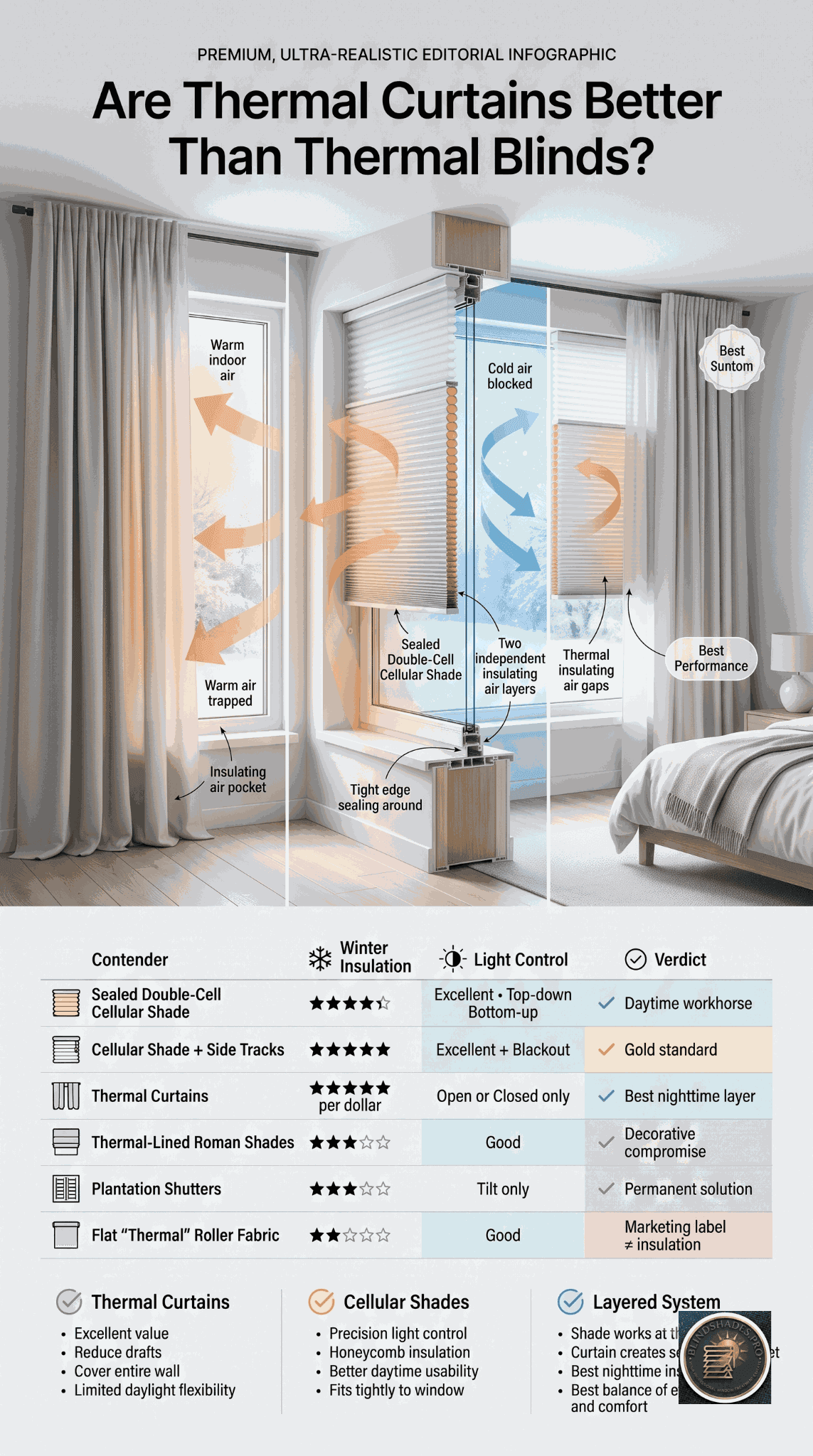
By Michael Turner, 30 years in the window treatment industry
Insulation is dead air, and the best thermal insulated blinds are the ones that trap the most of it and seal it in place: cellular honeycomb shades — double or triple cell — with sealed edges, ideally side tracks. That is the market’s unanimous verdict, from Hunter Douglas’s flat claim that cellular shades are the most insulating shades on the market to the sharpest sentence on this topic anywhere: the gold standard is honeycomb cellular shades with side tracks. What the market never explains is the rest: what R-value actually means at a window, why winter and summer are two different physics problems requiring two different products, whether the internet’s favorite challenger — thermal curtains — is actually right, and how to read claims like “reduces heat loss by up to 40 percent” without being fooled. This guide covers all of it.
Key Takeaways
- Trap decides the ceiling; seal decides reality. Cell structure sets the theoretical R-value — single, double, or triple cell — but an unsealed shade lets convection carry room air around the fabric, canceling insulation you paid for. Outside mounts beat inside; side tracks beat everything.
- Winter and summer are different problems. Winter loss is conduction and convection — trapped air wins, cellular is king. Summer gain is radiation — reject it before the glass with solar screens or tint, because an interior shade fights heat that already got in.
- R-value, honestly: bare single glazing sits around R-1; quality cellular shades add meaningful resistance in honest category ranges — but real-world numbers swing with fabric, fit, and mounting, which is why this guide gives ranges and points precise decimals to manufacturer cut sheets.
- The percentage claims all point one way. Up to forty percent heat-loss reduction (Blindsgalore), forty-five percent (Sun Zero’s thermal Romans), up to seventy percent (Affordable Blinds) — different denominators, same direction: sealed air layers work.
- The 193-answer verdict: the internet’s biggest worth-it thread on honeycomb insulation lands where the physics does — yes for comfort and drafty rooms, with paybacks that depend on your fuel bill, and thermal curtains as the honest budget rival this guide takes seriously below.
⭐ Quick Answer — The Best Thermal Insulated Blinds
The best thermal insulated blinds are chosen at three gates — Trap (double- or triple-cell honeycombs hold the dead air that does the insulating), Seal (outside mounts and side tracks stop convection around the shade), and Season (cellular fights winter loss; summer gain is rejected before the glass):
- The market verdict: cellular shades are the most insulating shades on the market per Hunter Douglas, and the stated gold standard adds side tracks — the tracked, made-in-USA class at EcoSmart Shades.
- The honest numbers: bare glass sits near R-1; double-cell shades add roughly two to three units as a category range, and heat-loss reductions up to forty percent are claimed at Blindsgalore — precise decimals belong to manufacturer cut sheets.
- The cell decision: a pleated shade is a cellular with the cells left open — which is why it costs less and insulates less; the comparison is in pleated vs cellular shades.
- The fabric science: cell geometry, single-vs-double detail and every honeycomb decision live in the complete cellular & honeycomb guide.
- The cheap-slat gap: how much warmth mini blinds give away against cells is quantified in mini blinds vs cellular shades.
Quick Specification Reference
| Specification | The Short Answer |
|---|---|
| Best overall | Blindster cordless blackout TDBU cellular — around twenty-nine dollars at forty-five percent off, four point seven across five thousand four hundred reviews |
| Best budget | Blindster no-tools blackout cellular — around twenty-six dollars, four point six across four thousand two hundred |
| Best sealed system | Guard 2 tracked total-blackout frame — around one fifty-three, four point nine across eight hundred forty-four; EcoSmart side-tracked cellulars as the custom route |
| Best thermal Roman | Sun Zero/Everton cordless thermal blackout Roman — around seventy-three at seventy percent off, four point five across three hundred seven |
| Best premium | Hunter Douglas Duette — the brand’s most-insulating-on-the-market claim, dealer-quoted |
| Typical cost range | Twenty-seven to three thirty-six per Blindsgalore; forty-three to two fifty-three per Affordable Blinds; tracked and USA-made systems eighty-six to five eighty-six per EcoSmart |
| The physics | Dead air trapped in cells + sealed edges; winter product — summer heat is a different problem |
| The gold standard | Honeycomb cellular with side tracks (ecosmartshades’ own words) |
Read the complete guide below for: the six Diamond picks, the Trap-Seal-Season Test, the honest R-value explanation nobody ranked provides, cell counts and seal upgrades in plain tables, the winter-map-versus-summer-map that stops you buying the wrong product for your season, the thermal-curtain verdict, and where to buy — including the one shopping result on this keyword that is actually a deer-hunting blind.
What Are the Best Thermal Insulated Blinds? Our Picks
Six picks, one per job — each verified against live listings, with the insulation claims attributed to whoever made them.
The best thermal insulated blinds for most windows is a double-cell blackout cellular with the best seal you can afford. The six lanes:
Best Overall — Blindster Cordless Blackout Top-Down Bottom-Up Cellular. Around twenty-nine dollars at forty-five percent off, four point seven across five thousand four hundred reviews — blackout double-layer cellular construction at a budget price, with TDBU flexibility that lets winter sun in the top while the room stays sealed below. The plain cordless blackout cellular runs around twenty-five (four point five across eight hundred forty-two).
Best Budget — Blindster No-Tools Blackout Cellular. Around twenty-six dollars, four point six across four thousand two hundred — tension-fit, renter-friendly, and the cheapest honest trap-layer on this market. Blindster’s own double-cell blackout construction carries the ninety-nine-percent light-block claim the category consensus quotes.
Best Sealed System — Guard 2 Total Blackout (tracked frame). Around one hundred fifty-three dollars at four point nine across eight hundred forty-four — a framed, side-tracked system, which is precisely the architecture the gold-standard sentence describes: the tracks close the convection loop that ordinary shades leave open. The custom side-tracked route is EcoSmart Shades — made-in-USA cellulars with tracks, eighty-six to five eighty-six.
Best Thermal Roman — Sun Zero / Everton Cordless Thermal Blackout Roman. Around seventy-three dollars at seventy percent off via Wayfair, four point five across three hundred seven — the decorative lane, with Sun Zero’s published claim of reducing energy loss by up to forty-five percent through its thermal polyester backing. Fabric warmth with real lining; the trade is a softer seal than cells-plus-tracks.
Best Blackout TDBU — Shadow White Top-Down Bottom-Up Blackout Cellular. Around ninety dollars via Home Depot, four point four across two hundred twenty-six — the mid-market TDBU blackout cellular for buyers who want big-box logistics with real cell construction.
Best Premium — Hunter Douglas Duette. The brand states it plainly on its insulating-shades page: cellular shades are the most insulating shades on the market, and Duette is the line that built that claim. Dealer-quoted; the buyable brand route is the Levolor blackout honeycomb via SelectBlinds at around eighty dollars at half off, with Blindsgalore’s Harmony blackout cellular (around fifty-eight, four point eight early ratings) as the custom-direct alternative.
| Pick | Product | Approx. Price (as listed) | Rating / Reviews | Wins the gate for |
|---|---|---|---|---|
| Best Overall | Blindster blackout TDBU cellular | Around twenty-nine (45% off) | 4.7 / 5,400 | Trap + flexibility at budget price |
| Best Budget | Blindster no-tools blackout cellular | Around twenty-six | 4.6 / 4,200 | The cheapest honest trap layer |
| Best Sealed System | Guard 2 tracked frame · EcoSmart custom | One fifty-three · eighty-six to five eighty-six | 4.9 / 844 · category specialist | The convection-killing architecture |
| Best Thermal Roman | Sun Zero/Everton thermal Roman | Around seventy-three (70% off) | 4.5 / 307 | Decorative lane, 45% claim attributed |
| Best Blackout TDBU | Shadow White TDBU cellular | Around ninety | 4.4 / 226 | Big-box TDBU blackout |
| Best Premium | Hunter Douglas Duette · Levolor via SelectBlinds | Dealer-quoted · around eighty | Brand benchmark | The most-insulating claim, attributed |
How Do You Choose? The Trap-Seal-Season Test
Three gates, in order: how much dead air the product traps, whether the edges actually seal it, and which season’s physics you’re fighting.
Gate 1 — Trap. Air is one of the poorest conductors of heat — Blindsgalore’s category page states the principle, and every honeycomb cell is a pocket of it held still against the glass. Cell structure decides capacity: a flat roller with “thermal” on the label traps almost nothing; a single-cell honeycomb traps one layer; double and triple cells stack barriers. The cell-count decision gets its own table below.
Gate 2 — Seal. The AI-era consensus finally says out loud what installers have known forever, in two pro-tips: mounting matters (outside mounts seal against the wall; inside mounts look sleeker and leak at both edges), and side tracks seal the gaps entirely. The physics is convection: warm room air slides behind an unsealed shade, touches cold glass, sinks, and exits the bottom — a continuous loop that ferries heat past any fabric. Kill the loop and the trap finally counts.
Gate 3 — Season. Winter loss and summer gain are different physics — conduction and convection versus radiation — and they want different products. This is the mistake the whole category invites, and it gets its own map below.
| Gate | The question | Pass looks like | Fail routes to |
|---|---|---|---|
| Trap | How much dead air does it hold? | Double/triple-cell honeycomb | Flat “thermal” fabrics: modest gains only |
| Seal | Do the edges close the convection loop? | Outside mount; side tracks or tracked frame | Inside-mount gaps: real-world R collapses |
| Season | Winter loss or summer gain? | Cellular for winter; exterior rejection for summer | Wrong-season purchase — see the map |
What Does R-Value Actually Mean for Window Blinds?
The number every store waves and none defines — here it is, honestly, with the reason we give ranges instead of decimals.
R-value measures resistance to heat flow: higher is warmer. Context makes the window numbers make sense — an insulated house wall runs R-13 and up, while bare single-pane glass sits at roughly R-1, and standard double glazing only around R-2. A window is a hole in your insulation; the question is how much of that hole a shade can plug.
Honest category ranges, as the industry generally presents them:
| Configuration | Honest resistance range | The note that matters |
|---|---|---|
| Bare single-pane glass | Roughly R-1 | The hole in your insulation |
| Standard double glazing | Roughly R-2 | Better glass, still the coldest surface in the room |
| + Single-cell cellular | Adds roughly one to two | The budget trap layer |
| + Double-cell cellular | Adds roughly two to three | The category sweet spot |
| + Triple-cell / specialty | Adds more still | Severe-climate territory |
| Any cellular + side tracks | Multiplies installed performance | Kills the convection loop — the gold standard |
Side-tracked systems multiply real-world performance — not by adding fabric but by killing the convection loop, which is why ecosmartshades calls tracked honeycombs the gold standard and why tightly-fitted is the operative word in Joey’z Shopping’s June 2026 summary of the research. Why ranges and not decimals? Because fabric density, cell size, mounting, and fit swing installed performance by more than a cell-count upgrade does — a leaky triple-cell loses to a tracked double-cell every winter. Precise tested values exist for specific products; find them on the manufacturer’s cut sheet, not a blog.
The market’s percentage claims, lined up and attributed: Blindsgalore’s category promises heat-loss reduction up to forty percent; Sun Zero’s thermal Romans claim up to forty-five percent energy-loss reduction through the backing; Affordable Blinds headlines up to seventy percent. Different denominators — whole-window loss versus specific transfer paths — but one direction: sealed air layers work.
And the worth-it verdict, from the internet’s own jury: a hundred-and-ninety-three-answer Reddit thread from June 2025 asked exactly this — are honeycomb blinds worth it for insulation — and the consensus lands where the physics does. Yes for comfort: cold radiating off glass disappears, drafty rooms calm down. Yes fastest where fuel is expensive and winters are real. The honest caveat: payback in pure currency depends on your bill — buy them first for the rooms you feel, and let the meter be the bonus. Deeper fabric science — cell geometry, single-versus-double in detail — lives in the complete cellular and honeycomb shades guide.
How Many Cells Do You Need — Single, Double, or Triple?
More cells, more trapped layers, thicker stack — the decision in one table.
| Cell count | What it buys | The trade | Choose it when |
|---|---|---|---|
| Single cell | One air barrier; the budget trap | Least resistance; fine in mild climates | Cost rules, or the room is already warm |
| Double cell | Two stacked barriers — the category sweet spot | Slightly thicker stack, modest premium | Cold winters, bedrooms, most buyers — the consensus pick |
| Triple cell / specialty | Maximum trap per square foot | Thickest stack when raised; priciest; fewer fabric options | Severe climates, oil or resistance heat, picture windows |
| Any count + side tracks | Multiplies real-world performance | Visible tracks; custom pricing | The gold standard — drafty rooms, energy-first buyers |
Two honest notes. Blackout linings add real thermal value — the metallized or opaque layer that blocks light also blocks radiant transfer, which is why the market’s insulation picks are overwhelmingly blackout cellulars (Blindster’s double-cell blackout with its ninety-nine-percent light claim, Select Blinds’ three-quarter-inch Click2Fit cells). And on the pleated question — a pleated shade is a cellular shade with the cells left open, which is most of why it costs less and insulates less; the full comparison is pleated vs cellular shades, with the blackout-specific version in blackout pleated vs blackout cellular.
How Do You Seal the Edges? Mounts, Side Tracks, and Magnetic Upgrades
The seal decisions, from free to gold-standard.
| Upgrade | Cost class | What it does | Worth it when |
|---|---|---|---|
| Outside mount (vs inside) | Free at order time | Shade overlaps the wall — closes the side gaps inside mounts leave | Always, where trim and looks allow |
| Generous overlap (3+ inches/side) | Free at order time | Longer leak path; better light control too | Every outside mount |
| Snug inside fit | Free (measuring discipline) | Minimizes, never eliminates, edge gaps | Trim too pretty to cover |
| Magnetic edge strips | Modest add-on | Fabric edges grip steel or adhesive strips | Retrofitting an existing shade |
| Side tracks / channels | Custom or system pricing | Closes the convection loop completely — the multiplier | Bedrooms, drafty rooms, energy-first buys |
| Tracked frame systems (Guard class) | Around one fifty-three | Full perimeter frame — seal plus true blackout | Sleep rooms wanting both jobs done |
One loop-closer: the same edge gaps that leak heat leak light — if you are sealing a bedroom for warmth you are three-quarters of the way to sealing it for sleep, and the light half of that project is mapped in why light comes through the sides of blackout blinds and the complete blackout guide.
Winter Loss vs Summer Gain: Which Product Does Your Season Need?
The map no ranked page draws — and the reason well-meaning buyers end up with the wrong product.
Winter cold does not radiate into your house; your heat conducts and convects out. Summer heat largely radiates in as sunlight. Two mechanisms, two toolkits:
| Season | The physics | The winning toolkit | The wrong buy |
|---|---|---|---|
| Winter (keeping heat in) | Conduction through glass + convection loops | Double/triple-cell cellular, sealed edges, side tracks, layered curtains | Exterior screens do little for indoor warmth |
| Summer (keeping heat out) | Solar radiation through glass | Reject BEFORE the glass: solar screens, window tint, exterior shades | An interior “thermal” shade absorbs heat already inside |
| Both (shoulder climates) | Mixed | Sealed cellular inside + light-colored/reflective backing; screens on the west face | One product forced to do two jobs |
| Overhead glass | Both, amplified | Its own physics — see skylight blinds for heat reduction | Treating a skylight like a wall window |
The summer half of this map belongs to our exterior-heat guides — the screens-versus-shades split is drawn canonically in the best solar screens guide, and overhead glass in the skylight hub. GoDear’s and Hestia’s summer roundups (June 2023 and June 2025) are honest that interior honeycombs help in summer too — they do, by slowing re-radiation — but the first dollar of a summer-heat budget belongs outside the glass. This page owns winter.
Room applications worth naming: below-grade rooms combine cold walls with small windows — cellular shades for basement windows covers that case; east glass gets a morning radiation spike — the east-facing bedroom guide handles it; and if the choice is between cheap slatted minis and cells, the thermal gap is the whole answer — mini blinds vs cellular shades.
Are Thermal Curtains Better Than Thermal Blinds?
The internet’s top answer taken seriously — because in the SERP’s biggest thread, the winning reply wasn’t a blind at all.
A fifty-plus-comment r/HomeImprovement thread asked for the best window coverings for insulation — oil heat, no AC, real stakes — and the top answer said: thermal curtains. It deserves a straight response, not a dodge.
The case for curtains is real: floor-length thermal drapes seal at the floor and wrap past the frame at the sides — exactly the edge discipline this guide keeps preaching — and per dollar of pure winter R, a heavy lined curtain over a leaky window is hard to beat. The case against: curtains give up daytime light control (open or closed is the menu), blanket the wall, collect what fabric collects, and do nothing precise — no TDBU privacy, no tilt, no fit.
The honest verdict is not either/or. It is the layered system: a sealed cellular shade doing the precision work at the glass, a thermal curtain closing over it at night as the second air gap. That is the same Two-Layer System our bedroom guide prescribes for light — it turns out to be the thermal answer too, one architecture solving both jobs: the complete bedroom blinds guide. Skeptics exist — a 2019 thread asked whether “thermal” blinds are marketing — and the skeptics are right about flat fabrics with thermal labels, and wrong about sealed cells: the label means nothing; the architecture means everything.
| Contender | Winter R per dollar | Light control | The verdict |
|---|---|---|---|
| Sealed cellular (double-cell+) | Strong | Excellent — TDBU, precise heights | The daytime workhorse |
| Cellular + side tracks | Strongest interior option | Excellent, plus blackout | The gold standard |
| Thermal curtains | Excellent per dollar | Binary — open or closed | The night layer, not the replacement |
| Thermal-lined Romans | Good | Good | The decorative compromise (Sun Zero’s 45% claim class) |
| Plantation shutters | Good — solid barrier vs drafts | Tilt only | The permanent-millwork lane: plantation shutters |
| Flat “thermal” roller fabrics | Modest | Good | The label to distrust |
Where Should You Buy Thermal Insulated Blinds?
Buy the architecture (cells + seal), not the adjective — and mind the one listing on this keyword that is a hunting blind.
| Retailer / Route | Listed range (as published) | Rating shown | Watch-out |
|---|---|---|---|
| Blindster (budget cellular) | Twenty-five to twenty-nine sale lines | 4.7 / 5,400 · 4.6 / 4,200 · 4.5 / 842 | The volume-value core of this category |
| Blindsgalore (custom) | Twenty-seven to three thirty-six | 4.7 store / 4,600 | The 40% claim’s home; half-off is the real price |
| EcoSmart Shades (side-tracked, USA) | Eighty-six to five eighty-six | Category specialist | The gold-standard architecture, custom-priced |
| Guard (tracked frames) | Around one fifty-three | 4.9 / 844 (Guard 2) | Frame systems — measure precisely |
| Affordable Blinds (custom) | Forty-three to two fifty-three | 4.5 store / 299 | The 70% headline — read the fine print’s denominator |
| Keego (thermal cellular) | One fifty to six sixty | Smaller base | Premium claims, thinner review record |
| Wayfair / big-box (Romans, TDBU) | Seventy-three to ninety sale lines | 4.5 / 307 · 4.4 / 226 | Steep list-price anchoring (70% off flags) |
| Hunter Douglas (dealer) | Custom-quoted | Brand benchmark | The most-insulating claim, priced accordingly |
And the consumer-protection line this keyword uniquely needs: mid-results on this exact search sits the Ameristep Pro Series Thermal Blind at around three hundred sixty-five dollars — sold by a sporting-goods store, because it is a camouflage hunting blind for deer season, not a window treatment. “Thermal blind” is a shared term of art between two industries; if the retailer sells ammunition, you are on the wrong tab.
Related Buying Guides
- Best Cellular & Honeycomb Shades — the fabric science behind the category
- Best Solar Screens — the summer half of the seasonal map
- Best Skylight Blinds & Shades — overhead glass, both seasons amplified
- Best Blackout Blinds & Shades — the same seal, pointed at light
- Best Bedroom Blinds & Shades — the Two-Layer System’s home
Complete Thermal Guide Library
- Best Cellular & Honeycomb Shades — the category’s engine room
- Pleated vs Cellular Shades — open cells vs closed, priced
- Blackout Pleated vs Blackout Cellular — the blackout-thermal overlap
- Blackout Roller vs Cellular Shades for Bedrooms — the sleep-room fork
- Cellular Shades for Basement Windows — the cold-room application
- Mini Blinds vs Cellular Shades — the thermal gap, quantified
- Skylight Blinds for Heat Reduction — overhead physics
- Best Solar Screens — summer’s first dollar
Frequently Asked Questions
What are the best thermal insulated blinds? The best thermal insulated blinds are double- or triple-cell honeycomb cellular shades with sealed edges — the market’s stated gold standard adds side tracks. Blindster’s blackout cellulars lead the budget lane (four point seven across five thousand four hundred), tracked systems like Guard 2 and EcoSmart’s side-tracked cellulars own the sealed-system lane, and Hunter Douglas Duette anchors the premium end with the brand’s most-insulating-on-the-market claim.
Do thermal blinds actually work? Sealed cellular architectures work — trapped dead air is real physics, and the market’s own claims (up to forty percent heat-loss reduction at Blindsgalore, forty-five percent for Sun Zero’s lined Romans) point the same direction as the research summarized in current guides. What often doesn’t work is the label: a flat fabric marked “thermal” with open edges traps little and seals nothing. Buy cells and seals, not adjectives.
What R-value do cellular shades add? Bare single glazing sits around R-1. As honest category ranges: single-cell shades add roughly one to two units of resistance, double-cell roughly two to three, triple-cell and specialty systems more — and side tracks multiply installed performance by stopping the convection loop around the shade. Fabric, fit, and mounting swing real numbers more than cell count does, so treat decimals as product-specific and read the manufacturer’s cut sheet.
Are thermal curtains better than thermal blinds? Per dollar of pure winter insulation, heavy floor-length thermal curtains are genuinely competitive — they seal at the floor and past the frame. They lose on everything else: no daytime light control, no fit, no precision. The best answer is layered: a sealed cellular shade at the glass for daytime control, a thermal curtain closing over it at night as a second air gap.
Do thermal blinds help in summer too? Somewhat — a sealed, light-backed cellular slows heat that has already entered. But summer gain is radiation, and the efficient move is rejecting it before the glass: solar screens, window films, and exterior shading do summer’s heavy lifting, while cellular shades do winter’s. Matching the product to the season’s physics is the single most cost-effective decision in this category.
What’s the difference between double-cell and triple-cell shades? One more stacked air barrier per pleat. Double-cell is the sweet spot — meaningfully warmer than single-cell at a modest premium and the consensus pick for cold-winter bedrooms. Triple-cell buys maximum trap for severe climates and expensive heat, at the cost of a thicker raised stack, higher price, and fewer fabric choices — and a leaky triple-cell still loses to a tracked double-cell.
