What Is the Best Window Treatment for a Bedroom That Faces East

Authored By Michael Turner -30 Years Home Improvement Expertise | Updated 2026 | BlindShades.pro
Updated on July 13, 2026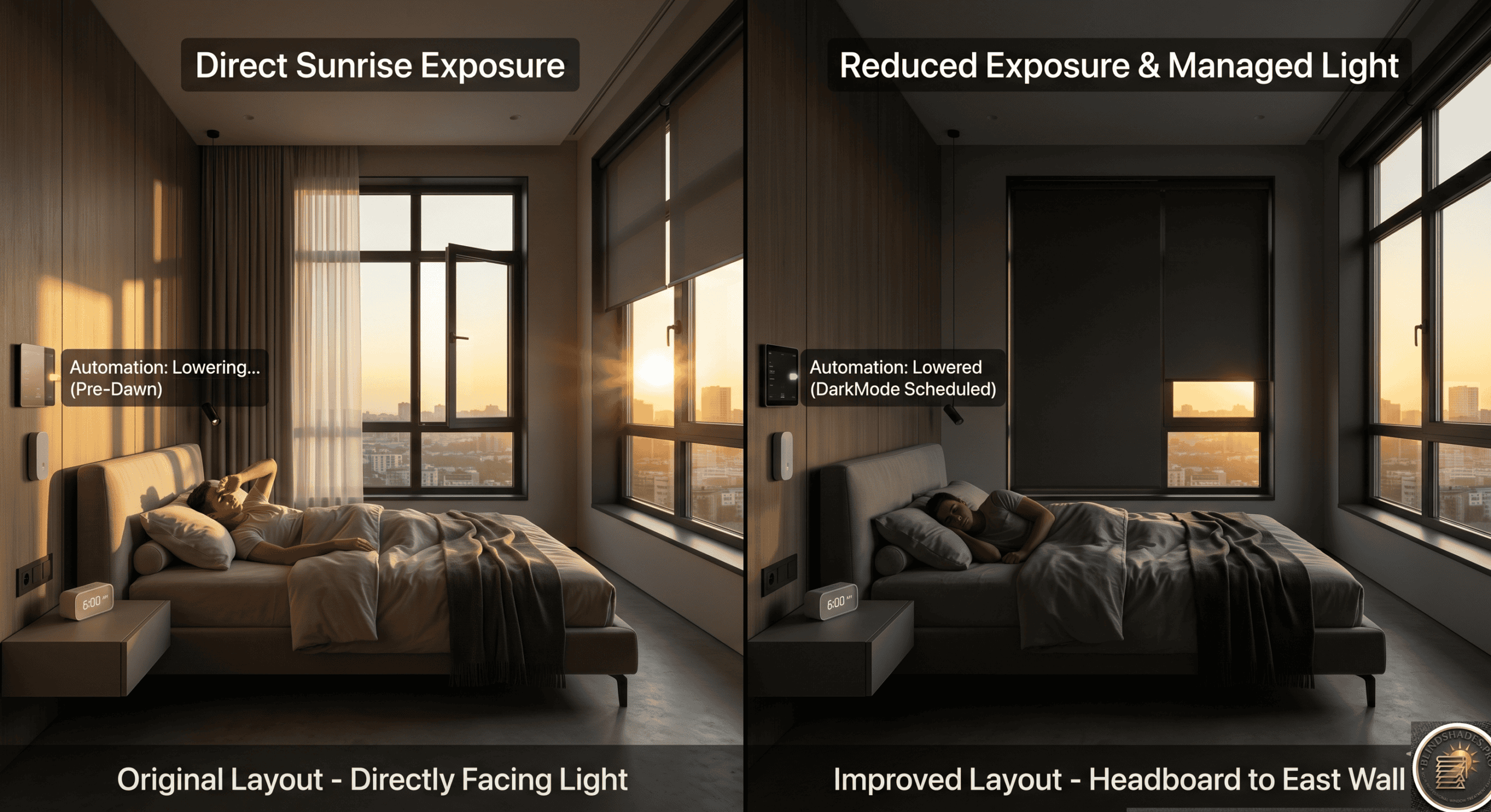
⭐ Quick Answer — Best Window Treatment for an East-Facing Bedroom
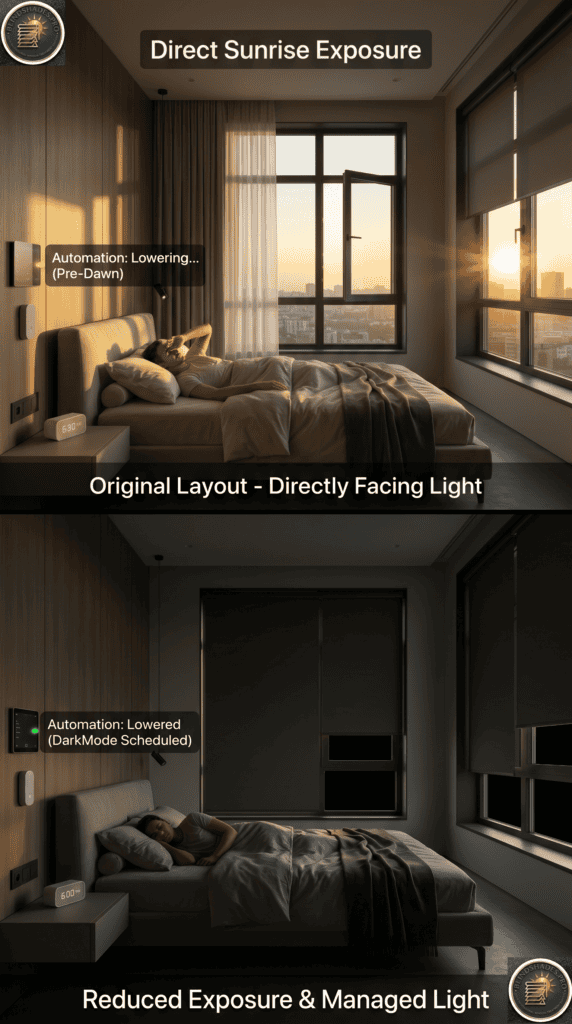
- Try the Free Fix First — Bed Position: If your headboard is against the west wall (face directed toward the east window), move it to the east wall (feet toward the window). A sleeper facing away from the sunrise experiences far less intrusion than one facing toward it. Test this before spending on any window treatment
- The Best Specification — Motorized Blackout With Sunrise Trigger: A motorized blackout shade with sunrise-triggered scheduling is the optimal east-facing bedroom treatment. It lowers automatically 30 minutes before sunrise and raises at your desired wake time — capturing full afternoon daylight (east rooms are COOL and pleasant after 11am) without any morning intrusion
- The Seasonal Schedule: June/July: lower ~4:45am, raise 7:30am · May/August: lower ~5:00am · March/October: lower ~6:00am · November–February: no schedule needed — winter sunrise is at or after your alarm time; the east-facing bedroom problem is a summer issue, not year-round
- TDBU Shade — The Correct East-Facing Configuration: At sunrise, light enters at a LOW horizontal angle through the lower half of the window. For east-facing use — raise the bottom of the TDBU shade (not lower the top). This blocks the low-angle dawn light while leaving the upper window open for sky view and ventilation
- The Circadian Clock Risk — Why This Matters Beyond One Morning: Morning light received 1–2 hours before your desired wake time advances your circadian clock by 15–30 minutes per day. After 2 weeks without blackout protection, your circadian rhythm shifts 1–3 hours earlier — making you progressively sleepier by 9pm and waking earlier involuntarily
- Best Sources: Sunrise-trigger motorized → Hunter Douglas PowerView · Lutron Serena · Mid-range motorized → Blindsgalore motorized roller · TDBU cellular → SelectBlinds Blackout Cellular TDBU
⚠️ The Summer Sunrise Geometry Problem — and Why Outside Mount Is Critical in Summer: In summer the sun rises from the northeast (~60° azimuth), not due east — it enters the bedroom’s northeast corner at a near-horizontal angle. In winter it rises from the southeast (~120° azimuth) — a completely different angle and corner. A shade with standard inside-mount edge gaps on the north side will fail specifically on summer mornings when northeast sunrise light enters through that gap. For summer northeast sun: outside mount extending 2–3 inches beyond the frame on the north side is the most critical edge, not the sides equally. And if you’re shopping in November or December — your current east bedroom problem is only 30% as severe as it will be next June. Buy for the summer specification, not your winter experience. See the full seasonal geometry guide below.
💡 East-Facing Thermal Profile + UV-B Warning: Unlike west-facing bedrooms (afternoon heat all day), east-facing rooms gain heat only from sunrise to ~11am — afternoons and evenings are cooler and more comfortable than south or west-facing rooms. A motorized shade that raises at 10:30am captures 6–7 hours of pleasant afternoon daylight a manual shade typically wastes by staying closed all day. Additionally: low-angle morning sun has higher UV-B content than midday sun (different atmospheric path). Hardwood floors, rugs, and upholstery in east-facing bedrooms are at significant UV-B damage risk during the sunrise window. A solar or blackout shade lowered during the morning sun period provides meaningful UV-B protection for flooring and furniture even when no one is sleeping. See the full thermal and UV guide below.
📖 Read the complete guide below for: the seasonal sunrise geometry (northeast in summer, southeast in winter), the seasonal timing table (why winter barely matters), the circadian clock advancement mechanism, the specific TDBU bottom-raise configuration for low-angle morning light, the motorized seasonal schedule, the east-facing thermal profile (heat only until 11am), the UV-B warning for floors and furniture, bed positioning as the free first fix, and the complete specification ranked by priority.
Related guides: dropping the top of the shade is the cleanest sunrise-glare tool — see the best top down bottom up shades.
Understanding the East-Facing Bedroom Problem — The Geometry Nobody Explains
Every guide says “east-facing bedrooms get intense morning sun.” None explain why the geometry changes significantly by season — which determines what specification actually solves the problem year-round.
The Summer East-Facing Problem (Worst Case)
Summer solstice (around June 21):
- Sunrise azimuth in the continental USA: approximately 55–65° (northeast)
- Sunrise time in most of the USA: approximately 5:15–5:45am
- Sun enters the northeast corner of an east-facing room at a near-horizontal angle
What this means: In summer, the sun rises approximately 2.5–3 hours before the typical 7:30–8:00am wake time. The low horizontal angle means the light enters the room nearly parallel to the floor, traveling deep into the room and reaching the bed directly. A shade that covers the window but has edge gaps on the north (northeast) side will fail on summer mornings because the sun’s angle brings it through that gap specifically.
Summer specification: The most demanding east-facing bedroom scenario. Outside mount with overlap on the north side is particularly important in summer. Motorized shade schedule: lower at 5:00am, raise at 7:30am.
The Winter East-Facing Non-Problem
Winter solstice (around December 21):
- Sunrise azimuth: approximately 115–125° (southeast)
- Sunrise time in most of the USA: approximately 7:00–7:30am
What this means: In winter, the sun rises approximately 30 minutes before or at the same time as most people’s alarm. The southeast-facing sunrise is less intense than the summer northeast sunrise. For many people — winter sunrise in an east-facing bedroom is actually pleasant and natural wake-up lighting rather than a problem.
Winter specification: Many east-facing bedrooms require no active shade management in winter. A motorized shade that automatically adjusts its lower/raise schedule with the season (sunrise-triggered automation rather than clock-time scheduling) handles this without manual adjustment.
The practical implication no guide draws: If you are shopping for east-facing bedroom window treatments in November or December — your current problem is less than half as severe as it will be in June. Buy for the summer specification, not the winter experience.
The Spring/Fall Equinox (The Middle Case)
Equinox (around March 21 and September 21):
- Sunrise azimuth: approximately 90° (due east)
- Sunrise time: approximately 6:15–6:30am in most of the USA
At the equinox, sunrise is directly east — the sun enters the window most directly, pointing straight at any east-facing window without the northeast or southeast angle variation. This is the “canonical” east-facing window problem that most guides describe.
The Free Solution — Bed Positioning Before Buying Anything
This is the one recommendation that every east-facing bedroom window treatment guide fails to make.
How bed position affects sunrise intrusion:
Scenario 1 — Headboard against the EAST wall (feet facing the window): The sleeper’s face is directed away from the east window. Even with light entering the room, the sleeper’s closed eyelids face the opposite direction from the sunrise. Intrusion is minimal except when the room is uniformly illuminated.
Scenario 2 — Bed perpendicular to the east window (side of bed faces east): The sleeper’s face is at 90° to the window. Low-angle morning light enters the room from the side. Moderate intrusion depending on room depth.
Scenario 3 — Headboard against the WEST wall (face directed toward the east window): The sleeper’s face is directed toward the sunrise. Even minimal light entering through edge gaps or imperfect blackout fabric strikes the sleeper’s face directly. This is the maximum intrusion scenario and the configuration most likely to cause early waking.
Before spending money on window treatments: If you currently have your headboard against the west wall in an east-facing bedroom — try repositioning to the east wall (headboard against east wall). For many moderate light-sensitivity sleepers, this repositioning alone reduces the problem sufficiently without any additional window treatment investment.
The Circadian Clock Advancement Effect — Why East-Facing Matters Beyond One Morning
All guides treat “morning light waking you early” as a one-time daily annoyance. The sleep science identifies a compounding long-term effect that no competitor guide mentions.
The circadian clock advance mechanism: The human circadian rhythm is set daily by light exposure timing. Morning light — particularly light in the blue wavelength spectrum present at dawn — is the most powerful circadian clock signal. Light received 1–2 hours earlier than the desired wake time sends a “wake earlier” signal to the SCN (suprachiasmatic nucleus), the brain’s circadian clock.
The compounding effect: If an east-facing bedroom admits dawn light at 5:30am and the desired wake time is 7:30am — the sleeper’s circadian clock receives a systematic “wake up at 5:30” signal every morning. This advances the circadian rhythm by approximately 15–30 minutes per day, compounding over weeks:
- After 1 week: circadian rhythm may have advanced 1–3 hours
- After 2 weeks: extreme morning type behaviour — sleeping by 9pm, waking by 5am
What this looks like in practice: People sleeping in east-facing bedrooms without adequate blackout treatment frequently report becoming progressively earlier risers over months, experiencing evening sleepiness earlier and earlier, and difficulty staying awake past 9pm — all symptoms of circadian clock advancement from systematic early morning light exposure. This is not a personality trait — it is a correctable light environment effect.
Blackout shades in east-facing bedrooms prevent this accumulating circadian shift, not just the one-morning annoyance of early waking.
The TDBU Correct Application for East-Facing Windows
Every guide recommends TDBU (top-down bottom-up) shades for east-facing bedrooms as a generic option. None explain the specific configuration that makes them particularly suited to east-facing morning sun.
The geometry of low-angle morning light: At sunrise, the sun is near the horizon — the light enters the room at a nearly horizontal angle, close to floor level. This means dawn light enters through the lower half of the window more than the upper half.
Standard TDBU use (incorrect for east-facing morning): The typical TDBU use is lowering the top portion of the shade to block overhead light while leaving the bottom open for view and privacy from street level. This works well for south-facing windows where overhead midday light is the problem.
Correct TDBU use for east-facing morning sun: For an east-facing bedroom at sunrise:
- Raise the bottom of the TDBU shade to cover the lower half of the window, where the low-angle dawn light enters
- Leave the top open (or partially open) for the upper window zone where less light enters at sunrise angle
- This configuration blocks the intrusive horizontal dawn light through the lower window while maintaining some morning sky view through the upper zone
Practical instruction: Position the TDBU shade so the shade fabric covers approximately the bottom 60–70% of the window at sunrise, with the upper 30–40% open. As the morning progresses and the sun rises higher, the shade can be progressively raised to cover less of the window.
The UV-B Warning for East-Facing Bedrooms
All guides mention UV protection. None explain why east-facing rooms have a specific UV damage profile.
Why morning sun has higher UV-B: UV radiation from the sun travels through the atmosphere before reaching a window. The longer the atmospheric path, the more UV is filtered. At solar noon, sunlight travels through the shortest atmospheric path (nearly vertical). At sunrise, sunlight travels at a low angle through a much longer atmospheric path — which filters more UV-A but NOT UV-B (UV-B behaves differently in atmospheric scattering).
The practical consequence: East-facing bedrooms receive direct UV-B exposure at sunrise — when UV-B levels from low-angle direct sun can be comparable to or exceed those at midday despite lower overall brightness. Hardwood floors, textile rugs, upholstered furniture, and fabrics adjacent to east-facing bedroom windows are at significant UV-B exposure risk during morning hours.
Specification for UV protection: Blackout shades (which block 100% of UV) provide complete UV protection. Solar shades with 3–5% openness provide 95–99% UV blockage during the period when the shade is lowered. For UV protection of floors and furniture in east-facing bedrooms — the shade should be lowered during the direct sunrise period even when no one is sleeping in the room.
The Motorized Scheduling Specification — The Optimal East-Facing Solution
For an east-facing bedroom, motorized scheduling is the highest-value specification of any window facing. Here is why — and what schedule to programme.
Why east-facing makes motorized scheduling most valuable: An east-facing bedroom has a short problem window — sunrise to approximately 11am. After 11am, the sun has moved to the south/west and the east-facing bedroom receives diffuse daylight only. Afternoon and evening comfort in an east-facing bedroom is excellent — often the most pleasant room orientation in the house.
A manual blackout shade in an east-facing bedroom is frequently left down all day because raising it at 5:30am is impractical. This wastes 6–8 hours of good afternoon daylight that the room could be enjoying. A motorized shade solves this without any effort.
The seasonal schedule:
| Month | Sunrise Time (Average US) | Shade Lower | Shade Raise |
|---|---|---|---|
| June / July | 5:15–5:45am | 4:45am | 7:30am |
| May / August | 5:30–6:00am | 5:00am | 7:30am |
| April / September | 6:00–6:30am | 5:45am | 7:30am |
| March / October | 6:15–7:00am | 6:00am | 7:30am |
| November / February | 6:45–7:15am | Not needed* | — |
| December / January | 7:15–7:30am | Not needed* | — |
*Winter sunrise is at or after typical alarm time — shade does not need to lower.
Sunrise-triggered automation (better than clock time): Hunter Douglas PowerView, Lutron Serena, and Blindsgalore’s smart motorized shade systems all support sunrise-triggered scheduling — the shade lowers automatically 30 minutes before local sunrise (calculated from your location and the date), adjusting throughout the year without manual seasonal reprogramming. This is the preferred specification for east-facing bedrooms.
The East-Facing Thermal Profile — Why Afternoon Matters Too
The full day thermal profile of an east-facing bedroom:
- 5:30–7am: Low-angle direct sun entry — rapid warming
- 7–11am: Moderate direct sun — continued warming
- 11am onward: Sun has moved south/southwest — east-facing room receives only diffuse daylight
- Afternoon/evening: East-facing room is significantly cooler than south or west-facing rooms
The specification implication: Unlike a west-facing bedroom where the afternoon sun creates sustained heat gain requiring the shade to remain lowered through 5pm — an east-facing bedroom only needs the shade for a short morning window. The shade can be raised by 10–11am in summer for full afternoon daylight access without heat or glare discomfort.
Thermal treatment specification: A blackout or room-darkening cellular shade for east-facing bedrooms provides adequate insulation for the short morning heat gain period. The aggressive thermal specification required for west-facing rooms (heavier fabric, higher R-value) is less critical for east-facing. A standard double-cell cellular shade is typically adequate.
The Complete East-Facing Bedroom Specification
Priority 1 — Try bed repositioning first (free): Move the headboard to the east wall if possible (feet toward the window). Assess whether this alone is sufficient.
Priority 2 — Motorized blackout shade with sunrise-triggered schedule: Motorized blackout roller shade or blackout cellular shade with outside mount (2–3 inches beyond frame on all sides). Programme sunrise-triggered schedule: lower 30 minutes before sunrise, raise at desired wake time. This is the complete solution for most east-facing bedrooms.
Priority 3 — TDBU shade with correct morning configuration (manual alternative): TDBU blackout cellular shade operated with the bottom raised to cover the lower 60–70% of the window at dawn, blocking the low-angle horizontal sunrise while keeping upper window open. More demanding to operate manually but provides good daylight flexibility.
Priority 4 — Dual-layer specification for design flexibility: Solar shade (3–5% openness) for diffusing and managing daytime light after 10am combined with a blackout roller shade on a second cassette headrail for morning blackout. More components but more flexibility for bedroom with strong aesthetics requirements.
Where to Order — East-Facing Bedroom Specifications
For motorized with sunrise scheduling (recommended): Hunter Douglas PowerView motorized shades — full sunrise/sunset scheduling, smart home integration. Lutron Serena motorized — location-aware sunrise scheduling with quieter motor. Blindsgalore motorized roller shade — app-based scheduling at mid-range pricing.
For TDBU cellular (manual, best value): SelectBlinds Cordless Blackout Cellular TDBU — double-cell construction, cordless, flexible morning configuration. Blindsgalore Blackout Cellular TDBU — available in single and double-cell, good edge coverage.
For dual-layer (aesthetic flexibility): Blindsgalore dual roller shade system — solar shade front, blackout roller rear on single double-cassette headrail.
Frequently Asked Questions
What is the best window treatment for a bedroom that faces east? A motorized blackout shade with a sunrise-triggered schedule is the optimal specification for east-facing bedrooms. The shade lowers automatically 30 minutes before sunrise — from approximately 4:45am in midsummer to not at all in midwinter — and raises at the desired wake time. After 10 to 11am, east-facing bedrooms receive only diffuse daylight and benefit from having the shade raised for the pleasant afternoon light. Manual alternatives include a blackout cellular TDBU shade operated with the bottom raised to block the low-angle morning light while leaving the upper window open.
Why does my east-facing bedroom get so bright so early in summer? In summer, the sun rises at approximately 5:15 to 5:45am from a northeast direction (60 to 65 degree azimuth in the USA), reaching the bedroom 2 to 3 hours before most alarm times. The low angle of the sunrise sun means light enters the room nearly horizontally, penetrating deep into the room. This is the worst-case east-facing bedroom scenario — far more severe than winter when sunrise is at 7 to 7:30am from a more southerly direction. Blackout shades need to lower before sunrise to prevent the light, not after it has already entered.
Should I use a top-down bottom-up shade for an east-facing bedroom? Yes, but in the opposite configuration from what most guides describe. At sunrise, morning light enters at a low horizontal angle through the lower half of the window. For east-facing bedrooms — raise the bottom of the TDBU shade to cover the lower 60 to 70 percent of the window where the low-angle dawn light enters. Leave the upper portion open. This blocks the intrusive horizontal sunrise while maintaining the upper window view and sky light.
Will moving my bed help with an east-facing bedroom? Potentially significantly, at no cost. If your headboard is currently against the west wall — meaning your face is directed toward the east window during sleep — moving the headboard to the east wall so your feet face the window reduces direct sunrise intrusion on your face. For moderate light-sensitivity sleepers, bed repositioning alone can reduce the problem enough that basic room-darkening shades are sufficient. For light-sensitive sleepers, bed repositioning reduces but does not eliminate the benefit of blackout shades.
How does an east-facing bedroom affect sleep long-term? Beyond the daily waking annoyance, morning light from an east-facing window received 1 to 2 hours before the desired wake time systematically advances the circadian clock by 15 to 30 minutes per day. Over 2 weeks, this can shift the circadian rhythm by 1 to 3 hours — manifesting as progressively earlier evening sleepiness, inability to stay awake past 9pm, and waking spontaneously earlier and earlier. This is a correctable light environment effect, not a personality trait. Blackout shades preventing dawn light entry stop the daily circadian advance signal.
Related Guides on BlindShades.pro
- The Best Bedroom Blinds & Shades Buying Guide — the complete bedroom specification guide
- Are Blackout Blinds Worth It for Better Sleep — The Science and the Specification — the sleep science including circadian clock advancement mechanism
- Motorized vs Manual Commercial Blinds — The 10-Year ROI Comparison — the motorized specification value guide (commercial context with residential parallels)
- Why Is Light Coming Through the Sides of My Blackout Blinds — How to Fix Light Gaps — the edge gap guide including outside mount for northeast summer sunrise
- How Do I Measure Windows for Blackout Blinds — Inside Mount vs Outside Mount Guide — the measurement and mount guide for east-facing outside mount specification
By Michael Turner | 30 Years Home Improvement Expertise | Updated 2026 | BlindShades.pro
