Blackout Roller Shades vs Blackout Cellular Shades — Which Is Better for a Bedroom

Authored By Michael Turner -30 Years Home Improvement Expertise | Updated 2026 | BlindShades.pro
Updated on July 16, 2026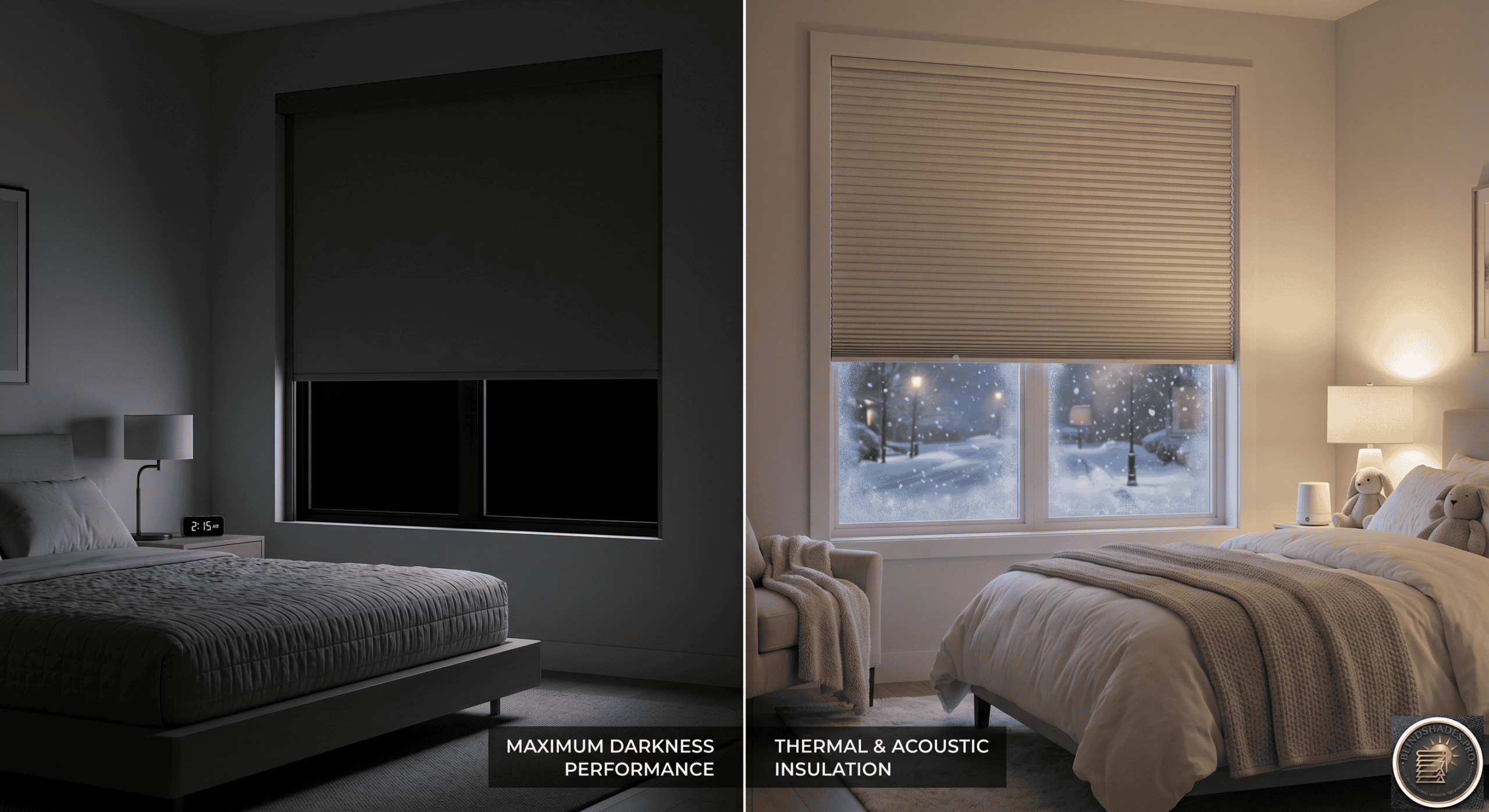
⭐ Quick Answer — Blackout Roller Shades vs Blackout Cellular Shades: Which Is Better for a Bedroom?
- The Honest Verdict: When comparing blackout roller shades vs blackout cellular shades for a bedroom — roller shades win on pure darkness efficiency. Roller + side channels achieves 0–10 lux for $90–$150. Cellular with LightLock channels achieves 0–15 lux for $200–$400. Cellular wins on thermal performance (R-3.5–5.0 vs R-0.8) and acoustic absorption (NRC 0.15–0.25 vs 0.05–0.10)
- Why Blackout Cellular Lets in More Light: Cellular shades have structural light paths that flat roller fabric does not — light enters at cell fold edges, cell end caps, and accordion accumulation points where the raised shade meets the lowered fabric. A blackout roller shade has only edge gaps to seal; a cellular shade has both edge gaps and internal structural paths
- Thermal + Acoustic — Where Cellular Wins: Double-cell cellular: R-3.5 to R-5.0 (vs roller R-0.5–0.8) · NRC 0.15–0.25 acoustic absorption vs roller NRC 0.05–0.10. For a cold climate bedroom or a noisy street-facing room — cellular’s thermal and acoustic advantages justify the higher cost
- The Wide Window and Cleaning Considerations: Blackout roller shades handle 72+ inch wide windows better — wide cellular shades accumulate weight causing uneven operation. And bedrooms generate more dust (skin cells during sleep) — cellular professional cleaning costs $30–$50 every 2–3 years vs roller wipe-down at $0–$5
- 10-Scenario Bedroom Verdict: Maximum darkness → roller + side channels · Cold climate → cellular double-cell · Noisy street → cellular · Nursery → cellular (GREENGUARD Gold) · Wide windows (72″+) → roller · Budget darkness → roller · Motorized sunrise → roller
- Best Sources: Blackout roller + channels → Blindsgalore Blackout Roller with Side Channels · Cellular blackout → SelectBlinds Premier Blackout Cordless Cellular · Premium → Hunter Douglas Duette LightLock
⚠️ The Bedroom Dust Problem With Cellular Shades — and the 10-Year Cleaning Cost When comparing blackout roller shades vs blackout cellular shades for bedroom cleaning: bedrooms shed approximately 30,000–40,000 skin cells per hour during sleep — more airborne particulate than any other room. The honeycomb cells of a cellular shade trap this bedroom-specific dust in the air pockets. Professional cellular shade cleaning costs $30–$50 per shade and is typically needed every 2–3 years in a bedroom (more often than in a living room). Over 10 years: cellular cleaning = $150–$250 per window; roller wipe-down = $0–$50. This bedroom-specific cleaning burden is one of the most commonly overlooked total cost differences between these two products. See the full 10-year cost comparison below.
💡 The Motorized Bedroom Comparison — and When Cellular Stacks Multiple Benefits: For motorized blackout roller shades vs blackout cellular shades: roller shades use a single tube motor — one mechanism, one failure point, quieter operation (~30 dB for Hunter Douglas PowerView). Cellular shades use an accordion mechanism with more components and can develop uneven fold accumulation on wider spans. For motorized sunrise scheduling — roller shades are the simpler and more reliable specification. The one scenario where cellular’s higher cost is definitively justified: cold climate + noisy street + nursery — when thermal (R-5.0), acoustic (NRC 0.25), and GREENGUARD Gold safety all stack together, no roller shade can match the combined value. See the full 10-scenario verdict table below.
📖 Read the complete guide below for: why blackout roller shades vs blackout cellular shades differ in darkness performance (cell fold edges, end caps, accordion accumulation), the R-value comparison table, the NRC acoustic values by construction type, the bedroom-specific dust and cleaning cost analysis, the wide window weight consideration, the motorized comparison, the cost-per-darkness-quality table, and the 10-scenario bedroom verdict with specific winner for each application.
Related guides: see how every format scores in the complete blackout blinds and shades guide.
Why Cellular Blackout Is Harder to Achieve Than Roller Blackout
This is the fundamental construction difference that no competitor comparison explains — and it determines which product actually delivers better bedroom darkness.
Why Roller Blackout Works
A blackout roller shade is a single flat piece of opaque fabric that rolls around a tube. When fully lowered, it presents one continuous opaque surface with no gaps, folds, or seams through the fabric itself.
The only light paths are:
- Edge gaps at the frame sides, top (headrail), and bottom (sill)
- The fabric itself (if it is true blackout fabric at ≤0.1% transmittance, this is negligible)
Once you solve the edge gap with side channels or outside mount, light transmission through a blackout roller shade is near zero.
Why Cellular Blackout Is More Challenging
A blackout cellular (honeycomb) shade is made from accordion-folded fabric layers creating honeycomb pockets. Even when “blackout fabric” is used for the cell material, multiple structural light paths exist that flat roller fabric does not have:
1. Cell fold edge transmission: Where the pleated fabric folds at the cell edges, the fabric is under stress and compressed. Under bright sunlight, light can transmit along these compressed fold lines.
2. Cell end cap gaps: The ends of the honeycomb cells where they meet the headrail and bottom rail are covered by end caps. These end caps create small gaps at the top and bottom of the shade where cell openings face outward.
3. Accordion accumulation at the top: When a cellular shade is partially raised, the accordion fabric bunches at the top into a thick stack of cell layers. At the junction between the raised accordion stack and the remaining lowered shade, small irregular gaps form as the layers compress.
The practical result: A standard inside-mounted blackout cellular shade typically achieves room darkness of 10–20 lux. A standard inside-mounted blackout roller shade of equivalent fabric specification typically achieves 15–25 lux — but with side channels, drops to 0–10 lux. A blackout cellular shade with Hunter Douglas LightLock or equivalent side channel system achieves 0–10 lux.
The conclusion: Roller shades are inherently easier to blackout because they have only edge gaps to seal. Cellular shades have both edge gaps AND internal structural light paths to address. A properly specified roller shade is consistently better value for pure bedroom darkness.
The R-Value Comparison — Where Cellular Wins Clearly
For bedroom thermal performance — cellular shades win without contest.
| Product | R-Value | Temperature Impact at Window |
|---|---|---|
| No treatment | R-0 | Full heat transfer |
| Blackout roller shade | R-0.5–0.8 | Minor |
| Single-cell blackout cellular | R-2.5–3.5 | Moderate: 2–3°F |
| Double-cell blackout cellular | R-3.5–5.0 | Meaningful: 3–4°F |
| Triple-cell blackout cellular | R-5.0–7.0 | Significant: 4–5°F |
For bedroom thermal comfort: The difference between a blackout roller shade (R-0.5–0.8) and a double-cell blackout cellular shade (R-3.5–5.0) is approximately 5–6× better thermal resistance. For a bedroom in Minnesota, Wisconsin, New England, the Pacific Northwest, or any cold climate — this thermal difference meaningfully reduces the temperature gradient at the window, reduces condensation, and reduces the heating cost attributed to window heat loss.
For a bedroom in a mild climate: The R-value difference is less impactful. If the bedroom maintains comfortable temperatures year-round — the thermal advantage of cellular shades does not justify their higher cost and more demanding maintenance.
The Acoustic Comparison — The Bedroom-Specific Advantage of Cellular
All guides mention that cellular shades reduce noise. None quantify what this means specifically for a bedroom.
The bedroom acoustic context: Bedrooms are particularly vulnerable to acoustic disturbance from outside noise sources that cause light sleep stage arousal: traffic, early morning birds, lawn mowers, delivery vehicles. For light sleepers in street-facing or garden-facing bedrooms — outside noise can be as disruptive as light.
Specific NRC values for bedroom comparison:
| Product | Approximate NRC | Acoustic Contribution |
|---|---|---|
| Bare window | 0.00 | Reflective (none) |
| Blackout roller shade (standard weight) | 0.05–0.10 | Minor |
| Single-cell blackout cellular | 0.10–0.15 | Moderate |
| Double-cell blackout cellular | 0.15–0.25 | Meaningful: 50–70% more absorption than roller |
| Triple-cell blackout cellular | 0.20–0.30 | Significant |
The practical bedroom impact: The difference between a blackout roller shade (NRC ~0.07) and a double-cell blackout cellular shade (NRC ~0.20) represents approximately 65% more sound absorption ( “see Prudent Reviews’ full cellular vs roller R-value analysis” ) per square foot of window area. For a bedroom with two standard windows — replacing roller shades with double-cell cellular adds a meaningful contribution to the room’s total sound absorption, reducing the reverberation that amplifies outside noise.
For light sleepers disturbed by outside noise — the acoustic advantage of double-cell cellular shades is a genuine functional benefit specific to the bedroom context that no general comparison guide addresses.
The Cleaning Reality in Bedrooms — More Demanding Than Other Rooms
All guides note that cellular shades are harder to clean than roller shades. None note that bedrooms create a more demanding cleaning environment than other rooms.
Why bedrooms are dustier: Bedrooms accumulate more airborne particulates than living rooms or offices. Sleeping occupants shed skin cells (approximately 30,000–40,000 cells per hour), and bedding disturbs these particles into the air during sleep and bed-making. An 8-hour sleep period in a bedroom generates more fine particulate loading in the room air than 8 waking hours in a living room.
The cellular shade cleaning burden in bedrooms: Honeycomb cells trap airborne particulates in the air pockets. Over 2–3 years of daily bedroom use — cellular shades accumulate significantly more dust than in a living room application. Professional cleaning of cellular shades costs approximately $30–$50 per shade and is recommended every 2–3 years for bedroom applications.
The roller shade cleaning advantage in bedrooms: The flat smooth surface of a roller shade can be vacuumed with a brush attachment or wiped with a damp cloth. Bedroom roller shade cleaning takes 5–10 minutes per shade and requires no specialist service.
The bedroom-specific cleaning cost over 10 years:
| Product | Annual Cleaning | 10-Year Total |
|---|---|---|
| Blackout roller shade | $0–$5 (DIY) | $0–$50 |
| Blackout cellular shade | $15–$25 (professional) | $150–$250 |
Wide Windows — Where Roller Shades Win on Operation
This is a practical comparison criterion absent from all guides.
The weight issue with wide cellular shades: A double-cell blackout cellular shade 72 inches wide carries significant fabric weight in its accordion structure. As the shade is raised and lowered repeatedly, the weight load on the operating mechanism increases. Wide cellular shades (72+ inches) can develop operating irregularities including:
- Uneven raising across the width (one side raises faster than the other)
- Cell compression becoming asymmetric over time
- Operating cord or mechanism wear from weight stress
Roller shade wide-window performance: A 72-inch blackout roller shade operates on a tube that handles the full width without accumulated weight issues. The tube mechanism is mechanically robust for wide spans. Commercial roller shade systems routinely span 10+ feet without operating issues.
For bedrooms with wide picture windows or continuous glazing runs: Specify blackout roller shades rather than cellular for spans above 72 inches (6 feet). For cellular at wide spans, specify motorized to eliminate the cord weight-lifting load that causes uneven operation.
The Motorized Bedroom Comparison
Motorized roller shade (bedroom): A single tube motor drives the rolling mechanism. One motor, one operating component, one failure point. Motorized roller shades in bedroom specification are extremely reliable and operate quietly (Hunter Douglas PowerView: ~30 dB).
Motorized cellular shade (bedroom): The accordion mechanism requires the motor to compress and extend fabric in accordion folds — a mechanically more complex operation than rolling fabric onto a tube. Motorized cellular shades have more components in the operating path. Wide motorized cellular shades can develop uneven fold accumulation over time, creating waves or uneven hemlines.
The bedroom-specific motorization recommendation: If motorization is a priority for the bedroom (sunrise scheduling, hands-free operation, smart home integration) — blackout roller shades are the better motorized specification. If thermal and acoustic performance are priorities alongside motorization — motorized double-cell blackout cellular is the correct specification but requires a higher budget and periodic mechanism inspection.
Blackout Roller Shades vs Blackout Cellular Shades — Verdict by Scenario
| Bedroom Scenario | Winner | Reason |
|---|---|---|
| Light-sensitive sleeper needing maximum darkness | ✅ Roller + side channels | Flat fabric easier to fully blackout; lower lux at lower cost |
| Cold climate bedroom (Minnesota, New England, PNW) | ✅ Cellular double-cell | R-3.5–5.0 vs R-0.5–0.8; temperature stability matters |
| Noisy street-facing or garden-facing bedroom | ✅ Cellular double-cell | NRC 0.15–0.25 vs 0.05–0.10; 50–70% more sound absorption |
| Nursery (blackout + safety + GREENGUARD) | ✅ Cellular | GREENGUARD Gold certification easier to source; softer appearance; TDBU available |
| Wide windows (72+ inches) | ✅ Roller | Better weight distribution; more reliable operation at wide spans |
| Contemporary/Scandinavian bedroom aesthetic | ✅ Roller | Flat smooth surface matches modern minimal interiors |
| Traditional/soft/cosy bedroom aesthetic | ✅ Cellular | Honeycomb texture is warmer and softer in appearance |
| Budget-first bedroom darkness | ✅ Roller | $80–$150 with side channels vs $200–$400 for cellular equivalent darkness |
| Bedroom with motorized sunrise schedule priority | ✅ Roller | Simpler, more reliable motor mechanism; quieter operation |
| Cold climate + noise + darkness combined priority | ✅ Cellular | Justifies cellular’s higher cost when multiple benefits stack |
The Cost-Per-Darkness-Quality Comparison
| Specification | Cost per Window | Room Darkness Achieved |
|---|---|---|
| Blackout roller, inside mount, no channels | $60–$100 | 15–30 lux |
| Blackout roller, outside mount (casing) | $70–$120 | 10–20 lux |
| Blackout roller, outside mount (wall) + side channels | $90–$150 | 0–10 lux ✅ |
| Blackout cellular, inside mount | $120–$180 | 15–30 lux |
| Blackout cellular, LightLock/channels | $200–$400 | 0–15 lux |
The verdict: For bedroom darkness alone — blackout roller with wall-surface outside mount and side channels achieves equivalent or better darkness than blackout cellular with LightLock, at 40–60% lower cost.
Where to Order — Bedroom Specification by Scenario
Blackout roller shades — maximum darkness at best value: Blindsgalore Blackout Roller Shade — specify outside mount with side channels for edge gap elimination. Available in charcoal for interior light absorption.
SelectBlinds Premier Blackout Roller Shade — mid-range pricing with outside mount option. Add light blocking side channel kit.
Blackout cellular shades — thermal, acoustic, and nursery applications: Hunter Douglas Duette with LightLock — the premium cellular blackout with factory-integrated U-shaped side channels, GREENGUARD Gold certification, and PowerView motorization for sunrise scheduling.
SelectBlinds Cordless Blackout Cellular — GREENGUARD Gold certified, cordless, double-cell construction. Best value cellular blackout for nurseries and cold-climate bedrooms.
Blindsgalore Blackout Cellular — double-cell specification with outside mount option for cold-climate bedrooms.
Related guides: if warmth matters as much as darkness, the cell-count and seal decisions are in the best thermal insulated blinds guide.
Frequently Asked Questions
Are blackout roller shades or blackout cellular shades better for a bedroom? It depends on the primary bedroom problem. For maximum darkness at the lowest cost — blackout roller shades with side channels win. They achieve 0 to 10 lux for $90 to $150 versus $200 to $400 for cellular with equivalent edge gap treatment. For a cold climate bedroom where thermal performance and acoustic absorption matter — double-cell blackout cellular shades win with R-3.5 to R-5.0 thermal resistance and NRC 0.15 to 0.25 acoustic absorption, compared to R-0.5 to R-0.8 and NRC 0.05 to 0.10 for roller shades.
Why do cellular blackout shades let in more light than blackout roller shades? Cellular shades have multiple structural light paths that flat roller fabric does not: light can transmit along compressed cell fold edges, through cell end cap gaps at the top and bottom rail, and through irregular gaps where the raised accordion stack meets the lowered shade fabric. A roller shade has only edge gaps at the frame sides, top, and bottom to seal. Side channels or outside mount eliminates these edge gaps for a roller shade, achieving near-complete darkness. Cellular shades require more sophisticated edge sealing such as Hunter Douglas LightLock or equivalent to address both structural light paths and edge gaps.
Do cellular blackout shades reduce noise better than blackout roller shades? Yes — meaningfully. Double-cell blackout cellular shades provide a Noise Reduction Coefficient of approximately 0.15 to 0.25, compared to approximately 0.05 to 0.10 for blackout roller shades — approximately 50 to 70 percent more sound absorption. For a bedroom facing a noisy street, early morning bird activity, or other outdoor sound sources, this acoustic difference can reduce the reverberant noise level enough to prevent light sleep stage arousal from outside sounds.
Which blackout shades are better for wide bedroom windows? Blackout roller shades perform better than cellular shades for bedroom windows wider than 72 inches. Wide cellular shades accumulate significant fabric weight in the accordion structure, causing uneven raising, asymmetric cell compression, and mechanism wear over time. A wide blackout roller shade operates on a tube that handles the full span without accumulated weight issues and is the standard specification for large bedroom windows.
Are blackout cellular shades worth the extra cost in a bedroom? In three specific scenarios — yes. For a cold climate bedroom where R-3.5 to R-5.0 cellular thermal resistance provides meaningful temperature stability that R-0.8 roller shade cannot. For a bedroom facing noisy outdoor environments where NRC 0.15 to 0.25 cellular acoustic absorption is a meaningful benefit. For a nursery where GREENGUARD Gold certification, soft appearance, and TDBU flexibility justify the higher cost. For a standard adult bedroom in a mild climate where the primary need is darkness — blackout roller shades with side channels achieve equivalent darkness at 40 to 60 percent lower cost.
Related Guides on BlindShades.pro
- The Best Bedroom Blinds & Shades Buying Guide — the complete bedroom specification guide
- What Is the Difference Between Blackout Shades and Room-Darkening Shades — the full blackout specification guide including triple-pass vs woven construction
- Why Is Light Coming Through the Sides of My Blackout Blinds — How to Fix Light Gaps — edge gap elimination for both roller and cellular shades
- What Are the Best Blinds for a Nursery — Blackout, Cordless and Safety Guide — the nursery-specific cellular specification guide
- Are Blackout Blinds Worth It for Better Sleep — The Science and the Specification — the sleep science and lux threshold guide
By Michael Turner | 30 Years Home Improvement Expertise | Updated 2026 | BlindShades.pro
