What Is the Difference Between Blackout Shades and Room-Darkening Shades

Authored By Michael Turner -30 Years Home Improvement Expertise | Updated 2026 | BlindShades.pro
Updated on July 12, 2026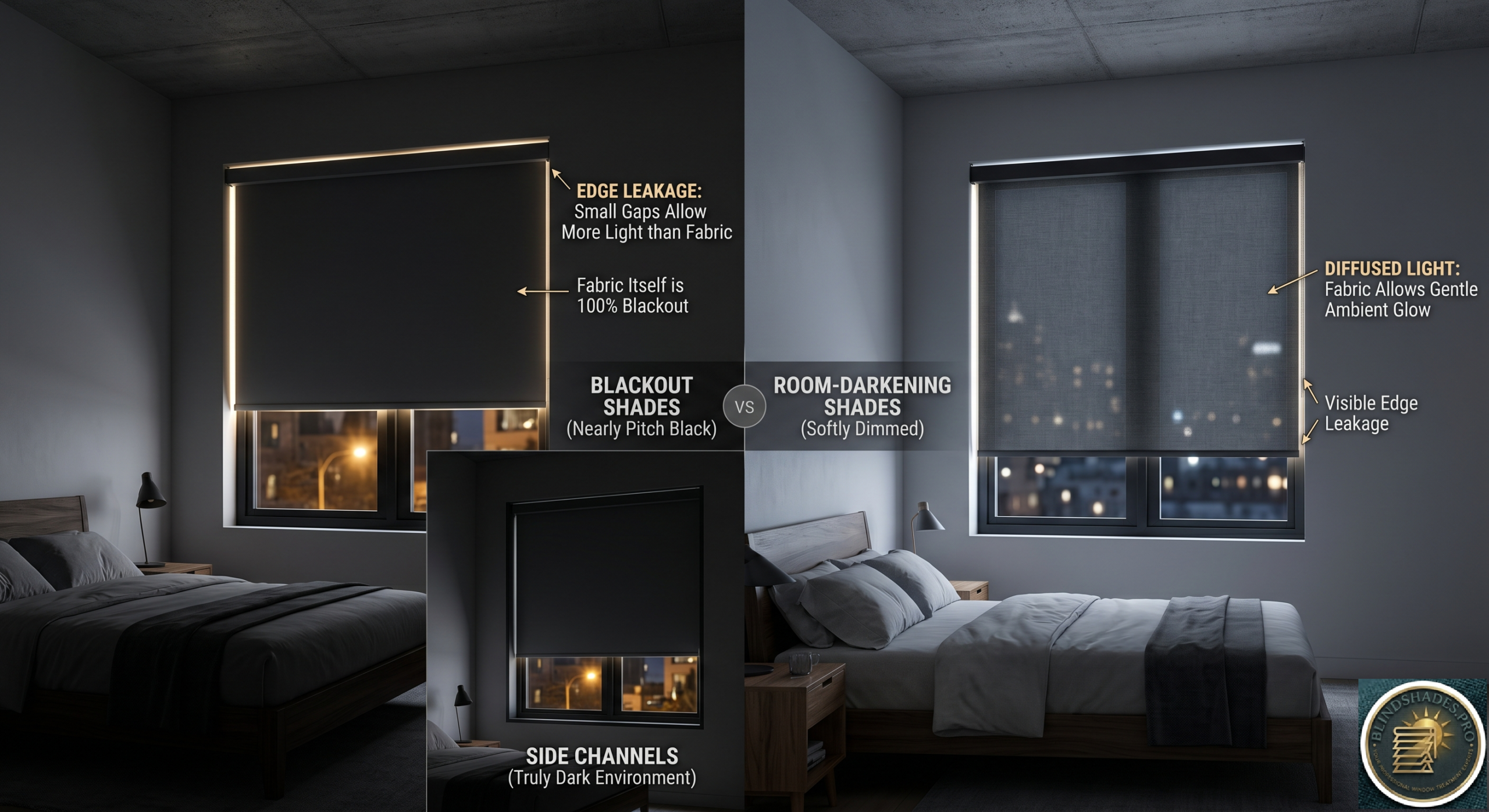
⭐ Quick Answer — Blackout Shades vs Room-Darkening Shades: What Is the Difference?
- The Official Difference: Blackout shades block 99–100% of light through the fabric. Room-darkening shades block approximately 95–99%. But no ANSI, ASTM, or industry body defines either term — manufacturers self-apply these labels. Brand A’s “room-darkening” may block more light than Brand B’s “blackout.” Always ask for the specific fabric’s blockage percentage, not the category label
- The Edge Gap Is the Bigger Problem: A 36×48 inch inside-mounted shade has approximately 42 sq inches of edge gap on all four sides. From 100,000 lux bright daylight, this gap admits ~2,400 lux into the room — far more than the 1% fabric transmission. Side channels or outside mounting fixes more darkness than upgrading from room-darkening to blackout fabric
- Fabric Construction Matters: Most “blackout” shades use triple-pass acrylic coating — effective but can crack and create pinholes after 5–8 years of daily rolling. Woven blackout fabric (no coating) is more durable, softer, and pinhole-free. For nurseries and daily-use bedrooms — woven is the better long-term specification
- Shade Colour Affects Darkness — Independently of Fabric Rating: A white or cream blackout shade reflects interior light (lamp, phone, TV standby) back into the room — making the room brighter even with the shade closed. A charcoal or dark neutral shade absorbs interior light. For light-sensitive sleepers — specify charcoal regardless of fabric blockage percentage
- Sleep Science Threshold: The American Academy of Sleep Medicine recommends below 1 lux for optimal sleep. Even 99.9% blockage of bright daylight leaves ~100 lux — still above the AASM target. True sleep-quality darkness requires both blackout fabric AND sealed edge gaps
- Best Sources: Blackout + side channels → Blindsgalore Blackout Roller with Side Channels · Cellular blackout → SelectBlinds Premier Blackout Cellular · Premium LightLock → Hunter Douglas Duette
⚠️ The Industry Labelling Problem — and When Room-Darkening Is Actually Better for Sleep: Every brand has its own threshold for “blackout” vs “room-darkening” — there is no governing standard. Before ordering, search the specific product page for the actual light-blocking percentage, not just the category name. Some brands publish this as “light transmittance 0.1%” — use this number. And counterintuitively, room-darkening may be better for sleep if you are a natural-light waker: research in the Journal of Biological Rhythms documents that gradual morning light in the 30–60 minutes before wake time improves waking ease and daytime mood. A manual blackout shade removes this circadian cue entirely. The best specification for light-sensitive sleepers who also want natural wake-up is a motorized blackout shade with a sunrise schedule — full darkness during sleep, gradual raise at wake time. See the full when-room-darkening-wins guide below.
💡 The R-Value Truth — Cellular Construction Beats the Blackout vs Room-Darkening Label for Energy Savings: All guides say “blackout shades provide insulation.” The thermal reality: a single-layer room-darkening roller shade adds approximately R-0.3 to R-0.5. A single-layer blackout roller shade adds R-0.5 to R-0.8 — barely different. But a double-cell blackout cellular shade adds R-3.5 to R-5.0. The construction type (roller vs cellular) matters 10× more than the blackout vs room-darkening label for bedroom energy savings. For a cold climate bedroom — specify cellular blackout, not blackout roller, for meaningful thermal improvement. See the full R-value comparison table below.
📖 Read the complete guide below for: why “blackout” and “room-darkening” have no industry standard definition, the triple-pass coating vs woven blackout construction difference and durability, the AASM 1-lux sleep science threshold with lux calculations, why the edge gap admits more light than the fabric (with geometry), the brand-by-brand labelling inconsistency, how shade colour affects room brightness independently of fabric rating, the R-value comparison table, when room-darkening is actually better for sleep, and the motorized sunrise specification.
Related guides: the best blackout blinds & shades guide — every format scored on the Five-Point Standard.
Why the Terminology Is Genuinely Confusing — And Not Your Fault
Every guide on this topic confidently declares: “Blackout blocks 99–100% of light. Room-darkening blocks 95–99%.” This sounds precise. It is not.
The absence of an industry standard: No regulatory body — not ANSI (American National Standards Institute), not ASTM International, not the Window Covering Manufacturers Association — has published a binding standard definition of “blackout” or “room-darkening” for window treatments. These are marketing labels, applied by each manufacturer according to their own internal criteria.
The practical consequence:
- A “room-darkening” shade from SelectBlinds may use a heavier fabric and block more light than a “blackout” shade from an unbranded online retailer
- Hunter Douglas uses its own classification system (“opaque,” “room darkening,” “light filtering”) that does not map directly to the “blackout vs room-darkening” binary used by other brands
- Graber’s “blackout” classification threshold may differ from Blindsgalore’s
The correct buying approach: Look for the specific fabric’s light blockage percentage — not the category label. Most reputable retailers (SelectBlinds, Blindsgalore, Hunter Douglas) publish the actual light transmittance percentage for each specific fabric. This number is reliable. The category label is not.
The Real Difference — Fabric Construction, Not Just Percentage
Once you have found fabrics with comparable claimed blockage percentages — the meaningful difference between better and worse light-blocking shades comes down to construction, not the label.
Triple-Pass Coating — What Most “Blackout” Shades Use
Triple-pass coating (also called triple-pass acrylic or triple-pass foam backing) is the most common blackout construction method. A woven base fabric (typically polyester) has three successive layers of acrylic foam sprayed onto its back surface. Each layer adds opacity.
Advantages:
- Cost-effective — the base fabric can be any woven polyester, and the coating adds blackout performance
- Wide colour and pattern selection — the decorative face of the fabric can be any texture or colour
- Effective light blocking when new
Disadvantages:
- The coating is a different material from the fabric base — it can crack, peel, or delaminate over years of rolling and unrolling, especially in dry or hot environments
- Cracking creates pinhole light transmission — a shade that was 99.9% light-blocking when new can develop visible light spots after 5–8 years
- The coating has a distinctive sheen and stiff feel that some buyers dislike
- Acrylic foam coatings can off-gas volatile organic compounds (VOCs) — relevant for nurseries; look for GREENGUARD certification
Woven Blackout Fabric — The Alternative Construction
A smaller number of blackout shades use densely woven blackout polyester where the opacity comes from the fibre density itself rather than a coating.
Advantages:
- No coating to crack or peel — opacity is maintained through the fabric’s life
- Softer, more textile-like hand-feel
- No VOC concern from acrylic coating
Disadvantages:
- Higher cost than coated fabrics
- More limited colour and texture options
- Slightly less opacity per millimetre of thickness compared to triple-pass coated
The specification implication: For a nursery or bedroom where the shade will be operated multiple times daily for many years — woven blackout fabric is the more durable specification. For a media room or guest bedroom with less frequent operation — triple-pass coated fabric provides excellent performance at lower cost.
The Sleep Science — What “Enough Darkness” Actually Means
All guides say “blackout shades improve sleep.” None cite the specific darkness threshold the sleep science literature actually recommends.
The American Academy of Sleep Medicine (AASM) recommendation: The AASM guidelines for optimal sleep environment specify ambient light levels below 1 lux during sleep — approximately the level of a moonless night outdoors. This is the scientific benchmark for “dark enough for optimal sleep onset and quality.”
What this means for shade selection:
Bright summer daylight: approximately 100,000 lux external.
With a room-darkening shade blocking 98% of this:
- Light through fabric: 100,000 × 0.02 = 2,000 lux transmitted
With a blackout shade blocking 99.9% of this:
- Light through fabric: 100,000 × 0.001 = 100 lux transmitted
Neither achieves the 1 lux AASM target from fabric transmission alone.
The critical insight: Even a true blackout fabric does not achieve 1 lux from daylight unless the edge gaps are also addressed. The edge gap, not the fabric, is the dominant light source in most real-world bedroom shade installations.
The Edge Gap Problem — More Important Than Blackout vs Room-Darkening
This is the most important practical fact about bedroom shade performance — and it is never quantified in competitor guides.
The geometry of an inside-mounted shade: A shade installed inside the window frame sits within the frame. Even when the shade is precisely cut to the frame dimensions, the shade fabric does not contact the frame surfaces on all four sides. There is a gap of approximately 1/16 to 1/4 inch on each side, top, and bottom where the shade mechanism must clear the frame.
The light admitted through a 1/4 inch edge gap: A 36 × 48 inch window with 1/4 inch gaps on all four sides has a total edge gap area of approximately:
- Left side: 48 inches × 0.25 inches = 12 sq inches
- Right side: 12 sq inches
- Top: 36 inches × 0.25 inches = 9 sq inches
- Bottom: 9 sq inches
- Total edge gap: 42 square inches
The same window’s shade fabric has an area of 1,728 square inches. The edge gap represents approximately 2.4% of the window area — admitting approximately 2,400 lux from a 100,000 lux day, regardless of whether the fabric blocks 95% or 99.9%.
The conclusion: Addressing the edge gap through side channels or outside mounting is the most effective action for bedroom shade darkness — far more impactful than the blackout vs room-darkening distinction.
How Shade Colour Affects Perceived Darkness — Independently of Fabric Rating
This is a counterintuitive factor that no competitor guide addresses.
The interior reflection effect: When a blackout shade is closed in a bedroom, the room’s artificial lighting (a bedside lamp, a phone screen, a TV standby light) reflects off the shade surface back into the room. A white or cream blackout shade has high reflectance — it bounces interior light around the room, creating a brighter overall environment even when the exterior light is fully blocked.
The charcoal shade advantage for bedroom darkness: A charcoal or dark-coloured blackout shade absorbs more interior light rather than reflecting it. In a bedroom with a standby TV light or phone charging indicator, a charcoal shade creates a measurably darker room than a white shade with identical light-blockage percentage.
For light-sensitive sleepers: If you are sensitive to light during sleep — specify dark neutral or charcoal blackout shades, not white or cream, regardless of the fabric’s blockage percentage. The interior reflection from a white shade is the often-overlooked contributor to bedroom brightness that a high blockage percentage alone cannot address.
The Room-Darkening vs Blackout Decision — By Scenario
| Scenario | Recommendation | Reason |
|---|---|---|
| Nursery | Blackout + side channels | Sleep schedule depends on consistent darkness regardless of time of day |
| Shift worker bedroom | Blackout + side channels + outside mount + charcoal colour | Sleeping in daylight requires maximum edge gap elimination |
| Primary bedroom, light-sensitive sleeper | Blackout + outside mount | Edge gap elimination more important than fabric spec |
| Primary bedroom, average sleeper | Room-darkening | 95–99% blockage is adequate; some morning light aids wake-up |
| Guest bedroom | Room-darkening | Flexible for varied guests; adequate for most |
| Media room / home theatre | Blackout | Complete darkness needed for screen contrast |
| Living room | Room-darkening | Glare control desired; not total darkness |
| Home office with screen glare | Room-darkening | Glare reduction sufficient; daylight still desirable |
When Room-Darkening Is Actually Better Than Blackout for Sleep
Every guide recommends blackout for sleep universally. The sleep science is more nuanced.
The morning light circadian cue: The human circadian rhythm is partially regulated by morning light exposure. Research published in the Journal of Biological Rhythms documents that gradual morning light exposure in the 30–60 minutes before wake time improves waking ease, morning alertness, and daytime mood. Full blackout, combined with an alarm-only wake-up, removes this light cue.
For natural-wake sleepers: If you prefer to wake gradually with the natural light rather than an alarm — a room-darkening shade (which allows some light diffusion as the morning brightens) actually supports better morning circadian alignment than full blackout that keeps the room at the same darkness from midnight to noon.
The motorized blackout solution: The best specification for light-sensitive sleepers who also want morning light cues is a motorized blackout shade programmed to raise gradually at the desired wake time — providing full darkness during sleep and a natural light sunrise simulation at wake. This is the specification that satisfies both sleep science requirements simultaneously.
Available from Hunter Douglas PowerView (PowerView Scenes and Schedules), Lutron Serena shades with sunrise scheduling, or Blindsgalore motorized roller shades with app-based wake time programming.
The Thermal Performance Difference — R-Values
All guides mention that blackout shades provide some insulation. None give specific thermal performance values.
R-value comparison for the same window:
| Treatment | Approximate R-Value Added |
|---|---|
| No treatment (bare window) | R-0 |
| Single-layer room-darkening roller shade | R-0.3–0.5 |
| Single-layer blackout roller shade (triple-pass) | R-0.5–0.8 |
| Single-cell blackout cellular shade | R-2.5–3.5 |
| Double-cell blackout cellular shade | R-3.5–5.0 |
| Triple-cell blackout cellular shade | R-5.0–7.0 |
The key finding: The distinction between room-darkening and blackout roller shades provides minimal thermal difference (R-0.3 vs R-0.5). The step to cellular shade construction — regardless of whether it is room-darkening or blackout — provides the dramatic R-value improvement. For energy efficiency in the bedroom — cellular construction matters far more than the blackout vs room-darkening label.
Where to Order — By Scenario
For nurseries and shift-worker bedrooms (maximum blackout specification): Blindsgalore Blackout Roller Shade with Side Channels — the combination of blackout fabric and side channels provides the most complete edge gap elimination at mid-range pricing. Hunter Douglas Duette LightLock — the best cellular blackout with U-shaped side channels in premium pricing.
For standard primary bedrooms (blackout to room-darkening): SelectBlinds Premier Blackout Cordless Cellular Shade — blackout cellular with cordless operation and good edge coverage. Blindsgalore Blackout Roller Shade in charcoal — excellent value with the dark colour for interior reflection advantage.
For motorized blackout with sunrise scheduling: Hunter Douglas PowerView motorized shades with scene scheduling. Lutron Serena shades with sunrise simulation. Blindsgalore motorized roller shade with app control.
Related guides: For complete buying advice, see our blackout blinds and shades buying guide.
Frequently Asked Questions
What is the difference between blackout shades and room-darkening shades? Blackout shades use fabric or construction rated to block 99 to 100 percent of light transmission through the material. Room-darkening shades typically block approximately 95 to 99 percent. However, neither term is defined by an industry standard body — manufacturers self-apply these labels, so a room-darkening shade from one brand may actually block more light than a blackout shade from another. Always check the specific fabric’s light blockage percentage rather than relying on the category label. And regardless of fabric rating — the light entering around the edges of an inside-mounted shade typically exceeds the light transmitting through the fabric, making side channels or outside mounting the most impactful specification for bedroom darkness.
Are blackout shades worth it for better sleep? For light-sensitive sleepers, shift workers, and nurseries — yes. The American Academy of Sleep Medicine recommends ambient light below 1 lux for optimal sleep, and true blackout fabric with proper edge gap elimination gets closest to this target. However, for average sleepers who do not work unusual hours — room-darkening shades blocking 95 to 99 percent are adequate for most people’s sleep needs, and they allow some morning light that supports circadian rhythm wake-up cues. The choice depends on light sensitivity and sleep schedule, not a universal rule.
Why does light still come through my blackout blinds? The light is almost certainly entering around the edges, not through the fabric. Even a perfectly specified blackout fabric allows light gaps at the sides, top, and bottom of an inside-mounted shade where the mechanism clears the frame. A 1 to 4 inch edge gap admits significantly more total light than 1 percent fabric transmission from bright daylight. The solutions are: outside-mount installation (shade overlaps the window frame on all sides); side-channel tracks that seal the fabric edge to the frame; or layering blackout shades with blackout curtains that cover the edge gaps.
Is triple-pass blackout better than woven blackout fabric? Both can achieve equivalent light blockage when new. Triple-pass coating is less expensive and available in wider colour and pattern selection but can crack or peel after years of rolling and unrolling, creating pinhole light transmission. Woven blackout fabric is more durable (no coating to degrade) and has a softer feel but costs more and has fewer pattern options. For nurseries and bedrooms with daily operation — woven blackout fabric is the more durable long-term specification. For occasional-use rooms — triple-pass coating provides excellent value.
Should blackout shades be white or charcoal for the darkest room? Charcoal or dark neutral blackout shades create a darker room environment than white or cream shades with identical light-blockage percentages. This is because interior light sources — a bedside lamp, phone screen, TV standby light — reflect off the shade surface back into the room. White shades have high reflectance and bounce interior light throughout the room. Charcoal shades absorb more interior light, reducing the overall room brightness when the shade is closed. For light-sensitive sleepers — specify charcoal or dark neutral colour regardless of fabric blockage percentage.
Related Guides on BlindShades.pro
- The Best Bedroom Blinds & Shades Buying Guide — the complete bedroom window treatment specification guide
- Why Is Light Coming Through the Sides of My Blackout Blinds — How to Fix Light Gaps — the full edge gap diagnostic and fix guide
- Are Blackout Blinds Worth It for Better Sleep — The Science and the Specification — the sleep science and circadian rhythm analysis
- Blackout Roller Shades vs Blackout Cellular Shades — Which Is Better for a Bedroom — the core product comparison guide
- What Are the Best Blinds for a Nursery — Blackout, Cordless and Safety Guide — the nursery-specific specification guide
By Michael Turner | 30 Years Home Improvement Expertise | Updated 2026 | BlindShades.pro
