The Best Blackout Blinds & Shades: Every Format Scored by the Five-Point Standard

Authored By Michael Turner -30 Years Home Improvement Expertise | Updated 2026 | BlindShades.pro
Updated on July 17, 2026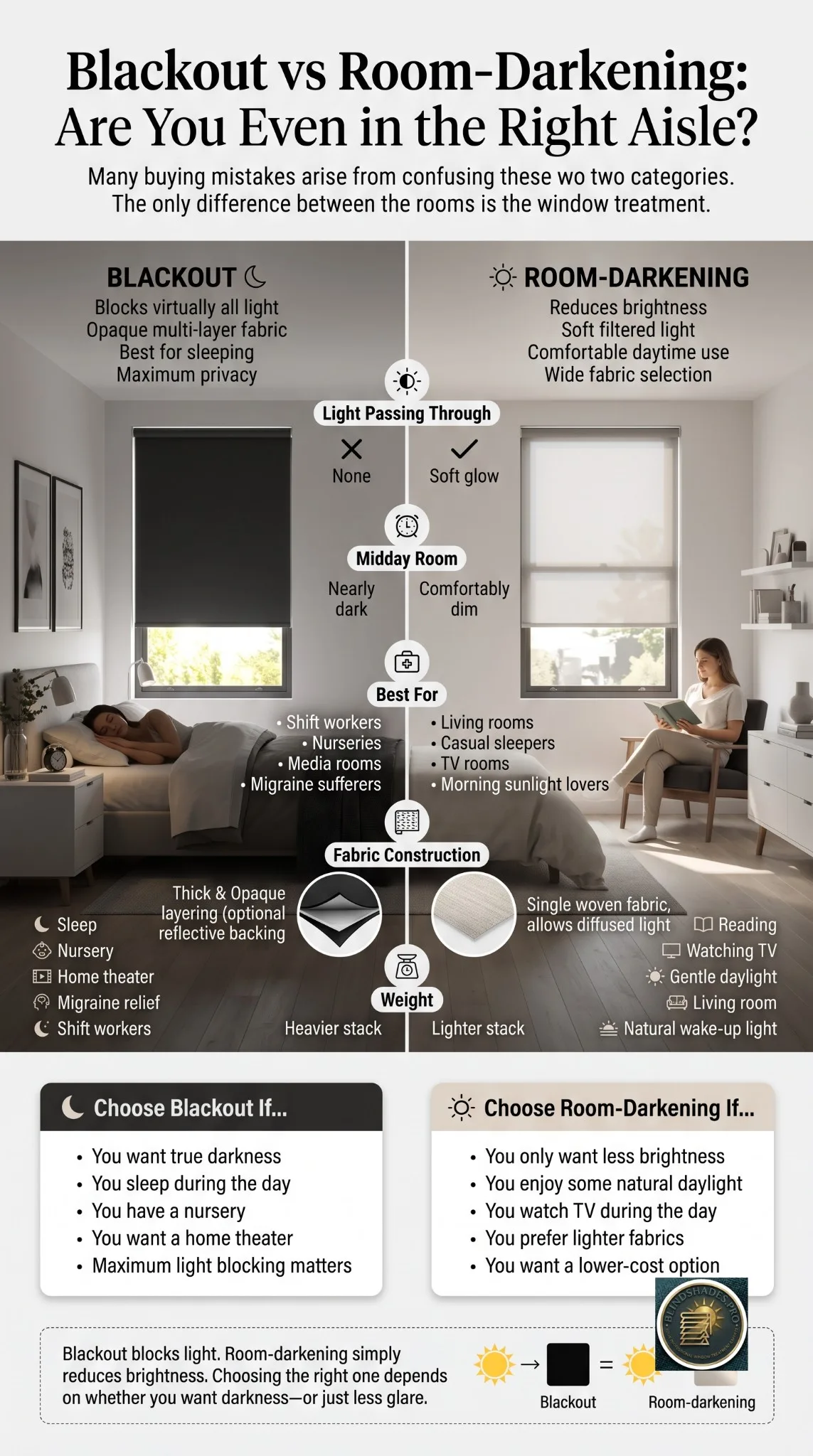
Authored by Michael Turner — 30 Years of Home Improvement Expertise | BlindShades.pro
The best blackout blinds are decided at the edges, not the fabric. Any true blackout fabric is already opaque — yet standard blinds can still leak 5 to 15 percent of light around their perimeter, which is why the loudest complaint in this category comes from owners who bought “blackout” and got a glowing picture frame. Blackout is a five-point problem: one opaque fabric plus four sealed edges — left, right, top, bottom — and every product in this market differs only in how many of those points it seals out of the box. This guide scores every format on that standard, reconciles the three professional testers whose verdicts disagree (The Spruce, Wirecutter, and UBlockout each crowned a different winner — and each was measuring something different), and gives the layered recipes behind the only claim this category can honestly make about 100 percent.
Hero infographic brief: a window diagram with five numbered seal points — fabric panel (1), left edge (2), right edge (3), top headrail (4), bottom sill (5) — with a light-leak glow drawn at each unsealed point. Alt text: “The Five-Point Standard for the best blackout blinds and shades: opaque fabric plus four sealed edges, showing where light leaks when each point is left open.”
⭐ Quick Answer — The Best Blackout Blinds & Shades
The best blackout blinds are decided at the edges, not the fabric — standard installs leak 5–15 percent of light at the perimeter, so score every product on five seal points (fabric + four edges):
- Best sealed system: UBlockout — patented side channels close the edge halo; the near-total single-product option (manufacturer-tested claims at UBlockout).
- Best independently tested: ChrisDowa blackout roller — best overall in The Spruce’s multi-year testing (April 2026) — and Select Blinds Classic Cordless, Wirecutter’s pick for best-looking and most effective (May 2025).
- Best cellular: Bali Blackout Cellular — double-cell design blocking about 97 percent of light while insulating; IKEA Trippevals is the budget insulator.
- Blackout ≠ room-darkening: blackout blocks, room-darkening dims — check the difference before paying the premium, and diagnose leaks via why light comes through the sides.
- Honest 100 percent is a system, not a product: even sealed tracks top out ~97–99 percent — the total-darkness recipe layers blackout drapes over the shade; the full build is in the shift-worker total-blackout guide.
Key Takeaways
- Fabric and edges are separate purchases in this category. Even fully opaque fabric leaves a perimeter halo — standard installs can leak 5 to 15 percent of incoming light at the edges, the statistic behind the sealed-track category’s existence. Judge every product by how many of the five points it seals stock.
- The independent testers disagree because they tested different things. The Spruce’s years-long testing crowned a budget ChrisDowa roller; The New York Times’ Wirecutter (May 2025) picked Select Blinds’ Classic Cordless as the best-looking and among the most effective; UBlockout’s own comparison crowned itself. Fabric quality, installed appearance, and edge-sealing are three different scales — this guide scores all three on one.
- Sealed-track systems are the only single products that approach total darkness — aluminum side channels plus top and bottom seals take a shade to roughly 97–99 percent — while every ordinary blind or shade needs added hardware or a drape layer to get there.
- The forum consensus is the honest one: 100 percent is a system, not a product. Reddit’s long-running threads converge on layering — a blackout shade plus blackout drapes over it — and the cheapest total-blackout recipe on record is exactly that pairing.
- Blackout is not room-darkening, and the label matters. Room-darkening fabric dims; blackout fabric blocks. Mislabeled expectations cause more returns than any product failure — the full distinction is one click away in this cluster.
Related guides: when the room needs real darkness at night but real daylight by day, the two-panel answer is in the day night blinds guide.
Quick Specification Reference
| Spec | The short answer |
|---|---|
| What “blackout” means | Opaque fabric — zero light through the material; says nothing about the edges |
| The leak reality | 5–15% of light can enter at unsealed edges of a standard install |
| Only near-total single products | Sealed-track systems (side channels + top/bottom seals), roughly 97–99% |
| The 100% recipe | Sealed or well-fitted blackout shade + blackout drapery layered over |
| Formats available | Roller, cellular, roman, pleated, faux wood (with caveats), track systems, shutters+layer |
| Best formats stock | Track system > cellular (fabric wraps edges tighter) > roller > roman > slatted blinds |
| Room-darkening vs blackout | Dims vs blocks — different fabrics, different honest uses |
| Safety standard | ANSI/WCMA A100.1 — cordless or motorized in any child’s room |
| Commercial note | Specify NFPA 701-rated blackout fabrics for contract interiors |
| Measuring rule | Inside mount needs depth and square; outside mount overlaps 2–3 inches per side for fewer leaks |
Read the complete guide below for: the Five-Point Standard that scores every format; the verified picks with what each tester actually measured; the format scorecard; blackout versus room-darkening; the edge-hardware table the side-tracks searches are looking for; room-by-room builds from nursery to media room; and the layered recipes behind honest 100 percent.
What Are the Best Blackout Blinds and Shades? Our Picks
Six verified picks — each the winner on a different scale, with the scale named.
| Pick | Product | Scale it won on | The attributed case |
|---|---|---|---|
| Best Sealed System | UBlockout 100% Blackout Shades | Edge-sealing | Patented side-channel design that seals the perimeter halo; the brand’s own testing and the category’s sealed-track benchmark — manufacturer claims, noted as such |
| Best Tested Budget | ChrisDowa Blackout Roller Shade | Independent fabric testing | The Spruce’s best overall after years of testing (April 14, 2026) at a bargain price |
| Best-Looking Tested | Select Blinds Classic Cordless Blackout | Installed looks + effectiveness | Wirecutter’s pick (May 27, 2025): best-looking of all tested and among the most effective at blocking light |
| Best Cellular | Bali Blackout Cellular Shades | Darkness + insulation | Double-cell design blocking about 97 percent of light while trapping insulating air |
| Best Insulating Budget | IKEA Trippevals Blackout Cellular | Insulation per dollar | The Spruce’s most-insulating pick |
| Best Roman | Sun Zero Thermal Blackout Roman | Soft look + foam-lined blackout | The category’s tested roman: linen face, foam-lined back, noise dampening |
How to use this table: buy the scale that matches your problem. A shift worker fighting side halos needs the sealed system or track hardware, not a prettier fabric; a nursery needs cordless-safe and dark-enough, where the Bali or Select Blinds picks shine; a living room that wants elegant dimming may not need blackout at all — check the room-darkening comparison below before spending.
The Five-Point Standard: How Every Blackout Product Is Actually Scored
One opaque fabric plus four sealed edges — count what’s included, and the market organizes itself.
The principle comes from our cellular blackout work and generalizes across every format: light enters at exactly five points, and no moving window product seals all five without help. Score each format on points sealed as sold:
| Format | Fabric (1) | Sides (2–3) | Top (4) | Bottom (5) | Stock score | What finishing costs |
|---|---|---|---|---|---|---|
| Sealed-track system (UBlockout-style) | ✔ | ✔ channels | ✔ cassette | ✔ seal | 5/5 | Nothing — priced in |
| Blackout cellular | ✔ | Near — fabric rides close | Gap at headrail | Rail floats | 2.5/5 | Side channels + seals, or drape layer |
| Blackout roller | ✔ | Deduction gap both sides | Gap behind tube | Rail floats | 1/5 | The full hardware set — or Wirecutter’s noted top-gap caveat bites |
| Blackout roman | ✔ | Gap both sides | Cassette helps | Soft hem seals poorly | 1.5/5 | Usually layered with drapes |
| Blackout pleated | ✔ | Gap both sides | Gap | Rail floats | 1/5 | Same as roller |
| Faux wood / slatted blinds | ✘ slats leak | ✘ | ✘ | ✘ | 0/5 | Not a blackout product alone — route-holes and slat gaps leak by design |
| Shutters + drape layer | ✔ panel | ✔ frame | ✔ frame | ✔ frame | 4.5/5 layered | The Reddit maximalist answer: shutters plus curtains |
Two readings worth internalizing. First, the score explains the price ladder honestly: sealed systems cost several times a bare roller because you’re buying points 2 through 5 pre-engineered. Second, a cheap fabric with finished edges beats an expensive fabric with none — the same fit-beats-tier rule that governs insulation governs darkness. Diagnosing which points your window fails takes two minutes in a darkened room; the condensed version is below, and the full walkthrough lives in why is light coming through the sides of my blackout blinds.
Who’s Grading the Homework? How to Read This Category’s Reviews
The answer box’s verdict, its statistics, and its top pick all trace to the winning brand’s own blog — here’s the neutral reconciliation.
This search’s summary calls sealed-track systems best overall, quotes a 5-to-15-percent edge-leak figure, and names UBlockout first — and the cited source for all three is UBlockout, which also holds two organic results, including a self-authored comparison against Wirecutter published December 2025. That’s not a scandal; it’s content marketing doing its job. But a buyer deserves to know the referee and the winner are the same company — and to see the genuinely independent tests laid side by side:
| Tester | What they measured | Their winner | Where the verdict applies |
|---|---|---|---|
| The Spruce (Apr 14, 2026) | Years of hands-on fabric and product testing | ChrisDowa roller (best overall); IKEA Trippevals (most insulating) | Fabric opacity and value — points 1 of 5; edges left to you |
| Wirecutter / NYT (May 27, 2025) | Installed testing: looks, operation, darkness | Select Blinds Classic Cordless | Real-bedroom performance; flags the roller top-gap hardware leak honestly |
| UBlockout (self-published) | Its own differentiator: edge sealing | UBlockout | Points 2–5; the sealed-system case, from the seller |
All three verdicts are true on their own scale. The Spruce found the best fabric per dollar; Wirecutter found the best complete ordinary shade; UBlockout demonstrated that sealing the edges beats both on raw darkness — which its own 5–15 percent statistic guarantees by definition. The Five-Point Standard is simply the scale that holds all three at once: buy fabric quality where edges don’t matter, buy the sealed system where darkness is the job, and know which job yours is before comparing prices.
Blackout vs Room-Darkening: Are You Even in the Right Aisle?
Blackout blocks; room-darkening dims — and half this category’s disappointment is a label problem.
| Question | Blackout | Room-darkening |
|---|---|---|
| Light through the fabric | None — opaque, often foil/Mylar-lined | A soft glow — woven density, no opaque liner |
| Midday room state (edges sealed) | Dark enough to sleep | Dim enough to watch TV |
| Who needs it | Shift workers, migraine sufferers, nurseries at nap time, media rooms | Casual sleepers, living rooms, anyone who likes waking with the sun |
| Cost and weight | Higher, heavier stack | Lower, lighter, more fabric choices |
| The honest test | You want darkness | You want less brightness |
If your goal is the second column, stop here and save money — most “blackout regret” purchases were room-darkening needs oversold. The full treatment, including how manufacturers label each tier, is in blackout shades vs room-darkening shades, and whether the upgrade pays for sleep quality specifically is worked through in are blackout blinds worth it for better sleep.
How Do You Seal the Edges? The Hardware the Side-Track Searches Want
Four tools, one per leak point — matched to renter-friendliness.
| Hardware | Seals | How | Renter-friendly? |
|---|---|---|---|
| Side tracks / channels | Points 2–3 | U-channels wrap the shade’s travel; the sealed-system core, also sold as retrofit kits | Adhesive versions yes; screwed, no |
| Magnetic strips / magnetic blinds | Points 2–3 on metal doors and frames | Magnet-edged shade grips a steel frame — the sliding-door and door-window answer | Yes |
| Top cassette / valance seal | Point 4 | Encloses the headrail gap — the leak Wirecutter flags on rollers | Adhesive yes |
| Bottom rail seal strip | Point 5 | Compressible strip meets the sill | Yes |
| Blackout drapery layer | All residual points | The over-layer that catches everything the hardware misses | Yes — tension or ceiling rods |
Sequence by leak size: sides first, top second, bottom third, drapes last. The two-minute diagnostic — stand in the darkened room at midday and let the light map its own entry points — is condensed here and run in full, with the fixes per finding, in how to get true blackout from cellular shades (the method transfers to every format) and the side-leak deep dive above.
100% Is a System, Not a Product
The forum consensus, formalized: no single moving shade seals all five points — the last percent is always layered.
Read the long threads in this SERP and one answer repeats across years: the r/homeowners veterans recommend cellular shades on the glass with blackout drapes on a rod over them — use both; the maximalists go further, shutters plus curtains, on the correct logic that any blind or shade alone will have light that creeps; and the budget answer that started it all (Houzz, 2019) was a blackout roller plus Eclipse blackout curtains — total blackout, relatively inexpensive. Even the best engineered track systems top out around 97–99 percent, because a shade that moves needs operating clearance somewhere. The recipes, by budget:
| Budget | The build | What it achieves |
|---|---|---|
| One product, maximum darkness | Sealed-track blackout system | ~97–99% engineered; the single-product ceiling |
| Mid — shade + hardware | Blackout cellular or roller + side tracks + top/bottom seals | Sealed-system territory, assembled piecemeal |
| Classic cheap total-blackout | Blackout roller + blackout drapes over | The Houzz recipe; catches every residual edge |
| Maximalist | Shutters + blackout curtains | The Reddit answer for “I never want to see the sun” |
| Rental | Magnetic or tension-mounted blackout + tension-rod drapes | No holes, near-total darkness |
Room-by-room, the same logic lands differently:
| Room | The build | The reasoning |
|---|---|---|
| Shift-worker bedroom | Blackout cellular or roller + full edge hardware, or a sealed-track system | Daytime sleep can’t tolerate the halo; the complete stack is in the total-blackout shift-worker guide |
| Ordinary bedroom | Well-fitted blackout cellular alone; add seals only if the Light Audit demands | Most sleepers clear the threshold without tracks; roller vs cellular for bedrooms settles the format |
| Nursery | Cordless blackout cellular + adhesive seals | Safety first — ANSI/WCMA A100.1 means no reachable cords, ever; picks in best blinds for a nursery |
| Media / projector room | Any blackout shade + planned drape layer from day one | Projection punishes the last 1–3 percent nothing else notices |
| Living room | Room-darkening, usually — blackout only for west-glare TV walls | Most living rooms want dimming and a view schedule, not a cave |
| Sliding doors / door glass | Vertical cellular, panel track in blackout fabric, or magnetic blackout on steel doors | Big spans leak big; magnetic strips are the door-window cheat |
| Rental | Magnetic or tension-mounted blackout + tension-rod drapes | The whole five points, zero holes |
Motorization, wherever it appears in these builds, is a comfort upgrade, not a darkness one — the honest math is in are motorized blackout blinds worth it. Commercial buyers add one spec line: NFPA 701-rated blackout fabrics for contract interiors, confirmed on the manufacturer cut sheet.
And before any hardware order, run the two-minute leak diagnosis — midday, room dark, shade closed, let your eyes adjust and the light will map its own entry points:
| What you see | Failing point | First fix |
|---|---|---|
| Vertical halos both sides | Sides (2–3) | Side tracks or magnetic strips; or outside-mount conversion |
| Glow line above the headrail | Top (4) | Cassette or adhesive valance seal |
| Bright line at the sill | Bottom (5) | Bottom rail seal strip |
| The whole fabric glows softly | Fabric (1) | You own room-darkening, not blackout — upgrade the fabric |
| Pinpoints mid-shade | Fabric damage | Back-face repair tape; assess before replacing |
Fix only the failing points, in leak-size order — most windows fail one or two, and diagnosing first routinely saves the cost of hardware the window never needed.
Whatever the build, measure before you buy: inside mounts need depth and square corners, outside mounts should overlap the opening two to three inches per side to shrink the halo before any hardware arrives — the tape-measure discipline is in how to measure windows for blackout blinds.
Do Blackout Blinds Also Insulate?
Partly — and the overlap is worth money, but don’t buy blackout for heat.
The materials that block light often slow heat too: the foam-lined back on the Sun Zero roman dampens noise and adds a thermal layer, the Mylar lining in blackout cellulars reflects radiant heat back into the room in winter, and Bali’s double-cell blackout construction pairs its roughly 97 percent light blocking with trapped-air insulation — which is why the most-insulating pick in The Spruce’s testing (IKEA’s Trippevals) is also a blackout cellular. If your window needs darkness and sits cold in January, the blackout cellular formats collect both benefits in one purchase, and that dual payoff is the honest version of “energy-saving blackout blinds.”
The caveat runs the other way: blackout fabric does not make a summer heat shield. Once solar radiation is through the glass, an interior shade — however opaque — absorbs part of it and re-releases that warmth indoors; darkness and heat rejection are different jobs, and hot-climate buyers chasing cooling belong with exterior or solar solutions first. If insulation is your primary motive and darkness the afterthought, start from the thermal and insulated blinds guide instead and add blackout as the fabric option; if darkness is primary, buy on the Five-Point Standard and take the winter insulation as the bonus it genuinely is.
Related guides: most blackout shades sold today are cordless — the spring mechanism, edge-light truth and safety case live in the cordless blinds guide.
Supporting Articles in This Cluster
- Blackout Shades vs Room-Darkening Shades
- Why Is Light Coming Through the Sides of My Blackout Blinds
- Are Blackout Blinds Worth It for Better Sleep
- Blackout Roller Shades vs Blackout Cellular Shades for a Bedroom
- How to Measure Windows for Blackout Blinds
- Best Blinds for a Shift Worker Bedroom — Total Blackout
- Are Motorized Blackout Blinds Worth It for a Bedroom
- Can You Get Blackout Roman Shades
- Do Blackout Roller Shades Block All Light
- How to Get True Blackout from Cellular Shades
Related Buying Guides
- The Best Bedroom Blinds & Shades Buying Guide
- The Best Cellular & Honeycomb Shades Buying Guide
- The Best Roller Shades Buying Guide
- The Best Thermal & Insulated Blinds Buying Guide
- The Best Pleated Blinds Buying Guide
Frequently Asked Questions
What are the best blackout blinds and shades?
It depends which of three scales you’re buying on. For raw darkness from one product, sealed-track systems like UBlockout lead — side channels plus top and bottom seals close the 5-to-15-percent edge leak that ordinary installs carry. For independently tested value, The Spruce’s pick is the ChrisDowa blackout roller; for the best complete ordinary shade, Wirecutter’s is the Select Blinds Classic Cordless. For darkness plus insulation, Bali’s double-cell blackout cellular blocks about 97 percent. Match the scale to your problem before comparing prices.
Do blackout blinds block 100 percent of light?
No single moving product does. Blackout fabric is fully opaque, but every shade needs operating clearance, so light leaks at the edges — 5 to 15 percent on standard installs, and even the best sealed-track systems reach roughly 97 to 99. Honest 100 percent is a system: a sealed or well-fitted blackout shade with blackout drapery layered over it — the recipe forums have converged on for years, and the cheapest total-blackout build on record.
What is the difference between blackout and room-darkening shades?
Blackout fabric is opaque — typically foil- or Mylar-lined — and passes no light through the material; room-darkening fabric is densely woven but unlined, dimming the room to a soft glow. Blackout is for people who need darkness: shift workers, nurseries at nap time, media rooms. Room-darkening is for people who want less brightness and a gentler look. Mislabeling between the two causes more returns in this category than any product defect.
Are blackout blinds with side tracks worth it?
If darkness is the actual goal, yes — sides are the largest leak on almost every window, and channels address the one thing no fabric upgrade can. Sealed-track systems price the hardware in; retrofit side-track kits and adhesive channel versions bring an existing blackout shade most of the way there, and magnetic strips do the same job on steel doors and door windows. If your room only needs dimming, skip the tracks and spend on fabric you like.
What are the best blackout blinds for a nursery?
Cordless first, dark second. The safety standard — ANSI/WCMA A100.1 — means nothing with a reachable cord belongs in a child’s room, so the build is a cordless blackout cellular or roller, adhesive top and bottom seals if naps fight the sun, and adhesive side channels only if the room genuinely needs near-total darkness. Cellular formats add insulation and quiet operation, both nursery virtues. Motorized is a convenience upgrade, not a safety requirement.
Are blackout blinds worth it for sleep?
For anyone whose sleep fights light — shift workers, early-summer sunrises, streetlights — the evidence and the owner reports both say yes, with one condition: the edges must be handled, or the fabric premium buys a glowing frame instead of darkness. Casual sleepers often do as well with room-darkening at lower cost. The sleep-science version of this answer, with the specification that actually delivers it, is in our worth-it-for-sleep deep dive.
