Best Day Night Blinds 2026: The Complete Buying Guide

Authored By Michael Turner -30 Years Home Improvement Expertise | Updated 2026 | BlindShades.pro
Updated on July 17, 2026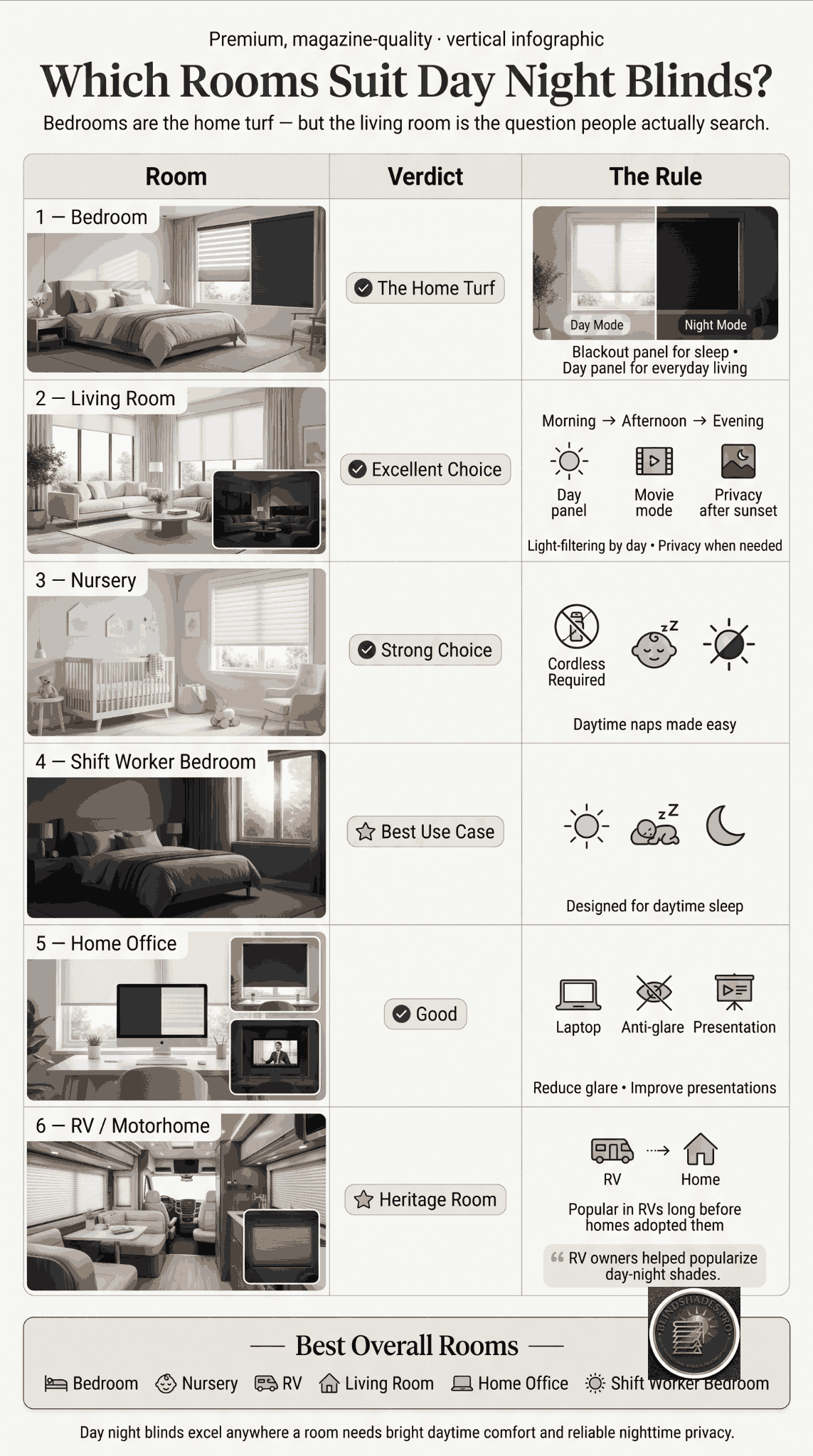
By Michael Turner, 30 years in the window treatment industry
A day night blind mounts two complete fabrics on one headrail — a light-filtering panel for waking hours and a true blackout panel for sleep — so one window gets both jobs done without compromise. That is the American meaning. There is also a second product wearing the same name: the zebra-style “day and night roller blind,” a different mechanism at a different price, and the ranked pages for this search sell both without ever telling you which is which. This guide untangles the name collision first, then ranks both formats honestly — from a thirty-six-dollar cellular with the category’s biggest review base to the custom flagships — answers the community’s top-down-bottom-up question in print, and tells the RV origin story that explains why this format exists at all.
Key Takeaways
- Two real fabrics beat every compromise. A true light-filtering panel and a true blackout panel, each full-width on one headrail — the day fabric never darkens your afternoon, the night fabric never leaks your sleep.
- “Day night blinds” is two products — pick the format first. The dual-fabric cellular (the US meaning) and the zebra-style day and night roller blind (the international meaning) share a name and nothing else; comparing their prices without knowing the difference is comparing apples to stripes.
- The value spread is dramatic. The category runs from around thirty-six dollars (with two hundred fifty-eight reviews behind it) to four hundred eighty-three at the custom ceiling — format and fabric grade, not magic, explain the gap.
- Yes, TDBU day-night combos exist. The community asked; the answer is Norman’s dual smartfit cellulars and their kin — and RVs ran day-night shades for years before houses caught on.
- You’ll flip it twice a day, every day. Operation quality is product quality here — cordless is the floor, motorized earns its keep on tall glass and rigid routines.
⭐ Quick Answer — The Best Day Night Blinds
The best day night blinds are chosen at three gates — Fabric (a true light-filtering panel AND a true blackout panel, each uncompromised), Format (dual-fabric cellular vs the zebra-style roller that shares the name), and Flip (cordless minimum — you operate this twice a day):
- The definition: a light-filtering daytime panel and a blackout panel for sleep on one headrail — in cordless, motorized, and RV styles — per the category spine at Blinds Chalet.
- Best overall: the Day/Night Cordless Cellular — two fabrics in one at around seventy-four dollars half off — at Blindsgalore, with the budget king (four point six across two hundred fifty-eight reviews, around thirty-six dollars) at Blindster and the Tranquil custom ladder at SelectBlinds.
- The name collision: “day and night roller blinds” usually means the banded zebra product — a different mechanism entirely, covered in the zebra & banded shades guide.
- The format’s parent: the honeycomb structure carrying both panels — cells, insulation, and specs — lives in the cellular & honeycomb guide.
- The honest limit: even blackout panels edge-glow at the frame — for darkness-critical rooms, escalate via the complete blackout guide.
Quick Specification Reference
| Specification | The Short Answer |
|---|---|
| Best overall | Blindsgalore Day/Night Cordless Cellular — around seventy-four dollars at half off, four point nine across thirty-seven |
| Best budget / biggest base | Blindster Cordless Day/Night Cellular — around thirty-six dollars, four point six across two hundred fifty-eight |
| Best custom | SelectBlinds Tranquil Day & Night — one fifty-nine fifty to four eighty-three, four point five across one hundred three |
| Best big-box | Home Decorators Collection via Home Depot — around sixty-six, four point four across seven hundred seventy-six |
| The two formats | Dual-fabric CELLULAR (two full panels, one headrail — the US meaning) vs zebra-style ROLLER (the banded cousin) |
| The mechanism | Light-filtering daytime panel + blackout panel for sleep on one headrail — the definition the category’s biggest store states plainly |
| The heritage | RV shades ran this format for years before homes adopted it |
| The honest rule | Format first, then price — a cellular and a roller sharing the name are not competitors |
Read the complete guide below for: the six Diamond picks across both formats, the Fabric-Format-Flip Test, the name-collision routing table this search desperately needs, every panel state honestly rated, the format comparison, room-by-room verdicts led by the living-room question people actually search, the review-volume price story with two listing-fragmentation warnings and one delivery-fee trap, and the TDBU answer the community asked for.
What Are the Best Day Night Blinds? Our Picks
Six picks across both meanings of the name — anchored to the biggest honest review bases, thin listings flagged.
The best day night blinds for most bedrooms is a cordless dual-fabric cellular — and the market’s six lanes split cleanly:
Best Overall — Blindsgalore Day/Night Cordless Cellular. Around seventy-four dollars at half off, four point nine across thirty-seven on the product page (a sibling listing carries five point zero across thirty-four) — and their copy states the whole category in one line: two fabrics in one, light-filtering for daytime and blackout for night, with the market’s own verdict attached: great considering the fair price. Child-safe cordless as standard.
Best Budget and Biggest Base — Blindster Cordless Day/Night Cellular. Around thirty-six dollars — the lowest real price in the category — carrying four point six across two hundred fifty-eight reviews, the largest honest base on this SERP’s product side. If the format is right for your window, this is the value verdict, full stop.
Best Custom — SelectBlinds Tranquil Day & Night Cellular. One fifty-nine fifty to four eighty-three at half-off anchoring, four point five across one hundred three: light-filtering cellular plus blackout materials in one sleek cordless solution, per their own framing — the flagship custom line, with the Day & Night Modern Light sibling at around eighty-six and the Premier at around one forty-three widening the ladder.
Best Motorized — Graywind Motorized Day Night Cellular. Around one eighty (four point five across four — thin base, flagged), with the Motionblinds-powered variant at around two forty-six for app-and-voice ecosystems; the protocol-and-power decision lives in the motorized guide. Motorization earns its premium here more than in most categories — this is a shade you operate twice daily.
Best Roller-Style — SelectBlinds Day & Night Double Roller. Around three nineteen at half off — the honest pick for searchers who meant the other day night blind: the banded, zebra-style dual roller. If that’s the product in your head, the full mechanism, picks, and night-privacy truth live in the zebra & banded shades guide. One warning for this lane: SpringBlinds’ heavily-marketed Day & Night Dual Shades list at around one hundred dollars — with a three-hundred-fifty-dollar delivery fee in the listing fine print. Read the shipping line before the price line.
Best Big-Box — Home Decorators Collection via Home Depot. Around sixty-six with four point four across seven hundred seventy-six — the largest review base anywhere on this SERP — with Linen Avenue via Lowe’s (around one sixteen, four point eight across twenty-nine) as the other walk-in door. A fragmentation caution in the same aisle: Chicology’s day-night listings scatter across retailers showing one point zero across one review here and three point zero across one there, while its plain cellular line holds four point four across one hundred seventy — same brand, chaotic listings; sort by review count, not brand memory.
| Pick | Product | Approx. Price (as listed) | Rating / Reviews | Wins the gate for |
|---|---|---|---|---|
| Best Overall | Blindsgalore day/night cordless cellular | Around seventy-four (half off) | 4.9 / 37 | The definition, fairly priced |
| Best Budget | Blindster cordless day/night cellular | Around thirty-six | 4.6 / 258 | Biggest base, lowest real price |
| Best Custom | SelectBlinds Tranquil day & night | One-sixty to four-eighty-three | 4.5 / 103 | The custom flagship ladder |
| Best Motorized | Graywind · Motionblinds variant | One-eighty · two-forty-six | 4.5 / 4 — thin, flagged | Twice-daily flips, automated |
| Best Roller-Style | SelectBlinds double roller | Around three-nineteen (half off) | The zebra-meaning pick | The other product, honestly served |
| Best Big-Box | Home Decorators · Linen Avenue | Sixty-six · one-sixteen | 4.4 / 776 · 4.8 / 29 | The SERP’s largest base, walk-in |
How Do You Choose? The Fabric-Format-Flip Test
Three gates, in order: the two-fabric pairing that is the product, the format the name hides, and the daily flip that decides operation.
Gate 1 — Fabric. The entire case for this category is that neither fabric compromises: the day panel is a genuine light-filtering material (soft glow, daytime privacy, no cave effect), and the night panel is genuine blackout (sleep-grade darkness, not “room darkening” — the vocabulary difference is mapped in blackout vs room darkening shades). Single-fabric shades pick one job and live with the other; day night blinds refuse the choice.
Gate 2 — Format. The name-collision gate — settled in full in the next section. Dual-fabric cellular (two complete panels, one headrail) or zebra-style roller (alternating bands, one loop)? Decide this before reading a single price.
Gate 3 — Flip. You will switch panels at dawn and dusk, every day. Cordless is the floor (and the child-safe standard the category leaders ship by default); motorized is the upgrade that turns the routine into a schedule, and pays for itself fastest on tall glass and multi-window bedrooms.
| Gate | The question | Pass looks like | Fail routes to |
|---|---|---|---|
| Fabric | Are both panels uncompromised? | True light-filtering + true blackout | “Room darkening” night panels → check the vocabulary |
| Format | Which product did you mean? | Cellular for insulation + true dark; roller-style for the banded look | Wrong-format purchases — the collision table below |
| Flip | Will the daily switch stay effortless? | Cordless minimum; motorized on tall glass | Corded loops in kids’ rooms — never |
The Name Collision: Two Products, One Name
“Day night blinds” means different things on different pages — untangled here, once, so you buy the right machine.
First, the naming thicket itself, because this category collects spellings the way it collects fabrics: day and night blinds, day & night blinds, day-night blinds, day night window blinds, day and night window blinds, night blinds, day night roller blinds, and day and night roller blinds — some searchers even type it backwards, blinds day and night, and land here all the same all land on this page’s territory — and that last one is the tell. When the word roller enters the phrase, the searcher usually means the zebra-style product: alternating sheer and opaque bands on one continuous loop, privacy by band alignment. When the phrase stands alone — day night blinds, day night shades — the US market means the dual-fabric cellular: two complete panels sharing one headrail, the definition the category’s biggest dealer states plainly: a light-filtering daytime panel and a blackout panel for sleep on one headrail, in cordless, motorized, and RV styles.
The ranked pages for this search prove the confusion is real: a five-year-old dealer article calls sheer and zebra shades “also called dual shades”; a marketing-heavy roller product ranks under the day-and-night banner; and two of the top editorial results are actually blackout roundups that Google pulled in on vibes. Nobody sorts it out — so here is the sorting:
| What you searched | What it actually is | The buying logic | The guide |
|---|---|---|---|
| Day night blinds / day night shades (US) | Dual-fabric CELLULAR — two full panels, one headrail | Insulation + true blackout + true light-filtering; this page’s main lane | You’re reading it |
| Day and night roller blinds | Zebra-style banded dual roller — one loop, alignment privacy | The striped look at roller prices; a different mechanism entirely | Zebra & banded shades |
| “Dual sheer shades” | Usually the zebra product again; occasionally vane sheers | The word “dual” is doing heavy lifting | Zebra · Sheer shades |
| Night blinds (alone) | Usually plain blackout shades | Darkness-first, no day panel | The blackout guide |
| TDBU day-night combos | Dual-fabric cellulars that ALSO open top-down | The community’s holy-grail question — answered below | TDBU guide + this page |
The rule this table earns: format first, then price. A seventy-four-dollar dual-fabric cellular and a hundred-dollar banded roller are not competitors — they are different machines for different jobs, and every “which is cheaper” comparison that ignores the format is comparing apples to stripes.
What Does Each Panel State Give You?
One headrail, three honest states.
| State | Light | Privacy | The moment |
|---|---|---|---|
| Day panel down | Soft, filtered glow — no cave effect | Solid daytime privacy | The default waking state |
| Night panel down | Sleep-grade darkness | Complete | Bedtime — the panel single-fabric shades can’t match |
| Both raised | Bare glass, full sun | None | The view moments |
Two honest riders. Even the blackout panel obeys blackout physics — fabric blocks, edges glow — so the perimeter-light story from do blackout roller shades block all light applies here too, and the escalation for the light-sensitive is side-tracked systems (the search suggestions’ own next step: blackout shades with side tracks) or the layered approach in the bedroom guide’s Two-Layer System. And mid-transition — one panel half-down chasing the sun — is a styling moment, not a setting; the product’s promise is the two committed states.
Cellular vs Roller-Style vs TDBU Combo: The Format Comparison
Three formats carry the day-night idea — here is what each trades.
| Format | Insulation | True blackout? | Price band (as listed) | The look |
|---|---|---|---|---|
| Dual-fabric cellular (the US default) | Real — honeycomb cells trap air; the cell structure decision applies | Yes — a dedicated blackout panel | Thirty-six to four-eighty-three | Soft, tailored, bedroom-native |
| Zebra-style dual roller | Minimal — flat fabric | No — bands align, light outlines at night | Fifty to three-nineteen | Striped, modern, living-space-native |
| TDBU day-night combo | Cellular-grade | Yes, plus top-down light | Premium — the Norman dual smartfit class | The everything option |
The cellular column is why this format owns bedrooms: the same honeycomb structure that insulates (the R-value case argued in the cellular & honeycomb guide) also carries the blackout panel without bulk. The thermal-insulated guide covers the energy math the cells earn.
Which Rooms Suit Day Night Blinds?
Bedrooms are the home turf — but the living room is the question people actually search.
| Room | Verdict | The rule |
|---|---|---|
| Bedroom | The home turf | The whole format was born for this — blackout panel for sleep, day panel for everything else |
| Living room | Yes — the best day night blinds for living room use are the same cellulars in lighter day fabrics | Day panel does the daily work; night panel earns its keep for movie afternoons and street-facing evenings |
| Nursery | Strong — cordless mandatory | Naps are daytime sleep: the blackout panel works the day shift; the blackout-nursery deep-dive lives under the blackout guide |
| Shift-worker rooms | The killer app | Daytime sleep is this product’s founding job — see the RV story below |
| Home office | Good | Day panel kills glare; night panel converts the room for presentations |
| RV / motorhome | The heritage room | Day-night shades ran in RVs for years before houses caught on — the community’s own top answer |
The One-Headrail Sleep System: Why Two Real Fabrics Win
The section that answers the community’s question — and tells the origin story the category forgot.
Here is the argument in full. Every single-fabric shade makes a permanent choice: light-filtering fabrics never truly darken; blackout fabrics never truly glow. The zebra compromise splits the difference with bands — and inherits the night-outline caveat our zebra guide resolves honestly. The day night format refuses the trade: two complete fabrics, each doing its one job at full strength, stacked on a single headrail with nothing shared but the brackets. The day panel is a real light-filtering cellular — soft glow, daytime privacy, no afternoon cave. The night panel is real blackout — sleep-grade, not “room darkening.” One window, both jobs, no apology.
And yes — the top-down bottom-up combination exists. A year-old community thread asked whether TDBU shades that are ALSO night-day shades exist; the answers hold up: RVs have used them for years — the top answer’s exact point — and Norman’s dual smartfit cellular line was named as the residential proof, with other makers following. The combo stacks the format’s two fabrics onto TDBU’s two-way opening: blackout below for privacy, daylight above the sightline, then the whole thing flips for sleep. It is the most capable window treatment a bedroom can buy, priced accordingly, and the mechanism’s own guide is the TDBU hub.
The RV heritage deserves its paragraph, because it explains the design. Motorhomes needed one compact treatment that handled brutal sun by day and true darkness for sleep in the same footprint — no room for layers, no tolerance for compromise. The dual-fabric day/night shade was the answer, and it ran in RVs for years before the residential market noticed that shift workers, nursery parents, and street-lit bedrooms have exactly the same problem as a campground at 6 a.m. When this operation reaches its RV guide, the format comes home; until then, know that the best day night blinds trace their pedigree to the road.
The escalation ladder, honestly: day night blinds solve ninety percent of sleep-light problems at the fabric level. The remaining ten percent — streetlight strafing the edges, blackout-critical medical sleep — escalates to side-tracked blackout systems (the sealed-track class the blackout field tests rank above 95% blocking) or the full Two-Layer System: shade plus curtain, the bedroom hub’s standing architecture. A category that knows its ceiling is a category you can trust.
What Do Day Night Blinds Cost? The Price-Band Truth
Thirty-six to four-eighty-three — format and fabric grade explain every dollar, and two listing traps deserve flags.
| Tier | What’s there (as listed) | The evidence |
|---|---|---|
| Budget (thirty-six to seventy-five) | Blindster’s 4.6/258 base at around thirty-six; Blindsgalore’s half-off seventy-four; Home Decorators around sixty-six at 4.4/776 | The value core — biggest bases, lowest prices |
| Mid (one hundred to two hundred) | Linen Avenue ~one-sixteen (4.8/29); Wayfair cordless ~one-twenty-three (4.8/29); Blindsavenue ~one-nineteen (4.5/378); Keego via Walmart ~one-thirty-two; SelectBlinds Premier ~one-forty-three | Big-box and custom entry |
| Premium (two hundred plus) | Tranquil ladder to four-eighty-three; Graywind motorized one-eighty to two-forty-six; the double-roller three-nineteen | Custom fabrics, motors, the roller-style flagship |
| The traps | SpringBlinds ~one-hundred + three-hundred-fifty-dollar delivery; Chicology’s 1.0/1 and 3.0/1 fragments beside its legitimate 4.4/170 cellular line | Read shipping lines; sort by review count |
Where Should You Buy Day Night Blinds?
The category spine is the dedicated dealers — with the definition stated plainly at the top.
| Retailer / Route | Why | Watch-out |
|---|---|---|
| Blinds Chalet (4.7 store / 1.1K) | The cleanest category page ranked — the one-headrail definition, cordless/motorized/RV styles | Category spine, not the cheapest |
| Blindsgalore | Best Overall’s home; child-safe cordless standard | Sibling listings split the review base |
| Blindster | The 258-review budget king | Sizes cap earlier than customs |
| SelectBlinds | The Tranquil custom ladder + the roller-style flagship | Half-off anchoring is the real price |
| Home Depot / Lowe’s / Walmart / Wayfair | Home Decorators’ 776-review base; Linen Avenue; Keego | The Chicology fragmentation lives here |
| Graywind / Motionblinds | The motorized lane | Thin bases — 4.5/4; buy the protocol, not the stars |
| RV suppliers | The heritage lane — custom RV day/night shades are a mature market | Measure RV windows to the millimeter |
Related guides: the day/night format was born in campers — which rigs it still suits, when to restring instead of replace, and the roller conversion trend are all in the complete RV blinds and shades guide.
Related Buying Guides
- Best Zebra & Banded Shades — the other “day and night roller blind”
- Best Sheer Shades — continuous tilt instead of panel swaps
- Best Cellular & Honeycomb Shades — the format’s parent family
- Best Blackout Blinds & Shades — the darkness-first lane
- Best Top-Down Bottom-Up Blinds & Shades — the combo’s other half
Complete Day Night Guide Library
- Best Zebra & Banded Shades — the banded meaning of the name
- Best Sheer Shades — the soft-light sibling
- Best Cellular & Honeycomb Shades — cells, structure, and insulation
- Best Blackout Blinds & Shades — when only darkness matters
- Best Top-Down Bottom-Up Blinds & Shades — the combo mechanism
- Blackout vs Room Darkening Shades — the vocabulary that matters here
- Single Cell vs Double Cell Shades — the cellular spec beneath the format
- Best Bedroom Blinds & Shades — the room this format serves
Frequently Asked Questions
What are the best day night blinds? The best day night blinds in the dual-fabric cellular format are Blindsgalore’s Day/Night Cordless Cellular at around seventy-four dollars (four point nine across thirty-seven), Blindster’s budget line at around thirty-six with the category’s biggest base (four point six across two hundred fifty-eight), and SelectBlinds’ Tranquil custom ladder to four eighty-three. For the roller-style meaning of the name, SelectBlinds’ Day & Night Double Roller leads, and the full banded category has its own guide.
What is a day and night blind — how does it work? Two complete fabrics on one headrail: a light-filtering panel you lower for waking hours (soft glow, daytime privacy) and a true blackout panel you lower for sleep. Each fabric does its single job at full strength — no single-fabric compromise. Note the name also gets used for zebra-style banded rollers, a different mechanism; the format table above sorts the two.
Are day and night blinds worth it? For bedrooms, nurseries, and shift-worker rooms, strongly yes — one headrail replaces the shade-plus-curtain workaround with purpose-built fabrics, from around thirty-six dollars at the value end. For rooms that never need real darkness, a single light-filtering shade does the job for less; and for the striped modern look without true blackout, the zebra-style cousin costs less again.
Do day night blinds provide privacy at night? Yes — with the blackout panel down, privacy is complete: the panel is opaque, and unlike banded or open-weave products there are no stripes or lattice to outline against interior light. Edge glow at the frame is the only caveat (all blackout treatments share it); outside-mounting with overlap, side-tracked systems, or a curtain layer close the perimeter for the truly light-sensitive.
Do top-down bottom-up day night shades exist? Yes — the combination the community keeps asking about is real: dual-fabric day/night cellulars with TDBU opening, led by Norman’s dual smartfit line, with RV makers running the format for years before residential brands adopted it. You get blackout below the sightline, daylight above, and the full night panel for sleep — the most capable single treatment a bedroom can buy.
How much do day and night window blinds cost? The dual-fabric cellular market runs from around thirty-six dollars (Blindster) through the sixty-six-to-one-fifty big-box and custom-entry band, to four eighty-three at the Tranquil custom ceiling, with motorized versions from around one eighty. Roller-style day and night blinds run roughly fifty to three nineteen. One listing warning: a heavily-marketed hundred-dollar roller option carries a three-hundred-fifty-dollar delivery fee — always read the shipping line.
