Best Sheer Shades 2026: The Complete Buying Guide

Authored By Michael Turner -30 Years Home Improvement Expertise | Updated 2026 | BlindShades.pro
Updated on July 19, 2026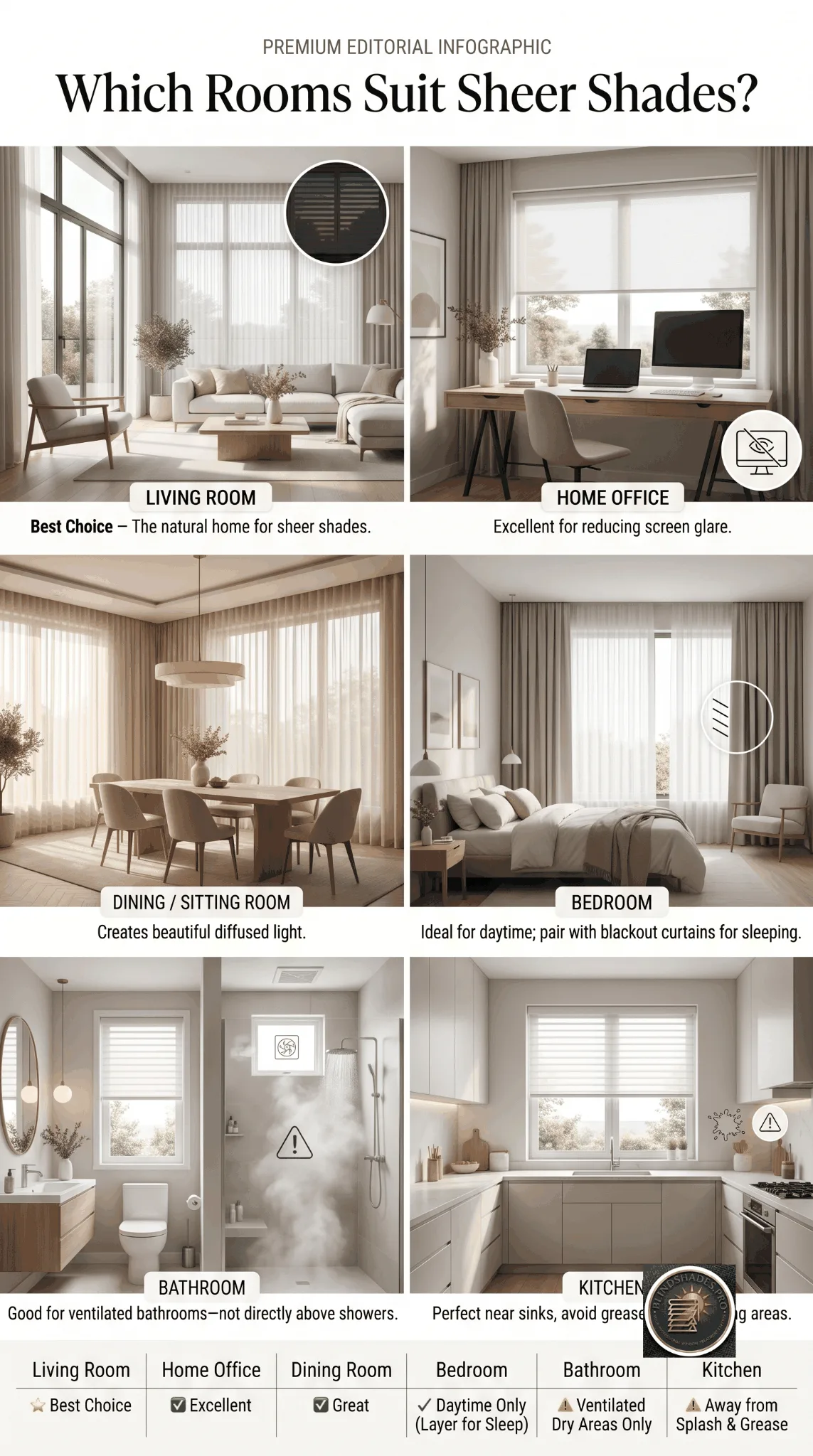
By Michael Turner, 30 years in the window treatment industry
A sheer shade is a venetian blind made of light: fabric vanes floating between two transparent sheer panels, tilting open to preserve your view while melting glare into glow, tilting closed to read as a soft shade. Hunter Douglas built the category with the Silhouette, and every ranked page on this topic orbits that one product — which leaves the real questions unanswered. What does the dealer price actually buy over the one-third-price online customs? Which of the seven different products called “sheer” do you actually want? And when a forty-six-vote Reddit thread says go sheer over solar shades and drapes, what was it really deciding? This guide answers all three — with the family tree nobody draws, the vane anatomy, the value tiers, and picks anchored to the biggest honest review bases on the market.
Key Takeaways
- The vanes are the product. S-shaped fabric slats suspended between front and back sheers tilt like a venetian — open for view and diffused light, closed for soft privacy — and vane size (two to three inches) sets the scale of everything.
- “Sheer” is seven products. Sheer shades, sheer curtains, sheer verticals, sheer rollers, zebra/dual shades, day-night cellulars, and solar shades all rank on this word — the family tree below routes you to the right one before you spend anything.
- The Silhouette question has a real answer. Dealer pricing buys fabric engineering, install, and warranty depth; online customs replicate the mechanism at roughly a third the price; big-box clones fill the gap — tiers, not tribalism.
- View is the buying reason. The category’s top community verdict — forty-six votes — says it plainly: where privacy isn’t the driver, go sheer and keep the view.
- Read review volume before brand names. This market’s listings run from a 218-review honest base to five-star ratings built on two reviews — the value-tier table flags which is which.
⭐ Quick Answer — The Best Sheer Shades
The best sheer shades are chosen at three gates — Vane (S-shaped fabric slats between two sheer panels; two-to-three-inch sizes set the view), View (tilted open they diffuse glare while keeping the outdoors — the reason to buy), and Value (dealer vs one-third-price online customs vs big-box):
- The premium reference: the Silhouette’s ClearView sheer fabrics at Hunter Douglas define the category, with the custom value core — light-filtering and room-darkening sheers from one-oh-six to three-seventy — at Blindsgalore.
- The cleanest definition: the functionality of a blind with the look of a shade, per the category page at American Blinds — and the biggest honest review bases are Home Depot’s Custom Home Collection (two hundred eighteen reviews) and Blinds.com’s customs (one hundred twenty-four).
- The word trap: seven different products rank as “sheer” — the curtain half of the family lives in the window sheers guide, and the striped “dual sheer” cousin in the zebra & banded shades guide.
- The heat boundary: sheers are a light decision, solars are a heat decision — if the job is sun and UV with a view, start with what percentage solar shade for a living room.
- The honest limit: light-filtering, not blackout — close the vanes at dusk (open weaves reverse at night), and give sleep rooms a second layer.
Quick Specification Reference
| Specification | The Short Answer |
|---|---|
| Best premium | Hunter Douglas Silhouette — the category’s originator; ClearView sheers; dealer-quoted |
| Best custom value | Blinds.com Custom Sheer Shades — around sixty-nine dollars at twenty-five percent off, four point three across one hundred twenty-four |
| Best big-box | Custom Home Collection via Home Depot — around one hundred eight dollars, four point four across two hundred eighteen |
| Best max-view vane | Bali 3-inch Vane via Costco — around two fifty-three, ninety-day returns |
| Typical cost range | One-oh-six to three-seventy per Blindsgalore; one-seventeen to five-seventy-three per American Blinds |
| The anatomy | Fabric vanes suspended between two sheer panels — tilt for view, close for privacy |
| The buying reason | Diffused light with a preserved view — glare control without blackout |
| The honest limit | Light-filtering, not room-darkening — bedrooms need a second layer |
Read the complete guide below for: the six Diamond picks with review-volume honesty, the Vane-View-Value Test, the sheer family tree that untangles seven products sharing one name, vane sizes and shade positions in plain tables, room-by-room verdicts including the humid-bathroom answer, the Silhouette-vs-knockoff value tiers, and where to buy — plus the one warning this keyword uniquely needs about the makeup aisle.
What Are the Best Sheer Shades? Our Picks
Six picks, one per job — the highest rated sheer shades by honest review volume, with thin-base listings flagged instead of hidden.
The best sheer shades for most rooms is a two-to-three-inch-vane custom from the online tier — but the market runs six lanes.
Best Premium — Hunter Douglas Silhouette. The product that invented the category and the one every ranked page crowns: floating S-shaped vanes between transparent panels, with ClearView sheer fabrics engineered to preserve the outdoor view while filtering UV. Dealer-quoted, dealer-installed — and what that premium actually buys is itemized honestly in the value section below.
Best Custom Value — Blinds.com Custom Sheer Shades. Around sixty-nine dollars at twenty-five percent off in starter sizes, four point three across one hundred twenty-four — the biggest custom review base on this market. The white horizontal variants run around one-eleven (three point nine across seventeen — thinner base, noted).
Best Big-Box — Custom Home Collection Light Filtering Sheer via Home Depot. Around one hundred eight dollars, four point four across two hundred eighteen — the largest review base on the entire SERP, and the modern descendant of the twelve-year-old knockoff question this guide finally answers. Walk-in returns included.
Best Max-View Vane — Bali 3-inch Vane Sheer via Costco. Around two fifty-three with ninety-day returns — the three-inch vane is the view-maximizing choice (fewer vanes, wider openings), and Bali’s own pitch says it straight: maximize your view to the outside. Bali’s motorized line (around four-seventy-four via American Blinds) is the powered route; the Bali sheer listing at Blindsgalore showing five stars carries just two reviews — pretty, but not evidence.
Best Brand-Buyable — Levolor Light Filtering Sheer. Around two-eighty at thirty-four percent off via Home Depot, four point one across one hundred seven — the national-brand middle path when dealer pricing stings but big-box feels generic.
Best Sheer Vertical — SelectBlinds Modern Sheer Vertical. Around one-eleven at half off, four point two across ten (thin base, flagged) — the answer to the splurge-worthy sheer-vertical question the community keeps asking, and the crossover product for sliding doors; the full vertical decision lives in the complete vertical blinds guide.
| Pick | Product | Approx. Price (as listed) | Rating / Reviews | Wins the gate for |
|---|---|---|---|---|
| Best Premium | Hunter Douglas Silhouette | Dealer-quoted | Category originator | Fabric engineering, ClearView, service |
| Best Custom Value | Blinds.com custom sheer | Around sixty-nine (25% off) | 4.3 / 124 | Biggest custom base, a third of dealer price |
| Best Big-Box | Custom Home Collection (Home Depot) | Around one-oh-eight | 4.4 / 218 | The SERP’s largest honest base |
| Best Max-View | Bali 3-inch vane (Costco) | Around two fifty-three | 90-day returns | Widest vane, widest view |
| Best Brand-Buyable | Levolor light filtering sheer | Around two-eighty (34% off) | 4.1 / 107 | National brand without dealer pricing |
| Best Sheer Vertical | SelectBlinds modern sheer vertical | Around one-eleven (half off) | 4.2 / 10 — thin, flagged | Sliding doors and the splurge question |
Related guides: the living-room bay is the sheer’s natural habitat — which styles clear the corners and how to layer curtains over them is in our guide to blinds for bay windows.
How Do You Choose? The Vane-View-Value Test
Three gates, in order: the vane that defines the product, the view that justifies it, and the tier that prices it.
Gate 1 — Vane. Everything about a sheer shade is its vanes: semi-opaque S-shaped fabric slats layered between light-diffusing front and back sheer panels — the anatomy Innuwindow’s dealer page states cleanly. Vane size is the first spec decision, tabled below.
Gate 2 — View. The category exists for one scenario: a window worth looking through, in a room where raw sun is the enemy. Tilted open, the sheers scatter glare into glow while the vanes disappear from the sightline. The top-voted answer in this market’s biggest community thread — forty-six votes, choosing between Silhouette sheers, solar shades, and custom drapes — reasoned exactly this way: privacy wasn’t the issue, so go sheer. When the room’s job is heat rejection rather than soft light, the answer flips to solar — that boundary is drawn honestly in the family tree below, and the percentage decision lives in what percentage solar shade for a living room.
Gate 3 — Value. One mechanism, three price tiers — dealer, online custom, big-box — separated by fabric, service, and warranty rather than by concept. The twelve-year-old question gets its own section.
| Gate | The question | Pass looks like | Fail routes to |
|---|---|---|---|
| Vane | Which size fits the window’s scale? | Two-inch for small panes; three-inch for view walls | — |
| View | Is diffused-light-with-view the job? | Living rooms, view windows, glare problems | Heat problems → solar; darkness → blackout |
| Value | Which tier matches the stakes? | Dealer for statement windows; custom for whole-home | Never dealer prices for big-box clones |
Sheer Shades vs Sheer Curtains vs Zebra vs Day-Night: The Family Tree
One word, seven products — the map this entire market refuses to draw.
One naming note first: this product answers to many names — sheer blinds, sheer shadings (Hunter Douglas’s own term is “window shadings”), sheer horizontal shades, and sheer window shades all describe the same vanes-between-sheers product, so if you searched for the best sheer blinds, you are in the right place. Google’s own related questions for this keyword drift to sheer curtains; its shopping rail ranks IKEA curtain panels and — genuinely — lipstick. So before a dollar moves, here is what each “sheer” actually is:
| Product | What it actually is | Choose it when | The guide |
|---|---|---|---|
| Sheer shades (this page) | S-shaped fabric vanes between two sheer panels — tilts like a venetian | View + diffused light + tilt privacy in one product | You’re reading it |
| Sheer curtains | Translucent drapery fabric on a rod | Softness, layering, budget; no tilt, no fit | The window sheers guide |
| Sheer verticals | Vertical vanes wrapped in sheer fabric | Sliding doors, tall glass | Vertical blinds + the pick above |
| Sheer/light-filtering rollers | A roller in translucent fabric — no vanes | Minimalist windows, budget diffusion | The roller shades guide |
| Zebra / banded / “dual sheer” shades | Alternating sheer and solid bands on a roller loop | Striped modern look, alignment-based privacy | Zebra & banded shades |
| Day-night shades | Two independent fabrics (sheer + opaque) on one headrail | Full sheer-to-blackout range in one window | Day-night blinds |
| Solar shades | Screen-weave rollers engineered for heat and UV | Heat and glare with view — not softness | Solar shades |
Two boundary notes worth their sentences. The market’s own searchers ask “zebra dual shades vs sheer horizontal shades” — the honest answer: zebras give you stripes and two-position privacy on a budget roller loop; true sheer shades give you continuous tilt, a cleaner view, and a softer read, at more money. And the forty-six-vote sheer-vs-solar verdict generalizes into a rule: sheers are a light decision, solars are a heat decision — same view-preserving promise, different physics job.
Related guides: for a full sheer-to-blackout range in a single window, the dual-fabric system is ranked in our day night blinds buying guide.
Related guides: if two alignment states and the striped look beat continuous tilt for your window, the banded side of the family is in the complete zebra & banded shades guide.
What Vane Size Should You Choose?
Two, two-and-a-half, or three inches — scale, view, and softness in one call.
| Vane size | View-through (open) | The read | Best for |
|---|---|---|---|
| Two inch | Good | Finest texture, most vanes | Small-to-standard panes, traditional rooms |
| Two-and-a-half inch | Better | The balanced default — SelectBlinds’ Tranquil class | Most windows |
| Three inch | Best — fewest vanes, widest openings | Modern, minimal | View walls, large glass — Bali’s own maximize-the-view case |
One market note: room-darkening sheer variants exist (SelectBlinds’ two-inch Tranquil room-darkening runs around one-fourteen at half off) — the vanes carry opaque backing, trading some glow for evening privacy. Useful, but keep expectations honest: no sheer shade is a blackout product, and sleep rooms build the second layer per the bedroom guide.
How Do Sheer Shades Behave in Each Position?
Three states, three different treatments — what separates sheer shades for windows from every fixed fabric, and why some shoppers call them sheer window blinds.
| Position | Light | View | Privacy | Use it for |
|---|---|---|---|---|
| Vanes open (tilted flat) | Maximum diffusion — glare becomes glow | Preserved through both sheers | Daytime only — sheers read from outside at night | The daytime default; the whole reason to buy |
| Vanes closed | Soft, filtered | Silhouetted | Solid daytime privacy; good evening privacy | Street-facing afternoons, TV rooms |
| Shade raised | Full sun, bare glass | Total | None | The view moments |
The honest night note — same physics as every open weave: after dark your lit room becomes the bright side, and open vanes plus sheer panels read from the street. Close the vanes at dusk; for rooms where that’s not enough, the layered answer is in bathroom privacy without losing light and sidelight privacy without blocking light — the two use-cases this product was born for.
Which Rooms Suit Sheer Shades?
Living rooms lead the demand — with the office glare case and the humid-bathroom question answered straight.
| Room | Verdict | The rule |
|---|---|---|
| Living room | The home turf — the category’s top room search | Three-inch vanes on view windows; close vanes at dusk |
| Home office | Strong — diffusion is the anti-glare tool | Screen-facing windows: vanes open kill glare without killing the room; the full setup is in reducing computer screen glare from office windows |
| Dining / sitting rooms | Yes | The soft-light showcase |
| Bedroom | Light-filtering honesty | Fine for waking hours; add the second layer for sleep |
| Bathroom | Conditional — and yes, people ask specifically about humid bathrooms | Fabric vanes tolerate normal bathroom use with ventilation; over a shower, steam is the enemy — route wet zones to the bathroom hub’s moisture-rated lanes and keep sheers for powder rooms and dry windows |
| Kitchen | Away from the splash zone | Diffused light over a sink is lovely; grease is not |
The Silhouette Question: What Does Dealer Pricing Actually Buy?
The twelve-year-old thread — Hunter Douglas Silhouettes versus the Home Depot version — answered with tiers instead of tribalism.
A Houzz thread has been asking this since twelve years ago, and the market has only made the question sharper: the Silhouette’s dealer quote can buy three-plus windows of big-box sheers. Here is the honest itemization.
What dealer pricing buys (real things): fabric engineering — ClearView-class sheers with genuinely better optical clarity and consistent vane geometry at width; premium lift systems; measured-and-installed service; deep warranties honored through a local dealer; and the fabric libraries the dealer-brand roll call — Graber, Norman, Alta, Insolroll, and company, per Made in the Shade 406’s own list — competes on. What online customs replicate at roughly a third the price: the mechanism itself. Vanes-between-sheers is no longer exclusive engineering — Blinds.com’s one-twenty-four-review custom line and American Blinds’ Premier and Prestige tiers (around one-oh-five to two-thirty-six) deliver the anatomy, made to measure. What big-box adds: the Custom Home Collection tier — around one-oh-eight with a two-hundred-eighteen-review base — plus walk-in returns.
| Tier | You’re paying for | Typical spend (as listed) | Buy it when |
|---|---|---|---|
| Dealer (HD Silhouette, Graber, Norman, Alta) | Fabric optics, install, warranty depth, service | Dealer-quoted — the premium is real | Statement windows; service matters; long-stay homes |
| Online custom (Blinds.com, American Blinds, Blindsgalore, JustBlinds) | The mechanism, made to measure | Sixty-nine to two-thirty-six | Whole-home coverage; the value core |
| Big-box (Custom Home Collection, Levolor via HD) | The mechanism, standard sizes, easy returns | One-oh-eight to two-eighty | First sheer shade; rental-grade flexibility |
The decision rule in one line: dealer for the window guests stare at, online custom for the other six, and never dealer money for a big-box clone. The forty-six-vote thread frames the close perfectly — the commenters weren’t debating brands at all; they were protecting a view. Whatever tier you buy, that’s the job.
Where Should You Buy Sheer Shades?
The value core is online custom — read sheer shades reviews by volume, not stars — and this keyword needs one unique warning.
| Retailer / Route | Listed range (as published) | Rating shown | Watch-out |
|---|---|---|---|
| Blinds.com | Sixty-nine to three-hundred customs | 4.3 / 124 · 3.9 / 17 | The custom-value pick’s home |
| Home Depot (Custom Home Collection, Levolor) | One-oh-eight · two-eighty | 4.4 / 218 · 4.1 / 107 | The two biggest honest bases on the SERP |
| Blindsgalore | One-oh-six to three-seventy | 4.7 store / 4.6K; Luminous 4.0 / 10 | Store rating strong; product bases thin |
| American Blinds | One-seventeen to five-seventy-three | 4.8 store / 680 | Premier/Prestige tiers; the best definition ranked |
| SelectBlinds | One-fourteen to one-sixty-three lines | 4.2 / 10 · 3.8 / 4 — thin, flagged | Half-off anchoring; wait for bases to grow |
| Costco (Bali) | Around two fifty-three | 90-day returns | The three-inch view vane; membership required |
| JustBlinds | Around one-ten | 4.2 / 17 | Budget custom backup |
| Dealer network (HD, Graber, Norman, Alta) | Quoted | The reference tier | Get two quotes; fabric grade moves price more than brand |
And the warning this keyword uniquely earns: sort this market by “sheer” and the shopping rail serves MAC Lustreglass lipstick (four point seven across fifty-seven thousand), NARS Sheer Glow foundation (four point five across twenty-five thousand), and an ILIA skin tint — with cosmetics brands in the suggested-brand chips. “Sheer” is a bigger word in makeup than in windows; if the product has an SPF rating, you have left the window aisle.
Related guides: entry glass is where the sheer’s soft middle ground gets tested daily — how it ranks against the TDBU and the twenty-dollar film answer is in the sidelight and entry door treatments guide.
How Do You Operate and Care for Sheer Shades?
Cordless is the default, motorized is the upgrade, and the fabric asks for a vacuum, not a bucket.
Lift choices mirror the wider market: cordless is the modern default and the child-safe standard; continuous cord loops persist on tall drops; and motorization — Bali’s motorized sheer line runs around four-seventy-four — earns its premium on view walls where the shade moves several times a day, with the full protocol-and-power decision in the motorized guide. Care is gentler than for any slat blind: the sheer panels are fabric, so it’s dusting-brush vacuum passes and spot-cleaning with a barely-damp cloth — never soaking, never steam, and never bending a vane against its S-curve. Two practical rules from three decades of installs: order room-darkening vanes only where you truly need them (the opaque backing costs you the glow that justifies the category), and on wide windows step up a vane size — bigger vanes carry width more gracefully and keep the view openings proportional.
Related Buying Guides
- Best Window Sheers — the curtain half of the sheer word
- Best Zebra & Banded Shades — the striped “dual sheer” cousin
- Best Day-Night Blinds — sheer-to-blackout in one headrail
- Best Solar Shades — the heat-decision alternative
- Best Vertical Blinds — sheer verticals’ home family
Complete Sheer Guide Library
- Best Window Sheers — sheer curtains and drapery fabric
- Best Zebra & Banded Shades — the banded roller alternative
- Best Day-Night Blinds — the dual-fabric system
- Best Solar Shades — heat and UV with a view
- What Percentage Solar Shade for a Living Room — the openness decision
- Bathroom Privacy Without Losing Light — this product’s founding use-case
- Sidelight Privacy Without Blocking Light — the entryway version
- Reducing Computer Screen Glare from Office Windows — the diffusion-at-work case
Frequently Asked Questions
What are the best sheer shades? The best sheer shades run in three honest tiers: Hunter Douglas Silhouette at the dealer top (the category’s originator, with ClearView sheer fabrics), online customs as the value core — Blinds.com’s line at four point three across one hundred twenty-four from around sixty-nine dollars — and big-box options led by Home Depot’s Custom Home Collection at four point four across two hundred eighteen. Bali’s three-inch vane via Costco is the max-view pick.
What exactly is a sheer shade? Semi-opaque S-shaped fabric vanes suspended between two light-diffusing sheer panels. Tilt the vanes open and the shade diffuses glare while preserving the outdoor view; tilt them closed and it reads as a soft privacy shade; raise it entirely and the glass is bare — three window treatments in one product, operated like a venetian made of light.
Are sheer shades good for privacy? Daytime, yes — closed vanes give solid privacy and even open vanes obscure detail from outside. At night the physics reverses: your lit room becomes the bright side and sheers read from the street, so close the vanes at dusk, and for rooms needing more, layer or choose a room-darkening vane variant. No sheer shade is a blackout product.
Sheer shades vs zebra shades — what’s the difference? Zebra (banded, “dual sheer”) shades are alternating sheer and solid stripes on a roller loop — privacy comes from aligning the bands, in two positions. True sheer shades use continuously tilting vanes between sheer panels — a cleaner view, infinite tilt angles, and a softer read, at a higher price. Zebras win on budget and the striped modern look; sheer shades win on view and refinement.
Are sheer shades worth the Hunter Douglas price? For statement windows, often yes — dealer pricing buys genuinely better fabric optics, consistent vane geometry at width, measured installation, and deep warranties. For whole-home coverage, online customs deliver the same mechanism at roughly a third the price, and the two-hundred-eighteen-review big-box tier exists for everything else. Dealer for the window guests stare at; custom for the rest.
Can you use sheer shades in a bathroom? In ventilated bathrooms and powder rooms, yes — fabric vanes handle normal humidity, and diffused light with privacy is exactly this product’s promise. Directly over a shower or tub, steam wins — route wet zones to moisture-rated treatments and keep the sheers for the dry window. In kitchens, same logic: beautiful over a sink, kept away from the splash-and-grease zone.
