Best Zebra & Banded Shades 2026: The Complete Buying Guide

Authored By Michael Turner -30 Years Home Improvement Expertise | Updated 2026 | BlindShades.pro
Updated on July 17, 2026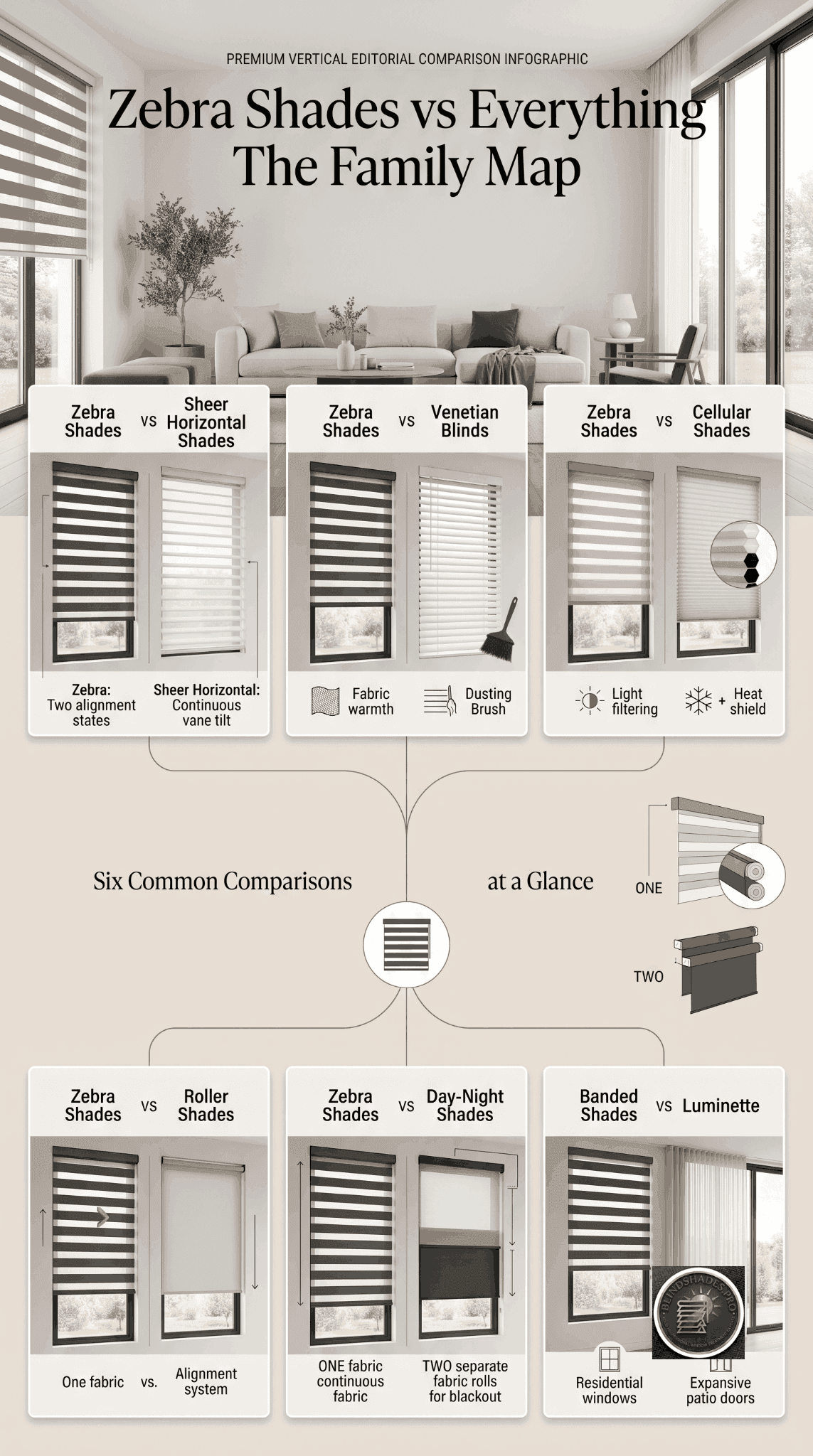
By Michael Turner, 30 years in the window treatment industry
A zebra shade is a roller shade that learned a trick: two fabric layers of alternating sheer and opaque stripes riding one continuous loop, so sliding the front layer snaps the window from striped, light-filtering openness to full overlap privacy. That trick is the whole product — and it comes with two truths the checkout pages whisper: privacy is an alignment state, not a dimmer (zebras are a two-position product), and offset fabric layers let interior light outline the stripes at night. This guide explains the mechanism, resolves the night-privacy question honestly, answers the Levolor questions people actually search — installation, colors, Lowe’s — and ranks the market from Graber’s Costco-priced Best Overall to the biggest review bases in the category.
Key Takeaways
- Privacy is alignment, not tilt. Bands offset = striped open view; bands overlapped = solid privacy — and everything between is shadow-play. Zebras are a two-state product, which is exactly what separates them from continuously-tilting sheer shades.
- The night outline is real — plan for it. Because the fabric layers sit apart, interior light can trace the stripes after dark; room-darkening bands, outside-mount overlap, or a curtain layer are the three fixes.
- Free-stop cordless is the feature worth paying for. Daily band alignment is the whole user experience — a lift that stops anywhere makes it effortless.
- The opacity fork decides the room. Light-filtering bands own living spaces; room-darkening bands earn bedrooms; sleep-critical windows route honestly to blackout.
- Buy review volume, not renders. This market runs from a five-hundred-seventy-six-review base to five-star listings built on two — the picks below flag which is which.
⭐ Quick Answer — The Best Zebra & Banded Shades
The best zebra shades are chosen at three gates — Stripe (light-filtering vs room-darkening bands), Slide (privacy is band alignment on a continuous roller loop — a two-state product, so free-stop cordless matters), and Shadow (offset layers can outline in stripes at night; room-darkening bands are the fix):
- Best overall: Graber Designer Banded Shades — smooth dual roller mechanism, a room-darkening band option, custom sizing, and Costco member pricing; the premium custom benchmark starts at one ninety-four list at Levolor.
- The volume verdict: Blindster’s Premium zebra duals hold four point five across five hundred seventy-six reviews, and every dual zebra shade is 100% custom-built to measure at Blindsgalore.
- The honest caveat: zebras may allow some visibility at night when interior lights are on, per the worth-it editorial at Blinds Chalet — the room-darkening fork and mounting fixes are covered in full below.
- The sibling boundary: continuous vane tilt instead of two alignment states lives in the sheer shades guide, and two fully independent fabrics on one headrail in the day-night blinds guide.
- The vocabulary: “room darkening” and “blackout” are different promises — the difference is mapped in blackout vs room darkening shades.
Quick Specification Reference
| Specification | The Short Answer |
|---|---|
| Best overall | Graber Designer Banded Shades — smooth dual roller mechanism, room-darkening band option, custom sizing, seventy-dollar-class member pricing at Costco |
| Best volume pick | Blindster Premium Light Filtering Zebra Dual — around two twenty-seven, four point five across five hundred seventy-six |
| Best budget | Chicology Free-Stop Cordless via Target — around forty-nine, four point two across four hundred seventy-three |
| Best room-darkening | Blindster Room Darkening Zebra Dual — around seventy-two, four point four across two hundred forty-six |
| Typical cost range | Ninety-five to three forty-seven per Blindsgalore; seventy-five to seven twenty-nine per American Blinds; fifty-three to one seventy-one per BlindsExpress |
| The mechanism | Two striped fabric layers on one continuous roller loop — the front layer slides to align or offset the bands |
| The two states | Offset = striped filtered light · Overlapped = privacy — alignment, not tilt |
| The honest caveat | Interior light can outline the stripes at night — room-darkening bands are the fix |
Read the complete guide below for: the six Diamond picks led by the Graber Best Overall, the Stripe-Slide-Shadow Test, how the alignment mechanism actually works, the band-opacity fork, every position honestly rated, the full versus-family map (sheer, venetian, cellular, roller, day-night, Luminette), the Levolor answers people search — installation, colors, Lowe’s — room verdicts, and where to buy without accidentally ordering an animal print.
What Are the Best Zebra & Banded Shades? Our Picks
Six picks, one per job — the highest rated zebra shades on the market, ranked the way honest banded shades reviews should be: by review volume, with the thin bases flagged.
The best zebra shades for most rooms is a free-stop cordless dual in light-filtering bands — with room-darkening bands the moment a bedroom enters the conversation. The six lanes:
Best Overall — Graber Designer Banded Shades. Smooth dual roller mechanism, a room-darkening band option, custom sizing, and available at Costco for members at seventy-dollar-class pricing — the rare premium-brand mechanism at warehouse-club money, with Costco’s return posture behind it. It remains the pick this guide has championed, and nothing on the current market unseats it.
Best Volume — Blindster Premium Light Filtering Zebra Dual. The category’s biggest honest base: around two hundred twenty-seven dollars, four point five across five hundred seventy-six reviews — the line the market consensus credits for high-quality woven polyesters and robust motorized lift options. The Ombrage natural colorway (around sixty-five in starter sizes) shares the same review family.
Best Budget — Chicology Dual Layer Free-Stop Cordless via Target. Around forty-nine dollars, four point two across four hundred seventy-three — and the name says the feature: free-stop cordless, meaning the shade halts wherever your hand leaves it, which is exactly what daily band alignment wants. Joydeco’s customs (from around thirty to forty-four) undercut it further with a thinner track record.
Best Room-Darkening — Blindster Room Darkening Zebra Dual. Around seventy-two dollars, four point four across two hundred forty-six — the Shadow gate’s direct answer: opaque bands dense enough to kill the night outline in bedrooms and media rooms. Levolor’s room-darkening zebra via SelectBlinds (around four seventy-seven at half off) is the premium version of the same idea.
Best Custom — Blindsgalore Dual Zebra Shades. Every dual zebra shade one hundred percent custom-built to your measurements — their claim, on the record — across ninety-five to three forty-seven, with opacity, color, and lift all selectable. Select Blinds’ Zebra Dual (around two forty-three at half off, four point three across one hundred sixty-nine) is the alternate custom route, and their Light Filtering Dual at around forty-two fifty (four point four across thirty-eight) is the value door into custom.
Best Premium — Levolor Custom Banded Shades, with Hunter Douglas Designer Banded as the anchor. Levolor: around one fifty-eight at forty-five percent off (four point three across forty-four), list pricing starting at one ninety-four — the brand this category’s searchers ask about by name, so its sub-questions get a full table below. Hunter Douglas Designer Banded is the dealer anchor — carried honestly with the community’s one-year verdict attached: “they’re alright, a unique look for sure; downsides are privacy and light blocking.” That sentence is not a knock; it is the category’s terms of service, and the Shadow section below turns it into a decision rule. (Levolor’s zebra sheer crossover at around three fifty-one shows four point eight — across four reviews. Thin base, flagged.)
| Pick | Product | Approx. Price (as listed) | Rating / Reviews | Wins the gate for |
|---|---|---|---|---|
| Best Overall | Graber Designer Banded (Costco) | Seventy-dollar-class member pricing | Room-darkening option, custom sizing | The mechanism + warehouse value |
| Best Volume | Blindster Premium LF Zebra Dual | Around two twenty-seven | 4.5 / 576 | The category’s biggest base |
| Best Budget | Chicology Free-Stop (Target) | Around forty-nine | 4.2 / 473 | Free-stop alignment on a budget |
| Best Room-Darkening | Blindster RD Zebra Dual | Around seventy-two | 4.4 / 246 | The night-outline fix |
| Best Custom | Blindsgalore dual zebra · Select Blinds | Ninety-five to three forty-seven | 4.3 / 169 (SB) | 100%-custom claim, full option set |
| Best Premium | Levolor Custom Banded · HD Designer | Around one fifty-eight (45% off) · dealer | 4.3 / 44 · Reddit verdict carried | The searched-by-name brands |
How Do You Choose? The Stripe-Slide-Shadow Test
Three gates, in order: the bands themselves, the mechanism that aligns them, and the night behavior nobody mentions until after checkout.
Gate 1 — Stripe. Band width sets the look (wider bands read calmer; narrow bands read busier), fabric class sets the hand, and the opacity fork sets the room: most zebra shades ship light-filtering, but room-darkening band options exist for bedrooms — the market consensus’s own first consideration. The fork gets its own table below.
Gate 2 — Slide. The mechanism is the product: two striped layers on one continuous loop, the front layer traveling until bands either offset (striped, filtered openness) or overlap (privacy). Because you will slide it daily, the lift decides the experience — cordless or motorized operations are ideal for easily sliding the stripes throughout the day, and free-stop cordless is the specific feature that makes half-inch alignment adjustments effortless.
Gate 3 — Shadow. The honest caveat, in the market’s own words: because the fabric layers sit apart, some light may outline the stripes at night when interior lights are on. It is physics, not a defect — and it is fixable. The full resolution, including who should route out of the category entirely, gets its own section.
| Gate | The question | Pass looks like | Fail routes to |
|---|---|---|---|
| Stripe | Which bands, which opacity? | Light-filtering for living spaces; room-darkening for bedrooms | Sleep-critical darkness → blackout |
| Slide | Will daily alignment be effortless? | Free-stop cordless; motorized on tall glass | Corded loops on kid-room windows |
| Shadow | Does the night outline matter here? | Style-first daytime rooms; RD bands where it counts | Privacy-critical night windows → RD bands or out |
How Does a Zebra Shade Actually Work? The Alignment Mechanism
Two layers, one loop, and privacy as a registration problem — the section the stores skip.
One naming note first, because this product collects names like a magnet: zebra shades, banded shades, zebra dual shades, dual sheer shades, transition shades, layered shades, zebra blinds, banded blinds, banded roller shades, banded window shades, and zebra soft horizontal shades are all the same product — alternating sheer and opaque stripes on a double fabric layer. If you searched any of those, or for the best zebra blinds generally, you are in the right place — a search for the best banded shades and a search for the best zebra shades land on the identical product; Levolor’s own page says it straight: “sometimes called zebra shades.”
Now the mechanism. A zebra shade is a roller shade whose fabric is one continuous striped loop running over the top tube: the back run hangs fixed against the glass while the front run travels as you operate the lift. Move it half a band-height and the sheer stripes of the front layer line up with the opaque stripes of the back layer — offset, the striped open state, filtered light passing through every sheer pair. Move it another half band and opaque lands on opaque, sheer on sheer — overlapped, the privacy state, an effectively solid curtain. That is the entire trick, and it explains the category’s defining truth: a zebra shade is a two-state product. Between the states you get partial eclipse — striped shadow-play that photographs beautifully and functions as neither privacy nor view. Compare that with a sheer shade’s vanes, which tilt continuously through every angle: zebras trade the infinite dial for a simpler mechanism, a lower price, and the striped look — the honest terms of the swap our sheer shades guide argues from the other side.
Which is why the lift matters more here than in any plain roller: free-stop cordless (Chicology’s own product name for it) lets the shade halt exactly where your fingers leave it — the half-band precision daily alignment wants — while motorized lifts with preset stops make alignment a button. And the whole assembly raises like any roller when you want bare glass, stacking into the cassette. Mechanically it is a member of the roller family — the family’s full mechanics live in the complete roller shades guide.
Light-Filtering vs Room-Darkening Bands: Which Opacity Do You Need?
The fork that decides the room — and the night outline’s first fix.
| Band opacity | Day behavior | Night behavior | Best rooms |
|---|---|---|---|
| Light-filtering (the default) | Sheer bands glow, opaque bands shade — the signature look | Stripes can outline against interior light | Living, dining, kitchen, office |
| Room-darkening bands | Same striped day look, denser shadows | Outline largely killed; overlap reads near-solid | Bedrooms, media rooms, street-facing glass |
| The honest ceiling | — | No zebra is a blackout product — edges and sheer bands both exist | Sleep-critical windows route to blackout |
The vocabulary here matters: “room darkening” and “blackout” are different promises, and the difference is mapped in blackout vs room darkening shades. For zebras the rule is simple — the room-darkening band option is what makes bedrooms possible, which is exactly why the Graber pick’s RD option and the Blindster RD line (four point four across two hundred forty-six) earn their Diamond slots.
What Does Each Position Actually Give You?
The best zebra shades earn their keep across three states plus the in-between — honestly rated.
| Position | Light | View | Privacy | The honest note |
|---|---|---|---|---|
| Bands offset (open) | Striped, filtered — the signature | Striped glimpses through sheer bands | Moderate by day | The state you bought it for |
| Bands overlapped (closed) | Soft glow through the doubled fabric | None | Solid by day; good by night with RD bands | The privacy state |
| Between states | Shifting stripe eclipse | Fragmentary | Poor | A styling moment, not a setting |
| Fully raised | Bare glass | Total | None | Any roller does this |
Zebra Shades vs Everything: The Family Map
Six matchups the best zebra shades keep getting measured against — one honest row each.
| Matchup | The one-line verdict | The deep dive |
|---|---|---|
| Zebra vs sheer horizontal shades | Zebras: two alignment states, stripes, lower price. Sheer shades: continuous vane tilt, cleaner view, softer read, more money | The sheer shades guide |
| Zebra blinds vs venetian blinds | Venetians tilt slats for infinite control and dusting; zebras slide fabric for two states and no slat clatter — fabric warmth vs mechanical precision | The venetian blinds guide |
| Zebra vs cellular shades | Cellulars insulate and darken; zebras style and filter — different jobs entirely, per the comparison the Florida dealers drew | Cellular & honeycomb guide |
| Zebra vs plain roller | Rollers are one fabric, one behavior; zebras add the alignment trick — more flexibility in light control, as Blinds Chalet’s March 2026 editorial puts it | Roller shades guide |
| Zebra vs day-night shades (also written day and night blinds) | The sibling confusion: zebras = bands on ONE loop, two states; day-night = TWO independent fabrics (sheer + opaque) on one headrail, each fully deployable | Day-night blinds guide |
| Banded shades vs Luminette | Luminette is HD’s vertical sheer-drapery system for wide glass — a different animal for a different wall, per DM Interiors’ January 2026 comparison | Dealer showrooms; sheer verticals |
Related guides: if what you actually want is two complete fabrics — a true light-filtering panel and a true blackout panel on one headrail — that product is the day night blinds guide’s territory.
The Levolor Questions, Answered — Plus Graber and Hunter Douglas
The brand this category searches by name, with its three sub-questions answered in one table.
| Question people search | The answer |
|---|---|
| Levolor banded shades — the line | Custom Banded Shades, list from one ninety-four, widely discounted to around one fifty-eight (four point three across forty-four); “the understated beauty of banded roller shades” is their own framing |
| Levolor banded shades installation | Standard roller-cassette mounting — two brackets, inside or outside mount, the same install as any cassette roller; no special hardware |
| Levolor banded shades colors | Neutral-led fabric families (the Woodward and Silvermist colorways surface across retailers) — greys, whites, naturals; the zebra sheer crossover line extends the palette |
| Levolor banded shades at Lowe’s | Levolor is Lowe’s’ house window-treatment brand, and banded lines rotate through; the custom program also sells direct and via the online customs |
| Graber banded shades | The Best Overall above: smooth dual roller mechanism, room-darkening band option, custom sizing, Costco member pricing — the strongest value story in the premium tier |
| Hunter Douglas Banded Shades | Designer Banded — dealer-quoted, beautifully made, and carrying the community’s honest one-year verdict: unique look, with privacy and light-blocking the admitted downsides |
Which Rooms Suit Zebra Shades?
Kitchens and living rooms are the home turf; bedrooms need the RD fork; the rest is honest routing.
| Room | Verdict | The rule |
|---|---|---|
| Living / dining | The home turf | Light-filtering bands; free-stop for daily play |
| Kitchen | Strong — the market consensus credits the versatility | Wipeable polyester bands; keep clear of the splash zone |
| Bathroom | Good with ventilation | Polyester tolerates humidity; the versatility case again |
| Home office | Strong | Offset bands kill glare without killing the room |
| Bedroom | Only with room-darkening bands | The Shadow section’s whole argument |
| Media room | RD bands or route out | Stripes and screens disagree at night |
| Nursery | Cordless mandatory; RD bands wise | And see the warning below about “nursery zebra” listings |
The Night Outline: The Honest Section
Why zebras glow in stripes after dark, the three fixes, and who should buy something else.
Here is the caveat resolved rather than whispered. By day, outside light exceeds inside light, and a zebra reads as designed. After dark the equation flips: your lit room becomes the bright side, and because the two fabric layers hang a small distance apart, light sneaks between them and traces the band edges — a soft striped glow visible from outside, even with bands overlapped. The market consensus now states this openly (“some light may outline the stripes at night when interior lights are on”), and the one-year Hunter Douglas owner thread said it with a shrug: unique look; downsides are privacy and light blocking. Both are correct, and neither is disqualifying — it is a matching problem.
The three fixes, in escalating order: room-darkening bands (the opacity fork above — kills most of the outline at the source); outside-mount with generous overlap (shrinks the glowing perimeter the same way it does for every shade — the side-light physics is the same one covered in do blackout roller shades block all light); and the layered system — a curtain drawn over the zebra at night, the architecture detailed in roller shades layered with curtains, which also upgrades bedroom light control generally.
The decision rule: style-first daytime rooms — buy zebras freely, light-filtering bands, enjoy the stripes. Rooms where evening privacy matters — buy the room-darkening bands and mount outside. Windows where night privacy or darkness is critical — a streetlight-facing bedroom, a ground-floor bath — buy a different product, with no hard feelings: that is what the blackout family is for. A category that tells you who shouldn’t buy it is a category you can trust.
Where Should You Buy Zebra & Banded Shades?
The zebra shades buying guide rule for retail: buy the mechanism and the review base — and check the product photo for actual zebras.
| Retailer / Route | Listed range (as published) | Rating shown | Watch-out |
|---|---|---|---|
| Costco (Graber) | Seventy-dollar-class member pricing | The Best Overall’s home | Membership required; measure carefully |
| Blindster | Sixty-five to three seventy-five lines | 4.5 / 576 · 4.4 / 246 | The volume king; Ombrage colorways share the base |
| Chicology via Target | Around forty-nine | 4.2 / 473 | Free-stop cordless named on the box |
| Blindsgalore (custom) | Ninety-five to three forty-seven | 4.7 store / 4.6K | The 100%-custom claim |
| Select Blinds | Forty-two fifty to two forty-three | 4.3 / 169 · 4.4 / 38 | Half-off anchoring is the real price |
| Blinds.com | Around eighty-seven cord-loop | 4.2 / 286 | Cord loop — prefer cordless where kids live |
| Levolor (direct + Lowe’s + customs) | One ninety-four list; around one fifty-eight sale | 4.3 / 44 | The PASF magnet; zebra-sheer crossover at 4.8/4 = thin base |
| American Blinds / BlindsExpress / BlindsOnline | Seventy-five to seven twenty-nine · fifty-three to one seventy-one · around eighty-eight | 4.8 store / 680 | Store ratings ≠ product bases — read the listing |
| HD dealers | Quoted | Designer Banded | Carry the Reddit verdict into the showroom |
And this keyword’s consumer-protection line: mid-shopping-rail sits a “Nursery Kid Baby Room Zebra Theme Window Roller Shade” at around ninety-nine dollars — a roller shade printed with actual zebras. “Zebra” names a mechanism on this page and an animal on that one; if the product photo has hooves, you have ordered a pattern, not a privacy system.
Related Buying Guides
- Best Sheer Shades — continuous vane tilt, the other half of the “dual sheer” confusion
- Best Day-Night Blinds — two independent fabrics, the sibling system
- Best Roller Shades — the mechanism family zebras belong to
- Best Venetian Blinds — the slat-tilt alternative the searches keep comparing
- Best Bedroom Blinds & Shades — where the RD fork and the layered fix live
Complete Zebra Guide Library
- Best Sheer Shades — the vane alternative, boundary drawn both ways
- Best Day-Night Blinds — one headrail, two full fabrics
- Best Roller Shades — the parent mechanism
- Best Venetian Blinds — the vs-venetian question’s home
- Blackout vs Room Darkening Shades — the opacity vocabulary
- Do Blackout Roller Shades Block All Light? — the edge-light physics
- Roller Shades Layered with Curtains — the night-outline fix, layered
- Best Bedroom Blinds & Shades — the room the RD fork serves
Frequently Asked Questions
What are the best zebra blinds? The best zebra blinds on the current market are Graber’s Designer Banded Shades — smooth dual roller mechanism, room-darkening band option, custom sizing, Costco member pricing — with Blindster’s Premium line as the volume pick at four point five across five hundred seventy-six reviews, Chicology’s free-stop cordless as the budget door at around forty-nine dollars, and Levolor’s Custom Banded line at the searched-by-name premium end.
What are banded shades — are they the same as zebra shades? Yes — banded shades, zebra shades, dual shades, transition shades, and layered shades all name the same product: alternating sheer and opaque fabric stripes on a continuous double layer. Slide the front layer half a band and the stripes offset for filtered light; slide again and opaque overlaps opaque for privacy. Levolor’s own page notes the products are “sometimes called zebra shades.”
Are zebra shades good for privacy? By day, yes — overlapped bands read solid. At night, partially: because the two fabric layers hang slightly apart, interior light can outline the stripes from outside even when closed. Room-darkening bands largely fix it, outside-mounting shrinks the glowing edges, and a curtain layer finishes the job. For privacy-critical night windows, blackout products are the honest answer.
What are the pros and cons of banded shades? Pros: the striped modern look, two-state light control on a simple roller mechanism, wipeable polyester fabrics, kitchen-and-bath versatility, and strong value from around forty-nine dollars. Cons: privacy is alignment-based rather than a continuous dial, the night stripe-outline effect, and no true blackout — the same downsides the Hunter Douglas owner community names, and all three are manageable with the room-darkening fork and smart mounting.
Zebra shades vs day-night blinds — what’s the difference? Zebras put alternating bands on one continuous loop — one fabric, two alignment states. Day-night blinds mount two independent fabrics — a full sheer and a full opaque — on one headrail, each deployable on its own, giving a true sheer-to-dark range at more cost and bulk. Zebras are the style pick; day-nights are the range pick.
How much do zebra shades cost? The live market runs from around thirty to forty-nine dollars at the budget end (Joydeco, Chicology), through fifty-three to one seventy-one at BlindsExpress and ninety-five to three forty-seven for Blindsgalore customs, to premium-brand territory — Levolor from one ninety-four list, Blindster’s premium lines to three seventy-five, and American Blinds’ range topping at seven twenty-nine — with Graber’s Costco pricing the standing value outlier.
