Do Blackout Roller Shades Block All Light? The Honest Answer

Authored By Michael Turner -30 Years Home Improvement Expertise | Updated 2026 | BlindShades.pro
Updated on July 21, 2026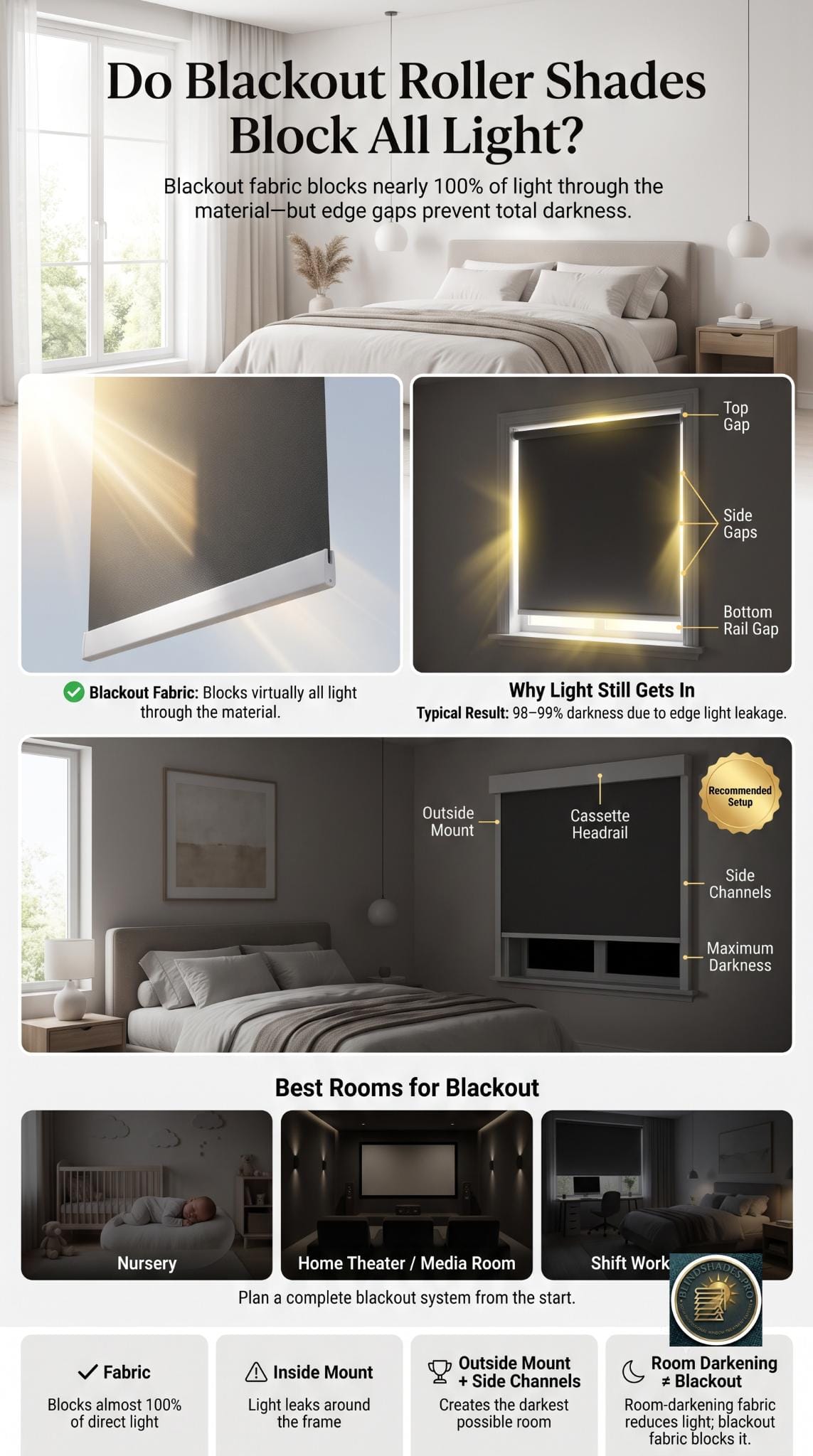
By Michael Turner | 30 years in window treatments
Do blackout roller shades block all light? No — the fabric blocks essentially all the light that hits it, but a standard inside-mounted shade still leaks around the edges, so the room is dark, not black. The honest figure the industry quietly agrees on is that a quality blackout roller shade blocks roughly 98% to 99% of the light in a room, and that last one or two percent — the glow at the sides, top, and bottom — is what wakes you at sunrise. The good news: every bit of that leak is fixable, and this guide ranks the fixes by how much darkness each one actually buys you.
🎯 5 Key Takeaways
- The fabric blocks nearly 100%; the room does not. Blackout roller shade fabric operates at essentially 0% openness, so almost no light passes through it — but light bleeds around the frame, which is where every complaint comes from.
- A standard inside mount tops out around 98% to 99%. Quality blackout roller shades block that share of room light when well fitted, per industry figures — genuinely dark, but not the total blackout many buyers expect.
- Mounting matters more than fabric. Once you have a true blackout fabric, the path to a darker room is an outside mount, side channels, and a cassette — not a “better” fabric. You buy the fabric but you install the darkness.
- The edges leak in a predictable order. The top (fabric roll gap) and the two sides leak most on an inside mount; the bottom pools light; on wide windows, two shades leak at the center where they meet.
- “All light” is possible only with a system. An outside-mounted blackout shade with side channels and a cassette approaches true darkness; no inside-mount shade, however premium the fabric, gets there alone.
⭐ Quick Answer
Do blackout roller shades block all light? No, the fabric blocks nearly all of it, but a standard inside mount leaks around the edges, so a room lands around 98% to 99% dark. The short version:
- The fabric is not the problem: blackout roller shades block virtually all light through the material, as The Shade Store notes; the leak is entirely around the frame.
- An inside mount tops out near 98% to 99%, with the last bit seeping around the edges rather than through the fabric, per Blindsgalore.
- To get an actually dark room, mount outside the frame, add side channels, and seal the top with a cassette headrail, in that order of impact.
- Room-darkening is not blackout: a room-darkening shade only reduces light, while blackout blocks it through the fabric, a line Graber draws clearly.
- For a nursery, media room, or bright bedroom, plan an outside-mount blackout system from the start; see the best roller shades for a bedroom.
Best Sources: The Shade Store (blackout roller shade benefits); 3 Day Blinds (blackout vs light-filtering comparison); Graber Blinds (room-darkening vs blackout); Blindsgalore (blackout myth guidance); Acadia Shutters (real-world darkness).
Related guides: the best blackout blinds guide scores rollers against sealed-track systems and cellulars.
Do Blackout Roller Shades Block All Light in a Real Room?
No — the fabric blocks nearly all the light that hits it, but because the shade cannot sit perfectly flush with the wall, a real room lands around 98% to 99% dark rather than fully black.
Here is the truth most product pages soften. A blackout roller shade uses an opaque fabric — often with a coated or foam backing — that operates at essentially 0% openness, so light does not pass through the material itself. Blindsgalore’s own guidance puts quality blackout shades at blocking 99% or more of light, with that tiny remaining percentage seeping around the edges rather than through the fabric. The Shade Store describes blackout roller shades as designed to prevent virtually all outside light from entering a room. Both are accurate — and both quietly point to the same gap: “virtually all” is not “all.”
The reason is mechanical. To roll up and down, the shade needs clearance from the window frame, so an inside-mounted shade is slightly narrower than the opening. That clearance becomes a light gap on both sides, at the top where the fabric leaves the roll, and along the bottom rail. In bright conditions those gaps glow. So the answer to “do blackout roller shades block all light” is a qualified no: the fabric does its job, the frame does not.
Where Exactly Does the Light Leak?
The Fabric-vs-Frame Rule: a blackout shade blocks light in two separate places — through the fabric, where it succeeds almost completely, and around the frame, where all the leakage happens.
Once you separate those two, the whole problem becomes solvable, because you stop chasing a “darker fabric” and start closing gaps. Here is what the fabric blocks versus what the room actually experiences.
| Where light is blocked | What happens | Typical result |
|---|---|---|
| Through the fabric | Opaque blackout material, ~0% openness | Blocks nearly 100% |
| Around the frame (inside mount) | Side, top, and bottom gaps leak | Room lands ~98% to 99% dark |
| Around the frame (outside mount + channels) | Gaps sealed by overlap and tracks | Room approaches true darkness |
And within the frame, the leaks are not equal. This gap map is the part no ranked competitor lays out, and it tells you exactly what to fix first.
| Gap location | Leak severity | Why it leaks | The fix |
|---|---|---|---|
| Top (fabric roll) | High | Fabric leaves the roll away from the wall | Cassette or valance |
| Both sides | High | Shade is narrower than the opening | Side channels or outside mount |
| Bottom rail | Medium | Rail sits above the sill; light pools up | Extend length; outside mount |
| Center (wide windows) | Medium | Two shades meet with a seam | Single wider shade or overlap |
That last row is the trap almost nobody warns about: on a wide window covered by two blackout shades, light leaks at the center meeting rail even when both edges are sealed. If darkness matters on a wide window, specify one wide shade rather than a pair.
How Do You Get an Actually Dark Room?
You install the darkness in a specific order — outside mount first, then side channels, then a cassette — because each step closes a bigger gap than the fabric ever could.
This is where the honest answer becomes useful. Since the fabric is already doing its part, every additional percent of darkness comes from mounting and sealing. Google’s own AI Overview and window-treatment experts converge on the same modifications; what they do not do is rank them by payoff. Here they are, ordered by how much darkness each buys versus the effort involved.
| Modification | Darkness gained | Effort / cost | Do this if… |
|---|---|---|---|
| Outside mount | Largest | Low — just measure past the frame | Darkness matters at all |
| Side channels / tracks | Large | Medium — added hardware | You need near-total dark (nursery, media) |
| Cassette headrail | Moderate | Low to medium | Sealing the top gap and a clean look |
| Extended bottom length | Small to moderate | Low | Light pools at the sill |
| Dark room-side fabric | Small | None (a spec choice) | Squeezing the last bit of glare |
The single highest-impact move is the cheapest: mount the shade outside the frame and extend it several inches past each side and above the top. That one decision, which costs nothing extra, does more than any fabric upgrade. Add side channels and a cassette and you reach the near-total darkness a nursery or shift-worker needs. Graber’s guidance is blunt about the ceiling here — blackout shades completely block the light, and the only light that reaches the room runs along the sides of the shade, which is exactly what channels and an outside mount eliminate.
For the full headrail decision, see our guide on what a cassette headrail is and whether it is worth it, and for bedroom-specific setups see the best roller shades for a bedroom.
What Is the Difference Between Room-Darkening and Blackout Roller Shades?
Room-darkening shades only reduce light; blackout shades block it through the fabric — they are different products, and confusing them is why some buyers feel their “blackout” shade underperformed.
This distinction drives a lot of the disappointment behind the search. 3 Day Blinds draws the line clearly: blackout roller shades are designed to block light through the fabric, while room-darkening shades reduce light but do not block as much. Think of it as three honest tiers.
| Tier | Light through fabric | Room result | Best for |
|---|---|---|---|
| Room-darkening | Reduced, not blocked | Dim, soft glow remains | TV rooms, guest rooms, lounges |
| Blackout (inside mount) | Blocked (~0% openness) | Dark, faint edge leak | Bedrooms wanting strong darkness |
| True dark (blackout + system) | Blocked | Near-total darkness | Nurseries, media rooms, shift workers |
If a shade was sold as “room-darkening” and the buyer expected blackout, the fabric was never going to make the room black. Matching the tier to the need up front prevents the letdown.
For the softer, insulating alternative that also filters rather than blocks, see our cellular honeycomb shades guide.
Do Blackout Roller Shades Block Light at Night and in Summer?
Yes to exterior light at night, with the same edge caveat — and summer is when the edge leak shows most, because sunrise arrives early and low.
The fabric does not care what time it is: it blocks streetlight, moonlight, and a neighbor’s security light just as it blocks daytime sun. What changes at night is only that any edge leak now shows exterior artificial light instead of sun — so an outside mount matters just as much for a streetlit bedroom. Summer is the real stress test. Long days mean the sun rises early and at a low angle, driving light straight into side and bottom gaps at 5 a.m. — precisely when you want to stay asleep. A shade that feels “dark enough” in winter can reveal its gaps in June. If summer sleep is the goal, plan the outside-mount system rather than a standard inside mount.
What Are the Disadvantages of Blackout Roller Shades?
Beyond edge leakage, blackout shades trade away daylight and view entirely when down, and a standard mount cannot reach total darkness — all manageable, but worth knowing.
The honest disadvantages, with fixes, are: edge light leak on inside mounts (solved by outside mount and channels); no view or daylight at all when lowered, unlike a solar or light-filtering shade (solved by pairing with a second sheer or solar layer); the center seam leak on wide double shades (solved by a single wide shade); and the expectation gap when a room-darkening shade is mistaken for blackout (solved by matching the tier). Acadia Shutters frames the underlying reality plainly: the fact most professionals will not volunteer is that blackout shades do not block 100% of natural light on their own. Knowing that going in is what lets you specify around it. For flexible day-and-night control, pairing a blackout roller with drapery is often the cleanest answer — see our guide on layering roller shades with curtains.
Related Buying Guides
- The Best Roller Shades Buying Guide — the full roller shade category
- The Best Cellular Honeycomb Shades Buying Guide — insulating light-filtering alternative
- The Best Roller Shades for a Bedroom — darkness-first bedroom setups
- What Is a Cassette Headrail? — sealing the top light gap
Frequently Asked Questions
Do blackout roller shades block all light? Not completely. The fabric blocks essentially all the light passing through it, but a standard inside-mounted shade leaks around the sides, top, and bottom, so a real room typically lands around 98% to 99% dark rather than fully black. To get closer to total darkness, mount the shade outside the frame, add side channels, and use a cassette headrail.
How effective are blackout shades at blocking light? Very effective through the fabric — quality blackout roller shades block 99% or more of the light that hits the material, per industry guidance. The effectiveness in the room depends on the mount: an inside mount leaves visible edge leak, while an outside mount with side channels and a cassette seals those gaps and approaches near-total darkness.
What are the disadvantages of blackout shades? The main ones are edge light leakage on inside mounts, no view or daylight when the shade is down, a center seam leak on wide windows covered by two shades, and buyer confusion when a room-darkening shade is mistaken for blackout. Each is fixable: outside mounting and side channels for leak, a second sheer or solar layer for daytime view, a single wide shade for the seam, and matching the product tier to the need.
What is the difference between room-darkening and blackout roller shades? Room-darkening shades reduce light but do not block it through the fabric, leaving a soft glow; blackout shades use an opaque, roughly 0% openness fabric that blocks light through the material. Room-darkening suits lounges and TV rooms, while blackout suits bedrooms — and only blackout paired with an outside-mount system reaches near-total darkness for nurseries and media rooms.
Do blackout roller shades work at night? Yes. The fabric blocks exterior light such as streetlights and moonlight just as it blocks daytime sun, so the room stays dark at night. The same edge caveat applies, though: any leak at the sides or top will show artificial exterior light, so a streetlit bedroom still benefits from an outside mount to seal those gaps.
Do blackout roller shades block light in the summer? They block the sun’s light through the fabric year-round, but summer exposes edge leaks most because the sun rises early and at a low angle, driving light into the side and bottom gaps around dawn. If summer sleep-in is the goal, plan an outside-mount blackout shade with side channels rather than relying on a standard inside mount.
