Roller Shades Layered With Curtains: How to Do It Right

Authored By Michael Turner -30 Years Home Improvement Expertise | Updated 2026 | BlindShades.pro
Updated on July 5, 2026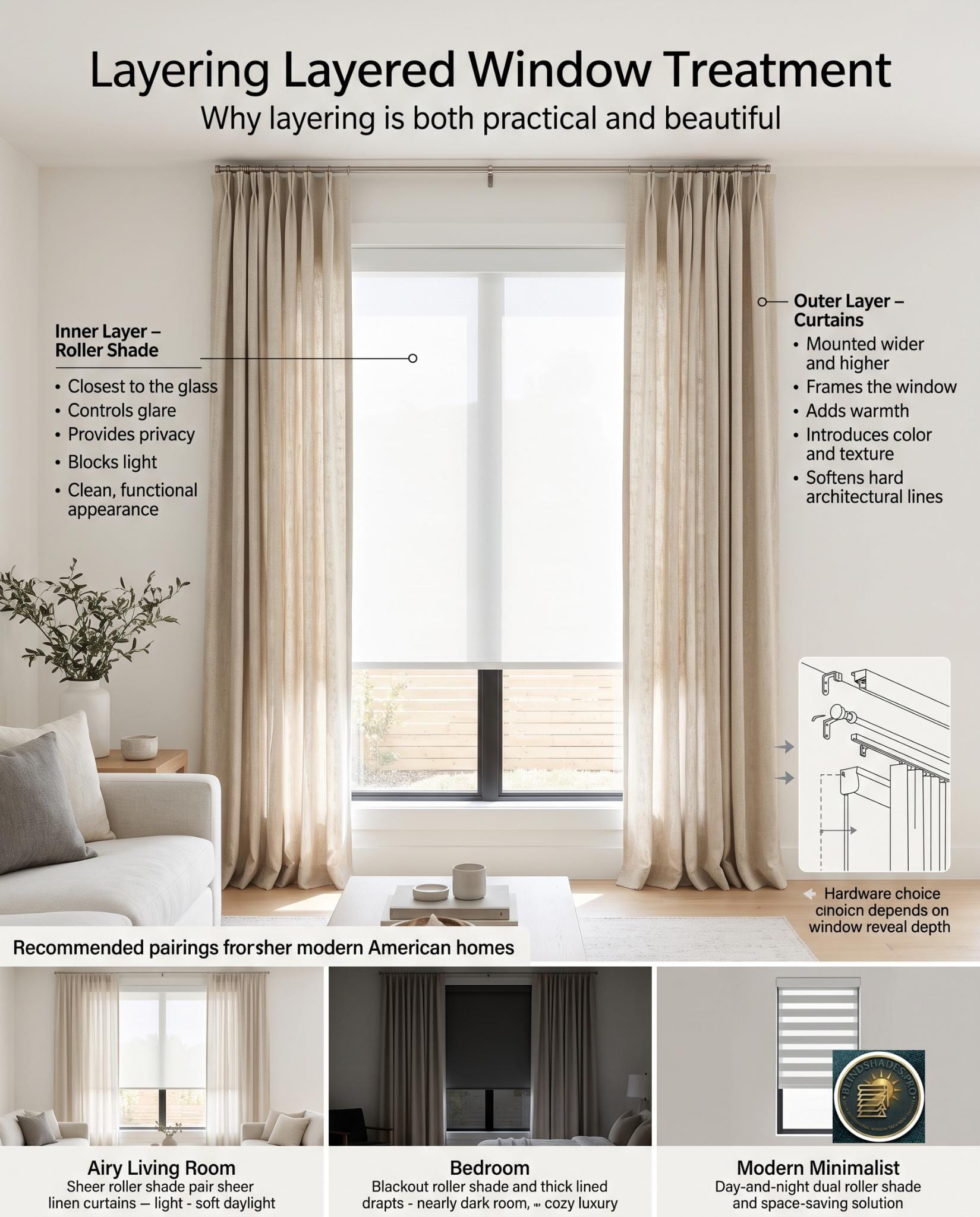
By Michael Turner | 30 years in window treatments
Yes, roller shades layered with curtains is one of the most effective and popular window setups — the roller shade does the work of controlling light and privacy, while the curtain frames the window and softens the room. Done right, layering gives you better light control, real insulation, quieter rooms, and a finished, decorator look. Done wrong, it crowds a shallow window or throws the proportions off. The trick is knowing which layer does which job, how to pair the fabrics, and how to mount both without them fighting for the same space. This guide walks all of it.
🎯 5 Key Takeaways
- The two layers have separate jobs. The inner roller shade handles function — light, glare, privacy; the outer curtain handles feeling — framing, softness, and color. Choose each for its own job rather than making one do both.
- Match the curtain to the shade type, not by guesswork. A sheer roller wants a different curtain partner than a blackout roller. The right pairing depends on what the inner shade already does.
- Reveal depth decides the mount. A deep window reveal lets you inside-mount the shade and outside-mount the curtain cleanly; a shallow or flush window usually needs both layers mounted outside on the wall or ceiling.
- Layering can beat a single dual shade — or lose to it. A light-filtering roller plus a drape often gives more flexibility for less than a premium day-and-night shade, but on a narrow window a single dual roller is the tidier buy.
- Most layering failures are proportion errors. Hanging curtains too low, too narrow, or crowding a shallow reveal are the common mistakes — all avoidable with a few measurements before you buy.
⭐ Quick Answer
Roller shades layered with curtains works because the shade controls light and privacy while the curtain frames the window and adds warmth. The short version:
- Give each layer one job: the inner roller shade handles light and privacy; the outer curtain handles framing, color, and softness, the inner-and-outer logic America’s Floor Source uses.
- Pair by shade type: sheer under sheers for an airy room; a heavier textured or lined drape over a blackout roller, a formula The Shade Store recommends.
- Reveal depth decides the hardware — a double-rod bracket, an inside shade with an outside curtain, or a ceiling track for a floor-length look.
- In a bedroom, a lined drape over a blackout roller seals the shade’s edge gaps for near-total darkness; see whether blackout roller shades block all light.
- Layering adds insulation and quiet from the trapped air pocket and fabric, per Excellent Blinds and Shutters, and a light drape gives a solar shade the nighttime privacy it lacks.
Best Sources: The Shade Store (layered window treatment guidance); Excellent Blinds and Shutters (combining shades with curtains); Skyline Window Coverings (shade-and-drapery pairing); America’s Floor Source (layering approach); Lutron (layering with motorized shades).
Can You Layer Roller Shades With Curtains?
Yes — putting curtains over roller shades is a standard, well-proven setup, and it is often better than either treatment alone.
This is the reassurance behind the search, so let’s settle it plainly: you can absolutely put curtains over roller shades, and interior designers do it constantly. The roller shade sits closest to the glass and handles the practical work — cutting glare, giving privacy, blocking light. The curtain hangs in front and slightly wider, framing the window and adding the softness and color a bare shade lacks. Together they deliver three benefits every ranked guide agrees on: better light control (the drape seals the side gaps a shade leaves), improved insulation from the air pocket between layers, and quieter rooms, since fabric curtains absorb sound. Excellent Blinds and Shutters frames the pairing as adding a second layer of insulation that reduces heat transfer, which is especially useful on large windows.
The question is never whether you can layer — it’s how to do it so the result looks intentional rather than cluttered.
Which Layer Goes Where?
The Two-Layer Rule: the inner roller shade does the function and the outer curtain does the feeling — assign each layer its job and every other decision gets easier.
Once you separate the jobs, the setup designs itself. The inner layer is chosen for performance; the outer layer is chosen for looks. Here is how the two divide the work.
| Layer | Its job | Where it mounts | Fabric choice |
|---|---|---|---|
| Inner — roller shade | Light, glare, privacy, blackout | Closest to glass, inside or outside frame | Function-first: sheer, light-filtering, solar, or blackout |
| Outer — curtain / drape | Framing, softness, color, insulation | Wider and higher, on the wall or ceiling | Look-first: sheer, textured, pinch-pleat, or lined |
The America’s Floor Source guidance uses the same inner-and-outer logic — a light-filtering roller shade as the inner layer with sheer curtains on a separate rod for a soft, minimalist look. Get the roles right and you never end up asking one layer to do a job the other should be handling.
How Do You Pick the Right Curtain for Your Roller Shade?
Match the curtain to what the roller shade already does — a sheer inner shade wants a light partner, a blackout inner shade wants a substantial one.
This is the step the ranked pages skip, and it is exactly what the people-also-search list is asking (vinyl, sheer, blackout, and fabric roller shades each layered with curtains). The pairing is not one-size-fits-all; it follows the inner shade.
| Inner roller shade | Best curtain partner | The look / effect |
|---|---|---|
| Sheer | Sheer or light drape on a second rod | Soft, bright, airy daytime privacy |
| Light-filtering | Sheer for airy, or textured drape for depth | Flexible everyday light with style |
| Solar | Light or medium drape | Keeps the view by day, adds nighttime privacy the solar shade lacks |
| Blackout | Heavier textured or lined drape | Maximum darkness; drape seals the shade’s edge gaps |
The Shade Store’s texture guidance pairs simple, neutral light-filtering or blackout rollers with rich, textured drapes such as pinch-pleat or grommet panels — a reliable formula. The key pairing insight: the drape should complement the shade’s function, not duplicate it. A blackout roller plus a heavy lined drape is redundant and darkening; a solar roller plus a light drape covers the one thing solar fails at — nighttime privacy, a gap we cover in our guide on what percentage solar shade you need.
What Hardware Do You Need to Layer Roller Shades and Curtains?
Your window’s reveal depth decides the hardware — a deep reveal allows an inside-mounted shade with an outside curtain, while a shallow window needs both layers mounted on the wall or ceiling.
Hardware is where layering succeeds or crowds. The three standard setups, and when each applies:
| Setup | Clearance needed | Best for |
|---|---|---|
| Double-rod bracket | Moderate wall projection | Both layers on one wall-mounted bracket; easiest retrofit |
| Inside shade + outside curtain | Deep window reveal | Clean, layered depth when the frame is deep enough |
| Ceiling-mounted track + rod | Full wall-to-ceiling height | Floor-length drama; makes windows look taller |
A double-rod system lets you draw each layer independently, which is the everyday convenience most people want. If you are motorizing the inner shade, plan the wiring or battery access before you hang the curtain — Lutron’s guidance on layering with motorized shades exists precisely because the powered layer needs to be set up first. For the cleanest look on a shallow window, mount both layers outside and hang the curtain to the floor to disguise the lack of reveal depth.
How Do You Style Layered Roller Shades by Room?
The right combination changes by room — bedrooms want darkness, living rooms want flexible light, and each has a reliable recipe.
Rather than a generic “pair neutral with textured,” here is the room-by-room formula that actually maps to how each space is used.
| Room | Inner roller shade | Outer curtain | Why it works |
|---|---|---|---|
| Bedroom | Blackout roller | Lined or textured drape | Drape seals edge leak for near-total darkness |
| Living room | Solar or light-filtering | Sheer or textured panel | Keeps view and light by day, privacy and warmth by night |
| Nursery | Blackout roller, cordless | Lined drape | Darkness for naps plus a soft, safe, cord-free look |
| Home office | Solar roller | Light drape | Cuts screen glare while framing the window |
| Dining / formal | Light-filtering | Pinch-pleat drape | Soft daytime light with a dressed, traditional feel |
The bedroom recipe is the one that solves a real problem: a blackout roller alone leaks at the edges, and a lined drape over it closes those gaps — the fix we detail in our guide on whether blackout roller shades block all light. For darkness-first bedroom setups, see our best roller shades for a bedroom guide.
What Mistakes Should You Avoid?
Most layering failures are proportion mistakes — curtains hung too low, too narrow, or crowded into a shallow reveal — and all of them are avoidable with measurements taken before you buy.
The honest pitfalls, with the fix for each: hanging the curtain rod at the window frame instead of high and wide makes the window look smaller — mount the rod close to the ceiling and extend it several inches past each side. Skimpy panels that barely cover the window look thin — buy curtain width generous enough to fall in soft folds. Crowding two bulky layers into a shallow reveal makes the shade and drape rub and bunch — on a shallow window, mount both outside rather than forcing the shade inside. And puddling long drapes in a high-traffic or kids’ room collects dust and trips feet — hang to just kiss the floor instead. Measure the reveal depth, the wall projection, and the drop before ordering, and every one of these disappears.
Is Layering Worth It Compared to a Dual Shade?
Layering wins for flexibility, style, and cost on most windows; a single dual or day-and-night roller wins on narrow windows and for simplicity.
There is a real decision here that no ranked page frames. A light-filtering roller shade plus a drape often costs less than a premium day-and-night dual shade while giving you more design range and independent control of each layer. But a dual roller — two fabrics on one headrail — is tidier on a narrow window, needs only one bracket, and avoids the bulk of a curtain where wall space is tight. Choose layering when you want the decorator look, insulation, and flexibility; choose a single dual shade when the window is narrow, the wall is crowded, or you want the simplest possible install. Both are covered in our best roller shades buying guide, and for the insulating layered alternative see our cellular honeycomb shades guide.
Related Buying Guides
- The Best Roller Shades Buying Guide — choosing the inner shade fabric
- Do Blackout Roller Shades Block All Light? — why a drape seals the edge gaps
- What Percentage Solar Shade for a Living Room? — the solar inner-layer choice
- The Best Cellular Honeycomb Shades Buying Guide — the insulating alternative
Frequently Asked Questions
Can you put curtains over roller shades? Yes, and it is one of the most popular window setups. The roller shade mounts closest to the glass to handle light and privacy, while the curtain hangs in front and slightly wider to frame the window and add softness. The two layers together also improve insulation and reduce noise, and the curtain seals the side gaps a roller shade leaves.
How do you pair roller shades with curtains? Match the curtain to what the shade already does. Pair a sheer or light-filtering roller with sheer curtains for an airy, bright room; pair a blackout roller with a heavier textured or lined drape for a bedroom; and pair a solar roller with a light drape to add the nighttime privacy solar fabric lacks. The curtain should complement the shade’s function, not duplicate it.
Can you have roller blinds and curtains together? Yes. Whether the inner treatment is called a roller shade or a roller blind, the same layering logic applies: the roller product does the functional light and privacy control, and the curtain frames and softens the window. Use a double-rod bracket or mount the roller inside the frame with the curtain outside it.
What hardware do you need to layer roller shades with curtains? The main options are a double-rod bracket that holds both layers on one wall mount, an inside-mounted shade paired with an outside curtain rod when the window reveal is deep enough, or a ceiling-mounted track with a curtain rod for a floor-length look. Your window’s reveal depth decides which works best, and a motorized inner shade should be wired or battery-set before the curtain goes up.
Is it better to layer roller shades with curtains or buy a dual shade? Layering gives more flexibility, style, and often a lower cost than a premium day-and-night dual shade, and it lets you draw each layer independently. A single dual roller is tidier on narrow windows, needs only one bracket, and is simpler to install. Choose layering for the decorator look and insulation, and a dual shade for narrow windows and simplicity.
Do layered roller shades and curtains help with insulation? Yes. The air pocket trapped between the roller shade and the curtain forms a thermal barrier that reduces heat transfer, keeping rooms warmer in winter and cooler in summer, an effect that is most valuable on large windows. The fabric curtain also absorbs sound, so the layered setup improves both temperature and acoustics.
