Best Plantation Shutters (2026): Brands, Louvers, and the Honest Buying Guide

Authored By Michael Turner -30 Years Home Improvement Expertise | Updated 2026 | BlindShades.pro
Updated on July 21, 2026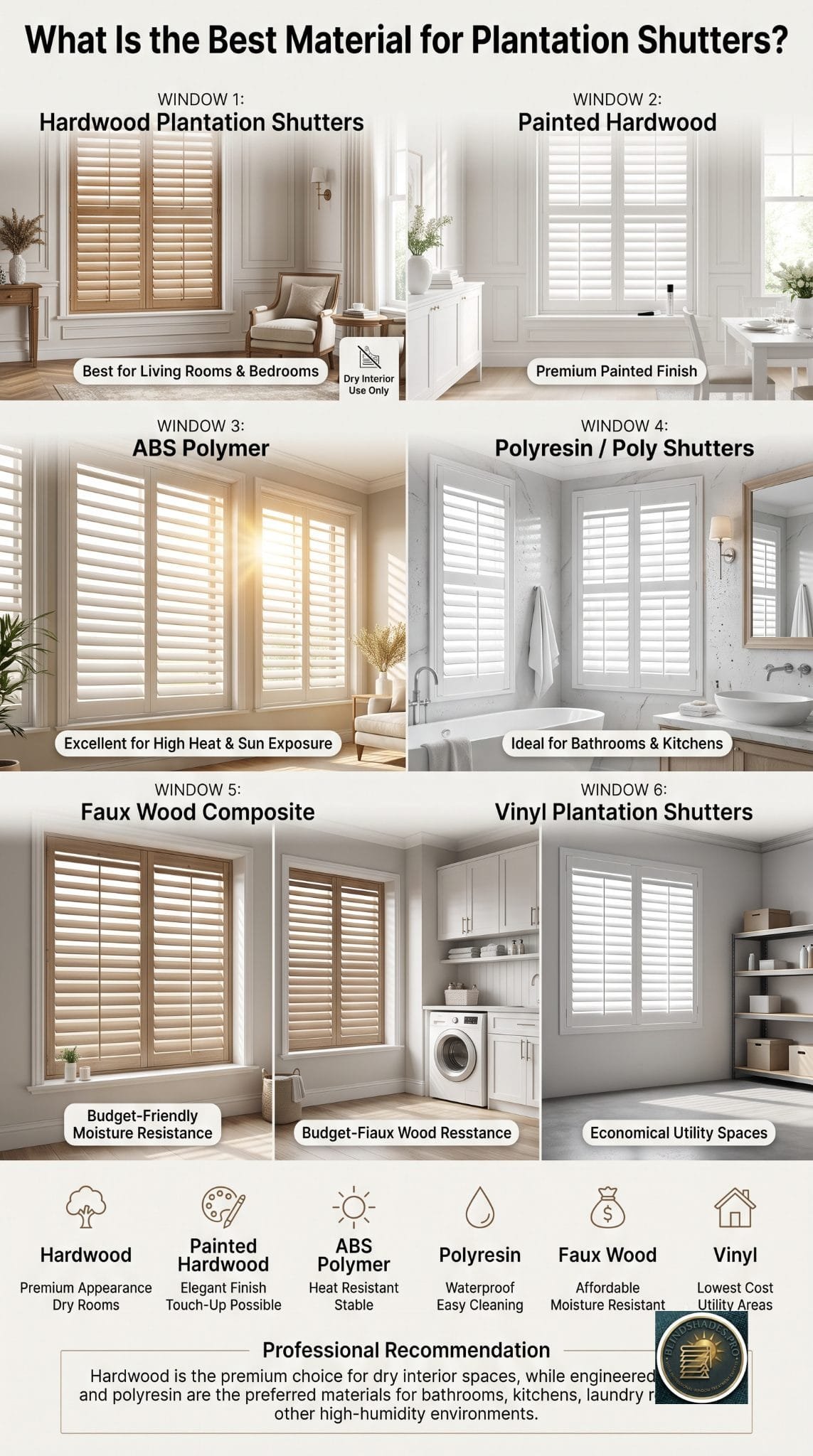
By Michael Turner — 30 years in window treatments
The best plantation shutters are decided by three choices, not thirty: the louver size (three and a half inches is the modern default for a reason), the material matched to the room (hardwood for living spaces, polymer where water lives), and the service model (DIY-online custom from around twenty-six dollars a panel versus measured dealer installation) — and the brand register below ranks the market the way the seller pages and the AI summaries can’t, because we don’t sell shutters. This guide also prints the two things the industry won’t: how much light shutters cost you even when they’re open, and how to read a shutter’s build quality from its tilt rod in five seconds.
Key Takeaways
- The brand consensus is knowable. Owner forums converge on Norman’s construction — the Garage Journal’s long-running shutter thread calls the joints and build “very tough” and the brand “probably the best” — while Coverly’s painted hardwood carries the strongest verified retail base in the market at four point eight across four hundred thirty-one reviews.
- Louver size is the view decision. Larger three-and-a-half to four-and-a-half inch louvers dominate current buying because they leave more open glass between slats — the honest fix for the category’s light problem.
- Material follows moisture. Hardwood (poplar, basswood) owns living rooms and bedrooms; polymer, ABS, and polyresin own bathrooms, kitchens, and garages — the professional consensus is blunt that wood does not belong in wet rooms.
- The open-shutter tax is real. The top-voted community answer on shutter buying admits what brochures omit: shutters block a meaningful share of light even when open — frame, stiles, and louver stack all subtract glass. This guide quantifies it and shows the three ways to shrink it.
- DIY-custom broke the price floor. Online made-to-measure panels now start around twenty-six dollars, with full custom programs running roughly one twenty to the low three hundreds per opening before the recurring forty-to-sixty-percent promotions — the dealer-install tier is a service purchase, not a product one.
⭐ Quick Answer — The Best Plantation Shutters
The best plantation shutters are decided by the Louver Rule — Size (three-and-a-half-inch louvers are the modern default for view), Substance (hardwood in dry rooms, polymer where water lives), and Service (DIY-online custom versus measured dealer installation):
- Best overall: Coverly’s painted North American hardwood — four point eight across four hundred thirty-one reviews at Coverly, around one hundred twenty-nine dollars on promotion, four finish coats deep.
- Best for moisture rooms: the faux-wood shutter class at four point six across five hundred reviews — the pros bar real wood from baths and garages; the material physics is in the faux wood blinds guide.
- The construction consensus: Norman’s Woodlore Plus tier — owner forums call the joints and build the market’s toughest — with DIY custom programs carrying five-year warranties at The Shutter Store.
- The honest downside: shutters subtract light even when open — frame, stiles, and louver stack all eat glass; bigger louvers and café styling shrink the tax, and the alternatives are mapped in the interior window shutters guide.
- Outside the glass: weather-facing shutters are a different engineering problem — covered in the exterior shutters guide; installer directories for measured quotes live at Houzz.
Quick Specification Reference
| Specification | Typical range for plantation shutters |
|---|---|
| Louver sizes | Two and a half, three, three and a half, four and a half inches |
| Configurations | Full height, café (bottom half), tier-on-tier (independent halves) |
| Materials | Hardwood (poplar, basswood), painted hardwood, ABS polymer, polyresin, faux wood, vinyl |
| Price class | Around twenty-six dollars a DIY panel to the low three hundreds custom; dealer tiers by quote (words-only; see cost table) |
| Tilt systems | Visible front rod, hidden rear tilt, invisible/geared tilt, motorized |
| Mount | Inside frame with hang strips, or outside frame build-out |
| Warranty norm | Five years at the DIY-custom tier; limited lifetime on premium dealer lines |
| Light control | Excellent closed; reduced open-glass area versus blinds — see the Open-Shutter Tax |
Read the complete guide below for: the independent brand register, the Louver Rule framework, the material-by-room verdict, our six verified picks, the Open-Shutter Tax nobody prints, the Tilt-Rod Tell for spotting quality in five seconds, configuration choices, honest cost bands, and the DIY-versus-dealer decision including the real answer to “plantation shutters near me.”
What Are the Best Brands of Plantation Shutters?
Norman for construction consensus, Coverly for verified retail satisfaction, Sunburst for the premium dealer experience, The Shutter Store for DIY custom, and the Lowe’s and Blinds.com channels for measured-online value — each verdict below is attributed, because we don’t sell any of them.
The top of this search is an AI-generated summary that lists brands without ranking them, followed by the brands ranking themselves. Here is the register with the receipts:
| Brand | Signature lines | The independent evidence | Best for |
|---|---|---|---|
| Norman | Woodlore Plus (ABS polymer), invisible tilt options | The Garage Journal’s shutter thread: construction and joints “very tough,” consensus “probably the best” | Temperature-swing rooms, premium build at dealer tier |
| Coverly | Painted North American hardwood, four coats of finish; economy polyresin | Four point eight across four hundred thirty-one reviews, corroborated at four point eight across two hundred six on a second listing | The verified-satisfaction pick for living spaces |
| Sunburst | Polywood faux, Ovation hardwood | Brand claim of a “Five-Star” wood rating — a marketing designation, noted as such; strong dealer network | White-glove measured installation |
| The Shutter Store | American wood, waterproof composite, DIY custom | Five-year warranty on every order and free shipping stated on-site; self-described “America’s highest-rated shutter store” — a store claim, not an audited one | Confident DIY measurers |
| Eclipse | Polyresin lines, invisible tilt systems | Named alongside Norman for reliable invisible-tilt engineering by the Little Rock dealer guide | Clean-face modern looks |
| Lowe’s / Blinds.com channel | Measured-online programs | The top community answer: ordered from Lowe’s online, “easy to install”; a six-year Garage Journal testimonial calls blinds.com shutters fantastic-looking for the money | Value custom without a dealer visit |
The pattern worth noticing: the brands the forums praise are praised for joints, tilt engineering, and finish coats — construction details — while the brands’ own pages lead with designations and superlatives. The Tilt-Rod Tell below turns that construction focus into a five-second showroom test.
The Louver Rule: Size · Substance · Service
Three decisions in order — louver size for the view, material substance for the room, service model for the budget — and every configuration question downstream answers itself.
Size. The market has voted: three-and-a-half and four-and-a-half inch louvers now dominate orders because larger slats mean fewer slats, and fewer slats mean more open glass when tilted — The Shutter Store’s own guidance puts the popular range at three and a half to four and a half inches for exactly this unobstructed-view reason. Small two-and-a-half inch louvers still earn their place on small panes and traditional cottage looks.
| Louver size | Window match | View effect |
|---|---|---|
| Two and a half inches | Small panes, cottage and traditional styles | Busiest slat pattern, most shading when open |
| Three inches | Transitional middle ground | Balanced |
| Three and a half inches | The modern default for standard windows | Noticeably more open glass |
| Four and a half inches | Large windows, view-priority rooms | Fewest slats, widest sightlines — and the biggest single fix for the Open-Shutter Tax |
Substance. The material question gets its own section next — the short version is moisture decides.
Service. DIY-online custom, measured-online, or full dealer — the cost section maps all three.
What Is the Best Material for Plantation Shutters?
Hardwood where the room is dry, engineered polymer where it isn’t — the professional consensus is unambiguous, and it’s the one thing the AI summary at the top of this search gets right.
| Material | What it is | Rooms it wins | The honest limit |
|---|---|---|---|
| Hardwood (poplar, basswood) | Solid milled wood, stained or painted | Living rooms, bedrooms, dining | Warps in sustained humidity; the pros bar it from baths, attics, garages |
| Painted hardwood (Coverly class) | Hardwood under multiple finish coats — four at the register’s top pick | Same dry rooms, brighter whites | Paint chips show wood beneath; touch-up kits matter |
| ABS polymer (Norman Woodlore Plus class) | Engineered thermoplastic over a stable core | Temperature-swing rooms, sun-hammered windows | Heavier panels; dealer pricing |
| Polyresin / poly (Sunburst Polywood, Eclipse class) | Solid synthetic, wipes clean | Bathrooms, kitchens, laundry | The widest louvers can sag on very wide panels — split with a divider |
| Faux wood | Composite boards | Moisture rooms on a budget — the four point six, five-hundred-review Blindster class | Weight; keep panels modest |
| Vinyl | Hollow or filled extrusion | Garages, rentals, the price floor around forty-nine dollars | The flex and the look match the price |
The wood-versus-composite decision here is the same physics argued across our blinds coverage — the fuller treatment lives in the faux wood blinds guide, and the case for real timber in dry rooms in the real wood blinds guide.
Best Plantation Shutters — Our Picks
Six picks with the review bases printed, the thin bases flagged, and the no-base dealer tiers labeled for what they are.
| Pick | Product | Rating and review base | Price class (words) | Why it wins |
|---|---|---|---|---|
| Best Overall | Coverly Painted Wood Plantation Shutter | Four point eight across four hundred thirty-one reviews (plus four point eight across two hundred six on its second listing) | Around one hundred twenty-nine dollars on promotion | North American hardwood, four finish coats, and the market’s strongest verified base |
| Best for Moisture Rooms | Blindster Faux Wood (Vanilla) | Four point six across five hundred reviews | Around one hundred four dollars on promotion | The largest faux-wood base in the SERP; bathroom-safe composite |
| Best Custom Program | Blinds.com Signature Wood | Four point five across one hundred fifty-seven, corroborated by four point six across one hundred fifteen on the custom white line | Around one hundred seventy-one on promotion | The measured-online lane with two agreeing bases — and six-year owner testimony behind it |
| Best Budget Custom | BlindsOnLine Custom Made-to-Measure | Four point eight across seventy-four reviews — a modest base buyers should weigh | Around twenty-six dollars a panel | The DIY price floor, made to measure |
| Best DIY Package | The Shutter Store American Wood | No public product rating — the store’s five-year warranty and free-shipping terms are the stated case | Roughly sixty to the low three hundreds across its lines | The self-install program built around DIY measuring |
| Best Premium Dealer | Norman Woodlore Plus | No public retail base — the owner-forum construction consensus is the evidence, and it is unusually strong | Dealer quote | The build-quality benchmark, with invisible tilt available |
Consistency note for our own cluster: the material ladder and the year-one-versus-year-ten dust verdict that frame every shutter decision live in the interior window shutters guide — this page ranks the plantation market specifically; that one decides whether plantation is even your type.
The Open-Shutter Tax: Where Your Light Goes
Plantation shutters subtract light three ways even when fully open — frame, stiles, and louver stack — and the honest number is enough that view-priority rooms should shrink it deliberately or choose differently.
The most useful sentence in this entire search sits in a community thread, not a brochure. The top-voted answer on where to buy shutters adds, unprompted: “They do block a lot of natural light, when they are open.” Here is why, and what to do about it.
A shutter is a frame inside your window frame. The outer frame and hang strips claim the perimeter; each panel’s stiles and rails claim more; and even at full tilt, a stack of louvers shades the glass behind it the way an open venetian still stripes a window. On a standard opening, the assembly can meaningfully shrink the clear-glass area versus a fully raised blind or shade — which retracts off the glass entirely.
| Mitigation | How it works | The trade |
|---|---|---|
| Go four and a half inch louvers | Fewer, wider slats — the least louver shading available | Contemporary look; not for tiny panes |
| Choose café style | Shutters on the lower half only; the upper glass runs free | Privacy stops at the rail line |
| Specify hidden or invisible tilt | Deletes the front rod’s shadow line | Modest upcharge; the quality brands do it best |
| Divider-free single panels where width allows | Fewer stiles across the opening | Wide poly louvers can sag — mind the material table |
| Choose a retracting treatment instead | Blinds and shades leave the glass fully clear when up | You give up the shutter’s fixed architecture — the alternatives are mapped in the interior window shutters guide |
This is also the fair answer to the downsides question this search asks: the tax, the cost tier, the fixed presence on the glass, and cleaning louvers by hand. Shutters repay all four with permanence, resale polish, and the best hot-climate ventilation control in the category — the Airbnb host community’s energy thread lands on well-sealed shutters and cellular shades as the efficiency picks — but the repayment is honest only if the tax is.
The Tilt-Rod Tell: Reading Quality in Five Seconds
Look at how the louvers tilt before you look at anything else — the tilt system is where build tiers announce themselves, and where cheap shutters fail first.
The Little Rock dealer’s buying guide notes that Norman and Eclipse have introduced invisible tilt systems with excellent reliability — and that detail is more useful than any brochure superlative, because tilt engineering is the fastest quality read in the showroom:
| Tilt system | What you see | What it tells you |
|---|---|---|
| Visible front rod, stapled links | A center rod stapled to each louver face | The legacy budget build; staples are the classic failure point |
| Visible front rod, geared or pinned | A rod without staples | A step up — serviceable and traditional |
| Hidden rear tilt | Clean louver faces, a slim bar behind | The modern mid-tier standard |
| Invisible / geared internal tilt | Nothing visible; louvers move in unison from any slat | The premium engineering tier — the Norman and Eclipse territory |
| Motorized tilt | App or remote louver control | The dealer-tier upgrade for high glass |
Three companion checks, all doable in a minute: rack a corner joint gently (the Garage Journal consensus praises Norman precisely for joints that feel “very tough”), count the finish coats on a painted sample edge (the register’s top pick runs four), and tilt a full louver stack — quality shutters move in one plane without flutter. A brand that passes the tilt test, the joint test, and the coat count is a brand whose warranty you’ll never need to read.
Full Height, Café, or Tier-on-Tier?
Full height is the default, café buys light at the cost of upper privacy, and tier-on-tier buys both at the cost of busier lines and a higher price.
| Configuration | What it is | Choose it when |
|---|---|---|
| Full height | One panel set covering the opening | The default — bedrooms, streets with sightlines, most rooms |
| Café style | Lower half shuttered, upper glass open | Ground-floor privacy with maximum daylight — and the biggest legal cheat on the Open-Shutter Tax |
| Tier-on-tier | Independent upper and lower panels | Bay windows and street-facing rooms wanting both modes; the configuration our bay-window coverage leans on in plantation shutters for bay windows |
| Specialty shapes | Arches, angles, circles | Shaped glass — the arch approach is in shutters for arched windows |
Narrow flanking glass deserves its own mention: shutters remain the tidiest sidelight solution in the category, covered pane-by-pane in plantation shutters for sidelights, with the whole entry-privacy decision in the sidelights and front door blinds guide.
What Do Plantation Shutters Cost?
Around twenty-six dollars a DIY panel to the low three hundreds per custom opening, dealer tiers by quote — and the promotion price is the real price, because half this market is on sale at any moment.
| Service model | Price band (words) | What’s included | Evidence |
|---|---|---|---|
| DIY made-to-measure panels | Around twenty-six to sixty dollars a panel | You measure, you install | The four point eight, seventy-four-review budget program |
| DIY custom programs | Roughly one hundred twenty to three hundred seven per opening | Custom build, free shipping, five-year warranty | The Shutter Store’s published band and terms |
| Measured-online custom | Around one hundred to one hundred seventy-five on promotion | Custom build to your measurements, support by phone | Blinds.com and Blindster listings above, discounts of twenty-four to sixty percent shown in-market today |
| Dealer measured-and-installed | By quote | Professional measure, install, and warranty service | Sunburst and Norman channel |
Two buying rules carry over from every custom category we cover: the list price is an anchor and the recurring sale price is the real price; and before any order, answer the deduction question — whether the maker subtracts operating clearance or builds the exact number you enter — the same protocol that governs made to measure blinds.
DIY Online or a Dealer — and the Honest “Near Me” Answer
Measure yourself and buy online when your windows are square and your tape discipline is good; pay the dealer when the openings are old, out of square, or shaped — that is the whole near-me question answered.
Searches for shutters near me are really asking who does the measuring. The online programs above ship nationwide and put the tape in your hands — the top community answer’s Lowe’s order was measured at home and self-installed “easy.” A local dealer earns the premium in exactly three cases: out-of-square historic frames, specialty shapes, and whole-home orders where one warranty covering measure, product, and install is worth paying for. A beginner-level walkthrough of the measuring itself has nearly two hundred thousand views on the Remodel With Robert channel — the demand for DIY confidence is the market’s own signal that the dealer visit is now optional for standard windows. If you do measure yourself, use the factory discipline: steel tape, three measurements per dimension with the smallest width governing inside mounts, both diagonals checked for square, and the deduction question answered on the order form before you click buy.
Which Shutter Guide Do You Need?
Plantation is the product, interior is the category, exterior is outside — three pages, three jobs.
This page ranks the plantation market — brands, louvers, materials, cost. If you’re still deciding whether plantation is the right type of interior shutter — against café-only, solid panel, or no shutter at all — start with the interior window shutters guide, which carries the material ladder and the honest dust verdict. Weather-facing shutters are their own engineering problem, covered in the exterior shutters guide. And whole-room planning beyond shutters — bedrooms are where the hardwood case is strongest — connects to the bedroom blinds and shades guide.
Related Buying Guides
- The Best Interior Window Shutters Guide — the category decision above this page
- The Best Exterior Shutters Guide — outside the glass
- The Best Faux Wood Blinds Guide — the composite-material physics
- The Best Real Wood Blinds Guide — timber in dry rooms
- The Best Sidelights & Front Door Blinds Guide — the entryway problem
- The Best Bay Window Blinds & Shades Guide — angled openings
- The Best Made to Measure Blinds Guide — the measuring protocol behind every custom order
Frequently Asked Questions
What are the best plantation shutters?
The best plantation shutters are Coverly’s painted hardwood line — four point eight across four hundred thirty-one reviews, around one hundred twenty-nine dollars on promotion — for dry living spaces, Blindster’s faux-wood shutter at four point six across five hundred reviews for moisture rooms, and Norman’s Woodlore Plus tier, the owner-forum construction consensus, in the dealer lane.
What are the best brands of plantation shutters?
Norman leads the construction consensus in owner forums, Coverly leads verified retail satisfaction, Sunburst leads the premium dealer experience with its Polywood and Ovation lines, The Shutter Store leads DIY custom with a five-year warranty on every order, and the Lowe’s and Blinds.com measured-online channels lead the value tier.
What is the best material for plantation shutters?
Hardwood — poplar or basswood, painted or stained — for living rooms, bedrooms, and dining rooms; ABS polymer, polyresin, or faux wood for bathrooms, kitchens, laundries, attics, and garages. The professional consensus is blunt that wood shutters don’t belong in wet or humid rooms.
What are the downsides of plantation shutters?
Four honest ones: they reduce open-glass area even when fully open (the frame, stiles, and louver stack all subtract light), the custom and dealer tiers cost more than blinds, they’re a fixed installation rather than a retracting one, and louvers are hand-cleaning territory. Larger louvers, café styling, and hidden tilt shrink the first; permanence and resale polish repay the rest.
What size louvers should I choose?
Three and a half inches is the modern default, and four and a half wins view-priority rooms — larger louvers mean fewer slats and more open glass, which is why the industry’s own guidance puts the popular range at three and a half to four and a half inches. Reserve two and a half inch louvers for small panes and traditional looks.
Are plantation shutters worth the price?
For rooms you’ll keep for years — yes: they’re the most permanent, resale-friendly treatment in the category, with strong hot-climate ventilation control, and DIY-custom programs from around twenty-six dollars a panel have cut the entry price sharply. For short stays, rentals, and view-priority glass, a quality blind or shade delivers more light per dollar.
