Best Exterior Shutters (2026): Function, Climate & Cladding

Authored By Michael Turner -30 Years Home Improvement Expertise | Updated 2026 | BlindShades.pro
Updated on July 19, 2026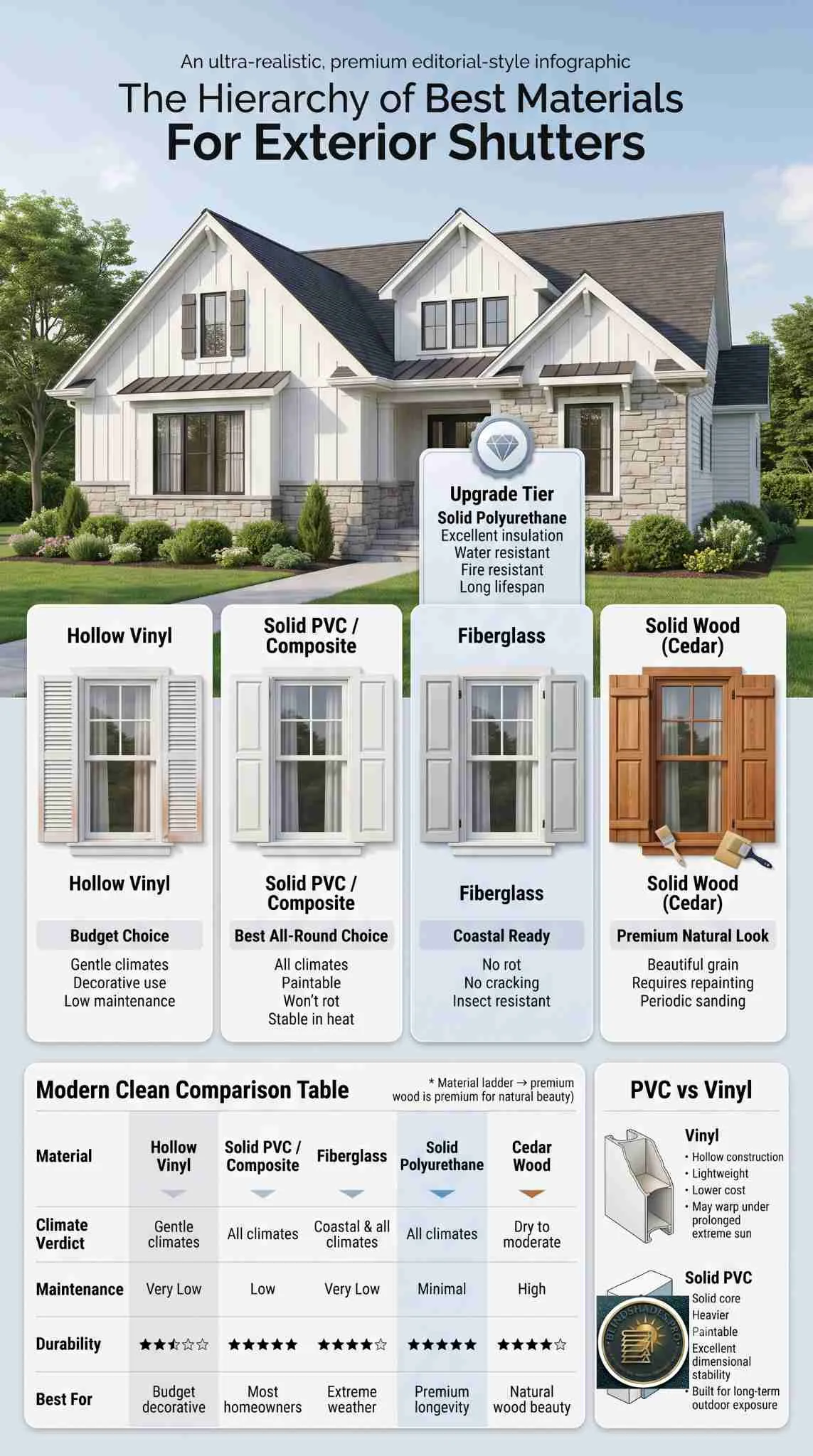
By Michael Turner — 30 years in the window treatment industry
The best exterior shutters are chosen by one question the entire market skips: will they ever close? Nearly everything this category sells is decorative — fixed panels screwed open beside the window, sized by proportion, never by coverage — while a small functional tier of operable louvers and Bermuda panels actually swings. Answer that first, then run Climate (vinyl’s direct-sun warp warning versus PVC’s all-weather case versus wood’s upkeep contract) and Cladding (brick, siding, and stucco each mount differently), and this brand-crowded market sorts itself in an afternoon. Below: the review arithmetic, the material triad decoded, the proportion rule that separates charming from fake, and the honest flags on a SERP where the loudest “best material” claim comes from the company selling it.
Key Takeaways
- Decorative is the default and that’s fine — the market’s own top seller is a fixed vinyl board-and-batten pair — but decorative sizing is proportion, not coverage: shutters should look like they could close, roughly half the window’s width each.
- The value verdict is loud: the SERP’s biggest review base is an open-louver vinyl pair at four point eight across forty-one hundred reviews for about thirty-seven — builder-grade priced, better-than-builder rated.
- The upgrade arc is documented: the community’s top answer swapped flimsy builder-grade vinyl for solid polyurethane — the thousand-dollar tier exists because the thirty-dollar tier flexes.
- PVC versus vinyl is a real distinction, not marketing: hollow vinyl is light, cheap, and warp-prone in hard sun; solid PVC and composites mimic wood, shrug off rot, and hold shape — the price gap is the wall between them.
- Your wall decides your weekend: siding takes standoff screws, brick takes masonry anchors and a hammer drill, stucco takes patience and sealant — the brick-house question has a hardware answer, not a product answer, and every penetration gets sealed.
⭐ Quick Answer — The Best Exterior Shutters
The best exterior shutters are chosen by the Exterior Test — Function (will they ever close?), Climate (what the sun and rain will do), Cladding (what wall takes the fasteners) — and the review arithmetic is unusually loud:
- The value verdict: Builders Choice’s open-louver vinyl pair — four point eight across roughly forty-one hundred reviews at about thirty-seven — with the top-selling board-and-batten class at The Home Depot confirming the decorative default.
- The proportion rule: decorative shutters should each measure about half the window’s width — they must look able to close, even though they never will.
- The material split: hollow vinyl for gentle exposures, solid PVC and composite for hard sun and coasts — the maker’s-own PVC-best claim at ShutterLand has merit and a motive, and the indoor PVC logic is in the faux wood blinds guide.
- The functional tier: movable louvers, Bermuda panels, and hinge-and-holdback hardware — style-mapped in the guides at Timberlane, with the wood-upkeep contract argued in the real wood blinds guide.
- The twin decision: the interior half of the shutter question — materials, louvers, and the dust honesty — lives in the interior window shutters guide.
Quick Specification Reference
| Specification | Exterior shutter reality (2026) |
|---|---|
| The default | Decorative fixed panels — sized by proportion, screwed open, never closing |
| The functional tier | Operable louvers, Bermuda (top-hinged), hinge-and-holdback hardware |
| The material triad | Vinyl (cheap, light, warp risk in hard sun) · composite/PVC (all climates) · wood (premium, upkeep) |
| The upgrade tier | Solid polyurethane and fiberglass — the no-rot, no-flex class |
| The proportion rule | Each shutter about half the window’s width — it should look able to close |
| The style map | Louvered (Colonial), board & batten (Farmhouse/Craftsman), raised panel (traditional), Bermuda (tropical) |
| Typical cost band | About thirty-three per piece to over a thousand per premium pair — watch per-piece vs per-pair listings |
| The wall question | Brick = masonry anchors; siding = standoffs; stucco = both skills at once |
| The paint rule | Prefinished vinyl fades on schedule; paintable PVC and wood repaint on yours |
Read the complete guide below for: the six picks by review arithmetic, the Exterior Test (Function · Climate · Cladding), the decorative-versus-functional split with the proportion rule, the material triad decoded including the PVC-versus-vinyl answer, the full style taxonomy, mounting by wall type, real cost math with the per-piece trap flagged, and the brand honesty table this SERP earns.
What Are the Best Exterior Shutters in 2026? — Our Picks
Review volumes are stated exactly as the market shows them, and two honesty notes come first.
First, the phrase people actually type — best exterior shutters consumer reports — hoping a lab has settled this: no independent lab has, and we are not Consumer Reports. What exists is the review arithmetic below plus the community record, and the best exterior shutters reddit threads are genuinely useful: the top answer in the freshest one describes swapping flimsy builder-grade vinyl for Atlantic Premium solid polyurethane shutters, which is the whole quality ladder in one sentence. Second, the loudest claim in this SERP — that PVC shutters are the best exterior shutters, ranking highest in almost every category — comes from ShutterLand, a maker of PVC shutters; the claim has real merit, and we cite it as a manufacturer’s own voice, not a verdict.
| Pick | Product | Rating / reviews | Price (words) | The lane |
|---|---|---|---|---|
| Best Value | Builders Choice Vinyl Open Louver | 4.8 across ~4,100 | About thirty-seven | The SERP’s biggest base, at its smallest price |
| Best Overall Vinyl | Builders Edge Louvered Vinyl | 4.5 across ~1,500 | About fifty per piece | The brand-chip standard, every color |
| Best Two-Panel Kit | Lifetime Vinyl Standard Two Equal | 4.6 across ~1,300 | About fifty-eight | The straightforward pair |
| Best Raised Panel | Perfect Shutters Premier Raised | 4.7 across ~1,000 | About fifty-three per piece | Traditional fronts |
| Best Board & Batten | Ply Gem Closed Board and Batten | 4.5 across 657 | About fifty-four per piece | The market’s own top seller class |
| Best Upgrade | Atlantic Premium Solid Polyurethane | Community-endorsed; no public base shown — flagged | About one thousand to thirteen hundred per set | When builder vinyl flexes, this is the exit |
The wood alternate: Dogberry Collections’ wood shutters (four point three across five hundred thirteen, about one sixty to one seventy) carry the stained-grain case — with the upkeep contract stated below. And the twin decision indoors is its own guide: the louver math, material ladder, and dust honesty for interior window shutters run parallel to everything here, one pane of glass apart.
The Exterior Test: Function · Climate · Cladding
Three questions in order — does it need to work, what will the weather do to it, and what wall is it going on — sort the whole catalog.
| Exterior Test step | The question | The failure it prevents |
|---|---|---|
| Function | Will these ever close over the glass? | Paying operable prices for decoration — or bolting decoration where storms demand function |
| Climate | Direct sun hours? Coastal wet? Freeze cycles? | The warped south-face vinyl the market’s own summary warns about |
| Cladding | Brick, siding, stucco, fiber cement? | The cracked mortar joint and the stripped siding screw |
The First Question: Will They Ever Close?
Roughly all of what this market sells is decorative — and that’s a legitimate choice, but it changes every rule that follows: sizing, hardware, even honesty of style.
The revealed preference says it plainly: the top-selling product in the category at the biggest home center is a closed board-and-batten vinyl pair in black — a fixed decoration, and a handsome one. Decorative shutters live by the proportion rule: each panel about half its window’s width, tall as the sash, mounted tight to the casing — close enough to plausible that the eye reads them as architecture rather than applique. Violate it (skinny strips beside wide windows) and you get the fake look the design forums mock. The functional tier is a different purchase: movable-louver panels and paneled shutters on real hinges with holdback dogs, sized to cover the glass, swinging shut for storms, privacy, or sun — plus the Bermuda shutter, top-hinged and propped open, which Timberlane’s guide assigns to laidback, tropical, and bungalow homes and which doubles as a shade awning. One honesty line for storm country: decorative shutters and even most operable ones are not rated storm protection — if hurricane duty is the actual requirement, shop rated storm panels first and aesthetics second.
| Question | Decorative (the default) | Functional (the tier) |
|---|---|---|
| Sizing | Proportion — half the window width | Coverage — the glass, exactly |
| Hardware | Screws, spacers | Hinges, holdbacks, dogs |
| Materials | Vinyl and composite dominate | PVC, wood, fiberglass — stiffness matters when it swings |
| Cost shape | Tens per piece | Hundreds per opening |
| The tell | It never moves | It must move smoothly for decades |
Two footnotes the split earns. For the decorative buyer: removal and replacement is a real feature — a faded vinyl pair unscrews in ten minutes and a fresh pair goes up for less than a dinner out, which is why the value tier’s fade schedule bothers owners less than the spec sheet suggests; treat cheap decorative shutters as a wear item, like porch cushions, and the thirty-seven-dollar pick becomes the rational buy it already is by review count. For the maker-hearted: the community’s second-favorite answer in the freshest thread is the DIY board-and-batten build — two wide boards per side, a pine tree cut from the center of one for character — and it is genuinely the easiest exterior carpentry project a house offers: dimensional lumber, exterior glue, three battens, and the same masonry anchors everyone else buys. The catch is the upkeep contract wood always signs, doubled outdoors: prime every face and edge before assembly, because the paint film is the shutter’s whole weather defense, and the end grain drinks first. Between those poles — the ten-minute vinyl swap and the weekend pine build — sits the entire market this guide just priced.
What Is the Best Material for Exterior Shutters?
The triad plus the upgrade tier — and the PVC-versus-vinyl question answered without a maker’s thumb on the scale.
What is the best material for exterior shutters is the category’s most-asked question, and the market’s own summary frames the triad well: vinyl as the cheapest, lightest, most popular choice for purely decorative use (typically fifty to two hundred a pair) with a warning about warping in extreme direct sunlight; composite and PVC as the wood-look, no-rot, all-climates middle; wood as the premium tier that stains beautifully and demands periodic sanding and repainting. To that triad add the specialists: fiberglass shutters exterior — grouped with PVC by one retailer as the benchmark materials that aren’t damaged by moisture and won’t rot, crack, or attract insects — and the solid-polyurethane class the community upgrade arc lands on, with one exterior maker positioning composite, PVC, and fiberglass together as sustainable alternatives with greater life expectancy than traditional wood.
So — which is better, PVC or vinyl shutters? They are not the same thing, and the price gap is the wall between them. Searchers typing PVC shutters exterior into the bar are usually asking exactly this. Hollow-formed vinyl is light and inexpensive; its weakness is stiffness and heat — the warp warning belongs to it. Solid PVC (and cellular PVC composites) is heavier, paintable, dimensionally stable, and priced accordingly. If your shutters face gentle exposure and a budget, vinyl’s forty-one-hundred-review value pick is genuinely enough. If they face south, coastal wet, or decades — solid PVC and composite exterior shutters earn their premium, exactly as the PVC-side logic in our faux wood blinds guide predicts from indoors.
| Material | Climate verdict | Upkeep | The honest note |
|---|---|---|---|
| Hollow vinyl | Gentle exposures | None — but fades on its own schedule | Warp risk in hard direct sun, per the market’s own warning |
| Solid PVC / composite | All climates | Repaintable | The maker-crowned “best” — with merit, and a motive |
| Fiberglass | All climates, coastal | Minimal | The benchmark class: no rot, crack, or insects |
| Solid polyurethane | All climates | Minimal | The community’s upgrade destination; foam-core versions praised as water- and fire-resistant with insulating qualities |
| Wood (cedar class) | Dry-to-moderate | Sanding and repainting, periodically, forever | The stain rule’s only home — the grain case, argued in our real wood blinds guide |
What Are the Most Popular Exterior Shutters? The Types, Mapped
Louvered shutters are America’s most popular — the market says so directly — and the full taxonomy of types of shutters exterior maps to house styles in one table.
| Style | The look | The house | The note |
|---|---|---|---|
| Louvered (fixed) | Classic angled slats | Colonial, Georgian | The most popular window shutter type in America, per the May 2025 market write-up — the slat geometry indoors is our venetian blinds guide’s territory |
| Louvered (movable) | Operable slats | The functional tier | One of the six canonical types in Southern Shutter’s taxonomy |
| Board & batten | Rustic vertical boards | Farmhouse, Craftsman | The top-seller’s style; also the community’s favorite DIY build — two wide boards per side |
| Raised panel | Recessed elegance | Traditional, formal | Perfect Shutters’ thousand-review lane |
| Combination | Panel below, louver above | Transitional | Timberlane’s ideal-trio member |
| Bermuda | Top-hinged awning style | Tropical, bungalow, coastal | Shade and shutter in one motion |
Cape Cod houses often look incomplete without shutters, one specialist observes, and can take basically any style — which is the taxonomy’s quiet lesson: the house votes first, the material second.
How Do You Mount Shutters on Brick, Siding, or Stucco?
The best exterior shutters for brick house searches have a hardware answer, not a product answer — the wall decides the fasteners, the workflow, and half the weekend.
| Wall | The method | The rules |
|---|---|---|
| Brick / masonry | Hammer drill, masonry bit, plastic or sleeve anchors — into the BRICK, not the mortar joint | Any material mounts to brick; pick colors against the brick’s undertone (black and deep green read best on red brick; softer earth tones on tan) |
| Vinyl / wood siding | Standoff screws through siding into sheathing or studs | Never crush the siding — shutter spacers keep the panel proud and the siding uncracked |
| Stucco | Masonry technique with siding patience — drill, anchor, seal | Seal every penetration; stucco cracks travel |
| Fiber cement | Pre-drill always | The brittle-edge rule — no impact driving at panel edges |
Two universal rules ride along. Every fastener penetration on any wall gets sealed — water that enters behind a shutter exits through your sheathing’s obituary. And the proportion rule from the Function section applies double on brick, where crisp shadows make undersized shutters look worst; measure the window, halve the width, and order to that number — the same measure-first discipline every custom order on this site inherits from our made to measure blinds guide.
What Color Should Exterior Shutters Be?
Color is half the purchase and none of the product page — the cladding picks the palette, the finish type picks the maintenance calendar, and the fade schedule is the spec nobody prints.
The cladding rule first, because the wall votes before you do. On red and orange brick, the classics dominate for a reason: black, deep green, and charcoal read as architecture, while mid-tones vanish against the mortar. On white and light siding, nearly anything works and contrast is the only rule — the top-selling black board-and-batten pair exists because black-on-white is the American default. On tan brick and earth-tone stucco, softer historics — sage, slate, bronze — outperform the hard blacks that can read stark. On gray fiber cement, navy and deep teal are the current market’s visible favorites. Then the finish-type rule, which is really a maintenance contract: prefinished vinyl arrives in its forever color and fades on the sun’s schedule, not yours — south and west faces fade fastest, and touch-up is impossible because the color runs through the material. Paintable PVC, composite, wood, and the paintable value class (the four-and-a-half-star, one-twenty-nine-review paintable lane in this very grid) repaint on your schedule instead, which is the quiet argument for spending up on hard-sun elevations even when the shape is purely decorative. One matching note the twin guide indoors makes from the other side: if street-facing windows carry interior shutters visible through the glass, pick the exterior color with the interior louver color in mind — white-through-glass beside black-outside is a deliberate look; accidental is another word for it.
How Much Do Exterior Shutters Cost?
In plain words from the live market — with the per-piece trap this grid sets flagged loudly.
| Tier | The live numbers (words) | The catch |
|---|---|---|
| Value vinyl | About thirty-three to fifty-eight | ⚠️ The grid mixes PER-PIECE and PER-PAIR listings — several show per-count pricing near twenty-five to thirty per piece; confirm before comparing |
| Mainstream vinyl and composite | About one hundred fourteen to one seventy | The Ekena and Designs-Done-Right class |
| Wood | About one sixty to two twenty-two | Plus the upkeep contract |
| Custom and specialty | About one twenty-four to one eighty per configured pair | ShutterLand and Perfect Shutters custom lanes |
| Premium polyurethane and estate | About one thousand to eighteen hundred | The Atlantic and privacy-panel tier |
| The discount theater | Sixteen to forty-one percent “off” across the grid | The recurring sale price is the real price, as always |
What Is the Best Brand of Shutters? — And the Warning Table
The brand chips this market votes with: Builders Edge (the volume king — fifteen hundred, eleven hundred, and one-thirty-four-review bases across its lines), Ply Gem (the top-seller), Ekena Millwork, Perfect Shutters, Alpha, Atlantic, Highwood, Fypon, Polaris — with Timberlane and Southern Shutter as the custom-functional specialists and a 2012-vintage forum recommendation for ShutterLand’s solid cedar carried here with its age showing. “Best brand” resolves the way it did indoors: by SKU arithmetic, not logo.
| Warning | The listing | The rule |
|---|---|---|
| Maker-crowned material | “PVC shutters are the best exterior shutters” — from a PVC maker | Merit noted, motive cited |
| Thin five-stars | 5.0 across 3 · 5.0 across 8 | Anecdotes, not ratings |
| The weak custom | 3.9 across 8 at a big-box custom lane | Small and low — pass |
| No-base premium | The thousand-dollar polyurethane tier shows no public review count | Community-endorsed, base-unverified — lean on return terms |
| Per-piece pricing | Multiple listings priced per count | Divide nothing — multiply everything by two before comparing pairs |
Related Buying Guides
- Best Interior Window Shutters — the twin decision, indoors
- Best Outdoor & Patio Blinds — the other exterior weather product
- Best Real Wood Blinds — the wood-grain case and its upkeep
- Best Faux Wood Blinds — the PVC logic, indoors
- Best Thermal & Insulating Blinds — where the insulating-foam claim leads
- Best Venetian Blinds — the louver geometry
- Best Bay Window Blinds & Shades — where hinged panels meet angled glass
- Best Made to Measure Blinds — the measure-first discipline
- Best Solar Shades — the sun-side science
- Best Blackout Blinds & Shades — when closing actually means darkness
FAQ
What is the best exterior shutter material? Solid PVC, composite, and fiberglass for all climates and long horizons — the no-rot, no-crack benchmark class — hollow vinyl for gentle exposures on a budget (with the direct-sun warp warning respected), solid polyurethane as the community’s upgrade tier, and wood only with a sanding-and-repainting plan.
What are the most popular exterior shutters? Louvered shutters — the most popular window shutter type in America by the market’s own account — with board-and-batten close behind (the category’s top seller is a closed board-and-batten vinyl pair) and raised panel carrying traditional fronts.
Which is better, PVC or vinyl shutters? They differ more than the names suggest: hollow vinyl is light, cheap, and warp-prone in hard sun; solid PVC is heavier, paintable, dimensionally stable, and priced accordingly. Gentle exposure and budget favor vinyl’s big-base value picks; south faces, coasts, and decades favor PVC and composite.
What is the best brand of shutters? By review arithmetic: Builders Choice’s forty-one-hundred-review open louver for value, Builders Edge as the volume standard, Perfect Shutters for raised panels, Ply Gem for board-and-batten — with Timberlane and Southern Shutter as the custom-functional specialists. Judge the SKU, not the logo.
How do you attach shutters to a brick house? Hammer drill and masonry bit, plastic or sleeve anchors set into the brick itself (never the mortar joint), panels held to the proportion rule, and every penetration sealed. The product list doesn’t change on brick — the fasteners and the patience do.
How much do exterior shutters cost? About thirty-three to fifty-eight for value vinyl (watching the per-piece-versus-per-pair trap), one fourteen to one seventy for mainstream composite, one sixty to two twenty-two for wood plus its upkeep, and a thousand to eighteen hundred for the premium polyurethane and estate tiers — with the recurring sale price, as ever, the real price.
The Bottom Line
Ask the closing question first and the catalog collapses into order. Decorative — which is nearly everyone — buys proportion, color against the cladding, and the forty-one-hundred-review value verdict without embarrassment. Functional buys stiffness, hinges, and a maker who builds for swinging. Then let Climate veto (hard sun vetoes hollow vinyl; wet coasts veto wood without a maintenance vow) and let Cladding write the shopping list’s hardware half. Remember the two escape hatches at the market’s edges — the ten-minute vinyl swap that makes cheap shutters a wear item, and the weekend board-and-batten build that makes them a craft — and price everything between them accordingly. The material debate this market stages between makers resolves the same way the interior one did: the ladder decides, the logo illustrates — and the shutters that look best in ten years are the ones sized to look like they could close, on the day they never will.
