Best Interior Window Shutters (2026): Material, Louver & Mount

Authored By Michael Turner -30 Years Home Improvement Expertise | Updated 2026 | BlindShades.pro
Updated on July 19, 2026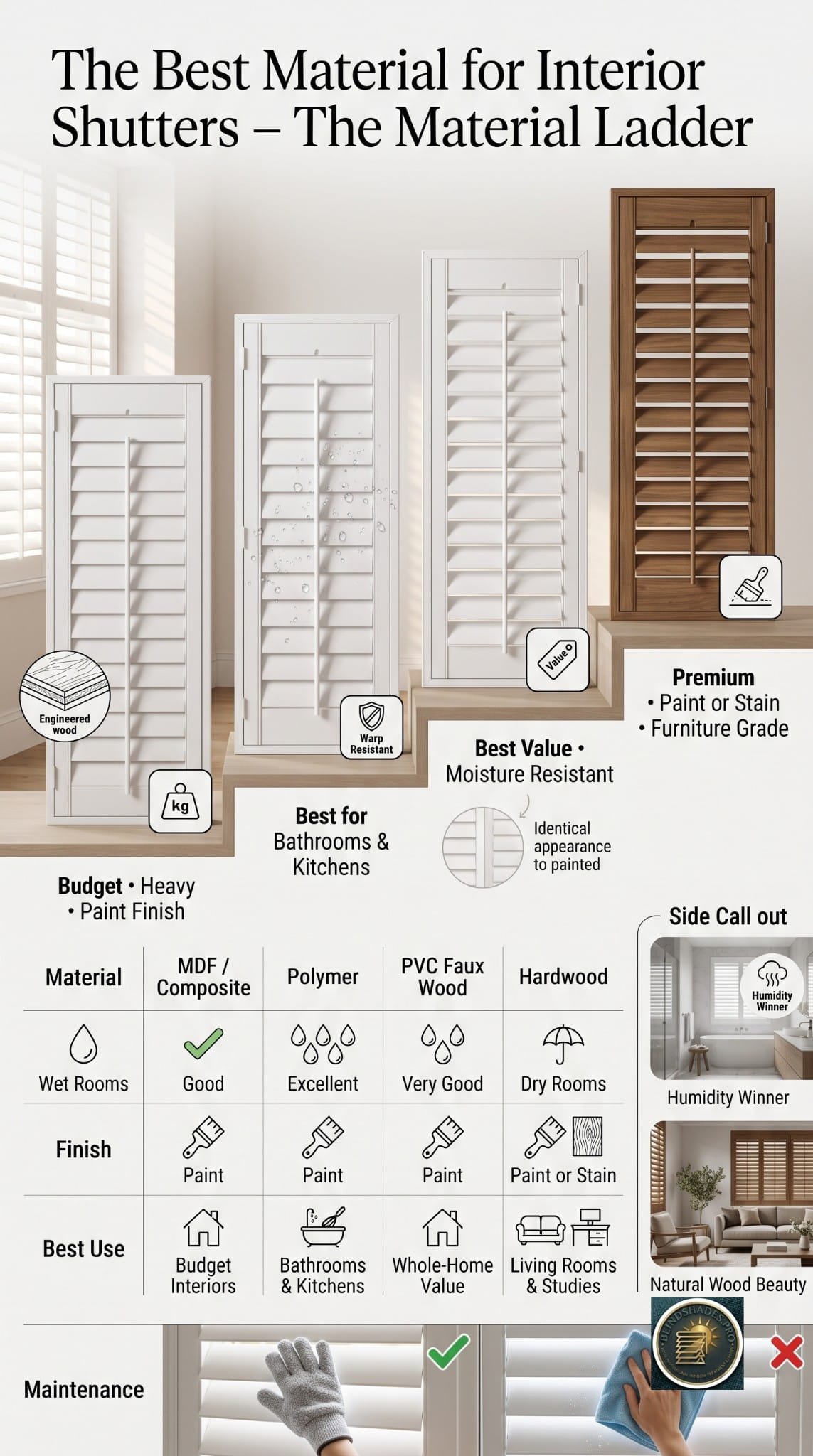
By Michael Turner — 30 years in the window treatment industry
The best interior window shutters are chosen in three moves — Material by the room’s humidity and your finish (paint tolerates composite, stain demands real wood), Louver by the window’s scale and your view, Mount by the frame your casing can actually take — and the brand names everyone recites are just examples standing on that ladder. The market’s AI-summarized consensus is a manufacturer’s catechism: Polywood and Woodlore for durability, Ovation and Normandy for premium. Useful — and sourced almost entirely from one brand family’s own pages. This guide gives you the generic decision underneath the brands, the review arithmetic that quietly complicates their hierarchy, and the one verdict no shutter seller will print: the community’s top-voted answer calls them dust collectors, and we take that seriously before disagreeing carefully.
Key Takeaways
- Material is the whole game: MDF composites for painted looks on a budget, polymer and PVC for wet rooms, hardwood (basswood, poplar) when you want stain — and the weight caveat nobody prints: composite is heavy, and wide panels sag on it.
- Plantation shutters are furniture, not a treatment. They screw into your casing, add resale value by the market’s own claim, and commit you — which is why the try-it-first lane matters.
- Louver size trades view against dust ledges. Bigger louvers mean more light, more view, and fewer horizontal shelves to wipe — the honest answer to the community’s dust-collector complaint.
- The review bases contradict the brand hierarchy: the two biggest verified products in this SERP are faux-wood value lines near five hundred reviews each, while one premium brand’s custom faux carries a three point eight.
- A self-awarded superlative is not a rating. One maker calls its flagship the only Five-Star wood shutter in the world — that is marketing language from its own page, and we flag it as exactly that.
⭐ Quick Answer — The Best Interior Window Shutters
The best interior window shutters pass the Shutter Test — Material by the room’s humidity and your finish, Louver by scale and view, Mount by what the casing carries — and the review arithmetic beats the brand recital:
- The verified twins: value faux-wood plantation shutters at four point six across roughly five hundred reviews apiece — from about forty-nine per panel — own this market’s evidence; the PVC logic behind them is in the faux wood blinds guide.
- The stain rule: only hardwood takes stain — basswood and poplar are the premium tier’s honest case, made from the slat side in the real wood blinds guide.
- The wet-room rule: polymer and composite only near steam — the won’t-warp flagship carries four point eight across fifty-one at Lowe’s, and the room-side rules live in the bathroom window blinds guide.
- The dated-but-useful verdict: the long-running brand thread at Houzz crowned Norman on quality-per-dollar — a 2014 opinion we cite with its age.
- The honest warning: the community’s top answer calls shutters dust collectors — bigger louvers and a weekly dry microfiber pass are the fix, or a different treatment is; the material-first guide at Elegant Touch Interiors agrees the ladder, not the logo, decides.
Quick Specification Reference
| Specification | Interior shutter reality (2026) |
|---|---|
| The default style | Plantation shutters interior — wide-louver hinged panels |
| The material ladder | MDF composite → polymer/poly → PVC faux wood → hardwood (basswood, poplar) |
| The wet-room rule | Synthetic only — the market’s own won’t-warp-crack-discolor claim class |
| The stain rule | Stained finishes require real wood; composites are paint-only |
| The weight caveat | Composite is heavy — wide panels want hardwood or split panels |
| Louver sizes | Roughly two-and-a-half to four-and-a-half inches; bigger = more view, fewer dust ledges |
| Frame styles | L-frame and Z-frame, inside or outside mount; café and half-height variants |
| Typical cost band | About twenty-six per small panel to high hundreds per large custom window |
| The commitment | Screwed to the casing, quoted by the window, valued at resale — furniture, not fabric |
Read the complete guide below for: the six picks by review arithmetic rather than brand recital, the Shutter Test (Material · Louver · Mount), the material ladder the AI answers won’t give you, louver and frame decisions with the café and half-height lanes named, the honest dust-collector verdict, real cost math in plain words, and the warning table this brand-heavy category needs.
What Are the Best Interior Window Shutters in 2026? — Our Picks
Review volumes are stated exactly as the market shows them; the brand consensus is noted and then tested against the arithmetic.
The consensus first, fairly stated: the market’s AI-summarized answer crowns Polywood (Sunburst’s synthetic) and Woodlore (Norman’s composite) for durability and energy efficiency, with Ovation and Normandy as the premium hardwood tier — and a June 2025 Sunburst-network post celebrates Ovation and Polywood as the country’s top residential interior shutters. Note the sourcing: that consensus is drawn overwhelmingly from the brands’ own properties, including the claim that Ovation is the only Five-Star wood shutter in the world — a self-awarded superlative we cite as marketing, not measurement. And a note to the searchers who arrive here two ways: whether you asked for the best rated interior shutters or for high quality interior window shutters, the answer below is the same table — “best rated” resolved by actual review arithmetic, “high quality” resolved by the material ladder that follows it. The verified arithmetic tells a flatter, more interesting story:
| Pick | Product | Rating / reviews | Price (words) | The lane |
|---|---|---|---|---|
| Best Overall Faux | Blindster Plantation Faux Wood (Vanilla) | 4.6 across 500 | About one hundred four | The category’s biggest verified base |
| Best Value | Blinds.com Acadia Custom Faux | 4.6 across 498 | About forty-nine | The same grade at half the spend |
| Best Wood | Blinds.com Signature Wood Plantation | 4.5 across 157 | About one seventy-one | The stained-grain lane with a real base |
| Best Custom White | Blinds.com Custom Plantation (16×20 class) | 4.6 across 115 | About one seventy-one per window class | The made-to-size mainstream |
| Best Budget Custom | BlindsOnline Made-to-Measure | 4.8 across 74 | From about twenty-six — verify per-PANEL vs per-window before celebrating | The price anomaly, flagged |
| Best Store Program | Blindsgalore Faux Shutters | 4.7 across 70 | About one eighty-five | The sample-first custom lane |
And the same-brand split this SERP teaches better than any: Levolor’s Classic shutters carry a four point eight across fifty-one at Lowe’s — the water-resistant won’t-warp flagship — while Levolor’s custom faux listing at Home Depot sits at three point eight across eighty-two and its by-pass custom at three point five across ten. Same logo, three different products, one lesson: review the SKU, never the brand. The twelve-year-old Houzz verdict deserves its dated citation too: Norman by far the best quality at a great price, Hunter Douglas great but not as nice and costlier — carried here as a 2014 opinion, not a 2026 fact.
The Shutter Test: Material · Louver · Mount
Three decisions in order — what the room’s moisture and your finish allow, what the window’s scale wants, what the casing can carry — and every brand name becomes an example instead of an answer.
| Shutter Test step | The question | The failure it prevents |
|---|---|---|
| Material | Wet room or dry? Paint or stain? How wide are the panels? | Warped hardwood over a tub; sagging composite across a picture window |
| Louver | How big is the window, how much view do you keep? | Tiny louvers on big glass — maximum dust ledges, minimum daylight |
| Mount | What frame does your casing accept — L, Z, inside, outside? | The gap-and-wobble install that makes people call shutters overrated |
What Is the Best Material for Interior Shutters? The Material Ladder
The generic ladder the brand answers skip: MDF composite for painted budgets, polymer and PVC for wet rooms, hardwood for stain — each rung with a weight, a finish, and a humidity verdict.
The PAA asks it three ways — what material is best for window shutters, what is the best material for interior shutters, what type of window shutters are the best — and the honest answer is a ladder, not a brand:
| Rung | What it is | Wet rooms | Finish | The caveat |
|---|---|---|---|---|
| MDF / composite | Engineered wood core, poly coating | Good — the August 2025 guide’s line: the best composites are high-quality MDF or high-grade polymer | Paint-look only | HEAVY — wide panels sag; keep panels narrow or split |
| Polymer / poly | Solid synthetic (the Polywood class) | Best — the won’t-warp-crack-discolor claim lives here | Paint-look only | Premium synthetic pricing |
| PVC faux wood | Vinyl over frame | Very good | Paint-look only | The value sweet spot — both five-hundred-review products live here |
| Hardwood (basswood, poplar) | Solid wood, furniture-grade | Dry rooms only | Paint OR stain — the only stain rung | The grain-and-stability case the premium tier sells; the real thing is covered in our real wood blinds guide |
Room by room, the ladder reads simply: bathrooms and kitchens take the synthetic rungs — the humid-climate rule the whole market agrees on, argued from the room’s side in our bathroom window blinds guide and our kitchen window blinds guide — while living rooms and studies earn the hardwood rung if, and only if, you want stained grain. If every shutter in the plan is painted white, the composite and PVC rungs deliver the identical look at a fraction of the spend, and the five-hundred-review bases say buyers already know it.
One finish-and-years note the ladder implies but buyers rarely ask: the rungs age differently. Synthetic surfaces are the finish — there is no repainting a polymer shutter a new color in year eight without specialty primers and a steady hand, so buy the white you will still want. Hardwood inverts that: a stained basswood panel can be sanded, restained, or painted over a decade later, which is the quiet second half of the premium tier’s stability argument. And every rung shares one maintenance truth the dust section returns to: louvers clean easiest with a dry microfiber glove weekly, not a wet rag monthly — moisture plus dust makes paste, and paste is what turns the community’s complaint from chore into grievance.
What Louver Size Should You Choose?
Bigger louvers mean more view, more light, and fewer dust ledges — the small-louver look is a deliberate style choice that costs you all three.
| Louver size (about) | The look | View & light | The dust math |
|---|---|---|---|
| Two-and-a-half inches | Traditional, cottage, café scale | Least | Most ledges per window |
| Three inches | The transitional default | Moderate | Moderate |
| Three-and-a-half inches | The plantation standard | Good | The mainstream balance |
| Four-and-a-half inches | Modern, big-glass scale | Most | Fewest ledges — the cleaning-conscious pick |
The louver is a horizontal slat wearing furniture clothes, and the slat geometry rules from our venetian blinds guide apply: bigger slats, fewer of them, less occlusion. On interior wood window shutters especially, the wider louver also shows the grain the hardwood rung was chosen for.
Which Mount and Frame Fits Your Window?
L-frame or Z-frame, inside or outside, full-height, café, or half — the frame decision is where good shutters become good installs.
| Frame choice | What it is | Choose it when |
|---|---|---|
| L-frame, inside mount | Slim right-angle frame in the reveal | Deep, square reveals; minimal look |
| Z-frame, inside mount | Lipped frame overlapping the casing | The reveal is shallow or out of square — the lip hides sins |
| Outside mount | Frame on the wall face | No reveal at all; adds presence |
| Café shutters (cafe shutters, in the search bar’s spelling) | Bottom half only, sill to mid-glass | Café shutters answer street-level privacy with daylight above — the small shutters for inside windows lane |
| Half window shutters interior | The same half-height idea, quoted per opening | Cottage and craftsman street fronts |
| Full-height with divider rail | One panel, two louver zones | The default for tall glass — operate top and bottom separately |
Measure like a professional even when ordering the budget lane: width and height three times each, the smallest figures govern, and squareness checked on both diagonals — the same made-to-measure discipline that governs every custom order on this site, and doubly binding on a product that gets screwed to the casing.
Are Plantation Shutters Worth It? The Dust-Collector Verdict
The community’s top-voted answer in this market is brutal — “they are dust collectors… I threw it away and got a window with built-in mini blinds” — and a guide worth trusting hears it out before answering.
Here is the full honest scorecard. The case against, from the owners’ side: every louver is a horizontal shelf; a twelve-louver panel on each of six windows is seventy-two shelves you dust or don’t; and the top Facebook answer’s arc — custom shutter, months of regret, thrown away for a built-in-blinds window, much improved — is a real ownership story, not trolling. (The built-in lane it ends in — blinds sealed between glass panes — is its own category with its own guide coming in this series.) The case for, from the market’s side: plantation shutters offer long-term durability, a classic look, and increase your home’s value — the resale claim the custom programs lead with — and they are the only treatment in this catalog that survives toddlers, dogs, and decades on the same hinges. And the thermal middle ground, from the homestead forums: an April 2022 comparison found both interior solid shutters and pelmeted blackout curtains address heat and light well, with the edge situational — the dead-air insulation case shutters share with cellular fabric, argued in our thermal and insulating blinds guide.
| You | The verdict |
|---|---|
| Dust-sensitive, minimal-cleaning household | Choose the biggest louvers — or choose blinds; the complaint is real |
| View-first rooms | Shutters occlude even open — consider the alternatives row below |
| Wet rooms, kids, dogs, decades | The synthetic rungs are the most durable treatment sold |
| Resale-minded owners | The value-add claim is the market’s, but it is consistently made |
| Renters, try-first buyers | Shutters are furniture — rent-friendly treatments live elsewhere on this site |
| The blackout question | Shutters darken well but never fully — edges leak; the true-dark lane is our blackout blinds guide |
| French doors and entries | Door-mounted shutter panels are a real lane — framed against the alternatives in our french door blinds guide |
One more honest synthesis before the verdict table closes the argument: the dust-collector answer and the value-add claim are both true, because they measure different years. The complaint is a year-one experience — the novelty fades, the shelves appear, the microfiber glove either becomes habit or doesn’t. The value claim is a year-ten experience — the same panels on the same hinges through two repaintings of the room, while three sets of fabric shades came and went next door. Shutters reward households that keep things and punish households that try things; know which one yours is, and this category’s most polarized thread resolves into two correct answers for two different homes. That framing — commit or don’t, but decide on purpose — is this guide’s actual recommendation.
Can You Install Interior Shutters Yourself?
Yes for square windows and Z-frames; think twice for wide spans, by-pass tracks, and hundred-year-old casings — the install is where the DIY lane’s savings are either real or refunded in frustration.
The honest split. DIY-friendly: standard single windows, Z-frame kits (the lip forgives an eighth of an inch of casing sin), pre-hinged panels, and the budget made-to-measure lane whose whole pitch is ready-to-install delivery. A careful owner with a level, a drill, and an afternoon per window gets professional-looking results, and the value-lane review bases are full of exactly that story. Pro-worthy: anything wide enough to need a by-pass or bi-fold track (alignment across a span is a trade skill, and the thin review bases in that tier suggest buyers finding that out), bay and bow runs where panels must meet at angles — hinged shutters follow those geometries beautifully, but only when each frame is set dead level, the discipline mapped in our bay window blinds guide — and old houses where no reveal has been square since the Coolidge administration. Two rules travel either way. First, the frame is the install: shim the frame perfectly level and plumb even if the window isn’t, because the panels hang from the frame, not the wall, and every wobble complaint in this category’s reviews traces to a frame set to match a crooked casing. Second, respect the weight: composite panels are genuinely heavy, and the fasteners that hold a faux-wood blind will not hold a faux-wood shutter — use the screws in the box, into framing, every hinge.
How Much Do Interior Window Shutters Cost?
Window shutters interior cost, in plain words from the live market — with the per-panel trap flagged.
| Lane | The live numbers (words) | The catch |
|---|---|---|
| Cheap indoor shutters (per-panel entries) | From about twenty-six at the made-to-measure budget lane | Verify per-PANEL versus per-WINDOW — a two-panel window doubles the headline |
| Value custom faux | About forty-nine to one hundred four | The five-hundred-review class; the honest default |
| Mainstream custom (wood and plantation) | About one thirty-three to two hundred per window class | Sale cycles of twenty-four to forty-nine percent — the recurring sale price is the real price |
| Premium and by-pass systems | About two hundred to two eighty-two and up | Check the review base first — this tier holds the 3.5-across-ten listing |
| Full custom programs | Roughly one twenty-six to seven eighty-six per the leading store’s stated range | Fourteen-day returns at that store — short for custom; confirm before ordering |
Where Should You Buy — and What Should You Avoid?
Buy where the arithmetic is: the value faux lanes at Blinds.com and Blindster (the twin five-hundred-review bases), the sample-first programs at Blindsgalore and American Blinds (free swatches; note the fourteen-day return window), the budget made-to-measure lane at BlindsOnline with the per-panel check done, and Lowe’s for the Levolor Classic flagship. The warning table:
| Warning | The listing | The rule |
|---|---|---|
| Same-brand split | Levolor: 4.8/51 flagship beside 3.8/82 and 3.5/10 customs | Review the SKU, not the logo |
| Self-awarded superlative | “The only Five-Star wood shutter in the world” — the maker’s own page | Marketing, cited as marketing |
| Thin premium bases | 4.0 across 7 · 4.0 across 48 · 4.1 across 31 | Promising, unproven — lean on return windows |
| The dated verdict | The 2014 Norman-vs-Hunter-Douglas thread | Directionally useful, twelve years old — verify current lines |
Related Buying Guides
- Best Real Wood Blinds — the hardwood rung, slatted
- Best Faux Wood Blinds — the PVC logic behind the value shutters
- Best Bathroom Window Blinds — the wet-room rules
- Best Kitchen Window Blinds & Shades — humidity case number two
- Best Venetian Blinds — the slat geometry louvers inherit
- Best Thermal & Insulating Blinds — the dead-air comparison
- Best French Door Blinds — the door-panel lane
- Best Blackout Blinds & Shades — when edges may not leak
- Best Bay Window Blinds & Shades — where hinged panels follow angles and bows
- Best Made to Measure Blinds — the measuring discipline shutters demand
FAQ
What type of window shutters are the best? Plantation shutters interior — wide-louver hinged panels — in faux wood or polymer for most rooms, with the category’s biggest verified bases (four point six across roughly five hundred reviews, twice over) sitting in the value faux class, and hardwood basswood or poplar reserved for stained finishes in dry rooms.
What is the best material for interior shutters? Follow the ladder: MDF composite for painted looks on a budget (heavy — keep panels narrow), polymer and PVC faux for bathrooms and kitchens where warp resistance rules, and hardwood when you want stain — the only rung that takes it. If everything will be painted white, the synthetic rungs match the look for less.
How to choose interior window shutters? Run the Shutter Test: Material by the room’s humidity and your finish intent, Louver by window scale and how much view you keep (bigger louvers, fewer dust ledges), Mount by your casing (L-frame for square reveals, Z-frame to hide shallow or crooked ones, café or half-height for street-level privacy).
Are plantation shutters worth it? For wet rooms, hard-wearing households, and resale-minded owners — yes, and they are the most durable treatment sold. For dust-sensitive, view-first, or try-it-first buyers, the community’s dust-collector complaint is real: choose the largest louvers, or choose a different treatment honestly.
How much do interior window shutters cost? From about twenty-six per small made-to-measure panel (verify per-panel versus per-window), through the forty-nine-to-one-hundred-four value faux class, to roughly one thirty-three to two eighty-two for mainstream and by-pass customs, with full custom programs quoting about one twenty-six to seven eighty-six per window and sale cycles making the discounted figure the real price.
Do interior shutters keep heat out? Well — the closed panel traps dead air like a rigid cellular shade, and a 2022 homestead comparison rated solid interior shutters and pelmeted blackout curtains as similarly effective on heat and light. For pure insulation per dollar, honeycomb fabric still wins; shutters add the durability and the furniture value.
The Bottom Line
Climb the ladder before you shop the brands. Material: synthetic for wet rooms and painted looks, hardwood only when stain is the point — and respect composite’s weight on wide glass. Louver: bigger is brighter, viewier, and easier to live with; the dust complaint is solved at four-and-a-half inches or it isn’t solved. Mount: let the Z-frame forgive your old casing, and give street windows the café option. Then, and only then, read the brand names — as examples. The five-hundred-review faux twins are the market’s real verdict, the premium tier’s superlatives are its own voice, and the dust-collector answer stays in this guide permanently as the price of your trust.
