The Best Kitchen Window Blinds & Shades Buying Guide 2026

Authored By Michael Turner -30 Years Home Improvement Expertise | Updated 2026 | BlindShades.pro
Updated on July 17, 2026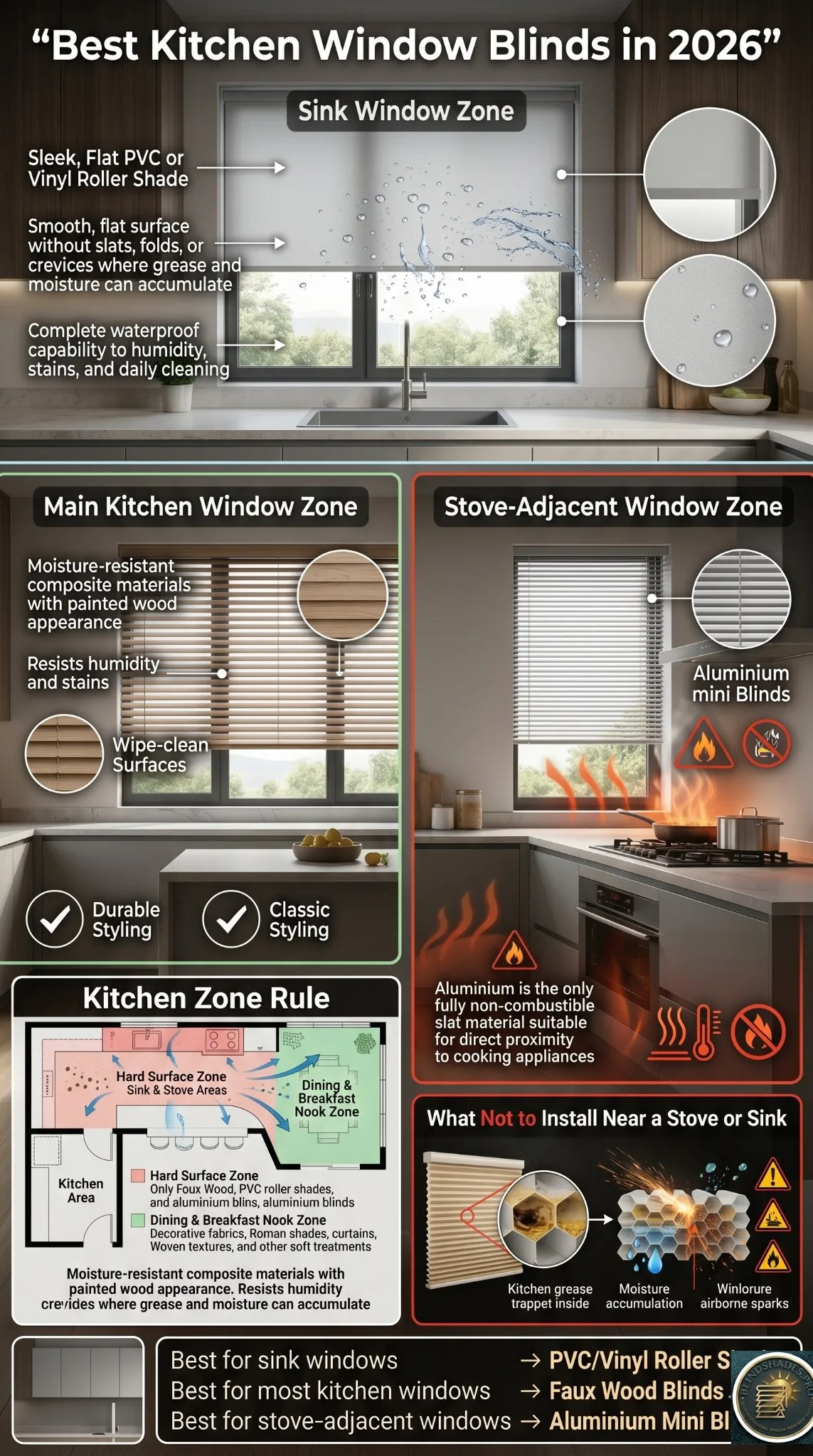
Authored by Michael Turner — 30 Years of Home Improvement Expertise | BlindShades.pro | Complete Buying Guide, Updated for 2026
The best kitchen window blinds and shades are chosen by three questions no style listicle asks: which zone of the kitchen holds the window, how the material handles airborne grease, and how you will operate a blind that sits behind a counter — with wet hands. Kitchens are the hardest room in the house on window treatments, because cooking does something no other room does: it aerosolizes oil, and that sticky film decides everything. The stable verdicts across the market agree once you see them through that lens — faux wood is the best overall (warm looks, wipes clean, laughs at sink humidity), vinyl roller shades are the easiest to clean, aluminum minis survive next to the stove, cellular insulates the breakfast nook, and Roman shades belong in the nook but never beside the cooktop, where fabric absorbs odors and splatter permanently. This guide maps the three zones, ranks every material by wipeability, solves the over-sink reach problem half the search box is asking about, and hands each style question to its dedicated deep-dive.
⭐ Quick Answer — The Best Kitchen Window Blinds & Shades
The best kitchen window blinds are chosen by zone, not style — the splash zone (sink), the heat-and-grease zone (cooktop), and the social zone (nook) each crown a different material:
- Best overall: cordless faux wood — moisture-, humidity-, and heat-resistant with the warm look of wood, the consensus pick across Blindsgalore and Blinds Chalet’s kitchen guides; the material in full is in the best faux wood blinds guide and the sink-window build in blinds for the kitchen sink window.
- Easiest to clean: vinyl/PVC roller shades — one smooth surface, no slats, damp-cloth recovery; aluminum minis take the windows closest to the stove.
- The grease rule: cooking aerosolizes oil that fabric absorbs permanently — keep Roman and cellular in the nook, and see how to clean kitchen blinds and grease for the recovery playbook.
- Over the sink: cordless lifts you can nudge with a knuckle, wand over cord (cords become grease ropes), and motorized rollers for deep-reach windows — Wirecutter’s smart-shades winner is the premium reference.
- Light strategy: light-filtering over room-darkening in almost every kitchen — tilt slats up to bounce glare off the counters, and keep the room bright.
Key Takeaways
- The kitchen is three rooms wearing one name. The splash zone (sink), the heat-and-grease zone (cooktop), and the social zone (nook and dining) punish window treatments differently — and the same Roman shade that is banned beside the range is the right answer across the room, which is why zone-first beats style-first shopping every time.
- Grease is the boss spec. Cooking aerosolizes oil that settles as a sticky film and bonds dust to it; smooth wipeable surfaces (vinyl roller, faux wood, aluminum) recover with a damp cloth, while fabric (Roman, cellular) absorbs grime and odors — the con-side sources say it plainly: Roman fabric holds moisture and stains, and cellular cells trap grime and resist deep cleaning.
- The market’s verdicts converge. Faux wood is the consensus best overall for kitchens — moisture-, humidity-, and heat-resistant with the warm look of wood — with vinyl roller shades as the easiest-clean pick and aluminum minis as the near-stove survivor; even the premium style lists and the budget forums land on the same trio for work zones.
- The over-sink window is an ergonomics problem, not a style problem. You operate it by leaning across a counter and a faucet with wet hands, which is the real case for knuckle-friendly cordless lifts, wand tilt over grease-collecting cords, top-down privacy, and motorization for the deep-reach installs — the question behind half of this search’s related terms.
- Kitchens want light, not darkness. Almost no kitchen needs room-darkening; light-filtering fabrics and tiltable slats manage glare on the work surfaces while keeping the room bright — spend the blackout budget in the bedroom instead.
Quick Specification Reference
| Spec | The short answer |
|---|---|
| The three gates | Zone (sink, stove, or nook) → Wipe (can the material be damp-cloth cleaned?) → Reach (how do you operate it behind a counter, with wet hands?) |
| Best overall material | Cordless faux wood — the market-wide verdict for moisture, heat, and wipeability with warm looks |
| Easiest to clean | Vinyl/PVC roller shades — one smooth surface, no slats, damp-cloth recovery |
| Near the cooktop | Aluminum mini blinds — heat- and moisture-proof, budget-friendly, splatter-wipeable |
| The nook answer | Cellular for insulation on sunny or drafty nooks; Roman or café styles for softness — kept away from the range |
| The fabric rule | Fabric absorbs grease and cooking odors permanently; distance from the cooktop is what makes fabric safe |
| Over-sink operation | Cordless (knuckle-operable), wand tilt over cords, top-down-bottom-up for privacy, motorized for deep reach |
| Light strategy | Light-filtering over room-darkening in almost every kitchen |
| Price band | Stock cordless options run from the low tens of dollars through custom mid-range — stated in words throughout, per our no-fabricated-prices rule |
| Store-rating snapshot | Blindsgalore 4.7 across roughly 4,600 reviews; Blinds Chalet 4.7 across roughly 1,100 — both with kitchen-specific category pages |
Read the complete guide below for: the Zone–Wipe–Reach Test that replaces style-first shopping; six verified picks; the three-zone map; the grease physics behind every cleanability claim on this market; the wipe-versus-absorb material hierarchy; the over-sink reach solution; the nook style matrix from Roman to café curtains; the light-versus-darkness call; and the where-to-buy comparison.
What Are the Best Kitchen Window Blinds & Shades? Our Picks
Six verified picks — one per job, because the kitchen is three rooms and no single blind wins all of them.
| Pick | Product / style | Zone it wins | The attributed case |
|---|---|---|---|
| Best Overall | Cordless faux wood blinds | Splash zone (and most kitchens) | The market-wide verdict: moisture-, humidity-, and heat-resistant with the warm look of real wood, called the best kitchen choice by Blinds Chalet’s April 2026 guide and the top pick in Blindsgalore’s kitchen category — with stock cordless faux at big-box rated 4.6 across roughly 120 reviews |
| Best Easy-Clean | Vinyl/PVC roller shade | Whole-kitchen workhorse | The easiest-to-clean verdict everywhere it appears — no slats, one wipeable surface; the long-running Bogleheads answer (“a vinyl roller shade is probably best”) and stock rows like LEVOLOR’s cordless vinyl rated 4.2 across roughly 631 reviews |
| Best Near the Stove | Aluminum mini blinds | Heat-and-grease zone | The durability pick for windows close to a cooking surface: heat- and moisture-proof, budget-friendly, and fully wipeable slat by slat |
| Best Nook Insulation | Cellular/honeycomb shade | Social zone (sunny or drafty nooks) | The temperature-control pick — per 3 Day Blinds (December 2025), excellent insulation for rooms with temperature swings; SelectBlinds’ honeycomb line carries a 4.7 across roughly 2,600 reviews |
| Best Soft Style | Cordless Roman shade — away from the cooktop | Social zone | The nook-and-dining pick with the caveat every honest source states: fabric absorbs cooking odors and splatter, so distance is the spec; Arlo’s cordless room-darkening Roman carries a 4.6 across roughly 1,100 reviews |
| Best Smart / Deep Reach | Lutron Serena smart roller | The unreachable window | Wirecutter’s smart-shades winner (May 8, 2026): premium build, ultra-quiet motors, straightforward automations — the engineering answer when the window sits beyond the counter’s reach |
Read the table as a zone map, not a ranking: most kitchens deploy two or three of these at once — faux wood over the sink, aluminum beside the range, something soft in the nook. The full product-level treatment of each style lives in its own guide: the faux verdict traces to the best faux wood blinds guide (where the material’s Three-W Test was built for exactly these rooms), rollers to the best roller shades guide, minis to the best mini blinds guide, cellular to the cellular and honeycomb shades guide, and Roman to the best Roman shades guide. And for the fastest possible answer — picks only, no architecture — our short-form spoke best blinds for kitchen windows stays the quick list; this page is the room-level decision.
How Do You Choose Kitchen Blinds? The Zone–Wipe–Reach Test
Three gates in order: which zone holds the window, whether the material wipes or absorbs, and how your wet hands will actually operate it.
| Gate | The question | What the answer decides |
|---|---|---|
| Zone | Is the window in the splash zone (sink), the heat-and-grease zone (cooktop), or the social zone (nook/dining)? | The material shortlist — humidity rules the sink, aerosolized oil and heat rule the stove, comfort and style rule the nook |
| Wipe | Does the surface recover with a damp cloth, or does it absorb? | Smooth and sealed (vinyl, faux wood, aluminum) belong in work zones; porous fabric (Roman, cellular, woven wood) survives only at distance |
| Reach | How is the blind operated — across a counter, over a faucet, with wet or floury hands? | Cordless over corded, wand over cord, top-down for privacy, motorized for the deep-reach window |
The gates exist because the kitchen’s failures are all gate-skips wearing style choices. The forums are full of them: the gorgeous Roman hung beside the range that smelled like every dinner within a season (a Zone miss the AI answer itself now warns about), the white cellular over the sink whose honeycomb cells trapped grime beyond deep-cleaning (a Wipe miss the con-side sources document), and the corded blind over the sink whose cord turned into a grease rope from a year of wet-hand tugs (a Reach miss nobody warns about — we will, below). Google’s answer for this exact search ends by asking three questions it cannot answer for you — where is the window, what is your budget, light-filtering or room-darkening — and the first is the Zone gate verbatim, while the third gets its own honest section later in this guide. Run the gates in order; the rest of the page arms each one.
Which Zone Is Your Window In? The Three-Zone Kitchen Map
One room, three environments — and the same treatment can be the best and worst answer twelve feet apart.
| Zone | The hazards | Banned or risky | Best answers |
|---|---|---|---|
| Splash zone — the sink window | Water splash, steam, constant humidity swings, wet-hand operation | Real wood (warps, peels), unsealed woven woods | Faux wood (the classic over-sink answer), vinyl roller, aluminum mini — cordless in all cases; the dedicated build is in blinds for the kitchen sink window |
| Heat-and-grease zone — beside the cooktop | Aerosolized oil, radiant heat, splatter, steam | All fabric (Roman, cellular, curtains) — absorbs oil and odor; vinyl too close to high heat can soften | Aluminum mini first, faux wood second at modest distance; the full treatment is in kitchen window treatments near the stove |
| Social zone — nook and dining | Sun, drafts, breakfast glare — the hazards of a living room, not a kitchen | Nothing banned; grease rules relax with distance | Cellular for insulation (cellular shades for kitchen windows), Roman for softness (Roman shades in the kitchen), café styles for charm |
Two edge cases complete the map. First, the real-wood question: timber’s warm look tempts every kitchen renovator, and the honest answer is that it survives only in the social zone of a well-ventilated kitchen, far from sink steam and cooktop aerosol — the full case, including when it genuinely works, is in real wood blinds in the kitchen. Second, ventilation moves the boundaries: a powerful vented range hood shrinks the grease zone dramatically, while a recirculating hood barely moves it — worth knowing before you put fabric anywhere near a cooking wall.
Why Is Kitchen Grime Different? The Grease Physics
Cooking does something no other room does: it puts oil in the air — and that one fact writes every cleanability rule on this market.
Here is the mechanism the listicles assert but never explain. Heat a pan past sizzle and some of the fat aerosolizes — microscopic oil droplets ride the warm air rising off the cooktop, drift on kitchen currents, and settle on every surface in range as an invisible, tacky film. That film then does two things ordinary dust never does: it bonds incoming dust into a composite grime that dry dusting cannot remove, and it wicks into any porous surface it lands on, carrying odor compounds with it. That is the entire science behind the market’s converging verdicts — why the con-side sources report that Roman fabric holds moisture and stains while cellular honeycombs trap grime beyond deep-cleaning, why the AI answer warns against Roman beside the cooktop where it absorbs odors and splatter, and why the budget forums’ standing answer is that a vinyl roller shade cleans best, followed by faux wood and metal slats.
The practical consequences, in order of usefulness:
The wipe test is really a porosity test. Sealed, smooth surfaces — PVC roller fabric, painted faux wood, coated aluminum — hold the grease film on top, where a damp cloth with a drop of dish soap lifts it completely. Porous surfaces — woven fabric, honeycomb cells, unsealed wood grain, cord fibers — drink it in, and once oil is inside a fiber, no household cleaning gets it all back out. This is also the quiet argument against corded lifts in work zones: an operating cord handled daily with cooking-adjacent hands becomes a grease-and-grime rope, and unlike a slat, it cannot be wiped clean. The zone-by-zone cleaning playbook — products, technique, and the slat-by-slat method for saving a greasy blind — lives in how to clean kitchen blinds and grease, and the odor half of the story, including which materials release smells and which hold them forever, is in kitchen blinds and cooking smells.
Distance is the fabric permit. Aerosol density falls off quickly with distance from the pan — which is why the ban on fabric is a cooking-wall rule, not a kitchen-wide rule, and why the same Roman shade that would ruin beside the range lives happily over a breakfast nook across the room. If you can regularly feel cooking warmth or smell yesterday’s dinner at the window, it is in the grease zone; if not, the social-zone rules apply.
Which Materials Wipe Clean — and Which Never Recover?
The cleanability hierarchy, from damp-cloth heroes to permanent-odor sponges.
| Material | Wipe verdict | The record |
|---|---|---|
| Vinyl/PVC roller shade | The champion — one smooth surface, no slats, full recovery | The easiest-clean pick across the AI answer, the sellers, and the forums alike |
| Faux wood blinds | Excellent — sealed slats wipe clean one by one | The best-overall consensus: moisture-, humidity-, and heat-resistant per Blinds Chalet’s 2026 guide; the material’s full physics live in our faux wood hub |
| Aluminum mini blinds | Excellent — nonporous metal, splatter-proof | The near-stove durability pick |
| Real wood blinds | Conditional — sealed finishes wipe, but humidity attacks the wood itself | Social-zone only |
| Woven wood / bamboo | Poor in work zones — textured and porous | Nook charm, grease-zone liability |
| Cellular/honeycomb | Poor near cooking — the cells trap grime and are hard to deep clean per Bringnox (February 2026) | Brilliant insulation, so deploy it at distance |
| Roman and fabric shades | Poorest near cooking — fabric holds moisture, stains, and odors | The social-zone specialist with a cooking-wall ban |
| Café curtains | Fabric rules apply — but they are machine-washable, which changes the math | The one fabric that can take a spin cycle; the head-to-head is in café curtains vs blinds in the kitchen |
One row deserves the expansion: café curtains are the loophole in the fabric ban. Because they hang from a simple rod, they come down in seconds and go through the washing machine — the only kitchen treatment where “absorbs grime” has a full reset button. They cover the lower sash only (privacy at eye level, light above — the same geometry logic as a top-down shade), suit cottage and century-home kitchens the style forums adore, and cost less than anything else on this page. Their limits are real too: no insulation, partial coverage, and a style commitment. The full comparison against hard treatments is linked above.
What About the Window Over the Sink? The Reach Problem
Half of this search’s related terms are one question: how do you live with a window you can only touch by leaning across a counter?
The over-sink window is the kitchen’s signature installation and its worst ergonomics. It sits a full counter-depth away, often behind a faucet, and every interaction happens mid-task — with wet, soapy, or floury hands. That reality, not style, should pick the operating system:
| Operation | Over-sink verdict | Why |
|---|---|---|
| Cordless lift | The default | A bottom rail you can nudge with a knuckle or wrist, no dangling parts, nothing to grip with dirty hands |
| Wand tilt (slatted blinds) | Yes — always over cords | A rigid wand is wipeable and one-handed; a cord loop handled daily near cooking becomes an uncleanable grease rope |
| Corded lift | Avoid here | The grease-rope problem plus the child-safety direction of the whole market |
| Top-down-bottom-up | The privacy upgrade | Drop the top for sky light while the band covers counter-level sightlines — the full geometry is in our top down bottom up shades guide |
| Motorized | The deep-reach answer | When the window sits beyond safe lean — behind deep counters, over cooktop islands, or high — a quiet motor ends the stretch entirely; Wirecutter’s May 2026 smart-shades winner (Lutron Serena) is the premium reference, and the kitchen-specific build is in motorized blinds for kitchen windows |
Two details complete the over-sink spec. Mount matters: an outside mount that clears the faucet’s swing arc saves both the blind and your patience — measure the faucet at full tilt before ordering, a step the generic measuring guides skip. And material meets reach here: this window lives in the splash zone, so the knuckle-friendly cordless lift should be hanging faux wood, vinyl, or aluminum — the wipeable trio — completing both gates at once. The route, power, and protocol decisions behind motorizing (battery vs wired, remote vs app) are mapped room-agnostically in the motorized and smart blinds guide.
Which Styles Fit a Breakfast Nook or Dining Area?
The social zone is where the kitchen gets to be a living room — style returns, with two practical footnotes.
Away from the cooking wall, the hazard list shrinks to sunlight, drafts, and breakfast glare, and the style vocabulary opens accordingly. The premium style lists lean soft here — Hunter Douglas’s kitchen top five runs cellular, modern Roman, sheer shadings, woven wood, and faux wood/shutters, a list that only makes sense once you realize it is describing the social zone — and the design blogs agree that color enters the kitchen most easily through a roller or Roman in a vibrant fabric (Joey’z Shopping, June 2026). The nook decision tree:
| Nook priority | The style answer | The footnote |
|---|---|---|
| Temperature — sunny or drafty nook | Cellular/honeycomb | The insulation pick per 3 Day Blinds; single-vs-double cell and the full fabric family live in the cellular hub |
| Softness and color | Cordless Roman in a washfast fabric | The style forums’ favorite — practical and gorgeous — with the distance rule already satisfied by the nook itself |
| Cottage and century-home charm | Café curtains | Machine-washable and cheap; the trade-offs are in the café-curtains comparison linked above |
| Natural texture | Woven wood/bamboo | Beautiful at distance; porous, so keep it out of the work zones |
| Morning glare on the table | Light-filtering roller, or top-down anything | Glare control without losing the garden view |
The one mistake to avoid in the social zone is importing bedroom logic: heavy, lined, room-darkening treatments that fight what a breakfast nook is for. Which raises the third of Google’s three questions — and it deserves a straight answer.
Related guides: alcove and sink windows are rarely stock sizes — the measuring protocol, maker tiers, and the deduction question that prevents remakes are all in the complete made to measure blinds guide.
Do You Need Light Filtering or Room Darkening in a Kitchen?
Almost always light filtering — and a guide that tells you not to buy the expensive upgrade is one you can trust.
| Situation | The call |
|---|---|
| Standard kitchen, any orientation | Light-filtering or tiltable slats — kitchens are daylight rooms; manage glare, keep brightness |
| Harsh western sun on work surfaces | Tiltable slats (faux, aluminum) or a denser light-filtering roller — angle the light, don’t kill it |
| East-facing breakfast nook | Light-filtering cellular or top-down — soften sunrise without dimming breakfast |
| Street-facing sink window, privacy concern | Top-down-bottom-up, café curtains, or a light-filtering fabric — privacy at counter level, light above |
| Open-plan kitchen bleeding into a media area | The one honest room-darkening case — and even then, darken the media windows, not the kitchen’s |
Room-darkening and blackout builds cost more per window, and in a kitchen that premium buys a problem: dim work surfaces and a cave where you handle knives. The tiltable-slat styles this guide already recommends for the work zones (faux wood, aluminum) are also the best glare tools — angle the slats up and the light bounces to the ceiling, off your cutting board and out of your eyes. Households that genuinely need darkness somewhere should spend that budget where it pays, and our blackout coverage handles those rooms; the kitchen’s job is light.
Where Is the Best Place to Buy Kitchen Blinds & Shades?
The kitchen is a stock-friendly room — most of its windows are standard, and the wipeable materials are the cheap ones.
| Channel | The record | Wins when |
|---|---|---|
| Custom online — kitchen category pages | Blindsgalore’s kitchen page (4.7 across roughly 4,600 store reviews, thirty-day returns) leads with faux wood and roller as top picks; Blinds Chalet’s kitchen page (4.7 across roughly 1,100, thirty-day returns) builds around easy cleaning and moisture resistance | Odd sizes, exact-fit over-sink installs, cordless and top-down upgrades |
| Big-box stock | The rated stock rows on this market: cordless faux wood at 4.6 (roughly 120 reviews), LEVOLOR cordless vinyl at 4.2 (roughly 631), plus flat-pack rollers like IKEA’s at 4.2 (roughly 958) | Standard windows, weekend timelines, rental refreshes |
| Marketplace / brand stock | SelectBlinds honeycomb 4.7 (roughly 2,600), Arlo cordless Roman 4.6 (roughly 1,100), Chicology Roman 4.2 (roughly 692) | Nook styles and cellular at stock prices |
| Premium dealer | Hunter Douglas’s kitchen top five for the design-led social zone | Designer fabrics, complex installs |
| Smart | Lutron Serena via Wirecutter’s May 2026 verdict | The deep-reach and automation cases |
The channel logic for this room is refreshingly simple: work-zone treatments (faux, vinyl roller, aluminum) are inexpensive materials in mostly standard sizes, so stock and marketplace routes cover them well — save the custom channel for the over-sink window where an exact fit around the faucet arc earns its premium, and for top-down or motorized builds. Order fabric and finish samples for anything in the social zone; and whichever channel you choose, the spec sheet from this guide travels with you — zone, wipeable material, cordless or wand, light-filtering.
Related guides: rental kitchen? Every no-screw mounting route — and the frame check that keeps them up — is in the complete guide to no drill blinds.
Supporting Articles in This Cluster
- Best Blinds for Kitchen Windows — the quick-picks list
- Blinds for the Kitchen Sink Window
- Kitchen Window Treatments Near the Stove
- Kitchen Blinds and Cooking Smells
- How to Clean Kitchen Blinds and Grease
- Roman Shades in the Kitchen
- Cellular Shades for Kitchen Windows
- Café Curtains vs Blinds in the Kitchen
- Motorized Blinds for Kitchen Windows
- Real Wood Blinds in the Kitchen
Related Buying Guides
- The Best Faux Wood Blinds Buying Guide — this room’s best-overall material, in full
- The Best Roller Shades Buying Guide
- The Best Cellular & Honeycomb Shades Buying Guide
- The Best Roman Shades Buying Guide
- The Best Mini Blinds Buying Guide
- The Best Top Down Bottom Up Shades Buying Guide
- The Best Bathroom Window Blinds & Shades Buying Guide — the other wet room
Frequently Asked Questions
What are the best kitchen window blinds overall?
Cordless faux wood blinds are the market-wide best-overall verdict — they carry the warm look of real wood while resisting the moisture, humidity, and heat that define kitchen windows, and their sealed slats wipe clean of grease film with a damp cloth. Vinyl/PVC roller shades are the easiest-clean alternative (one smooth surface, no slats), and aluminum mini blinds take over for windows very close to a cooking surface. The right pick depends on the zone: sink windows want the wipeable trio, cooktop-adjacent windows want aluminum or faux at distance, and breakfast nooks open up to cellular, Roman, and café styles.
What blinds are best over the kitchen sink?
Cordless faux wood is the classic over-sink answer: waterproof against splash and steam, wipeable, and operable with a knuckle when your hands are wet. The over-sink spec is as much ergonomics as material — choose a cordless lift or wand tilt (never a cord, which turns into an uncleanable grease rope with daily wet-hand use), mount clear of the faucet’s swing arc, and consider a top-down-bottom-up build for counter-level privacy with sky light above. For windows beyond safe reach, quiet motorized rollers end the lean-and-stretch entirely.
Are Roman shades OK in a kitchen?
Yes — in the right zone. Fabric absorbs aerosolized cooking oil and odors permanently, so Roman shades are banned beside the cooktop; but aerosol density falls off quickly with distance, which is why the same shade is a lovely, safe choice over a breakfast nook or dining window across the room. Choose a washfast fabric, keep it off the cooking wall, and if you want fabric charm with a full reset button, café curtains are the loophole — they come off the rod and go through the washing machine.
How do you keep kitchen blinds clean?
Match the material to the mess first: sealed surfaces (vinyl roller, faux wood, aluminum) hold grease film on top where a damp cloth with a drop of dish soap lifts it; porous surfaces (fabric, honeycomb cells, wood grain, cords) absorb it beyond household recovery. Then clean little and often — the grease film bonds dust over time, so a monthly two-minute wipe beats an annual rescue mission. Slatted blinds clean fastest closed flat, one pass per side. Fabric in the social zone needs only regular dusting, since distance keeps the oil off it.
Should kitchen blinds be light filtering or blackout?
Light filtering, almost without exception. Kitchens are daylight workrooms — room-darkening builds cost more and buy dim counters and glare-free gloom nobody wants at breakfast. Manage glare instead: tiltable slats (faux wood, aluminum) bounce harsh sun to the ceiling and off your work surfaces, and light-filtering rollers or cellular soften a bright nook without dimming it. Save the blackout budget for bedrooms and media rooms, where it actually pays.
What is the most popular style of kitchen blinds?
Faux wood leads the work zones and the overall market — it tops the seller verdicts and the AI answer alike — with vinyl rollers as the easy-clean runner-up and cellular shades leading the nook for insulation. Style-first lists from the premium dealers add modern Roman, sheer shadings, and woven wood, all of which belong to the social zone. In practice the most popular kitchen is a mix: wipeable slats at the sink and stove, something soft and colorful where the family actually sits.
By Michael Turner | 30 Years Home Improvement Expertise | Updated 2026 | BlindShades.pro
