Do Kitchen Window Blinds Absorb Cooking Smells

Authored By Michael Turner -30 Years Home Improvement Expertise | Updated 2026 | BlindShades.pro
Updated on July 14, 2026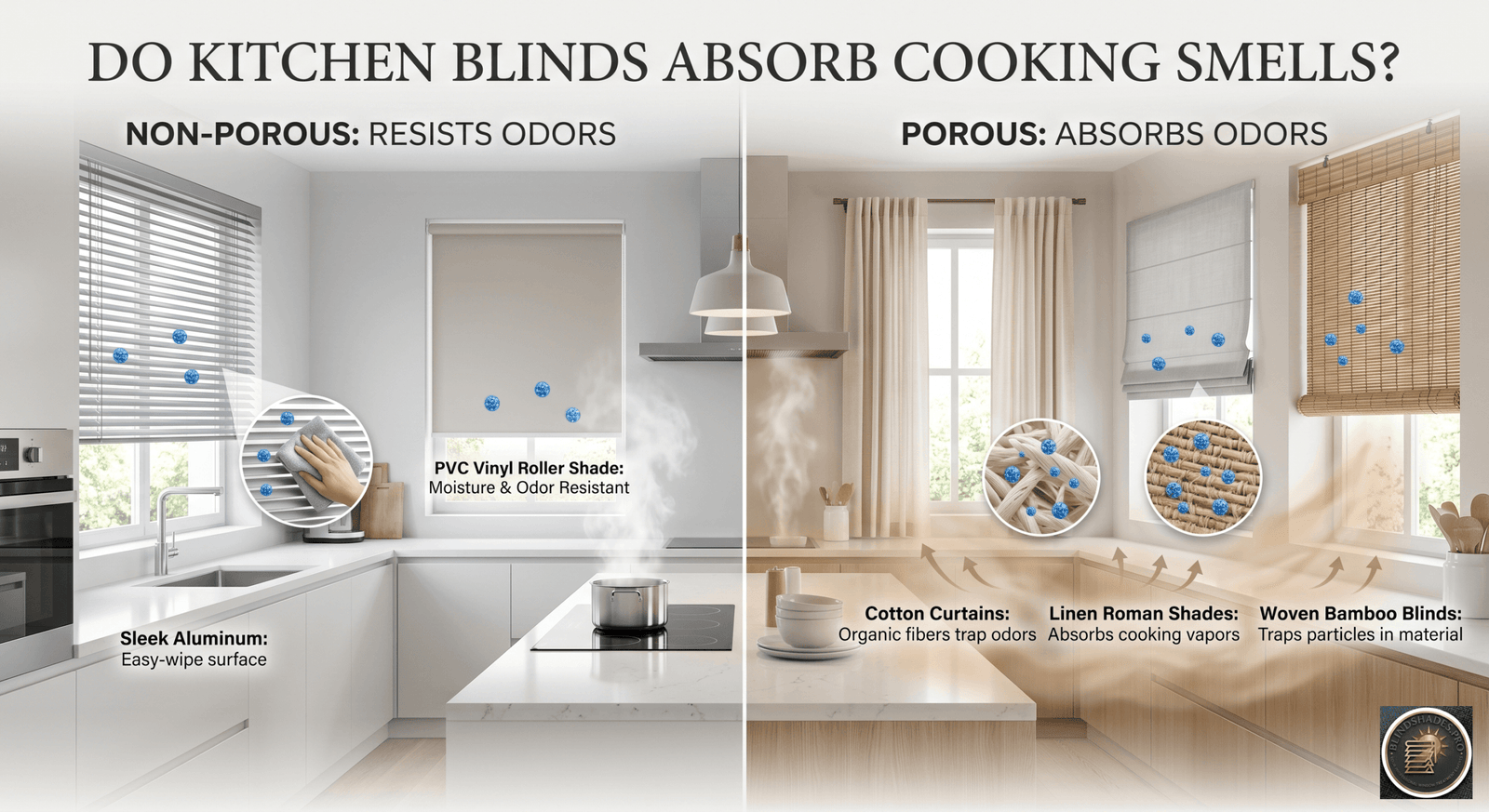
⭐ Quick Answer — Do Kitchen Window Blinds Absorb Cooking Smells?
- The Material Decides — Not the Ventilation: Whether kitchen blinds absorb cooking smells depends entirely on the blind material. Aluminium and PVC vinyl: zero odour retention — no molecular pore structure; cooking VOC molecules land on the surface and evaporate or wipe off. Cotton and linen: permanent odour absorption — cooking aldehydes, sulfur compounds, and terpenes diffuse into the hollow porous fibre interior through molecular diffusion; surface cleaning cannot reach them. Standard polyester: moderate — surface absorption, partially reducible by machine washing. Natural bamboo/woven wood: highest — organic fibres with maximum porosity
- Why the Smell Returns After You’ve Aired the Kitchen: Kitchen blinds with fabric construction act as VOC reservoirs. During cooking, the blind absorbs volatile organic compounds from the high-concentration kitchen air. After cooking ends and the kitchen is ventilated, the air VOC concentration drops — but the fabric still contains its absorbed load. The concentration gradient reverses: the fabric now releases VOCs back into the room through the same diffusion mechanism. This VOC off-gassing continues for hours after cooking ends. With each cooking session, more VOCs accumulate until the fabric reaches saturation — a permanent background cooking smell the kitchen cannot be aired clear of
- Which Cooking Creates the Most Smell in Blinds: Highest VOC production (fastest blind odour saturation): deep frying in oil, fish cooking (trimethylamine), curry and spice cooking (terpenes and aldehydes), brassica cooking (sulfur compounds). Medium: meat roasting, garlic and onion. Lowest: steaming, boiling, microwaving. A household that primarily steams and boils with minimal frying can expect a treated polyester Zone K3 blind to remain acceptable for significantly longer than a deep-frying, fish-cooking household
- Steam Cleaning: Works on Polyester, Fails on Cotton: Steam cleaning at 100°C+ off-gasses VOCs from the outer layer of polyester fabric — surface-deposited VOCs evaporate under heat, meaningfully reducing odour. For cotton and linen blinds: steam penetration is insufficient to reach VOCs absorbed inside the hollow fibre interior. The surface odour improves temporarily but the interior off-gassing resumes as the fabric cools. For cotton kitchen blinds with persistent cooking smell: replacement, not cleaning, is the effective solution
- New PVC Blind Smell Is Different — Dissipates in 2–4 Weeks: New PVC vinyl and faux wood blinds have a distinct chemical smell from manufacturing plasticiser off-gassing. This is not cooking odour absorption — it is manufacturing residue that dissipates completely in 2–4 weeks with ventilation. To accelerate: unpack and ventilate the blind in a well-aired room for 48–72 hours before installation. The chemical smell will disappear permanently — unlike cooking odour absorption in fabric blinds which is cumulative and permanent
- Best Sources: PVC vinyl zero-odour kitchen range → Blindsgalore kitchen range · Kitchen blind odour and material guide → English Blinds roller blind kitchen guide · Full material survival guide → DotcomBlinds kitchen chaos guide
⚠️ The Odour Retention Ranking and the Ducted Hood Factor: The full kitchen blinds cooking smells ranking from lowest to highest retention: (1) Baked enamel aluminium — zero (inorganic metal, no pores); (2) PVC vinyl roller — near-zero (thermoplastic, no pores); (3) PVC composite faux wood — very low (outer PVC surface); (4) Moisture-treated polyester — low (hydrophobic coating reduces VOC surface adhesion); (5) Standard polyester — moderate (synthetic fibre, partial surface absorption); (6) Cotton/linen — high (hollow cellulosic fibres absorb permanently); (7) Natural bamboo/woven wood — highest (organic fibres, maximum porosity). And the ventilation factor: a ducted external extraction range hood rated at 300+ CFM captures cooking VOCs at source before they disperse into the kitchen air and deposit on blind fabric — significantly extending the life of any Zone K3 fabric blind. A recirculating hood returns VOCs to the kitchen and provides minimal benefit. Open windows during cooking combined with a ducted hood provides the best protection for fabric blinds. For the full zone-by-zone specification including odour-free material recommendations, see What Are the Best Blinds for Kitchen Windows. See the full VOC off-gassing mechanism below.
💡 Activated Charcoal and Zeolite Fabrics — the Advanced Specification for High-Odour Kitchens: For kitchens where fabric window treatment aesthetics are important but odour resistance is critical — households that deep fry regularly, cook fish frequently, or make strong curries — activated charcoal-infused or zeolite-treated fabric provides significantly better odour performance than standard polyester kitchen blind fabric. Activated charcoal and zeolites have extremely high internal surface area (thousands of square metres per gram of material). Cooking smell VOC molecules entering the fabric are captured in the microporous charcoal or zeolite structure rather than diffusing into fibre interiors — the fabric captures VOCs rather than absorbing and re-releasing them. The charcoal/zeolite eventually saturates but can be partially regenerated by placing the blind in direct sunlight for several hours (UV energy and elevated temperature drive the adsorbed VOCs out of the micropores). This specification is niche but available from specialist fabric blind suppliers for households where cooking odour in blinds is a genuine ongoing problem. For the Roman shades equivalent and the cotton vs polyester fibre mechanism detail, see Can You Use Roman Shades in a Kitchen. See the full charcoal fabric specification below.
📖 Read the complete guide below for: the VOC chemistry of cooking odours (aldehydes, ketones, terpenes, sulfur compounds, trimethylamine) and why they permanently diffuse into hollow cotton fibres but not non-porous PVC, the full odour retention ranking by material (aluminium zero to natural bamboo highest), the cooking type VOC production guide (deep fry and fish highest, steaming lowest), the off-gassing reservoir mechanism that releases cooking smell back into the kitchen after cooking ends, the ventilation factor and ducted vs recirculating hood effect, the new PVC blind chemical smell distinction (manufacturing off-gassing vs cooking absorption), the steam cleaning effectiveness assessment by fabric type, and the activated charcoal and zeolite fabric specification for high-odour cooking households.
Kitchen Blinds Cooking Smells – The Material Absorption Guide
Definition: Cooking odour absorption in kitchen blinds is the process by which volatile organic compound (VOC) molecules produced during cooking penetrate into the molecular pore structure of porous blind materials and become bonded to or trapped within the fibre interior.
The chemistry behind why some blinds hold cooking smells:
Cooking odours are not simple airborne particles – they are volatile organic compounds. The primary VOC classes produced during kitchen cooking include:
- Aldehydes: produced when fats and oils are heated, particularly in frying; the primary source of cooking grease smell
- Ketones: produced during browning (Maillard reaction) of proteins; bread, meat, roasted vegetables
- Terpenes: from herbs, spices, and citrus; aromatic cooking
- Sulfur compounds (thiols, allyl sulfides): from alliums (garlic, onion) and brassicas (cabbage, broccoli); the most persistent cooking odours
- Trimethylamine: from fish; one of the most penetrating cooking odours
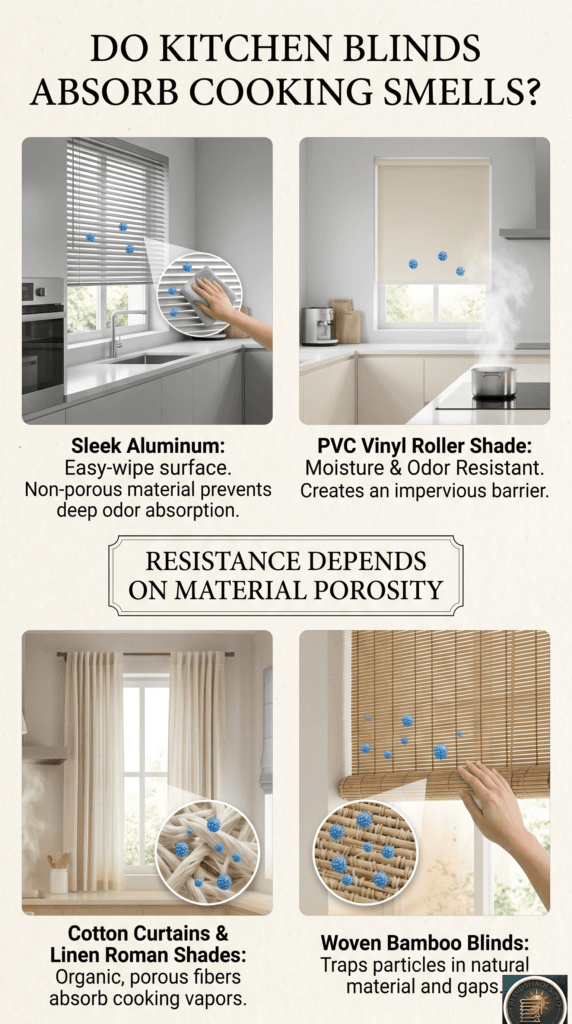
Why porous fibres absorb these compounds permanently: Cotton, linen, and natural fibre blind fabrics are composed of hollow cellulosic tubes. VOC molecules are small enough to enter these hollow tubes through molecular diffusion. Once inside the fibre interior, the VOC molecules bond to the cellulose fibre wall through Van der Waals forces – weak but cumulative molecular attraction. This bonded-in-fibre VOC cannot be removed by surface wiping because the cleaning agent is on the outside of the fibre tube, not inside it.
Why non-porous surfaces do not absorb these compounds: PVC vinyl and aluminium have no molecular pore structure. VOC molecules that land on a PVC vinyl surface find no entry point into the material. They sit on the surface and are removed either by natural evaporation or by surface wiping with a damp cloth.
The Odour Retention Ranking by Blind Material
No competitor guide ranks blind materials by odour retention. This is the practical specification guide for kitchens where cooking smell management is a priority.
| Rank | Material | Odour Retention | Why | Kitchen Zones |
|---|---|---|---|---|
| 1 (zero) | Baked enamel aluminium | Zero | Inorganic metal; no molecular pore structure; VOCs evaporate from smooth metal surface | All zones (K1-K4) |
| 2 (near-zero) | PVC vinyl roller shade | Near-zero | Thermoplastic polymer; no molecular pores; VOCs surface-deposit and wipe off | All zones (K1-K4) |
| 3 (very low) | PVC composite faux wood | Very low | Outer PVC surface; negligible absorption; some wood fibre content in composite may absorb marginally | Zone K1-K4 |
| 4 (low) | Moisture-treated polyester | Low | Hydrophobic coating reduces surface VOC adhesion; some diffusion through coating over time | Zone K3 acceptable |
| 5 (moderate) | Standard polyester fabric | Moderate | Synthetic non-hollow fibres; surface absorption; machine washing removes most but not all VOCs | Zone K3 only |
| 6 (high) | Cotton / linen | High | Hollow cellulosic fibres; VOCs diffuse into fibre interior; permanent absorption; washing partially effective | Not recommended near cooking |
| 7 (highest) | Natural woven bamboo / wood | Highest | Organic fibres; highest natural porosity; absorb both VOCs and grease molecules; no effective cleaning | Zone K3 only (accept replacement) |
The Off-Gassing Mechanism – Why the Smell Returns After Cooking Ends
This is the odour retention mechanism that explains a common kitchen experience: the smell of last night’s cooking still in the kitchen the next morning.
Standard explanation from all guides: “Fabric blinds trap cooking smells.”
The accurate mechanism:
When cooking occurs, VOC molecules at elevated concentration in the kitchen air deposit on all surfaces – including blind fabric – through a process driven by the concentration gradient between the kitchen air and the blind fabric surface. The blind absorbs VOCs because the air concentration is higher than the fabric concentration.
After cooking ends and the kitchen is ventilated: the kitchen air VOC concentration drops (the source is gone). But the fabric still contains the VOCs absorbed during cooking. Now the concentration gradient reverses: the fabric has a higher VOC concentration than the cleaned kitchen air.
The fabric then slowly releases the absorbed VOCs back into the kitchen air through the same concentration-driven diffusion – but now in reverse. This slow release is called VOC off-gassing from the fabric, and it continues until the concentration equilibrium is re-established.
The practical result: A fabric blind acts as a VOC buffer and reservoir. During cooking it absorbs odours; after cooking it releases them back. This is why cooking smells persist in a fabric-blind kitchen long after the kitchen has been aired. The blind is not simply “holding” the smell – it is actively releasing it back into the room.
With each cooking session, more VOCs are absorbed into the fabric. Over months, the fabric reaches a saturation point where it holds a permanent background level of VOCs – and the kitchen has a persistent background cooking smell that cannot be eliminated by ventilation alone.
The Cooking Type Factor – Which Foods Most Affect Kitchen Blinds
All guides say “fish and curry are worst.” None quantify the difference by cooking type or provide an actionable guide.
High VOC production (fastest blind odour absorption):
- Deep frying in oil: acrolein and C6-C9 aldehydes at high concentration; the most aggressive cooking VOCs for blind fabric absorption
- Fish cooking: trimethylamine (the fishy smell compound) is highly persistent in porous fabrics; fish-smell cotton blinds cannot be effectively cleaned
- Curry and spice cooking: terpene and aldehyde compounds from heating spices; highly penetrating and persistent
- Brassica cooking (cabbage, broccoli): volatile sulfur compounds; highly distinctive persistent odour in fabrics
Medium VOC production:
- Meat roasting: Maillard reaction aldehydes; persistent but less severe than frying or fish
- Onion and garlic cooking: allyl sulfides; moderate persistence; machine washing reduces significantly
- Bread baking: mostly pleasant diacetyl and furaneol; low persistence, generally acceptable in fabric blinds
Low VOC production (slowest blind odour impact):
- Steaming vegetables: primarily water steam with trace VOCs
- Boiling pasta or rice: minimal VOC production
- Microwave reheating: contained cooking; minimal VOC dispersal
The practical implication: A household that primarily steams and boils with occasional roasting and minimal frying can reasonably use a treated polyester fabric blind in Zone K3 and expect several years of acceptable performance. A household that deep fries, cooks fish, or makes strong curries regularly will experience fabric blind odour saturation significantly faster – within 6-12 months in Zone K3.
For the full material specification by cooking activity and zone, see What Are the Best Blinds for Kitchen Windows.
The Ventilation Factor – How Kitchen Ventilation Changes the Timeline
A critical variable that determines how quickly kitchen blinds absorb cooking smells – absent from all competitor guides.
VOC deposition on blind fabric is driven by the VOC concentration in the kitchen air. Anything that reduces the kitchen air VOC concentration during cooking reduces the rate at which VOCs are absorbed by blind fabric.
Ducted range hood (external extraction, 300+ CFM): A properly rated ducted hood captures cooking VOCs at source – at the point where they leave the cooking surface – before they disperse into the kitchen air. With an effective ducted hood:
- Kitchen air VOC concentration during cooking is significantly lower
- The concentration gradient between air and blind fabric is lower
- Blind fabric absorbs VOCs more slowly
- The effective lifespan of a Zone K3 fabric blind before odour saturation is extended meaningfully
Recirculating range hood: Filters cooking particles and returns air to the kitchen. VOCs pass through the charcoal filter partially, but a significant fraction is returned to the kitchen air. Provides some benefit over no hood but does not eliminate the VOC concentration problem.
Cross-ventilation (windows open, trickle vents): Dilutes kitchen air VOC concentration with outside air during cooking. Combined with a ducted hood, significantly extends fabric blind life. Window opening during cooking is the most effective low-cost protection for Zone K3 fabric blinds.
No ventilation: VOC concentration in kitchen air reaches maximum levels; blind fabric absorbs at maximum rate; odour saturation of fabric blinds occurs most rapidly.
The New Blind Chemical Smell – A Different Problem From Cooking Odour
This is a completely distinct issue that is confused with cooking odour absorption in consumer complaints – and no guide addresses the distinction.
The “new blind” chemical smell: New PVC vinyl roller shades and faux wood blinds often have a noticeable chemical smell when first unpacked and installed. This is NOT related to cooking odour absorption. It is the off-gassing of:
- Residual plasticiser compounds (phthalates or alternative plasticisers) from PVC manufacturing
- Polymer processing residues from the extrusion process
- Anti-microbial or anti-static treatment chemicals applied during manufacturing
Why this is important: A homeowner who installs new PVC vinyl blinds in a kitchen and immediately starts cooking may blame the “smell” on cooking odour absorption – when in fact the smell is manufacturing residue off-gassing, which will dissipate completely within 2-4 weeks regardless of cooking activity.
To accelerate off-gassing of new PVC blinds:
- Unpack and unroll new blinds in a well-ventilated room before installation
- Leave in ventilated space for 48-72 hours before kitchen installation
- After installation, ventilate the kitchen well for 1-2 weeks
- The chemical smell will dissipate entirely and will not return – unlike cooking odour absorption, which is cumulative and permanent in fabric materials
Steam Cleaning Assessment for Smelly Kitchen Blinds
Bloomin’ Blinds recommends steam cleaning for smelly curtains and blinds. For kitchen fabric blinds specifically, the assessment is more nuanced.
Steam cleaning mechanism: High-temperature steam (100+ degrees Celsius) applied to fabric surface heats the fibres rapidly. This heat causes VOCs in the outer fibre layer to off-gas rapidly from the fabric surface – temporarily reducing surface odour. Steam cleaning physically penetrates the fabric face to a depth of approximately 1-2 millimetres.
Effectiveness by fabric type:
Standard polyester fabric blind (surface odour): Steam cleaning is moderately effective. Polyester fibre does not have a hollow interior – VOCs are primarily surface-deposited rather than fibre-interior absorbed. Steam heating off-gases the surface-deposited VOCs and reduces odour meaningfully. Multiple steam cleaning sessions can extend the useful life of a Zone K3 polyester fabric blind.
Cotton or linen fabric blind (absorbed interior odour): Steam cleaning has limited effectiveness. The VOCs in cotton and linen are absorbed inside the hollow fibre interior – steam at 100 degrees Celsius penetrates the fibre surface but does not effectively reach the VOC molecules bonded inside the fibre tube. Steam cleaning reduces surface odour temporarily, but the deeply absorbed fibre interior VOCs continue to off-gas after the steam treatment ends. The cotton blind smells improved for a few days then returns to its baseline persistent odour.
The honest assessment: Steam cleaning is worth attempting on polyester kitchen blinds with developing odour. For cotton or linen kitchen blinds with persistent odour: steam cleaning provides temporary improvement only; replacement is the more effective long-term solution.
The Activated Charcoal and Zeolite Fabric Option
No competitor guide mentions this specification, yet it is the most sophisticated solution for kitchens where fabric aesthetics are important but odour resistance is critical.
Definition: Activated charcoal-infused fabric and zeolite-treated fabric are textile materials where the fibre structure contains or is coated with microporous materials that physically adsorb VOC molecules through a different mechanism from standard fibre absorption.
How it works: Activated charcoal and zeolites have extremely high surface area within their microporous structure – thousands of square metres per gram. When cooking VOC molecules contact charcoal-infused or zeolite-treated fabric, they are captured in the microporous structure through physical adsorption rather than diffusing into fibre interiors.
The advantage over standard fabric: Standard polyester: VOCs slowly diffuse through the fibre surface and accumulate over time. Charcoal-treated fabric: VOCs are captured in the charcoal micropores and do not off-gas back into the room air – the fabric captures rather than absorbs and re-releases.
The limitation: Activated charcoal and zeolite eventually saturate – when all micropores are occupied, the fabric loses its additional adsorption benefit and behaves like standard fabric. However, both can be partially regenerated by exposure to UV light or elevated temperature (placing the blind in direct sun for several hours) which drives the adsorbed VOCs out of the micropore structure.
Related guides: odor is half the story; the zone map and wipeable-material hierarchy live in our kitchen window treatment guide.
Where to Order – Odour-Resistant Kitchen Blind Specification
For zero odour retention (Zone K1, K2, K3 – recommended for any cooking-active household): Blindsgalore PVC vinyl roller shade – see blindsgalore.com/kitchen for the wipe-clean vinyl range. Zero VOC absorption; wipes clean of all surface odour molecules. English Blinds waterproof PVC roller shades for kitchens – see englishblinds.co.uk roller blinds kitchen guide for the PVC vinyl kitchen specification rationale.
For understanding the full kitchen blind odour problem: DotcomBlinds kitchen blind odour and grease guide at dotcomblinds.com covers the material selection angle with the fish and curry use-case examples.
Related guides: For complete buying advice, see our kitchen window blinds buying guide.
Frequently Asked Questions
Do kitchen window blinds absorb cooking smells? Kitchen blinds absorb cooking smells only if they are made from porous materials. Aluminium and PVC vinyl blinds have no molecular pore structure and do not absorb cooking odours – VOC molecules land on the non-porous surface and either evaporate or wipe off completely. Cotton, linen, natural woven bamboo, and other organic fabric blinds absorb cooking smells permanently through VOC molecular diffusion into the hollow porous fibre interior. Standard polyester absorbs cooking smells moderately through surface deposition and partial diffusion, but machine washing can reduce this over time.
Why do kitchen blinds still smell of cooking after the kitchen has been aired? Kitchen fabric blinds act as VOC reservoirs – they absorb volatile organic compounds from cooking during the cooking session and then release them slowly back into the kitchen air through VOC off-gassing. After cooking ends and the kitchen is ventilated, the VOC concentration in the kitchen air drops. The blind fabric now has a higher VOC concentration than the room air, so it releases absorbed VOCs back through the same concentration-driven diffusion mechanism that caused absorption. This off-gassing continues until equilibrium is re-established and is why cooking smells persist in fabric-blind kitchens for hours after cooking.
Which kitchen blind material holds cooking smells the most? Natural woven bamboo and wood shades have the highest cooking smell retention because organic fibres have the highest natural porosity. Cotton and linen blinds are the second most odour-retentive in a kitchen. Standard polyester fabric has moderate retention. Moisture-treated polyester has lower retention due to hydrophobic surface coating. PVC composite faux wood has very low retention at the outer PVC surface. PVC vinyl roller shades have near-zero retention. Baked enamel aluminium has zero retention – VOC molecules cannot enter the inorganic metal surface.
Does a range hood prevent kitchen blinds from absorbing cooking smells? A ducted external extraction range hood significantly reduces cooking smell absorption in kitchen blinds by capturing cooking VOCs at source before they disperse into the kitchen air. With an effective ducted hood rated at 300 or more cubic feet per minute, the VOC concentration in the kitchen air during cooking is substantially lower, reducing the concentration gradient that drives VOC absorption into blind fabric. A recirculating charcoal filter hood reduces VOC concentration partially but returns filtered air to the kitchen, providing less benefit than ducted extraction. Cross-ventilation with open windows during cooking also reduces kitchen air VOC concentration and extends the useful life of Zone K3 fabric blinds.
Can you steam clean cooking smells out of kitchen blinds? Steam cleaning is moderately effective for polyester fabric kitchen blinds where VOCs are primarily surface-deposited rather than fibre-interior absorbed. The high-temperature steam off-gases surface VOCs and can meaningfully reduce odour in polyester shades. For cotton and linen kitchen blinds, steam cleaning has limited long-term effectiveness because VOC molecules are absorbed inside the hollow fibre interior where steam penetration is insufficient. The odour in cotton blinds is temporarily reduced by steam cleaning but returns as the fabric returns to room temperature and the interior VOCs resume off-gassing.
Related Guides on BlindShades.pro
- The Best Kitchen Window Blinds and Shades Buying Guide
- What Are the Best Blinds for Kitchen Windows
- Can You Use Roman Shades in a Kitchen
- How Do You Clean Greasy Kitchen Blinds
- Are Cellular Shades Good for Kitchen Windows
By Michael Turner | 30 Years Home Improvement Expertise | Updated 2026 | BlindShades.pro
