What Are the Best Blinds for Kitchen Windows?

Authored By Michael Turner -30 Years Home Improvement Expertise | Updated 2026 | BlindShades.pro
Updated on July 14, 2026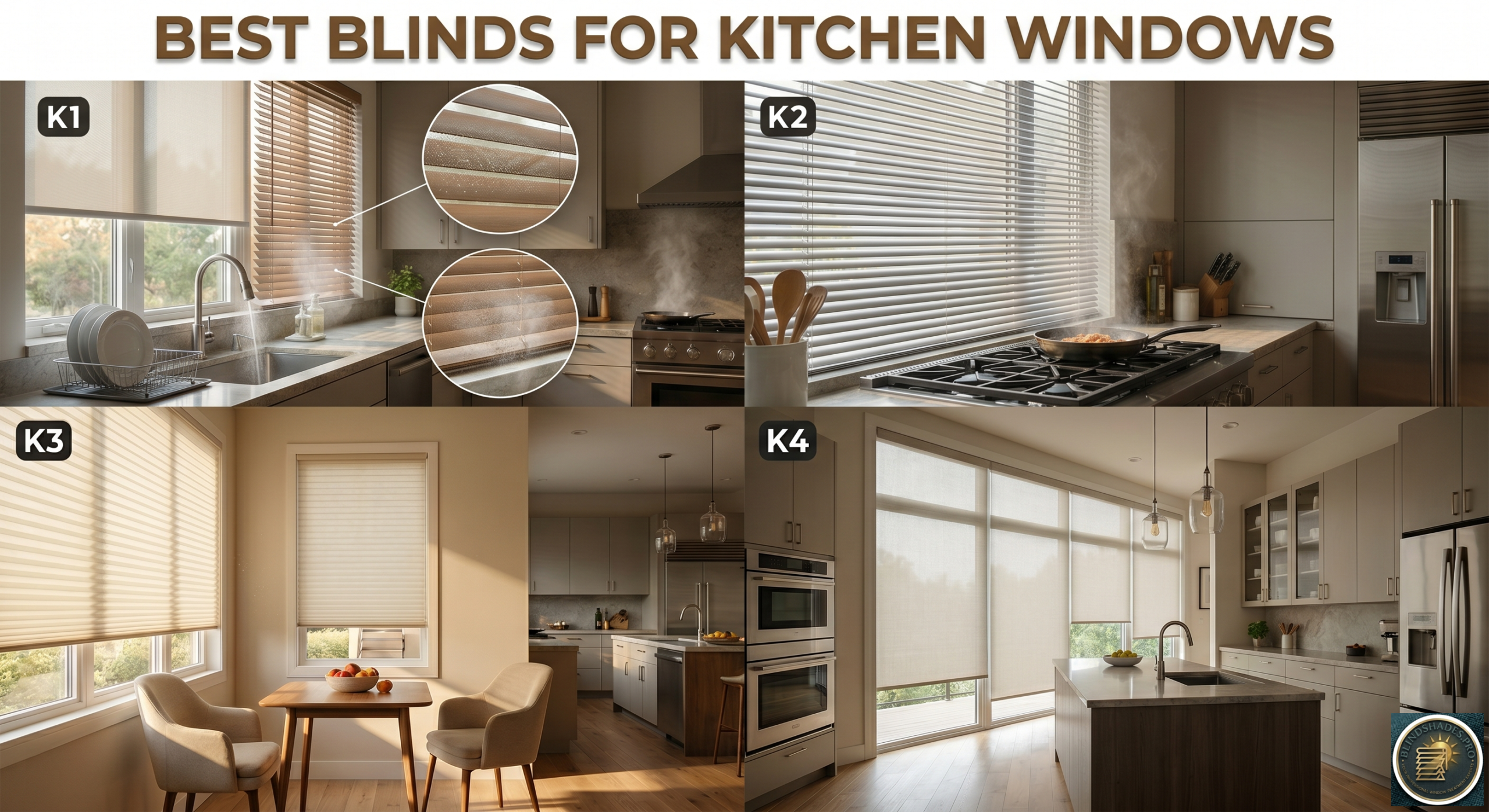
⭐ Quick Answer — What Are the Best Blinds for Kitchen Windows?
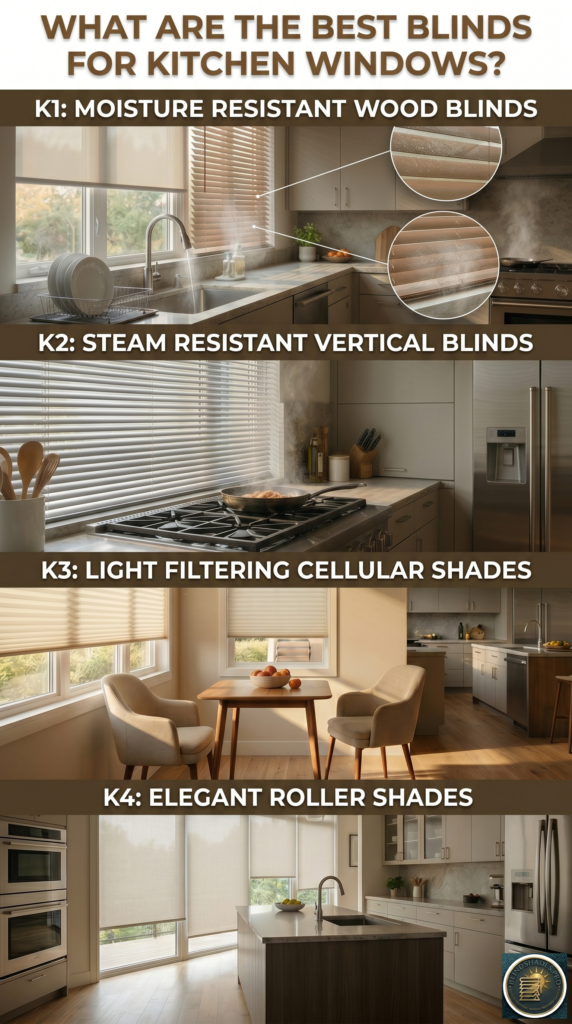
- The Answer Depends on Which Zone the Window Is In: The best blinds for kitchen windows are not one material — they are four different specifications for four different positions. Zone K1 (above sink): PVC vinyl roller shade on outside mount — single flat surface, zero grease absorption, wipes clean in one pass. Zone K2 (near stove): baked enamel aluminium — PVC faux wood softens at 60–70°C and fabric degrades from 70°C; aluminium tolerates 600°C+. Zone K3 (breakfast nook): any moisture-resistant material. Zone K4 (picture window): solar shade or adjustable-slat faux wood for glare management
- The Grease-Dust Bond — Why Kitchen Blinds Get Dirtier Faster Than Any Other Room: Pan-frying, roasting, and stir-frying release aerosolised lipid particles that travel the full kitchen and deposit on blind surfaces. These grease particles oxidise and act as an adhesive — household dust bonds to the grease layer to form a sticky grease-dust matrix significantly harder to clean than either alone. In an active cooking kitchen, wipe down every 1–2 weeks before this matrix forms — not monthly as most guides state. PVC vinyl roller shades have a non-porous surface that resists this bonding; slat-based and fabric blinds accumulate it faster
- Outside Mount Wins for the Sink Window: The window frame and sill above a kitchen sink accumulate grease splatter daily. An inside-mount blind leaves the frame and sill exposed and visible when the blind is raised. An outside-mount blind covers the frame and sill completely — cleaner overall appearance and one fewer surface to clean. Outside mount also positions the headrail further from the direct steam and splash zone above the sink
- The Kitchen Window Orientation Changes the Specification: East-facing: morning breakfast glare — light-filtering cellular or faux wood slats angled upward. West-facing: evening meal preparation glare (worst case) — solar shade 3–5% openness or adjustable-slat blind essential. South-facing: passive solar heat gain in winter — adjustable faux wood Venetian, keep slats open in winter. North-facing: no direct sun, consistent diffuse light — privacy primary, any material appropriate
- The Café Curtain Height Problem: A standard café curtain covering the lower half of a kitchen sink window (sill at 38–44 inches) covers the 38–56 inch zone only — below chest height. A standing person at the sink (60–66 inches tall) remains visible through the upper uncovered portion. For ground-floor sink windows facing a street or neighbour: a lower-half café curtain does not provide head-height privacy; specify a two-tier curtain, a full blind, or combine with upper-window frosted film
- Best Sources: Zone K1 PVC vinyl roller → Blindsgalore kitchen range · Zone K2 aluminium → Hunter Douglas kitchen guide · Zone framework → Graber Blinds kitchen considerations
⚠️ Grease Absorption by Material — The 5-Year Appearance Reality: When choosing the best blinds for kitchen windows, the material’s grease absorption rate determines how the blind looks after 3–5 years of active cooking. Aluminium and PVC vinyl: zero grease absorption — grease sits on the surface and wipes off completely; appearance unchanged after 5 years with regular cleaning. PVC composite faux wood: very low absorption — good long-term appearance. Treated polyester fabric: low-moderate absorption — adequate away from the cooking zone. Cotton or linen fabric (Roman shades, café curtains): high absorption — grease bonds to fibres and cannot be fully removed; cooking odour retention begins within 6–12 months in a regularly used kitchen near the cooking zone. This is why the same Roman shade that works beautifully in a dining room becomes discoloured and odorous within a year above a kitchen sink. Specify Roman shades and fabric blinds for Zone K3 breakfast nook only — never for Zone K1 or Zone K2. See Can You Use Roman Shades in a Kitchen for the complete zone-specific Roman shade guide. See the full material comparison table below.
💡 The Kitchen-Style Specific Verdict and the Stove Clearance Rule: For the best blinds for kitchen windows, the kitchen design style changes the specification. Galley kitchen (narrow, single-wall): no fold depth available — roller shades or slim aluminium mini blinds; Roman shades fold stack is too deep for narrow window surrounds. Open-plan kitchen-diner: larger windows, aesthetic matters more — faux wood Venetian or solar shade for daytime privacy without blocking light to the dining area. Farmhouse/country kitchen: natural materials acceptable for Zone K3 nook; woven bamboo or linen café curtains appropriate away from the cooking zone. Modern minimal kitchen: vinyl roller shade wins — zero profile, no slat shadow lines, streamlined aesthetic. And the stove clearance rule every guide skips: minimum 60 cm between any combustible blind and the cooking appliance. Within 60 cm of a hob, only aluminium mini blinds or window film are appropriate; PVC faux wood begins distorting at sustained 60–70°C heat exposure at close range. For the complete guide to windows specifically near cooking appliances, see What Are the Best Window Treatments for a Kitchen Near a Stove. See the full four-zone framework below.
📖 Read the complete guide below for: the four-zone kitchen window framework (Zone K1 sink / K2 stove / K3 nook / K4 picture window) with material specification for each, the grease-dust chemical bond mechanism and 2-week cleaning protocol, the heat tolerance comparison table (aluminium 600°C / PVC 60–70°C / fabric 70–90°C), grease absorption by material and 5-year appearance quality, the kitchen window orientation matrix (east/west/south/north with specific guidance), the café curtain tier height calculation for kitchen sink windows, why outside mount is preferred for sink windows, and the kitchen-style specific verdict (galley / open-plan / farmhouse / modern minimal).
Related guides: for the full zone-by-zone decision — sink, stove, and nook — see the complete kitchen window blinds & shades guide.
What Makes a Kitchen Window Different From Every Other Window in the Home
Definition: A kitchen window treatment is any blind, shade, or covering installed on a kitchen window that must simultaneously manage natural light, provide privacy, withstand cooking moisture and heat, and be cleanable after exposure to aerosolised cooking grease.
The kitchen presents a combination of environmental conditions found nowhere else in the home:
| Condition | Kitchen | Bathroom | Bedroom |
|---|---|---|---|
| Moisture source | Steam + direct water splash | Shower steam | Minimal |
| Grease exposure | Aerosolised cooking lipids daily | None | None |
| Heat source | Stove/hob radiation + cooking steam | Hot shower steam | Minimal |
| Cleaning frequency needed | Every 1-2 weeks (grease matrix) | Every 1-2 weeks (organic film) | Monthly |
| Odour absorption risk | High for fabric materials | Low | Low |
| Cordless requirement | Yes (cords collect grease + safety) | Yes (safety) | Recommended |
The combination of grease and moisture is what makes kitchen window treatment selection fundamentally different from bathroom or bedroom specification. A material that handles bathroom humidity adequately may still fail in a kitchen within 12-18 months because it absorbs cooking odours or the grease-dust matrix makes it unclenable.
The Best Blinds for Kitchen Windows – The Four-Zone Framework
All competitor guides treat the kitchen as a single environment. The four kitchen window zones have meaningfully different specifications – and this is the framework no other guide provides.
Zone K1 – Window Above or Adjacent to the Sink (Direct Splash + High Grease)
Description: The sink window is the most demanding kitchen window zone. It faces direct water splash during washing up, concentrated cooking steam rising from the sink area, the highest grease deposition rate in the kitchen (grease-laden steam rises toward the nearest window), and the reach-over-wet-surface operation challenge.
Best specification for Zone K1:
- First choice: PVC vinyl roller shade – single flat surface, zero grease absorption, wipes completely clean with a single damp cloth, no slats for grease to collect between
- Second choice: Baked enamel aluminium Venetian blind – corrosion-resistant, zero grease absorption, slat-by-slat cleaning possible, precise light control
- Third choice: Faux wood Venetian blind – moisture-resistant, good aesthetic, but slat pivot holes collect grease and require more detailed cleaning than roller shade
Mount type for Zone K1: Outside mount. The window sill and frame above a kitchen sink collect grease splatter from daily cooking. An outside-mount blind covers the frame and sill, presenting a cleaner appearance over time than inside mount which leaves the frame exposed and visible.
Cordless or motorized: Strongly recommended for Zone K1. A cord above a wet sink accumulates grease from the kitchen air and becomes difficult to clean. Motorized specification over the sink also allows hands-free operation during cooking – raising or lowering the blind without touching it with cooking-soiled hands.
Zone K2 – Window Adjacent to the Stove or Hob (Heat + Cooking Vapour)
Description: A window within 60-90 cm of the stove or hob faces a different primary challenge from the sink window – heat radiation and high-temperature cooking vapour rather than direct water splash.
Heat tolerance by blind material:
| Material | Heat Distortion Point | Safe Distance from Stove |
|---|---|---|
| Aluminium | 600+ degrees Celsius | Minimum 30 cm |
| Tempered glass / Window film | 250-300 degrees Celsius | Any distance |
| PVC faux wood composite | 60-70 degrees Celsius | Minimum 60-90 cm |
| Standard PVC vinyl roller | 70-80 degrees Celsius | Minimum 60 cm |
| Fabric roller shade | Discolouration from 70-90 degrees Celsius | Minimum 90 cm |
| Cotton/linen Roman shade | Fire risk above 250 degrees Celsius | Not recommended near stove |
Best specification for Zone K2:
- First choice: Baked enamel aluminium Venetian blind – highest heat tolerance of any practical kitchen blind material, reflects heat rather than absorbing it
- Second choice: PVC vinyl roller shade – adequate heat tolerance if the stove is more than 60 cm from the window
- Not recommended: Fabric Roman shades, cellular shades, or woven wood within 90 cm of a cooking hob
UK and US fire safety guidance recommends a minimum 60 cm clearance between any combustible window treatment and a cooking appliance. For a window where this clearance cannot be maintained, window film or glazing modification rather than a blind is the correct specification.
Zone K3 – Breakfast Nook, Eating Area, or Window Away From Cooking Zone
Description: A kitchen window positioned away from both the sink and the stove – typically in a breakfast nook, dining area, or on a wall remote from the cooking zone – has the most relaxed specification of any kitchen window. It receives ambient cooking steam but not direct splash or concentrated heat.
Best specification for Zone K3:
- Any moisture-resistant material is appropriate
- Aesthetic preference and light management are the primary decisions
- Woven wood and bamboo shades are appropriate here (not appropriate near sink or stove)
- Roman shades in treated polyester or performance fabric are appropriate here
- Café curtains are appropriate and popular for a breakfast nook aesthetic
For a full breakdown of café curtain vs blind for kitchen eating areas, see Are Cafe Curtains Better Than Blinds for a Kitchen Window.
Zone K4 – Large Picture Window or Pass-Through (Light Management Primary)
Description: A large kitchen picture window, a window above a kitchen island, or a pass-through window is primarily a light management challenge. Privacy is typically less critical than in other kitchen zones (high window position or garden-facing orientation often provide inherent privacy), and the primary specification driver is managing sun glare during meal preparation.
Best specification for Zone K4:
- Solar shade (3-5% openness) – reduces glare and UV while preserving the view; acceptable for Zone K4 where nighttime privacy is less critical than a ground-floor bathroom
- Light-filtering cellular shade – diffuse, even light distribution ideal for a kitchen workspace
- Faux wood Venetian blind with slats angled – directs sunlight upward (toward ceiling) to illuminate the space without direct glare on work surfaces
For the kitchen window orientation guide covering east-facing vs west-facing vs south-facing specifications, see the light management section below.
The Grease-Dust Chemical Bond – Why Kitchen Blinds Get Dirtier Faster
This is the single most important maintenance insight that no kitchen blinds guide explains.
The chemistry of kitchen blind soiling:
When food is cooked – particularly pan-frying, stir-frying, roasting, or grilling – polymerised lipid particles (aerosolised cooking fat) are released into the kitchen air. These particles are microscopic and travel the full volume of the kitchen before settling on surfaces including blind slats, shade fabric, and headrails.
Unlike bathroom moisture which evaporates, cooking grease deposits remain on surfaces and become progressively more viscous as they oxidise at room temperature. When normal household dust – skin cells, textile fibres, pet dander – lands on a grease-coated blind surface, the grease acts as an adhesive. The resulting grease-dust matrix is:
- Significantly more adhesive than dry dust alone (which wipes off easily)
- Significantly more difficult to dissolve than grease alone (which wipes off with degreaser)
- Progressive – each cooking session adds another layer if not cleaned between events
- Odour-retaining in any fabric material – the oxidising grease in fabric fibres creates a persistent cooking smell that does not wash out completely
The practical implication: The cleaning frequency for kitchen blinds in an active cooking kitchen is every 1-2 weeks to prevent the grease-dust matrix from forming. Waiting until visible soiling appears (as most guides recommend) means the matrix has already formed and requires more aggressive cleaning agents and more effort.
The material that eliminates the grease-dust problem: PVC vinyl roller shade has a completely smooth, non-porous surface. The aerosolised grease sits on the surface and is completely removed with a single wipe of warm water and mild dish soap before it has time to bond with dust. This is the primary reason roller shades are the most practical Zone K1 and Zone K2 specification for active cooking kitchens.
The Kitchen Window Orientation Matrix
The compass orientation of a kitchen window fundamentally changes the blind specification. This is absent from all competitor kitchen blind guides.
East-facing kitchen window: Receives direct low-angle morning sun during breakfast preparation (6am-10am). The low sun angle creates direct glare on kitchen countertops and into the eyes of anyone at the sink. Specification priority: glare reduction during morning hours while maintaining diffuse ambient light.
- Best: Light-filtering cellular shade (diffuses morning sun without full blockage) or faux wood slats angled to deflect direct sun upward
- The solar shade consideration: a 3-5% solar shade on an east-facing kitchen window provides ideal morning glare reduction while preserving the view
West-facing kitchen window: Receives strong afternoon and evening sun during dinner preparation (4pm-7pm). This is the most problematic kitchen window orientation for glare – the sun is at low angle and at maximum intensity during the most demanding kitchen use period.
- Best: Solar shade (3-5% openness) or faux wood Venetian with adjustable slat angle
- The glare on the cooking surface problem: a west-facing window above a stove during evening cooking creates a direct glare challenge that a Roman shade or roller shade in the fully open position cannot address – only an adjustable-slat blind or a solar shade with an open weave provides glare control without full coverage
South-facing kitchen window: Receives the most total solar gain over the day. In summer the sun is high angle (mostly overhead) and the window receives minimal direct sun. In winter the sun is low angle and the window receives the most useful natural light of any orientation.
- Best: Faux wood Venetian with adjustable slats to maximise winter light while controlling summer heat gain
- Energy consideration: the US Department of Energy notes that south-facing windows are the primary source of passive solar heat gain in winter – a fully opaque blind on a south-facing kitchen window in winter wastes this free heat and light
North-facing kitchen window: Receives no direct sunlight year-round. Provides the most consistent, shadowless diffuse light – ideal for food preparation tasks requiring colour accuracy (distinguishing ripeness, checking doneness).
- Best: Any material – privacy is the primary consideration with no glare management needed
- Light quality note: the consistent north light is prized by professional kitchen designers; a heavy cellular or blackout blind on a north-facing kitchen window reduces the best-quality natural kitchen light unnecessarily
The Café Curtain Height Calculation
Café curtains are a popular kitchen window treatment. Every guide recommends them without giving the specific height calculation that determines whether they actually provide adequate privacy.
Definition: A café curtain is a short curtain that covers only the lower portion of a window, leaving the upper portion uncovered for natural light. The standard configuration covers the lower half of the window.
The kitchen sink window café curtain problem: Standard kitchen sink window sill height: 38-44 inches from finished floor. Standard kitchen window height: 24-36 inches tall. This means the window spans approximately 38 to 74 inches from the floor.
A café curtain covering the lower half covers: 38 to 56 inches from the floor (the bottom 18 inches of a 36-inch tall window).
A standing person at the kitchen sink is at approximately 60-66 inches tall. From the perspective of a street-level observer:
- The lower café curtain covers the 38-56 inch zone of the window – this is primarily the counter level and lower torso
- The 56-74 inch zone (chest to head height of the sink occupant) remains uncovered
- A street-level observer at ground floor can see the head and shoulders of the person at the sink through the upper uncovered portion of the window
The correct café curtain specification for adequate sink privacy: For a ground-floor kitchen sink window facing a street or neighbour, a standard lower-half café curtain does not provide adequate upper-body privacy. Options:
- Double-tier café curtain (two tiers covering the full window) – provides full coverage with two separate fabrics
- Café curtain covering the upper two-thirds of the window, leaving only the very top strip open – reverses the standard configuration to protect head-height privacy
- Combine café curtain (lower) with frosted film or privacy film on the upper portion
- Specify a different window treatment altogether for a ground-floor sink window facing a public area
The Inside Mount vs Outside Mount Decision for Kitchen Windows
The kitchen-specific outside mount advantage:
For Zone K1 sink windows, outside mount is preferred for a reason specific to kitchens: the window sill and frame above a kitchen sink accumulate grease and cooking residue. An inside-mount blind leaves the sill and frame visible and exposed – the greasy window sill is visible below the bottom rail of the blind when it is raised.
An outside-mount blind installed above and beyond the window frame covers the sill and frame completely when lowered, and when raised, the roller or headrail sits above the window casing where it is less exposed to direct steam and splash.
When inside mount is preferred:
- Deep window recesses (3+ inches of depth available) where the blind is recessed from the kitchen environment
- Zone K3 and K4 windows away from the cooking zone where sill cleanliness is less critical
- Modern minimal kitchens where the clean inside-mount profile is an aesthetic priority
Material Comparison Table – Kitchen Blind Specification
| Material | Zone K1 Sink | Zone K2 Stove | Zone K3 Nook | Zone K4 Picture | Grease Absorption | 5-Year Appearance |
|---|---|---|---|---|---|---|
| PVC vinyl roller | Best | Good | Good | Good | None | Excellent |
| Baked enamel aluminium | Good | Best | Good | Good | None | Excellent |
| PVC composite faux wood | Good | Caution (60-70°C) | Good | Good | Very low | Very good |
| Polyester cellular | Avoid | Avoid | Good | Good | Low-moderate | Good (if away from grease zone) |
| Fabric Roman shade | Avoid | Avoid | Acceptable | Acceptable | High | Poor near cooking zone |
| Woven wood/bamboo | Avoid | Avoid | Good | Good | High | Fair |
| Real wood | Avoid | Avoid | Poor | Poor | Moderate | Poor |
Where to Order – Kitchen Blind Specification
For Zone K1 PVC vinyl roller shade (best over-sink specification): Blindsgalore vinyl roller shade – see blindsgalore.com/kitchen for the cordless and motorized options. SelectBlinds PVC vinyl roller with outside mount brackets.
For Zone K2 baked enamel aluminium (best near-stove specification): Hunter Douglas Precious Metals aluminium blinds – see the Hunter Douglas kitchen window guide for heat-appropriate specifications. Specify baked enamel finish – not spray-painted.
For Zone K3 and Zone K4 faux wood Venetian: Blindsgalore faux wood Venetian blind – routeless option recommended to eliminate slat cord holes that collect grease. See the Graber Blinds kitchen consideration guide for the zone-by-zone installation guidance.
Related guides: For complete buying advice, see our kitchen window blinds buying guide.
Frequently Asked Questions
What are the best blinds for kitchen windows? The best blinds for kitchen windows depend on the window’s position in the kitchen. For a window above or adjacent to the sink, PVC vinyl roller shade on outside mount is the best specification – it has a single flat surface with zero grease absorption that wipes completely clean with mild dish soap. For a window near the stove, baked enamel aluminium Venetian blinds have the highest heat tolerance of any practical kitchen blind material. For a breakfast nook or eating area window away from the cooking zone, faux wood Venetian blinds or treated fabric roller shades are appropriate. For a large picture window, solar shades or adjustable-slat faux wood manage kitchen glare while preserving the view.
Why do kitchen blinds get so greasy? Kitchen blinds collect a combination of aerosolised cooking grease and household dust that bonds together into a sticky matrix harder to clean than either alone. When food is pan-fried, roasted, or stir-fried, microscopic lipid particles travel through the kitchen air and deposit on all surfaces including blind slats and shade fabric. These grease particles oxidise at room temperature and become increasingly adhesive, bonding with dust to create a sticky film. In an active cooking kitchen, blinds should be wiped every 1 to 2 weeks with warm water and mild dish soap before this matrix has time to form. PVC vinyl roller shades have a non-porous surface that resists this bonding – the grease deposits sit on the surface rather than penetrating the material.
Can you use Roman shades in a kitchen? Roman shades can be used in kitchen windows that are positioned away from the sink and stove – breakfast nooks, eating areas, or windows remote from the cooking zone. Roman shades should not be used as the primary treatment for sink windows because the fabric absorbs water, cooking steam, and aerosolised grease, developing a persistent cooking odour within 6 to 12 months in an active kitchen. They should not be used within 90 cm of a stove because the fabric fold structure can degrade or discolour at sustained temperatures above 70 to 90 degrees Celsius.
Should kitchen blinds be inside mount or outside mount? Outside mount is generally preferred for kitchen sink windows because it covers the window frame and sill – surfaces that accumulate grease splatter during cooking. An inside-mount blind leaves the sill and frame visible below the raised blind, showing the grease deposits that collect on the sill in an active kitchen. Outside mount also keeps the headrail above the window casing and further from the direct steam and splash zone above the sink. Inside mount is appropriate for deep-recessed kitchen windows, Zone K3 eating area windows, and modern minimal kitchens where the built-in inside-mount profile is an aesthetic priority.
What is the easiest kitchen blind to keep clean? PVC vinyl roller shades are the easiest kitchen blind to keep clean because the shade is a single flat panel of smooth, non-porous vinyl with no slats, pivot holes, or fabric weave to collect grease. A single wipe with a damp cloth and mild dish soap removes the daily grease-and-dust deposit completely. Aluminium Venetian blinds are the second easiest – each aluminium slat has a smooth metal surface that wipes clean, but the slat-by-slat cleaning is more time-intensive than a single-surface roller shade. Fabric-based blinds including cellular shades and Roman shades are the most difficult kitchen blinds to keep clean because the fabric weave absorbs grease and cooking odours.
Related Guides on BlindShades.pro
- The Best Kitchen Window Blinds and Shades Buying Guide
- What Are the Best Blinds for a Window Over the Kitchen Sink
- Can You Use Roman Shades in a Kitchen
- How Do You Clean Greasy Kitchen Blinds
- What Are the Best Window Treatments for a Kitchen Near a Stove
By Michael Turner | 30 Years Home Improvement Expertise | Updated 2026 | BlindShades.pro
