Are Cafe Curtains Better Than Blinds for a Kitchen Window?

Authored By Michael Turner -30 Years Home Improvement Expertise | Updated 2026 | BlindShades.pro
Updated on May 25, 2026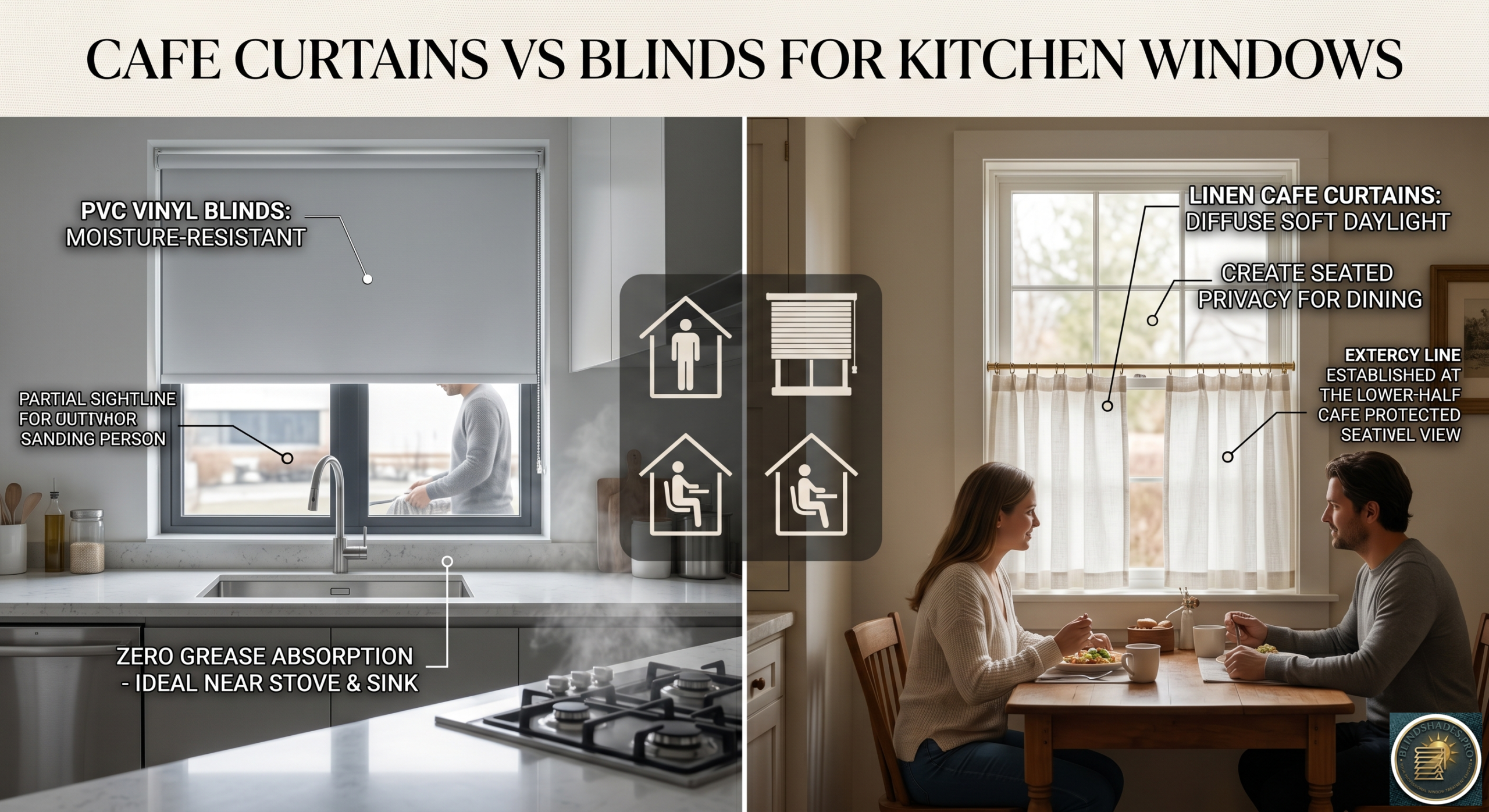
⭐ Quick Answer — Are Café Curtains Better Than Blinds for a Kitchen Window?
- The Zone Verdict — Neither Wins Universally: For cafe curtains vs blinds kitchen windows — the position decides. Zone K1 (sink): PVC vinyl roller blind wins — zero grease absorption, single wipe-clean, motorized for deep sinks. Zone K2 (near stove): blinds win decisively — no fabric near heat. Zone K3 (breakfast nook, dining area): cafe curtains win — warm farmhouse aesthetic, seated privacy adequate, machine-washable, no daily operation needed
- The Standing Privacy Problem Every Guide Gets Wrong: All 10 guides claim cafe curtains provide “privacy while washing up.” This is incorrect. A standard half-curtain covers the 38–56 inch zone of the window. A standing person at the sink is at 60–66 inches tall — head and shoulders are visible above the curtain. For ground-floor sink window standing privacy: the curtain must cover 60–65% of the window height (not 50%), or specify a two-tier system with upper tier closed, or use a PVC roller blind
- The Grease Absorption Timeline: Cotton cafe curtain near active cooking: visible grease discolouration in 3–6 months; persistent cooking smell by 6–12 months — machine-washable but smell absorbed into cotton fibres permanently over time. Polyester cafe curtain: better than cotton; yellowing from 6–12 months. PVC vinyl roller: zero grease absorption; unchanged appearance with weekly wipe throughout 12–15 year lifespan
- The Stationary Advantage Over a Sink: Unlike blinds (which must be raised/lowered daily for privacy and light), cafe curtains on a tension rod require no daily operation — they are stationary at a fixed privacy level. For a kitchen sink where daily reaching over wet surfaces to operate a blind is inconvenient: a fixed-position tension-rod cafe curtain eliminates the over-sink operation problem entirely. The trade-off: no ability to choose between full-window light and privacy — one fixed position
- Two-Tier System — More Flexible Than Either Alone: A two-tier curtain system has separate upper and lower panels on independent rods. Lower tier: always closed for seated privacy. Upper tier: opened for morning light or closed for full window coverage. This provides better flexibility than either a standard half-curtain (fixed lower coverage) or a single blind (full-window open or closed). Best for Zone K3 dining areas where seated baseline privacy is always needed but morning light flexibility is valued
- Best Sources: Blinds vs curtains comparison → The Shade Store guide · Low kitchen window solutions → GotchaCovered kitchen guide · 2026 cafe curtain trend → Livingetc privacy windows
⚠️ The Rod Hardware Warning for Zone K1 Sink Windows — and the Wash Frequency Reality: In the cafe curtains vs blinds kitchen comparison, hardware matters for Zone K1 sink windows. Standard spring-tension cafe curtain rods are zinc-plated steel — in the over-sink steam and splash environment, zinc-plated hardware corrodes within 12–24 months, causing the rod to seize in the recess or rust-stain the window frame. For Zone K1 sink windows: specify stainless steel or solid chrome brass fixed bracket rods. And the wash frequency reality: cotton cafe curtains near active cooking need machine washing every 2–4 weeks (hands-on: 10–15 minutes; machine unattended: 35–45 minutes). PVC vinyl roller blinds need wiping every week (2–5 minutes). In total annual effort, both are comparable in Zone K3 positions — but cotton cafe curtains absorb grease into fibres over time and may develop persistent cooking smell after 12–18 months even with regular washing. For Zone K3 cafe curtain specification: specify 100% polyester (not cotton or linen) to avoid permanent grease absorption into the fibre interior. See Can You Use Roman Shades in a Kitchen for the full cotton vs polyester fibre mechanism (the same principle applies to cafe curtains). See the full height calculation below.
💡 Seated vs Standing Privacy — and the Correct Height Specification: The most common mistake in the cafe curtains vs blinds kitchen decision is applying a half-curtain to a ground-floor sink window and assuming it provides adequate privacy. It provides seated dining privacy (seated eye height 44–48 inches, covered by a curtain to 56 inches) but NOT standing privacy (60–66 inches). For Zone K3 breakfast nook windows where the primary occupant is seated while dining: a standard half-curtain is correct. For any window where a standing person at the sink needs to be private: specify a curtain covering 60–65% of the window height, a two-tier system with upper tier routinely closed, or a PVC vinyl roller blind that covers the full window. The tier curtain system is the best middle ground — lower tier permanently closed for seated privacy, upper tier adjustable for standing privacy as needed. For the full zone-by-zone kitchen blind specification, see What Are the Best Blinds for Kitchen Windows. See the full tier curtain system guide below.
📖 Read the complete guide below for: the zone-by-zone verdict (Zone K1 sink / K2 stove / K3 nook / standing vs seated privacy), the height calculation showing why standard half-curtain misses standing privacy (56 inches vs 60–66 inches), the grease absorption timeline comparison (cotton 3–6 months / polyester better / PVC vinyl zero), the stationary over-sink advantage of cafe curtains vs daily blind operation, the two-tier curtain system as the best of both (lower tier always closed, upper tier adjustable), the wash frequency and effort comparison table, the Zone K1 rod hardware specification (stainless/chrome vs corroding zinc-plated), and the complete verdict table by kitchen type.
Cafe Curtains vs Blinds Kitchen – The Verdict by Window Position
Definition: A cafe curtain is a short curtain that covers only the lower portion of a window – traditionally the lower half – leaving the upper portion uncovered to admit natural light. A kitchen blind is a hard or semi-hard window treatment (Venetian, roller, cellular) that covers the full window and can be adjusted for light, privacy, and ventilation.
The cafe curtains vs blinds kitchen comparison is decided by the kitchen zone:
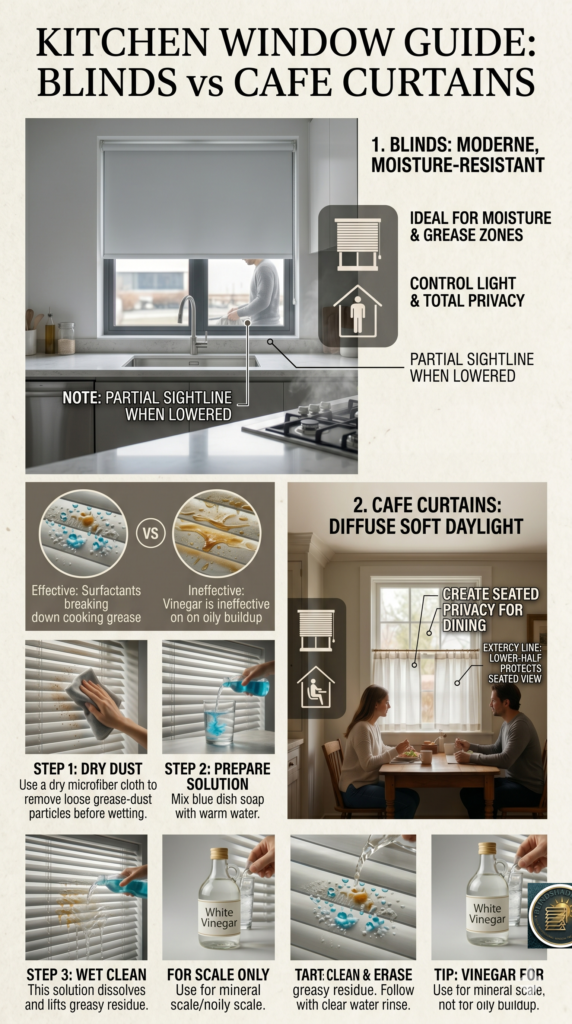
Zone K1 (sink window) – Blinds win: A PVC vinyl roller shade above a kitchen sink provides zero grease absorption on a single wipe-clean surface, can be raised and lowered without the occupant touching it (motorized), and does not accumulate steam or cooking odour in fabric fibres. A cafe curtain above an active kitchen sink develops cooking odour retention and grease discolouration within 6 months in a regular cooking household. Advantage: PVC vinyl blind.
Zone K2 (near stove) – Blinds win decisively: No fabric window treatment of any type should be near a stove. Cafe curtains near a cooking hob are a fire proximity risk. Advantage: aluminium or PVC vinyl blind, positioned above the heat zone.
Zone K3 (breakfast nook, dining area) – Cafe curtains win: A breakfast nook or dining area window positioned away from the sink and stove (more than 90 cm from both) is the traditional and appropriate location for cafe curtains. The seated dining occupant is at approximately 44-48 inches height – a standard half-curtain covering to 56 inches provides adequate seated privacy. The warm farmhouse aesthetic of cafe curtains in an eating area genuinely improves the kitchen dining experience in a way that a functional PVC blind cannot replicate.
For the full zone specification guide for all kitchen window positions, see What Are the Best Blinds for Kitchen Windows.
The Height Calculation – The Standard Advice Is Wrong for Standing Privacy
This is the most practically important correction in this guide, and it contradicts the claim made in virtually every cafe curtain article.
The standard advice: “Cafe curtains cover the lower half of the window, providing privacy while leaving the upper half open for light.”
What this actually means: A standard kitchen window has a sill at approximately 38-44 inches from the finished floor. A cafe curtain covering the “lower half” means the fabric runs from the sill to approximately the window midpoint – covering the zone from 38-56 inches from the floor.
A seated person at a kitchen table: Eye height approximately 44-48 inches from the floor. A cafe curtain covering to 56 inches provides adequate privacy for a seated diner – the eye level is below the curtain top. Cafe curtains are APPROPRIATE for seated dining privacy at Zone K3 windows.
A standing person at the kitchen sink: Eye height approximately 60-66 inches from the floor. A cafe curtain covering to 56 inches leaves the head and upper body (56-66 inches) completely visible through the uncovered upper window. A standard half-curtain does NOT provide standing privacy for a person at the sink.
The correct height specification for standing kitchen privacy: For any ground-floor kitchen window where standing privacy is required, the cafe curtain must cover the window from the sill to at least 60 inches from the floor – not just the lower half. This means covering approximately 55-65% of the window height rather than 50%.
Alternative approach: For windows requiring both standing privacy and upper-zone daylight, the correct specification is not a standard cafe curtain but a tier curtain system (see below) or a combination of cafe curtain (lower two-thirds) plus upper frosted film.
The Tier Curtain System – More Flexibility Than a Standard Cafe Curtain
All guides present cafe curtains as a single-tier solution. The two-tier system provides significantly more privacy and light flexibility.
Definition: A tier curtain system is a two-panel window treatment where the upper and lower portions of the window are covered by separate curtain panels on separate rods, each operated independently.
Standard cafe curtain (single tier):
- Lower half of window covered by one panel
- Upper half uncovered
- Privacy: seated level only
- Light: through upper half always
- Adjustment: open or closed lower half only
Two-tier system:
- Lower third to half of window: lower tier (always closed for privacy)
- Upper third to half: upper tier (can be opened for full light or closed for full privacy)
- Independent operation of each tier
- Privacy when both closed: full window
- Light when both open: full window
- Everyday position: lower closed (privacy at sill level), upper open (light from above)
For Zone K3 kitchen dining areas where a seated-height privacy baseline is always needed but morning light is important: the two-tier system provides better flexibility than either a standard cafe curtain or a blind because the lower tier is permanently set for seated privacy while the upper tier adjusts for light.
The Grease Absorption Timeline Comparison
All guides say “blinds are easier to clean.” None give the timeline that shows the practical difference.
| Treatment | Grease Surface Type | 3-Month Appearance | 6-12 Month Appearance | Cleaning Method |
|---|---|---|---|---|
| Cotton cafe curtain (active cooking kitchen) | Porous woven fabric | Slight yellowing at top hem nearest cooking zone | Visible grease discolouration; persistent cooking smell | Machine wash every 2-4 weeks |
| Polyester cafe curtain (active cooking kitchen) | Semi-porous woven fabric | Better than cotton; surface greasy | Yellowing; cooking smell less severe than cotton | Machine wash every 4-6 weeks |
| PVC vinyl roller shade | Non-porous smooth surface | Unchanged; surface grease wipes off completely | Unchanged with weekly cleaning | Single wipe weekly (2-5 minutes) |
| Faux wood Venetian blind | Non-porous smooth slat surface | Unchanged | Unchanged with fortnightly cleaning | Slat-by-slat wipe (20-30 minutes) |
The practical implication: Cotton cafe curtains in an active cooking kitchen near the cooking zone require machine washing every 2-4 weeks to prevent grease discolouration and cooking smell buildup. This is significantly more laundry than the equivalent blind maintenance but the washing process is simpler (remove, machine wash, rehang = 10-15 minutes total). PVC vinyl roller shades require less frequent cleaning (weekly wipe, 2-5 minutes) and never need removing from the window.
For Zone K3 dining area windows far from active cooking: the cafe curtain washing frequency drops to monthly – making the laundry burden manageable and the warm aesthetic benefit worth the trade-off.
The Sink Window Operation Comparison
Cafe curtains versus blinds for the window above the kitchen sink:
PVC vinyl roller blind (raised and lowered daily): The reach-over-sink operation challenge covered in What Are the Best Blinds for a Window Over the Kitchen Sink requires motorized or cordless specification for deep farmhouse sinks. Manual operation requires reaching over a wet sink.
Cafe curtain on a tension rod (stationary): The primary operational advantage of cafe curtains over blinds for a sink window: cafe curtains are typically stationary – they are not raised and lowered for privacy during each use. The curtain is installed once and provides a fixed level of lower-window privacy throughout the day without daily adjustment. This eliminates the daily reach-over-sink operation entirely.
The trade-off: A stationary cafe curtain provides the SAME privacy level regardless of whether someone is at the sink or not. A blind can be raised for full light when no one is at the sink and lowered for privacy during use. The cafe curtain’s single fixed position means you cannot choose between full-window light (no one at sink) and privacy (someone at sink) – you get one or the other permanently.
The verdict for the sink window: If maximum light when no one is at the sink is important: PVC vinyl roller blind (motorized recommended for deep sinks) provides the best light/privacy flexibility. If a fixed semi-private configuration is acceptable and daily adjustment is not desired: tension-rod cafe curtain provides the simplest installation with no daily operation required.
The Cafe Curtain Rod Hardware for Kitchen Installations
This specification detail is absent from all competitor guides.
Tension cafe curtain rod (inside the window recess): Spring-loaded rod that presses outward against the recess walls – no drilling required. Easy to remove for curtain washing. Limited weight capacity (light cotton or polyester only – no heavy lined curtains). In Zone K1 kitchen over-sink position, the spring mechanism and metal end caps corrode within 12-24 months from steam and splash exposure.
Fixed bracket cafe curtain rod (wall-mounted): Brackets screwed into the window frame or surrounding wall. Holds heavier curtains. Stays in place while curtain is removed for washing. More permanent installation. Requires drilling. Specify stainless steel or chrome-plated hardware for Zone K1 to resist corrosion.
Material recommendation by zone:
- Zone K1 (sink window): stainless steel or solid chrome brass rod on fixed brackets – avoid zinc-plated steel (corrodes in 12-24 months in steam environment, same hardware issue as blind brackets covered in Article 47-2)
- Zone K3 (breakfast nook): standard tension rod acceptable – no direct steam or splash exposure
The Wash Frequency and Effort Comparison
The full practical maintenance comparison for cafe curtains vs blinds in a kitchen:
Cafe curtains:
- Frequency near active cooking (Zone K3 adjacent to cooking area): wash every 2-4 weeks
- Frequency in dining area remote from cooking: wash every 4-8 weeks
- Time per wash: remove rod (2-3 minutes) + machine wash cycle (30-40 minutes unattended) + rehang (5-10 minutes) = 10-15 minutes hands-on
- Annual wash cycles near cooking: 13-26 washes
- Advantage: unattended machine washing; fully refreshed after each wash
PVC vinyl roller blind:
- Frequency near cooking (Zone K1/K2): wipe weekly
- Frequency in Zone K3: wipe every 2-3 weeks
- Time per wipe: single damp cloth pass = 2-5 minutes
- Annual wipe cycles: 17-52 wipes
- Advantage: faster and simpler per clean; no removal required; stays in place
The honest verdict on maintenance: In total annual time investment, cafe curtains and PVC vinyl roller shades are comparable in Zone K3 positions. Cafe curtains require less frequent attention but each wash involves machine cycle time. PVC vinyl requires more frequent cleaning but each clean is faster. Cotton cafe curtains near active cooking are harder to maintain than PVC vinyl due to higher wash frequency and washing’s inability to remove absorbed grease from cotton fibres over time.
The Complete Verdict Table
| Kitchen Position | Cafe Curtains | Blinds | Winner |
|---|---|---|---|
| Zone K1 sink window | Cotton/linen: avoid (grease/steam); polyester: marginal | PVC vinyl roller (motorized for deep sink) | Blinds |
| Zone K2 near stove | NOT appropriate | Aluminium or PVC vinyl | Blinds decisively |
| Zone K3 breakfast nook (seated privacy) | Excellent (standard half-curtain covers seated eye level at 44-48 inches) | Functional but less aesthetic warmth | Cafe curtains |
| Zone K3 standing privacy required | Two-tier or 60-65% height curtain needed | Blind at full coverage | Blinds (simpler to specify correctly) |
| Modern or minimal kitchen aesthetic | Against aesthetic | Roller shade wins | Blinds |
| Farmhouse or country kitchen (Zone K3) | Classic and appropriate | Functional alternative | Cafe curtains |
| Over-sink, no daily adjustment preferred | Tension rod fixed position | Requires daily operation or motorized | Cafe curtains |
Where to Order
For Zone K3 cafe curtains (breakfast nook, dining area): The Shade Store kitchen window treatments – see theshadestore.com/blog/blinds-vs-curtains for the blind vs curtain kitchen comparison. GotchaCovered kitchen window solutions – see gotchacovered.com for the zone-specific kitchen window guide including cafe curtain hardware recommendations.
For the 2026 cafe curtain style context: Livingetc 2026 curtain trend overview at livingetc.com confirms cafe curtains remain the top 2026 kitchen window trend for farmhouse and country kitchen aesthetics.
Frequently Asked Questions
Are cafe curtains better than blinds for a kitchen window? In the cafe curtains vs blinds kitchen comparison, cafe curtains win for breakfast nook and Zone K3 dining area windows where seated privacy at 44 to 48 inch eye height is adequate, the farmhouse or country kitchen aesthetic is a priority, and daily adjustments are not required. Blinds win for windows above the sink where grease absorption and steam exposure rule out fabric, for windows near the stove where no fabric should be used, and for standing-privacy applications where a standard half-curtain does not cover the 60 to 66 inch standing eye level.
Do cafe curtains provide privacy while standing at the kitchen sink? No – a standard cafe curtain covering the lower half of a kitchen window provides privacy for a SEATED person at 44 to 48 inch eye height but not for a STANDING person at 60 to 66 inch eye height. A standard half-curtain on a window with a sill at 38 to 44 inches covers the zone from the sill to approximately 56 inches – leaving the upper window from 56 to 72 inches uncovered. A standing person at the sink at 60 to 66 inches is visible through this uncovered upper zone. For standing kitchen privacy, specify a curtain covering 60 to 65 percent of the window height (not 50 percent) or use a PVC vinyl roller blind that covers the full window height.
How often do kitchen cafe curtains need to be washed? In an active cooking household, cotton kitchen cafe curtains near the cooking zone require washing every 2 to 4 weeks to prevent grease discolouration and cooking smell buildup. The machine washing process takes 10 to 15 minutes hands-on time. In a breakfast nook or dining area away from the cooking zone, washing every 4 to 8 weeks is sufficient. Cotton cafe curtains that absorb cooking grease over time develop a persistent cooking smell that washing can reduce but not fully eliminate after 12 to 18 months of use near active cooking. Polyester cafe curtains in the same position perform better than cotton because polyester fibres do not absorb grease into the fibre interior.
What is the difference between a cafe curtain and a tier curtain? A cafe curtain is a single tier of fabric covering the lower half of a window. A tier curtain system is a two-tier arrangement with separate upper and lower panels on independent rods, each covering approximately one third of the window. A two-tier system provides significantly more privacy and light flexibility than a single cafe curtain: the lower tier stays closed for baseline privacy at seated eye level, and the upper tier can be opened for morning light or closed for full window privacy. For Zone K3 kitchen dining areas where seated-height privacy is always needed but full light control is also desired, a two-tier system is more functional than either a standard cafe curtain or a single blind.
What rod hardware should kitchen cafe curtains use? Kitchen cafe curtain hardware should match the window zone. For Zone K1 windows above the sink, specify stainless steel or solid chrome brass fixed bracket rods – standard zinc-plated steel rods corrode within 12 to 24 months from steam and splash exposure in the over-sink environment. For Zone K3 breakfast nook windows away from steam and splash, standard spring-tension rods are appropriate and have the advantage of no-drill installation that makes curtain removal for washing more convenient.
Related Guides on BlindShades.pro
- The Best Kitchen Window Blinds and Shades Buying Guide
- What Are the Best Blinds for Kitchen Windows
- What Are the Best Blinds for a Window Over the Kitchen Sink
- Can You Use Roman Shades in a Kitchen
- How Do You Clean Greasy Kitchen Blinds
By Michael Turner | 30 Years Home Improvement Expertise | Updated 2026 | BlindShades.pro
